By: Dr.Wesam Abdelaziz
Early Signs of a critically ill patient
Initial management of a critically ill
patient
ABCDE Approach
 Most cardiac arrest cases are predictable
 Hypoxia and Hypotension are the most
common causes
 Medical Emergency Team (MET)
 A: Airway
 B: Breathing
 C: Circulation
 D: Disability
 E: Exposure
 Safety
 Treat life-threatening problems
 Assess effects of treatment/interventions
 Call for help early
 Continuous assessment is very important
Causes of airway obstruction:
1. CNS depression
2. Blood
3. Vomit
4. Foreign body
5. Trauma
Talking means patent airway
Difficulty breathing, distressed, choking
Shortness of breath
Noisy breathing
 Stridor, wheeze, gurgling
See-saw respiratory pattern, accessory
muscles
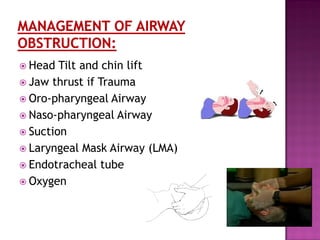
 Head Tilt and chin lift
 Jaw thrust if Trauma
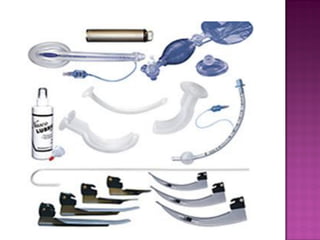
 Oro-pharyngeal Airway
 Naso-pharyngeal Airway
 Suction
 Laryngeal Mask Airway (LMA)
 Endotracheal tube
 Oxygen
 Causes if breathing problems:
 Decreased respiratory drive
 CNS depression
 Decreased respiratory effort
 Muscle weakness
 Nerve damage
 Restrictive chest
defect
 Pain from fractured
ribs
 Lung disorders
 Pneumothorax
 Hemothorax
 Infection
 COPD
 Asthma
 Pulmonary
embolus
 ARDS
 Inspection:
• Respiratory Rate
• Chest expansion
• Working accessory
muscle
• Deformity
 Palpation:
• Tenderness
• Surgical emphysema
• Crepitus
 Percussion:
• Dullness or hyper-
resonance
 Auscultation:
• For breath sounds and
equality
 Open Airway
 Oxygen Supply
 Treat Underlying Problem:
 Bronchodilator Nebulizer is wheezy chest
 Needle Thoracocentesis if Tension
Pneumothorax
 Assisted Ventilation if inadequate breathing
 Causes of circulation problems:
Primary
 Acute coronary syndromes
 Arrhythmias
 Hypertensive disease
 Valve disease
 Drugs
 Inherited cardiac diseases
 Electrolyte/acid base
abnormalities
Secondary
 Aasphyxia
 Hypoxemia
 Blood loss
 Hypothermia
 Septic shock
 Pulse :
 Central & peripheral
 Rate, Rhythm, Equality
 Blood pressure
 Peripheral perfusion - capillary refill time ( < 2 sec)
 Organ perfusion
– Chest pain, mental state, urine output
 Look at the patient : Pallor, Bleeding
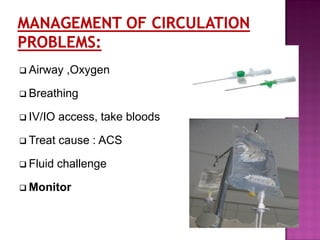
 Airway ,Oxygen
 Breathing
 IV/IO access, take bloods
 Treat cause : ACS
 Fluid challenge
 Monitor
Recognition:
AVPU
A: Alert
V: Responsive to verbal Stimuli
P: Responsive to Painful stimuli
U: Unresponsive
Pupils
Blood glucose
Normally is 4 mmol/ L (70 mg/dl)
Treatment:
 ABC
 Treat underlying
Cause:
 Check for drug chart
 Remove clothes to enable examination
e.g. injuries, bleeding, rashes
 Avoid heat loss
 Maintain dignity
 Indication of complete Exposure
• Consult Specialist and Admission
• Investigations
• Continuous Assessment
 Follow the ABCDE in assessment of any
patient.
 Assess and re-assess all the time.
 Don’t delay Calling senior Help
 Basic Life Support
 The ALS algorithm
 Treatment of shockable and non-shockable rhythms
 Potentially reversible causes of cardiac arrest
 Role of resuscitation team
Approach safely
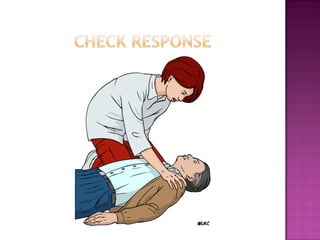
Check response
Open airway
Check breathing
Call 123
30 chest compressions
2 rescue breaths
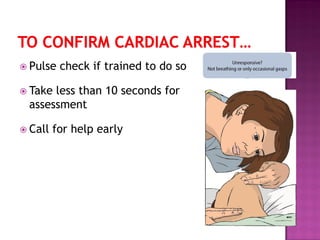
 Patient response
 Open airway
 Look, Listen, Feel
 Check for normal breathing
 Caution agonal breathing
 Check for signs of life
 Pulse check if trained to do so
 Take less than 10 seconds for
assessment
 Call for help early
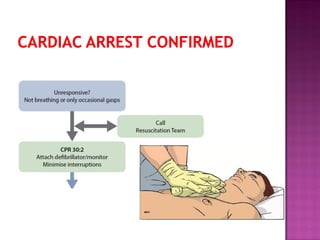
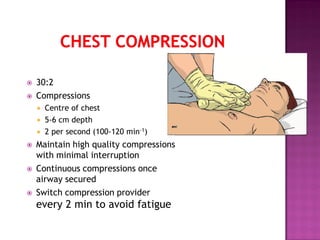
 30:2
 Compressions
 Centre of chest
 5-6 cm depth
 2 per second (100-120 min-1)
 Maintain high quality compressions
with minimal interruption
 Continuous compressions once
airway secured
 Switch compression provider
every 2 min to avoid fatigue
Team Means:
Monitor
Skilled Persons
Drugs
Start With Monitor
MINIMISE INTERRUPTIONS IN CHEST COMPRESSIONS
START PAUSE
Assess
rhythm
Shockable
(VF / Pulseless VT)
Non-Shockable
(PEA / Asystole)
CPR
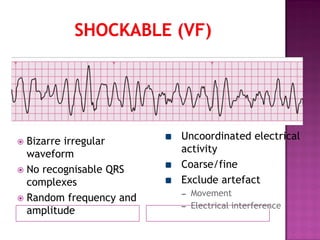
 Bizarre irregular
waveform
 No recognisable QRS
complexes
 Random frequency and
amplitude
Uncoordinated electrical
activity
Coarse/fine
Exclude artefact
– Movement
– Electrical interference
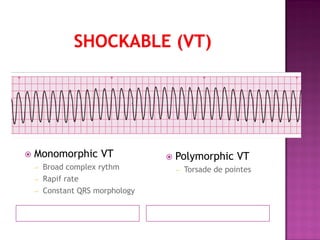
 Monomorphic VT
– Broad complex rythm
– Rapif rate
– Constant QRS morphology
 Polymorphic VT
– Torsade de pointes
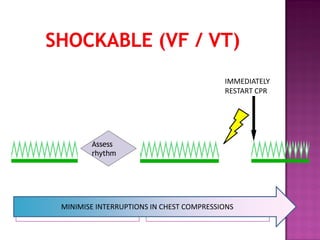
MINIMISE INTERRUPTIONS IN CHEST COMPRESSIONS
Assess
rhythm
IMMEDIATELY
RESTART CPR
MINIMISE INTERRUPTIONS IN CHEST COMPRESSIONS
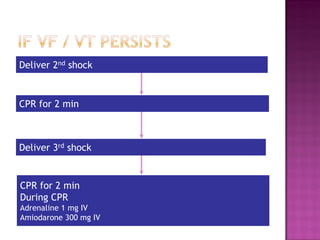
CPR for 2 min
CPR for 2 min
During CPR
Adrenaline 1 mg IV
Amiodarone 300 mg IV
Deliver 2nd shock
Deliver 3rd shock
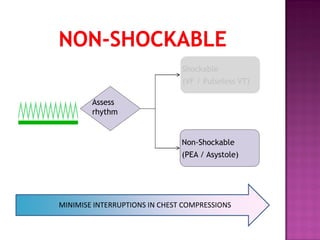
Assess
rhythm
Shockable
(VF / Pulseless VT)
Non-Shockable
(PEA / Asystole)
MINIMISE INTERRUPTIONS IN CHEST COMPRESSIONS
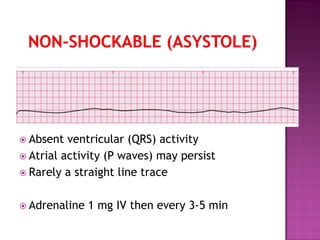
 Absent ventricular (QRS) activity
 Atrial activity (P waves) may persist
 Rarely a straight line trace
 Adrenaline 1 mg IV then every 3-5 min
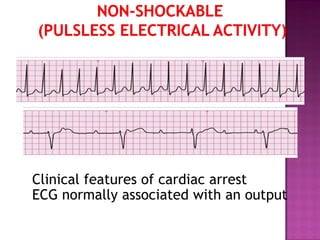
Clinical features of cardiac arrest
ECG normally associated with an output
 Adrenaline 1 mg IV every 3-5 min
 Continue chest compression and ventillation
 Assesment of rhythm every 2 minutes
Any questions

Abcde, bls, als

  • 1.
  • 2.
    Early Signs ofa critically ill patient Initial management of a critically ill patient ABCDE Approach
  • 4.
     Most cardiacarrest cases are predictable  Hypoxia and Hypotension are the most common causes  Medical Emergency Team (MET)
  • 5.
     A: Airway B: Breathing  C: Circulation  D: Disability  E: Exposure
  • 6.
     Safety  Treatlife-threatening problems  Assess effects of treatment/interventions  Call for help early  Continuous assessment is very important
  • 7.
    Causes of airwayobstruction: 1. CNS depression 2. Blood 3. Vomit 4. Foreign body 5. Trauma
  • 8.
    Talking means patentairway Difficulty breathing, distressed, choking Shortness of breath Noisy breathing  Stridor, wheeze, gurgling See-saw respiratory pattern, accessory muscles
  • 9.
     Head Tiltand chin lift  Jaw thrust if Trauma  Oro-pharyngeal Airway  Naso-pharyngeal Airway  Suction  Laryngeal Mask Airway (LMA)  Endotracheal tube  Oxygen
  • 11.
     Causes ifbreathing problems:  Decreased respiratory drive  CNS depression  Decreased respiratory effort  Muscle weakness  Nerve damage  Restrictive chest defect  Pain from fractured ribs  Lung disorders  Pneumothorax  Hemothorax  Infection  COPD  Asthma  Pulmonary embolus  ARDS
  • 12.
     Inspection: • RespiratoryRate • Chest expansion • Working accessory muscle • Deformity  Palpation: • Tenderness • Surgical emphysema • Crepitus  Percussion: • Dullness or hyper- resonance  Auscultation: • For breath sounds and equality
  • 13.
     Open Airway Oxygen Supply  Treat Underlying Problem:  Bronchodilator Nebulizer is wheezy chest  Needle Thoracocentesis if Tension Pneumothorax  Assisted Ventilation if inadequate breathing
  • 15.
     Causes ofcirculation problems: Primary  Acute coronary syndromes  Arrhythmias  Hypertensive disease  Valve disease  Drugs  Inherited cardiac diseases  Electrolyte/acid base abnormalities Secondary  Aasphyxia  Hypoxemia  Blood loss  Hypothermia  Septic shock
  • 16.
     Pulse : Central & peripheral  Rate, Rhythm, Equality  Blood pressure  Peripheral perfusion - capillary refill time ( < 2 sec)  Organ perfusion – Chest pain, mental state, urine output  Look at the patient : Pallor, Bleeding
  • 17.
     Airway ,Oxygen Breathing  IV/IO access, take bloods  Treat cause : ACS  Fluid challenge  Monitor
  • 18.
    Recognition: AVPU A: Alert V: Responsiveto verbal Stimuli P: Responsive to Painful stimuli U: Unresponsive Pupils Blood glucose Normally is 4 mmol/ L (70 mg/dl) Treatment:  ABC  Treat underlying Cause:  Check for drug chart
  • 19.
     Remove clothesto enable examination e.g. injuries, bleeding, rashes  Avoid heat loss  Maintain dignity  Indication of complete Exposure
  • 20.
    • Consult Specialistand Admission • Investigations • Continuous Assessment
  • 24.
     Follow theABCDE in assessment of any patient.  Assess and re-assess all the time.  Don’t delay Calling senior Help
  • 26.
     Basic LifeSupport  The ALS algorithm  Treatment of shockable and non-shockable rhythms  Potentially reversible causes of cardiac arrest  Role of resuscitation team
  • 28.
    Approach safely Check response Openairway Check breathing Call 123 30 chest compressions 2 rescue breaths
  • 30.
     Patient response Open airway  Look, Listen, Feel  Check for normal breathing  Caution agonal breathing  Check for signs of life
  • 31.
     Pulse checkif trained to do so  Take less than 10 seconds for assessment  Call for help early
  • 34.
     30:2  Compressions Centre of chest  5-6 cm depth  2 per second (100-120 min-1)  Maintain high quality compressions with minimal interruption  Continuous compressions once airway secured  Switch compression provider every 2 min to avoid fatigue
  • 35.
  • 37.
    MINIMISE INTERRUPTIONS INCHEST COMPRESSIONS START PAUSE Assess rhythm Shockable (VF / Pulseless VT) Non-Shockable (PEA / Asystole) CPR
  • 38.
     Bizarre irregular waveform No recognisable QRS complexes  Random frequency and amplitude Uncoordinated electrical activity Coarse/fine Exclude artefact – Movement – Electrical interference
  • 39.
     Monomorphic VT –Broad complex rythm – Rapif rate – Constant QRS morphology  Polymorphic VT – Torsade de pointes
  • 40.
    MINIMISE INTERRUPTIONS INCHEST COMPRESSIONS Assess rhythm IMMEDIATELY RESTART CPR MINIMISE INTERRUPTIONS IN CHEST COMPRESSIONS
  • 41.
    CPR for 2min CPR for 2 min During CPR Adrenaline 1 mg IV Amiodarone 300 mg IV Deliver 2nd shock Deliver 3rd shock
  • 42.
    Assess rhythm Shockable (VF / PulselessVT) Non-Shockable (PEA / Asystole) MINIMISE INTERRUPTIONS IN CHEST COMPRESSIONS
  • 43.
     Absent ventricular(QRS) activity  Atrial activity (P waves) may persist  Rarely a straight line trace  Adrenaline 1 mg IV then every 3-5 min
  • 44.
    Clinical features ofcardiac arrest ECG normally associated with an output
  • 45.
     Adrenaline 1mg IV every 3-5 min  Continue chest compression and ventillation  Assesment of rhythm every 2 minutes
  • 48.