Market
• Market is a place in which buyers
and sellers come into contact for the
purchase and sale of goods and
services.
Market structure
• refers to number of firms operating in
an industry, nature of competition
between them and the nature of
product.
Types of market
• Perfect competition.
• Monopoly.
• Monopolistic Competition
• Oligopoly.
Perfect competition
• It refers to a market situation in
which there are large number of
buyers and sellers. Firms sell
homogeneous products at a uniform
price.
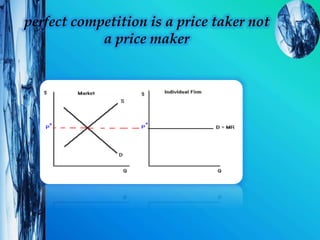
perfect competition is a price taker
not a price maker
• A firm under perfect competition is a price
taker not a price maker because the price is
determined by the market forces of demand
of supply. This price is known as
equilibrium price. All the firms in the
industry have to sell their outputs at this
equilibrium price. The reason is that,
number of firms under perfect competition
is so large. So no firm can influence the
price by its supply. All firms produce
homogeneous product.
perfect competition is a price taker not
a price maker
Demand Curve Under Perfect
Competition
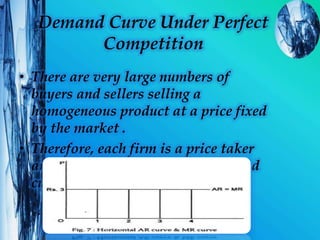
• There are very large numbers of
buyers and sellers selling a
homogeneous product at a price fixed
by the market .
• Therefore, each firm is a price taker
and faces a perfectly elastic demand
curve.
Monopoly market
• Monopoly is a market situation
dominated by a single seller who
has full control over the price.
Monopolistic competition
• It refers to a market situation in
which there are many firms who
sell closely related but
differentiated products.
Demand Curve : Monopolistic
COMPETITION vs MONOPOLY
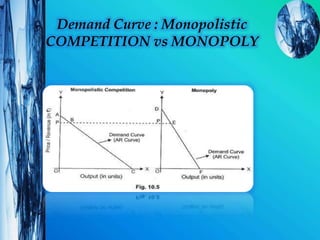
• The demand curve of monopolistic
competition looks exactly like the demand
curve monopoly as both faces downward
sloping demand curves. However Demand
Curve under monopolistic competition is
more elastic as compared to demand curve
under monopoly. This happens because
differentiated products under
monopolistic competition.
Demand Curve : Monopolistic
COMPETITION vs MONOPOLY
Oligopoly
• It is a market structure in which
there are few large sellers of a
commodity and large number of
buyers.
Duopoly
• It is a special case of oligopoly , in which
there are exactly two sellers.
• Under Duopoly, it is assumed that the
product sold by the two firms is
homogeneous and there is no Substitute for
it.
• E.g., Pepsi and Coca-Cola in the soft drink
market.
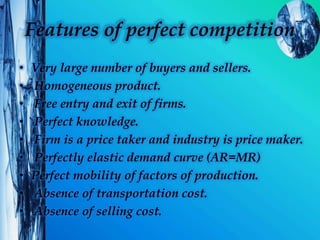
Features of perfect competition
• Very large number of buyers and sellers.
• Homogeneous product.
• Free entry and exit of firms.
• Perfect knowledge.
• Firm is a price taker and industry is price maker.
• Perfectly elastic demand curve (AR=MR)
• Perfect mobility of factors of production.
• Absence of transportation cost.
• Absence of selling cost.
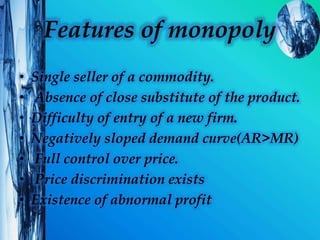
Features of monopoly
• Single seller of a commodity.
• Absence of close substitute of the product.
• Difficulty of entry of a new firm.
• Negatively sloped demand curve(AR>MR)
• Full control over price.
• Price discrimination exists
• Existence of abnormal profit
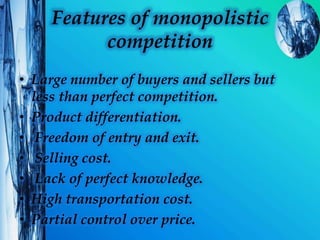
Features of monopolistic
competition
• Large number of buyers and sellers but
less than perfect competition.
• Product differentiation.
• Freedom of entry and exit.
• Selling cost.
• Lack of perfect knowledge.
• High transportation cost.
• Partial control over price.
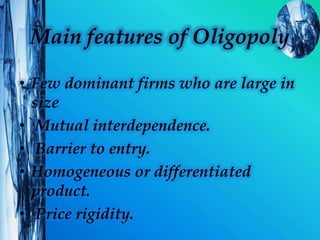
Main features of Oligopoly
• Few dominant firms who are large in
size
• Mutual interdependence.
• Barrier to entry.
• Homogeneous or differentiated
product.
• Price rigidity.
Features of pure competition
• Large number of buyers and
sellers.
• Homogeneous products.
• Free entry and exit of firm.
Main market forms

Main market forms

  • 2.
    Market • Market isa place in which buyers and sellers come into contact for the purchase and sale of goods and services.
  • 3.
    Market structure • refersto number of firms operating in an industry, nature of competition between them and the nature of product.
  • 4.
    Types of market •Perfect competition. • Monopoly. • Monopolistic Competition • Oligopoly.
  • 5.
    Perfect competition • Itrefers to a market situation in which there are large number of buyers and sellers. Firms sell homogeneous products at a uniform price.
  • 6.
    perfect competition isa price taker not a price maker • A firm under perfect competition is a price taker not a price maker because the price is determined by the market forces of demand of supply. This price is known as equilibrium price. All the firms in the industry have to sell their outputs at this equilibrium price. The reason is that, number of firms under perfect competition is so large. So no firm can influence the price by its supply. All firms produce homogeneous product.
  • 7.
    perfect competition isa price taker not a price maker
  • 8.
    Demand Curve UnderPerfect Competition • There are very large numbers of buyers and sellers selling a homogeneous product at a price fixed by the market . • Therefore, each firm is a price taker and faces a perfectly elastic demand curve.
  • 9.
    Monopoly market • Monopolyis a market situation dominated by a single seller who has full control over the price.
  • 10.
    Monopolistic competition • Itrefers to a market situation in which there are many firms who sell closely related but differentiated products.
  • 11.
    Demand Curve :Monopolistic COMPETITION vs MONOPOLY • The demand curve of monopolistic competition looks exactly like the demand curve monopoly as both faces downward sloping demand curves. However Demand Curve under monopolistic competition is more elastic as compared to demand curve under monopoly. This happens because differentiated products under monopolistic competition.
  • 12.
    Demand Curve :Monopolistic COMPETITION vs MONOPOLY
  • 13.
    Oligopoly • It isa market structure in which there are few large sellers of a commodity and large number of buyers.
  • 14.
    Duopoly • It isa special case of oligopoly , in which there are exactly two sellers. • Under Duopoly, it is assumed that the product sold by the two firms is homogeneous and there is no Substitute for it. • E.g., Pepsi and Coca-Cola in the soft drink market.
  • 15.
    Features of perfectcompetition • Very large number of buyers and sellers. • Homogeneous product. • Free entry and exit of firms. • Perfect knowledge. • Firm is a price taker and industry is price maker. • Perfectly elastic demand curve (AR=MR) • Perfect mobility of factors of production. • Absence of transportation cost. • Absence of selling cost.
  • 16.
    Features of monopoly •Single seller of a commodity. • Absence of close substitute of the product. • Difficulty of entry of a new firm. • Negatively sloped demand curve(AR>MR) • Full control over price. • Price discrimination exists • Existence of abnormal profit
  • 17.
    Features of monopolistic competition •Large number of buyers and sellers but less than perfect competition. • Product differentiation. • Freedom of entry and exit. • Selling cost. • Lack of perfect knowledge. • High transportation cost. • Partial control over price.
  • 18.
    Main features ofOligopoly • Few dominant firms who are large in size • Mutual interdependence. • Barrier to entry. • Homogeneous or differentiated product. • Price rigidity.
  • 19.
    Features of purecompetition • Large number of buyers and sellers. • Homogeneous products. • Free entry and exit of firm.