INTERNAL
TRADE
INTERNAL TRADE
Trade between people
of the same country is
known as Internal trade
or Inland trade or Home
trade or Domestic trade.
INTERNAL TRADE
Internal Trade is classified into two:
● Wholesale Trade
● Retail Trade
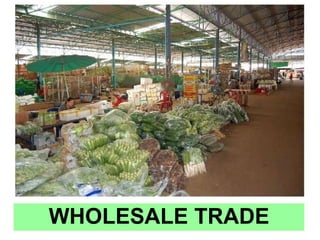
WHOLESALE TRADE
WHOLESALE TRADE
Buying and Selling of goods in large quantities
from manufacturers or producers and selling
them in small quantities to retailers.
● The person who deals in wholesale trade is
known as Wholesaler.
● Wholesaler acts as a connecting link between
producer and the retailer.
SERVICE
OF
WHOLESALERS
SERVICE TO MANUFACTURERS
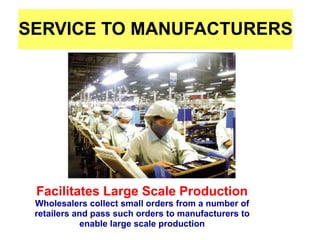
Facilitates Large Scale Production
Wholesalers collect small orders from a number of
retailers and pass such orders to manufacturers to
enable large scale production
SERVICE TO MANUFACTURERS
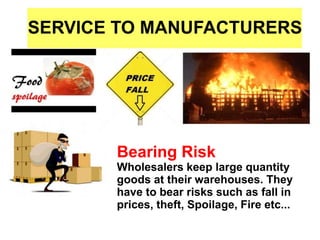
Bearing Risk
Wholesalers keep large quantity
goods at their warehouses. They
have to bear risks such as fall in
prices, theft, Spoilage, Fire etc...
SERVICE TO MANUFACTURERS
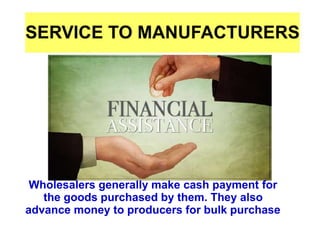
Wholesalers generally make cash payment for
the goods purchased by them. They also
advance money to producers for bulk purchase
SERVICE TO MANUFACTURERS
As wholesalers are in direct contact with
retailers, they are in a position to advice
manufacturers about customers taste,
preferences , market conditions etc...
SERVICE TO MANUFACTURERS
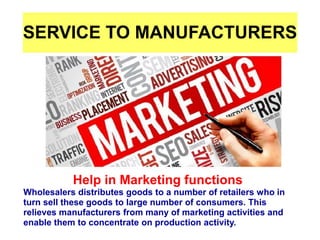
Help in Marketing functions
Wholesalers distributes goods to a number of retailers who in
turn sell these goods to large number of consumers. This
relieves manufacturers from many of marketing activities and
enable them to concentrate on production activity.
SERVICE TO MANUFACTURERS
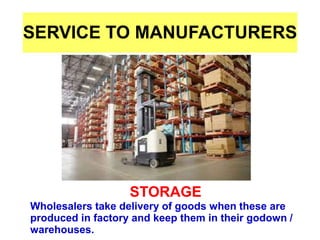
STORAGE
Wholesalers take delivery of goods when these are
produced in factory and keep them in their godown /
warehouses.
SERVICE TO MANUFACTURERS
●
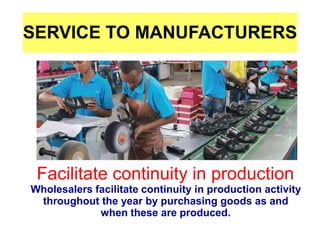
Facilitate continuity in production
Wholesalers facilitate continuity in production activity
throughout the year by purchasing goods as and
when these are produced.
Service to Retailers
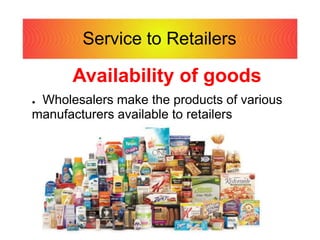
Availability of goods
● Wholesalers make the products of various
manufacturers available to retailers
Service to Retailers
Marketing Support
● Wholesalers perform marketing activities
such as advertising and sales promotional
activities. Retailers benefited by this.
Service to Retailers
Grant of Credit
● Wholesalers generally extend credit
facilities to their regular customers
Service to Retailers
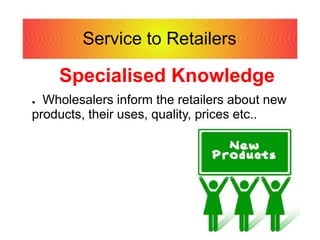
Specialised Knowledge
● Wholesalers inform the retailers about new
products, their uses, quality, prices etc..
Service to Retailers
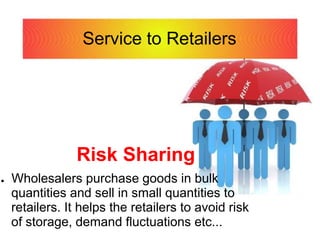
Risk Sharing
● Wholesalers purchase goods in bulk
quantities and sell in small quantities to
retailers. It helps the retailers to avoid risk
of storage, demand fluctuations etc...
RETAIL
TRADE
RETAIL TRADE
● Retail Trade means all activities related to
sale of goods to consumers for
consumption.
● Person who sells goods to ultimate
consumers are called Retailer.
● Retailer acts as a connecting link between
wholesalers and consumers.
SERVICE
OF
RETAILERS
Service to Manufacturers and
Wholesalers
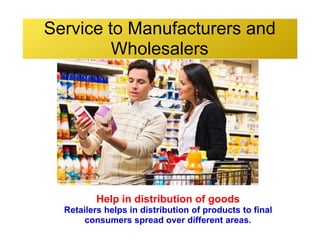
Help in distribution of goods
Retailers helps in distribution of products to final
consumers spread over different areas.
Service to Manufacturers and
Wholesalers
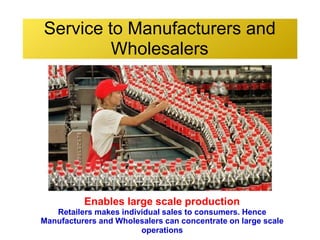
Enables large scale production
Retailers makes individual sales to consumers. Hence
Manufacturers and Wholesalers can concentrate on large scale
operations
Service to Manufacturers and
Wholesalers
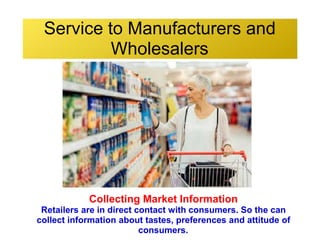
Collecting Market Information
Retailers are in direct contact with consumers. So the can
collect information about tastes, preferences and attitude of
consumers.
Service to Manufacturers and
Wholesalers
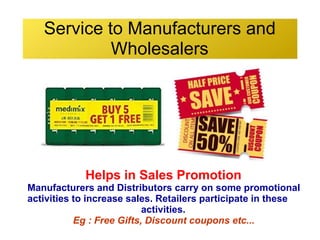
Helps in Sales Promotion
Manufacturers and Distributors carry on some promotional
activities to increase sales. Retailers participate in these
activities.
Eg : Free Gifts, Discount coupons etc...
Service to Consumers
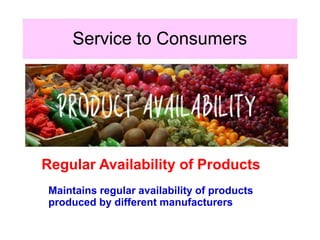
Regular Availability of Products
Maintains regular availability of products
produced by different manufacturers
Service to Consumers
Information about new products
By displaying products, Retailers provide information about
arrival, special features etc.. of new products
Service to Consumers
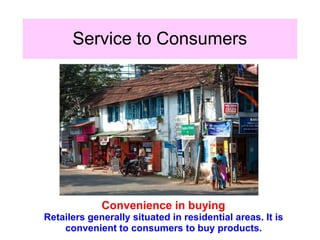
Convenience in buying
Retailers generally situated in residential areas. It is
convenient to consumers to buy products.
Service to Consumers
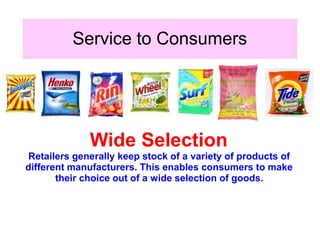
Wide Selection
Retailers generally keep stock of a variety of products of
different manufacturers. This enables consumers to make
their choice out of a wide selection of goods.
Service to Consumers
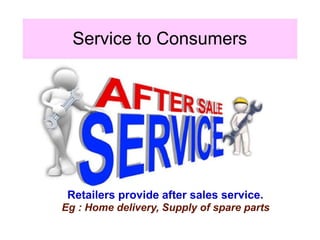
Retailers provide after sales service.
Eg : Home delivery, Supply of spare parts
Service to Consumers
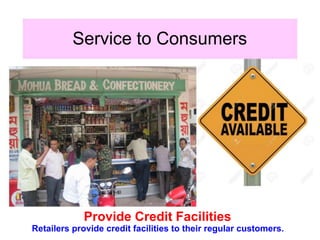
Provide Credit Facilities
Retailers provide credit facilities to their regular customers.
TYPES
OF
Retailers are classified into
two :
● Itinerent Traders
● Fixed shop retailers
ITINERANT TRADERS
MEANING
● Retailers having no fixed place for
business are called itinerant traders.
● They deal in vegetables, fish, fruits,
household utensils etc...
● They operate on a small investment and
with limited stock.
TYPES
OF
ITINERANT
TRADERS
HAWKERS & PEDLARS
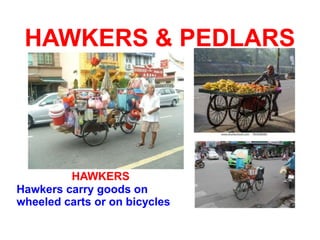
HAWKERS
Hawkers carry goods on
wheeled carts or on bicycles
HAWKERS & PEDLARS
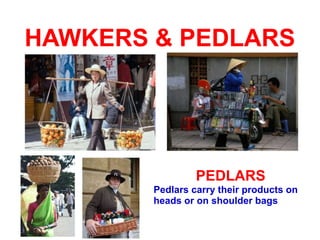
PEDLARS
Pedlars carry their products on
heads or on shoulder bags
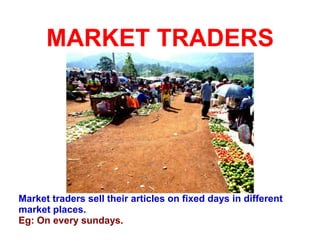
MARKET TRADERS
Market traders sell their articles on fixed days in different
market places.
Eg: On every sundays.
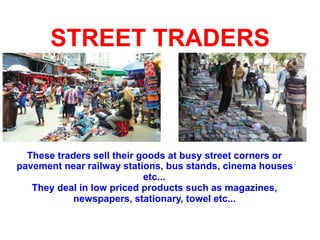
STREET TRADERS
These traders sell their goods at busy street corners or
pavement near railway stations, bus stands, cinema houses
etc...
They deal in low priced products such as magazines,
newspapers, stationary, towel etc...
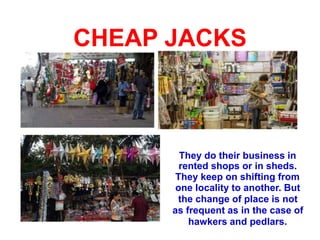
CHEAP JACKS
They do their business in
rented shops or in sheds.
They keep on shifting from
one locality to another. But
the change of place is not
as frequent as in the case of
hawkers and pedlars.
FIXED
SHOP
RETAILERS
FIXED SHOP RETAILERS
● Fixed shop retailers carry on business in fixed
building either owned or rented.
● Fixed shop traders are of two types :
- Small scale retailers
- Large scale retailers
Small
Scale
Retailers
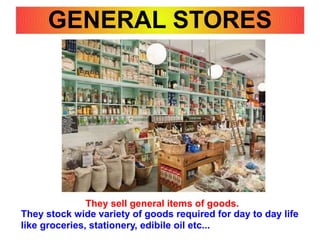
GENERAL STORES
They sell general items of goods.
They stock wide variety of goods required for day to day life
like groceries, stationery, edibile oil etc...
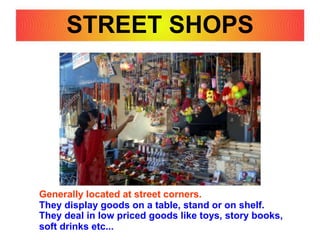
STREET SHOPS
Generally located at street corners.
They display goods on a table, stand or on shelf.
They deal in low priced goods like toys, story books,
soft drinks etc...
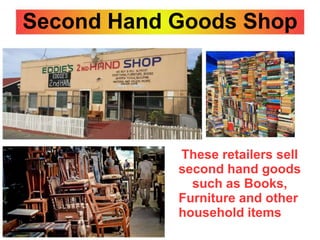
Second Hand Goods Shop
These retailers sell
second hand goods
such as Books,
Furniture and other
household items
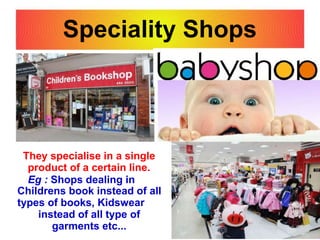
Speciality Shops
They specialise in a single
product of a certain line.
Eg : Shops dealing in
Childrens book instead of all
types of books, Kidswear
instead of all type of
garments etc...
Large
Scale
Retailers
Large Scale Retailers
Large Scale retailers means
the retail trade involving
operations on a large scale
and sale of goods in small
quantities
Large Scale Retailers
Different form of large scale retailers
● Departmental Stores
● Multiple Shops (Chain Stores)
● Mail Order Business
● Consumer Co-operative Stores
● Super Bazaar
DEPARTMENTAL STORES
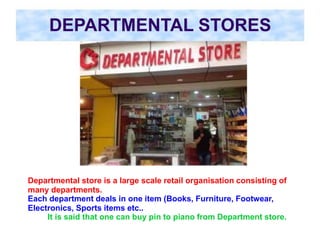
Departmental store is a large scale retail organisation consisting of
many departments.
Each department deals in one item (Books, Furniture, Footwear,
Electronics, Sports items etc..
It is said that one can buy pin to piano from Department store.
Features
of
Departmental Stores
Features of Departmental Stores
● It is a large scale retail organisation
● A wide variety of products are available under
one roof.
● Products are arranged in separate
departments.
● No Credit - It deals in cash and carry basis.
● Door delivery.
Advantages
of
Departmental Stores
Advantages of Departmental Stores
● Central Location - Placed at centre of a town. So it
attract large number of customers.
● Convenience to consumers - Customer can buy all
requirements from one place. It saves time,
expenses.
● Risk distribution - If there is loss in one department,
it may be compensated by gain of other departments.
● Automatic mutual advertisement - One department
advertises the other.
Disadvantages of Departmental
Stores
● Heavy operational cost - High rent in cities, huge salary to
specialised staff etc... increases operational cost.
● High prices - Due to high operating cost, price charged is slightly
high.
● Location - Always situated in town and serves only a section of
society.
● Lack of personal attention - They have to deal with a large
number of customers daily. Hence not able to give personal attention
to customers.
● Possibility of huge loss - Change in fashion, fluctuations in price
etc.. will adversely affect the business, as they stock large quantity of
goods.
MULTIPLE SHOPS
[CHAIN SHOPS]
A Multiple shop is a large scale retail organisation with a number of
branches at different places under one ownership and management.
Head office controls the branches through Branch Managers. They
supply goods to the branches.
Eg : Bata shoe stores
Features of Multiple Shops
● It is a large scale retail shop
● It operates through a large number of branches
● Each shop deals in same type of goods.
● Each shop is decorated in same style and layout.
● It generally sells goods on cash and carry basis
● It aims at elimination of middlemen.
● Goods sold are of durable nature.
Advantages of Multiple shop
● No bad debts - They sells goods on cash basis. Hence there is no
bad debts.
● Transfer of goods - If a particular product has no demand at one
branch, it can be transferred to another branch where it is in
demand.
● Public Confidence - All branches sell standard goods at uniform
price.
● No overstocking of goods - Since branches get their supply from
head office as per requirements, there is no fear of overstocking of
goods.
● Elimination of middlemen - By selling directly to consumers, it is
able to eliminate middlemen in sale of goods.
Disadvantages of Multiple Shops
● Limited Choice - They deal in one brand. They
cannot offer variety or choice.
● No personal touch - Multiple shops constitute a
number of branch shops with paid employees who
lacks personal touch.
● No credit facilities - Hence affects sales volume.
● Risk due to change in demand - Fall in demand
due to change in fashion etc.. will lead to great loss
to the shop.
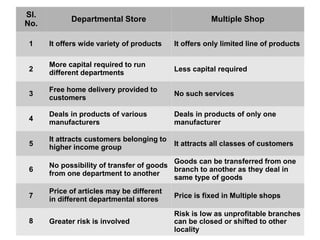
DIFFERENCE
BETWEEN
DEPARTMENTAL STORE
AND
MULTIPLE SHOP
Sl.
No.
Departmental Store Multiple Shop
1 It offers wide variety of products It offers only limited line of products
2
3
4
5
6
7
More capital required to run
different departments
Free home delivery provided to
customers
Deals in products of various
manufacturers
It attracts customers belonging to
higher income group
No possibility of transfer of goods
from one department to another
Price of articles may be different
in different departmental stores
Less capital required
No such services
Deals in products of only one
manufacturer
It attracts all classes of customers
Goods can be transferred from one
branch to another as they deal in
same type of goods
Price is fixed in Multiple shops
Risk is low as unprofitable branches
8 Greater risk is involved can be closed or shifted to other
locality
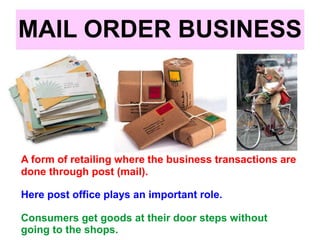
MAIL ORDER BUSINESS
A form of retailing where the business transactions are
done through post (mail).
Here post office plays an important role.
Consumers get goods at their door steps without
going to the shops.
MAIL ORDER BUSINESS
Mode of operation
● Seller advertises their products in newspapers
● Prepares mailing list. Catalogues, brochures, pricelist
etc.. to addressees.
● Interested customers send orders by mail.
● Properly packed goods are sent to customers by VPP
(Value Payable Post).
● The goods will be received by Postal authorities
● The postman delivers them to addressees and collect
payment and remits the money to retailer.
Advantages of Mail Order Business
● Convenience in buying - Customers get the required
goods at their door steps through mail.
● Wider Market - Area of operation is not limited to a
particular locality.
● Limited Capital Requirement - This type of business
can be started with a small amount of capital because it
does not require huge buildings, large stock of finished
goods etc..
● Elimination of middlemen - Elimination of middlemen
saves a lot of money to buyers as well as to the seller.
Disadvantages of Mail Order
Business
● No personal contact - There is no contact between buyer
and seller
● No chance for inspection - Buyer does not get an
opportunity to inspect the goods personally before buying.
● Not suitable for all items - Only limited type of products
(Non-perishable goods like pen, books, toys, watches...)
can be sold under this business
● Depends on postal services - Success of this business
depends on availability of efficient postal services at a
place
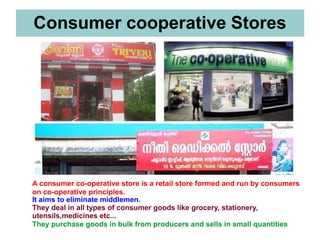
Consumer cooperative Stores
A consumer co-operative store is a retail store formed and run by consumers
on co-operative principles.
It aims to eliminate middlemen.
They deal in all types of consumer goods like grocery, stationery,
utensils,medicines etc...
They purchase goods in bulk from producers and sells in small quantities
Advantages of Cooperative Stores
● It is easy to form. Any 10 people can come together
to form a cooperative store on the basis of
cooperative principles.
● It provides consumer goods at lower prices by
eliminating middlemen
● No possibility of bad debts as goods are sold on
cash basis
● Cooperative stores are generally opened at
convenient public places.
Disadvantages of Cooperative Store
● Lack of Initiative
● Shortage of Funds
● Lack of business training
SUPER MARKET
[Super Bazaar / Self Service Store]
Super Market is a large scale retail store selling a wide
variety of consumer goods.
They deal in consumer products such as grocery,
utensils, electronic appliances etc...
Features of Super Market
● Buyers can purchase different products
under one roof.
● Absence of salesmen
● Goods are sold on cash basis only.
● Super Markets are generally located at
central locations to secure high turnover.
Advantages of Super Market
● Consumer can buy their requirements from one
place.
● Super markets keep a wide variety of goods. It
enables the buyer to make better selection.
● No bad debts as the sales are on cash basis.
● Super markets are generally located at suitable
places within the reach of buyers.
Disadvantages of Super Market
● Credit facilities are not provided. It lowers the
turnover.
● Super market works on the principle of Self-
service. So customers do not get personal
attention.
● Some customers handle the goods kept in the
shelf carelessly.
● Running a supermarket requires huge investment.
internal trade new.pptx

internal trade new.pptx

  • 1.
  • 2.
    INTERNAL TRADE Trade betweenpeople of the same country is known as Internal trade or Inland trade or Home trade or Domestic trade.
  • 3.
    INTERNAL TRADE Internal Tradeis classified into two: ● Wholesale Trade ● Retail Trade
  • 4.
  • 5.
    WHOLESALE TRADE Buying andSelling of goods in large quantities from manufacturers or producers and selling them in small quantities to retailers. ● The person who deals in wholesale trade is known as Wholesaler. ● Wholesaler acts as a connecting link between producer and the retailer.
  • 6.
  • 7.
    SERVICE TO MANUFACTURERS FacilitatesLarge Scale Production Wholesalers collect small orders from a number of retailers and pass such orders to manufacturers to enable large scale production
  • 8.
    SERVICE TO MANUFACTURERS BearingRisk Wholesalers keep large quantity goods at their warehouses. They have to bear risks such as fall in prices, theft, Spoilage, Fire etc...
  • 9.
    SERVICE TO MANUFACTURERS Wholesalersgenerally make cash payment for the goods purchased by them. They also advance money to producers for bulk purchase
  • 10.
    SERVICE TO MANUFACTURERS Aswholesalers are in direct contact with retailers, they are in a position to advice manufacturers about customers taste, preferences , market conditions etc...
  • 11.
    SERVICE TO MANUFACTURERS Helpin Marketing functions Wholesalers distributes goods to a number of retailers who in turn sell these goods to large number of consumers. This relieves manufacturers from many of marketing activities and enable them to concentrate on production activity.
  • 12.
    SERVICE TO MANUFACTURERS STORAGE Wholesalerstake delivery of goods when these are produced in factory and keep them in their godown / warehouses.
  • 13.
    SERVICE TO MANUFACTURERS ● Facilitatecontinuity in production Wholesalers facilitate continuity in production activity throughout the year by purchasing goods as and when these are produced.
  • 14.
    Service to Retailers Availabilityof goods ● Wholesalers make the products of various manufacturers available to retailers
  • 15.
    Service to Retailers MarketingSupport ● Wholesalers perform marketing activities such as advertising and sales promotional activities. Retailers benefited by this.
  • 16.
    Service to Retailers Grantof Credit ● Wholesalers generally extend credit facilities to their regular customers
  • 17.
    Service to Retailers SpecialisedKnowledge ● Wholesalers inform the retailers about new products, their uses, quality, prices etc..
  • 18.
    Service to Retailers RiskSharing ● Wholesalers purchase goods in bulk quantities and sell in small quantities to retailers. It helps the retailers to avoid risk of storage, demand fluctuations etc...
  • 19.
  • 20.
    RETAIL TRADE ● RetailTrade means all activities related to sale of goods to consumers for consumption. ● Person who sells goods to ultimate consumers are called Retailer. ● Retailer acts as a connecting link between wholesalers and consumers.
  • 21.
  • 22.
    Service to Manufacturersand Wholesalers Help in distribution of goods Retailers helps in distribution of products to final consumers spread over different areas.
  • 23.
    Service to Manufacturersand Wholesalers Enables large scale production Retailers makes individual sales to consumers. Hence Manufacturers and Wholesalers can concentrate on large scale operations
  • 24.
    Service to Manufacturersand Wholesalers Collecting Market Information Retailers are in direct contact with consumers. So the can collect information about tastes, preferences and attitude of consumers.
  • 25.
    Service to Manufacturersand Wholesalers Helps in Sales Promotion Manufacturers and Distributors carry on some promotional activities to increase sales. Retailers participate in these activities. Eg : Free Gifts, Discount coupons etc...
  • 26.
    Service to Consumers RegularAvailability of Products Maintains regular availability of products produced by different manufacturers
  • 27.
    Service to Consumers Informationabout new products By displaying products, Retailers provide information about arrival, special features etc.. of new products
  • 28.
    Service to Consumers Conveniencein buying Retailers generally situated in residential areas. It is convenient to consumers to buy products.
  • 29.
    Service to Consumers WideSelection Retailers generally keep stock of a variety of products of different manufacturers. This enables consumers to make their choice out of a wide selection of goods.
  • 30.
    Service to Consumers Retailersprovide after sales service. Eg : Home delivery, Supply of spare parts
  • 31.
    Service to Consumers ProvideCredit Facilities Retailers provide credit facilities to their regular customers.
  • 32.
  • 33.
    Retailers are classifiedinto two : ● Itinerent Traders ● Fixed shop retailers
  • 35.
    ITINERANT TRADERS MEANING ● Retailershaving no fixed place for business are called itinerant traders. ● They deal in vegetables, fish, fruits, household utensils etc... ● They operate on a small investment and with limited stock.
  • 36.
  • 37.
    HAWKERS & PEDLARS HAWKERS Hawkerscarry goods on wheeled carts or on bicycles
  • 38.
    HAWKERS & PEDLARS PEDLARS Pedlarscarry their products on heads or on shoulder bags
  • 39.
    MARKET TRADERS Market traderssell their articles on fixed days in different market places. Eg: On every sundays.
  • 40.
    STREET TRADERS These traderssell their goods at busy street corners or pavement near railway stations, bus stands, cinema houses etc... They deal in low priced products such as magazines, newspapers, stationary, towel etc...
  • 41.
    CHEAP JACKS They dotheir business in rented shops or in sheds. They keep on shifting from one locality to another. But the change of place is not as frequent as in the case of hawkers and pedlars.
  • 42.
  • 43.
    FIXED SHOP RETAILERS ●Fixed shop retailers carry on business in fixed building either owned or rented. ● Fixed shop traders are of two types : - Small scale retailers - Large scale retailers
  • 44.
  • 45.
    GENERAL STORES They sellgeneral items of goods. They stock wide variety of goods required for day to day life like groceries, stationery, edibile oil etc...
  • 46.
    STREET SHOPS Generally locatedat street corners. They display goods on a table, stand or on shelf. They deal in low priced goods like toys, story books, soft drinks etc...
  • 47.
    Second Hand GoodsShop These retailers sell second hand goods such as Books, Furniture and other household items
  • 48.
    Speciality Shops They specialisein a single product of a certain line. Eg : Shops dealing in Childrens book instead of all types of books, Kidswear instead of all type of garments etc...
  • 49.
  • 50.
    Large Scale Retailers LargeScale retailers means the retail trade involving operations on a large scale and sale of goods in small quantities
  • 51.
    Large Scale Retailers Differentform of large scale retailers ● Departmental Stores ● Multiple Shops (Chain Stores) ● Mail Order Business ● Consumer Co-operative Stores ● Super Bazaar
  • 52.
    DEPARTMENTAL STORES Departmental storeis a large scale retail organisation consisting of many departments. Each department deals in one item (Books, Furniture, Footwear, Electronics, Sports items etc.. It is said that one can buy pin to piano from Department store.
  • 53.
  • 54.
    Features of DepartmentalStores ● It is a large scale retail organisation ● A wide variety of products are available under one roof. ● Products are arranged in separate departments. ● No Credit - It deals in cash and carry basis. ● Door delivery.
  • 55.
  • 56.
    Advantages of DepartmentalStores ● Central Location - Placed at centre of a town. So it attract large number of customers. ● Convenience to consumers - Customer can buy all requirements from one place. It saves time, expenses. ● Risk distribution - If there is loss in one department, it may be compensated by gain of other departments. ● Automatic mutual advertisement - One department advertises the other.
  • 57.
    Disadvantages of Departmental Stores ●Heavy operational cost - High rent in cities, huge salary to specialised staff etc... increases operational cost. ● High prices - Due to high operating cost, price charged is slightly high. ● Location - Always situated in town and serves only a section of society. ● Lack of personal attention - They have to deal with a large number of customers daily. Hence not able to give personal attention to customers. ● Possibility of huge loss - Change in fashion, fluctuations in price etc.. will adversely affect the business, as they stock large quantity of goods.
  • 58.
    MULTIPLE SHOPS [CHAIN SHOPS] AMultiple shop is a large scale retail organisation with a number of branches at different places under one ownership and management. Head office controls the branches through Branch Managers. They supply goods to the branches. Eg : Bata shoe stores
  • 59.
    Features of MultipleShops ● It is a large scale retail shop ● It operates through a large number of branches ● Each shop deals in same type of goods. ● Each shop is decorated in same style and layout. ● It generally sells goods on cash and carry basis ● It aims at elimination of middlemen. ● Goods sold are of durable nature.
  • 60.
    Advantages of Multipleshop ● No bad debts - They sells goods on cash basis. Hence there is no bad debts. ● Transfer of goods - If a particular product has no demand at one branch, it can be transferred to another branch where it is in demand. ● Public Confidence - All branches sell standard goods at uniform price. ● No overstocking of goods - Since branches get their supply from head office as per requirements, there is no fear of overstocking of goods. ● Elimination of middlemen - By selling directly to consumers, it is able to eliminate middlemen in sale of goods.
  • 61.
    Disadvantages of MultipleShops ● Limited Choice - They deal in one brand. They cannot offer variety or choice. ● No personal touch - Multiple shops constitute a number of branch shops with paid employees who lacks personal touch. ● No credit facilities - Hence affects sales volume. ● Risk due to change in demand - Fall in demand due to change in fashion etc.. will lead to great loss to the shop.
  • 62.
  • 63.
    Sl. No. Departmental Store MultipleShop 1 It offers wide variety of products It offers only limited line of products 2 3 4 5 6 7 More capital required to run different departments Free home delivery provided to customers Deals in products of various manufacturers It attracts customers belonging to higher income group No possibility of transfer of goods from one department to another Price of articles may be different in different departmental stores Less capital required No such services Deals in products of only one manufacturer It attracts all classes of customers Goods can be transferred from one branch to another as they deal in same type of goods Price is fixed in Multiple shops Risk is low as unprofitable branches 8 Greater risk is involved can be closed or shifted to other locality
  • 64.
    MAIL ORDER BUSINESS Aform of retailing where the business transactions are done through post (mail). Here post office plays an important role. Consumers get goods at their door steps without going to the shops.
  • 65.
    MAIL ORDER BUSINESS Modeof operation ● Seller advertises their products in newspapers ● Prepares mailing list. Catalogues, brochures, pricelist etc.. to addressees. ● Interested customers send orders by mail. ● Properly packed goods are sent to customers by VPP (Value Payable Post). ● The goods will be received by Postal authorities ● The postman delivers them to addressees and collect payment and remits the money to retailer.
  • 66.
    Advantages of MailOrder Business ● Convenience in buying - Customers get the required goods at their door steps through mail. ● Wider Market - Area of operation is not limited to a particular locality. ● Limited Capital Requirement - This type of business can be started with a small amount of capital because it does not require huge buildings, large stock of finished goods etc.. ● Elimination of middlemen - Elimination of middlemen saves a lot of money to buyers as well as to the seller.
  • 67.
    Disadvantages of MailOrder Business ● No personal contact - There is no contact between buyer and seller ● No chance for inspection - Buyer does not get an opportunity to inspect the goods personally before buying. ● Not suitable for all items - Only limited type of products (Non-perishable goods like pen, books, toys, watches...) can be sold under this business ● Depends on postal services - Success of this business depends on availability of efficient postal services at a place
  • 68.
    Consumer cooperative Stores Aconsumer co-operative store is a retail store formed and run by consumers on co-operative principles. It aims to eliminate middlemen. They deal in all types of consumer goods like grocery, stationery, utensils,medicines etc... They purchase goods in bulk from producers and sells in small quantities
  • 69.
    Advantages of CooperativeStores ● It is easy to form. Any 10 people can come together to form a cooperative store on the basis of cooperative principles. ● It provides consumer goods at lower prices by eliminating middlemen ● No possibility of bad debts as goods are sold on cash basis ● Cooperative stores are generally opened at convenient public places.
  • 70.
    Disadvantages of CooperativeStore ● Lack of Initiative ● Shortage of Funds ● Lack of business training
  • 71.
    SUPER MARKET [Super Bazaar/ Self Service Store] Super Market is a large scale retail store selling a wide variety of consumer goods. They deal in consumer products such as grocery, utensils, electronic appliances etc...
  • 72.
    Features of SuperMarket ● Buyers can purchase different products under one roof. ● Absence of salesmen ● Goods are sold on cash basis only. ● Super Markets are generally located at central locations to secure high turnover.
  • 73.
    Advantages of SuperMarket ● Consumer can buy their requirements from one place. ● Super markets keep a wide variety of goods. It enables the buyer to make better selection. ● No bad debts as the sales are on cash basis. ● Super markets are generally located at suitable places within the reach of buyers.
  • 74.
    Disadvantages of SuperMarket ● Credit facilities are not provided. It lowers the turnover. ● Super market works on the principle of Self- service. So customers do not get personal attention. ● Some customers handle the goods kept in the shelf carelessly. ● Running a supermarket requires huge investment.