MARKET STRUCTUR
CONTENTS
1.Intro to market structure
2.Factors to be considered in classifying market
struture
3.Types of market structure and their
characteristics
i.Perfect competition
ii.Monopoly market
iii.Monopolistic competition market
iv.Oligopoly market
4.Comparison among the markets
Introduction
Market structure is the institutional arrangment
which shows the behaviour relationship
between buyers and sellers.
It is a conduct and structure at the market.
FACTORS TO BE CONSIDERED IN CLASSIFYING MARKET STRUCTURE
1.Number of buyers and sellers, How many buyers and sellers are on the market?.
for example monopoy has one seller
2.Degree of product differentiation. Determine if the products are similar to each
other or if a product is unique.
3.Nature of entry and exit.
Are there any barriers to entry? an entry barrier can be high startup costs, For
example the startup cost of settting an aircraft factory that requires high investement
funds is one of teh barrier that there are few aircraft producers
On exit it refers to how easy it is to get out of the investment.For example if the firm
has many machine that cannot be converted to use in production of other
products,then geting out of the market wont be easy, some companies may opt not to
enter because of the risk.
4.Goverment intervation
Does the goverment interfere in the market? Has the goverment set any barrier in
form of regulation?. For example a goverment might choose to restrict number of
firms to produce a particular product or service.
5.Degree of competition.
TYPES OF MARKET
STRUCTURES AND THEIR
CHARACTERISTICS
 There are four main types of market structure
i.Perfect market competition
ii.Monopoly market
iii.Monopolistic market
iv.Oligopoly market.
Perfect competitive market
 It is the market where there is a large number
of buyers and sellers selling homogenous
product (i.e same nature of product are
sold!!).
For example maize, flour
FEATURES/CHARACTERISTICS OF PERFECT COMPETITIVE MARKET
The market is characterized by the following six main features.
1.Large number of buyers and sellers.
There are many large companies offering the product, hence forcing companies to
offer the products at market price, if the company sells products at high price, it
wont sell the products it manufactures.Also many buyers are available to buy the
product due to its needs. For example Flour and sugar
2.Product sold is homogenous
The product offered is not unique, it is identical to other products offered by sellers.
consumers can susbtistute from one seller to another.
3.Both buyers and sellers are price takers
The sellers are price takers since they have to go along with the market price, if
they increase their price, they will loose their customers as customers can shift to
other substitute sellers.
The customers also have to accept the price as there will be no product at a price
below market price
4.There is free entry and exit
There is easy of entry and exit due to a way that resources used can be used in
multiple activties in a market, because of this firms can enter and go out easly.
5.The consumers/buyers have the perfect information about the product
The consumers know everything about the product resulting to low or no
advertisement needed. For example in most countries, buyers have perfect
information about sugar or milk.
Monopoly market
 It is a market structure which has a single supplier
or firm with no substitute.
There is only one firm producing a prooduct or
service, there are no substitutes.hence
consumers have no choice but only to buy a
product or service at one place.
The firm has the power to set price and entry by
other firms is not possible.
For example, In most contries there is only one
electrical company which is regulated by the
goverment.
FEATURES OF MONOPOLY MARKET
1.There is a single supplier
Due to the presence of single supplier, consumers have no choice but only to buy
the product or service at one place
2.Products have no close substitutes
Due to single producer, there is no close substitutes. Hence the consumers have
to buy the product from single supplier.There are no other companies/producers
that offer the same products.
3.The monopolistic has the power to set the price
Since the products have no substitutes, the firm has the power to set price that it
sees fit for it to gain profit. The firm is the price maker
4.There are entry barriers.
Barriers for other firms to enter can be many such as startup cost barriers and
goverment intervention in the market etc
5.There is goverment intervention
Monopolistic competition
market
 It is the market where by there are many
buyers and sellers selling different products
that are differentiated interms of colour, size,
quality and packaging.
FEATURES/CHARACTERISTICS OF MONOPOLISTIC COMPETITION
MARKET
1.Large number of buyers and sellers
2.Easy of entry because of relative low costs and easy of exit
3.Products are differentiated interms of colour, quality, size and packaging
For example restaurants offer the same product which is food, but they differ in
taste as each restaurant has its own way of cooking , which results to food that
is completely different from others.
4.The firm is a price maker
The company or seller has the power to set its own price, if the product is of
high quality and more better than other competitors, a firm can set price higher
than its competitors
OLIGOPOLY MARKET
It is a market structure where there are few
sellers selling differentiated products, it is
dominated by few giant companies.
For example; automobile manufacture or
cellphone manaufacture: they offer different
cellphones with different shapes,specification
and design. Example HTC and SAMSUNG
FEATURES OF OLIGOPOLY MARKET
1.There are few sellers
2.The market is dominated by giant company
3.There is high level of competition
4.There is a barrier to entry.i.e the cost of starting is high
5.The firms are interdependent. Each firm is affected what others do
6.There is higher level of collusion
COLLUSION: It is the formal agreement among oligopolist on price setting and
market share. In simple collusion means agreement between people to act together
secretely or legally in order to achieve a certain goal
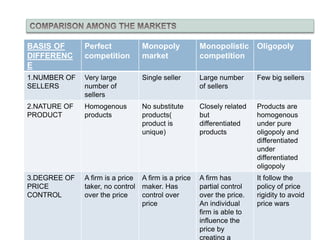
BASIS OF
DIFFERENC
E
Perfect
competition
Monopoly
market
Monopolistic
competition
Oligopoly
1.NUMBER OF
SELLERS
Very large
number of
sellers
Single seller Large number
of sellers
Few big sellers
2.NATURE OF
PRODUCT
Homogenous
products
No substitute
products(
product is
unique)
Closely related
but
differentiated
products
Products are
homogenous
under pure
oligopoly and
differentiated
under
differentiated
oligopoly
3.DEGREE OF
PRICE
CONTROL
A firm is a price
taker, no control
over the price
A firm is a price
maker. Has
control over
price
A firm has
partial control
over the price.
An individual
firm is able to
influence the
price by
creating a
It follow the
policy of price
rigidity to avoid
price wars
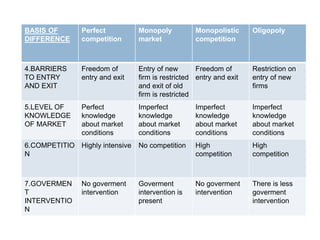
BASIS OF
DIFFERENCE
Perfect
competition
Monopoly
market
Monopolistic
competition
Oligopoly
4.BARRIERS
TO ENTRY
AND EXIT
Freedom of
entry and exit
Entry of new
firm is restricted
and exit of old
firm is restricted
Freedom of
entry and exit
Restriction on
entry of new
firms
5.LEVEL OF
KNOWLEDGE
OF MARKET
Perfect
knowledge
about market
conditions
Imperfect
knowledge
about market
conditions
Imperfect
knowledge
about market
conditions
Imperfect
knowledge
about market
conditions
6.COMPETITIO
N
Highly intensive No competition High
competition
High
competition
7.GOVERMEN
T
INTERVENTIO
N
No goverment
intervention
Goverment
intervention is
present
No goverment
intervention
There is less
goverment
intervention
Market structure
Market structure

Market structure

  • 1.
    MARKET STRUCTUR CONTENTS 1.Intro tomarket structure 2.Factors to be considered in classifying market struture 3.Types of market structure and their characteristics i.Perfect competition ii.Monopoly market iii.Monopolistic competition market iv.Oligopoly market 4.Comparison among the markets
  • 2.
    Introduction Market structure isthe institutional arrangment which shows the behaviour relationship between buyers and sellers. It is a conduct and structure at the market.
  • 3.
    FACTORS TO BECONSIDERED IN CLASSIFYING MARKET STRUCTURE 1.Number of buyers and sellers, How many buyers and sellers are on the market?. for example monopoy has one seller 2.Degree of product differentiation. Determine if the products are similar to each other or if a product is unique. 3.Nature of entry and exit. Are there any barriers to entry? an entry barrier can be high startup costs, For example the startup cost of settting an aircraft factory that requires high investement funds is one of teh barrier that there are few aircraft producers On exit it refers to how easy it is to get out of the investment.For example if the firm has many machine that cannot be converted to use in production of other products,then geting out of the market wont be easy, some companies may opt not to enter because of the risk. 4.Goverment intervation Does the goverment interfere in the market? Has the goverment set any barrier in form of regulation?. For example a goverment might choose to restrict number of firms to produce a particular product or service. 5.Degree of competition.
  • 4.
    TYPES OF MARKET STRUCTURESAND THEIR CHARACTERISTICS  There are four main types of market structure i.Perfect market competition ii.Monopoly market iii.Monopolistic market iv.Oligopoly market.
  • 5.
    Perfect competitive market It is the market where there is a large number of buyers and sellers selling homogenous product (i.e same nature of product are sold!!). For example maize, flour
  • 6.
    FEATURES/CHARACTERISTICS OF PERFECTCOMPETITIVE MARKET The market is characterized by the following six main features. 1.Large number of buyers and sellers. There are many large companies offering the product, hence forcing companies to offer the products at market price, if the company sells products at high price, it wont sell the products it manufactures.Also many buyers are available to buy the product due to its needs. For example Flour and sugar 2.Product sold is homogenous The product offered is not unique, it is identical to other products offered by sellers. consumers can susbtistute from one seller to another. 3.Both buyers and sellers are price takers The sellers are price takers since they have to go along with the market price, if they increase their price, they will loose their customers as customers can shift to other substitute sellers. The customers also have to accept the price as there will be no product at a price below market price 4.There is free entry and exit There is easy of entry and exit due to a way that resources used can be used in multiple activties in a market, because of this firms can enter and go out easly. 5.The consumers/buyers have the perfect information about the product The consumers know everything about the product resulting to low or no advertisement needed. For example in most countries, buyers have perfect information about sugar or milk.
  • 7.
    Monopoly market  Itis a market structure which has a single supplier or firm with no substitute. There is only one firm producing a prooduct or service, there are no substitutes.hence consumers have no choice but only to buy a product or service at one place. The firm has the power to set price and entry by other firms is not possible. For example, In most contries there is only one electrical company which is regulated by the goverment.
  • 8.
    FEATURES OF MONOPOLYMARKET 1.There is a single supplier Due to the presence of single supplier, consumers have no choice but only to buy the product or service at one place 2.Products have no close substitutes Due to single producer, there is no close substitutes. Hence the consumers have to buy the product from single supplier.There are no other companies/producers that offer the same products. 3.The monopolistic has the power to set the price Since the products have no substitutes, the firm has the power to set price that it sees fit for it to gain profit. The firm is the price maker 4.There are entry barriers. Barriers for other firms to enter can be many such as startup cost barriers and goverment intervention in the market etc 5.There is goverment intervention
  • 9.
    Monopolistic competition market  Itis the market where by there are many buyers and sellers selling different products that are differentiated interms of colour, size, quality and packaging.
  • 10.
    FEATURES/CHARACTERISTICS OF MONOPOLISTICCOMPETITION MARKET 1.Large number of buyers and sellers 2.Easy of entry because of relative low costs and easy of exit 3.Products are differentiated interms of colour, quality, size and packaging For example restaurants offer the same product which is food, but they differ in taste as each restaurant has its own way of cooking , which results to food that is completely different from others. 4.The firm is a price maker The company or seller has the power to set its own price, if the product is of high quality and more better than other competitors, a firm can set price higher than its competitors
  • 11.
    OLIGOPOLY MARKET It isa market structure where there are few sellers selling differentiated products, it is dominated by few giant companies. For example; automobile manufacture or cellphone manaufacture: they offer different cellphones with different shapes,specification and design. Example HTC and SAMSUNG
  • 12.
    FEATURES OF OLIGOPOLYMARKET 1.There are few sellers 2.The market is dominated by giant company 3.There is high level of competition 4.There is a barrier to entry.i.e the cost of starting is high 5.The firms are interdependent. Each firm is affected what others do 6.There is higher level of collusion COLLUSION: It is the formal agreement among oligopolist on price setting and market share. In simple collusion means agreement between people to act together secretely or legally in order to achieve a certain goal
  • 13.
    BASIS OF DIFFERENC E Perfect competition Monopoly market Monopolistic competition Oligopoly 1.NUMBER OF SELLERS Verylarge number of sellers Single seller Large number of sellers Few big sellers 2.NATURE OF PRODUCT Homogenous products No substitute products( product is unique) Closely related but differentiated products Products are homogenous under pure oligopoly and differentiated under differentiated oligopoly 3.DEGREE OF PRICE CONTROL A firm is a price taker, no control over the price A firm is a price maker. Has control over price A firm has partial control over the price. An individual firm is able to influence the price by creating a It follow the policy of price rigidity to avoid price wars
  • 14.
    BASIS OF DIFFERENCE Perfect competition Monopoly market Monopolistic competition Oligopoly 4.BARRIERS TO ENTRY ANDEXIT Freedom of entry and exit Entry of new firm is restricted and exit of old firm is restricted Freedom of entry and exit Restriction on entry of new firms 5.LEVEL OF KNOWLEDGE OF MARKET Perfect knowledge about market conditions Imperfect knowledge about market conditions Imperfect knowledge about market conditions Imperfect knowledge about market conditions 6.COMPETITIO N Highly intensive No competition High competition High competition 7.GOVERMEN T INTERVENTIO N No goverment intervention Goverment intervention is present No goverment intervention There is less goverment intervention