MARKET
STRUCTURE &
PRICING
DECISION
The Concept of Market:-
The market means a system by which sellers and
buyers of a commodity interact to settle its price and the quantity
to be bought & sold.
Important aspects of Market
 A market need not to be situated in a particular place or
lacality. The geographical area of a market depends on how far &
wide are the buyers & sellers scattered.
 Buyers & sellers need not come into personal contact with
each other.
 The word market refers to commodity or services. Example:-
Fruit market, Share market,
etc..
Law Of Demand
All other things remaining constant, the
Quantity demanded of a commodity increases when its price
decreases and decreases when its price increases.
Other factors affecting law of demand
Consumers income
Price of substitutes and complementary goods
Consumer tastes and preference
Advertisements, Etc.
DEMAND SCHEDULE
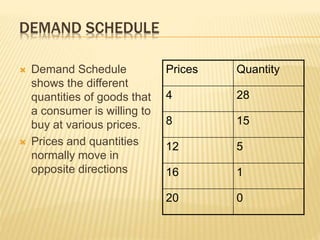
 Demand Schedule
shows the different
quantities of goods that
a consumer is willing to
buy at various prices.
 Prices and quantities
normally move in
opposite directions
Prices Quantity
4 28
8 15
12 5
16 1
20 0
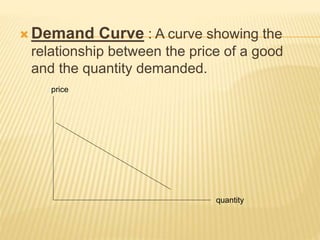
 Demand Curve : A curve showing the
relationship between the price of a good
and the quantity demanded.
price
quantity
SHIFT OF THE DEMAND CURVE
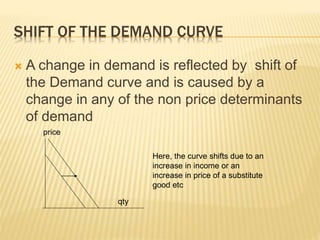
 A change in demand is reflected by shift of
the Demand curve and is caused by a
change in any of the non price determinants
of demand
price
qty
Here, the curve shifts due to an
increase in income or an
increase in price of a substitute
good etc
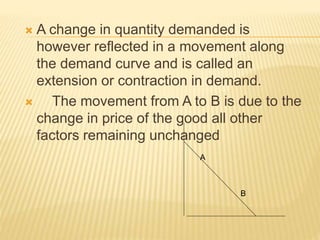
 A change in quantity demanded is
however reflected in a movement along
the demand curve and is called an
extension or contraction in demand.
 The movement from A to B is due to the
change in price of the good all other
factors remaining unchanged
A
B
SUPPLY
 The quantity supplied is the number of units
that sellers want to sell over a specified
period of time at a particular price.
 Law of Supply states that all other factors
remaining unchanged the supply of a good
increases as its price increases. This can be
shown by a supply schedule, a supply curve
or a supply function.
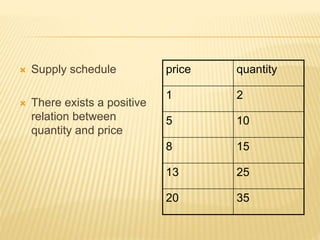
 Supply schedule
 There exists a positive
relation between
quantity and price
price quantity
1 2
5 10
8 15
13 25
20 35
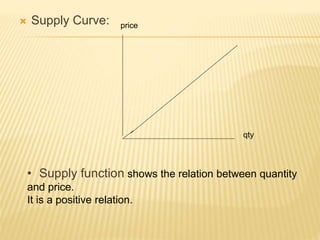
 Supply Curve:
qty
price
• Supply function shows the relation between quantity
and price.
It is a positive relation.
DETERMINANTS OF SUPPLY
 Price
 Cost of production
 Technological progress
 Prices of related outputs
 Govt. policy
All factors other than price cause a shift of
the supply curve and is called a change in
supply
CHANGE IN SUPPLY (SHIFT): INCREASE OR
DECREASE IN SUPPLY
 A shift in supply curve is caused by
changes in factors other than the price of
good.
 These factors are:
a) Price of other commodities
b) State of technology
c) Cost of production
d) Government policy
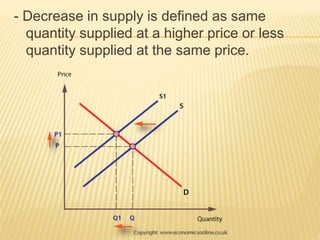
- Decrease in supply is defined as same
quantity supplied at a higher price or less
quantity supplied at the same price.
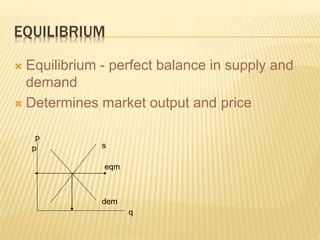
EQUILIBRIUM
 Equilibrium - perfect balance in supply and
demand
 Determines market output and price
eqm
p
q
s
dem
p
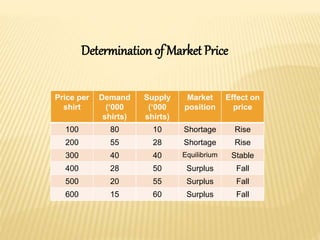
Price per
shirt
Demand
(‘000
shirts)
Supply
(‘000
shirts)
Market
position
Effect on
price
100 80 10 Shortage Rise
200 55 28 Shortage Rise
300 40 40 Equilibrium Stable
400 28 50 Surplus Fall
500 20 55 Surplus Fall
600 15 60 Surplus Fall
Determination of Market Price
MARKET FORCES DRIVE MARKET TO
EQUILIBRIUM
 at prices < equilibrium level: excess demand
(amount by which quantity demanded
exceeds quantity supplied at the specified
price)
 at price > equilibrium level: excess supply
 equilibrium price is market clearing price: no
excess demand or excess supply
MARKET STRUCTURE
 Market structure refers to number of firms in an
industry and the degree of competition among
the firms.
 The types of market structures include- Perfect
Competition, Monopoly, Monopolistic
Competition, Oligopoly, Duopoly.
 Market structure is best defined as the
organizational and other characteristics of a
market.
PERFECT COMPETITION
1. All firms sell an identical product.
2. All firms are price takers.
3. All firms have a relatively small market share.
4. Buyers know the nature of the product being
sold and the prices charged by each firm.
5. The industry is characterized by freedom of
entry and exit.
It is also referred as “PURE COMPETITION”.
PERFECT COMPETITION
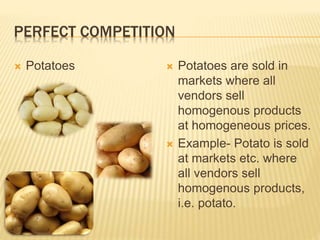
 Potatoes  Potatoes are sold in
markets where all
vendors sell
homogenous products
at homogeneous prices.
 Example- Potato is sold
at markets etc. where
all vendors sell
homogenous products,
i.e. potato.
MONOPOLY
 A Monopoly is a market structure in which
there is only one producer/seller for a
product. In other words, the single business
is the industry.
 Entry into such a market is restricted due to
high costs or other impediments, which may
be economic, social or political.
MONOPOLY
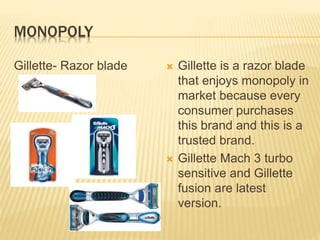
Gillette- Razor blade  Gillette is a razor blade
that enjoys monopoly in
market because every
consumer purchases
this brand and this is a
trusted brand.
 Gillette Mach 3 turbo
sensitive and Gillette
fusion are latest
version.
MONOPOLISTIC COMPETITION
 Monopolistic competition is a type of imperfect
competition such that one or two producers sell
products that are differentiated from one another
as goods but not perfect substitutes (such as
from branding, quality, or location).
 In monopolistic competition, a firm takes the
prices charged by its rivals as given and ignores
the impact of its own prices on the prices of
other firms.
 Consumers may like some special thing in the
particular brand.
MONOPOLISTIC COMPETITION
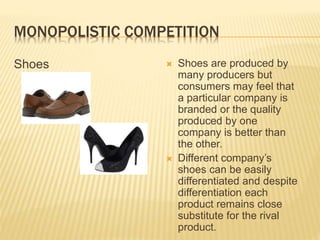
Shoes  Shoes are produced by
many producers but
consumers may feel that
a particular company is
branded or the quality
produced by one
company is better than
the other.
 Different company’s
shoes can be easily
differentiated and despite
differentiation each
product remains close
substitute for the rival
product.
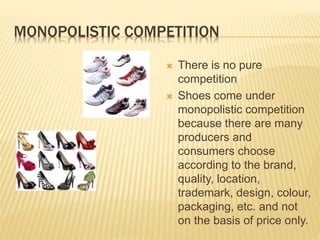
MONOPOLISTIC COMPETITION
 There is no pure
competition
 Shoes come under
monopolistic competition
because there are many
producers and
consumers choose
according to the brand,
quality, location,
trademark, design, colour,
packaging, etc. and not
on the basis of price only.
DUOPOLY
 A situation in which two companies own all or
nearly all of the market for a given product or
service.
 It is a specific type of oligopoly where only two
producers exist in one market. In reality, this
definition is generally used where only two firms
have dominant control over a market.
 In the field of industrial organization, it is the
most commonly studied form of oligopoly due to
its simplicity.
DUOPOLY
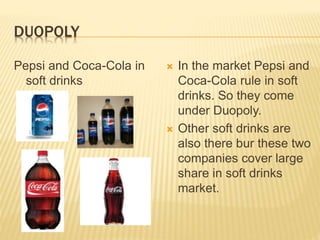
Pepsi and Coca-Cola in
soft drinks
 In the market Pepsi and
Coca-Cola rule in soft
drinks. So they come
under Duopoly.
 Other soft drinks are
also there bur these two
companies cover large
share in soft drinks
market.
OLIGOPOLY
 It is a situation in which a particular market is
controlled by a small group of firms.
 An oligopoly is a market form in which a
market or industry is dominated by a small
number of sellers (oligopolists). Because
there are few sellers, each oligopolist is likely
to be aware of the actions of the others.
 The decisions of one firm influence, and are
influenced by, the decisions of other firms.
OLIGOPOLY
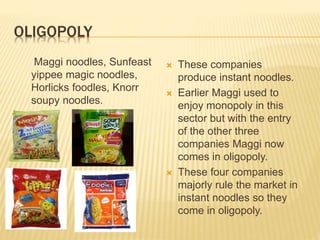
Maggi noodles, Sunfeast
yippee magic noodles,
Horlicks foodles, Knorr
soupy noodles.
 These companies
produce instant noodles.
 Earlier Maggi used to
enjoy monopoly in this
sector but with the entry
of the other three
companies Maggi now
comes in oligopoly.
 These four companies
majorly rule the market in
instant noodles so they
come in oligopoly.
Market structure

Market structure

  • 1.
  • 2.
    The Concept ofMarket:- The market means a system by which sellers and buyers of a commodity interact to settle its price and the quantity to be bought & sold. Important aspects of Market  A market need not to be situated in a particular place or lacality. The geographical area of a market depends on how far & wide are the buyers & sellers scattered.  Buyers & sellers need not come into personal contact with each other.  The word market refers to commodity or services. Example:- Fruit market, Share market, etc..
  • 3.
    Law Of Demand Allother things remaining constant, the Quantity demanded of a commodity increases when its price decreases and decreases when its price increases. Other factors affecting law of demand Consumers income Price of substitutes and complementary goods Consumer tastes and preference Advertisements, Etc.
  • 4.
    DEMAND SCHEDULE  DemandSchedule shows the different quantities of goods that a consumer is willing to buy at various prices.  Prices and quantities normally move in opposite directions Prices Quantity 4 28 8 15 12 5 16 1 20 0
  • 5.
     Demand Curve: A curve showing the relationship between the price of a good and the quantity demanded. price quantity
  • 6.
    SHIFT OF THEDEMAND CURVE  A change in demand is reflected by shift of the Demand curve and is caused by a change in any of the non price determinants of demand price qty Here, the curve shifts due to an increase in income or an increase in price of a substitute good etc
  • 7.
     A changein quantity demanded is however reflected in a movement along the demand curve and is called an extension or contraction in demand.  The movement from A to B is due to the change in price of the good all other factors remaining unchanged A B
  • 8.
    SUPPLY  The quantitysupplied is the number of units that sellers want to sell over a specified period of time at a particular price.  Law of Supply states that all other factors remaining unchanged the supply of a good increases as its price increases. This can be shown by a supply schedule, a supply curve or a supply function.
  • 9.
     Supply schedule There exists a positive relation between quantity and price price quantity 1 2 5 10 8 15 13 25 20 35
  • 10.
     Supply Curve: qty price •Supply function shows the relation between quantity and price. It is a positive relation.
  • 11.
    DETERMINANTS OF SUPPLY Price  Cost of production  Technological progress  Prices of related outputs  Govt. policy All factors other than price cause a shift of the supply curve and is called a change in supply
  • 12.
    CHANGE IN SUPPLY(SHIFT): INCREASE OR DECREASE IN SUPPLY  A shift in supply curve is caused by changes in factors other than the price of good.  These factors are: a) Price of other commodities b) State of technology c) Cost of production d) Government policy
  • 13.
    - Decrease insupply is defined as same quantity supplied at a higher price or less quantity supplied at the same price.
  • 14.
    EQUILIBRIUM  Equilibrium -perfect balance in supply and demand  Determines market output and price eqm p q s dem p
  • 15.
    Price per shirt Demand (‘000 shirts) Supply (‘000 shirts) Market position Effect on price 10080 10 Shortage Rise 200 55 28 Shortage Rise 300 40 40 Equilibrium Stable 400 28 50 Surplus Fall 500 20 55 Surplus Fall 600 15 60 Surplus Fall Determination of Market Price
  • 16.
    MARKET FORCES DRIVEMARKET TO EQUILIBRIUM  at prices < equilibrium level: excess demand (amount by which quantity demanded exceeds quantity supplied at the specified price)  at price > equilibrium level: excess supply  equilibrium price is market clearing price: no excess demand or excess supply
  • 17.
    MARKET STRUCTURE  Marketstructure refers to number of firms in an industry and the degree of competition among the firms.  The types of market structures include- Perfect Competition, Monopoly, Monopolistic Competition, Oligopoly, Duopoly.  Market structure is best defined as the organizational and other characteristics of a market.
  • 18.
    PERFECT COMPETITION 1. Allfirms sell an identical product. 2. All firms are price takers. 3. All firms have a relatively small market share. 4. Buyers know the nature of the product being sold and the prices charged by each firm. 5. The industry is characterized by freedom of entry and exit. It is also referred as “PURE COMPETITION”.
  • 19.
    PERFECT COMPETITION  Potatoes Potatoes are sold in markets where all vendors sell homogenous products at homogeneous prices.  Example- Potato is sold at markets etc. where all vendors sell homogenous products, i.e. potato.
  • 20.
    MONOPOLY  A Monopolyis a market structure in which there is only one producer/seller for a product. In other words, the single business is the industry.  Entry into such a market is restricted due to high costs or other impediments, which may be economic, social or political.
  • 21.
    MONOPOLY Gillette- Razor blade Gillette is a razor blade that enjoys monopoly in market because every consumer purchases this brand and this is a trusted brand.  Gillette Mach 3 turbo sensitive and Gillette fusion are latest version.
  • 22.
    MONOPOLISTIC COMPETITION  Monopolisticcompetition is a type of imperfect competition such that one or two producers sell products that are differentiated from one another as goods but not perfect substitutes (such as from branding, quality, or location).  In monopolistic competition, a firm takes the prices charged by its rivals as given and ignores the impact of its own prices on the prices of other firms.  Consumers may like some special thing in the particular brand.
  • 23.
    MONOPOLISTIC COMPETITION Shoes Shoes are produced by many producers but consumers may feel that a particular company is branded or the quality produced by one company is better than the other.  Different company’s shoes can be easily differentiated and despite differentiation each product remains close substitute for the rival product.
  • 24.
    MONOPOLISTIC COMPETITION  Thereis no pure competition  Shoes come under monopolistic competition because there are many producers and consumers choose according to the brand, quality, location, trademark, design, colour, packaging, etc. and not on the basis of price only.
  • 25.
    DUOPOLY  A situationin which two companies own all or nearly all of the market for a given product or service.  It is a specific type of oligopoly where only two producers exist in one market. In reality, this definition is generally used where only two firms have dominant control over a market.  In the field of industrial organization, it is the most commonly studied form of oligopoly due to its simplicity.
  • 26.
    DUOPOLY Pepsi and Coca-Colain soft drinks  In the market Pepsi and Coca-Cola rule in soft drinks. So they come under Duopoly.  Other soft drinks are also there bur these two companies cover large share in soft drinks market.
  • 27.
    OLIGOPOLY  It isa situation in which a particular market is controlled by a small group of firms.  An oligopoly is a market form in which a market or industry is dominated by a small number of sellers (oligopolists). Because there are few sellers, each oligopolist is likely to be aware of the actions of the others.  The decisions of one firm influence, and are influenced by, the decisions of other firms.
  • 28.
    OLIGOPOLY Maggi noodles, Sunfeast yippeemagic noodles, Horlicks foodles, Knorr soupy noodles.  These companies produce instant noodles.  Earlier Maggi used to enjoy monopoly in this sector but with the entry of the other three companies Maggi now comes in oligopoly.  These four companies majorly rule the market in instant noodles so they come in oligopoly.