Introduction to
Microeconomics
MICRO ECONOMICS
• It is a study of behaviour of
individual units of an economy
such as individual consumer,
producer etc.
ECONOMY
• An economy is a system by
which people get their
living.
TYPES OF ECONOMY
• Capitalist economy / Market
economy
• Socialist economy / Planned economy
• Mixed economy
MARKET ECONOMY
• It is an economic system, in which all
material means of production are
owned and operated by the private
with profit motive
PLANNED ECONOMY
• In this economy all material means of
production are owned by the government
or by a centrally planned authority. All
important decisions regarding production,
exchange and distributions, consumptions
of goods and services are made by the
government or by a centrally planned
authority
ECONOMIC PROBLEM
• “An economic problem is basically
the problem of choice” which arises
due to scarcity of resources having
alternative uses.
CAUSES OF ECONOMIC
PROBLEM
• Scarcity of resources
• Unlimited wants
• Limited resources having alternative
uses
BASIC (CENTRAL)
ECONOMIC PROBLEMS
Allocation of resources
• What to produce?
• How to produce?
• For whom to produce
• ii). Efficient Utilization of resources
• iii.) Growth of resources
PRODUCTION POSSIBILITY
CURVE/Frontier (PPC) or(PPF)
• PP curve shows all the possible
combination of two goods that can be
produced with the help of available
resources and technology.
MARGINAL OPPORTUNITY
COST
• MOC of a particular good along PPC is
the amount of other good which is
sacrificed for production of additional
unit of another good.
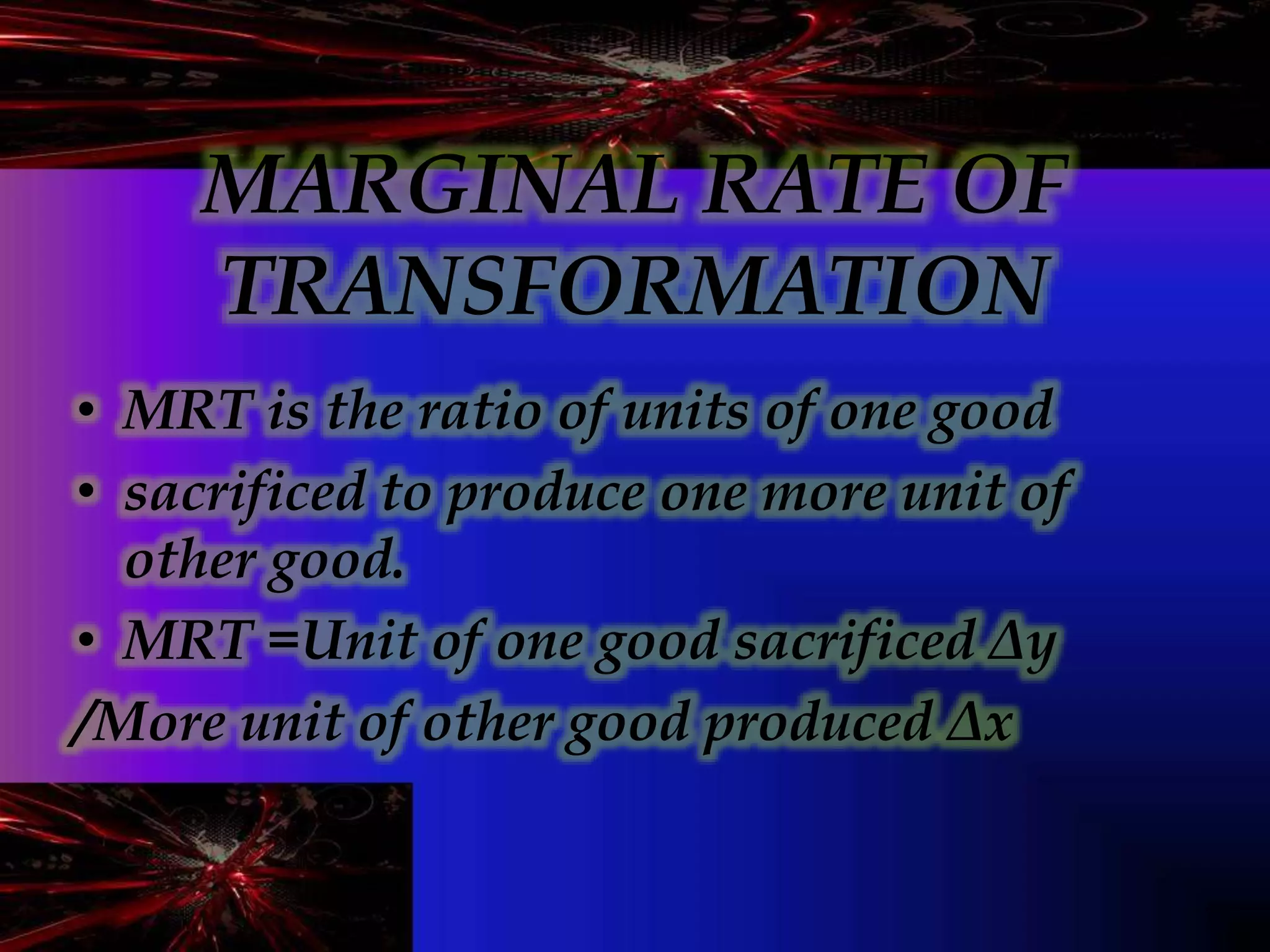
MARGINAL RATE OF
TRANSFORMATION
• MRT is the ratio of units of one good
• sacrificed to produce one more unit of
other good.
• MRT =Unit of one good sacrificed Δy
/More unit of other good produced Δx
SCARCITY OF RESOURCES
• Scarcity of resources means shortage
of resources in relation to their
demand.
OPPORTUNITY COST
• It is the cost of next best
alternative foregone
POSITIVE ECONOMICS
• Positive economics deals with what
is, what was (or) how an economic
problem facing the society is actually
solved.
NORMATIVE ECONOMICS
• It deals with what ought to be
(or) how an economic problem
should be solved.
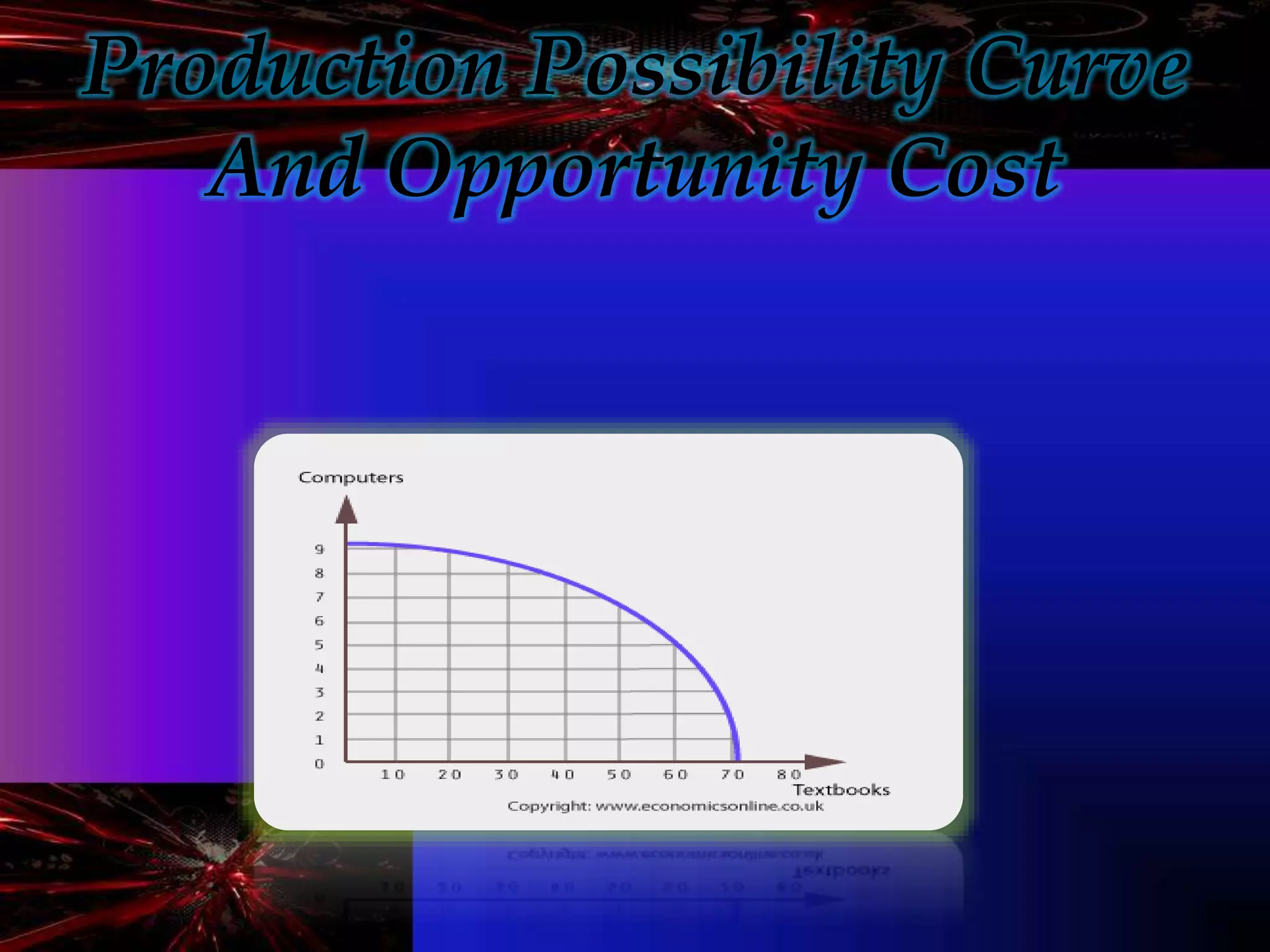
Production Possibility Curve
And Opportunity Cost• It refers to a curve which shows the various
production possibilities that can be produced
with given resources and technology.
• If the economy devotes all its resources to
the production of commodity B, it can
produce 15 units but then the production of
commodity A will be zero. There can be a
number of production possibilities of
commodity A & B.
• If we want to produce more commodity B,
we have to reduce the output of commodity A
Production Possibility Curve
And Opportunity Cost
Shape of PP curve and
marginal opportunity cost
• PP curve is a downward sloping curve.
• In a full employment economy, more of
one goods can be obtained only by giving
up the production of other goods. It is not
possible to increase the production of both
of them with the given resources
Shape of PP curve and
marginal opportunity cost
• The shape of the production possibility
curve is concave to the origin.
• The opportunity cost for a commodity is
the amount of other commodity that has
been foregone in order to produce the first.
• The marginal opportunity cost of a
particular good along the PPC is defined
as the amount sacrificed of the other good
per unit increase in the production of the
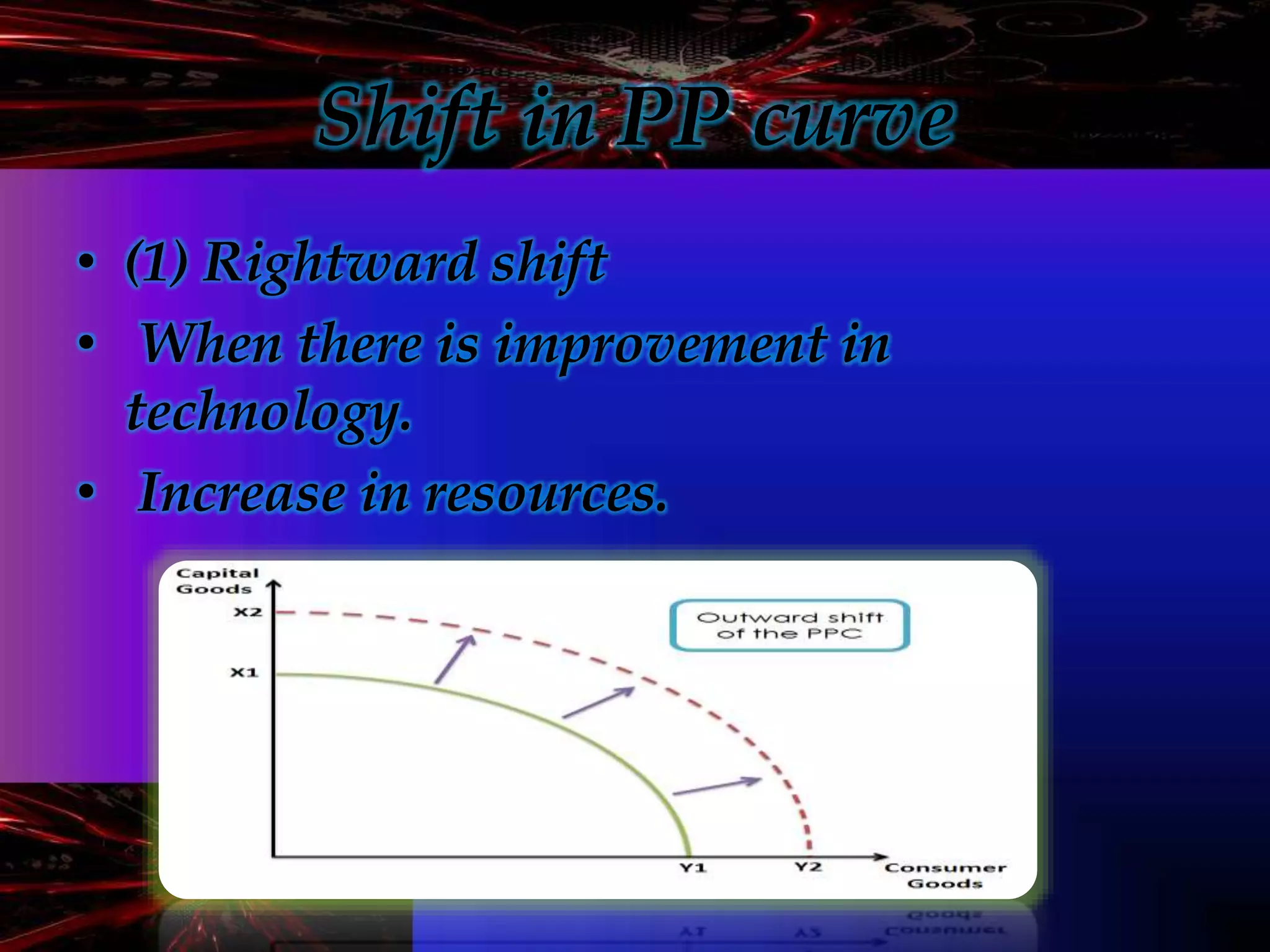
Shift in PP curve
• (1) Rightward shift
• When there is improvement in
technology.
• Increase in resources.
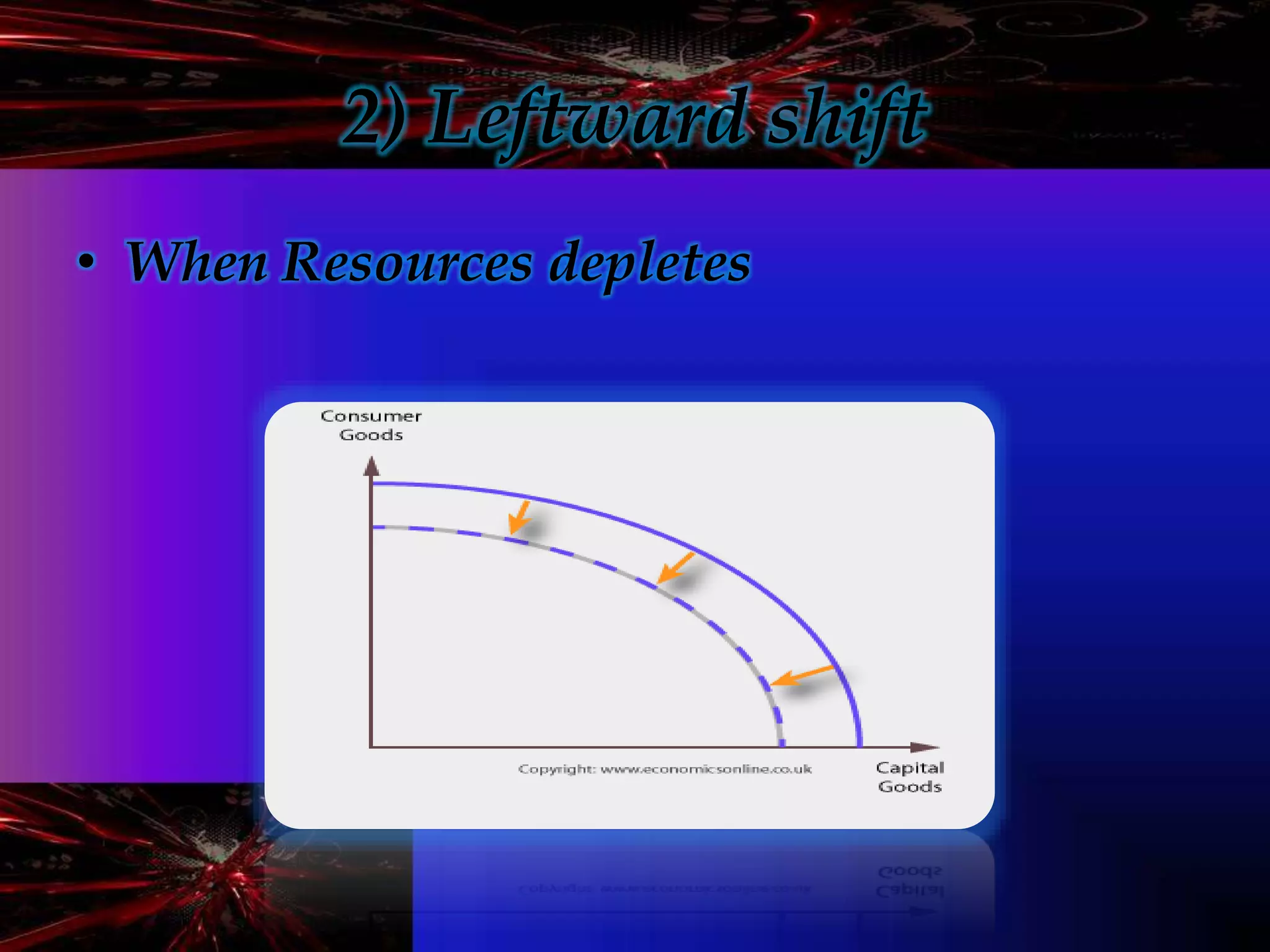
2) Leftward shift
• When Resources depletes
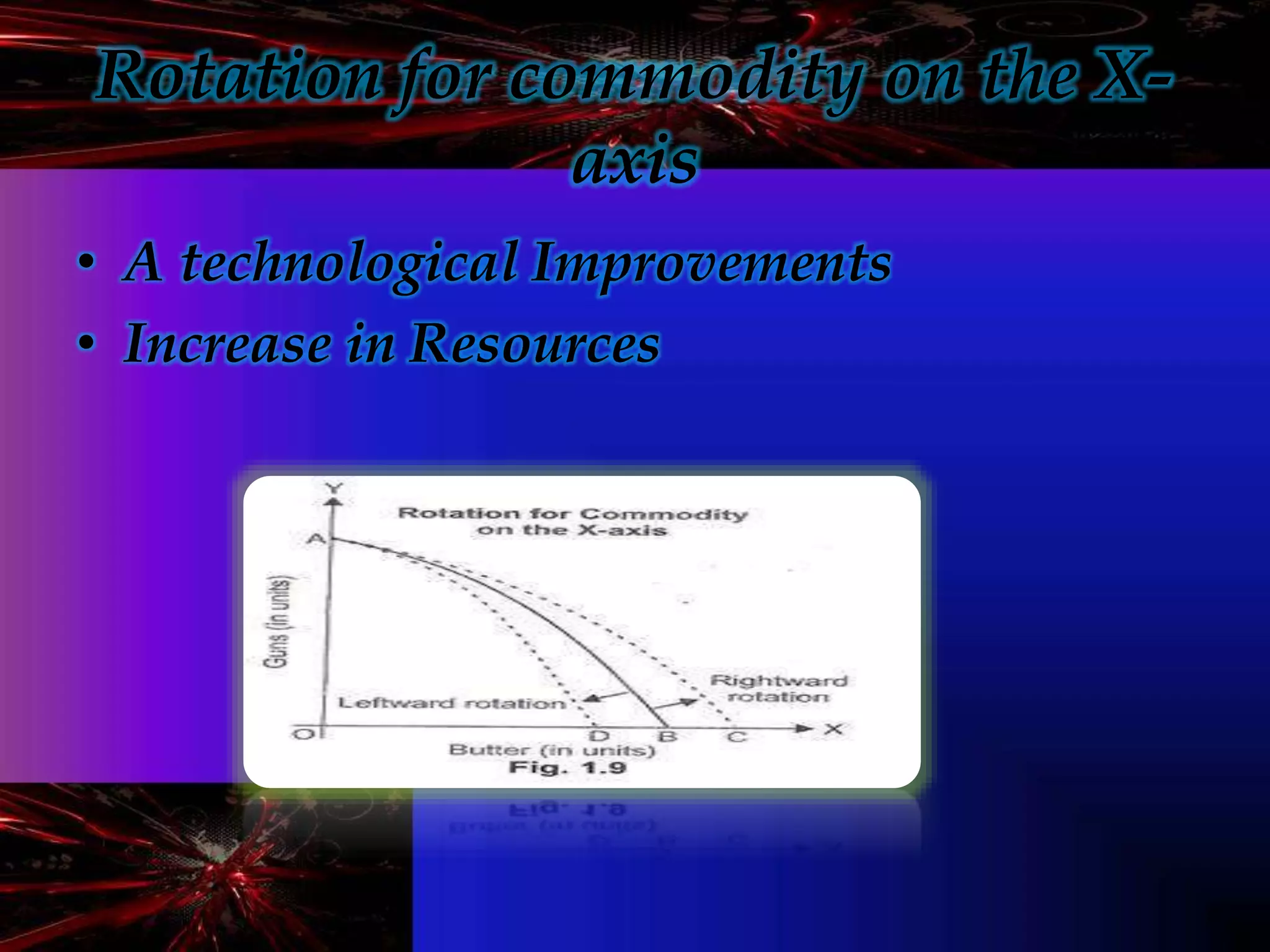
Rotation for commodity on the X-
axis
• A technological Improvements
• Increase in Resources
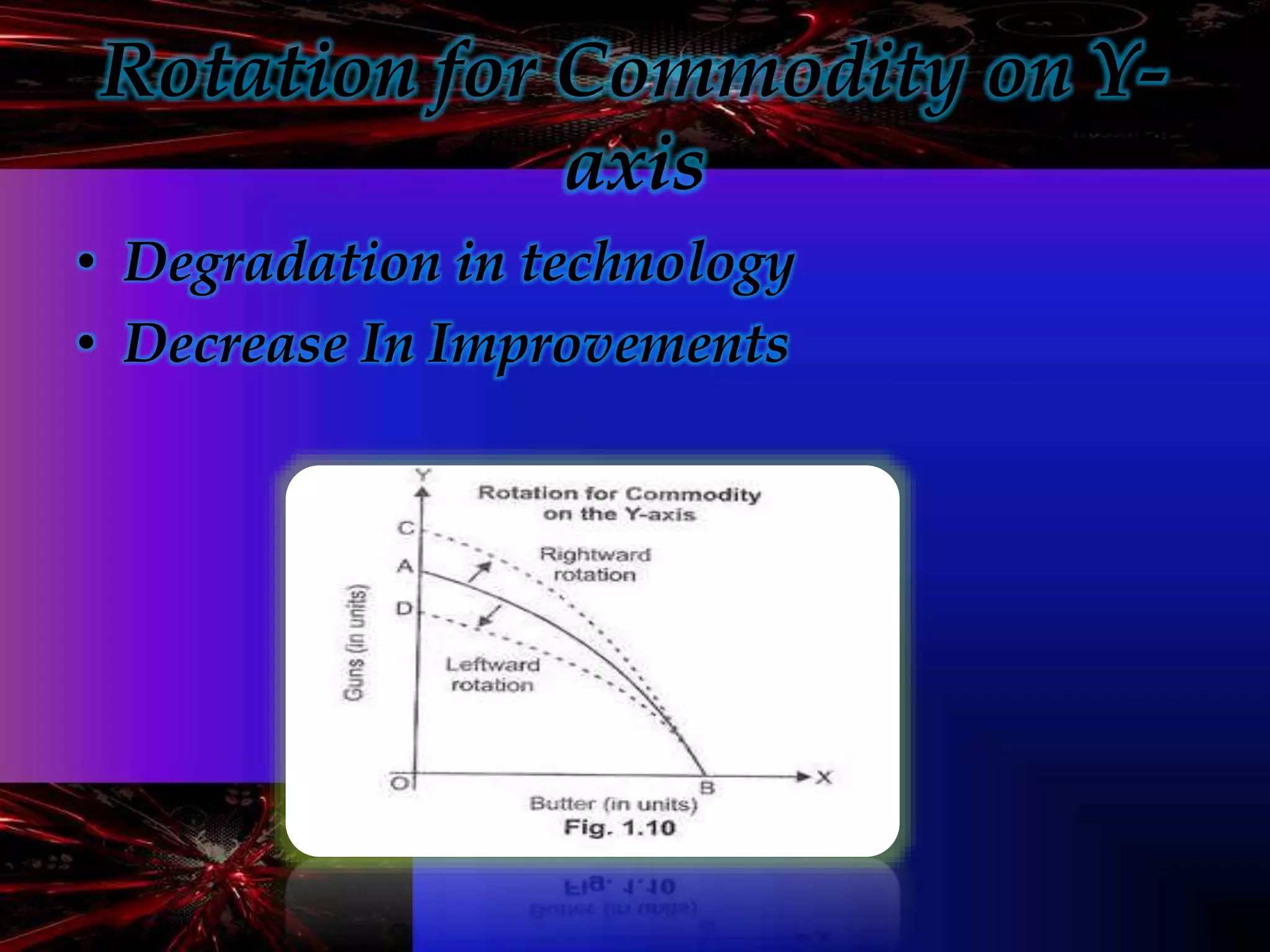
Rotation for Commodity on Y-
axis
• Degradation in technology
• Decrease In Improvements
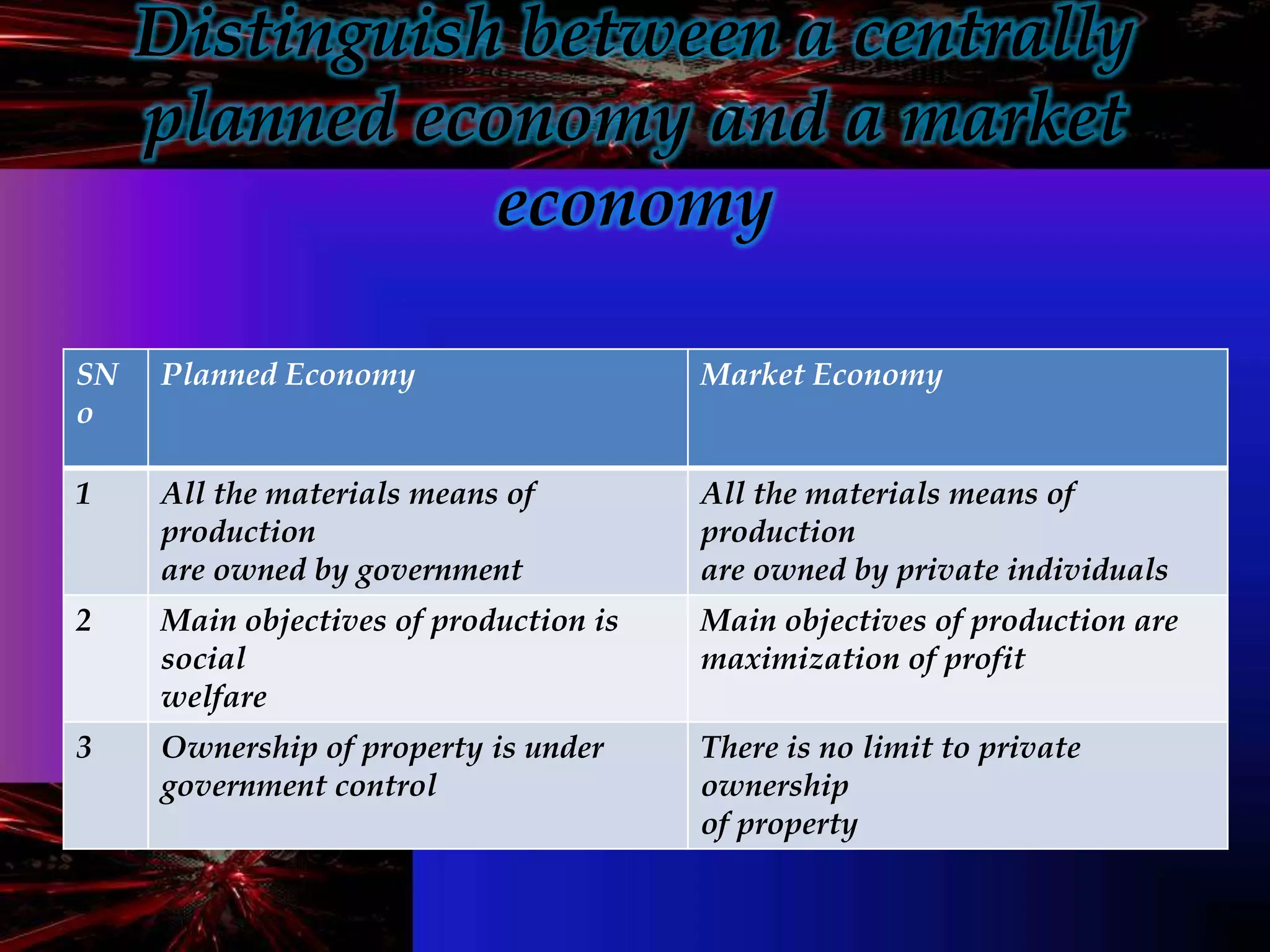
Distinguish between a centrally
planned economy and a market
economy
SN
o
Planned Economy Market Economy
1 All the materials means of
production
are owned by government
All the materials means of
production
are owned by private individuals
2 Main objectives of production is
social
welfare
Main objectives of production are
maximization of profit
3 Ownership of property is under
government control
There is no limit to private
ownership
of property
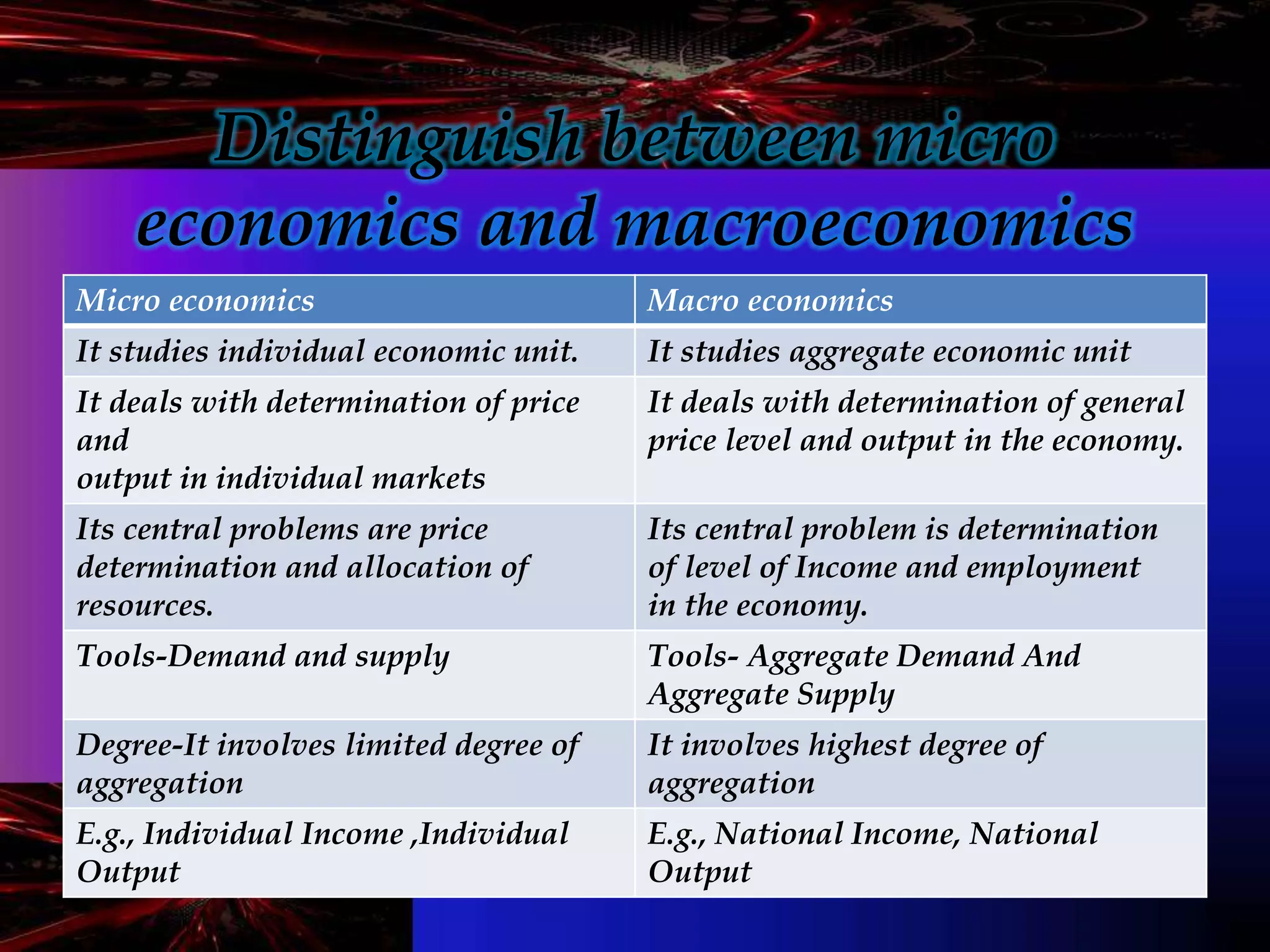
Distinguish between micro
economics and macroeconomics
Micro economics Macro economics
It studies individual economic unit. It studies aggregate economic unit
It deals with determination of price
and
output in individual markets
It deals with determination of general
price level and output in the economy.
Its central problems are price
determination and allocation of
resources.
Its central problem is determination
of level of Income and employment
in the economy.
Tools-Demand and supply Tools- Aggregate Demand And
Aggregate Supply
Degree-It involves limited degree of
aggregation
It involves highest degree of
aggregation
E.g., Individual Income ,Individual
Output
E.g., National Income, National
Output
Introduction Microeconomics

Introduction Microeconomics

  • 1.
  • 2.
    MICRO ECONOMICS • Itis a study of behaviour of individual units of an economy such as individual consumer, producer etc.
  • 3.
    ECONOMY • An economyis a system by which people get their living.
  • 4.
    TYPES OF ECONOMY •Capitalist economy / Market economy • Socialist economy / Planned economy • Mixed economy
  • 5.
    MARKET ECONOMY • Itis an economic system, in which all material means of production are owned and operated by the private with profit motive
  • 6.
    PLANNED ECONOMY • Inthis economy all material means of production are owned by the government or by a centrally planned authority. All important decisions regarding production, exchange and distributions, consumptions of goods and services are made by the government or by a centrally planned authority
  • 7.
    ECONOMIC PROBLEM • “Aneconomic problem is basically the problem of choice” which arises due to scarcity of resources having alternative uses.
  • 8.
    CAUSES OF ECONOMIC PROBLEM •Scarcity of resources • Unlimited wants • Limited resources having alternative uses
  • 9.
    BASIC (CENTRAL) ECONOMIC PROBLEMS Allocationof resources • What to produce? • How to produce? • For whom to produce • ii). Efficient Utilization of resources • iii.) Growth of resources
  • 10.
    PRODUCTION POSSIBILITY CURVE/Frontier (PPC)or(PPF) • PP curve shows all the possible combination of two goods that can be produced with the help of available resources and technology.
  • 11.
    MARGINAL OPPORTUNITY COST • MOCof a particular good along PPC is the amount of other good which is sacrificed for production of additional unit of another good.
  • 12.
    MARGINAL RATE OF TRANSFORMATION •MRT is the ratio of units of one good • sacrificed to produce one more unit of other good. • MRT =Unit of one good sacrificed Δy /More unit of other good produced Δx
  • 13.
    SCARCITY OF RESOURCES •Scarcity of resources means shortage of resources in relation to their demand.
  • 14.
    OPPORTUNITY COST • Itis the cost of next best alternative foregone
  • 15.
    POSITIVE ECONOMICS • Positiveeconomics deals with what is, what was (or) how an economic problem facing the society is actually solved.
  • 16.
    NORMATIVE ECONOMICS • Itdeals with what ought to be (or) how an economic problem should be solved.
  • 17.
    Production Possibility Curve AndOpportunity Cost• It refers to a curve which shows the various production possibilities that can be produced with given resources and technology. • If the economy devotes all its resources to the production of commodity B, it can produce 15 units but then the production of commodity A will be zero. There can be a number of production possibilities of commodity A & B. • If we want to produce more commodity B, we have to reduce the output of commodity A
  • 18.
  • 19.
    Shape of PPcurve and marginal opportunity cost • PP curve is a downward sloping curve. • In a full employment economy, more of one goods can be obtained only by giving up the production of other goods. It is not possible to increase the production of both of them with the given resources
  • 20.
    Shape of PPcurve and marginal opportunity cost • The shape of the production possibility curve is concave to the origin. • The opportunity cost for a commodity is the amount of other commodity that has been foregone in order to produce the first. • The marginal opportunity cost of a particular good along the PPC is defined as the amount sacrificed of the other good per unit increase in the production of the
  • 21.
    Shift in PPcurve • (1) Rightward shift • When there is improvement in technology. • Increase in resources.
  • 22.
    2) Leftward shift •When Resources depletes
  • 23.
    Rotation for commodityon the X- axis • A technological Improvements • Increase in Resources
  • 24.
    Rotation for Commodityon Y- axis • Degradation in technology • Decrease In Improvements
  • 25.
    Distinguish between acentrally planned economy and a market economy SN o Planned Economy Market Economy 1 All the materials means of production are owned by government All the materials means of production are owned by private individuals 2 Main objectives of production is social welfare Main objectives of production are maximization of profit 3 Ownership of property is under government control There is no limit to private ownership of property
  • 26.
    Distinguish between micro economicsand macroeconomics Micro economics Macro economics It studies individual economic unit. It studies aggregate economic unit It deals with determination of price and output in individual markets It deals with determination of general price level and output in the economy. Its central problems are price determination and allocation of resources. Its central problem is determination of level of Income and employment in the economy. Tools-Demand and supply Tools- Aggregate Demand And Aggregate Supply Degree-It involves limited degree of aggregation It involves highest degree of aggregation E.g., Individual Income ,Individual Output E.g., National Income, National Output