SEMINAR Presentation


Consumer Equilibrium under Indifference Curve Analysis

                    BA Economics Programme

                     Muhammed Haneef T.P
                           Askar
                     Muhammed Younis Salim


          SAFI Institute of Advanced Study, Vazhayoor
Consumer Equilibrium under Indifference Curve Analysis


I.   Introduction to Indifference curve analysis

II. Assumptions to equilibrium of the consumer

III. Indifference Map and Budget Line of consumer

IV. Consumer’s Equilibrium or Maximization of Satisfaction

V. First and Second order condition for consumer equilibrium.

VI. Income Effect: Income consumption Curve

     a) ICC of Normal Good

     b) ICC of Luxury Goods

     c)   ICC of Inferior good

VII. Conclusion
Consumer Equilibrium under Indifference Curve Analysis


     1. Introduction to Indifference curve analysis
Consumer Equilibrium under Indifference Curve Analysis

1. Introduction to Indifference curve analysis


          • Ordinal means- Can be compare with each other- 1St , 2nd , 3rd etc.
          • Ordinal Utility analysis - Utility can compare but can not be measure.
          • Popularized by J.R. Hicks and R.G.D. Allen
          • Used the tool named Indifference Curve
          • Known as Indifference curve approach of utility analysis
Consumer Equilibrium under Indifference Curve Analysis

1. Introduction to Indifference curve analysis


                        Assumptions Indifference Curve Analysis

        a) Consumer is rational or Rationality
        b) Utility is ordinal
        c)   Consistence in choice
                                If A > B, then never become B > A
        4. Consumer’s Preference is Transitive:
                                 If A > B and B > C, then A > C
        5. Diminishing Marginal Substitution of goods:
        6. Dependent Utility
        7. A Large bundle of goods preferred to small bundle
Consumer Equilibrium under Indifference Curve Analysis


  II. Assumptions to explain equilibrium of the consumer
Consumer Equilibrium under Indifference Curve Analysis


II. Assumptions to equilibrium of the consumer


To Explain the consumers equilibrium the following assumption is there


1. The consumer has Indifference Map of good X and Good Y
2. The consumer have a fixed money income which are spend on X and Y
3. The Prices of good X –Px and good Y – Py are given
4. Good are homogenous
Consumer Equilibrium under Indifference Curve Analysis


    III. Indifference Map and Budget Line of consumer
Consumer Equilibrium under Indifference Curve Analysis


III. Indifference Map and Budget Line of consumer


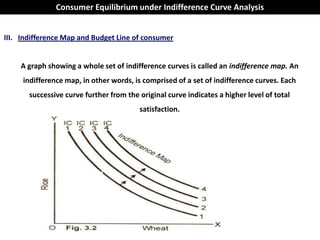
    A graph showing a whole set of indifference curves is called an indifference map. An
     indifference map, in other words, is comprised of a set of indifference curves. Each
       successive curve further from the original curve indicates a higher level of total
                                         satisfaction.
Consumer Equilibrium under Indifference Curve Analysis

III. Indifference Map and Budget Line of consumer
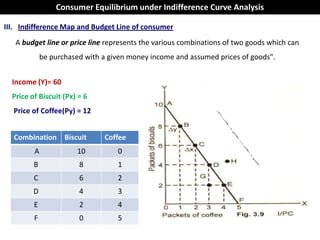
   A budget line or price line represents the various combinations of two goods which can
             be purchased with a given money income and assumed prices of goods".


  Income (Y)= 60
  Price of Biscuit (Px) = 6
  Price of Coffee(Py) = 12


  Combination Biscuit          Coffee
         A             10          0
         B              8          1
         C              6          2
         D              4          3
         E              2          4
         F              0          5
Consumer Equilibrium under Indifference Curve Analysis


 IV. Consumer’s Equilibrium or Maximization of Satisfaction
Consumer Equilibrium under Indifference Curve Analysis


IV. Consumer’s Equilibrium or Maximization of Satisfaction


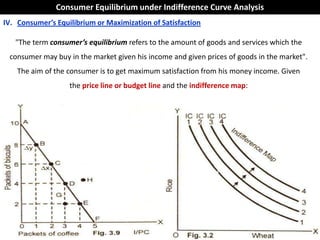
        "The term consumer’s equilibrium refers to the amount of goods and services
       which the consumer may buy in the market given his income and given prices of
              goods in the market, that give maximum satisfaction to consumer".


       The aim of the consumer is to get maximum satisfaction from his money income.
                Given the price line or budget line and the indifference map:
Consumer Equilibrium under Indifference Curve Analysis
IV. Consumer’s Equilibrium or Maximization of Satisfaction

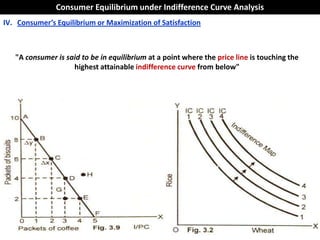
   "The term consumer’s equilibrium refers to the amount of goods and services which the
 consumer may buy in the market given his income and given prices of goods in the market".
    The aim of the consumer is to get maximum satisfaction from his money income. Given
                   the price line or budget line and the indifference map:
Consumer Equilibrium under Indifference Curve Analysis
IV. Consumer’s Equilibrium or Maximization of Satisfaction


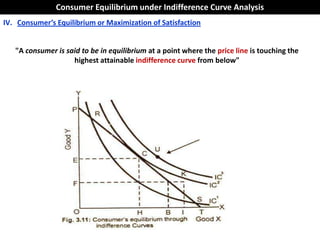
   "A consumer is said to be in equilibrium at a point where the price line is touching the
                    highest attainable indifference curve from below"
Consumer Equilibrium under Indifference Curve Analysis
IV. Consumer’s Equilibrium or Maximization of Satisfaction


   "A consumer is said to be in equilibrium at a point where the price line is touching the
                    highest attainable indifference curve from below"
Consumer Equilibrium under Indifference Curve Analysis


IV. First order and Second order condition for consumer Equilibrium
Consumer Equilibrium under Indifference Curve Analysis
IV. First order and Second order condition for consumer Equilibrium

 Thus the consumer’s equilibrium under the indifference curve theory must meet the following
                                      two conditions:


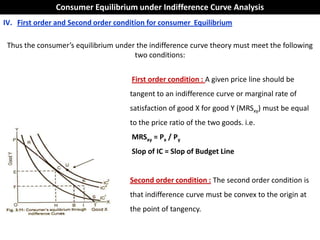
                                      First order condition : A given price line should be
                                     tangent to an indifference curve or marginal rate of
                                     satisfaction of good X for good Y (MRSxy) must be equal
                                     to the price ratio of the two goods. i.e.
                                      MRSxy = Px / Py
                                      Slop of IC = Slop of Budget Line


                                     Second order condition : The second order condition is
                                     that indifference curve must be convex to the origin at
                                     the point of tangency.
Consumer Equilibrium under Indifference Curve Analysis
IV. First order and Second order condition for consumer Equilibrium

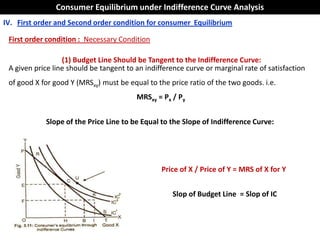
 First order condition : Necessary Condition

                  (1) Budget Line Should be Tangent to the Indifference Curve:
 A given price line should be tangent to an indifference curve or marginal rate of satisfaction
 of good X for good Y (MRSxy) must be equal to the price ratio of the two goods. i.e.
                                         MRSxy = Px / Py


            Slope of the Price Line to be Equal to the Slope of Indifference Curve:


                                                 Price of X / Price of Y = MRS of X for Y


                                                    Slop of Budget Line = Slop of IC
Consumer Equilibrium under Indifference Curve Analysis
IV. First order and Second order condition for consumer Equilibrium


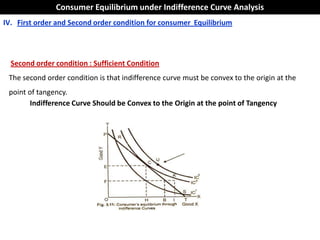
  Second order condition : Sufficient Condition
 The second order condition is that indifference curve must be convex to the origin at the
 point of tangency.
       Indifference Curve Should be Convex to the Origin at the point of Tangency
Consumer Equilibrium under Indifference Curve Analysis


V. Income Effect: Income consumption Curve

    a) ICC of Normal Good

    b) ICC of Inferior good

    c)   Luxury good
Consumer Equilibrium under Indifference Curve Analysis


V. Income Effect: Income consumption Curve


      The Income effect in economics can be defined as the change in consumption
                          resulting from a change in real income.


 If the prices of goods, tastes and preferences of the consumer remains constant and
 there a change in his income, it will directly affect consumer’s demand. This effect on the
 purchase due to change in income is called the income effect.
Consumer Equilibrium under Indifference Curve Analysis


V. Income Effect: Income consumption Curve


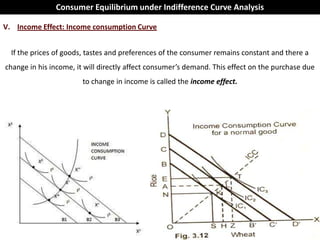
     The Income Consumption Curve show how income effect on the quantity consumed
                                     of the good
Consumer Equilibrium under Indifference Curve Analysis

V. Income Effect: Income consumption Curve


  If the prices of goods, tastes and preferences of the consumer remains constant and there a
change in his income, it will directly affect consumer’s demand. This effect on the purchase due
                        to change in income is called the income effect.
Consumer Equilibrium under Indifference Curve Analysis


V. Income Effect: Income consumption Curve

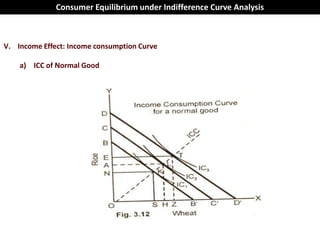
    a) ICC of Normal Good
Consumer Equilibrium under Indifference Curve Analysis


V. Income Effect: Income consumption Curve

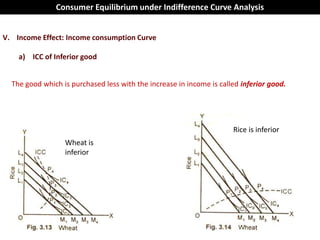
    a) ICC of Inferior good


  The good which is purchased less with the increase in income is called inferior good.


                                                                      Rice is inferior
                  Wheat is
                  inferior
Consumer Equilibrium under Indifference Curve Analysis


V. Income Effect: Income consumption Curve


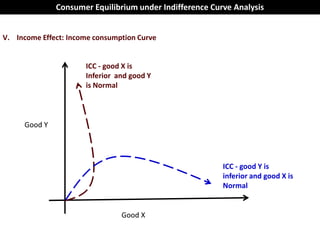
                      ICC - good X is
                      Inferior and good Y
                      is Normal


     Good Y


                                                         ICC - good Y is
                                                         inferior and good X is
                                                         Normal


                                Good X
Consumer Equilibrium under Indifference Curve Analysis


V. Income Effect: Income consumption Curve


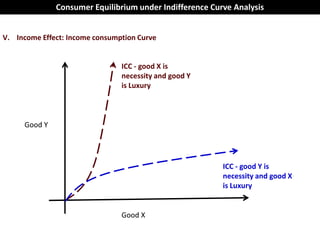
                                ICC - good X is
                                necessity and good Y
                                is Luxury


     Good Y


                                                         ICC - good Y is
                                                         necessity and good X
                                                         is Luxury


                                Good X
Consumer Equilibrium under Indifference Curve Analysis


I.   Introduction to Indifference curve analysis

II. Assumptions to equilibrium of the consumer

III. Indifference Map and Budget Line of consumer

IV. Consumer’s Equilibrium or Maximization of Satisfaction

V. First and Second order condition for consumer equilibrium.

VI. Income Effect: Income consumption Curve

     a) ICC of Normal Good

     b) ICC of Luxury Goods

     c)   ICC of Inferior good

VII. Conclusion
Consumer Equilibrium under Indifference Curve Analysis


                      Conclusion

Consumer equilibrium under indifference curve analysis

  • 1.
    SEMINAR Presentation Consumer Equilibriumunder Indifference Curve Analysis BA Economics Programme Muhammed Haneef T.P Askar Muhammed Younis Salim SAFI Institute of Advanced Study, Vazhayoor
  • 2.
    Consumer Equilibrium underIndifference Curve Analysis I. Introduction to Indifference curve analysis II. Assumptions to equilibrium of the consumer III. Indifference Map and Budget Line of consumer IV. Consumer’s Equilibrium or Maximization of Satisfaction V. First and Second order condition for consumer equilibrium. VI. Income Effect: Income consumption Curve a) ICC of Normal Good b) ICC of Luxury Goods c) ICC of Inferior good VII. Conclusion
  • 3.
    Consumer Equilibrium underIndifference Curve Analysis 1. Introduction to Indifference curve analysis
  • 4.
    Consumer Equilibrium underIndifference Curve Analysis 1. Introduction to Indifference curve analysis • Ordinal means- Can be compare with each other- 1St , 2nd , 3rd etc. • Ordinal Utility analysis - Utility can compare but can not be measure. • Popularized by J.R. Hicks and R.G.D. Allen • Used the tool named Indifference Curve • Known as Indifference curve approach of utility analysis
  • 5.
    Consumer Equilibrium underIndifference Curve Analysis 1. Introduction to Indifference curve analysis Assumptions Indifference Curve Analysis a) Consumer is rational or Rationality b) Utility is ordinal c) Consistence in choice If A > B, then never become B > A 4. Consumer’s Preference is Transitive: If A > B and B > C, then A > C 5. Diminishing Marginal Substitution of goods: 6. Dependent Utility 7. A Large bundle of goods preferred to small bundle
  • 6.
    Consumer Equilibrium underIndifference Curve Analysis II. Assumptions to explain equilibrium of the consumer
  • 7.
    Consumer Equilibrium underIndifference Curve Analysis II. Assumptions to equilibrium of the consumer To Explain the consumers equilibrium the following assumption is there 1. The consumer has Indifference Map of good X and Good Y 2. The consumer have a fixed money income which are spend on X and Y 3. The Prices of good X –Px and good Y – Py are given 4. Good are homogenous
  • 8.
    Consumer Equilibrium underIndifference Curve Analysis III. Indifference Map and Budget Line of consumer
  • 9.
    Consumer Equilibrium underIndifference Curve Analysis III. Indifference Map and Budget Line of consumer A graph showing a whole set of indifference curves is called an indifference map. An indifference map, in other words, is comprised of a set of indifference curves. Each successive curve further from the original curve indicates a higher level of total satisfaction.
  • 10.
    Consumer Equilibrium underIndifference Curve Analysis III. Indifference Map and Budget Line of consumer A budget line or price line represents the various combinations of two goods which can be purchased with a given money income and assumed prices of goods". Income (Y)= 60 Price of Biscuit (Px) = 6 Price of Coffee(Py) = 12 Combination Biscuit Coffee A 10 0 B 8 1 C 6 2 D 4 3 E 2 4 F 0 5
  • 11.
    Consumer Equilibrium underIndifference Curve Analysis IV. Consumer’s Equilibrium or Maximization of Satisfaction
  • 12.
    Consumer Equilibrium underIndifference Curve Analysis IV. Consumer’s Equilibrium or Maximization of Satisfaction "The term consumer’s equilibrium refers to the amount of goods and services which the consumer may buy in the market given his income and given prices of goods in the market, that give maximum satisfaction to consumer". The aim of the consumer is to get maximum satisfaction from his money income. Given the price line or budget line and the indifference map:
  • 13.
    Consumer Equilibrium underIndifference Curve Analysis IV. Consumer’s Equilibrium or Maximization of Satisfaction "The term consumer’s equilibrium refers to the amount of goods and services which the consumer may buy in the market given his income and given prices of goods in the market". The aim of the consumer is to get maximum satisfaction from his money income. Given the price line or budget line and the indifference map:
  • 14.
    Consumer Equilibrium underIndifference Curve Analysis IV. Consumer’s Equilibrium or Maximization of Satisfaction "A consumer is said to be in equilibrium at a point where the price line is touching the highest attainable indifference curve from below"
  • 15.
    Consumer Equilibrium underIndifference Curve Analysis IV. Consumer’s Equilibrium or Maximization of Satisfaction "A consumer is said to be in equilibrium at a point where the price line is touching the highest attainable indifference curve from below"
  • 16.
    Consumer Equilibrium underIndifference Curve Analysis IV. First order and Second order condition for consumer Equilibrium
  • 17.
    Consumer Equilibrium underIndifference Curve Analysis IV. First order and Second order condition for consumer Equilibrium Thus the consumer’s equilibrium under the indifference curve theory must meet the following two conditions: First order condition : A given price line should be tangent to an indifference curve or marginal rate of satisfaction of good X for good Y (MRSxy) must be equal to the price ratio of the two goods. i.e. MRSxy = Px / Py Slop of IC = Slop of Budget Line Second order condition : The second order condition is that indifference curve must be convex to the origin at the point of tangency.
  • 18.
    Consumer Equilibrium underIndifference Curve Analysis IV. First order and Second order condition for consumer Equilibrium First order condition : Necessary Condition (1) Budget Line Should be Tangent to the Indifference Curve: A given price line should be tangent to an indifference curve or marginal rate of satisfaction of good X for good Y (MRSxy) must be equal to the price ratio of the two goods. i.e. MRSxy = Px / Py Slope of the Price Line to be Equal to the Slope of Indifference Curve: Price of X / Price of Y = MRS of X for Y Slop of Budget Line = Slop of IC
  • 19.
    Consumer Equilibrium underIndifference Curve Analysis IV. First order and Second order condition for consumer Equilibrium Second order condition : Sufficient Condition The second order condition is that indifference curve must be convex to the origin at the point of tangency. Indifference Curve Should be Convex to the Origin at the point of Tangency
  • 20.
    Consumer Equilibrium underIndifference Curve Analysis V. Income Effect: Income consumption Curve a) ICC of Normal Good b) ICC of Inferior good c) Luxury good
  • 21.
    Consumer Equilibrium underIndifference Curve Analysis V. Income Effect: Income consumption Curve The Income effect in economics can be defined as the change in consumption resulting from a change in real income. If the prices of goods, tastes and preferences of the consumer remains constant and there a change in his income, it will directly affect consumer’s demand. This effect on the purchase due to change in income is called the income effect.
  • 22.
    Consumer Equilibrium underIndifference Curve Analysis V. Income Effect: Income consumption Curve The Income Consumption Curve show how income effect on the quantity consumed of the good
  • 23.
    Consumer Equilibrium underIndifference Curve Analysis V. Income Effect: Income consumption Curve If the prices of goods, tastes and preferences of the consumer remains constant and there a change in his income, it will directly affect consumer’s demand. This effect on the purchase due to change in income is called the income effect.
  • 24.
    Consumer Equilibrium underIndifference Curve Analysis V. Income Effect: Income consumption Curve a) ICC of Normal Good
  • 25.
    Consumer Equilibrium underIndifference Curve Analysis V. Income Effect: Income consumption Curve a) ICC of Inferior good The good which is purchased less with the increase in income is called inferior good. Rice is inferior Wheat is inferior
  • 26.
    Consumer Equilibrium underIndifference Curve Analysis V. Income Effect: Income consumption Curve ICC - good X is Inferior and good Y is Normal Good Y ICC - good Y is inferior and good X is Normal Good X
  • 27.
    Consumer Equilibrium underIndifference Curve Analysis V. Income Effect: Income consumption Curve ICC - good X is necessity and good Y is Luxury Good Y ICC - good Y is necessity and good X is Luxury Good X
  • 28.
    Consumer Equilibrium underIndifference Curve Analysis I. Introduction to Indifference curve analysis II. Assumptions to equilibrium of the consumer III. Indifference Map and Budget Line of consumer IV. Consumer’s Equilibrium or Maximization of Satisfaction V. First and Second order condition for consumer equilibrium. VI. Income Effect: Income consumption Curve a) ICC of Normal Good b) ICC of Luxury Goods c) ICC of Inferior good VII. Conclusion
  • 29.
    Consumer Equilibrium underIndifference Curve Analysis Conclusion