MARKET STRUCTURES
Submitted by:-
Meenal Gupta
827
MBA 1st yr
Submitted to:-
Ajay samyal
What Are Markets?
A market is where buyers and sellers:
meet to exchange goods and services.
are affected by some level of competition.
The market may be in one specific place
or
It does not exist physically at all
Markets are classified by 4 structures
1. Pure (perfect) Competition
2. Monopolistic Competition
3. Oligopoly
4. Monopoly
Forms of Markets?
A firm is a price taker, not a price
maker.
1. Perfect Competition
It is a form of market where there is a
large number of buyers and sellers of
a commodity.
Features of perfect competition
• LARGE number of SMALL buyers and sellers.
• No single buyer or seller can influence the price.
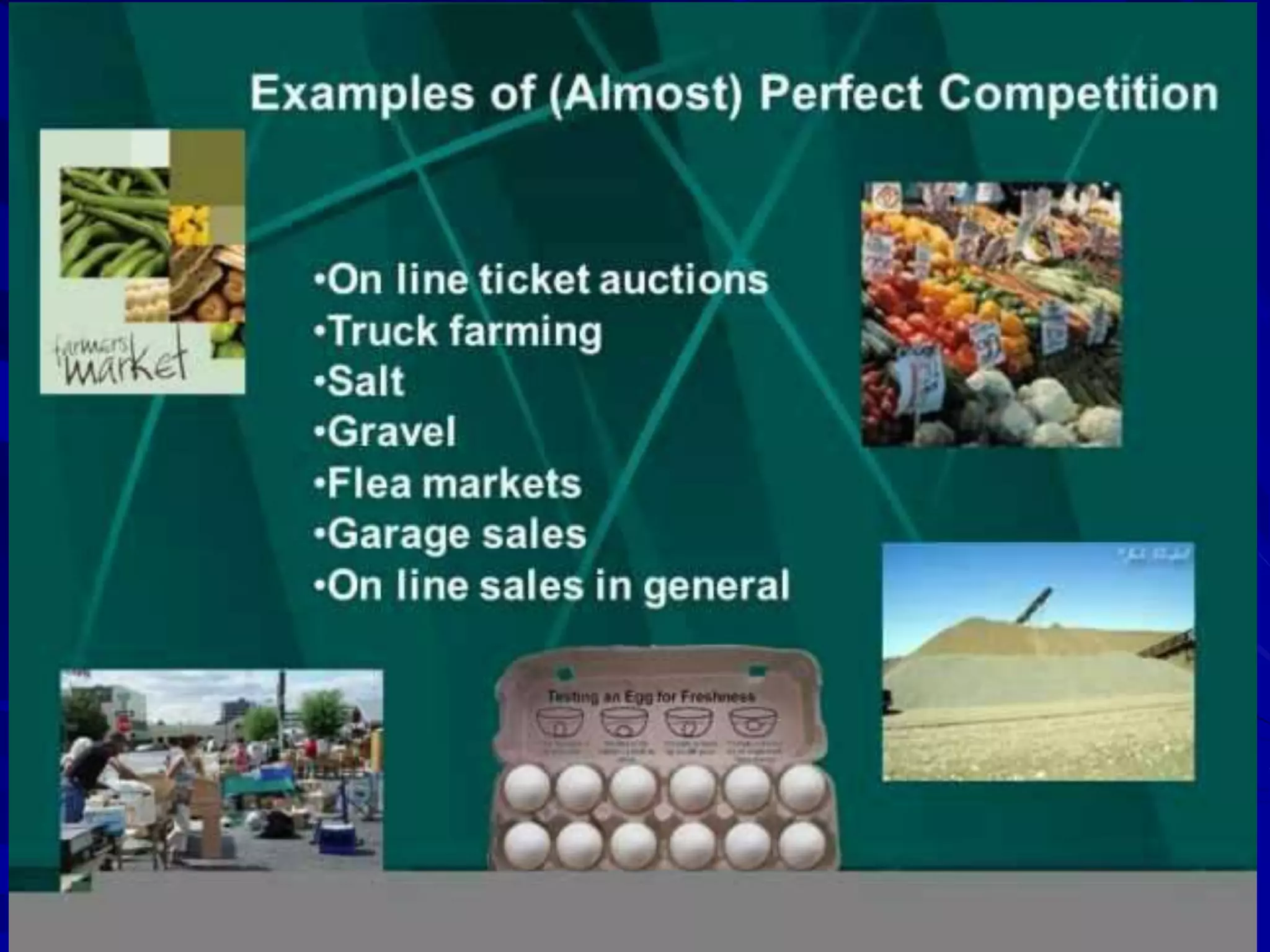
• No product differences. (EXAMPLES: Salt, Flour,
Commodity, Corn)
• Perfect knowledge.
• No Barriers to Entry.
• Same price.
• Perfect mobility.
Price determination under perfect
competition
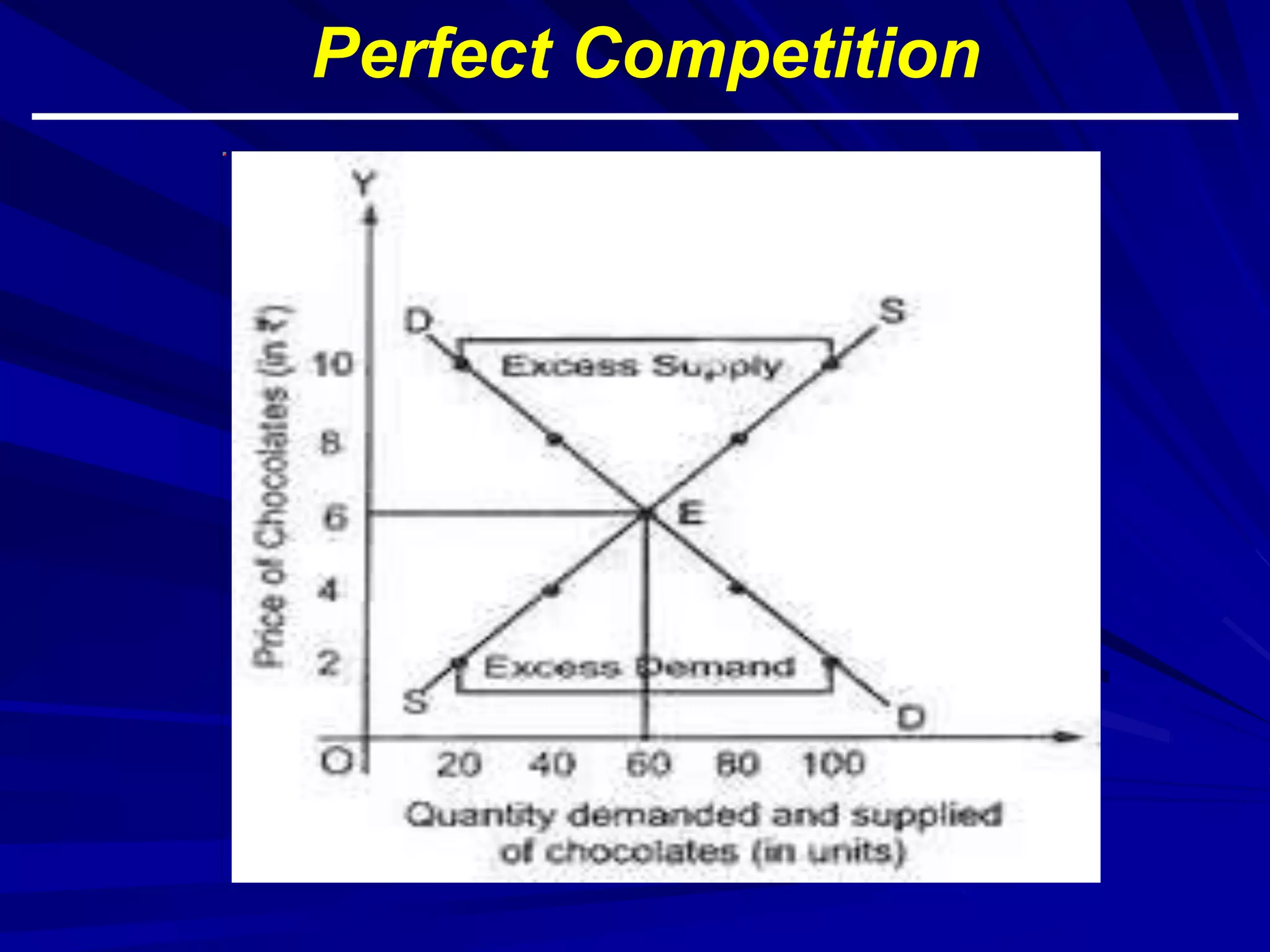
Market supply of
chocolates
Price per unit
(Rs)
Market demand for
chocolates
100 10 20
80 8 40
60 6 60
40 4 80
20 2 100
Equilibrium price of a commodity is determined at the
point where market demand is equal to its market supply.
Perfect Competition
Perfect Competition
Price is determined at the point where market's
demand curve intersects market's suppy curve.
Price determination of short-run
equilibrium of the firm
l Super normal profits
l Normal profits
l Minimum losses
Super normal profits
AR > AC
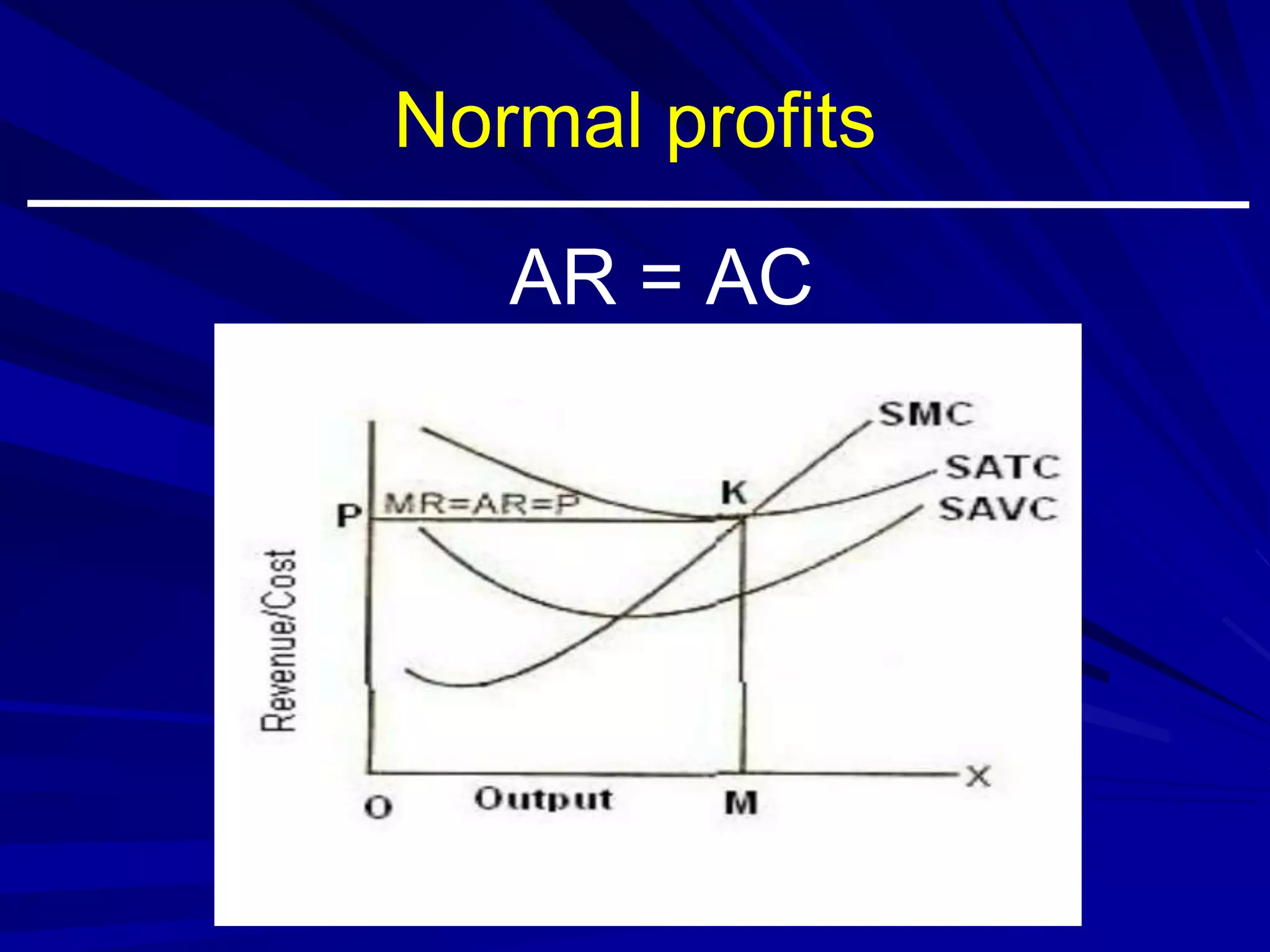
Normal profits
AR = AC
Minimum losses
AR < AC
Monopoly competition
Monopoly is a price maker.
l Monopoly is a form of the market in
which there is a single seller or
producer of a commodity.
l It has a complete control over price
and can also practice price
discrimination.
Examples of Monopolies
EXAMPLE: Only
person selling
water in the
desert.
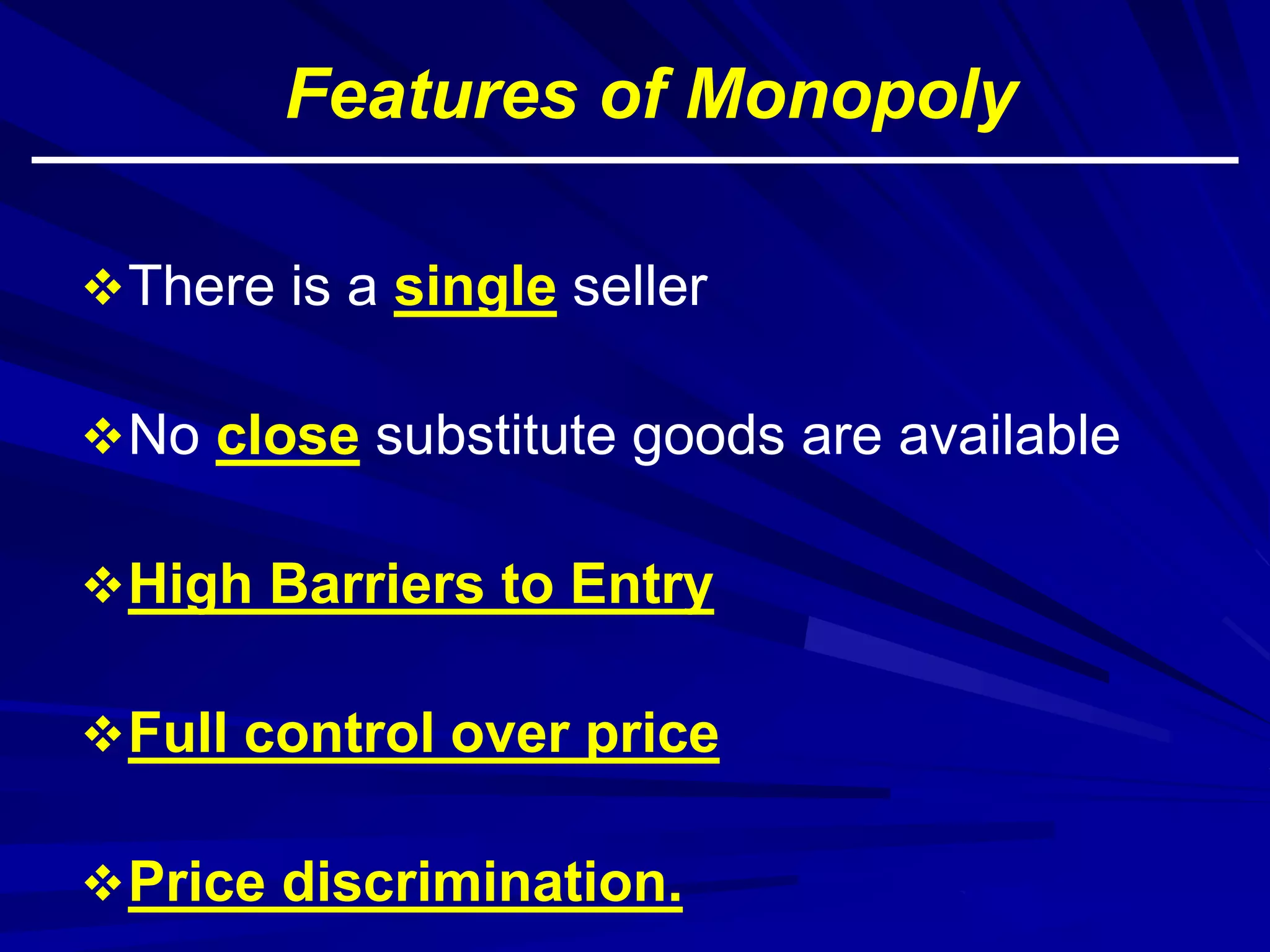
Features of Monopoly
There is a single seller
No close substitute goods are available
High Barriers to Entry
Full control over price
Price discrimination.
l Short term
u Super normal profits
u Normal profits
u Minimum losses
l Long term
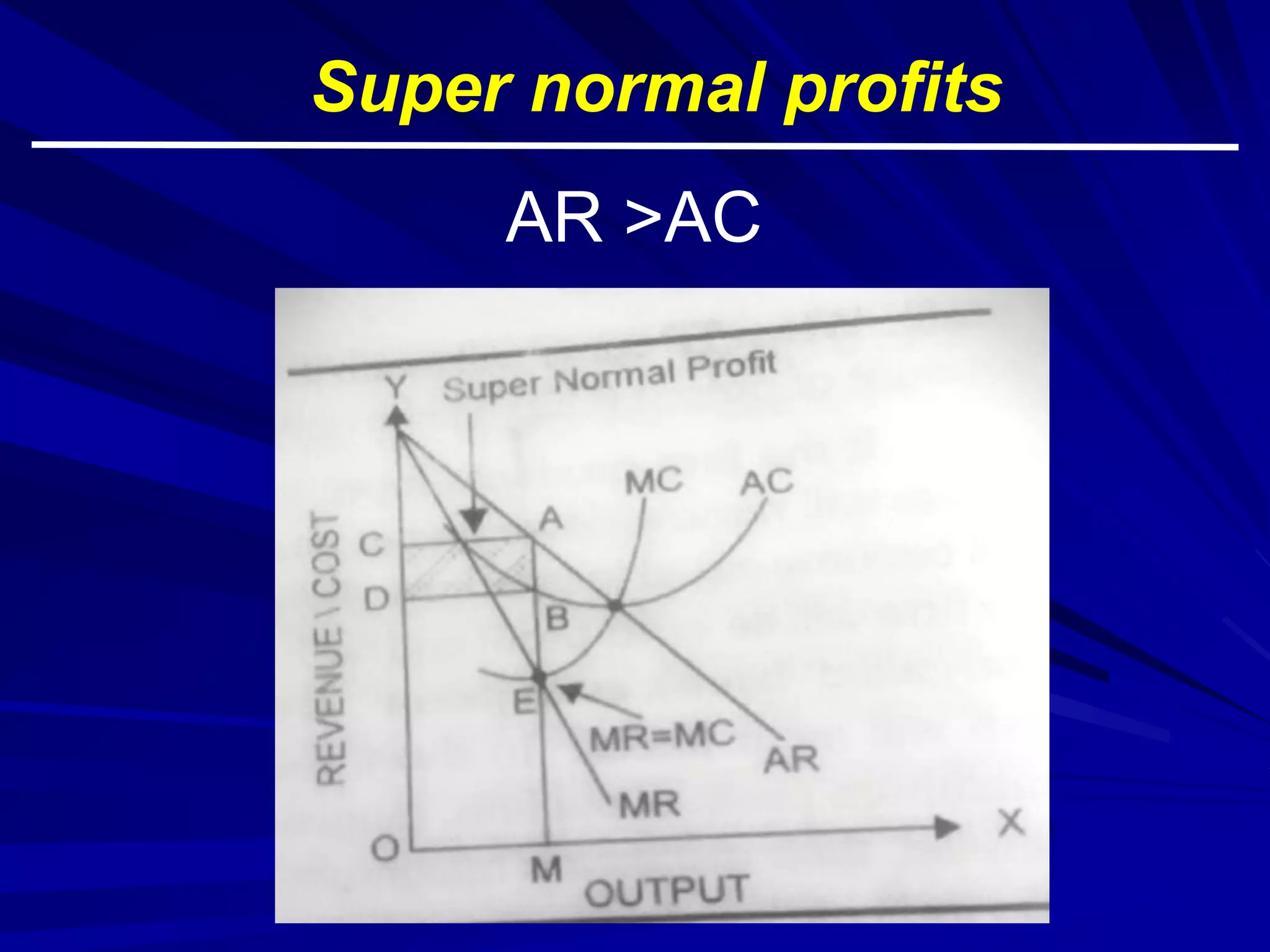
Price determination under Monopoly
AR >AC
Super normal profits
AR = AC
Normal profits
AR >AC
Minimum loss
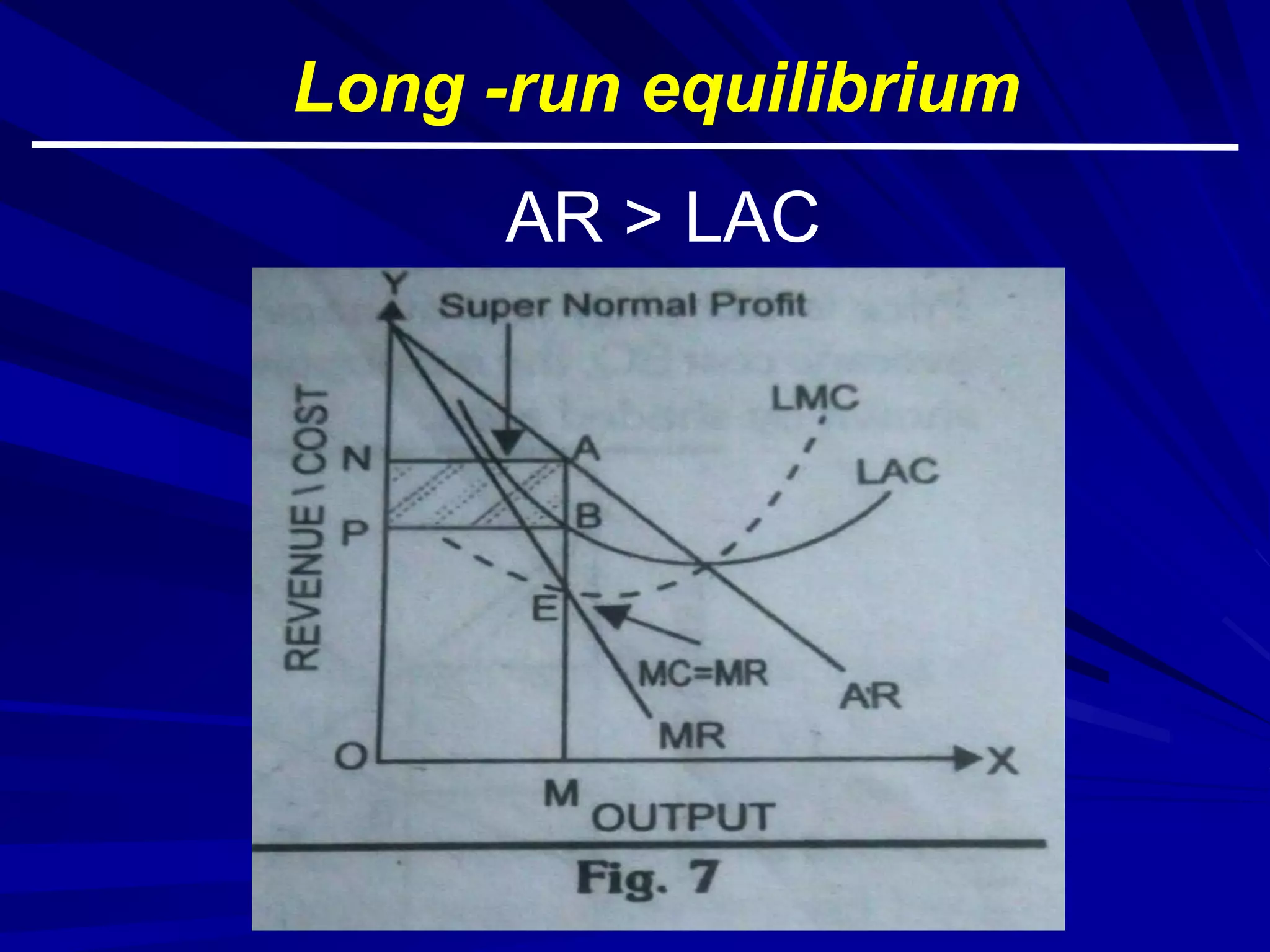
AR > LAC
Long -run equilibrium
Monopolistic competition
It is a form of the market in which there are many
sellers of the product , but the product of each
seller is somewhat different from other.
There are many sellers , selling a differentiated
product.
It exercise partial control over price.
Examples of Monopolistic Competition
Auto, Steel, Gas, Fast Food, Airlines.
1) LARGE number of large companies
Sellers can influence the price through creating a product identity
1) Products are NOT exactly identical, BUT VERY SIMILAR, so
companies use PRODUCT DIFFERENTIATION .
2) Heavy Competition: Firms must remain aware of their
competitor’s actions, but they each have some ability to
control their own prices.
3) Low Barriers to Entry.
4) Monopolistic competition takes its name and its structure
from elements of monopoly and perfect competition.
Feature's of Monopolistic
Competition
Price determination under
monopolistic competition
lShort-run equilibrium ( same as
monopoly )
uSuper normal profits
uNormal profits
uMinimum losses
lLong-run equilibrium
Long-run equilibrium
AR > LAC
What is an Oligopoly?
A market in which a two-three large sellers control
most of the production of a good or service and they
work together on setting prices.
Features of an Oligopoly
1)Very few Sellers that control the entire market.
2)Products may be differentiated or identical (but
they are usually standardized)
3)Medium barriers to entry: Difficult to Enter the
market because the competitors work together to
control all the resources & prices.
4)The actions of one affects all the producers.
5)Collusion = an agreement to act together or
behave in a cooperative manner.
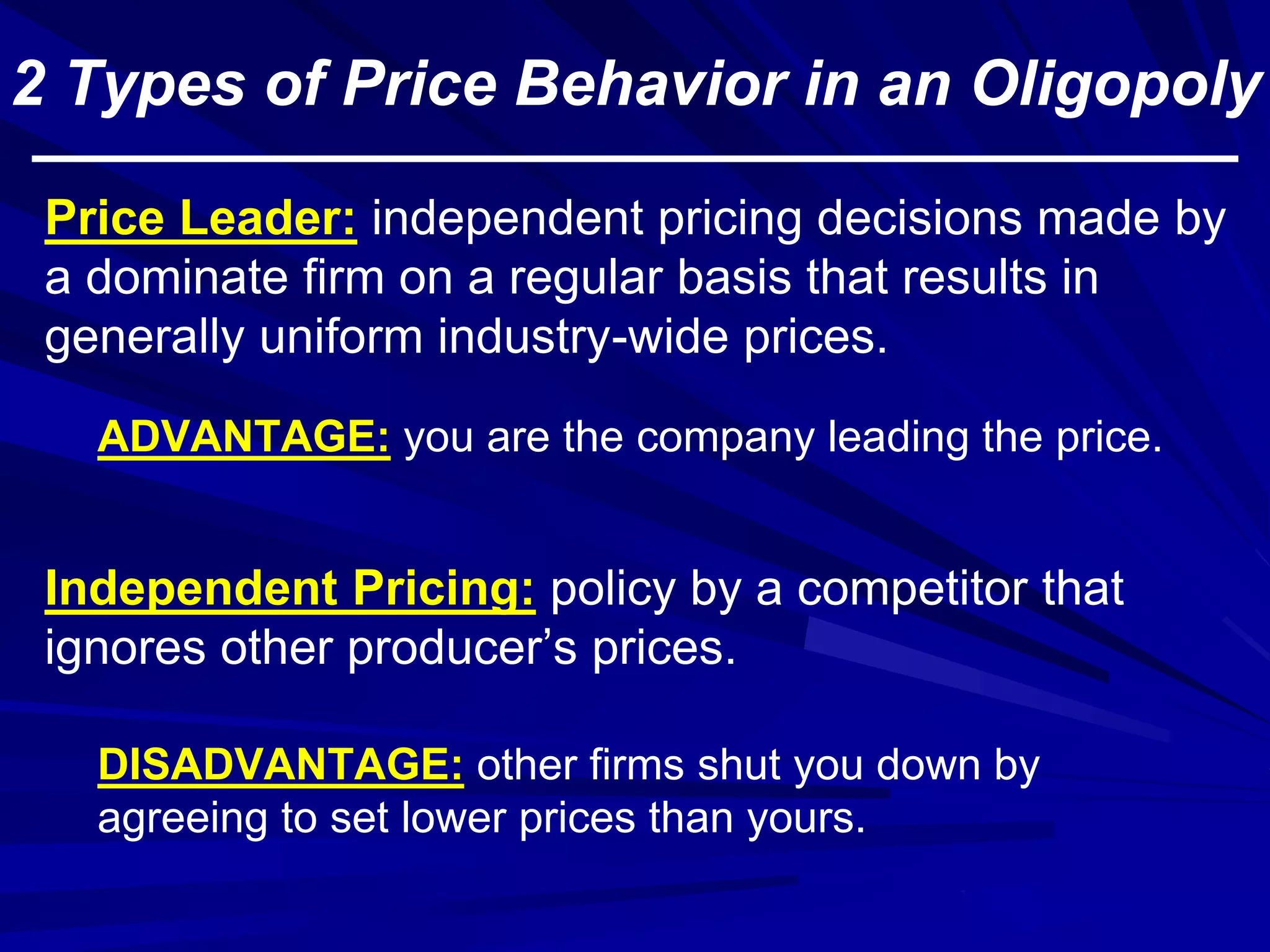
2 Types of Price Behavior in an Oligopoly
Independent Pricing: policy by a competitor that
ignores other producer’s prices.
Price Leader: independent pricing decisions made by
a dominate firm on a regular basis that results in
generally uniform industry-wide prices.
DISADVANTAGE: other firms shut you down by
agreeing to set lower prices than yours.
ADVANTAGE: you are the company leading the price.
Sweezy's kinky Demand
Curve
Based on following assumptions:
l 1 firm reduces its price other firms also
reduces its price.
l 1 firm increases its price, other firms will
not follow price increase.
l There is established prevailing price.
l MCC will pass through the dotted portion
of MRC.
Markets work best when three conditions are
met:
Adequate competition must exist in all
markets.
Buyers and sellers are reasonably well-
informed about conditions and
opportunities.
Resources must be free to move from one
industry to another.
Market Failure occurs when any of the 3
conditions alter significantly.
3 Conditions of Efficient & Successful
Markets
References
l https://www.google.co.in/url?sa=t&so
urce=web&rct=j&url=https://d3jc3ahdj
ad7x7.cloudfront.
l T.R Jain and V.K Ohri,
microeconomics and
macroeconomics, 2012-2013
,chapter- 11,12.
l T.R Jain and O.P Khanna ,
managerial economics, 2011-2012,
THANK YOU

Market structure

  • 1.
    MARKET STRUCTURES Submitted by:- MeenalGupta 827 MBA 1st yr Submitted to:- Ajay samyal
  • 2.
    What Are Markets? Amarket is where buyers and sellers: meet to exchange goods and services. are affected by some level of competition. The market may be in one specific place or It does not exist physically at all
  • 3.
    Markets are classifiedby 4 structures 1. Pure (perfect) Competition 2. Monopolistic Competition 3. Oligopoly 4. Monopoly Forms of Markets?
  • 4.
    A firm isa price taker, not a price maker. 1. Perfect Competition It is a form of market where there is a large number of buyers and sellers of a commodity.
  • 6.
    Features of perfectcompetition • LARGE number of SMALL buyers and sellers. • No single buyer or seller can influence the price. • No product differences. (EXAMPLES: Salt, Flour, Commodity, Corn) • Perfect knowledge. • No Barriers to Entry. • Same price. • Perfect mobility.
  • 7.
    Price determination underperfect competition Market supply of chocolates Price per unit (Rs) Market demand for chocolates 100 10 20 80 8 40 60 6 60 40 4 80 20 2 100 Equilibrium price of a commodity is determined at the point where market demand is equal to its market supply.
  • 8.
  • 9.
    Perfect Competition Price isdetermined at the point where market's demand curve intersects market's suppy curve.
  • 10.
    Price determination ofshort-run equilibrium of the firm l Super normal profits l Normal profits l Minimum losses
  • 11.
  • 12.
  • 13.
  • 14.
    Monopoly competition Monopoly isa price maker. l Monopoly is a form of the market in which there is a single seller or producer of a commodity. l It has a complete control over price and can also practice price discrimination.
  • 15.
    Examples of Monopolies EXAMPLE:Only person selling water in the desert.
  • 16.
    Features of Monopoly Thereis a single seller No close substitute goods are available High Barriers to Entry Full control over price Price discrimination.
  • 17.
    l Short term uSuper normal profits u Normal profits u Minimum losses l Long term Price determination under Monopoly
  • 18.
  • 19.
  • 20.
  • 21.
    AR > LAC Long-run equilibrium
  • 22.
    Monopolistic competition It isa form of the market in which there are many sellers of the product , but the product of each seller is somewhat different from other. There are many sellers , selling a differentiated product. It exercise partial control over price.
  • 23.
    Examples of MonopolisticCompetition Auto, Steel, Gas, Fast Food, Airlines.
  • 24.
    1) LARGE numberof large companies Sellers can influence the price through creating a product identity 1) Products are NOT exactly identical, BUT VERY SIMILAR, so companies use PRODUCT DIFFERENTIATION . 2) Heavy Competition: Firms must remain aware of their competitor’s actions, but they each have some ability to control their own prices. 3) Low Barriers to Entry. 4) Monopolistic competition takes its name and its structure from elements of monopoly and perfect competition. Feature's of Monopolistic Competition
  • 25.
    Price determination under monopolisticcompetition lShort-run equilibrium ( same as monopoly ) uSuper normal profits uNormal profits uMinimum losses lLong-run equilibrium
  • 26.
  • 27.
    What is anOligopoly? A market in which a two-three large sellers control most of the production of a good or service and they work together on setting prices. Features of an Oligopoly 1)Very few Sellers that control the entire market. 2)Products may be differentiated or identical (but they are usually standardized) 3)Medium barriers to entry: Difficult to Enter the market because the competitors work together to control all the resources & prices. 4)The actions of one affects all the producers. 5)Collusion = an agreement to act together or behave in a cooperative manner.
  • 28.
    2 Types ofPrice Behavior in an Oligopoly Independent Pricing: policy by a competitor that ignores other producer’s prices. Price Leader: independent pricing decisions made by a dominate firm on a regular basis that results in generally uniform industry-wide prices. DISADVANTAGE: other firms shut you down by agreeing to set lower prices than yours. ADVANTAGE: you are the company leading the price.

  • 29.
    Sweezy's kinky Demand Curve Basedon following assumptions: l 1 firm reduces its price other firms also reduces its price. l 1 firm increases its price, other firms will not follow price increase. l There is established prevailing price. l MCC will pass through the dotted portion of MRC.
  • 31.
    Markets work bestwhen three conditions are met: Adequate competition must exist in all markets. Buyers and sellers are reasonably well- informed about conditions and opportunities. Resources must be free to move from one industry to another. Market Failure occurs when any of the 3 conditions alter significantly. 3 Conditions of Efficient & Successful Markets
  • 32.
    References l https://www.google.co.in/url?sa=t&so urce=web&rct=j&url=https://d3jc3ahdj ad7x7.cloudfront. l T.RJain and V.K Ohri, microeconomics and macroeconomics, 2012-2013 ,chapter- 11,12. l T.R Jain and O.P Khanna , managerial economics, 2011-2012,
  • 33.