UNIT-03
1
Market and Criteria for Market Classification
Market
A market is any organization whereby buyers and sellers of a good are kept in close
touch with each other. It is precisely in this context that a market has four basic
components i. consumers ii. sellers iii. a commodity iv. a price.
Criteria for Market Classification
There are many possible ways of categorizing market structures, the following
characteristics are frequently employed.
i. Classification by area
ii. Classification by the nature of transactions
iii. Classification by the volume of business
iv. Classification on the basis of time
v. Classification by the status of sellers
vi. Classification by the nature of competition
2
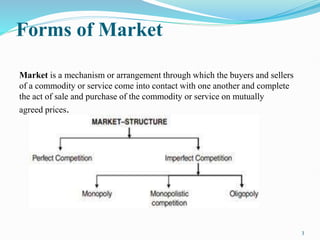
Forms of Market
Market is a mechanism or arrangement through which the buyers and sellers
of a commodity or service come into contact with one another and complete
the act of sale and purchase of the commodity or service on mutually
agreed prices.
3
Perfect competition
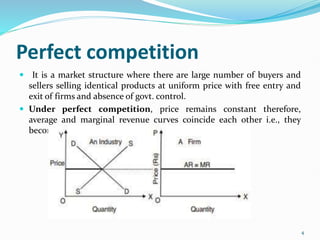
 It is a market structure where there are large number of buyers and
sellers selling identical products at uniform price with free entry and
exit of firms and absence of govt. control.
 Under perfect competition, price remains constant therefore,
average and marginal revenue curves coincide each other i.e., they
become equal and parallel to x-axis.
4
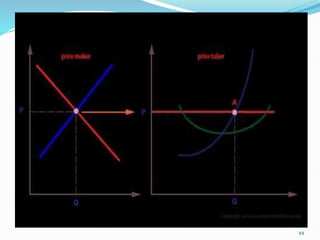
 Under perfect competition price is determined by the industry on
the basis of market forces of demand and supply. No individual firm
can influence the price of the product. A firm can takes the decision
regarding the output only. So industry is price maker and firm is price
taker.
 Feature of perfect competition :
 (a) Very large no. of buyers and sellers.
 (b) Homogeneous product.
 (c) Free entry and exit of firms in the market.
 (d) Perfect knowledge.
 (e) Perfect Mobility.
 (f) Perfectly elastic demand curve.
 (g) No transportation cost.
 H) Firm is price taker and industry is maker
5
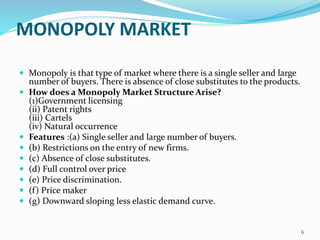
MONOPOLY MARKET
 Monopoly is that type of market where there is a single seller and large
number of buyers. There is absence of close substitutes to the products.
 How does a Monopoly Market Structure Arise?
(1)Government licensing
(ii) Patent rights
(iii) Cartels
(iv) Natural occurrence
 Features :(a) Single seller and large number of buyers.
 (b) Restrictions on the entry of new firms.
 (c) Absence of close substitutes.
 (d) Full control over price
 (e) Price discrimination.
 (f) Price maker
 (g) Downward sloping less elastic demand curve.
6
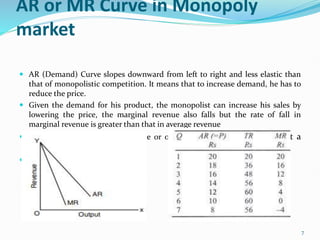
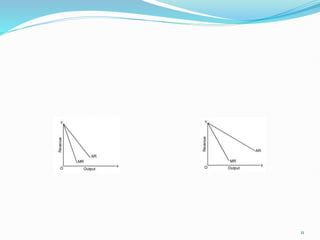
AR or MR Curve in Monopoly
market
 AR (Demand) Curve slopes downward from left to right and less elastic than
that of monopolistic competition. It means that to increase demand, he has to
reduce the price.
 Given the demand for his product, the monopolist can increase his sales by
lowering the price, the marginal revenue also falls but the rate of fall in
marginal revenue is greater than that in average revenue
 A monopolist either decides price or output. He cannot decides both at a
time.
 .
7
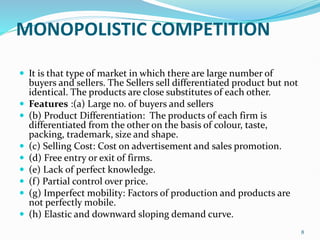
MONOPOLISTIC COMPETITION
 It is that type of market in which there are large number of
buyers and sellers. The Sellers sell differentiated product but not
identical. The products are close substitutes of each other.
 Features :(a) Large no. of buyers and sellers
 (b) Product Differentiation: The products of each firm is
differentiated from the other on the basis of colour, taste,
packing, trademark, size and shape.
 (c) Selling Cost: Cost on advertisement and sales promotion.
 (d) Free entry or exit of firms.
 (e) Lack of perfect knowledge.
 (f) Partial control over price.
 (g) Imperfect mobility: Factors of production and products are
not perfectly mobile.
 (h) Elastic and downward sloping demand curve.
8
9
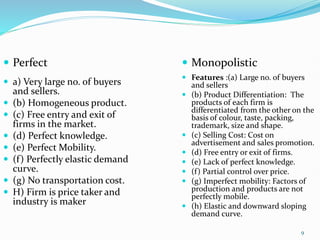
 Perfect
 a) Very large no. of buyers
and sellers.
 (b) Homogeneous product.
 (c) Free entry and exit of
firms in the market.
 (d) Perfect knowledge.
 (e) Perfect Mobility.
 (f) Perfectly elastic demand
curve.
 (g) No transportation cost.
 H) Firm is price taker and
industry is maker
 Monopolistic
 Features :(a) Large no. of buyers
and sellers
 (b) Product Differentiation: The
products of each firm is
differentiated from the other on the
basis of colour, taste, packing,
trademark, size and shape.
 (c) Selling Cost: Cost on
advertisement and sales promotion.
 (d) Free entry or exit of firms.
 (e) Lack of perfect knowledge.
 (f) Partial control over price.
 (g) Imperfect mobility: Factors of
production and products are not
perfectly mobile.
 (h) Elastic and downward sloping
demand curve.
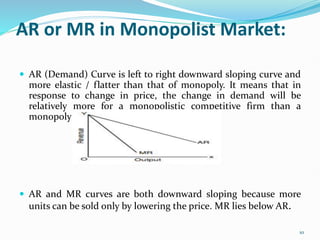
AR or MR in Monopolist Market:
 AR (Demand) Curve is left to right downward sloping curve and
more elastic / flatter than that of monopoly. It means that in
response to change in price, the change in demand will be
relatively more for a monopolistic competitive firm than a
monopoly firm.
 AR and MR curves are both downward sloping because more
units can be sold only by lowering the price. MR lies below AR.
10
11
OLIGOPOLY
 Oligopoly is the form of market in which there are few sellers or
few large firms, intensely competing against one another and
recognizing interdependence in their decision-making.
 Features of Oligopoly
 (a) Few Sellers
 (b) All the firms produce homogeneous or differentiated
product.
 (c) Under oligopoly demand curve cannot be determined. It has
a kinked demand curve.
 (d) All the firms are interdependent in respect of price
determination.
 (e) Price rigidity.
 (F) Not possible to determine firm’s demand curve
(G) Formation of cartels
12
 On the basis of production, oligopoly can be categorised in two
categories:
 (i) Collusive oligopoly is that form of oligopoly in which all the firms
decide to avoid competition and determine the price and quantity of
output on the basis of cooperative behaviour.
 (ii) Non-collusive oligopoly is that form of oligopoly in which all the
firms determine the price and quantity of output according to the
action and reaction of the rival firms.
 On the basis of product differentiation,
 Oligopoly, can be categorized in two categories:
 (i) Perfect Oligopoly: The Oligopoly is perfect or pure when the firms
deal in the homogeneous products.
(ii) Imperfect Oligopoly: Whereas the Oligopoly is said to be imperfect,
when the firms deal in heterogeneous products, i.e. products that are
close but are not perfect substitutes.
13
Ingredients for a successful cartel
• Control a large share of the market
• Inelastic and stable demand for the
product
• Similar costs among cartel members
• Fairly homogenous product
• Few number of firms
• Ways of preventing cheating on the
agreement
14
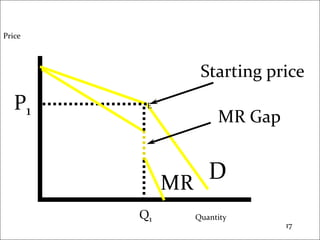
Kinked demand curve model of oligopoly:
assumption, rivals will match all price cuts
but not price increases. Under this
assumption, its as if each firm faces a
“kinked” demand curve, with 2 sections to it:
more elastic above the existing price, since
rivals won’t match a price increase, and less
elastic below the existing price, since rivals
quickly match price cuts.
15
16
Kinked Demand Curve
17
P1
Starting price
17
D
MR
MR Gap
Price
Quantity
Q1
E
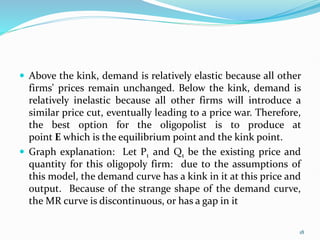
 Above the kink, demand is relatively elastic because all other
firms' prices remain unchanged. Below the kink, demand is
relatively inelastic because all other firms will introduce a
similar price cut, eventually leading to a price war. Therefore,
the best option for the oligopolist is to produce at
point E which is the equilibrium point and the kink point.
 Graph explanation: Let P1 and Q1 be the existing price and
quantity for this oligopoly firm: due to the assumptions of
this model, the demand curve has a kink in it at this price and
output. Because of the strange shape of the demand curve,
the MR curve is discontinuous, or has a gap in it
18
DUOPOLY
Two Words –Duo+Polies
 Duo---Two
 Polies---Sellers
 Market with TWO sellers
 Just below Monopoly
 Simplest Form of Oligopoly
 Have Power to control Market
 Super Normal Profits
 Two Classifications: One in which there is coordination
b/w duopolists.
 One in which there is no coordination.
19
• A situation in which two companies control all or nearly all of the
market for a given product or service.
• A Duopoly is the most basic form of oligopoly, which is a market
dominated by a small number of companies.
• A Duopoly can have the same impact on the market as a
Monopoly if the two players collude on prices or output.
Collusion results in consumers paying higher prices than they
would in a truly competitive market and is illegal under U.S.
antitrust law.
• A duopoly, quite simply, is a situation where there are just two
sellers in a market. A duopoly can also refer to a situation where a
market is dominated by two sellers. There may be more than two
sellers in the market but the supply of the product is controlled
by just two of them.
20
Features
 • Two firms
 • Strong price control
 • Barriers to entry
Advantages-
 Close competition
• Interaction
Disadvantages –
• Establishment of New firms is difficult due to Duopolies.
• Lack of new firms means lack of new products which leads
to Stale in the market.
21
Examples of duopoly
• Boeing and Airbus have been called a duopoly for their
command of the large passenger airplane market.
• Similarly, Amazon and Apple have been called a
duopoly for their dominance in the e- book
marketplace.
22
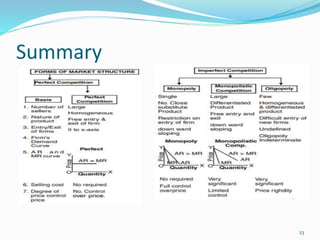
Summary
23
24
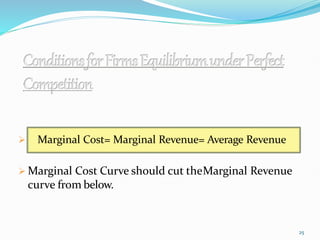
 Marginal Cost= Marginal Revenue= Average Revenue
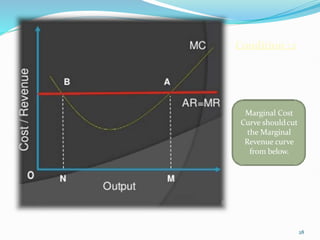
 Marginal Cost Curve should cut theMarginal Revenue
curve from below.
25
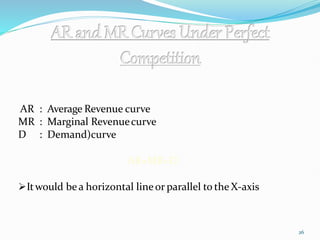
AR : Average Revenue curve
MR : Marginal Revenuecurve
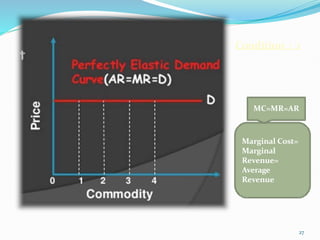
D : Demand)curve
AR=MR=D
Itwould bea horizontal lineor parallel to the X-axis
26
Condition : 1
MC=MR=AR
Marginal Cost=
Marginal
Revenue=
Average
Revenue
27
Condition :2
Marginal Cost
Curve shouldcut
the Marginal
Revenue curve
from below.
28
29
 Short Period is defined as the time
period in which the firm can change its
output without changing theexisting plant
& machinery.
30
 Price will be affected because we cannot increase
our supplyacc. to demand..
 Only variable factors can be altered..
 Price set so in the short run is EQUILIBRIUM
PRICE..
31
Price at which there is no tendency to
change in the current situation..
Demand & Supply areequal…
32
 Pricing Decision is inf luenced by these
two forces of DEMAND & SUPPLY…
33
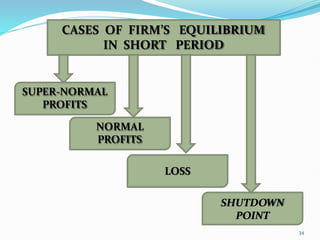
CASES OF FIRM’S EQUILIBRIUM
IN SHORT PERIOD
SUPER-NORMAL
PROFITS
NORMAL
PROFITS
LOSS
SHUTDOWN
POINT
34
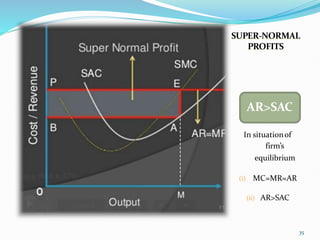
SUPER-NORMAL
PROFITS
In situationof
firm’s
equilibrium
(i) MC=MR=AR
(ii) AR>SAC
AR>SAC
35
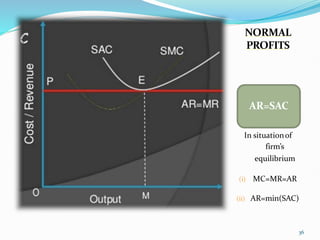
NORMAL
PROFITS
AR=SAC
In situationof
firm’s
equilibrium
(i) MC=MR=AR
(ii) AR=min(SAC)
36
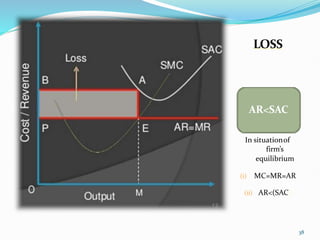
 Firms can also earn zero profit or even a loss
where MC = MR.
 Even though economic profit is zero, all
resources, including entrepreneurs, are being paid
their opportunity costs.
 In all threecases (profit, loss, zero profit), determining
the profit-maximizing output level does not depend
on fixed cost or average total cost, by only where
marginal cost equalsprice.
37
LOSS
AR<SAC
In situationof
firm’s
equilibrium
(i) MC=MR=AR
(ii) AR<(SAC)
38
 The shutdown point is the point at which the firm
will gain more byshutting down than itwill bystaying
in business.
 As long as total revenue is more than total variable
cost, temporarilyproducing ata loss is the firm’s best
strategysince it is taking lessof a loss than itwould by
shutting down.
39
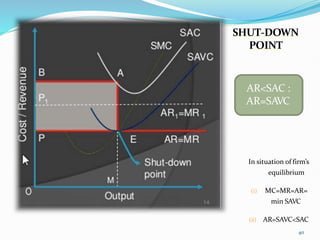
SHUT-DOWN
POINT
In situation of firm’s
equilibrium
(i) MC=MR=AR=
min SAVC
(ii) AR=SAVC<SAC
AR<SAC :
AR=SAVC
40
 Equilibrium Price is determined at the point
where the se forces are EQUAL…
 Quantitydemanded & supplied at this point is
EQULIBRIUM QUANTITY…
41
 When the price is less /more than equilibrium
price , then there will be tendency of movement
of this equilibrium output & ultimately equilibrium
price will prevail…
 Demand & Supply forces counteract each other…
42
Industry :as pricemaker
Firm :as pricetaker.
43
44
45
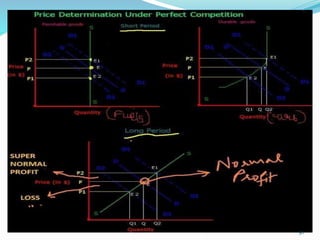
Long Period is defined as that period
during which , all factors become variable
factors & firms can change their scale of
production…
46
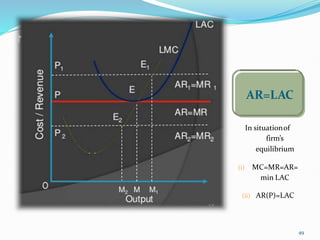
 Price that prevails in long-run is NORMAL
PRICE..
 Supply plays a dominant role in determination of
long-run normal price..
 Demand & Supply can be adjusted to every
possible way as per requirement in long run..
47
 Change all types of fixed factors..
 Normal Price is always equal to minimum long
run average cost..
 Supply gets sufficient time to adjust itself
according tochanged conditions & demand..
48
In situationof
firm’s
equilibrium
(i) MC=MR=AR=
min LAC
(ii) AR(P)=LAC
AR=LAC
49
50
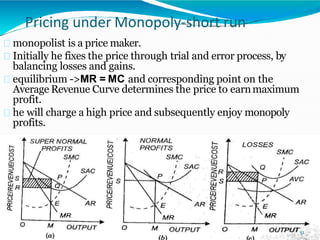
Pricing under Monopoly-short run
monopolist is a price maker.
Initially he fixes the price through trial and error process, by
balancing losses and gains.
equilibrium ->MR = MC and corresponding point on the
Average Revenue Curve determines the price to earnmaximum
profit.
he will charge a high price and subsequently enjoy monopoly
profits.
51
Pricing under Monopoly- long run
In the long run , the monopolist firm strives and plans
to earn onlyprofits
He may also practice price-discrimination -charging
different prices to different buyers and in different
regions for the sameproduct
Selling his product in foreign market at a price lower
than his own market is itself referred to as Dumping.
52
Pricing under Monopolistic
Competition
a group of producers producing same but not identical
product compete with each other in the market.
They practice product-differentiation instead of
having a price war witheach
the prices charged are quite competitive innature.
Eg- Lux, Liril, Dove, etc.
53
Pricing under Monopolistic
Competition
In monopolistic competition, every firm has a certain
degree of monopoly power and can take initiative to
set aprice.
there can never be a unique price but the prices will be
in a group reflecting the consumers’ tastes and
preferences for differentiated products.
the price of the product of the firm is determined by
its cost function, demand, its objectiveetc
54
Pricing under Monopolistic
Competition
Demand curve /average revenue curve of a firm under monopolistic
competition is elastic sloping downwards to the right but not perfectly
elastic
Reason :
reduction in the price will increase the sales of the firm but itwill have
little effect on other firms as each will lose only a few of its customers.
an increase in price will reduce demand substantially but each ofits
rivals will attract only a few of itscustomers.
This happens because the products are close substitutes butnot
indentical.
When it exercises some control over price, it resembles monopoly and
when its demand curve is affected by market conditions it resembles
pure competition. Such a situation is, characterised as monopolistic
competition.
55
Pricing under Monopolistic
Competition
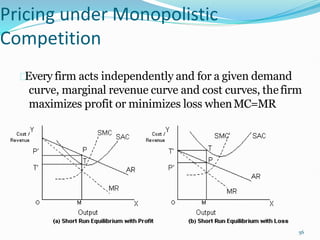
Every firm acts independently and for a given demand
curve, marginal revenue curve and cost curves, thefirm
maximizes profit or minimizes loss whenMC=MR
56
Pricing under Monopolistic
Competition
If a firm in a is making substantial amount of economic
profits and assuming that the other firms in the marketare
also making profits, attracted by the super-normal profits,
new firms will enter thegroup.
As a result, there will be an increase in the number of close
substitutes available in the market and hence the demand
curve would shift downwards since each existing firm
would lose market share. The entry of new firms would
continue as long as there are economicprofits.
Thus monopolistic competition is similar to perfect
competition where economic profits are eliminated inthe
long run.
57
Pricing under Monopolistic
Competition
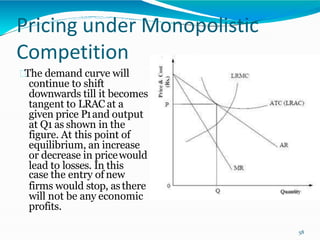
The demand curve will
continue to shift
downwards till it becomes
tangent to LRAC at a
given price P1and output
at Q1 as shown in the
figure. At this point of
equilibrium, an increase
or decrease in pricewould
lead to losses. In this
case the entry of new
firms would stop, asthere
will not be any economic
profits.
58
Pricing under Monopolistic
Competition
Due to free entry, many firms can enter the market and
there may be a condition where the demand fallsbelow
LRAC and ultimately suffers losses resulting in the exit
of the firms. Therefore under the monopolistic
competition free entry and exit must lead to asituation
where demand becomes tangent to LRAC
Due to product differentiation/ availability of variety firms
in the long run do not produce at the minimum point of
their average cost curve, and thus there is excess capacity
available with each firm and consumers pay the higher
price for the increased variety available in themarket.
59

unit 3..................................

  • 1.
  • 2.
    Market and Criteriafor Market Classification Market A market is any organization whereby buyers and sellers of a good are kept in close touch with each other. It is precisely in this context that a market has four basic components i. consumers ii. sellers iii. a commodity iv. a price. Criteria for Market Classification There are many possible ways of categorizing market structures, the following characteristics are frequently employed. i. Classification by area ii. Classification by the nature of transactions iii. Classification by the volume of business iv. Classification on the basis of time v. Classification by the status of sellers vi. Classification by the nature of competition 2
  • 3.
    Forms of Market Marketis a mechanism or arrangement through which the buyers and sellers of a commodity or service come into contact with one another and complete the act of sale and purchase of the commodity or service on mutually agreed prices. 3
  • 4.
    Perfect competition  Itis a market structure where there are large number of buyers and sellers selling identical products at uniform price with free entry and exit of firms and absence of govt. control.  Under perfect competition, price remains constant therefore, average and marginal revenue curves coincide each other i.e., they become equal and parallel to x-axis. 4
  • 5.
     Under perfectcompetition price is determined by the industry on the basis of market forces of demand and supply. No individual firm can influence the price of the product. A firm can takes the decision regarding the output only. So industry is price maker and firm is price taker.  Feature of perfect competition :  (a) Very large no. of buyers and sellers.  (b) Homogeneous product.  (c) Free entry and exit of firms in the market.  (d) Perfect knowledge.  (e) Perfect Mobility.  (f) Perfectly elastic demand curve.  (g) No transportation cost.  H) Firm is price taker and industry is maker 5
  • 6.
    MONOPOLY MARKET  Monopolyis that type of market where there is a single seller and large number of buyers. There is absence of close substitutes to the products.  How does a Monopoly Market Structure Arise? (1)Government licensing (ii) Patent rights (iii) Cartels (iv) Natural occurrence  Features :(a) Single seller and large number of buyers.  (b) Restrictions on the entry of new firms.  (c) Absence of close substitutes.  (d) Full control over price  (e) Price discrimination.  (f) Price maker  (g) Downward sloping less elastic demand curve. 6
  • 7.
    AR or MRCurve in Monopoly market  AR (Demand) Curve slopes downward from left to right and less elastic than that of monopolistic competition. It means that to increase demand, he has to reduce the price.  Given the demand for his product, the monopolist can increase his sales by lowering the price, the marginal revenue also falls but the rate of fall in marginal revenue is greater than that in average revenue  A monopolist either decides price or output. He cannot decides both at a time.  . 7
  • 8.
    MONOPOLISTIC COMPETITION  Itis that type of market in which there are large number of buyers and sellers. The Sellers sell differentiated product but not identical. The products are close substitutes of each other.  Features :(a) Large no. of buyers and sellers  (b) Product Differentiation: The products of each firm is differentiated from the other on the basis of colour, taste, packing, trademark, size and shape.  (c) Selling Cost: Cost on advertisement and sales promotion.  (d) Free entry or exit of firms.  (e) Lack of perfect knowledge.  (f) Partial control over price.  (g) Imperfect mobility: Factors of production and products are not perfectly mobile.  (h) Elastic and downward sloping demand curve. 8
  • 9.
    9  Perfect  a)Very large no. of buyers and sellers.  (b) Homogeneous product.  (c) Free entry and exit of firms in the market.  (d) Perfect knowledge.  (e) Perfect Mobility.  (f) Perfectly elastic demand curve.  (g) No transportation cost.  H) Firm is price taker and industry is maker  Monopolistic  Features :(a) Large no. of buyers and sellers  (b) Product Differentiation: The products of each firm is differentiated from the other on the basis of colour, taste, packing, trademark, size and shape.  (c) Selling Cost: Cost on advertisement and sales promotion.  (d) Free entry or exit of firms.  (e) Lack of perfect knowledge.  (f) Partial control over price.  (g) Imperfect mobility: Factors of production and products are not perfectly mobile.  (h) Elastic and downward sloping demand curve.
  • 10.
    AR or MRin Monopolist Market:  AR (Demand) Curve is left to right downward sloping curve and more elastic / flatter than that of monopoly. It means that in response to change in price, the change in demand will be relatively more for a monopolistic competitive firm than a monopoly firm.  AR and MR curves are both downward sloping because more units can be sold only by lowering the price. MR lies below AR. 10
  • 11.
  • 12.
    OLIGOPOLY  Oligopoly isthe form of market in which there are few sellers or few large firms, intensely competing against one another and recognizing interdependence in their decision-making.  Features of Oligopoly  (a) Few Sellers  (b) All the firms produce homogeneous or differentiated product.  (c) Under oligopoly demand curve cannot be determined. It has a kinked demand curve.  (d) All the firms are interdependent in respect of price determination.  (e) Price rigidity.  (F) Not possible to determine firm’s demand curve (G) Formation of cartels 12
  • 13.
     On thebasis of production, oligopoly can be categorised in two categories:  (i) Collusive oligopoly is that form of oligopoly in which all the firms decide to avoid competition and determine the price and quantity of output on the basis of cooperative behaviour.  (ii) Non-collusive oligopoly is that form of oligopoly in which all the firms determine the price and quantity of output according to the action and reaction of the rival firms.  On the basis of product differentiation,  Oligopoly, can be categorized in two categories:  (i) Perfect Oligopoly: The Oligopoly is perfect or pure when the firms deal in the homogeneous products. (ii) Imperfect Oligopoly: Whereas the Oligopoly is said to be imperfect, when the firms deal in heterogeneous products, i.e. products that are close but are not perfect substitutes. 13
  • 14.
    Ingredients for asuccessful cartel • Control a large share of the market • Inelastic and stable demand for the product • Similar costs among cartel members • Fairly homogenous product • Few number of firms • Ways of preventing cheating on the agreement 14
  • 15.
    Kinked demand curvemodel of oligopoly: assumption, rivals will match all price cuts but not price increases. Under this assumption, its as if each firm faces a “kinked” demand curve, with 2 sections to it: more elastic above the existing price, since rivals won’t match a price increase, and less elastic below the existing price, since rivals quickly match price cuts. 15
  • 16.
  • 17.
    Kinked Demand Curve 17 P1 Startingprice 17 D MR MR Gap Price Quantity Q1 E
  • 18.
     Above thekink, demand is relatively elastic because all other firms' prices remain unchanged. Below the kink, demand is relatively inelastic because all other firms will introduce a similar price cut, eventually leading to a price war. Therefore, the best option for the oligopolist is to produce at point E which is the equilibrium point and the kink point.  Graph explanation: Let P1 and Q1 be the existing price and quantity for this oligopoly firm: due to the assumptions of this model, the demand curve has a kink in it at this price and output. Because of the strange shape of the demand curve, the MR curve is discontinuous, or has a gap in it 18
  • 19.
    DUOPOLY Two Words –Duo+Polies Duo---Two  Polies---Sellers  Market with TWO sellers  Just below Monopoly  Simplest Form of Oligopoly  Have Power to control Market  Super Normal Profits  Two Classifications: One in which there is coordination b/w duopolists.  One in which there is no coordination. 19
  • 20.
    • A situationin which two companies control all or nearly all of the market for a given product or service. • A Duopoly is the most basic form of oligopoly, which is a market dominated by a small number of companies. • A Duopoly can have the same impact on the market as a Monopoly if the two players collude on prices or output. Collusion results in consumers paying higher prices than they would in a truly competitive market and is illegal under U.S. antitrust law. • A duopoly, quite simply, is a situation where there are just two sellers in a market. A duopoly can also refer to a situation where a market is dominated by two sellers. There may be more than two sellers in the market but the supply of the product is controlled by just two of them. 20
  • 21.
    Features  • Twofirms  • Strong price control  • Barriers to entry Advantages-  Close competition • Interaction Disadvantages – • Establishment of New firms is difficult due to Duopolies. • Lack of new firms means lack of new products which leads to Stale in the market. 21
  • 22.
    Examples of duopoly •Boeing and Airbus have been called a duopoly for their command of the large passenger airplane market. • Similarly, Amazon and Apple have been called a duopoly for their dominance in the e- book marketplace. 22
  • 23.
  • 24.
  • 25.
     Marginal Cost=Marginal Revenue= Average Revenue  Marginal Cost Curve should cut theMarginal Revenue curve from below. 25
  • 26.
    AR : AverageRevenue curve MR : Marginal Revenuecurve D : Demand)curve AR=MR=D Itwould bea horizontal lineor parallel to the X-axis 26
  • 27.
    Condition : 1 MC=MR=AR MarginalCost= Marginal Revenue= Average Revenue 27
  • 28.
    Condition :2 Marginal Cost Curveshouldcut the Marginal Revenue curve from below. 28
  • 29.
  • 30.
     Short Periodis defined as the time period in which the firm can change its output without changing theexisting plant & machinery. 30
  • 31.
     Price willbe affected because we cannot increase our supplyacc. to demand..  Only variable factors can be altered..  Price set so in the short run is EQUILIBRIUM PRICE.. 31
  • 32.
    Price at whichthere is no tendency to change in the current situation.. Demand & Supply areequal… 32
  • 33.
     Pricing Decisionis inf luenced by these two forces of DEMAND & SUPPLY… 33
  • 34.
    CASES OF FIRM’SEQUILIBRIUM IN SHORT PERIOD SUPER-NORMAL PROFITS NORMAL PROFITS LOSS SHUTDOWN POINT 34
  • 35.
  • 36.
  • 37.
     Firms canalso earn zero profit or even a loss where MC = MR.  Even though economic profit is zero, all resources, including entrepreneurs, are being paid their opportunity costs.  In all threecases (profit, loss, zero profit), determining the profit-maximizing output level does not depend on fixed cost or average total cost, by only where marginal cost equalsprice. 37
  • 38.
  • 39.
     The shutdownpoint is the point at which the firm will gain more byshutting down than itwill bystaying in business.  As long as total revenue is more than total variable cost, temporarilyproducing ata loss is the firm’s best strategysince it is taking lessof a loss than itwould by shutting down. 39
  • 40.
    SHUT-DOWN POINT In situation offirm’s equilibrium (i) MC=MR=AR= min SAVC (ii) AR=SAVC<SAC AR<SAC : AR=SAVC 40
  • 41.
     Equilibrium Priceis determined at the point where the se forces are EQUAL…  Quantitydemanded & supplied at this point is EQULIBRIUM QUANTITY… 41
  • 42.
     When theprice is less /more than equilibrium price , then there will be tendency of movement of this equilibrium output & ultimately equilibrium price will prevail…  Demand & Supply forces counteract each other… 42
  • 43.
  • 44.
  • 45.
  • 46.
    Long Period isdefined as that period during which , all factors become variable factors & firms can change their scale of production… 46
  • 47.
     Price thatprevails in long-run is NORMAL PRICE..  Supply plays a dominant role in determination of long-run normal price..  Demand & Supply can be adjusted to every possible way as per requirement in long run.. 47
  • 48.
     Change alltypes of fixed factors..  Normal Price is always equal to minimum long run average cost..  Supply gets sufficient time to adjust itself according tochanged conditions & demand.. 48
  • 49.
  • 50.
  • 51.
    Pricing under Monopoly-shortrun monopolist is a price maker. Initially he fixes the price through trial and error process, by balancing losses and gains. equilibrium ->MR = MC and corresponding point on the Average Revenue Curve determines the price to earnmaximum profit. he will charge a high price and subsequently enjoy monopoly profits. 51
  • 52.
    Pricing under Monopoly-long run In the long run , the monopolist firm strives and plans to earn onlyprofits He may also practice price-discrimination -charging different prices to different buyers and in different regions for the sameproduct Selling his product in foreign market at a price lower than his own market is itself referred to as Dumping. 52
  • 53.
    Pricing under Monopolistic Competition agroup of producers producing same but not identical product compete with each other in the market. They practice product-differentiation instead of having a price war witheach the prices charged are quite competitive innature. Eg- Lux, Liril, Dove, etc. 53
  • 54.
    Pricing under Monopolistic Competition Inmonopolistic competition, every firm has a certain degree of monopoly power and can take initiative to set aprice. there can never be a unique price but the prices will be in a group reflecting the consumers’ tastes and preferences for differentiated products. the price of the product of the firm is determined by its cost function, demand, its objectiveetc 54
  • 55.
    Pricing under Monopolistic Competition Demandcurve /average revenue curve of a firm under monopolistic competition is elastic sloping downwards to the right but not perfectly elastic Reason : reduction in the price will increase the sales of the firm but itwill have little effect on other firms as each will lose only a few of its customers. an increase in price will reduce demand substantially but each ofits rivals will attract only a few of itscustomers. This happens because the products are close substitutes butnot indentical. When it exercises some control over price, it resembles monopoly and when its demand curve is affected by market conditions it resembles pure competition. Such a situation is, characterised as monopolistic competition. 55
  • 56.
    Pricing under Monopolistic Competition Everyfirm acts independently and for a given demand curve, marginal revenue curve and cost curves, thefirm maximizes profit or minimizes loss whenMC=MR 56
  • 57.
    Pricing under Monopolistic Competition Ifa firm in a is making substantial amount of economic profits and assuming that the other firms in the marketare also making profits, attracted by the super-normal profits, new firms will enter thegroup. As a result, there will be an increase in the number of close substitutes available in the market and hence the demand curve would shift downwards since each existing firm would lose market share. The entry of new firms would continue as long as there are economicprofits. Thus monopolistic competition is similar to perfect competition where economic profits are eliminated inthe long run. 57
  • 58.
    Pricing under Monopolistic Competition Thedemand curve will continue to shift downwards till it becomes tangent to LRAC at a given price P1and output at Q1 as shown in the figure. At this point of equilibrium, an increase or decrease in pricewould lead to losses. In this case the entry of new firms would stop, asthere will not be any economic profits. 58
  • 59.
    Pricing under Monopolistic Competition Dueto free entry, many firms can enter the market and there may be a condition where the demand fallsbelow LRAC and ultimately suffers losses resulting in the exit of the firms. Therefore under the monopolistic competition free entry and exit must lead to asituation where demand becomes tangent to LRAC Due to product differentiation/ availability of variety firms in the long run do not produce at the minimum point of their average cost curve, and thus there is excess capacity available with each firm and consumers pay the higher price for the increased variety available in themarket. 59