PRODUCER EQUILIBRIUM
XII – ECONOMICS
CBSE - 2017-18
PRESENTATION BY:-
CS. SOHIL GAJJAR
COMMITTED TO
EXCELLENCE
LEARNING OBJECTIVE
• To focus on
determination of
equilibrium level of
producer.
• To deal with
determination of a
level of output,
which yields the
maximum profit.
INTRODUCTION
 Having understood the behaviour of
Revenue and Cost for a firm, it is now
time to understand how a producer
strikes his equilibrium.
 A consumer’s equilibrium is
achieved when he derives maximum
satisfaction by spending his income
on consumption of goods and
services. Similarly a producer also
aims to maximise his satisfaction in
terms of profit.
TOPICS TO BE COVERED
1. PRODUCER
2. PROFIT
3. MEANING AND CONCEPT OF PE
4. METHODS FOR DETERMINING PE
5. CONDITIONS OF PE
6. PRODUCER EQUILIBRIUM WHEN
PRICE REMAINS CONSTANT
[PERFECT COMPETITION]
7. PRODUCER EQUILIBRIUM WHEN
PRICE CHANGES/FALLS
[IMPERFECT COMPETITION]
PRODUCER
Creator of Utility
is known as a
Producer.
A person who
converts inputs
into outputs.
PROFIT
The ultimate aim of any firm is to earn the
maximum profit.
Profit refers to the excess of revenue over
cost.
Profit = TR – TC
[Where R = Revenue & C = Cost]
EQUILIBRIUM
Equilibrium refers to a state
of rest when no change is
required. A firm [Producer]
is said to be in equilibrium
when it has no inclination to
expand or to contract its
output. This state is either
reflects maximum profits or
minimum losses.
PRODUCER EQUILIBRIUM
Producer equilibrium
refers to that price
and output
combination which
brings maximum
profit to the
producer and profit
declines as more is
produced.
METHOD OF DETERMINING
PRODUCER EQUILIBRIM
There is only one method for determination of
Producer Equilibrium:
Marginal Revenue and Marginal Cost
Approach [MR-MC Approach]
*** TR-TC Approach is not in syllabus
MR-MC APPROACH
Producer can attain the equilibrium level
under two different situations:-
1.When Price remains Constant
[Perfect Competition]
2.When Price Falls with rise in Output
[Imperfect Competition]
CONDITIONS
1. MC=MR: As long as MC is less than MR, it is profitable for
the producer to go on producing more because it adds to
its profits. He stops producing more only when MC = MR.
2. MC > MR after MC = MR OR MC curve intersect the MR
curve from below: MC=MR is a necessary condition, but
not a sufficient enough to ensure equilibrium. It is
because MC=MR may occur at more than one level of
output. However, out of these, only that output level is the
equilibrium output when MC > MR after equilibrium. It is
because if MC is greater than MR, then producing beyond
MC=MR output will reduce profits. So first, condition
must be supplemented with the second condition to
attain producer equilibrium.
QUICK RECALL
1. Who is the producer?
2. What is the main objective of a producer?
3. Define profits.
4. What do you mean by equilibrium?
5. Define producer equilibrium.
6. Name the method for determining producer equilibrium.
7. State the two different approaches to attain producer
equilibrium.
8. State the conditions to achieve producer equilibrium.
9. Is it enough to say that profit is maximized when MC=MR?
10. At a certain level of output, the MC of a firm is above its MR.
Can this be its equilibrium output?
PRICE CONSTANT
When price remains constant, firms can sell
any quantity of output at the price fixed by
market. Price [AR] remains same at all levels
of output. Also, the revenue from every
additional unit [MR] is equal to AR.
SCHEDULE
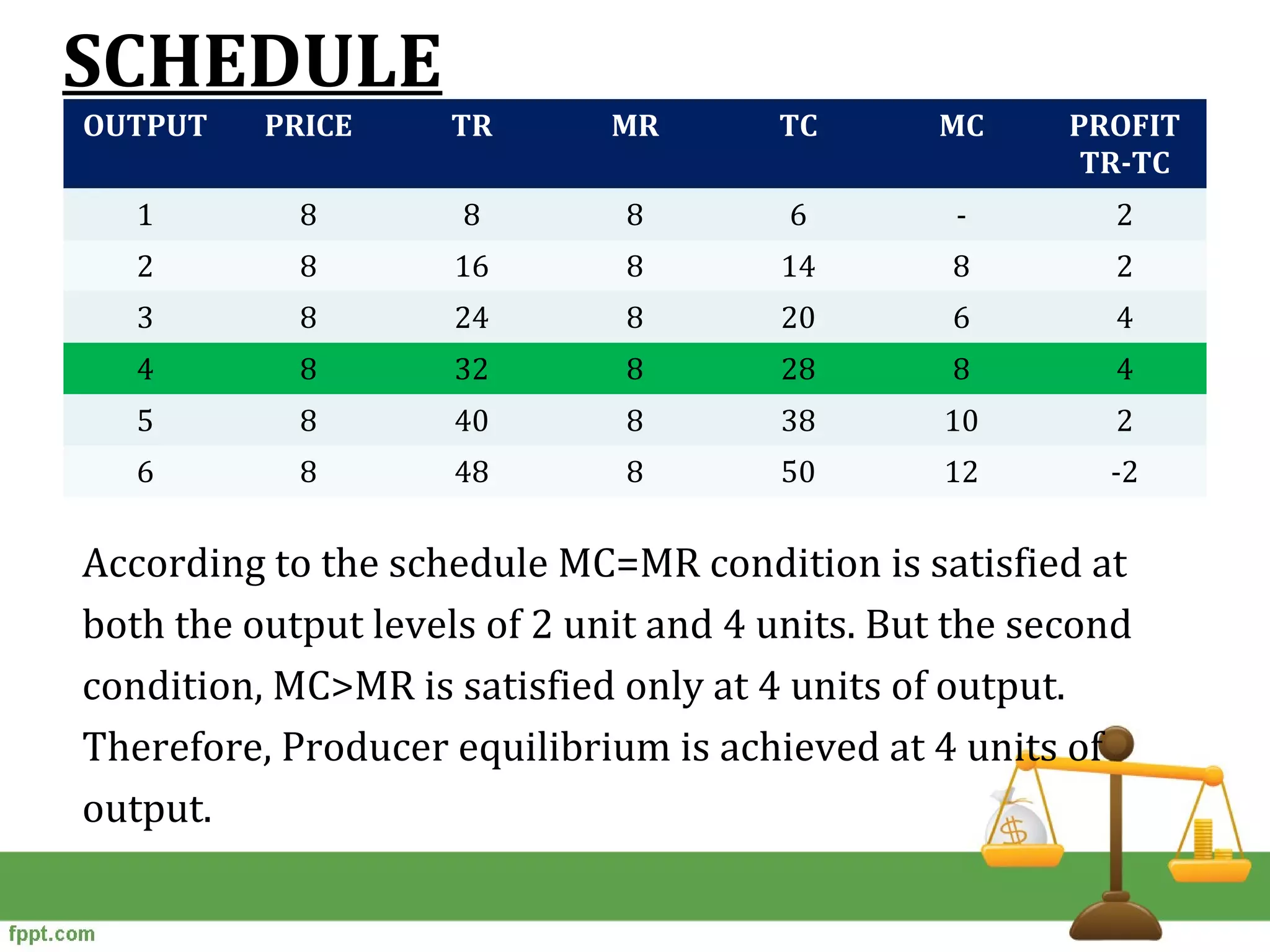
According to the schedule MC=MR condition is satisfied at
both the output levels of 2 unit and 4 units. But the second
condition, MC>MR is satisfied only at 4 units of output.
Therefore, Producer equilibrium is achieved at 4 units of
output.
OUTPUT PRICE TR MR TC MC PROFIT
TR-TC
1 8 8 8 6 - 2
2 8 16 8 14 8 2
3 8 24 8 20 6 4
4 8 32 8 28 8 4
5 8 40 8 38 10 2
6 8 48 8 50 12 -2
FIGURE Both AR & MR curves are
straight line parallel to X –
axis. MC is U-shaped.
Producer equilibrium will
be determined at OQ level
of output corresponding to
point ‘E’, because at point
‘E’, the following two
conditions are met:-
1. MC= MR
2. MC > MR after MC=MR.
QUICK RECALL
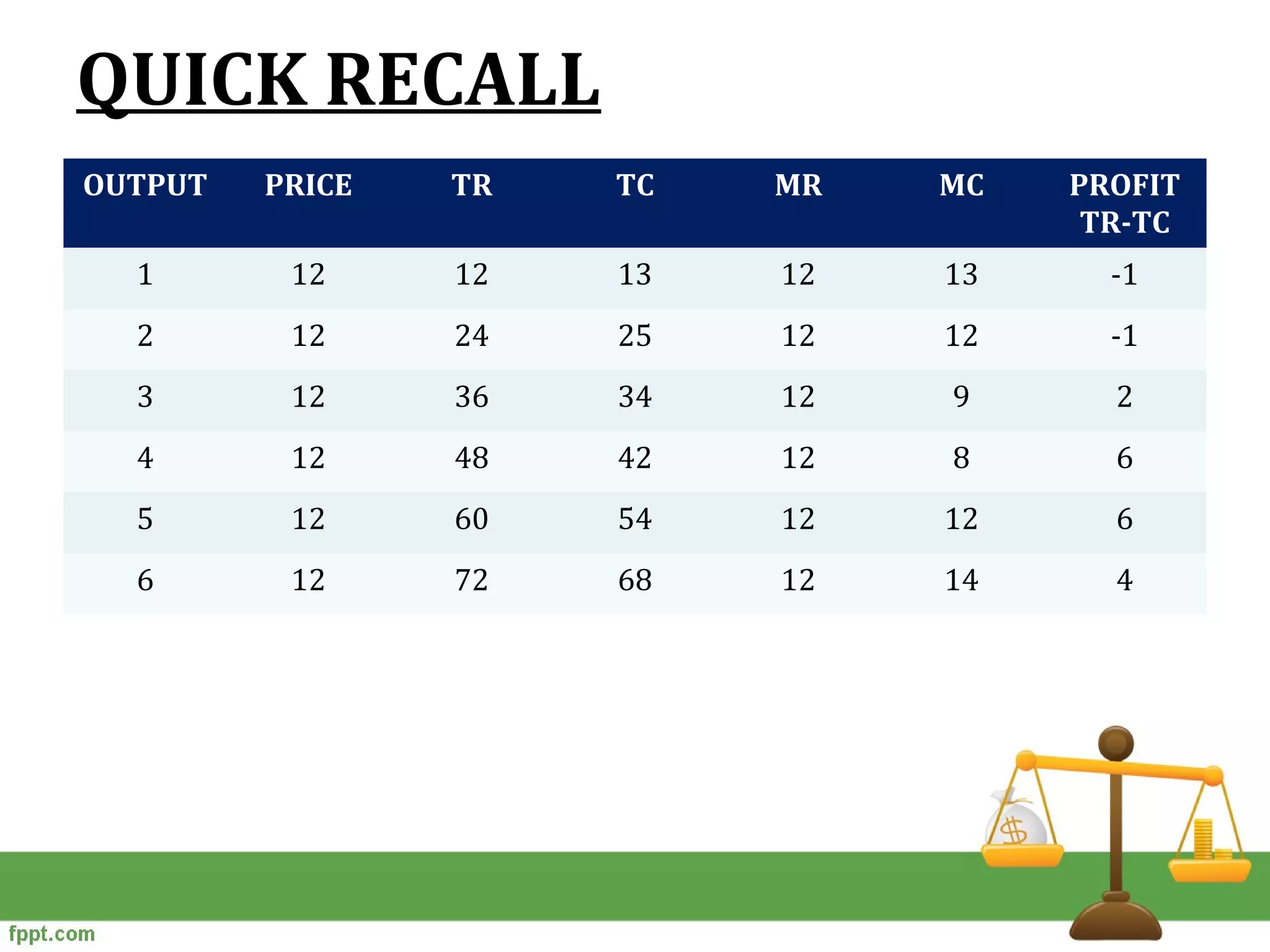
OUTPUT PRICE TR TC MR MC PROFIT
TR-TC
1 12 12 13 12 13 -1
2 12 24 25 12 12 -1
3 12 36 34 12 9 2
4 12 48 42 12 8 6
5 12 60 54 12 12 6
6 12 72 68 12 14 4
OUTPUT PRICE TR TC MR MC
1 7 7 8 7 8
2 7 14 15 7 7
3 7 21 22 7 7
4 7 28 28 7 6
5 7 35 33 7 5
6 7 42 40 7 7
7 7 49 48 7 8
OUTPUT PRICE TR TC MR MC PROFIT
TR-TC
1 24 24 26 24 -2
2 24 48 50 24 24 -2
3 24 72 72 24 22 0
4 24 96 92 24 20 4
5 24 120 115 24 23 5
6 24 144 139 24 24 5
7 24 168 165 24 26 3
WHEN PRICE FALLS
When there is no price fixed and more output
can be sold only by reducing the prices, MR
curve slopes downwards.
SCHEDULE
From the above schedule both the conditions are satisfied at
3 units of output. MC = MR & MC > MR. So the producer
equilibrium is achieved at 3 units of output.
OUTPUT PRICE TR TC MR MC PROFIT
TR-TC
1 12 12 4 12 4 8
2 11 22 10 10 6 12
3 10 30 18 8 8 12
4 9 36 28 6 10 8
5 8 40 45 4 17 -5
FIGURE
Y
P
E AR
MR
0 M X
OUTPUT
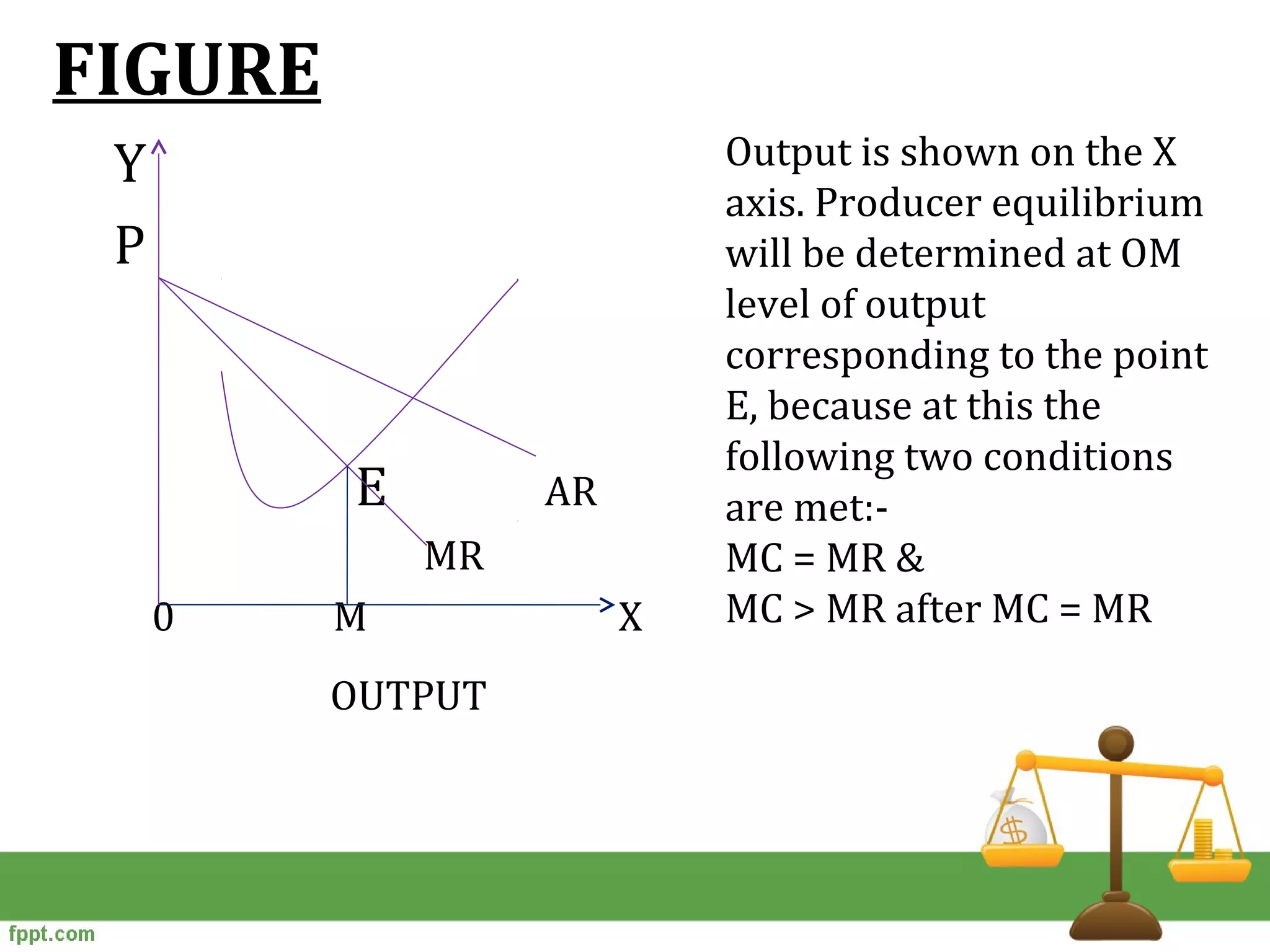
Output is shown on the X
axis. Producer equilibrium
will be determined at OM
level of output
corresponding to the point
E, because at this the
following two conditions
are met:-
MC = MR &
MC > MR after MC = MR
QUICK RECALL
OUTPUT PRICE TR TC MR MC PROFIT
TR-TC
1 8 8 6 8 6 2
2 7 14 11 6 5 3
3 6 18 15 4 4 3
4 5 20 20 2 5 0
5 4 20 26 0 6 -6
QUESTIONS
1. Explain producer equilibrium with the help of a diagram.
2. Explain the conditions leading to the profit maximisation by a
producer.
3. Explain producer equilibrium with the help of MR-MC Schedule.
4. What is meant by Producer equilibrium? Explain the conditions of
Producer’s Equilibrium through MR-MC approach.
5. Why is equality between MR & MC necessary for a firm to be in
equilibrium? Is it sufficient to ensure equilibrium? Explain
6. Give the meaning of Producer Equilibrium. A producer produces that
quantity of his product at which MC & MR are equal. Is he earning
maximum profits? Give reasons for your answer.
7. Explain why will a producer not be in equilibrium if the conditions of
equilibrium are not met.
8. Explain the conditions of producer equilibrium with the help of a
schedule, assuming that the producer can sell more only by lowering
the price.
CONCLUSION
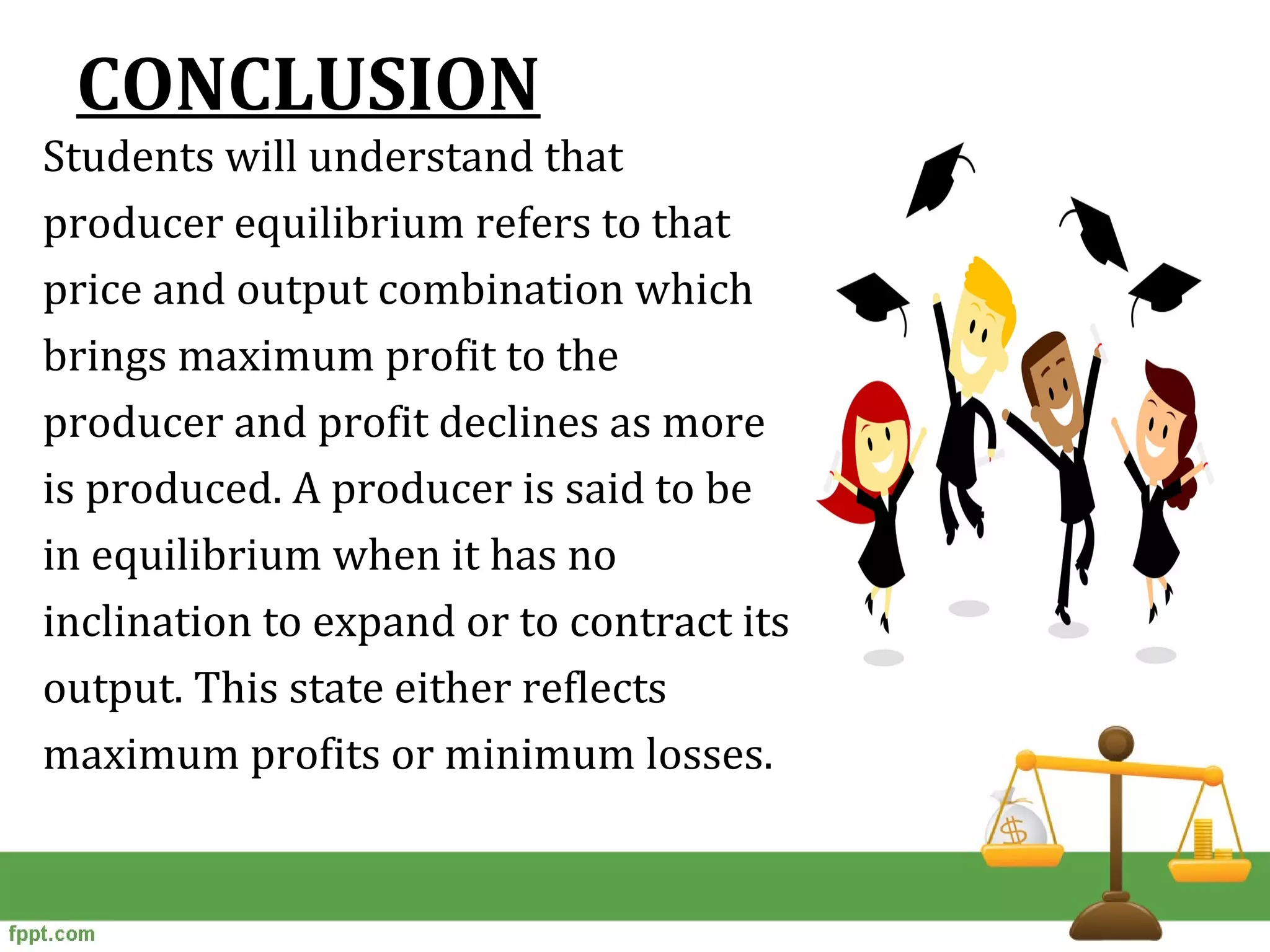
Students will understand that
producer equilibrium refers to that
price and output combination which
brings maximum profit to the
producer and profit declines as more
is produced. A producer is said to be
in equilibrium when it has no
inclination to expand or to contract its
output. This state either reflects
maximum profits or minimum losses.
For any enquires or topic suggestions,
E-mail: sohilgajjar77@gmail.com
THINK
ECONOMICS
THINK
SOHIL SIR

PRODUCER EQUILIBRIUM

  • 1.
    PRODUCER EQUILIBRIUM XII –ECONOMICS CBSE - 2017-18
  • 2.
    PRESENTATION BY:- CS. SOHILGAJJAR COMMITTED TO EXCELLENCE
  • 3.
    LEARNING OBJECTIVE • Tofocus on determination of equilibrium level of producer. • To deal with determination of a level of output, which yields the maximum profit.
  • 4.
    INTRODUCTION  Having understoodthe behaviour of Revenue and Cost for a firm, it is now time to understand how a producer strikes his equilibrium.  A consumer’s equilibrium is achieved when he derives maximum satisfaction by spending his income on consumption of goods and services. Similarly a producer also aims to maximise his satisfaction in terms of profit.
  • 5.
    TOPICS TO BECOVERED 1. PRODUCER 2. PROFIT 3. MEANING AND CONCEPT OF PE 4. METHODS FOR DETERMINING PE 5. CONDITIONS OF PE 6. PRODUCER EQUILIBRIUM WHEN PRICE REMAINS CONSTANT [PERFECT COMPETITION] 7. PRODUCER EQUILIBRIUM WHEN PRICE CHANGES/FALLS [IMPERFECT COMPETITION]
  • 6.
    PRODUCER Creator of Utility isknown as a Producer. A person who converts inputs into outputs.
  • 7.
    PROFIT The ultimate aimof any firm is to earn the maximum profit. Profit refers to the excess of revenue over cost. Profit = TR – TC [Where R = Revenue & C = Cost]
  • 8.
    EQUILIBRIUM Equilibrium refers toa state of rest when no change is required. A firm [Producer] is said to be in equilibrium when it has no inclination to expand or to contract its output. This state is either reflects maximum profits or minimum losses.
  • 9.
    PRODUCER EQUILIBRIUM Producer equilibrium refersto that price and output combination which brings maximum profit to the producer and profit declines as more is produced.
  • 10.
    METHOD OF DETERMINING PRODUCEREQUILIBRIM There is only one method for determination of Producer Equilibrium: Marginal Revenue and Marginal Cost Approach [MR-MC Approach] *** TR-TC Approach is not in syllabus
  • 11.
    MR-MC APPROACH Producer canattain the equilibrium level under two different situations:- 1.When Price remains Constant [Perfect Competition] 2.When Price Falls with rise in Output [Imperfect Competition]
  • 12.
    CONDITIONS 1. MC=MR: Aslong as MC is less than MR, it is profitable for the producer to go on producing more because it adds to its profits. He stops producing more only when MC = MR. 2. MC > MR after MC = MR OR MC curve intersect the MR curve from below: MC=MR is a necessary condition, but not a sufficient enough to ensure equilibrium. It is because MC=MR may occur at more than one level of output. However, out of these, only that output level is the equilibrium output when MC > MR after equilibrium. It is because if MC is greater than MR, then producing beyond MC=MR output will reduce profits. So first, condition must be supplemented with the second condition to attain producer equilibrium.
  • 13.
    QUICK RECALL 1. Whois the producer? 2. What is the main objective of a producer? 3. Define profits. 4. What do you mean by equilibrium? 5. Define producer equilibrium. 6. Name the method for determining producer equilibrium. 7. State the two different approaches to attain producer equilibrium. 8. State the conditions to achieve producer equilibrium. 9. Is it enough to say that profit is maximized when MC=MR? 10. At a certain level of output, the MC of a firm is above its MR. Can this be its equilibrium output?
  • 14.
    PRICE CONSTANT When priceremains constant, firms can sell any quantity of output at the price fixed by market. Price [AR] remains same at all levels of output. Also, the revenue from every additional unit [MR] is equal to AR.
  • 15.
    SCHEDULE According to theschedule MC=MR condition is satisfied at both the output levels of 2 unit and 4 units. But the second condition, MC>MR is satisfied only at 4 units of output. Therefore, Producer equilibrium is achieved at 4 units of output. OUTPUT PRICE TR MR TC MC PROFIT TR-TC 1 8 8 8 6 - 2 2 8 16 8 14 8 2 3 8 24 8 20 6 4 4 8 32 8 28 8 4 5 8 40 8 38 10 2 6 8 48 8 50 12 -2
  • 16.
    FIGURE Both AR& MR curves are straight line parallel to X – axis. MC is U-shaped. Producer equilibrium will be determined at OQ level of output corresponding to point ‘E’, because at point ‘E’, the following two conditions are met:- 1. MC= MR 2. MC > MR after MC=MR.
  • 17.
    QUICK RECALL OUTPUT PRICETR TC MR MC PROFIT TR-TC 1 12 12 13 12 13 -1 2 12 24 25 12 12 -1 3 12 36 34 12 9 2 4 12 48 42 12 8 6 5 12 60 54 12 12 6 6 12 72 68 12 14 4
  • 18.
    OUTPUT PRICE TRTC MR MC 1 7 7 8 7 8 2 7 14 15 7 7 3 7 21 22 7 7 4 7 28 28 7 6 5 7 35 33 7 5 6 7 42 40 7 7 7 7 49 48 7 8
  • 19.
    OUTPUT PRICE TRTC MR MC PROFIT TR-TC 1 24 24 26 24 -2 2 24 48 50 24 24 -2 3 24 72 72 24 22 0 4 24 96 92 24 20 4 5 24 120 115 24 23 5 6 24 144 139 24 24 5 7 24 168 165 24 26 3
  • 20.
    WHEN PRICE FALLS Whenthere is no price fixed and more output can be sold only by reducing the prices, MR curve slopes downwards.
  • 21.
    SCHEDULE From the aboveschedule both the conditions are satisfied at 3 units of output. MC = MR & MC > MR. So the producer equilibrium is achieved at 3 units of output. OUTPUT PRICE TR TC MR MC PROFIT TR-TC 1 12 12 4 12 4 8 2 11 22 10 10 6 12 3 10 30 18 8 8 12 4 9 36 28 6 10 8 5 8 40 45 4 17 -5
  • 22.
    FIGURE Y P E AR MR 0 MX OUTPUT Output is shown on the X axis. Producer equilibrium will be determined at OM level of output corresponding to the point E, because at this the following two conditions are met:- MC = MR & MC > MR after MC = MR
  • 23.
    QUICK RECALL OUTPUT PRICETR TC MR MC PROFIT TR-TC 1 8 8 6 8 6 2 2 7 14 11 6 5 3 3 6 18 15 4 4 3 4 5 20 20 2 5 0 5 4 20 26 0 6 -6
  • 24.
    QUESTIONS 1. Explain producerequilibrium with the help of a diagram. 2. Explain the conditions leading to the profit maximisation by a producer. 3. Explain producer equilibrium with the help of MR-MC Schedule. 4. What is meant by Producer equilibrium? Explain the conditions of Producer’s Equilibrium through MR-MC approach. 5. Why is equality between MR & MC necessary for a firm to be in equilibrium? Is it sufficient to ensure equilibrium? Explain 6. Give the meaning of Producer Equilibrium. A producer produces that quantity of his product at which MC & MR are equal. Is he earning maximum profits? Give reasons for your answer. 7. Explain why will a producer not be in equilibrium if the conditions of equilibrium are not met. 8. Explain the conditions of producer equilibrium with the help of a schedule, assuming that the producer can sell more only by lowering the price.
  • 25.
    CONCLUSION Students will understandthat producer equilibrium refers to that price and output combination which brings maximum profit to the producer and profit declines as more is produced. A producer is said to be in equilibrium when it has no inclination to expand or to contract its output. This state either reflects maximum profits or minimum losses.
  • 26.
    For any enquiresor topic suggestions, E-mail: sohilgajjar77@gmail.com THINK ECONOMICS THINK SOHIL SIR