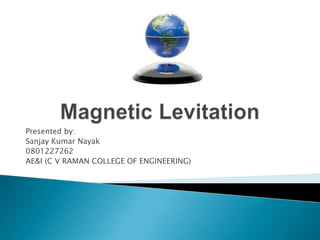
Magnetic LevitationPresented by: Sanjay Kumar Nayak0801227262AE&I (C V RAMAN COLLEGE OF ENGINEERING)
Introduction.Fundamentals.Ways to magnetically levitate .Applications.Magnetic transportation.Super Levitron.Magnetic Bearing.Maglev space propulsion.Future scope.Advantages.Limitations.Conclusion.BibliographyContents:
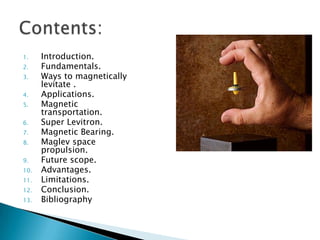
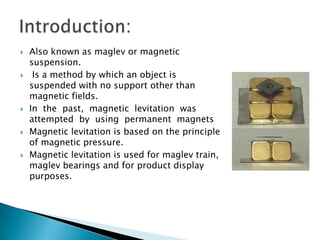
Introduction:Also known as maglev or magnetic suspension. Is a method by which an object is suspended with no support other than magnetic fields.In  the  past,  magnetic  levitation  was  attempted  by  using  permanent  magnetsMagnetic levitation is based on the principle of magnetic pressure.Magnetic levitation is used for maglev train, maglev bearings and for product display purposes.
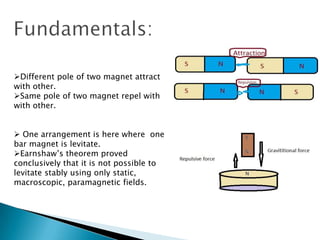
Fundamentals:Different pole of two magnet attract with other.
Same pole of two magnet repel with with other.
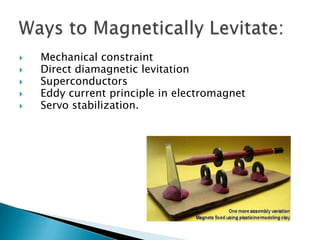
 One arrangement is here where  one bar magnet is levitate.
Earnshaw’s theorem proved conclusively that it is not possible to levitate stably using only static, macroscopic, paramagnetic fields.Mechanical constraintDirect diamagnetic levitationSuperconductorsEddy current principle in electromagnetServo stabilization.Ways to Magnetically Levitate:
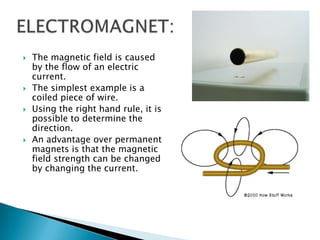
ELECTROMAGNET:The magnetic field is caused by the flow of an electric current.The simplest example is a coiled piece of wire.Using the right hand rule, it is possible to determine the direction. An advantage over permanent magnets is that the magnetic field strength can be changed by changing the current.
Magnetic Transportation.       -maglev train       -maglev truckMaglev Bearing.       -Flywheels       -Centrifuges      - Magnetic ring spinningApplications:
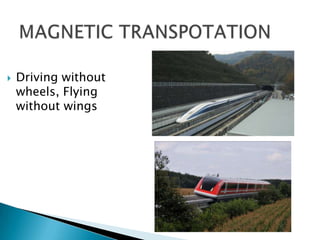
MAGNETIC TRANSPOTATIONDriving without wheels, Flying without wings
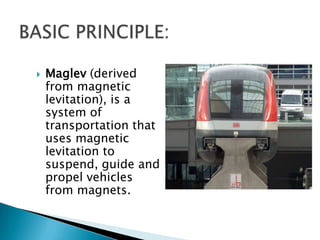
BASIC PRINCIPLE:Maglev (derived from magnetic levitation), is a system of transportation that uses magnetic levitation to suspend, guide and propel vehicles from magnets.
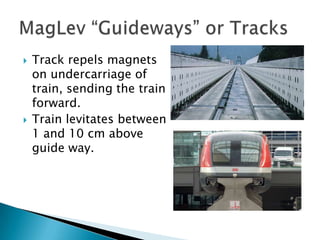
Track repels magnets on undercarriage of train, sending the train forward.Train levitates between 1 and 10 cm above guide way.MagLev “Guideways” or Tracks
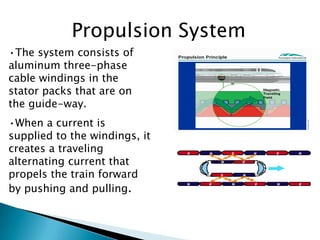
Propulsion SystemThe system consists of aluminum three-phase cable windings in the stator packs that are on  the guide-way.
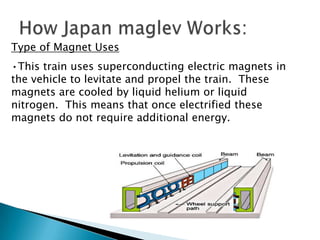
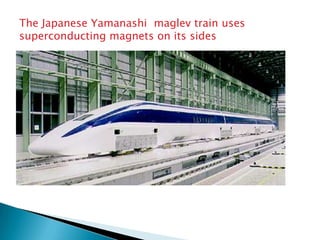
When a current is supplied to the windings, it creates a traveling alternating current that propels the train forward by pushing and pulling.How Japan maglev Works:Type of Magnet UsesThis train uses superconducting electric magnets in the vehicle to levitate and propel the train.  These magnets are cooled by liquid helium or liquid nitrogen.  This means that once electrified these magnets do not require additional energy.The Japanese Yamanashi  maglev train uses superconducting magnets on its sides
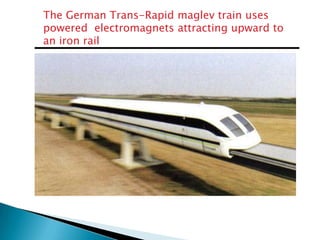
The German Trans-Rapid maglev train uses powered  electromagnets attracting upward to an iron rail
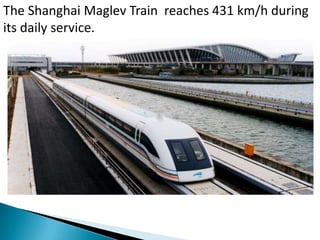
The Shanghai Maglev Train  reaches 431 km/h during its daily service.
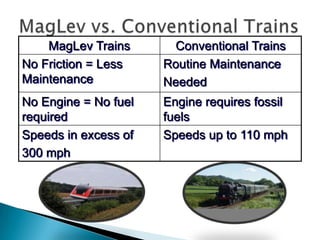
MagLev vs. Conventional Trains
Less energy consumption because no rail-track frictionRequires no fossil fuel which can harm the environment.Less noise pollution since the train never hits the trackMagLevguideways and trains take up less space than conventional trainsBetter for the Environment
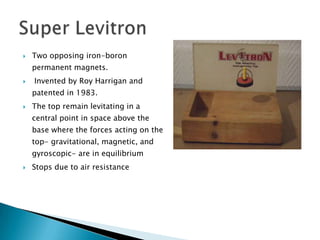
Two opposing iron-boron permanent magnets. Invented by Roy Harriganand patented in 1983. The top remain levitating in a central point in space above the base where the forces acting on the top- gravitational, magnetic, and gyroscopic- are in equilibriumStops due to air resistanceSuper Levitron
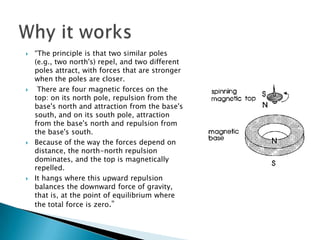
Why it works “The principle is that two similar poles (e.g., two north's) repel, and two different poles attract, with forces that are stronger when the poles are closer. There are four magnetic forces on the top: on its north pole, repulsion from the base's north and attraction from the base's south, and on its south pole, attraction from the base's north and repulsion from the base's south. Because of the way the forces depend on distance, the north-north repulsion dominates, and the top is magnetically repelled.It hangs where this upward repulsion balances the downward force of gravity, that is, at the point of equilibrium where the total force is zero.”
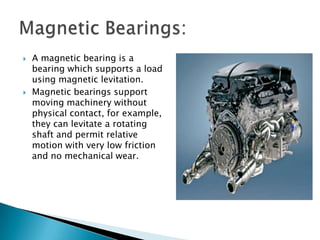
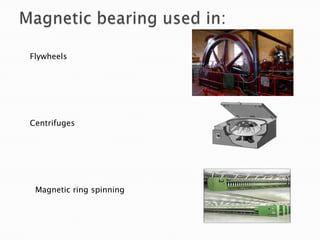
A magnetic bearing is a bearing which supports a load using magnetic levitation.Magnetic bearings support moving machinery without physical contact, for example, they can levitate a rotating shaft and permit relative motion with very low friction and no mechanical wear.Magnetic Bearings:
Magnetic bearing used in:FlywheelsCentrifugesMagnetic ring spinning
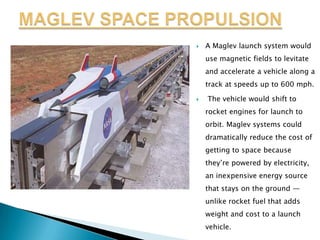
MAGLEV SPACE PROPULSIONA Maglev launch system would use magnetic fields to levitate and accelerate a vehicle along a track at speeds up to 600 mph. The vehicle would shift to rocket engines for launch to orbit. Maglev systems could dramatically reduce the cost of getting to space because they’re powered by electricity, an inexpensive energy source that stays on the ground — unlike rocket fuel that adds weight and cost to a launch vehicle.
Future Scopes:   MACH-3:    If the Maglev vehicles operate in a low-pressure tunnel, however, air drag is effectively zero and no longer a factor, so that vehicles can travel at speeds of thousands of miles per hour. There still is a small magnetic drag due to power losses in the normal metal loops on the guide way, but this does not impose any practical limit. MagLev Trains in INDIA.
Maglev space propulsion.
Electric generators- made with superconducting wire: They have a 99% efficiency and have about half the size of conventional generators.More economical.Environment friendly.Less energy consumption.Less noise pollution.Take less space.Advantages :
Requires complex circuitry.Requires highly skilled and trained operators.Requires  more research.Limitations:
  Magnetic levitation is very advantageous technology with promising future scopes to be used in almost every fields. Although it is yet to be completely explored but the existing technology can also significantly develop our life to a large extent.  Conclusion:

Maglev

  • 1.
    Magnetic LevitationPresented by:Sanjay Kumar Nayak0801227262AE&I (C V RAMAN COLLEGE OF ENGINEERING)
  • 2.
    Introduction.Fundamentals.Ways to magneticallylevitate .Applications.Magnetic transportation.Super Levitron.Magnetic Bearing.Maglev space propulsion.Future scope.Advantages.Limitations.Conclusion.BibliographyContents:
  • 3.
    Introduction:Also known asmaglev or magnetic suspension. Is a method by which an object is suspended with no support other than magnetic fields.In the past, magnetic levitation was attempted by using permanent magnetsMagnetic levitation is based on the principle of magnetic pressure.Magnetic levitation is used for maglev train, maglev bearings and for product display purposes.
  • 4.
    Fundamentals:Different pole oftwo magnet attract with other.
  • 5.
    Same pole oftwo magnet repel with with other.
  • 6.
    One arrangementis here where one bar magnet is levitate.
  • 7.
    Earnshaw’s theorem provedconclusively that it is not possible to levitate stably using only static, macroscopic, paramagnetic fields.Mechanical constraintDirect diamagnetic levitationSuperconductorsEddy current principle in electromagnetServo stabilization.Ways to Magnetically Levitate:
  • 8.
    ELECTROMAGNET:The magnetic fieldis caused by the flow of an electric current.The simplest example is a coiled piece of wire.Using the right hand rule, it is possible to determine the direction. An advantage over permanent magnets is that the magnetic field strength can be changed by changing the current.
  • 9.
    Magnetic Transportation. -maglev train -maglev truckMaglev Bearing. -Flywheels -Centrifuges - Magnetic ring spinningApplications:
  • 10.
    MAGNETIC TRANSPOTATIONDriving withoutwheels, Flying without wings
  • 11.
    BASIC PRINCIPLE:Maglev (derivedfrom magnetic levitation), is a system of transportation that uses magnetic levitation to suspend, guide and propel vehicles from magnets.
  • 12.
    Track repels magnetson undercarriage of train, sending the train forward.Train levitates between 1 and 10 cm above guide way.MagLev “Guideways” or Tracks
  • 13.
    Propulsion SystemThe systemconsists of aluminum three-phase cable windings in the stator packs that are on the guide-way.
  • 14.
    When a currentis supplied to the windings, it creates a traveling alternating current that propels the train forward by pushing and pulling.How Japan maglev Works:Type of Magnet UsesThis train uses superconducting electric magnets in the vehicle to levitate and propel the train. These magnets are cooled by liquid helium or liquid nitrogen. This means that once electrified these magnets do not require additional energy.The Japanese Yamanashi maglev train uses superconducting magnets on its sides
  • 15.
    The German Trans-Rapidmaglev train uses powered electromagnets attracting upward to an iron rail
  • 16.
    The Shanghai MaglevTrain reaches 431 km/h during its daily service.
  • 17.
  • 18.
    Less energy consumptionbecause no rail-track frictionRequires no fossil fuel which can harm the environment.Less noise pollution since the train never hits the trackMagLevguideways and trains take up less space than conventional trainsBetter for the Environment
  • 19.
    Two opposing iron-boronpermanent magnets. Invented by Roy Harriganand patented in 1983. The top remain levitating in a central point in space above the base where the forces acting on the top- gravitational, magnetic, and gyroscopic- are in equilibriumStops due to air resistanceSuper Levitron
  • 20.
    Why it works“The principle is that two similar poles (e.g., two north's) repel, and two different poles attract, with forces that are stronger when the poles are closer. There are four magnetic forces on the top: on its north pole, repulsion from the base's north and attraction from the base's south, and on its south pole, attraction from the base's north and repulsion from the base's south. Because of the way the forces depend on distance, the north-north repulsion dominates, and the top is magnetically repelled.It hangs where this upward repulsion balances the downward force of gravity, that is, at the point of equilibrium where the total force is zero.”
  • 21.
    A magnetic bearingis a bearing which supports a load using magnetic levitation.Magnetic bearings support moving machinery without physical contact, for example, they can levitate a rotating shaft and permit relative motion with very low friction and no mechanical wear.Magnetic Bearings:
  • 22.
    Magnetic bearing usedin:FlywheelsCentrifugesMagnetic ring spinning
  • 23.
    MAGLEV SPACE PROPULSIONAMaglev launch system would use magnetic fields to levitate and accelerate a vehicle along a track at speeds up to 600 mph. The vehicle would shift to rocket engines for launch to orbit. Maglev systems could dramatically reduce the cost of getting to space because they’re powered by electricity, an inexpensive energy source that stays on the ground — unlike rocket fuel that adds weight and cost to a launch vehicle.
  • 24.
    Future Scopes: MACH-3: If the Maglev vehicles operate in a low-pressure tunnel, however, air drag is effectively zero and no longer a factor, so that vehicles can travel at speeds of thousands of miles per hour. There still is a small magnetic drag due to power losses in the normal metal loops on the guide way, but this does not impose any practical limit. MagLev Trains in INDIA.
  • 25.
  • 26.
    Electric generators- madewith superconducting wire: They have a 99% efficiency and have about half the size of conventional generators.More economical.Environment friendly.Less energy consumption.Less noise pollution.Take less space.Advantages :
  • 27.
    Requires complex circuitry.Requireshighly skilled and trained operators.Requires more research.Limitations:
  • 28.
    Magneticlevitation is very advantageous technology with promising future scopes to be used in almost every fields. Although it is yet to be completely explored but the existing technology can also significantly develop our life to a large extent. Conclusion: