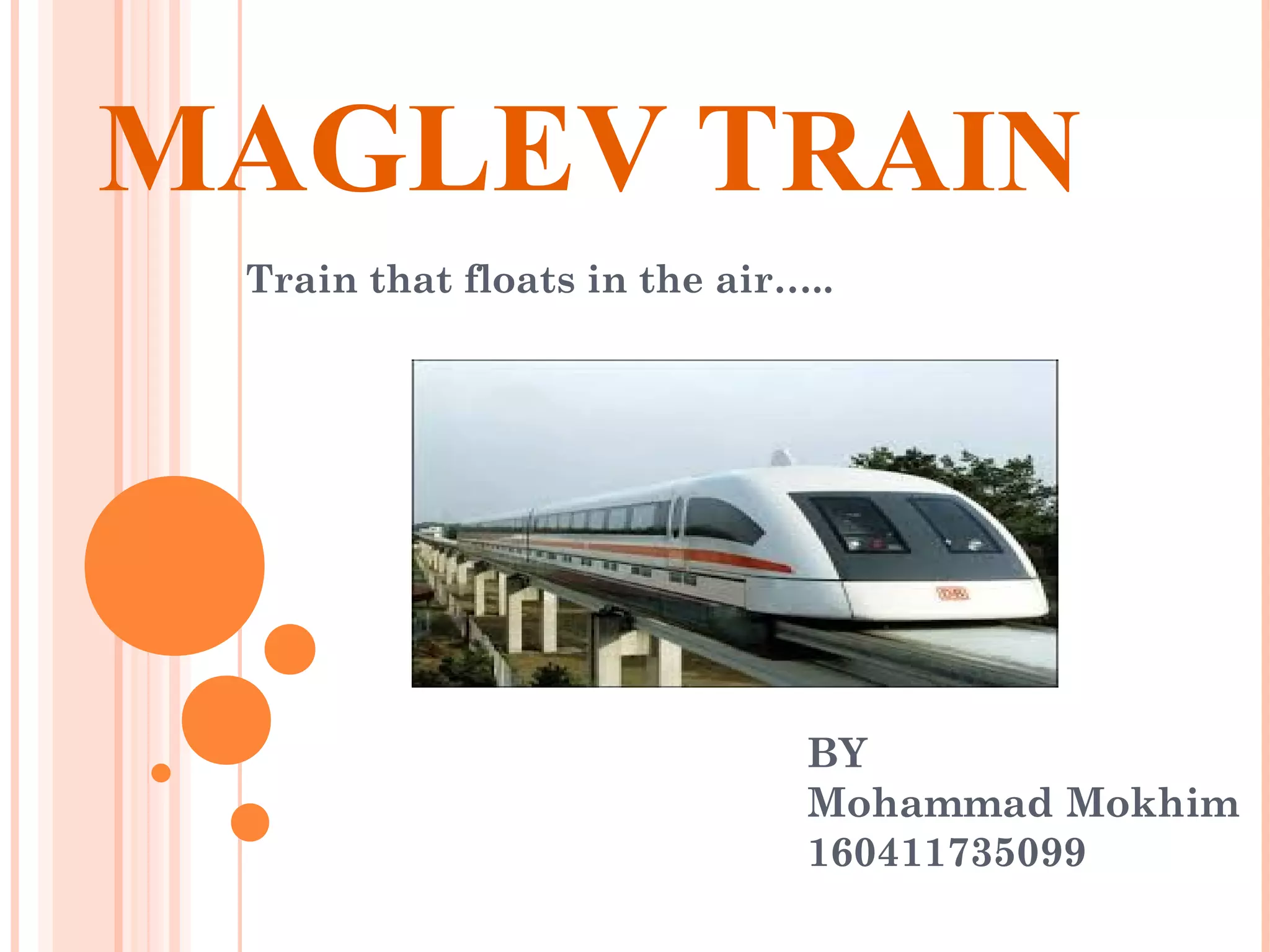
MAGLEV TRAIN
Train that floats in the air…..
BY
Mohammad Mokhim
160411735099
INTRODUCTION:
 Maglev=Magnetic + Levitation
 Maglev runs on the principle of magnetic
levitation.
 Maglev is noiseless ,friction less , and require no
maintenance.
 Maglev is the best alternative for means of
transport.
MAGNETIC LEVIATION
MagLev Technology;
-levitates objects in air
- electromagnetic propulsion
- caused by electro magnets
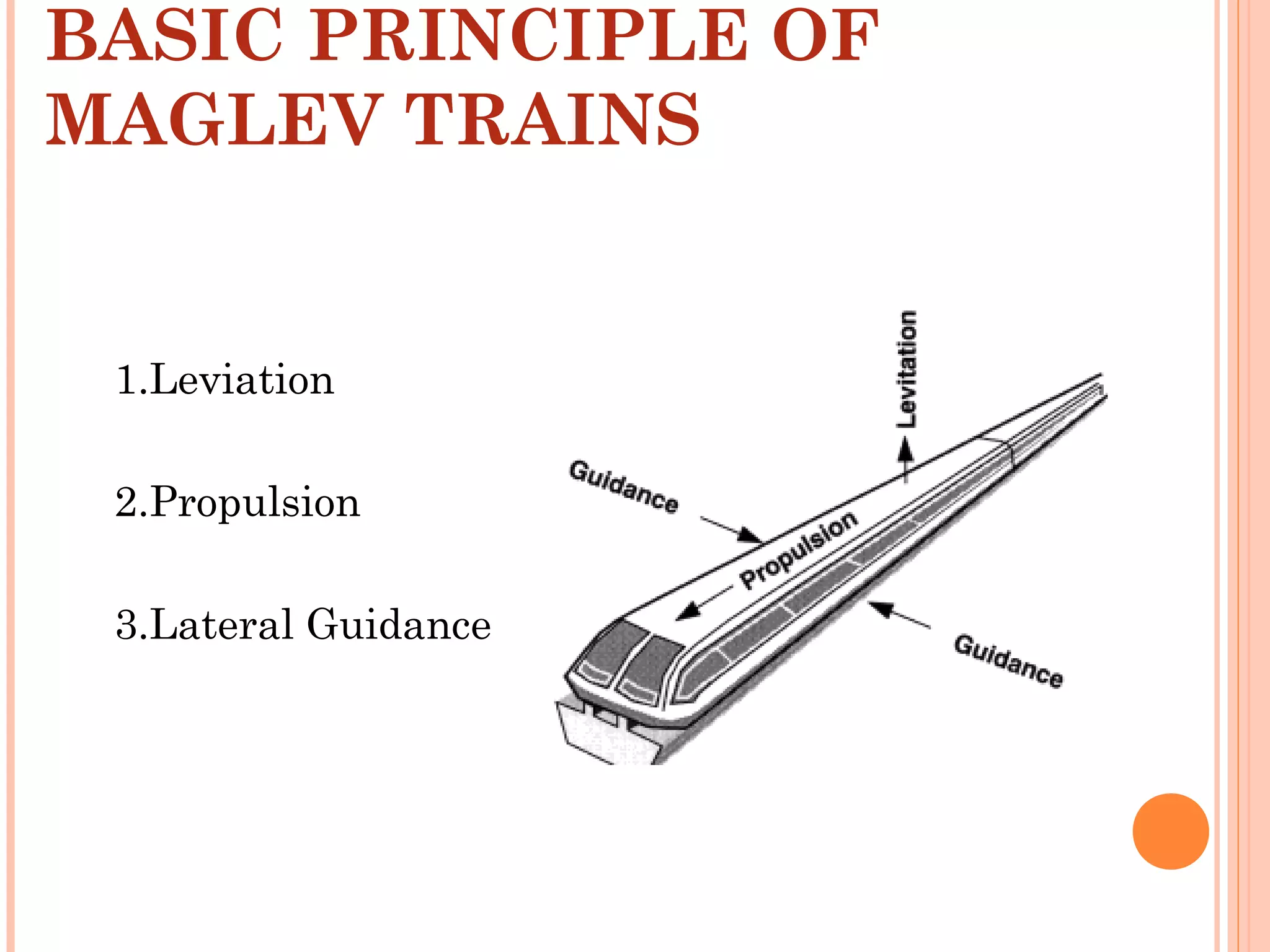
BASIC PRINCIPLE OF
MAGLEV TRAINS
1.Leviation
2.Propulsion
3.Lateral Guidance
TRAINS
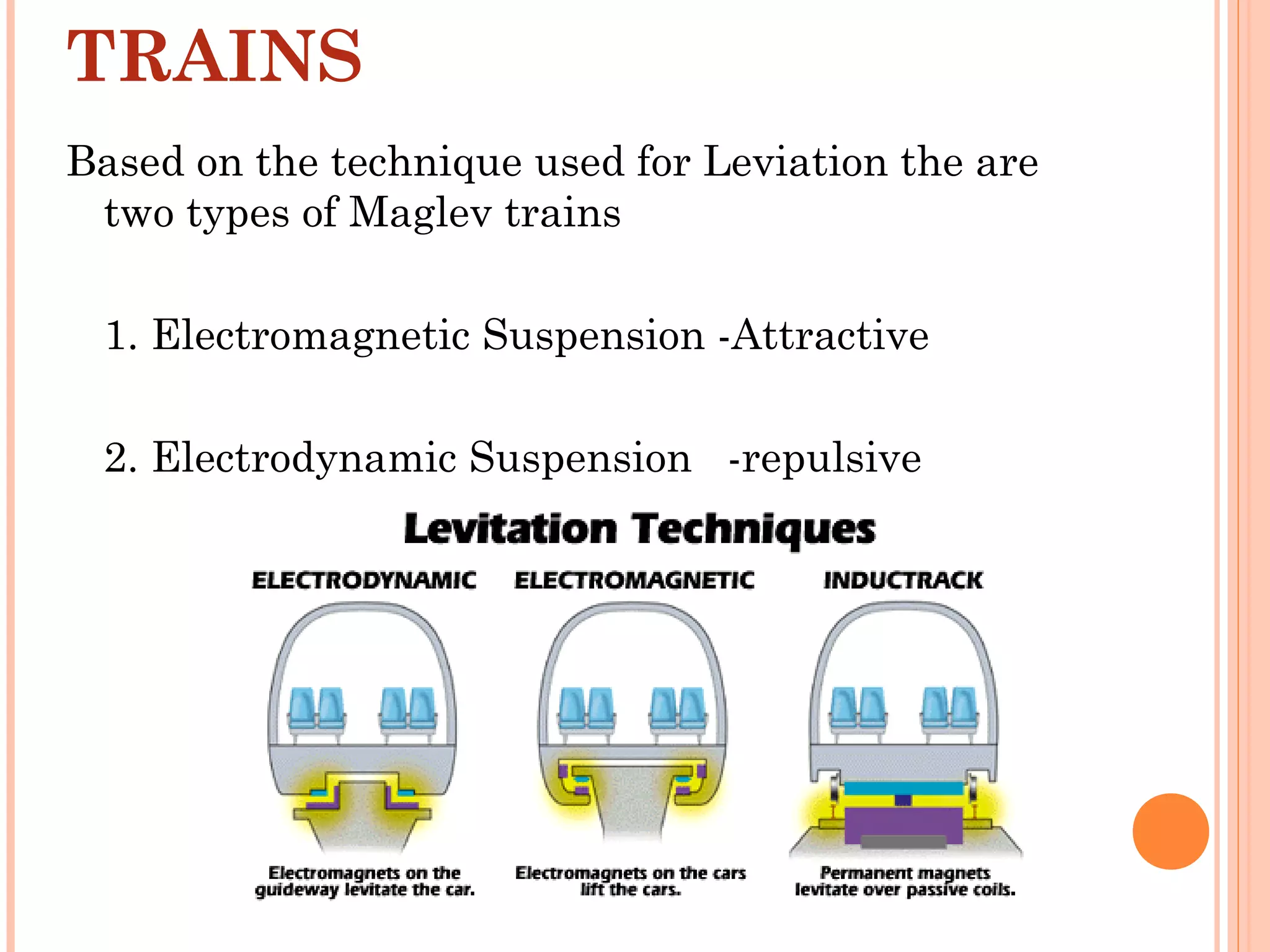
Based on the technique used for Leviation the are
two types of Maglev trains
1. Electromagnetic Suspension -Attractive
2. Electrodynamic Suspension -repulsive
ELECTROMAGNETIC
SUSPENSION(EMS)
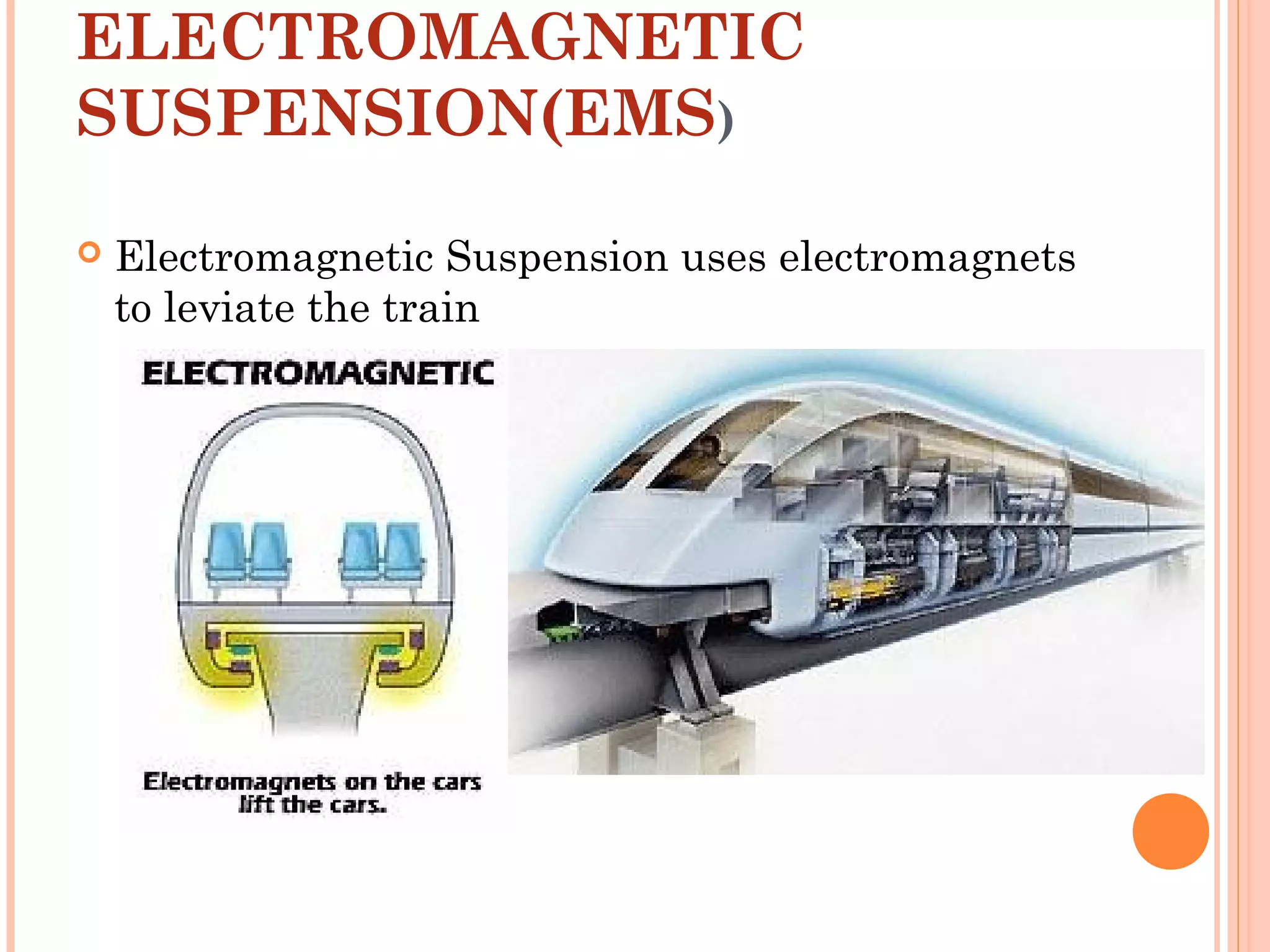
 Electromagnetic Suspension uses electromagnets
to leviate the train
PRINCIPLE OF MAGNETIC
LEVIATION
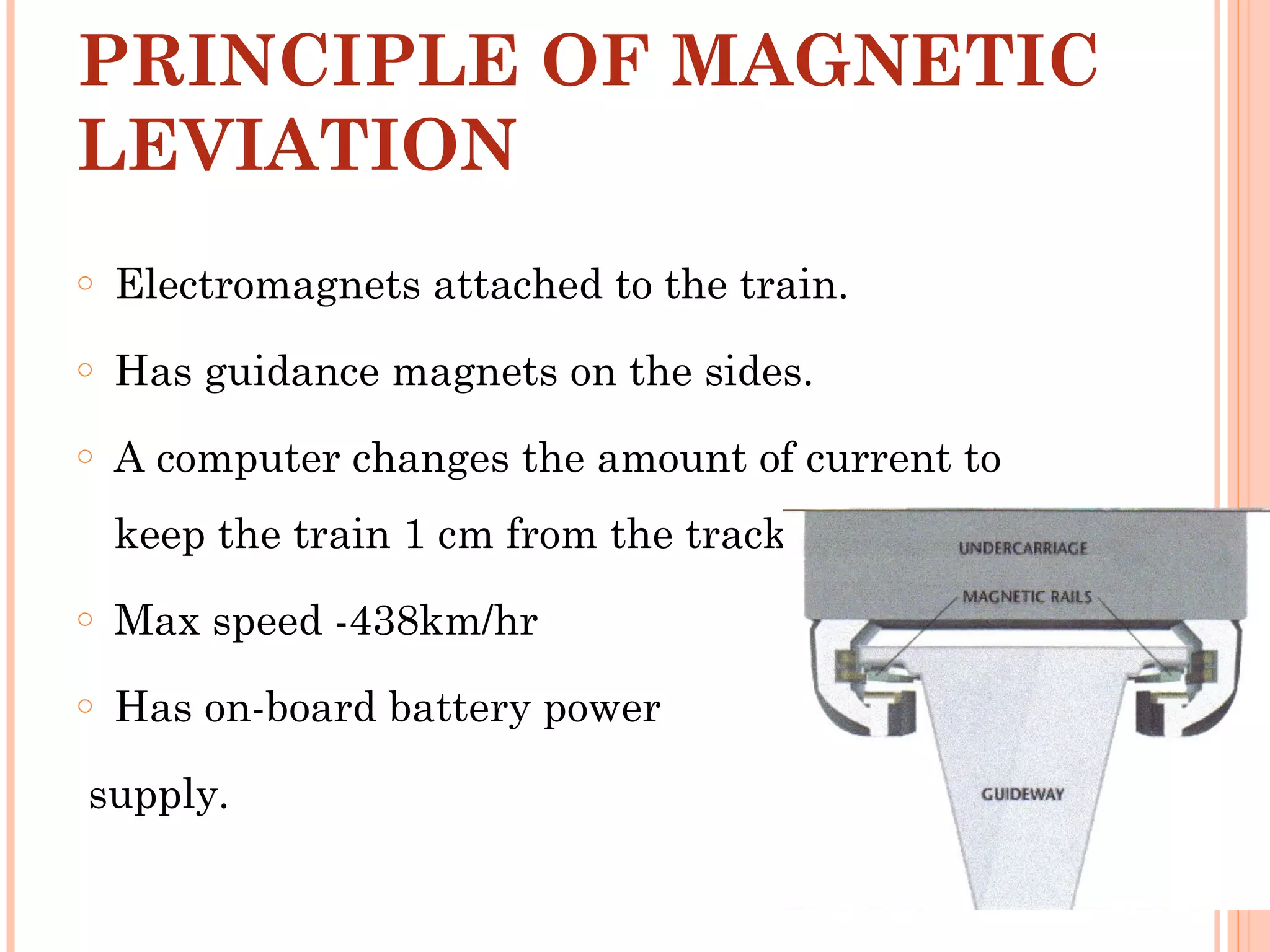
o Electromagnets attached to the train.
o Has guidance magnets on the sides.
o A computer changes the amount of current to
keep the train 1 cm from the track.
o Max speed -438km/hr
o Has on-board battery power
supply.
PRINCIPLE OF
PROPULSION
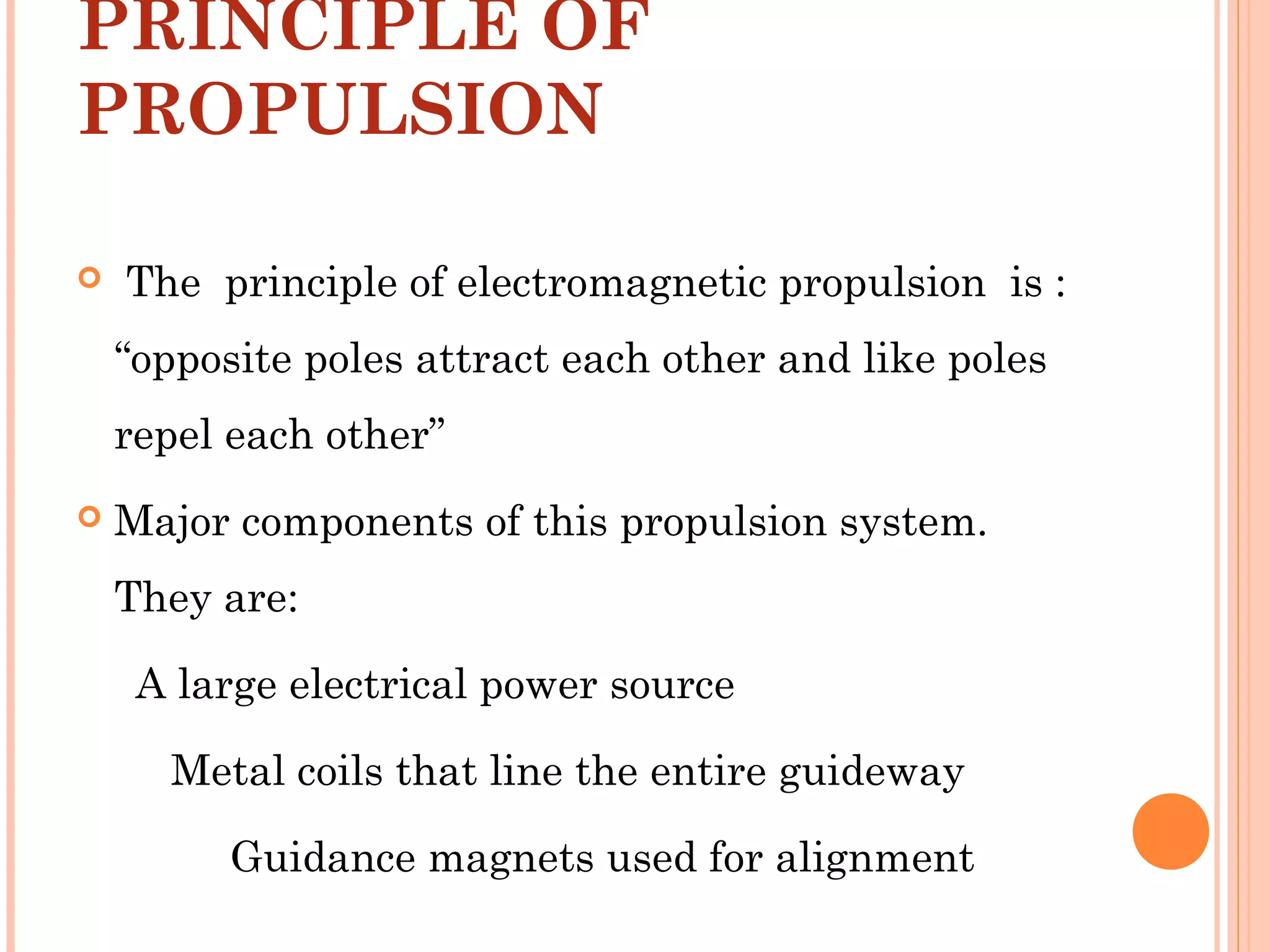
 The principle of electromagnetic propulsion is :
“opposite poles attract each other and like poles
repel each other”
 Major components of this propulsion system.
They are:
A large electrical power source
Metal coils that line the entire guideway
Guidance magnets used for alignment
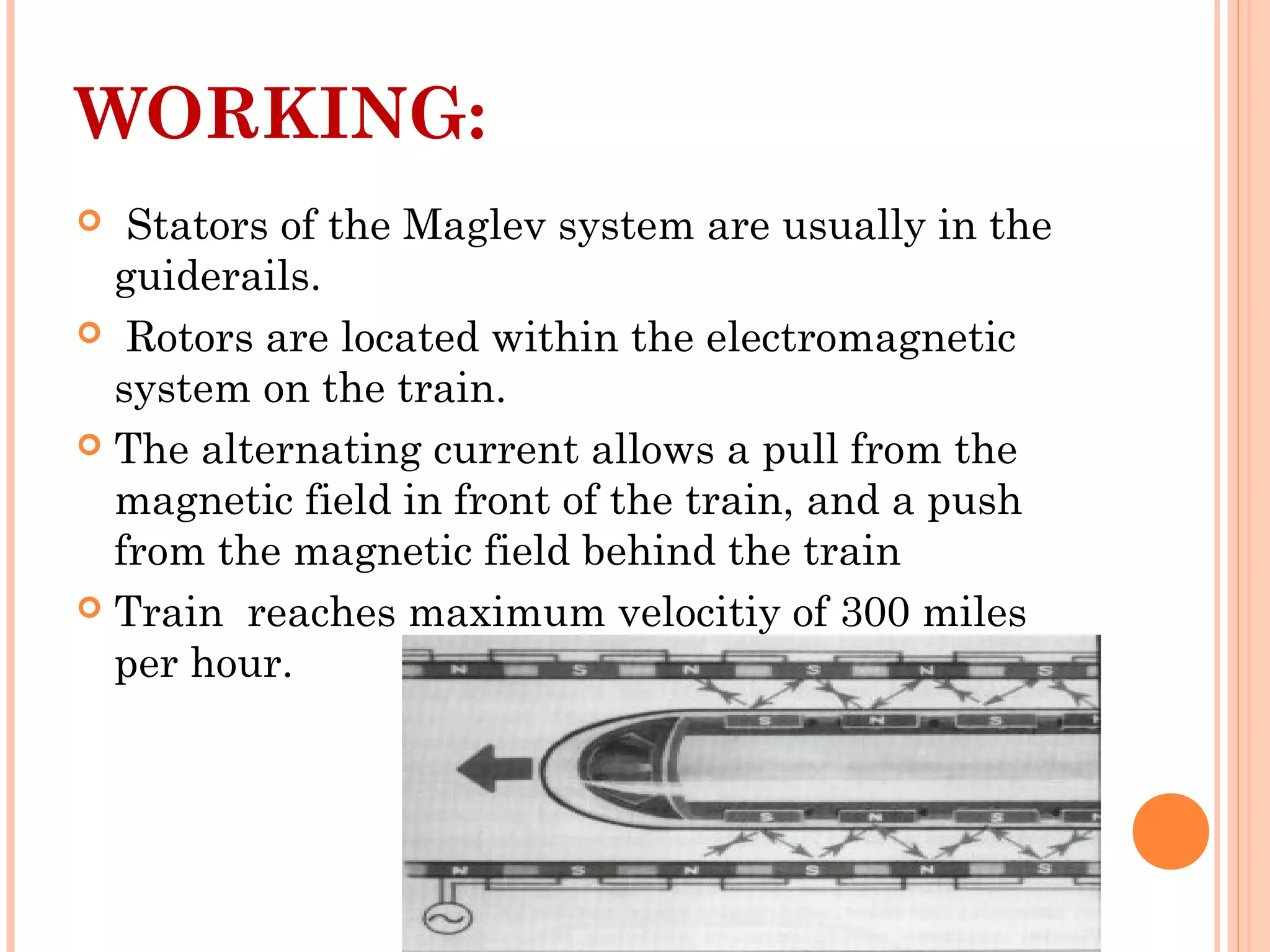
WORKING:
 Stators of the Maglev system are usually in the
guiderails.
 Rotors are located within the electromagnetic
system on the train.
 The alternating current allows a pull from the
magnetic field in front of the train, and a push
from the magnetic field behind the train
 Train reaches maximum velocitiy of 300 miles
per hour.
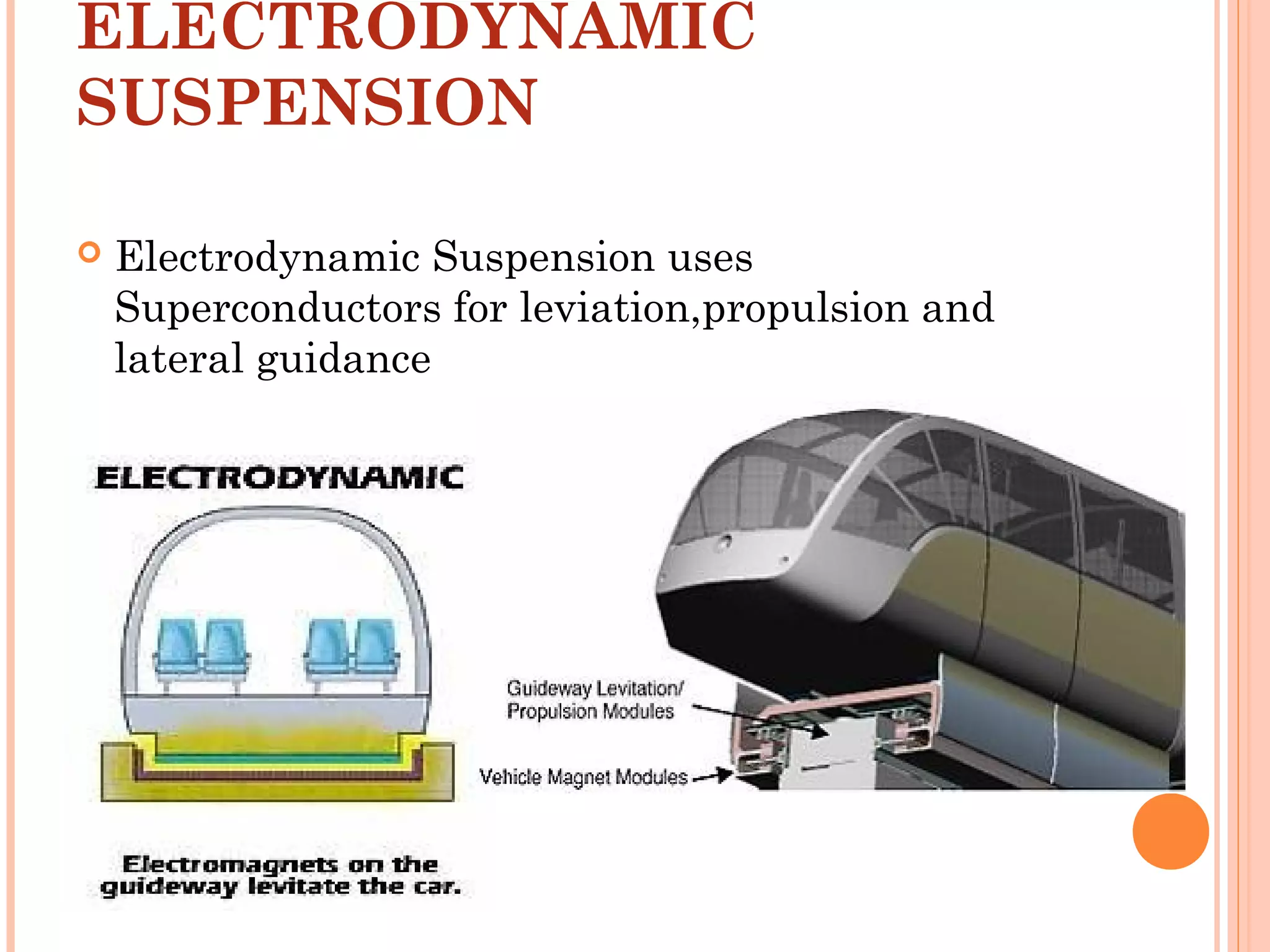
ELECTRODYNAMIC
SUSPENSION
 Electrodynamic Suspension uses
Superconductors for leviation,propulsion and
lateral guidance
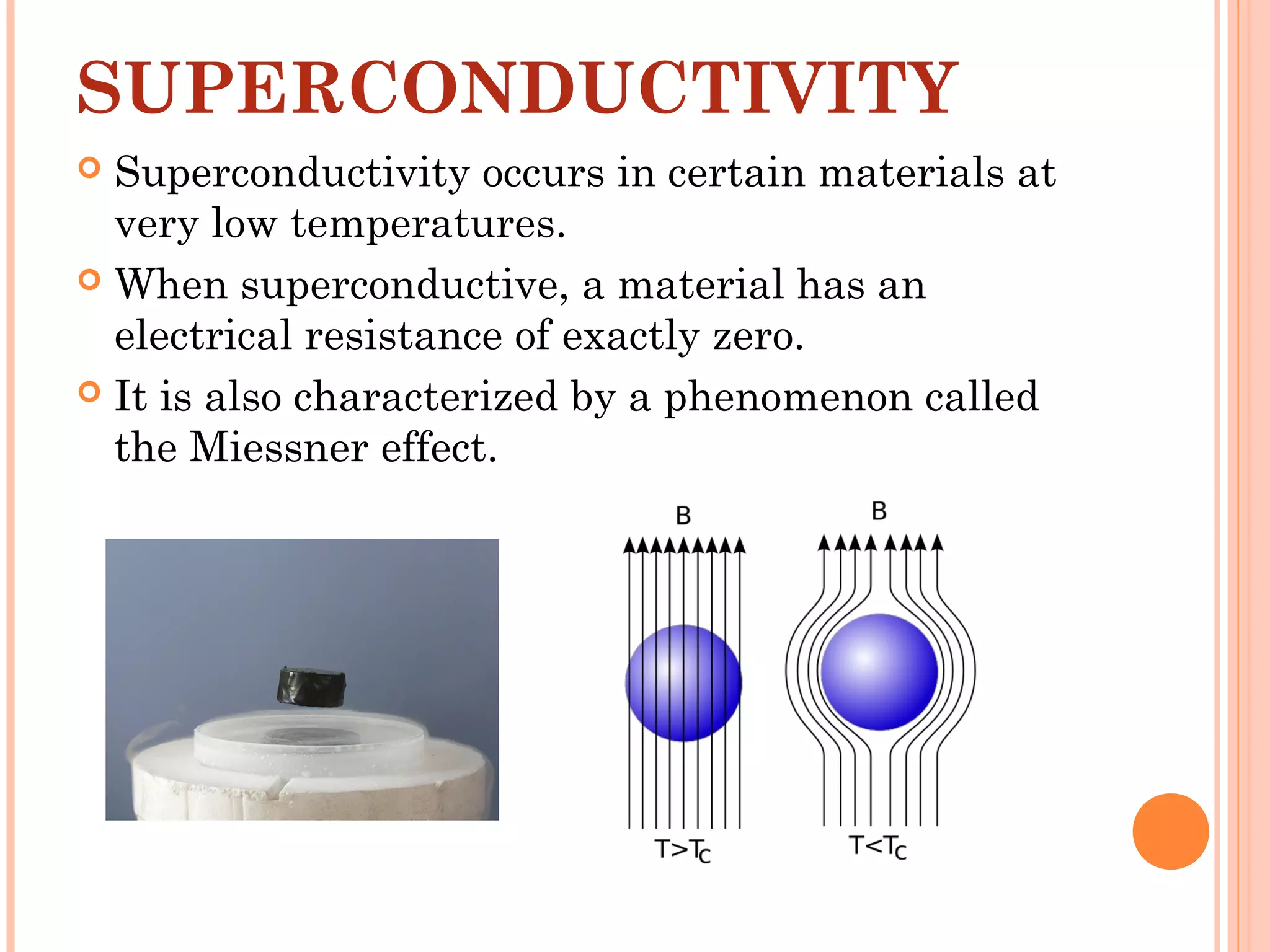
SUPERCONDUCTIVITY
 Superconductivity occurs in certain materials at
very low temperatures.
 When superconductive, a material has an
electrical resistance of exactly zero.
 It is also characterized by a phenomenon called
the Miessner effect.
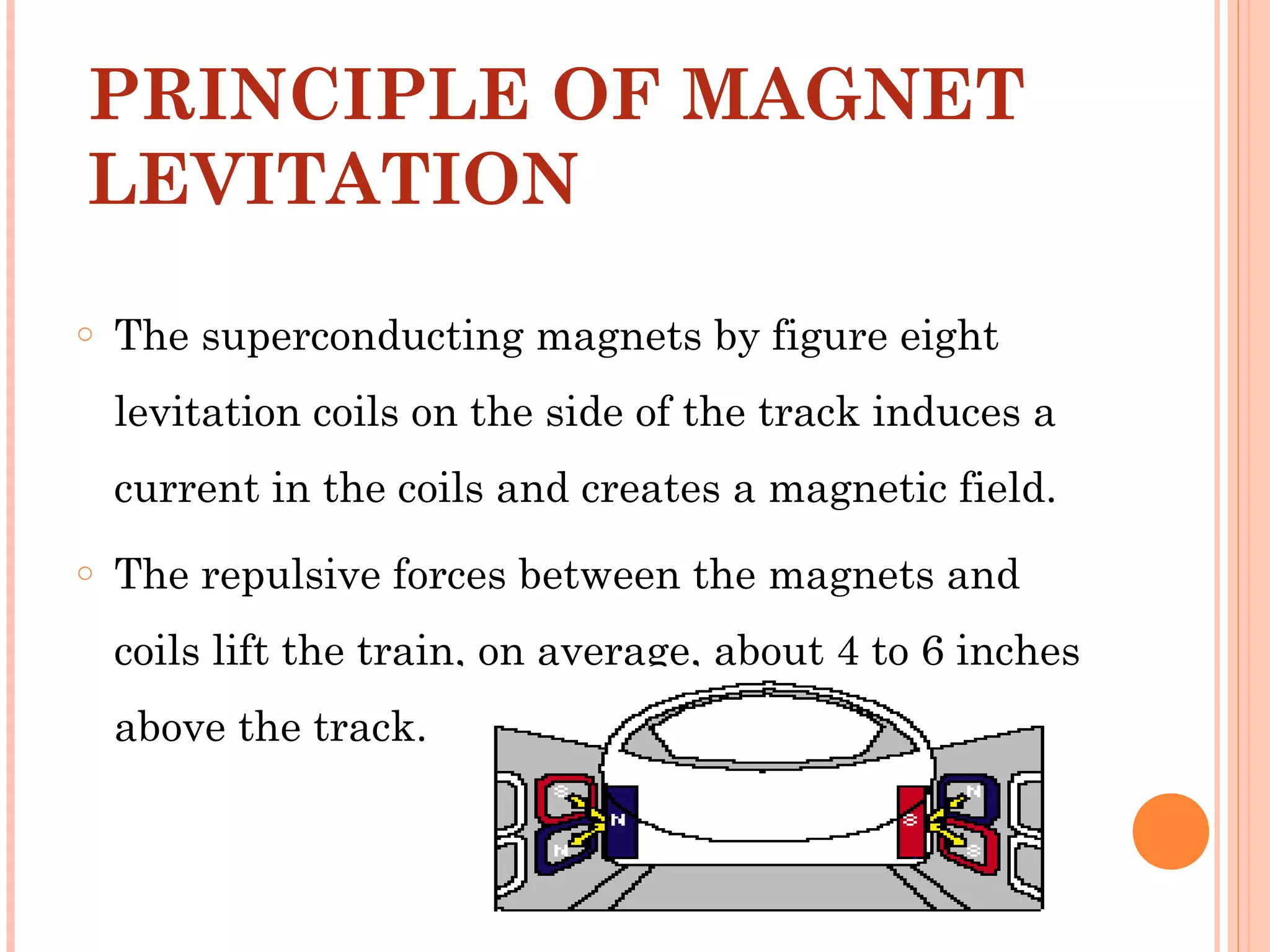
PRINCIPLE OF MAGNET
LEVITATION
o The superconducting magnets by figure eight
levitation coils on the side of the track induces a
current in the coils and creates a magnetic field.
o The repulsive forces between the magnets and
coils lift the train, on average, about 4 to 6 inches
above the track.
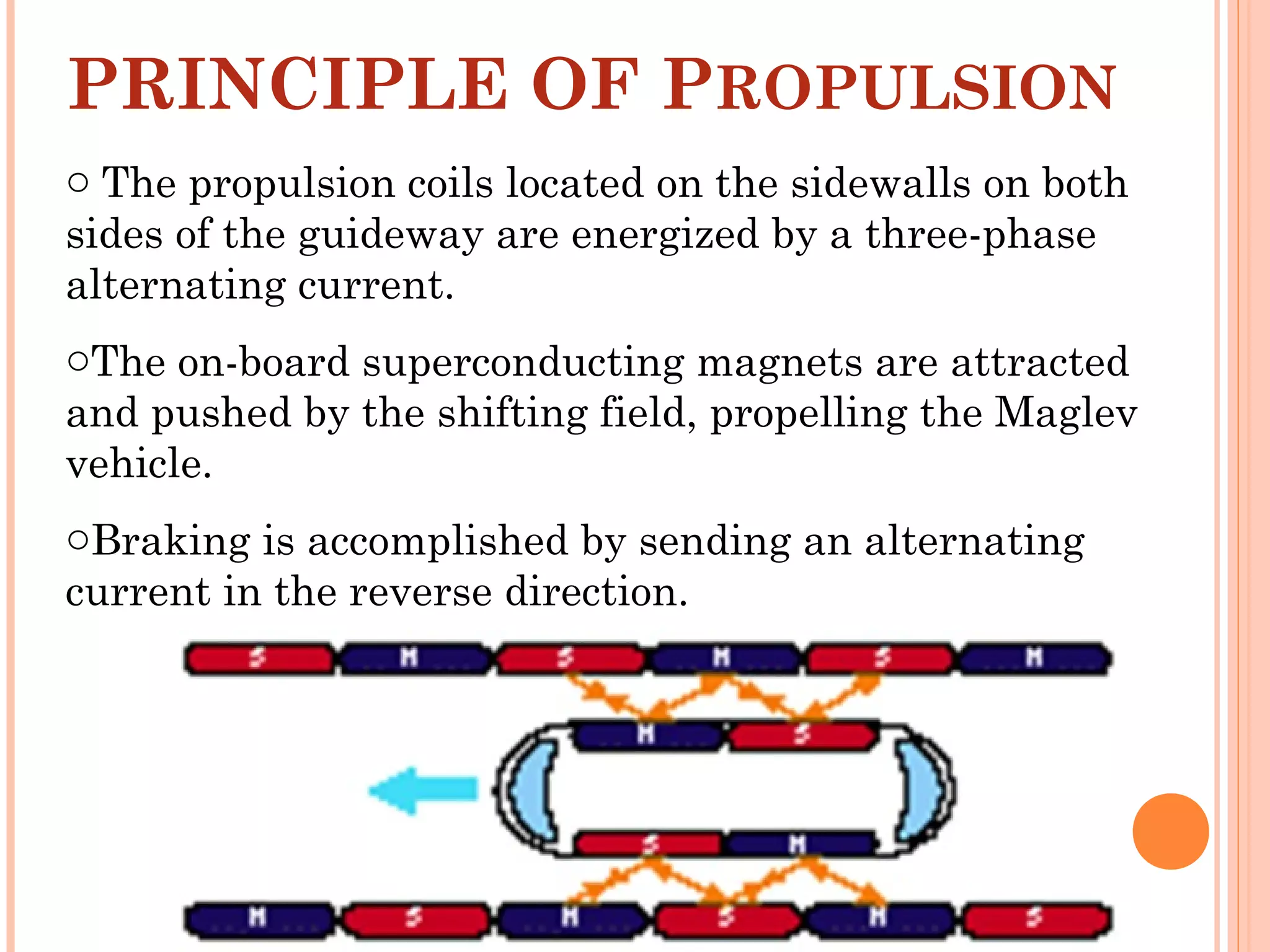
o The propulsion coils located on the sidewalls on both
sides of the guideway are energized by a three-phase
alternating current.
oThe on-board superconducting magnets are attracted
and pushed by the shifting field, propelling the Maglev
vehicle.
oBraking is accomplished by sending an alternating
current in the reverse direction.
PRINCIPLE OF PROPULSION
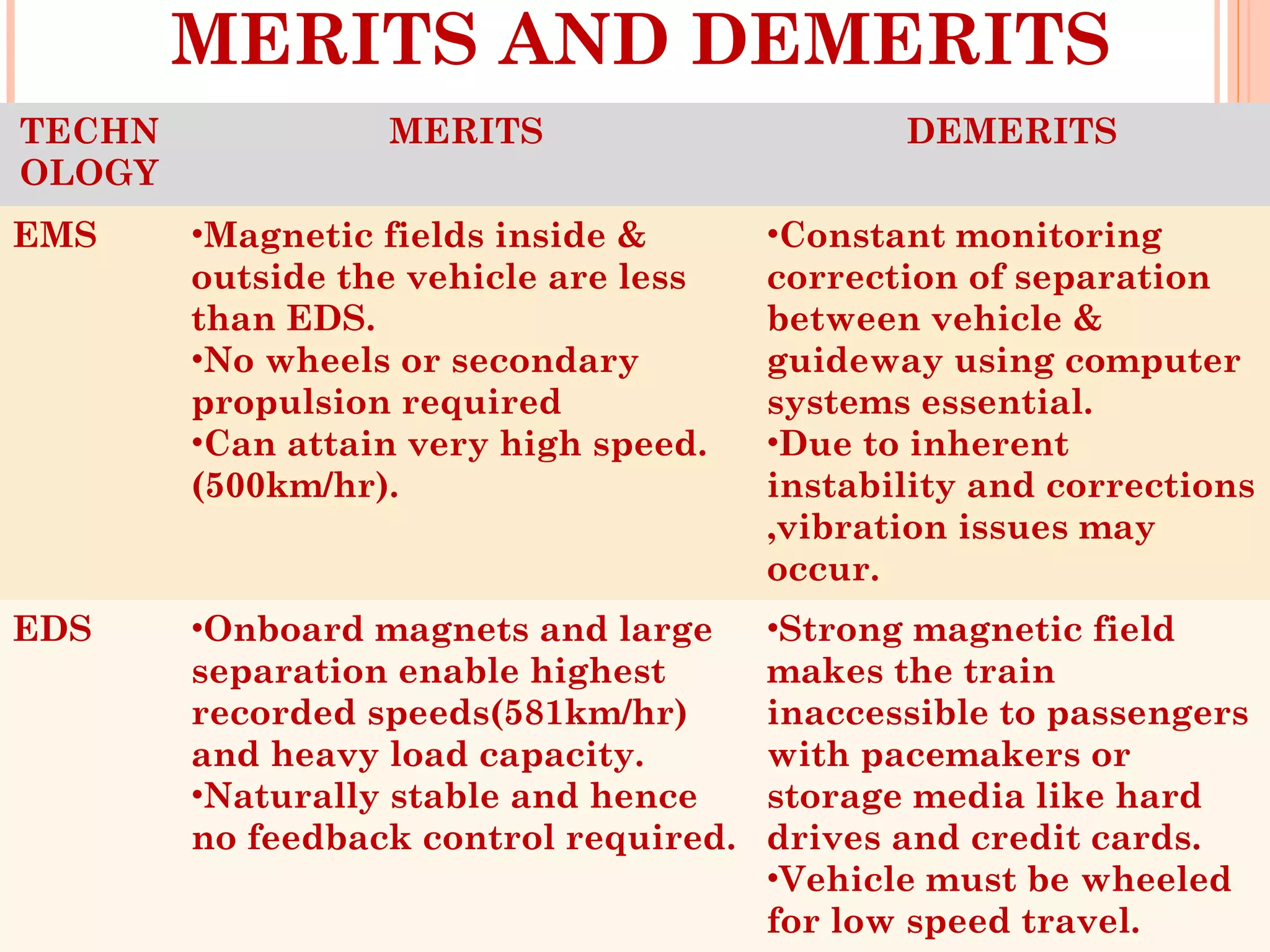
MERITS AND DEMERITS
TECHN
OLOGY
MERITS DEMERITS
EMS •Magnetic fields inside &
outside the vehicle are less
than EDS.
•No wheels or secondary
propulsion required
•Can attain very high speed.
(500km/hr).
•Constant monitoring
correction of separation
between vehicle &
guideway using computer
systems essential.
•Due to inherent
instability and corrections
,vibration issues may
occur.
EDS •Onboard magnets and large
separation enable highest
recorded speeds(581km/hr)
and heavy load capacity.
•Naturally stable and hence
no feedback control required.
•Strong magnetic field
makes the train
inaccessible to passengers
with pacemakers or
storage media like hard
drives and credit cards.
•Vehicle must be wheeled
for low speed travel.
ADVANTAGES OF MAGNETIC
LEVITATED TRANSPORTATION
SYSTEM
 A Maglev is way faster than your usual bullet
train. Maglevs can reach speeds up to 500
kilometres per hour. (Mumbai-Delhi in 2-3 hrs)
 Due to its lack of wheels, MagLevs are quieter
than normal trains, or sometimes even traffic.
 Maglevs use 30% less energy than normal trains.
 In theory, a Maglev and its track would require
very little maintenance since the train never
touches the track there is virtually no wear and
OTHER
APPLICATIONS
 NASA plans to use magnetic levitation for
launching of space vehicles into low earth orbit.
 Boeing is pursuing research in MagLev to
provide a Hypersonic Ground Test Facility for
the Air Force.
 The mining industry will also benefit from
MagLev.
 There are probably many more undiscovered
applications!
DISADVANTAGES:
 The Maglev's track is much more expensive than
railroad tracks.
 Whole new sets of tracks would have to be built
for the Maglev to run. Many Transportation
vehicles in Europe run on existing track, like the
TGV trains in France.
 Although Maglevs are pretty quiet, noise caused
by air disturbance still occurs.
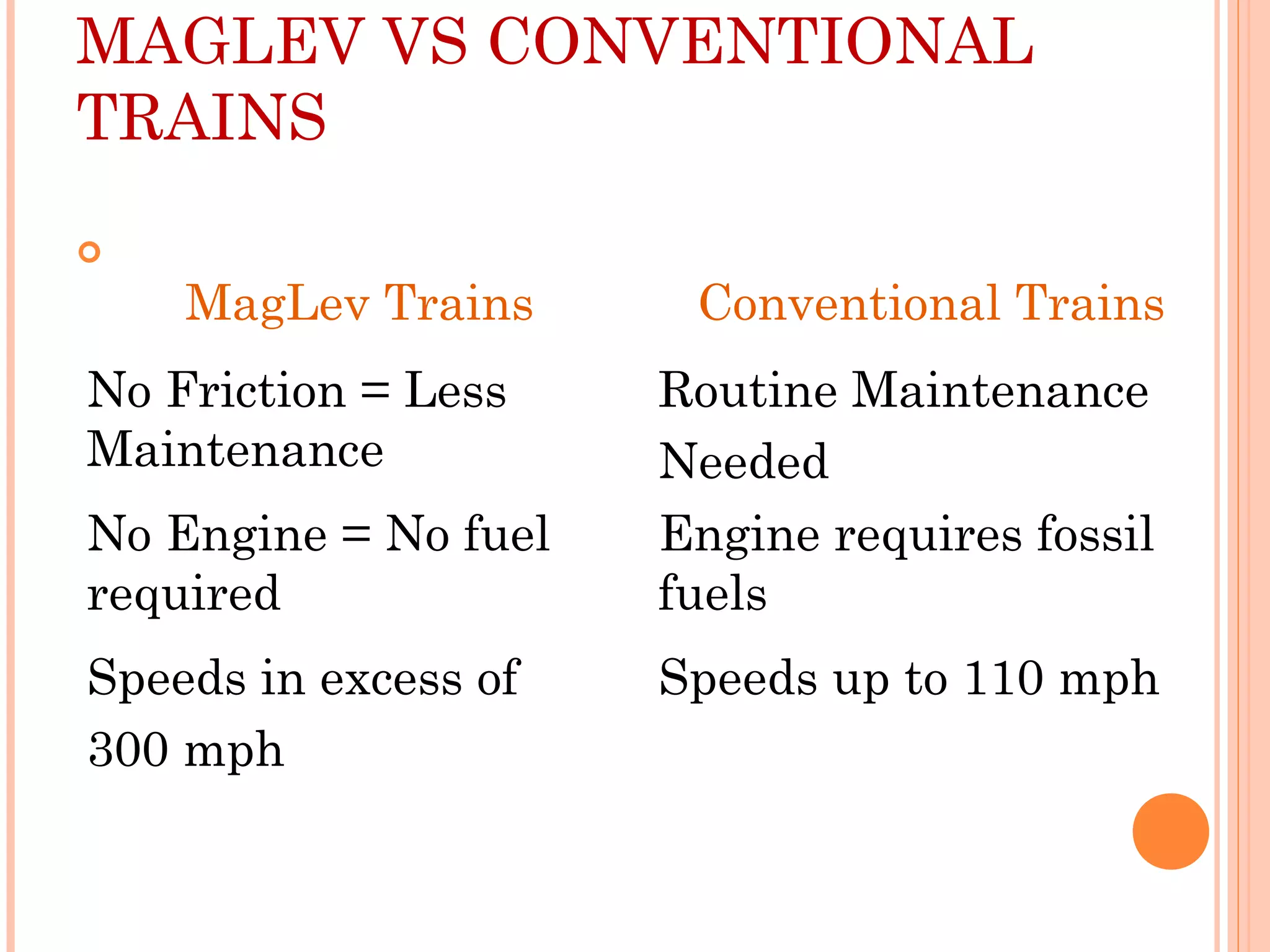
MAGLEV VS CONVENTIONAL
TRAINS

MagLev Trains Conventional Trains
No Friction = Less
Maintenance
Routine Maintenance
Needed
No Engine = No fuel
required
Engine requires fossil
fuels
Speeds in excess of
300 mph
Speeds up to 110 mph
CONCLUSION
 The MagLev Train: Research on this ‘dream
train' has been going on for the last 30 odd years
in various parts of the world.
 The chief advantages of this type of train are:
Non-contact and non-wearing propulsion,
independent of friction, no mechanical
components like wheel, axle.
 Maintenance cost is less.
 A country like India could benefit very much if
this were implemented here.
MAGLEV TRAIN (Train that floats in the air)

MAGLEV TRAIN (Train that floats in the air)

  • 1.
    MAGLEV TRAIN Train thatfloats in the air….. BY Mohammad Mokhim 160411735099
  • 2.
    INTRODUCTION:  Maglev=Magnetic +Levitation  Maglev runs on the principle of magnetic levitation.  Maglev is noiseless ,friction less , and require no maintenance.  Maglev is the best alternative for means of transport.
  • 3.
    MAGNETIC LEVIATION MagLev Technology; -levitatesobjects in air - electromagnetic propulsion - caused by electro magnets
  • 4.
    BASIC PRINCIPLE OF MAGLEVTRAINS 1.Leviation 2.Propulsion 3.Lateral Guidance
  • 5.
    TRAINS Based on thetechnique used for Leviation the are two types of Maglev trains 1. Electromagnetic Suspension -Attractive 2. Electrodynamic Suspension -repulsive
  • 6.
  • 7.
    PRINCIPLE OF MAGNETIC LEVIATION oElectromagnets attached to the train. o Has guidance magnets on the sides. o A computer changes the amount of current to keep the train 1 cm from the track. o Max speed -438km/hr o Has on-board battery power supply.
  • 8.
    PRINCIPLE OF PROPULSION  Theprinciple of electromagnetic propulsion is : “opposite poles attract each other and like poles repel each other”  Major components of this propulsion system. They are: A large electrical power source Metal coils that line the entire guideway Guidance magnets used for alignment
  • 9.
    WORKING:  Stators ofthe Maglev system are usually in the guiderails.  Rotors are located within the electromagnetic system on the train.  The alternating current allows a pull from the magnetic field in front of the train, and a push from the magnetic field behind the train  Train reaches maximum velocitiy of 300 miles per hour.
  • 10.
    ELECTRODYNAMIC SUSPENSION  Electrodynamic Suspensionuses Superconductors for leviation,propulsion and lateral guidance
  • 11.
    SUPERCONDUCTIVITY  Superconductivity occursin certain materials at very low temperatures.  When superconductive, a material has an electrical resistance of exactly zero.  It is also characterized by a phenomenon called the Miessner effect.
  • 12.
    PRINCIPLE OF MAGNET LEVITATION oThe superconducting magnets by figure eight levitation coils on the side of the track induces a current in the coils and creates a magnetic field. o The repulsive forces between the magnets and coils lift the train, on average, about 4 to 6 inches above the track.
  • 13.
    o The propulsioncoils located on the sidewalls on both sides of the guideway are energized by a three-phase alternating current. oThe on-board superconducting magnets are attracted and pushed by the shifting field, propelling the Maglev vehicle. oBraking is accomplished by sending an alternating current in the reverse direction. PRINCIPLE OF PROPULSION
  • 14.
    MERITS AND DEMERITS TECHN OLOGY MERITSDEMERITS EMS •Magnetic fields inside & outside the vehicle are less than EDS. •No wheels or secondary propulsion required •Can attain very high speed. (500km/hr). •Constant monitoring correction of separation between vehicle & guideway using computer systems essential. •Due to inherent instability and corrections ,vibration issues may occur. EDS •Onboard magnets and large separation enable highest recorded speeds(581km/hr) and heavy load capacity. •Naturally stable and hence no feedback control required. •Strong magnetic field makes the train inaccessible to passengers with pacemakers or storage media like hard drives and credit cards. •Vehicle must be wheeled for low speed travel.
  • 15.
    ADVANTAGES OF MAGNETIC LEVITATEDTRANSPORTATION SYSTEM  A Maglev is way faster than your usual bullet train. Maglevs can reach speeds up to 500 kilometres per hour. (Mumbai-Delhi in 2-3 hrs)  Due to its lack of wheels, MagLevs are quieter than normal trains, or sometimes even traffic.  Maglevs use 30% less energy than normal trains.  In theory, a Maglev and its track would require very little maintenance since the train never touches the track there is virtually no wear and
  • 16.
    OTHER APPLICATIONS  NASA plansto use magnetic levitation for launching of space vehicles into low earth orbit.  Boeing is pursuing research in MagLev to provide a Hypersonic Ground Test Facility for the Air Force.  The mining industry will also benefit from MagLev.  There are probably many more undiscovered applications!
  • 17.
    DISADVANTAGES:  The Maglev'strack is much more expensive than railroad tracks.  Whole new sets of tracks would have to be built for the Maglev to run. Many Transportation vehicles in Europe run on existing track, like the TGV trains in France.  Although Maglevs are pretty quiet, noise caused by air disturbance still occurs.
  • 18.
    MAGLEV VS CONVENTIONAL TRAINS  MagLevTrains Conventional Trains No Friction = Less Maintenance Routine Maintenance Needed No Engine = No fuel required Engine requires fossil fuels Speeds in excess of 300 mph Speeds up to 110 mph
  • 19.
    CONCLUSION  The MagLevTrain: Research on this ‘dream train' has been going on for the last 30 odd years in various parts of the world.  The chief advantages of this type of train are: Non-contact and non-wearing propulsion, independent of friction, no mechanical components like wheel, axle.  Maintenance cost is less.  A country like India could benefit very much if this were implemented here.