Maglev Train
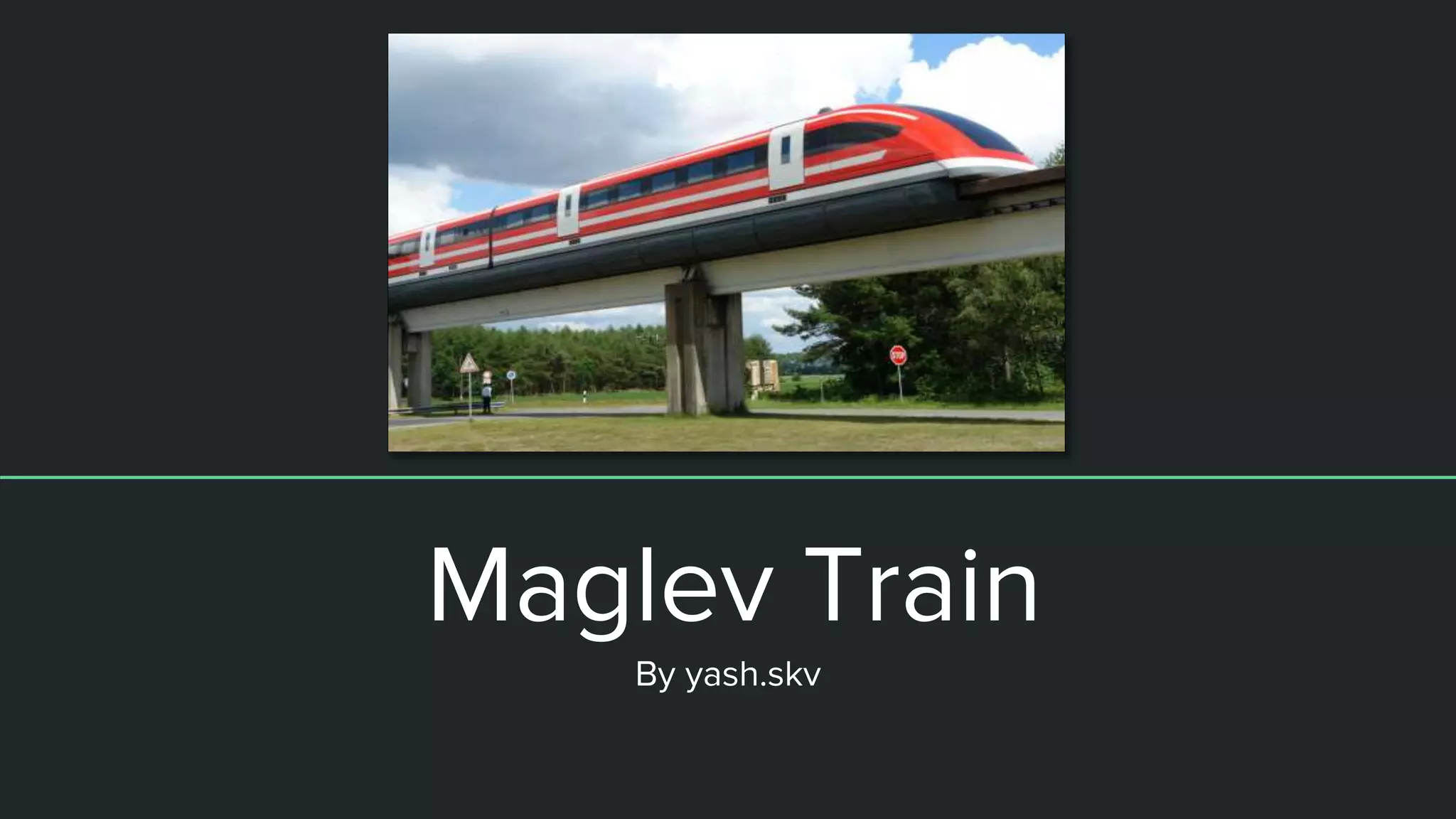
Maglev Train
By yash.skv
Maglev Train
Introduction
“Maglev =Magnetic + Levitation”
Any thing which may float or
raise by help of magnetic power
is called Magnetic Levitation.
Cost Effective House
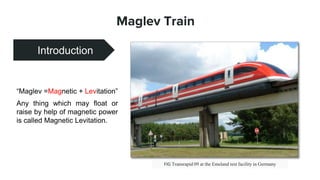
FIG Transrapid 09 at the Emsland test facility in Germany
STEPS OF MY PROJECT
In 1902, the first magnetic train was
invented by Alfred Zehden of Germany.
In 1959, the design for the first
magnetic train was created.
In 1979, first magnetic train was built in Hamburg,
Germany but was closed months later.
In 1984, the first train the people could
ride was built in Birmingham, England.
BRIEF HISTORY
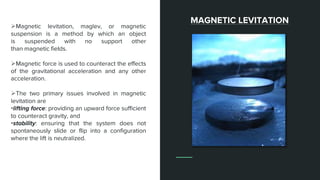
Magnetic levitation, maglev, or magnetic
suspension is a method by which an object
is suspended with no support other
than magnetic fields.
Magnetic force is used to counteract the effects
of the gravitational acceleration and any other
acceleration.
The two primary issues involved in magnetic
levitation are
•lifting force: providing an upward force sufficient
to counteract gravity, and
•stability: ensuring that the system does not
spontaneously slide or flip into a configuration
where the lift is neutralized.
MAGNETIC LEVITATION
STEPS OF MY PROJECT
LIFT
Magnetic materials and systems are able to attract or press each other apart or together with
a force dependent on the magnetic field and the area of the magnets.
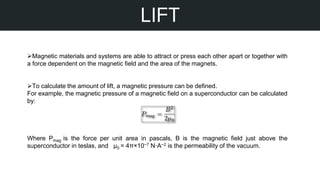
To calculate the amount of lift, a magnetic pressure can be defined.
For example, the magnetic pressure of a magnetic field on a superconductor can be calculated
by:
Where Pmag is the force per unit area in pascals, B is the magnetic field just above the
superconductor in teslas, and µ0 = 4π×10−7 N·A−2 is the permeability of the vacuum.
STEPS OF MY PROJECT
STABILITY
Using only paramagnetic materials (such as ferromagnetic iron) ,it is impossible for a static
system to stably levitate against gravity.
In some cases the lifting force is provided by magnetic levitation, but stability is provided by a
mechanical support bearing little load. This is termed pseudo-levitation.
STEPS OF MY PROJECT
TYPES OF STABILITY
STATIC STABILITY:
•Static stability means that any small displacement away from a stable equilibrium causes a
net force to push it back to the equilibrium point.
•Diamagnetic materials are used to provide static stability.
DYNAMIC STABILITY:
•Dynamic stability occurs when the levitation system is able to damp out any vibration-like
motion that may occur.
•Dynamic stability are provided byeddy current damping (conductive metal influenced by field)
and tuned mass dampers in the levitated object.
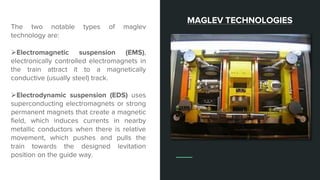
The two notable types of maglev
technology are:
Electromagnetic suspension (EMS),
electronically controlled electromagnets in
the train attract it to a magnetically
conductive (usually steel) track.
Electrodynamic suspension (EDS) uses
superconducting electromagnets or strong
permanent magnets that create a magnetic
field, which induces currents in nearby
metallic conductors when there is relative
movement, which pushes and pulls the
train towards the designed levitation
position on the guide way.
MAGLEV TECHNOLOGIES
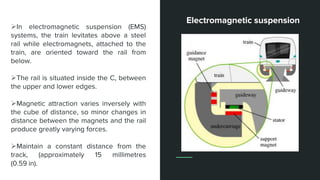
In electromagnetic suspension (EMS)
systems, the train levitates above a steel
rail while electromagnets, attached to the
train, are oriented toward the rail from
below.
The rail is situated inside the C, between
the upper and lower edges.
Magnetic attraction varies inversely with
the cube of distance, so minor changes in
distance between the magnets and the rail
produce greatly varying forces.
Maintain a constant distance from the
track, (approximately 15 millimetres
(0.59 in).
Electromagnetic suspension
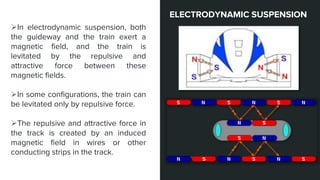
In electrodynamic suspension, both
the guideway and the train exert a
magnetic field, and the train is
levitated by the repulsive and
attractive force between these
magnetic fields.
In some configurations, the train can
be levitated only by repulsive force.
The repulsive and attractive force in
the track is created by an induced
magnetic field in wires or other
conducting strips in the track.
ELECTRODYNAMIC SUSPENSION
STEPS OF MY PROJECT
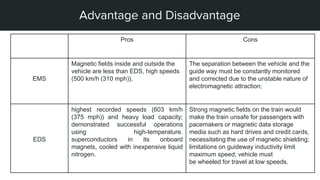
Advantage and Disadvantage
Pros Cons
EMS
Magnetic fields inside and outside the
vehicle are less than EDS, high speeds
(500 km/h (310 mph)).
The separation between the vehicle and the
guide way must be constantly monitored
and corrected due to the unstable nature of
electromagnetic attraction;
EDS
highest recorded speeds (603 km/h
(375 mph)) and heavy load capacity;
demonstrated successful operations
using high-temperature.
superconductors in its onboard
magnets, cooled with inexpensive liquid
nitrogen.
Strong magnetic fields on the train would
make the train unsafe for passengers with
pacemakers or magnetic data storage
media such as hard drives and credit cards,
necessitating the use of magnetic shielding;
limitations on guideway inductivity limit
maximum speed; vehicle must
be wheeled for travel at low speeds.
STEPS OF MY PROJECT
TRACKS
The term "maglev" refers not only to the vehicles, but to the railway system as well,
specifically designed for magnetic levitation and propulsion.
The SPM (Stabilized Permanent Magnet) maglev system is inter-operable with steel rail
tracks and would permit maglev vehicles and conventional trains to operate on the same
tracks. MAN in Germany also designed a maglev system that worked with conventional rails,
but it was never fully developed.
STEPS OF MY PROJECT
PROPULSION
EMS systems such as Linimo(is a magnetic levitation train line in Aichi
Prefecture, Japan, near the city of Nagoya) can provide both levitation
and propulsion using an onboard linear motor.
But EDS systems and some EMS systems such as Transrapid levitate
but do not propel. Such systems need some other technology
for propulsion.
A linear motor (propulsion coils) mounted in the track is one solution.
Over long distances coil costs could be prohibitive.
STEPS OF MY PROJECT
GUIDANCE SYSTEM
Some systems use Null Current systems (also sometimes called Null
Flux systems).
These use a coil that is wound so that it enters two opposing,
alternating fields, so that the average flux in the loop is zero.
When the vehicle is in the straight ahead position, no current flows, but
any moves off-line create flux that generates a field that naturally
pushes/pulls it back into line.
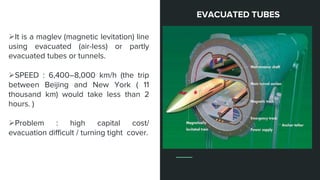
It is a maglev (magnetic levitation) line
using evacuated (air-less) or partly
evacuated tubes or tunnels.
SPEED : 6,400–8,000 km/h (the trip
between Beijing and New York ( 11
thousand km) would take less than 2
hours. )
Problem : high capital cost/
evacuation difficult / turning tight cover.
EVACUATED TUBES
STEPS OF MY PROJECT
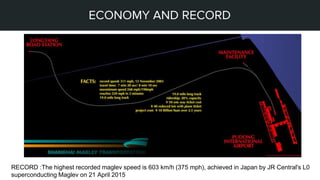
ECONOMY AND RECORD
RECORD :The highest recorded maglev speed is 603 km/h (375 mph), achieved in Japan by JR Central's L0
superconducting Maglev on 21 April 2015
STEPS OF MY PROJECT
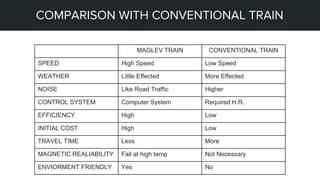
COMPARISON WITH CONVENTIONAL TRAIN
MAGLEV TRAIN CONVENTIONAL TRAIN
SPEED High Speed Low Speed
WEATHER Little Effected More Effected
NOISE Like Road Traffic Higher
CONTROL SYSTEM Computer System Required H.R.
EFFICIENCY High Low
INITIAL COST High Low
TRAVEL TIME Less More
MAGNETIC REALIABILITY Fail at high temp Not Necessary
ENVIORMENT FRIENDLY Yes No
STEPS OF MY PROJECT
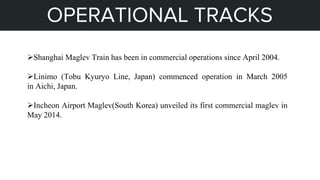
OPERATIONAL TRACKS
Shanghai Maglev Train has been in commercial operations since April 2004.
Linimo (Tobu Kyuryo Line, Japan) commenced operation in March 2005
in Aichi, Japan.
Incheon Airport Maglev(South Korea) unveiled its first commercial maglev in
May 2014.
STEPS OF MY PROJECT
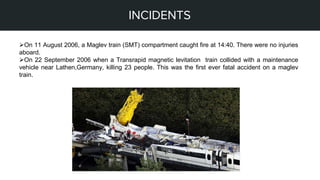
INCIDENTS
On 11 August 2006, a Maglev train (SMT) compartment caught fire at 14:40. There were no injuries
aboard.
On 22 September 2006 when a Transrapid magnetic levitation train collided with a maintenance
vehicle near Lathen,Germany, killing 23 people. This was the first ever fatal accident on a maglev
train.
FEASIBILITY IN INDIA
Pune (Pimple Saudagar) – Mumbai(Panvel) (100 Km and estimated cost $30 billion): The Indian
Ministry was in the process of reviewing a proposal to start a Maglev train system in India..
Pune and Mumbai has a freeway(also called as expressway) where approximately 14000 vehicles travel
daily, making fuel consumption at 0.2 million liters a day.
Chennai – Mysore ( 147 Km and estimated cost $ 26 million/ km) :Per Large and Medium Scale
Industries Minister of Karnataka Mr. Murugesh Nirani, a detailed report will be prepared and submitted by
December 2012 . The speed of Maglev will be 350 kmph and the Bangalore to Mysore portion would take as
little as 30 minutes.
Mumbai - Nagpur :The State of Maharashtra has also approved a feasibility study for a maglev train
between Mumbai (the commercial capital of India as well as the State government capital) and Nagpur (the
second State capital) about 1,000 km (620 mi) away.
THANKS

Seminar ppt

  • 1.
  • 2.
    Maglev Train Introduction “Maglev =Magnetic+ Levitation” Any thing which may float or raise by help of magnetic power is called Magnetic Levitation. Cost Effective House FIG Transrapid 09 at the Emsland test facility in Germany
  • 3.
    STEPS OF MYPROJECT In 1902, the first magnetic train was invented by Alfred Zehden of Germany. In 1959, the design for the first magnetic train was created. In 1979, first magnetic train was built in Hamburg, Germany but was closed months later. In 1984, the first train the people could ride was built in Birmingham, England. BRIEF HISTORY
  • 4.
    Magnetic levitation, maglev,or magnetic suspension is a method by which an object is suspended with no support other than magnetic fields. Magnetic force is used to counteract the effects of the gravitational acceleration and any other acceleration. The two primary issues involved in magnetic levitation are •lifting force: providing an upward force sufficient to counteract gravity, and •stability: ensuring that the system does not spontaneously slide or flip into a configuration where the lift is neutralized. MAGNETIC LEVITATION
  • 5.
    STEPS OF MYPROJECT LIFT Magnetic materials and systems are able to attract or press each other apart or together with a force dependent on the magnetic field and the area of the magnets. To calculate the amount of lift, a magnetic pressure can be defined. For example, the magnetic pressure of a magnetic field on a superconductor can be calculated by: Where Pmag is the force per unit area in pascals, B is the magnetic field just above the superconductor in teslas, and µ0 = 4π×10−7 N·A−2 is the permeability of the vacuum.
  • 6.
    STEPS OF MYPROJECT STABILITY Using only paramagnetic materials (such as ferromagnetic iron) ,it is impossible for a static system to stably levitate against gravity. In some cases the lifting force is provided by magnetic levitation, but stability is provided by a mechanical support bearing little load. This is termed pseudo-levitation.
  • 7.
    STEPS OF MYPROJECT TYPES OF STABILITY STATIC STABILITY: •Static stability means that any small displacement away from a stable equilibrium causes a net force to push it back to the equilibrium point. •Diamagnetic materials are used to provide static stability. DYNAMIC STABILITY: •Dynamic stability occurs when the levitation system is able to damp out any vibration-like motion that may occur. •Dynamic stability are provided byeddy current damping (conductive metal influenced by field) and tuned mass dampers in the levitated object.
  • 8.
    The two notabletypes of maglev technology are: Electromagnetic suspension (EMS), electronically controlled electromagnets in the train attract it to a magnetically conductive (usually steel) track. Electrodynamic suspension (EDS) uses superconducting electromagnets or strong permanent magnets that create a magnetic field, which induces currents in nearby metallic conductors when there is relative movement, which pushes and pulls the train towards the designed levitation position on the guide way. MAGLEV TECHNOLOGIES
  • 9.
    In electromagnetic suspension(EMS) systems, the train levitates above a steel rail while electromagnets, attached to the train, are oriented toward the rail from below. The rail is situated inside the C, between the upper and lower edges. Magnetic attraction varies inversely with the cube of distance, so minor changes in distance between the magnets and the rail produce greatly varying forces. Maintain a constant distance from the track, (approximately 15 millimetres (0.59 in). Electromagnetic suspension
  • 10.
    In electrodynamic suspension,both the guideway and the train exert a magnetic field, and the train is levitated by the repulsive and attractive force between these magnetic fields. In some configurations, the train can be levitated only by repulsive force. The repulsive and attractive force in the track is created by an induced magnetic field in wires or other conducting strips in the track. ELECTRODYNAMIC SUSPENSION
  • 11.
    STEPS OF MYPROJECT Advantage and Disadvantage Pros Cons EMS Magnetic fields inside and outside the vehicle are less than EDS, high speeds (500 km/h (310 mph)). The separation between the vehicle and the guide way must be constantly monitored and corrected due to the unstable nature of electromagnetic attraction; EDS highest recorded speeds (603 km/h (375 mph)) and heavy load capacity; demonstrated successful operations using high-temperature. superconductors in its onboard magnets, cooled with inexpensive liquid nitrogen. Strong magnetic fields on the train would make the train unsafe for passengers with pacemakers or magnetic data storage media such as hard drives and credit cards, necessitating the use of magnetic shielding; limitations on guideway inductivity limit maximum speed; vehicle must be wheeled for travel at low speeds.
  • 12.
    STEPS OF MYPROJECT TRACKS The term "maglev" refers not only to the vehicles, but to the railway system as well, specifically designed for magnetic levitation and propulsion. The SPM (Stabilized Permanent Magnet) maglev system is inter-operable with steel rail tracks and would permit maglev vehicles and conventional trains to operate on the same tracks. MAN in Germany also designed a maglev system that worked with conventional rails, but it was never fully developed.
  • 13.
    STEPS OF MYPROJECT PROPULSION EMS systems such as Linimo(is a magnetic levitation train line in Aichi Prefecture, Japan, near the city of Nagoya) can provide both levitation and propulsion using an onboard linear motor. But EDS systems and some EMS systems such as Transrapid levitate but do not propel. Such systems need some other technology for propulsion. A linear motor (propulsion coils) mounted in the track is one solution. Over long distances coil costs could be prohibitive.
  • 14.
    STEPS OF MYPROJECT GUIDANCE SYSTEM Some systems use Null Current systems (also sometimes called Null Flux systems). These use a coil that is wound so that it enters two opposing, alternating fields, so that the average flux in the loop is zero. When the vehicle is in the straight ahead position, no current flows, but any moves off-line create flux that generates a field that naturally pushes/pulls it back into line.
  • 15.
    It is amaglev (magnetic levitation) line using evacuated (air-less) or partly evacuated tubes or tunnels. SPEED : 6,400–8,000 km/h (the trip between Beijing and New York ( 11 thousand km) would take less than 2 hours. ) Problem : high capital cost/ evacuation difficult / turning tight cover. EVACUATED TUBES
  • 16.
    STEPS OF MYPROJECT ECONOMY AND RECORD RECORD :The highest recorded maglev speed is 603 km/h (375 mph), achieved in Japan by JR Central's L0 superconducting Maglev on 21 April 2015
  • 17.
    STEPS OF MYPROJECT COMPARISON WITH CONVENTIONAL TRAIN MAGLEV TRAIN CONVENTIONAL TRAIN SPEED High Speed Low Speed WEATHER Little Effected More Effected NOISE Like Road Traffic Higher CONTROL SYSTEM Computer System Required H.R. EFFICIENCY High Low INITIAL COST High Low TRAVEL TIME Less More MAGNETIC REALIABILITY Fail at high temp Not Necessary ENVIORMENT FRIENDLY Yes No
  • 18.
    STEPS OF MYPROJECT OPERATIONAL TRACKS Shanghai Maglev Train has been in commercial operations since April 2004. Linimo (Tobu Kyuryo Line, Japan) commenced operation in March 2005 in Aichi, Japan. Incheon Airport Maglev(South Korea) unveiled its first commercial maglev in May 2014.
  • 19.
    STEPS OF MYPROJECT INCIDENTS On 11 August 2006, a Maglev train (SMT) compartment caught fire at 14:40. There were no injuries aboard. On 22 September 2006 when a Transrapid magnetic levitation train collided with a maintenance vehicle near Lathen,Germany, killing 23 people. This was the first ever fatal accident on a maglev train.
  • 20.
    FEASIBILITY IN INDIA Pune(Pimple Saudagar) – Mumbai(Panvel) (100 Km and estimated cost $30 billion): The Indian Ministry was in the process of reviewing a proposal to start a Maglev train system in India.. Pune and Mumbai has a freeway(also called as expressway) where approximately 14000 vehicles travel daily, making fuel consumption at 0.2 million liters a day. Chennai – Mysore ( 147 Km and estimated cost $ 26 million/ km) :Per Large and Medium Scale Industries Minister of Karnataka Mr. Murugesh Nirani, a detailed report will be prepared and submitted by December 2012 . The speed of Maglev will be 350 kmph and the Bangalore to Mysore portion would take as little as 30 minutes. Mumbai - Nagpur :The State of Maharashtra has also approved a feasibility study for a maglev train between Mumbai (the commercial capital of India as well as the State government capital) and Nagpur (the second State capital) about 1,000 km (620 mi) away.
  • 21.