SUBMITTED BY:
Vishnu v
20030903
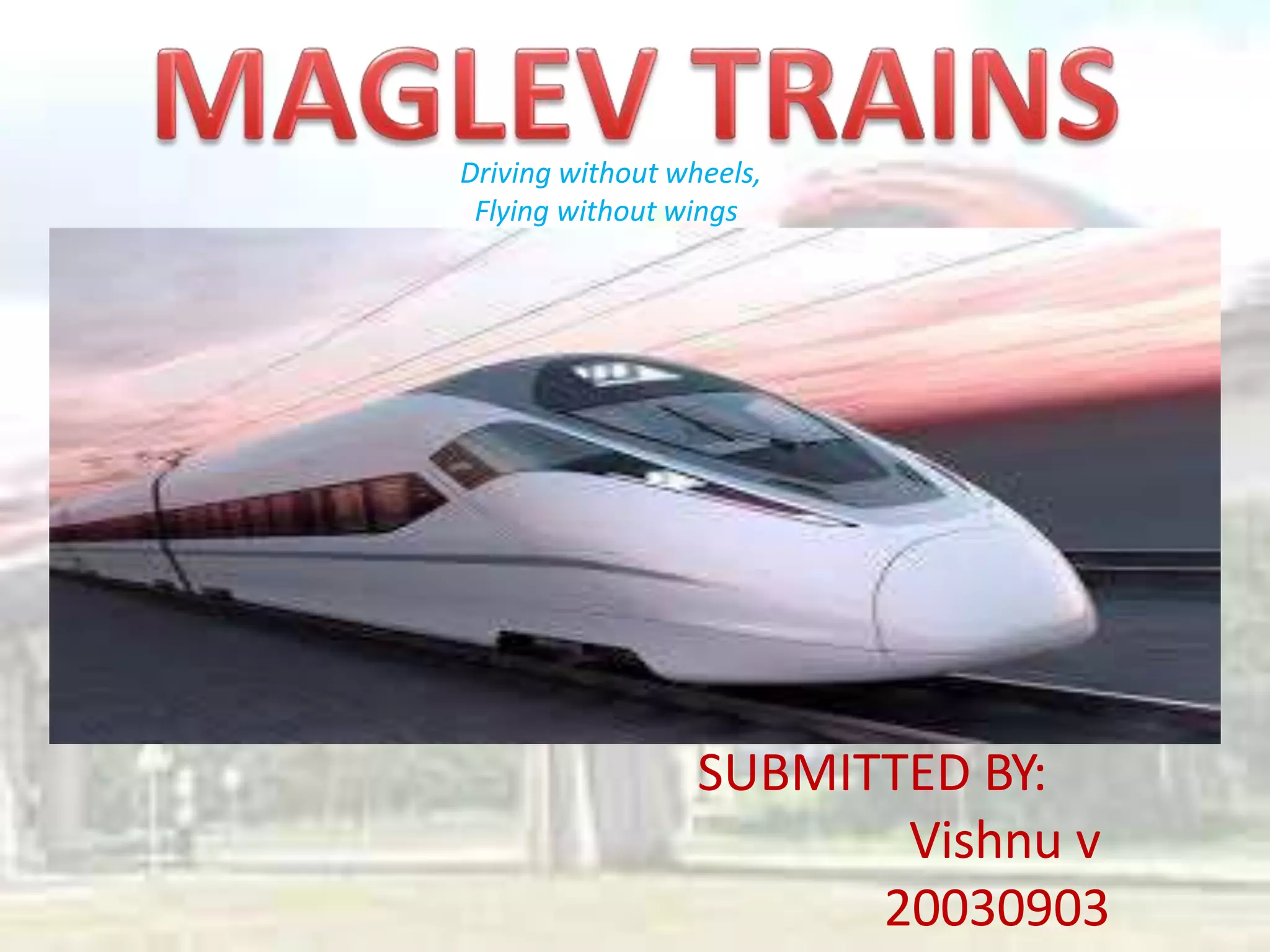
Driving without wheels,
Flying without wings
• INTRODUCTION
• BASIC PRINCIPLE OF MAGLEV TRAINS
• TECHNOLOGY AND TYPES
• EVACUATED TUBES
• POWER AND ENERGY
• EXISTING MAGLEV SYSTEMS
• SUMMARY
• REFERENCE
What is meant by MAGLEV?
MAGLEV = MAGNETIC + LEVITATION
Any thing which may levitate(raise or float) by means of a
magnetic power is simply called as magnetic levitation.
LEVITATION :
Meaning :
• A Latin word meaning lightness.
•Process by which an object is suspended by a physical force against gravity, in a
stable position without any solid physical contact.
Principle :
• First a force is required vertically upwards and equal to the gravitational force.
•Second for any small displacement of the levitating object a returning force
should appear to stabilize it.
Major Types :
• Electromagnetic levitation
• Buoyant levitation
• Aerodynamic levitation
Maglev is the system of transportation that uses
magnetic levitation to suspend ,guide and propel the
vehicles using magnets.
First described by Robert Goddard, American Rocket
Scientist, 1909 Scientific American.
Later in 1937 & 1941 a series of German patents for
maglev trains propelled by linear motors awarded to
Hermann Kemper .
In the 1960s in Britain Eric Laithwaite developed a
functional maglev train.
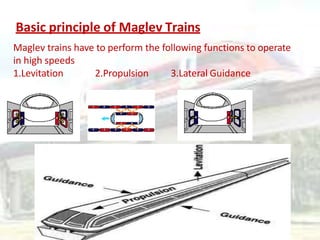
Maglev trains have to perform the following functions to operate
in high speeds
1.Levitation 2.Propulsion 3.Lateral Guidance
Basic principle of Maglev Trains
Levitation
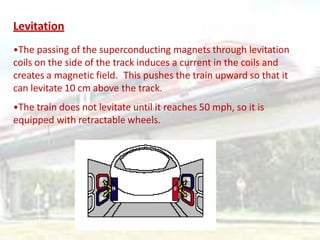
•The passing of the superconducting magnets through levitation
coils on the side of the track induces a current in the coils and
creates a magnetic field. This pushes the train upward so that it
can levitate 10 cm above the track.
•The train does not levitate until it reaches 50 mph, so it is
equipped with retractable wheels.
Propulsion
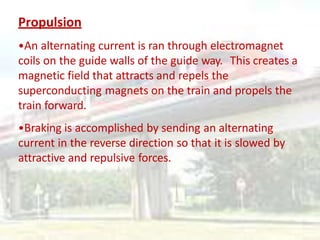
•An alternating current is ran through electromagnet
coils on the guide walls of the guide way. This creates a
magnetic field that attracts and repels the
superconducting magnets on the train and propels the
train forward.
•Braking is accomplished by sending an alternating
current in the reverse direction so that it is slowed by
attractive and repulsive forces.
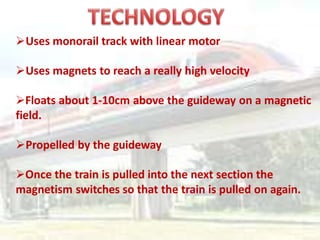
Uses monorail track with linear motor
Uses magnets to reach a really high velocity
Floats about 1-10cm above the guideway on a magnetic
field.
Propelled by the guideway
Once the train is pulled into the next section the
magnetism switches so that the train is pulled on again.
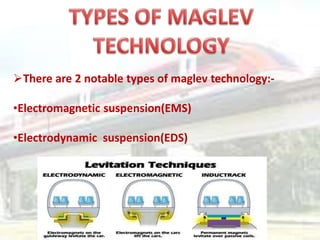
There are 2 notable types of maglev technology:-
•Electromagnetic suspension(EMS)
•Electrodynamic suspension(EDS)
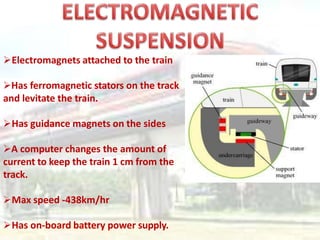
Electromagnets attached to the train
Has ferromagnetic stators on the track
and levitate the train.
Has guidance magnets on the sides
A computer changes the amount of
current to keep the train 1 cm from the
track.
Max speed -438km/hr
Has on-board battery power supply.
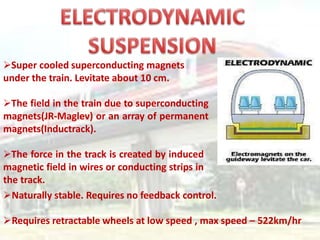
Super cooled superconducting magnets
under the train. Levitate about 10 cm.
The field in the train due to superconducting
magnets(JR-Maglev) or an array of permanent
magnets(Inductrack).
The force in the track is created by induced
magnetic field in wires or conducting strips in
the track.
Naturally stable. Requires no feedback control.
Requires retractable wheels at low speed , max speed – 522km/hr
Some systems use the use of vac trains-maglev
train technology used in evacuated tubes , which
removes the air drag.
This increases the speed and efficiency greatly .
It is a proposed design for super high-speed
transportation about 4000-5000 mph.
But the passengers may suffer from the risk of
cabin depressurization in the event of a train
malfunction.
Hence require tunnel monitoring system for
repressurization
Energy is used to make the Maglev train levitate and to
stabilise the movement.
Main part of the energy used to overcome the air drag.
For very short distances the energy for accelerating is
considerable.
But the power used to overcome the air drag increases with
square of velocity and hence dominates at high speed.
Many maglev have lift-to-drag ratio that exceed that of
aircraft.
But jet transport aircraft take advantage of low air density
at high altitudes to reduce drag during cruise.
Airlines cannot come close to the reliability or
performance of maglev trains in all weather conditions.
Has significant safety margin as they are designed not to
crash into other.
TESTING TRACKS
120 m test track of General Atomics at San Diego , USA.
Tranrapid , a German maglev company has test track at Emsland ,
Germany of length 31.5km.
JR-Maglev , Japan has a test track that can reach a speed of
581km/hr.
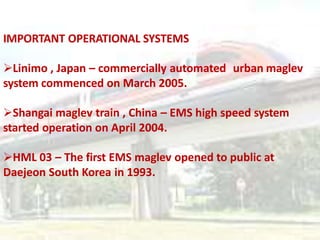
IMPORTANT OPERATIONAL SYSTEMS
Linimo , Japan – commercially automated urban maglev
system commenced on March 2005.
Shangai maglev train , China – EMS high speed system
started operation on April 2004.
HML 03 – The first EMS maglev opened to public at
Daejeon South Korea in 1993.
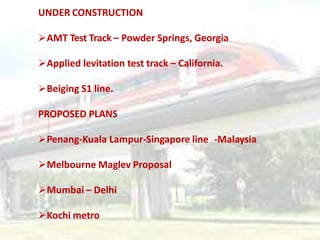
UNDER CONSTRUCTION
AMT Test Track – Powder Springs, Georgia
Applied levitation test track – California.
Beiging S1 line.
PROPOSED PLANS
Penang-Kuala Lampur-Singapore line -Malaysia
Melbourne Maglev Proposal
Mumbai – Delhi
Kochi metro
They consume less energy.
Require no engine.
Move faster than normal trains because they are not affected by
ground friction; their rights-of-way, meanwhile, cost about the
same to build.
Incompatible with existing rail lines, unlike traditional high-
speed rail.
Initial cost is very high.
Wikipedia –”Maglev Trains”
 Science reporter magazine October 2014.
Heller, Arnie (June 1998). "A New Approach for Magnetically Levitating
Trains—and Rockets". Science & Technology Review.
Hood, Christopher P.(2006). Shinkansen – From Bullet Train to Symbol of
Modern Japan. Routledge.
Science journal.’Maglev train’ April 19, 2010,
http://science.howstuffworks.com/maglev-train.htm
Thank you

DOC-20221111-WA0008..pptx

  • 1.
    SUBMITTED BY: Vishnu v 20030903 Drivingwithout wheels, Flying without wings
  • 2.
    • INTRODUCTION • BASICPRINCIPLE OF MAGLEV TRAINS • TECHNOLOGY AND TYPES • EVACUATED TUBES • POWER AND ENERGY • EXISTING MAGLEV SYSTEMS • SUMMARY • REFERENCE
  • 3.
    What is meantby MAGLEV? MAGLEV = MAGNETIC + LEVITATION Any thing which may levitate(raise or float) by means of a magnetic power is simply called as magnetic levitation.
  • 4.
    LEVITATION : Meaning : •A Latin word meaning lightness. •Process by which an object is suspended by a physical force against gravity, in a stable position without any solid physical contact. Principle : • First a force is required vertically upwards and equal to the gravitational force. •Second for any small displacement of the levitating object a returning force should appear to stabilize it. Major Types : • Electromagnetic levitation • Buoyant levitation • Aerodynamic levitation
  • 5.
    Maglev is thesystem of transportation that uses magnetic levitation to suspend ,guide and propel the vehicles using magnets. First described by Robert Goddard, American Rocket Scientist, 1909 Scientific American. Later in 1937 & 1941 a series of German patents for maglev trains propelled by linear motors awarded to Hermann Kemper . In the 1960s in Britain Eric Laithwaite developed a functional maglev train.
  • 6.
    Maglev trains haveto perform the following functions to operate in high speeds 1.Levitation 2.Propulsion 3.Lateral Guidance Basic principle of Maglev Trains
  • 7.
    Levitation •The passing ofthe superconducting magnets through levitation coils on the side of the track induces a current in the coils and creates a magnetic field. This pushes the train upward so that it can levitate 10 cm above the track. •The train does not levitate until it reaches 50 mph, so it is equipped with retractable wheels.
  • 8.
    Propulsion •An alternating currentis ran through electromagnet coils on the guide walls of the guide way. This creates a magnetic field that attracts and repels the superconducting magnets on the train and propels the train forward. •Braking is accomplished by sending an alternating current in the reverse direction so that it is slowed by attractive and repulsive forces.
  • 9.
    Uses monorail trackwith linear motor Uses magnets to reach a really high velocity Floats about 1-10cm above the guideway on a magnetic field. Propelled by the guideway Once the train is pulled into the next section the magnetism switches so that the train is pulled on again.
  • 10.
    There are 2notable types of maglev technology:- •Electromagnetic suspension(EMS) •Electrodynamic suspension(EDS)
  • 11.
    Electromagnets attached tothe train Has ferromagnetic stators on the track and levitate the train. Has guidance magnets on the sides A computer changes the amount of current to keep the train 1 cm from the track. Max speed -438km/hr Has on-board battery power supply.
  • 12.
    Super cooled superconductingmagnets under the train. Levitate about 10 cm. The field in the train due to superconducting magnets(JR-Maglev) or an array of permanent magnets(Inductrack). The force in the track is created by induced magnetic field in wires or conducting strips in the track. Naturally stable. Requires no feedback control. Requires retractable wheels at low speed , max speed – 522km/hr
  • 13.
    Some systems usethe use of vac trains-maglev train technology used in evacuated tubes , which removes the air drag. This increases the speed and efficiency greatly . It is a proposed design for super high-speed transportation about 4000-5000 mph. But the passengers may suffer from the risk of cabin depressurization in the event of a train malfunction. Hence require tunnel monitoring system for repressurization
  • 14.
    Energy is usedto make the Maglev train levitate and to stabilise the movement. Main part of the energy used to overcome the air drag. For very short distances the energy for accelerating is considerable. But the power used to overcome the air drag increases with square of velocity and hence dominates at high speed.
  • 15.
    Many maglev havelift-to-drag ratio that exceed that of aircraft. But jet transport aircraft take advantage of low air density at high altitudes to reduce drag during cruise. Airlines cannot come close to the reliability or performance of maglev trains in all weather conditions. Has significant safety margin as they are designed not to crash into other.
  • 16.
    TESTING TRACKS 120 mtest track of General Atomics at San Diego , USA. Tranrapid , a German maglev company has test track at Emsland , Germany of length 31.5km. JR-Maglev , Japan has a test track that can reach a speed of 581km/hr.
  • 17.
    IMPORTANT OPERATIONAL SYSTEMS Linimo, Japan – commercially automated urban maglev system commenced on March 2005. Shangai maglev train , China – EMS high speed system started operation on April 2004. HML 03 – The first EMS maglev opened to public at Daejeon South Korea in 1993.
  • 18.
    UNDER CONSTRUCTION AMT TestTrack – Powder Springs, Georgia Applied levitation test track – California. Beiging S1 line. PROPOSED PLANS Penang-Kuala Lampur-Singapore line -Malaysia Melbourne Maglev Proposal Mumbai – Delhi Kochi metro
  • 19.
    They consume lessenergy. Require no engine. Move faster than normal trains because they are not affected by ground friction; their rights-of-way, meanwhile, cost about the same to build. Incompatible with existing rail lines, unlike traditional high- speed rail. Initial cost is very high.
  • 20.
    Wikipedia –”Maglev Trains” Science reporter magazine October 2014. Heller, Arnie (June 1998). "A New Approach for Magnetically Levitating Trains—and Rockets". Science & Technology Review. Hood, Christopher P.(2006). Shinkansen – From Bullet Train to Symbol of Modern Japan. Routledge. Science journal.’Maglev train’ April 19, 2010, http://science.howstuffworks.com/maglev-train.htm
  • 21.