CONTENTS
INTRODUCTION
TYPES OF MAGLEV TECHNOLOGY
BASIC STRUCTURE
COMPARISON WITH COMMERCIAL TRAINS
ADVANTAGES
CONCLUSION
INTRODUCTION
Maglev is a system of transportation that suspends, guides and
 propels vehicles, predominantly trains, using magnetic
 levitation from a very large number of magnets for lift and
 propulsion.

The highest recorded speed is 581 km/h achieved in Japan in
 2003.
TYPES OF MAGLEV TECHNOLOGY

There are 2 notable types of maglev technology:-

• Electromagnetic suspension(EMS)
• Electrodynamic suspension(EDS)
• Induct rack
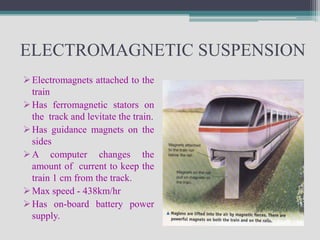
ELECTROMAGNETIC SUSPENSION
 Electromagnets attached to the
  train
 Has ferromagnetic stators on
  the track and levitate the train.
 Has guidance magnets on the
  sides
 A computer changes the
  amount of current to keep the
  train 1 cm from the track.
 Max speed - 438km/hr
 Has on-board battery power
  supply.
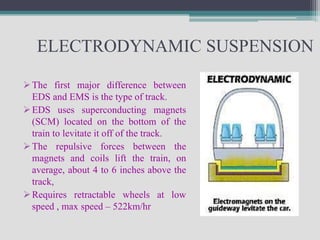
ELECTRODYNAMIC SUSPENSION

 The first major difference between
  EDS and EMS is the type of track.
 EDS uses superconducting magnets
  (SCM) located on the bottom of the
  train to levitate it off of the track.
 The repulsive forces between the
  magnets and coils lift the train, on
  average, about 4 to 6 inches above the
  track,
 Requires retractable wheels at low
  speed , max speed – 522km/hr
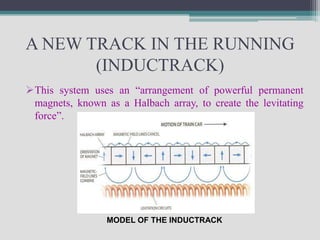
A NEW TRACK IN THE RUNNING
       (INDUCTRACK)
This system uses an “arrangement of powerful permanent
 magnets, known as a Halbach array, to create the levitating
 force”.


                 MODEL OF THE INDUCTRACK
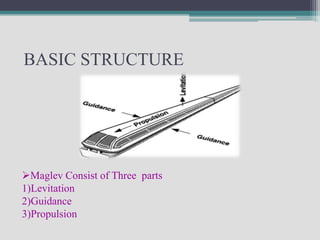
BASIC STRUCTURE


Maglev Consist of Three parts
1)Levitation
2)Guidance
3)Propulsion
LEVITATION
In EDS , levitation coils levitate the train 10cm above the
 track. Levitates when speed reaches 100km/hr

In EMS , stator & support magnet levitate the train 1cm above
 the track. Levitates even when train is not moving.
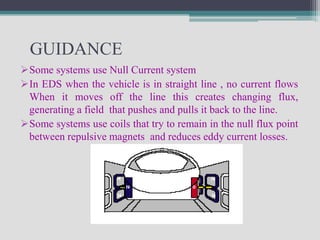
GUIDANCE
Some systems use Null Current system
In EDS when the vehicle is in straight line , no current flows
 When it moves off the line this creates changing flux,
 generating a field that pushes and pulls it back to the line.
Some systems use coils that try to remain in the null flux point
 between repulsive magnets and reduces eddy current losses.
PROPULSION
EMS systems provide levitation & propulsion using onboard
 linear motor.
 EDS system and Train rapid systems levitate using onboard
 magnets & use propulsion coils for propulsion .
Cost of propulsion coils increase over long distances.
COMPARISION WITH COMMERCIAL TRAINS

Maglev trains produce less noise than a conventional train at
  equivalent speeds.
Maglev is atmosphere friendly not produce toxic Smoke
Relatively very high speed than Commercial trains.
No resistance between the rail and Track so very high speed is
  attainable, that's why some times Maglev is compared with
  aeroplanes.
ADVANTAGES
Elimination of wheel and track wear providing consequent
  reduction in maintenance cost.
The absence of wheels removes much noise and vibration.
It needs less power supply.
It is more safety.
It is fire resistance.
CONCLUSION
Maglev will have a positive impact on sustainability. Using
 superconducting magnets instead of fossil fuels, it will not
 emit greenhouse gases into the atmosphere.

Maglev will contribute more to our society and our planet than
 it takes away. Considering everything Maglev has to offer, the
 transportation of our future is on very capable tracks.
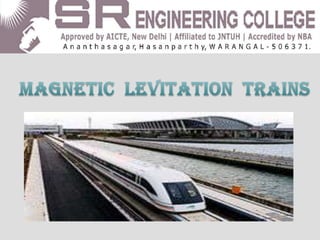
Magnetic  levitation  trai ns

Magnetic levitation trai ns

  • 2.
    CONTENTS INTRODUCTION TYPES OF MAGLEVTECHNOLOGY BASIC STRUCTURE COMPARISON WITH COMMERCIAL TRAINS ADVANTAGES CONCLUSION
  • 3.
    INTRODUCTION Maglev is asystem of transportation that suspends, guides and propels vehicles, predominantly trains, using magnetic levitation from a very large number of magnets for lift and propulsion. The highest recorded speed is 581 km/h achieved in Japan in 2003.
  • 4.
    TYPES OF MAGLEVTECHNOLOGY There are 2 notable types of maglev technology:- • Electromagnetic suspension(EMS) • Electrodynamic suspension(EDS) • Induct rack
  • 5.
    ELECTROMAGNETIC SUSPENSION  Electromagnetsattached to the train  Has ferromagnetic stators on the track and levitate the train.  Has guidance magnets on the sides  A computer changes the amount of current to keep the train 1 cm from the track.  Max speed - 438km/hr  Has on-board battery power supply.
  • 6.
    ELECTRODYNAMIC SUSPENSION  Thefirst major difference between EDS and EMS is the type of track.  EDS uses superconducting magnets (SCM) located on the bottom of the train to levitate it off of the track.  The repulsive forces between the magnets and coils lift the train, on average, about 4 to 6 inches above the track,  Requires retractable wheels at low speed , max speed – 522km/hr
  • 7.
    A NEW TRACKIN THE RUNNING (INDUCTRACK) This system uses an “arrangement of powerful permanent magnets, known as a Halbach array, to create the levitating force”. MODEL OF THE INDUCTRACK
  • 8.
    BASIC STRUCTURE Maglev Consistof Three parts 1)Levitation 2)Guidance 3)Propulsion
  • 9.
    LEVITATION In EDS ,levitation coils levitate the train 10cm above the track. Levitates when speed reaches 100km/hr In EMS , stator & support magnet levitate the train 1cm above the track. Levitates even when train is not moving.
  • 10.
    GUIDANCE Some systems useNull Current system In EDS when the vehicle is in straight line , no current flows When it moves off the line this creates changing flux, generating a field that pushes and pulls it back to the line. Some systems use coils that try to remain in the null flux point between repulsive magnets and reduces eddy current losses.
  • 11.
    PROPULSION EMS systems providelevitation & propulsion using onboard linear motor.  EDS system and Train rapid systems levitate using onboard magnets & use propulsion coils for propulsion . Cost of propulsion coils increase over long distances.
  • 12.
    COMPARISION WITH COMMERCIALTRAINS Maglev trains produce less noise than a conventional train at equivalent speeds. Maglev is atmosphere friendly not produce toxic Smoke Relatively very high speed than Commercial trains. No resistance between the rail and Track so very high speed is attainable, that's why some times Maglev is compared with aeroplanes.
  • 13.
    ADVANTAGES Elimination of wheeland track wear providing consequent reduction in maintenance cost. The absence of wheels removes much noise and vibration. It needs less power supply. It is more safety. It is fire resistance.
  • 14.
    CONCLUSION Maglev will havea positive impact on sustainability. Using superconducting magnets instead of fossil fuels, it will not emit greenhouse gases into the atmosphere. Maglev will contribute more to our society and our planet than it takes away. Considering everything Maglev has to offer, the transportation of our future is on very capable tracks.