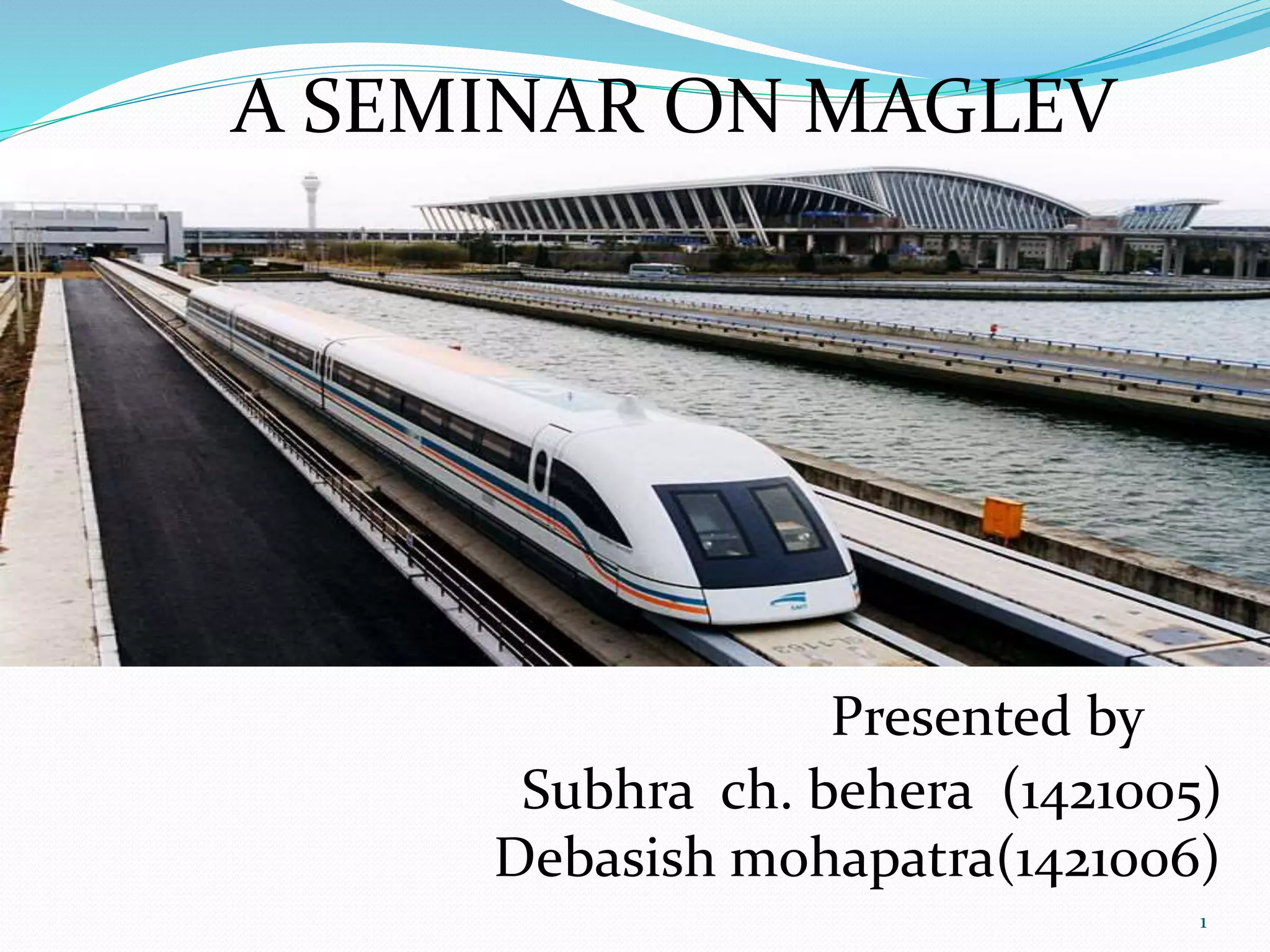
A SEMINAR ON MAGLEV
Presented by
Subhra ch. behera (1421005)
Debasish mohapatra(1421006)
1
AGENDA
 INTRODUCTION
 WHAT IS MAGLEV TRAIN
 WHY MAGLEV TRAIN??
 HISTORY
 TYPES OF MAGNETIC LEVITATION
 Types of technology involved
 Working principle
 Future scopes
 conclusion
2
INTRODUCTion
 Maglev = magnetic +levitation.
• It is a method by which an
object is suspended with no
support other than magnetic
fields.
• Magnetic force is used to
counteract the effects of the
gravitational and any other
accelerations.
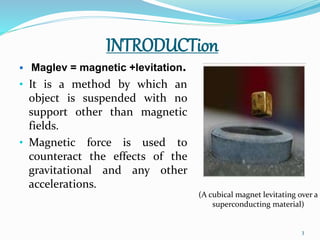
(A cubical magnet levitating over a
superconducting material)
3
WHAT IS MAGLEV TRAIN ??
 Magnetic Levitation Train (Maglev Train) is an
advanced train technology in which magnetic forces
lift, propel, and guide a vehicle over a guide way.
 It employs powerful superconducting magnets to
levitate or "float“ cars about 2 inches above a guideway.
 Liquid helium cools the magnets to near absolute zero
enabling relatively small magnets to create very
powerful fields.
4
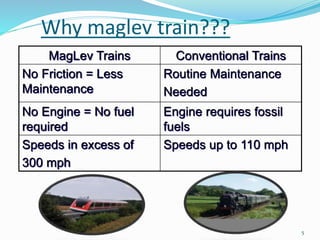
Why maglev train???
MagLev Trains Conventional Trains
No Friction = Less
Maintenance
Routine Maintenance
Needed
No Engine = No fuel
required
Engine requires fossil
fuels
Speeds in excess of
300 mph
Speeds up to 110 mph
5
HISTORY
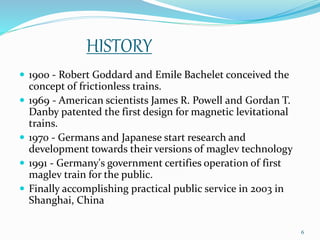
 1900 - Robert Goddard and Emile Bachelet conceived the
concept of frictionless trains.
 1969 - American scientists James R. Powell and Gordan T.
Danby patented the first design for magnetic levitational
trains.
 1970 - Germans and Japanese start research and
development towards their versions of maglev technology
 1991 - Germany's government certifies operation of first
maglev train for the public.
 Finally accomplishing practical public service in 2003 in
Shanghai, China
6
Basic of Magnetic Levitation
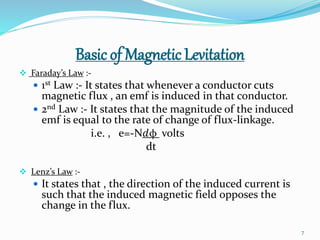
 Faraday’s Law :-
 1st Law :- It states that whenever a conductor cuts
magnetic flux , an emf is induced in that conductor.
 2nd Law :- It states that the magnitude of the induced
emf is equal to the rate of change of flux-linkage.
i.e. , e=-Nⅆφ volts
dt
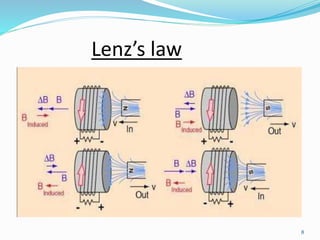
 Lenz’s Law :-
 It states that , the direction of the induced current is
such that the induced magnetic field opposes the
change in the flux.
7
Lenz’s law
8
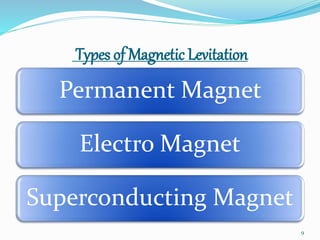
Types of Magnetic Levitation
Permanent Magnet
Electro Magnet
Superconducting Magnet
9
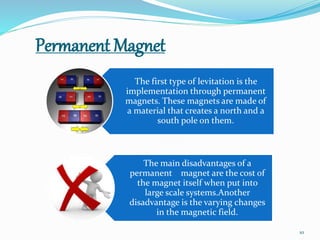
Permanent Magnet
The first type of levitation is the
implementation through permanent
magnets. These magnets are made of
a material that creates a north and a
south pole on them.
The main disadvantages of a
permanent magnet are the cost of
the magnet itself when put into
large scale systems.Another
disadvantage is the varying changes
in the magnetic field.
10
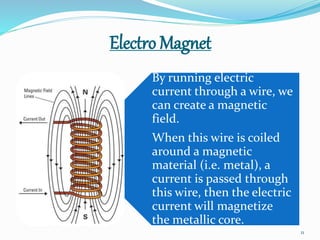
Electro Magnet
By running electric
current through a wire, we
can create a magnetic
field.
When this wire is coiled
around a magnetic
material (i.e. metal), a
current is passed through
this wire, then the electric
current will magnetize
the metallic core.
11
Superconducting Magnet
 The superconducting magnets is a material which
presents no electrical resistivity to electrical current.
 Once a current has been fed into the coils of this
material, it will indefinitely flow without requiring the
input of any additional current
I2R loss = 0
12
Types of Technology
Electro Magnetic Suspension
Electro Dynamic Suspension
Induced Track System
13
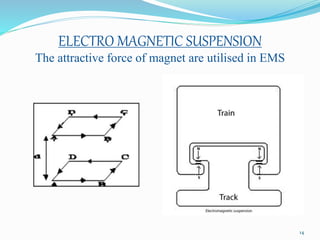
ELECTRO MAGNETIC SUSPENSION
The attractive force of magnet are utilised in EMS
14
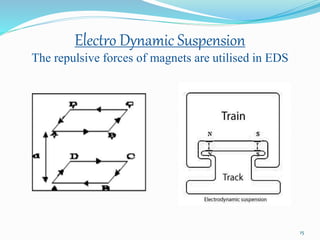
Electro Dynamic Suspension
The repulsive forces of magnets are utilised in EDS
15
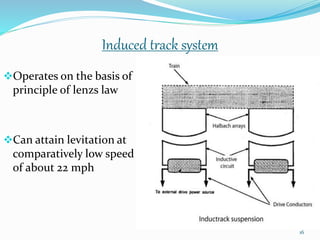
Induced track system
Operates on the basis of
principle of lenzs law
Can attain levitation at
comparatively low speed
of about 22 mph
16
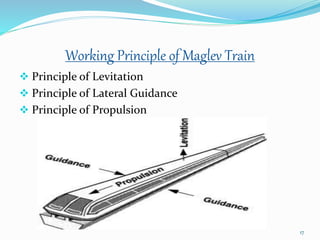
Working Principle of Maglev Train
 Principle of Levitation
 Principle of Lateral Guidance
 Principle of Propulsion
17
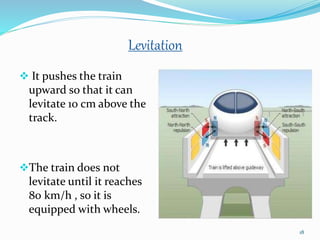
Levitation
 It pushes the train
upward so that it can
levitate 10 cm above the
track.
The train does not
levitate until it reaches
80 km/h , so it is
equipped with wheels.
18
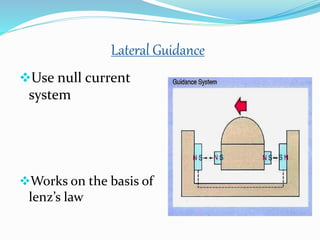
Lateral Guidance
Use null current
system
Works on the basis of
lenz’s law
Propulsion
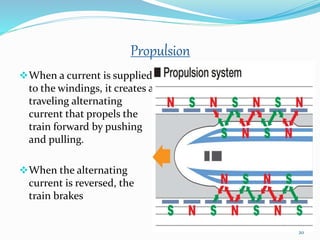
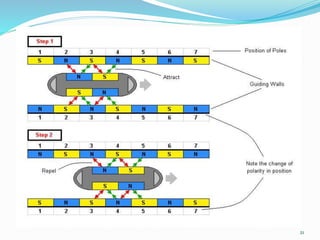
When a current is supplied
to the windings, it creates a
traveling alternating
current that propels the
train forward by pushing
and pulling.
When the alternating
current is reversed, the
train brakes
20
21
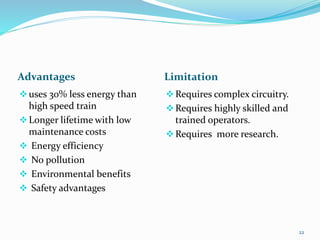
Advantages Limitation
uses 30% less energy than
high speed train
Longer lifetime with low
maintenance costs
 Energy efficiency
 No pollution
 Environmental benefits
 Safety advantages
Requires complex circuitry.
Requires highly skilled and
trained operators.
Requires more research.
22
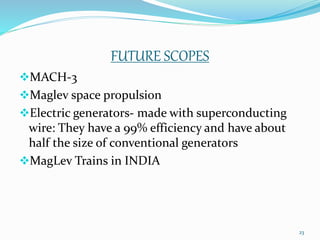
FUTURE SCOPES
MACH-3
Maglev space propulsion
Electric generators- made with superconducting
wire: They have a 99% efficiency and have about
half the size of conventional generators
MagLev Trains in INDIA
23
conclusion
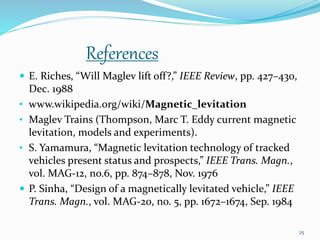
Maglev trains use magnets to levitate and propel the
trains forward.
 Since there is no friction these trains can reach high
speeds.
 It is a safe and efficient way to travel.
24
References
 E. Riches, “Will Maglev lift off?,” IEEE Review, pp. 427–430,
Dec. 1988
• www.wikipedia.org/wiki/Magnetic_levitation
• Maglev Trains (Thompson, Marc T. Eddy current magnetic
levitation, models and experiments).
• S. Yamamura, “Magnetic levitation technology of tracked
vehicles present status and prospects,” IEEE Trans. Magn.,
vol. MAG-12, no.6, pp. 874–878, Nov. 1976
 P. Sinha, “Design of a magnetically levitated vehicle,” IEEE
Trans. Magn., vol. MAG-20, no. 5, pp. 1672–1674, Sep. 1984
25
THANK YOU
26

Maglev

  • 1.
    A SEMINAR ONMAGLEV Presented by Subhra ch. behera (1421005) Debasish mohapatra(1421006) 1
  • 2.
    AGENDA  INTRODUCTION  WHATIS MAGLEV TRAIN  WHY MAGLEV TRAIN??  HISTORY  TYPES OF MAGNETIC LEVITATION  Types of technology involved  Working principle  Future scopes  conclusion 2
  • 3.
    INTRODUCTion  Maglev =magnetic +levitation. • It is a method by which an object is suspended with no support other than magnetic fields. • Magnetic force is used to counteract the effects of the gravitational and any other accelerations. (A cubical magnet levitating over a superconducting material) 3
  • 4.
    WHAT IS MAGLEVTRAIN ??  Magnetic Levitation Train (Maglev Train) is an advanced train technology in which magnetic forces lift, propel, and guide a vehicle over a guide way.  It employs powerful superconducting magnets to levitate or "float“ cars about 2 inches above a guideway.  Liquid helium cools the magnets to near absolute zero enabling relatively small magnets to create very powerful fields. 4
  • 5.
    Why maglev train??? MagLevTrains Conventional Trains No Friction = Less Maintenance Routine Maintenance Needed No Engine = No fuel required Engine requires fossil fuels Speeds in excess of 300 mph Speeds up to 110 mph 5
  • 6.
    HISTORY  1900 -Robert Goddard and Emile Bachelet conceived the concept of frictionless trains.  1969 - American scientists James R. Powell and Gordan T. Danby patented the first design for magnetic levitational trains.  1970 - Germans and Japanese start research and development towards their versions of maglev technology  1991 - Germany's government certifies operation of first maglev train for the public.  Finally accomplishing practical public service in 2003 in Shanghai, China 6
  • 7.
    Basic of MagneticLevitation  Faraday’s Law :-  1st Law :- It states that whenever a conductor cuts magnetic flux , an emf is induced in that conductor.  2nd Law :- It states that the magnitude of the induced emf is equal to the rate of change of flux-linkage. i.e. , e=-Nⅆφ volts dt  Lenz’s Law :-  It states that , the direction of the induced current is such that the induced magnetic field opposes the change in the flux. 7
  • 8.
  • 9.
    Types of MagneticLevitation Permanent Magnet Electro Magnet Superconducting Magnet 9
  • 10.
    Permanent Magnet The firsttype of levitation is the implementation through permanent magnets. These magnets are made of a material that creates a north and a south pole on them. The main disadvantages of a permanent magnet are the cost of the magnet itself when put into large scale systems.Another disadvantage is the varying changes in the magnetic field. 10
  • 11.
    Electro Magnet By runningelectric current through a wire, we can create a magnetic field. When this wire is coiled around a magnetic material (i.e. metal), a current is passed through this wire, then the electric current will magnetize the metallic core. 11
  • 12.
    Superconducting Magnet  Thesuperconducting magnets is a material which presents no electrical resistivity to electrical current.  Once a current has been fed into the coils of this material, it will indefinitely flow without requiring the input of any additional current I2R loss = 0 12
  • 13.
    Types of Technology ElectroMagnetic Suspension Electro Dynamic Suspension Induced Track System 13
  • 14.
    ELECTRO MAGNETIC SUSPENSION Theattractive force of magnet are utilised in EMS 14
  • 15.
    Electro Dynamic Suspension Therepulsive forces of magnets are utilised in EDS 15
  • 16.
    Induced track system Operateson the basis of principle of lenzs law Can attain levitation at comparatively low speed of about 22 mph 16
  • 17.
    Working Principle ofMaglev Train  Principle of Levitation  Principle of Lateral Guidance  Principle of Propulsion 17
  • 18.
    Levitation  It pushesthe train upward so that it can levitate 10 cm above the track. The train does not levitate until it reaches 80 km/h , so it is equipped with wheels. 18
  • 19.
    Lateral Guidance Use nullcurrent system Works on the basis of lenz’s law
  • 20.
    Propulsion When a currentis supplied to the windings, it creates a traveling alternating current that propels the train forward by pushing and pulling. When the alternating current is reversed, the train brakes 20
  • 21.
  • 22.
    Advantages Limitation uses 30%less energy than high speed train Longer lifetime with low maintenance costs  Energy efficiency  No pollution  Environmental benefits  Safety advantages Requires complex circuitry. Requires highly skilled and trained operators. Requires more research. 22
  • 23.
    FUTURE SCOPES MACH-3 Maglev spacepropulsion Electric generators- made with superconducting wire: They have a 99% efficiency and have about half the size of conventional generators MagLev Trains in INDIA 23
  • 24.
    conclusion Maglev trains usemagnets to levitate and propel the trains forward.  Since there is no friction these trains can reach high speeds.  It is a safe and efficient way to travel. 24
  • 25.
    References  E. Riches,“Will Maglev lift off?,” IEEE Review, pp. 427–430, Dec. 1988 • www.wikipedia.org/wiki/Magnetic_levitation • Maglev Trains (Thompson, Marc T. Eddy current magnetic levitation, models and experiments). • S. Yamamura, “Magnetic levitation technology of tracked vehicles present status and prospects,” IEEE Trans. Magn., vol. MAG-12, no.6, pp. 874–878, Nov. 1976  P. Sinha, “Design of a magnetically levitated vehicle,” IEEE Trans. Magn., vol. MAG-20, no. 5, pp. 1672–1674, Sep. 1984 25
  • 26.