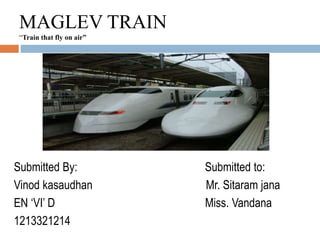
MAGLEV TRAIN
“Train that fly on air”
Submitted By: Submitted to:
Sujit kumar singh Mr. Sitaram jana
EN ‘VI’ C Mrs. Vandana
1213321200
PRESENTATION OUTLINE:
INTRODUCTION
 HISTORY
THE TECHNOLOGY
 WORKING
PROPULSION SYSTEM
 POWER SUPPLY
MAGLEV VS CONVENTIONAL TRAIN
EFFECT ON ENVIRONMENT
FUTURE OF CONVENTIONAL TRAIN
ADVANTAGES
DISADVANTAGES
CONCLUSION
REFERENCE
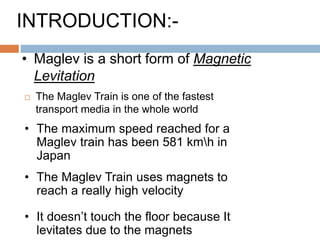
INTRODUCTION:-
 The Maglev Train is one of the fastest
transport media in the whole world
• The maximum speed reached for a
Maglev train has been 581 kmh in
Japan
• The Maglev Train uses magnets to
reach a really high velocity
• It doesn’t touch the floor because It
levitates due to the magnets
• Maglev is a short form of Magnetic
Levitation
HISTORY:
 1971: West Germany
(90 kmph)
 1972 : Japan (60
kmph)
 1975 : West Germany
(401.3 kmph)
 1979 : Japan (517
kmph)
•Figure -Trial run of the Transrapid
TR06, near
Lingen, Germany [9]
The Technology:
 3 types of technologies are in use:
 EMS (Electro Magnetic Suspension)
 EDS (Electrodynamic Suspension)
 Inductrack System (Permanent Magnet Passive
Suspension)
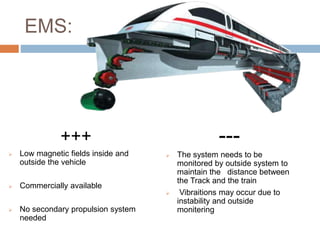
EMS:
+++
 Low magnetic fields inside and
outside the vehicle
 Commercially available
 No secondary propulsion system
needed
---
 The system needs to be
monitored by outside system to
maintain the distance between
the Track and the train
 Vibraitions may occur due to
instability and outside
monitering
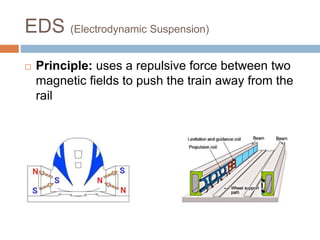
EDS (Electrodynamic Suspension)
 Principle: uses a repulsive force between two
magnetic fields to push the train away from the
rail
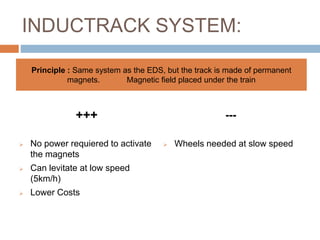
INDUCTRACK SYSTEM:
+++
 No power requiered to activate
the magnets
 Can levitate at low speed
(5km/h)
 Lower Costs
---
 Wheels needed at slow speed
Principle : Same system as the EDS, but the track is made of permanent
magnets. Magnetic field placed under the train
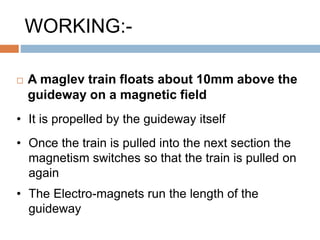
WORKING:-
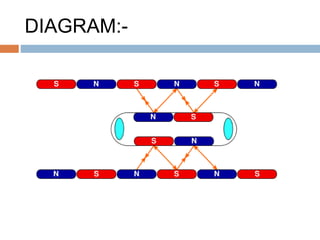
 A maglev train floats about 10mm above the
guideway on a magnetic field
• It is propelled by the guideway itself
• Once the train is pulled into the next section the
magnetism switches so that the train is pulled on
again
• The Electro-magnets run the length of the
guideway
DIAGRAM:-
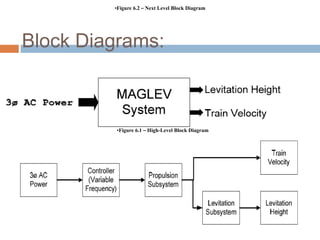
Block Diagrams:
•Figure 6.1 – High-Level Block Diagram
•Figure 6.2 – Next Level Block Diagram
PROPULSION SYSTEM:-
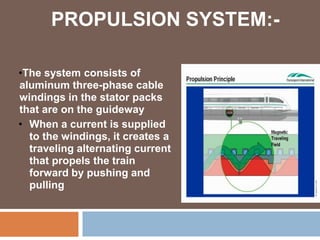
•The system consists of
aluminum three-phase cable
windings in the stator packs
that are on the guideway
• When a current is supplied
to the windings, it creates a
traveling alternating current
that propels the train
forward by pushing and
pulling
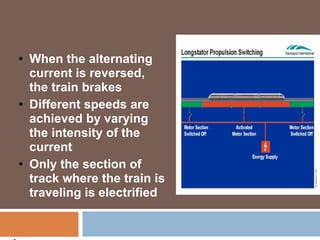
• When the alternating
current is reversed,
the train brakes
• Different speeds are
achieved by varying
the intensity of the
current
• Only the section of
track where the train is
traveling is electrified
POWER SUPPLY
• Batteries on the train power the system, and
therefore it still functions without propulsion
• The batteries can levitate the train for 30
minutes without any additional energy
• Linear generators in the magnets on board of
the train use the motion of the train to recharge
the batteries
• Levitation system uses less power than the
trains air conditioning
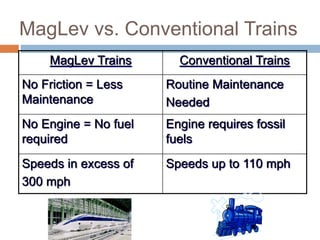
MagLev vs. Conventional Trains
MagLev Trains Conventional Trains
No Friction = Less
Maintenance
Routine Maintenance
Needed
No Engine = No fuel
required
Engine requires fossil
fuels
Speeds in excess of
300 mph
Speeds up to 110 mph
EFFECT ON ENVIRONMENT:-
 It doesn’t need any kind of fuel
 It doesn’t send out any CO2
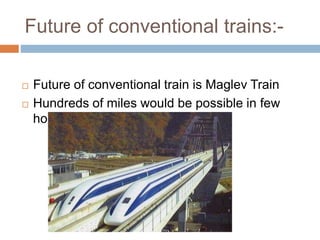
Future of conventional trains:-
 Future of conventional train is Maglev Train
 Hundreds of miles would be possible in few
hours
Advantages:-
• It is 250 times safer than conventional railroads
• 700 times safer than automobile travel
• Speeds up to 500 km/h
• A accident between two maglev trains is nearly
impossible
• Smooth motion & Less noisy
Contd…
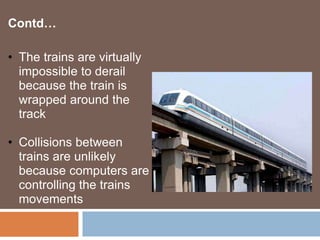
• The trains are virtually
impossible to derail
because the train is
wrapped around the
track
• Collisions between
trains are unlikely
because computers are
controlling the trains
movements
CONTD…
•The train is earthquake proof because the
greater space (10 mm) between the track and
the train leaves more room for track deformation
• Linear generators will produce all the electricity
needed in the train’s interior
• Only the part of the track that is used will be
electrified so no energy is wasted
Disadvantages:-
 The big problem about this is that the pieces
for the maglev are really expensive
 The procedure to build it up is very expensive
as well
CONCLUSION:-
• Maglev trains use magnets to levitate and
propel the trains forward
• Since there is no friction these trains can
reach high speeds
• It is a safe and efficient way to travel
• Its construction cost is more but
maintainance cost is less
REFERENCE
 http://www.railserve.com/maglev.html
 http://www.tech-faq.com/how-does-a-
 maglev-train-work.shtml
 http://www.okeating.com/hsr/maglev.ht
m
 Book: The mistery of Magnets
MAGLEV
MAGLEV

MAGLEV

  • 1.
    MAGLEV TRAIN “Train thatfly on air” Submitted By: Submitted to: Sujit kumar singh Mr. Sitaram jana EN ‘VI’ C Mrs. Vandana 1213321200
  • 2.
    PRESENTATION OUTLINE: INTRODUCTION  HISTORY THETECHNOLOGY  WORKING PROPULSION SYSTEM  POWER SUPPLY MAGLEV VS CONVENTIONAL TRAIN EFFECT ON ENVIRONMENT FUTURE OF CONVENTIONAL TRAIN ADVANTAGES DISADVANTAGES CONCLUSION REFERENCE
  • 3.
    INTRODUCTION:-  The MaglevTrain is one of the fastest transport media in the whole world • The maximum speed reached for a Maglev train has been 581 kmh in Japan • The Maglev Train uses magnets to reach a really high velocity • It doesn’t touch the floor because It levitates due to the magnets • Maglev is a short form of Magnetic Levitation
  • 4.
    HISTORY:  1971: WestGermany (90 kmph)  1972 : Japan (60 kmph)  1975 : West Germany (401.3 kmph)  1979 : Japan (517 kmph) •Figure -Trial run of the Transrapid TR06, near Lingen, Germany [9]
  • 5.
    The Technology:  3types of technologies are in use:  EMS (Electro Magnetic Suspension)  EDS (Electrodynamic Suspension)  Inductrack System (Permanent Magnet Passive Suspension)
  • 6.
    EMS: +++  Low magneticfields inside and outside the vehicle  Commercially available  No secondary propulsion system needed ---  The system needs to be monitored by outside system to maintain the distance between the Track and the train  Vibraitions may occur due to instability and outside monitering
  • 7.
    EDS (Electrodynamic Suspension) Principle: uses a repulsive force between two magnetic fields to push the train away from the rail
  • 8.
    INDUCTRACK SYSTEM: +++  Nopower requiered to activate the magnets  Can levitate at low speed (5km/h)  Lower Costs ---  Wheels needed at slow speed Principle : Same system as the EDS, but the track is made of permanent magnets. Magnetic field placed under the train
  • 9.
    WORKING:-  A maglevtrain floats about 10mm above the guideway on a magnetic field • It is propelled by the guideway itself • Once the train is pulled into the next section the magnetism switches so that the train is pulled on again • The Electro-magnets run the length of the guideway
  • 10.
  • 11.
    Block Diagrams: •Figure 6.1– High-Level Block Diagram •Figure 6.2 – Next Level Block Diagram
  • 12.
    PROPULSION SYSTEM:- •The systemconsists of aluminum three-phase cable windings in the stator packs that are on the guideway • When a current is supplied to the windings, it creates a traveling alternating current that propels the train forward by pushing and pulling
  • 13.
    • When thealternating current is reversed, the train brakes • Different speeds are achieved by varying the intensity of the current • Only the section of track where the train is traveling is electrified
  • 14.
    POWER SUPPLY • Batterieson the train power the system, and therefore it still functions without propulsion • The batteries can levitate the train for 30 minutes without any additional energy • Linear generators in the magnets on board of the train use the motion of the train to recharge the batteries • Levitation system uses less power than the trains air conditioning
  • 15.
    MagLev vs. ConventionalTrains MagLev Trains Conventional Trains No Friction = Less Maintenance Routine Maintenance Needed No Engine = No fuel required Engine requires fossil fuels Speeds in excess of 300 mph Speeds up to 110 mph
  • 16.
    EFFECT ON ENVIRONMENT:- It doesn’t need any kind of fuel  It doesn’t send out any CO2
  • 17.
    Future of conventionaltrains:-  Future of conventional train is Maglev Train  Hundreds of miles would be possible in few hours
  • 18.
    Advantages:- • It is250 times safer than conventional railroads • 700 times safer than automobile travel • Speeds up to 500 km/h • A accident between two maglev trains is nearly impossible • Smooth motion & Less noisy
  • 19.
    Contd… • The trainsare virtually impossible to derail because the train is wrapped around the track • Collisions between trains are unlikely because computers are controlling the trains movements
  • 20.
    CONTD… •The train isearthquake proof because the greater space (10 mm) between the track and the train leaves more room for track deformation • Linear generators will produce all the electricity needed in the train’s interior • Only the part of the track that is used will be electrified so no energy is wasted
  • 21.
    Disadvantages:-  The bigproblem about this is that the pieces for the maglev are really expensive  The procedure to build it up is very expensive as well
  • 22.
    CONCLUSION:- • Maglev trainsuse magnets to levitate and propel the trains forward • Since there is no friction these trains can reach high speeds • It is a safe and efficient way to travel • Its construction cost is more but maintainance cost is less
  • 23.
    REFERENCE  http://www.railserve.com/maglev.html  http://www.tech-faq.com/how-does-a- maglev-train-work.shtml  http://www.okeating.com/hsr/maglev.ht m  Book: The mistery of Magnets