Directions:
Write FACT if the statement is
true, otherwise write BLUFF if it
is false.
Aristotle thought that heavy
objects fall faster than light
objects in proportion to their
weight.
fact
Velocity is the length of the
part travelled from starting
point to final point
bluff
According to Aristotle, force
is not required to maintain
horizontal motion.
bluff
This constant acceleration g
is called the acceleration
due to gravity.
fact
The standard value of g at or near
the earth’s surface is
approximately 5.0 m/s2.
bluff
In this lesson, you will be able to explain how Galileo inferred that
objects in vacuum fall with uniform acceleration and that force are
not necessary to sustain horizontal motion.
Directions:
Unscramble the words related to
uniform acceleration. Write
down your answers in your
answer sheet.
It is defined as the motion of an
object where gravity is the only
force acting upon it
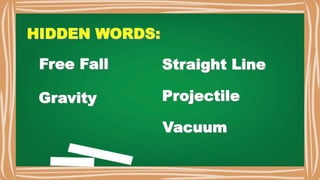
EFER LFLA
Free fall
It is the force that attracts a body
toward the center of the earth, or
toward any other physical body
having mass.
aigvryt
gravity
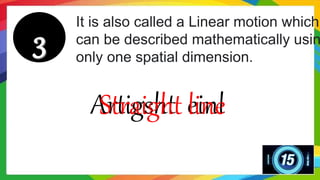
It is also called a Linear motion which
can be described mathematically usin
only one spatial dimension.
Artigsht einl
Straight line
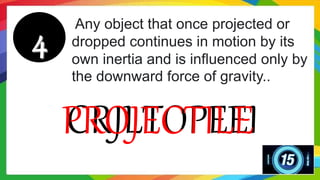
Any object that once projected or
dropped continues in motion by its
own inertia and is influenced only by
the downward force of gravity..
CRJLTOPEEI
PROJECTILE
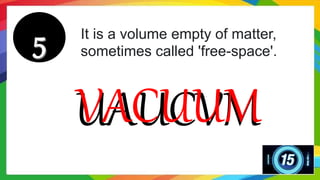
It is a volume empty of matter,
sometimes called 'free-space'.
UAUCVM
VACUUM
Directions:
Observe the two objects as they
will fall downwards. Answer the
following guide questions that
follows.
1.Do the two objects reach the
ground at the same time? If no,
which falls to the ground first?
2.What factors affect the fall of the
object? Justify your answer.
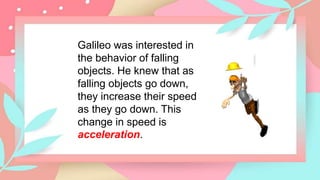
Galileo was interested in
the behavior of falling
objects. He knew that as
falling objects go down,
they increase their speed
as they go down. This
change in speed is
acceleration.
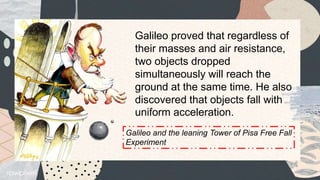
Galileo proved that regardless of
their masses and air resistance,
two objects dropped
simultaneously will reach the
ground at the same time. He also
discovered that objects fall with
uniform acceleration.
Galileo and the leaning Tower of Pisa Free Fall
Experiment
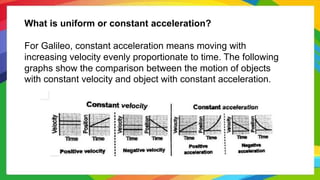
What is uniform or constant acceleration?
For Galileo, constant acceleration means moving with
increasing velocity evenly proportionate to time. The following
graphs show the comparison between the motion of objects
with constant velocity and object with constant acceleration.
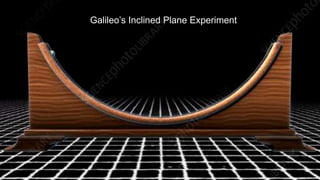
Galileo’s Inclined Plane Experiment
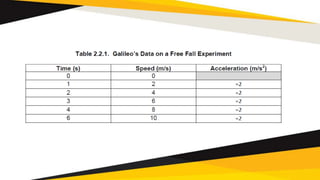
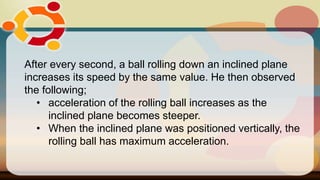
After every second, a ball rolling down an inclined plane
increases its speed by the same value. He then observed
the following;
• acceleration of the rolling ball increases as the
inclined plane becomes steeper.
• When the inclined plane was positioned vertically, the
rolling ball has maximum acceleration.
To have a constant velocity, an object must have a
constant speed in a constant direction. If an object
maintains a constant or a uniform change in its
velocity in a given time interval along a straight line,
then it is said to have a constant acceleration.
Is Force necessary to
sustain horizontal
motion?
Galileo rolled balls down inclined planes and observed and
recorded the gain in speed as the rolling continued.
• On downward-sloping planes, the force of gravity increases a ball’s speed while on
an upward slope, the force of gravity decreases a ball’s speed.
• With regards to the ball rolling on a level surface, it neither slows down nor speeds
up. It maintains a constant speed. Galileo reasoned that a ball would move forever if
it is in a horizontal motion.
• A moving object needs no force to keep it moving. when friction is absent. Such a
ball would remain in motion all by itself of its inertia.
A
B
Throw a crumpled paper upward.
Observe closely. Why does the
crumpled paper not hang there
forever? Write your observation on
a clean sheet of paper.

M2_Lesson 2_Uniform Acceleration.pptx

  • 3.
    Directions: Write FACT ifthe statement is true, otherwise write BLUFF if it is false.
  • 4.
    Aristotle thought thatheavy objects fall faster than light objects in proportion to their weight. fact
  • 5.
    Velocity is thelength of the part travelled from starting point to final point bluff
  • 6.
    According to Aristotle,force is not required to maintain horizontal motion. bluff
  • 7.
    This constant accelerationg is called the acceleration due to gravity. fact
  • 8.
    The standard valueof g at or near the earth’s surface is approximately 5.0 m/s2. bluff
  • 9.
    In this lesson,you will be able to explain how Galileo inferred that objects in vacuum fall with uniform acceleration and that force are not necessary to sustain horizontal motion.
  • 11.
    Directions: Unscramble the wordsrelated to uniform acceleration. Write down your answers in your answer sheet.
  • 12.
    It is definedas the motion of an object where gravity is the only force acting upon it EFER LFLA Free fall
  • 13.
    It is theforce that attracts a body toward the center of the earth, or toward any other physical body having mass. aigvryt gravity
  • 14.
    It is alsocalled a Linear motion which can be described mathematically usin only one spatial dimension. Artigsht einl Straight line
  • 15.
    Any object thatonce projected or dropped continues in motion by its own inertia and is influenced only by the downward force of gravity.. CRJLTOPEEI PROJECTILE
  • 16.
    It is avolume empty of matter, sometimes called 'free-space'. UAUCVM VACUUM
  • 20.
    Directions: Observe the twoobjects as they will fall downwards. Answer the following guide questions that follows.
  • 21.
    1.Do the twoobjects reach the ground at the same time? If no, which falls to the ground first? 2.What factors affect the fall of the object? Justify your answer.
  • 22.
    Galileo was interestedin the behavior of falling objects. He knew that as falling objects go down, they increase their speed as they go down. This change in speed is acceleration.
  • 23.
    Galileo proved thatregardless of their masses and air resistance, two objects dropped simultaneously will reach the ground at the same time. He also discovered that objects fall with uniform acceleration. Galileo and the leaning Tower of Pisa Free Fall Experiment
  • 24.
    What is uniformor constant acceleration? For Galileo, constant acceleration means moving with increasing velocity evenly proportionate to time. The following graphs show the comparison between the motion of objects with constant velocity and object with constant acceleration.
  • 25.
  • 27.
    After every second,a ball rolling down an inclined plane increases its speed by the same value. He then observed the following; • acceleration of the rolling ball increases as the inclined plane becomes steeper. • When the inclined plane was positioned vertically, the rolling ball has maximum acceleration.
  • 28.
    To have aconstant velocity, an object must have a constant speed in a constant direction. If an object maintains a constant or a uniform change in its velocity in a given time interval along a straight line, then it is said to have a constant acceleration.
  • 29.
    Is Force necessaryto sustain horizontal motion?
  • 31.
    Galileo rolled ballsdown inclined planes and observed and recorded the gain in speed as the rolling continued. • On downward-sloping planes, the force of gravity increases a ball’s speed while on an upward slope, the force of gravity decreases a ball’s speed. • With regards to the ball rolling on a level surface, it neither slows down nor speeds up. It maintains a constant speed. Galileo reasoned that a ball would move forever if it is in a horizontal motion. • A moving object needs no force to keep it moving. when friction is absent. Such a ball would remain in motion all by itself of its inertia.
  • 33.
  • 35.
    Throw a crumpledpaper upward. Observe closely. Why does the crumpled paper not hang there forever? Write your observation on a clean sheet of paper.