1
Chapter 12
Intermolecular
Forces and the
Physical Properties
of Liquids and
Solids
Insert picture from
First page of chapter
Copyright McGraw-Hill 2009
Copyright McGraw-Hill 2009 2
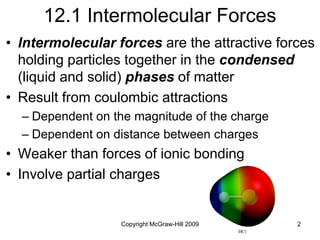
12.1 Intermolecular Forces
• Intermolecular forces are the attractive forces
holding particles together in the condensed
(liquid and solid) phases of matter
• Result from coulombic attractions
– Dependent on the magnitude of the charge
– Dependent on distance between charges
• Weaker than forces of ionic bonding
• Involve partial charges
Copyright McGraw-Hill 2009 3
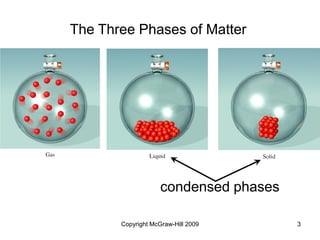
The Three Phases of Matter
condensed phases
Copyright McGraw-Hill 2009 4
Types of Intermolecular Forces
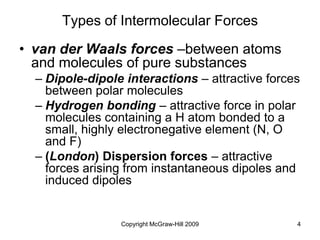
• van der Waals forces –between atoms
and molecules of pure substances
– Dipole-dipole interactions – attractive forces
between polar molecules
– Hydrogen bonding – attractive force in polar
molecules containing a H atom bonded to a
small, highly electronegative element (N, O
and F)
– (London) Dispersion forces – attractive
forces arising from instantaneous dipoles and
induced dipoles
Copyright McGraw-Hill 2009 5
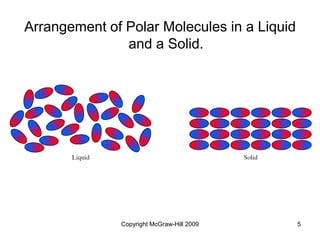
Arrangement of Polar Molecules in a Liquid
and a Solid.
Copyright McGraw-Hill 2009 6
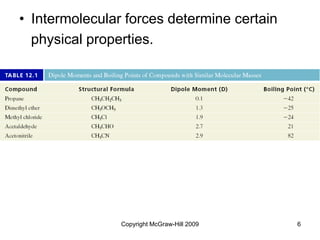
• Intermolecular forces determine certain
physical properties.
Copyright McGraw-Hill 2009 7
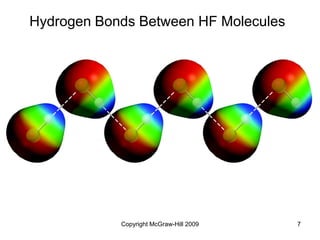
Hydrogen Bonds Between HF Molecules
Copyright McGraw-Hill 2009 8
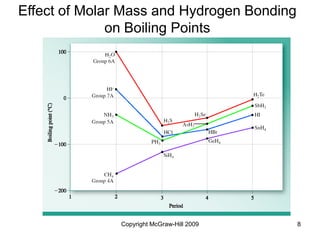
Effect of Molar Mass and Hydrogen Bonding
on Boiling Points
Copyright McGraw-Hill 2009 9
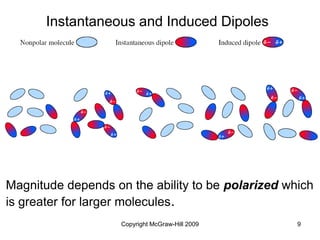
Instantaneous and Induced Dipoles
Magnitude depends on the ability to be polarized which
is greater for larger molecules.
Copyright McGraw-Hill 2009 10
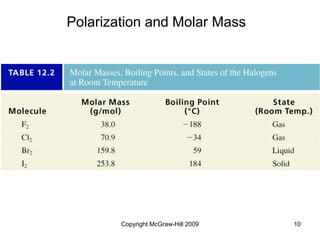
Polarization and Molar Mass
Copyright McGraw-Hill 2009 11
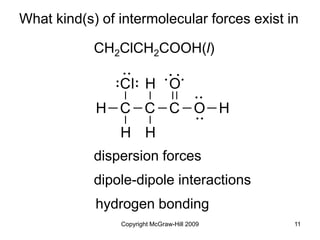
What kind(s) of intermolecular forces exist in
CH2ClCH2COOH(l)
C C
H
Cl
H
C
H
H
O
O H
dispersion forces
dipole-dipole interactions
hydrogen bonding
Copyright McGraw-Hill 2009 12
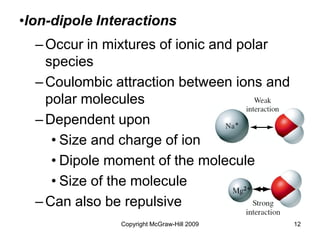
–Occur in mixtures of ionic and polar
species
–Coulombic attraction between ions and
polar molecules
–Dependent upon
• Size and charge of ion
• Dipole moment of the molecule
• Size of the molecule
–Can also be repulsive
•Ion-dipole Interactions
Copyright McGraw-Hill 2009 13
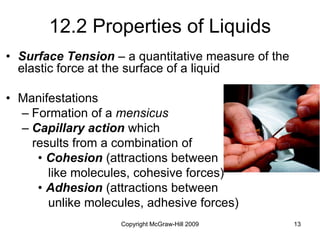
12.2 Properties of Liquids
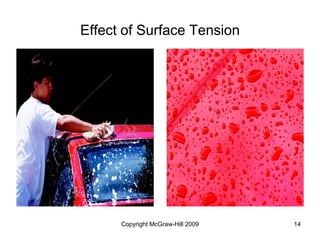
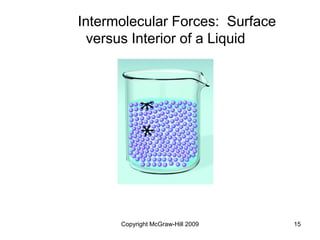
• Surface Tension – a quantitative measure of the
elastic force at the surface of a liquid
• Manifestations
– Formation of a mensicus
– Capillary action which
results from a combination of
• Cohesion (attractions between
like molecules, cohesive forces)
• Adhesion (attractions between
unlike molecules, adhesive forces)
Copyright McGraw-Hill 2009 14
Effect of Surface Tension
Copyright McGraw-Hill 2009 15
Intermolecular Forces: Surface
versus Interior of a Liquid
Copyright McGraw-Hill 2009 16
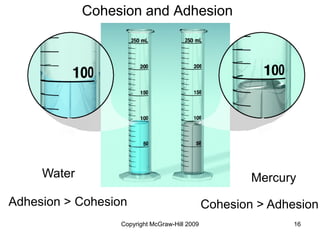
Cohesion and Adhesion
Water Mercury
Adhesion > Cohesion Cohesion > Adhesion
Copyright McGraw-Hill 2009 17
• Viscosity – a measure of a fluid’s
resistance to flow
–Units: N.s/m2
–The higher the viscosity the greater the
resistance to flow
–Varies inversely with temperature
–Stronger intermolecular forces produce
higher viscosities
Copyright McGraw-Hill 2009 18
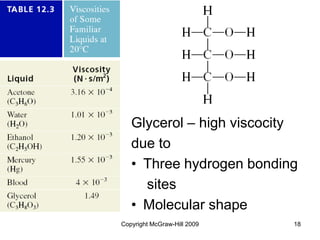
Glycerol – high viscocity
due to
• Three hydrogen bonding
sites
• Molecular shape
Copyright McGraw-Hill 2009 19
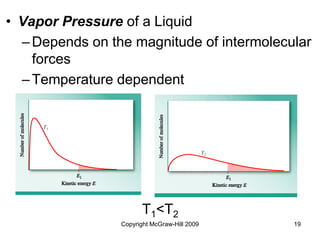
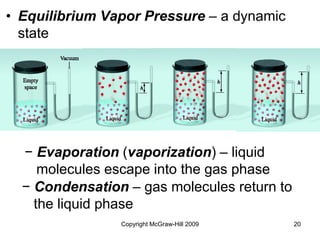
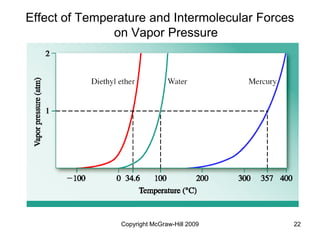
• Vapor Pressure of a Liquid
–Depends on the magnitude of intermolecular
forces
–Temperature dependent
T1<T2
Copyright McGraw-Hill 2009 20
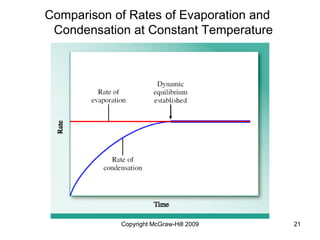
• Equilibrium Vapor Pressure – a dynamic
state
− Evaporation (vaporization) – liquid
molecules escape into the gas phase
− Condensation – gas molecules return to
the liquid phase
Copyright McGraw-Hill 2009 21
Comparison of Rates of Evaporation and
Condensation at Constant Temperature
Copyright McGraw-Hill 2009 22
Effect of Temperature and Intermolecular Forces
on Vapor Pressure
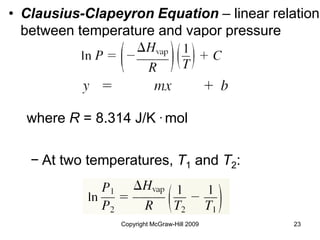
Copyright McGraw-Hill 2009 23
• Clausius-Clapeyron Equation – linear relation
between temperature and vapor pressure
− At two temperatures, T1 and T2:
where R = 8.314 J/K . mol
Copyright McGraw-Hill 2009 24
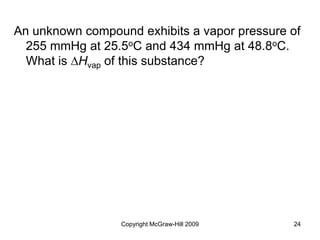
An unknown compound exhibits a vapor pressure of
255 mmHg at 25.5oC and 434 mmHg at 48.8oC.
What is DHvap of this substance?
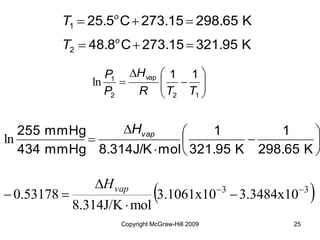
Copyright McGraw-Hill 2009 25
K
298.65
273.15
C
25.5
1 

 o
T
K
321.95
273.15
C
48.8
2 

 o
T








D

K
298.65
1
K
321.95
1
mol
8.314J/K
mmHg
434
mmHg
255 vap
H
ln
 
3
3
3.3484x10
3.1061x10
mol
8.314J/K
0.53178 



D


vap
H









D

1
2
vap
2
1 1
1
T
T
R
H
P
P
ln
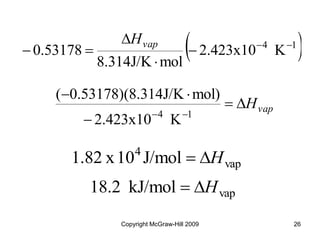
Copyright McGraw-Hill 2009 26
vap
H
D





 1
4
K
2.423x10
mol)
.314J/K
0.53178)(8
(
 
1
4
K
2.423x10
mol
8.314J/K
0.53178 



D


vap
H
vap
4
J/mol
10
x
1.82 H
D

vap
kJ/mol
18.2 H
D

Copyright McGraw-Hill 2009 27
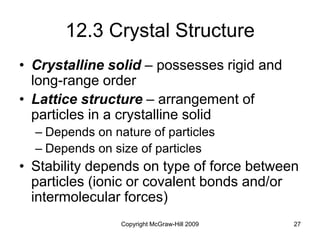
12.3 Crystal Structure
• Crystalline solid – possesses rigid and
long-range order
• Lattice structure – arrangement of
particles in a crystalline solid
– Depends on nature of particles
– Depends on size of particles
• Stability depends on type of force between
particles (ionic or covalent bonds and/or
intermolecular forces)
Copyright McGraw-Hill 2009 28
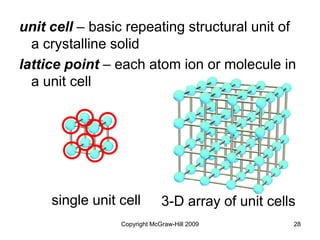
unit cell – basic repeating structural unit of
a crystalline solid
lattice point – each atom ion or molecule in
a unit cell
single unit cell 3-D array of unit cells
Copyright McGraw-Hill 2009 29
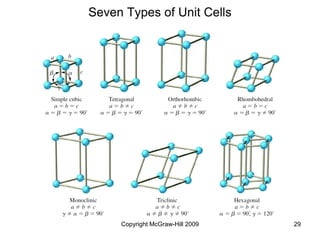
Seven Types of Unit Cells
Copyright McGraw-Hill 2009 30
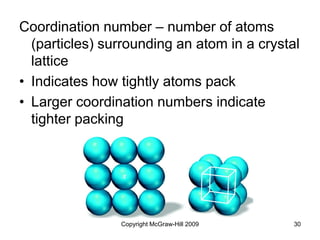
Coordination number – number of atoms
(particles) surrounding an atom in a crystal
lattice
• Indicates how tightly atoms pack
• Larger coordination numbers indicate
tighter packing
Copyright McGraw-Hill 2009 31
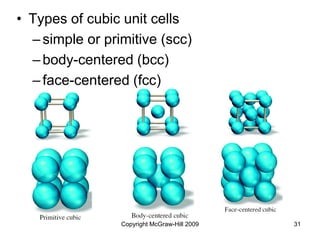
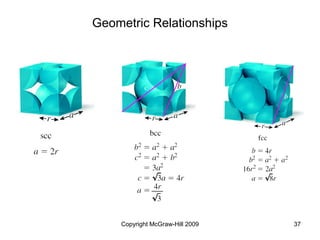
• Types of cubic unit cells
–simple or primitive (scc)
–body-centered (bcc)
–face-centered (fcc)
Copyright McGraw-Hill 2009 32
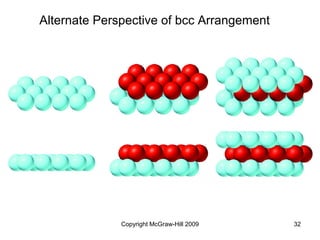
Alternate Perspective of bcc Arrangement
Copyright McGraw-Hill 2009 33
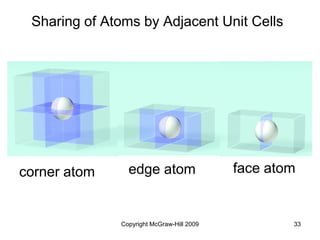
Sharing of Atoms by Adjacent Unit Cells
corner atom edge atom face atom
Copyright McGraw-Hill 2009 34
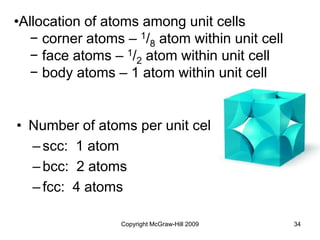
• Number of atoms per unit cell
–scc: 1 atom
–bcc: 2 atoms
–fcc: 4 atoms
•Allocation of atoms among unit cells
− corner atoms – 1/8 atom within unit cell
− face atoms – 1/2 atom within unit cell
− body atoms – 1 atom within unit cell
Copyright McGraw-Hill 2009 35
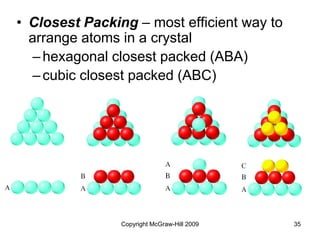
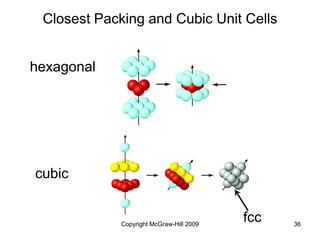
• Closest Packing – most efficient way to
arrange atoms in a crystal
–hexagonal closest packed (ABA)
–cubic closest packed (ABC)
Copyright McGraw-Hill 2009 36
Closest Packing and Cubic Unit Cells
fcc
cubic
hexagonal
Copyright McGraw-Hill 2009 37
Geometric Relationships
Copyright McGraw-Hill 2009 38
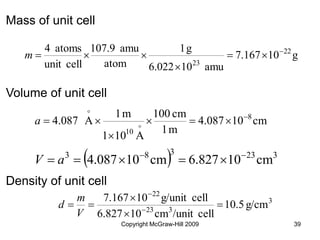
When silver crystallizes, it forms face-
centered cubic cells. The unit cell edge
length is 4.087A . Calculate the density of
silver.
o
Copyright McGraw-Hill 2009 39
g
10
7.167
amu
10
6.022
g
1
atom
amu
107.9
cell
unit
atoms
4 22
23







m
  3
23
3
8
3
cm
10
6.827
cm
10
4.087 





 a
V
cm
10
4.087
m
1
cm
00
1
A
10
1
m
1
A
4.087 8
10






 

a
3
3
23
22
g/cm
10.5
cell
/unit
cm
10
6.827
cell
g/unit
10
7.167




 

V
m
d
Mass of unit cell
Volume of unit cell
Density of unit cell
Copyright McGraw-Hill 2009 40
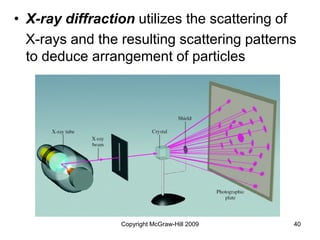
• X-ray diffraction utilizes the scattering of
X-rays and the resulting scattering patterns
to deduce arrangement of particles
Copyright McGraw-Hill 2009 41
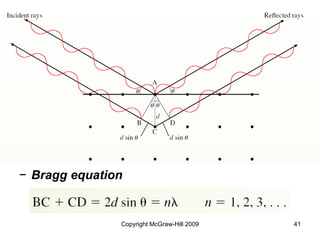
− Bragg equation
Copyright McGraw-Hill 2009 42
12.4 Types of Crystals
• Ionic Crystals
– Composed of anions and cations
– Held together by coulombic forces
– Anions generally are bigger than cations
– Size and relative number of each ion
determines the crystal structure
Copyright McGraw-Hill 2009 43
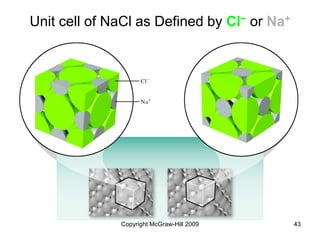
Unit cell of NaCl as Defined by Cl− or Na+
Copyright McGraw-Hill 2009 44
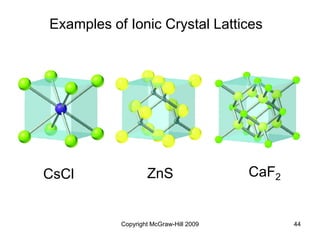
Examples of Ionic Crystal Lattices
CsCl ZnS CaF2
Copyright McGraw-Hill 2009 45
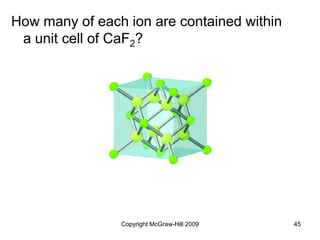
How many of each ion are contained within
a unit cell of CaF2?
Copyright McGraw-Hill 2009 46
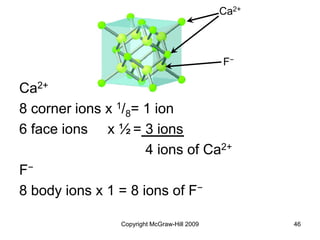
Ca2+
8 corner ions x 1/8= 1 ion
6 face ions x ½ = 3 ions
4 ions of Ca2+
F−
8 body ions x 1 = 8 ions of F−
Ca2+
F−
Copyright McGraw-Hill 2009 47
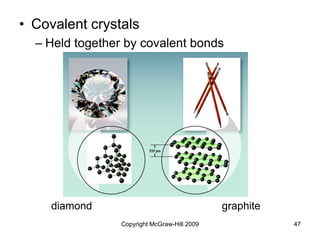
• Covalent crystals
– Held together by covalent bonds
diamond graphite
Copyright McGraw-Hill 2009 48
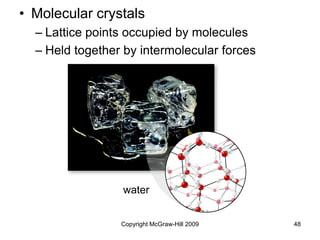
• Molecular crystals
– Lattice points occupied by molecules
– Held together by intermolecular forces
water
Copyright McGraw-Hill 2009 49
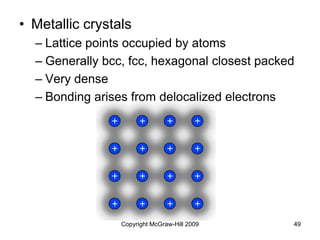
• Metallic crystals
– Lattice points occupied by atoms
– Generally bcc, fcc, hexagonal closest packed
– Very dense
– Bonding arises from delocalized electrons
Copyright McGraw-Hill 2009 50
Copyright McGraw-Hill 2009 51
12.5 Amorphous Solids
• Lack regular arrangement of atoms
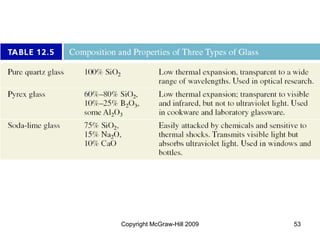
• Glass is a familiar and important
amorphous solid
– Transparent fusion of inorganic materials
– Chief component SiO2
– Behaves more as a liquid than a solid
Copyright McGraw-Hill 2009 52
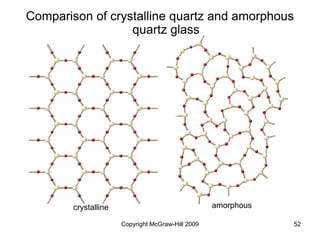
Comparison of crystalline quartz and amorphous
quartz glass
crystalline amorphous
Copyright McGraw-Hill 2009 53
Copyright McGraw-Hill 2009 54
12.6 Phase Changes
• Phase – homogenous part of a system
that is separated from the rest of the
system by a well-defined boundary
• Phase change – transition from one
phase to another
–Caused by the removal or addition of
energy
–Energy involved is usually in the form of
heat
Copyright McGraw-Hill 2009 55
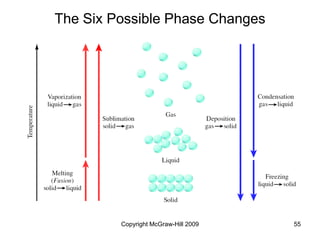
The Six Possible Phase Changes
Copyright McGraw-Hill 2009 56
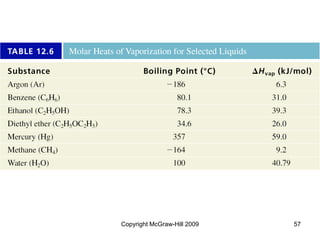
• Liquid-Vapor Phase Transition
– Boiling point – the temperature at which the
vapor pressure of liquid equals atmospheric
pressure
– Molar heat of vaporization (DHvap) – the
amount of heat required to vaporize one mole
of a substance at its boiling point usually in
kJ/mol
– Dependent on the strength of intermolecular
forces
– Condensation – opposite of vaporization
Copyright McGraw-Hill 2009 57
Copyright McGraw-Hill 2009 58
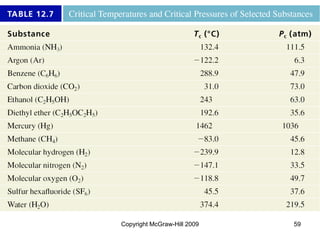
• Critical temperature (Tc) – the
temperature above which a gas cannot be
liquified by application of pressure
• Critical pressure (Pc) – the pressure that
must be applied to liquefy a gas at Tc.
• Supercritical fluid – the fluid that exists
above Tc and Pc.
Copyright McGraw-Hill 2009 59
Copyright McGraw-Hill 2009 60
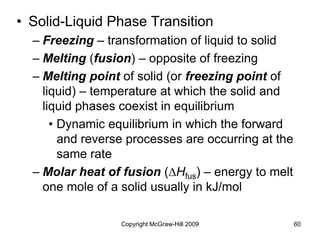
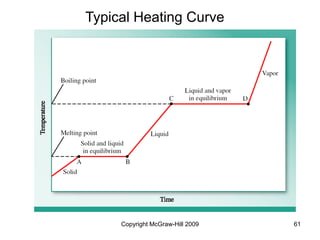
• Solid-Liquid Phase Transition
– Freezing – transformation of liquid to solid
– Melting (fusion) – opposite of freezing
– Melting point of solid (or freezing point of
liquid) – temperature at which the solid and
liquid phases coexist in equilibrium
• Dynamic equilibrium in which the forward
and reverse processes are occurring at the
same rate
– Molar heat of fusion (DHfus) – energy to melt
one mole of a solid usually in kJ/mol
Copyright McGraw-Hill 2009 61
Typical Heating Curve
Copyright McGraw-Hill 2009 62
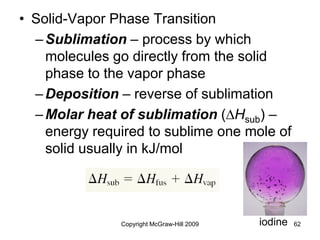
• Solid-Vapor Phase Transition
–Sublimation – process by which
molecules go directly from the solid
phase to the vapor phase
–Deposition – reverse of sublimation
–Molar heat of sublimation (DHsub) –
energy required to sublime one mole of
solid usually in kJ/mol
iodine
Copyright McGraw-Hill 2009 63
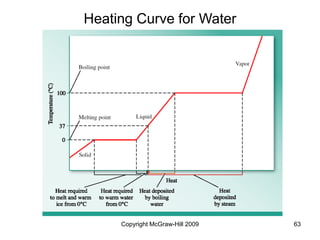
Heating Curve for Water
Copyright McGraw-Hill 2009 64
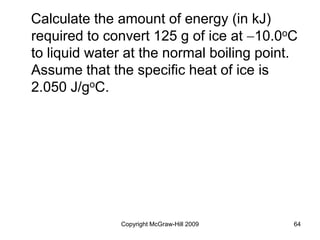
Calculate the amount of energy (in kJ)
required to convert 125 g of ice at 10.0oC
to liquid water at the normal boiling point.
Assume that the specific heat of ice is
2.050 J/goC.
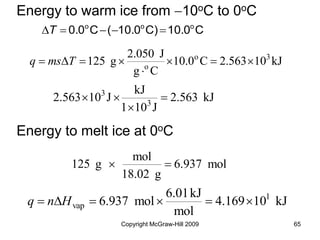
Copyright McGraw-Hill 2009 65
Energy to warm ice from 10oC to 0oC
C
10.0
C)
10.0
(
C
0.0 o
o
o




DT
kJ
10
2.563
C
10.0
C
g
J
2.050
g
125 3
o
o






D
 T
ms
q
Energy to melt ice at 0oC
kJ
10
4.169
mol
kJ
6.01
mol
937
.
6 1
vap 



D
 H
n
q
kJ
2.563
J
10
1
kJ
J
10
2.563 3
3




mol
6.937
g
18.02
mol
g
125 

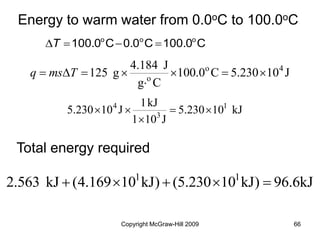
Copyright McGraw-Hill 2009 66
Energy to warm water from 0.0oC to 100.0oC
C
100.0
C
0.0
C
100.0 o
o
o



DT
J
10
5.230
C
100.0
C
g
J
4.184
g
125 4
o
o






D
 T
ms
q
Total energy required
kJ
10
5.230
J
10
1
kJ
1
J
10
5.230 1
3
4





96.6kJ
)
kJ
10
5.230
(
)
kJ
10
4.169
(
kJ
2.563 1
1





Copyright McGraw-Hill 2009 67
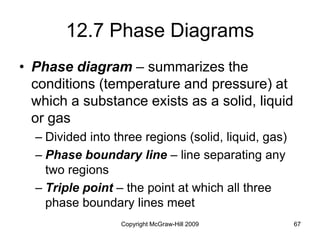
12.7 Phase Diagrams
• Phase diagram – summarizes the
conditions (temperature and pressure) at
which a substance exists as a solid, liquid
or gas
– Divided into three regions (solid, liquid, gas)
– Phase boundary line – line separating any
two regions
– Triple point – the point at which all three
phase boundary lines meet
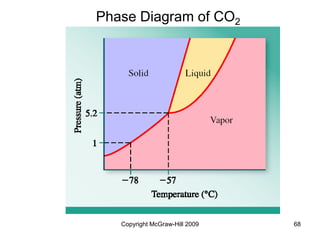
Copyright McGraw-Hill 2009 68
Phase Diagram of CO2
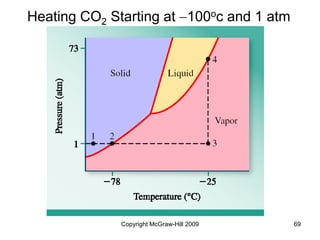
Copyright McGraw-Hill 2009 69
Heating CO2 Starting at 100oc and 1 atm
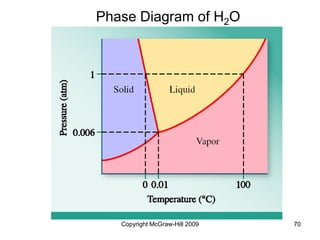
Copyright McGraw-Hill 2009 70
Phase Diagram of H2O
Copyright McGraw-Hill 2009 71
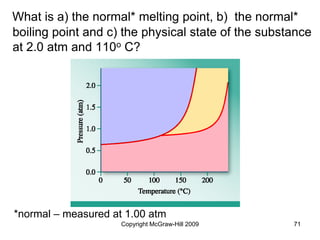
What is a) the normal* melting point, b) the normal*
boiling point and c) the physical state of the substance
at 2.0 atm and 110o C?
*normal – measured at 1.00 atm
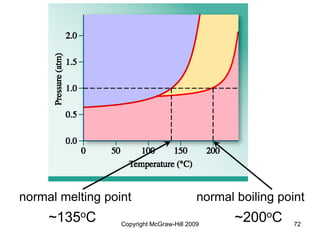
Copyright McGraw-Hill 2009 72
normal melting point normal boiling point
~135oC ~200oC
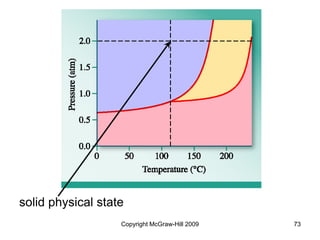
Copyright McGraw-Hill 2009 73
solid physical state
Copyright McGraw-Hill 2009 74
Key Points
• Intermolecular forces
– Dipole-dipole interactions
– Hydrogen bonding
– (London) dispersion forces
• Properties of liquids
– Surface tension
– Viscosity
– Vapor pressure
• Clausius-Clapeyron equation
Copyright McGraw-Hill 2009 75
• Crystal structure
– Unit cells
• Lattice point
– Packing spheres
• Coordination number
• Cubic unit cells
– Closest Packing
• Types of crystals
– Ionic
– Covalent
– Molecular
– Metallic
Copyright McGraw-Hill 2009 76
• Amorphous solids
• Phase changes
– Liquid-vapor transitions
• Boiling point
• Heat of vaporization
• Critical temperature and pressure
– Solid-liquid transitions
• Melting point
• Heat of fusion
• Phase diagrams

ch12temp.pdf

  • 1.
    1 Chapter 12 Intermolecular Forces andthe Physical Properties of Liquids and Solids Insert picture from First page of chapter Copyright McGraw-Hill 2009
  • 2.
    Copyright McGraw-Hill 20092 12.1 Intermolecular Forces • Intermolecular forces are the attractive forces holding particles together in the condensed (liquid and solid) phases of matter • Result from coulombic attractions – Dependent on the magnitude of the charge – Dependent on distance between charges • Weaker than forces of ionic bonding • Involve partial charges
  • 3.
    Copyright McGraw-Hill 20093 The Three Phases of Matter condensed phases
  • 4.
    Copyright McGraw-Hill 20094 Types of Intermolecular Forces • van der Waals forces –between atoms and molecules of pure substances – Dipole-dipole interactions – attractive forces between polar molecules – Hydrogen bonding – attractive force in polar molecules containing a H atom bonded to a small, highly electronegative element (N, O and F) – (London) Dispersion forces – attractive forces arising from instantaneous dipoles and induced dipoles
  • 5.
    Copyright McGraw-Hill 20095 Arrangement of Polar Molecules in a Liquid and a Solid.
  • 6.
    Copyright McGraw-Hill 20096 • Intermolecular forces determine certain physical properties.
  • 7.
    Copyright McGraw-Hill 20097 Hydrogen Bonds Between HF Molecules
  • 8.
    Copyright McGraw-Hill 20098 Effect of Molar Mass and Hydrogen Bonding on Boiling Points
  • 9.
    Copyright McGraw-Hill 20099 Instantaneous and Induced Dipoles Magnitude depends on the ability to be polarized which is greater for larger molecules.
  • 10.
    Copyright McGraw-Hill 200910 Polarization and Molar Mass
  • 11.
    Copyright McGraw-Hill 200911 What kind(s) of intermolecular forces exist in CH2ClCH2COOH(l) C C H Cl H C H H O O H dispersion forces dipole-dipole interactions hydrogen bonding
  • 12.
    Copyright McGraw-Hill 200912 –Occur in mixtures of ionic and polar species –Coulombic attraction between ions and polar molecules –Dependent upon • Size and charge of ion • Dipole moment of the molecule • Size of the molecule –Can also be repulsive •Ion-dipole Interactions
  • 13.
    Copyright McGraw-Hill 200913 12.2 Properties of Liquids • Surface Tension – a quantitative measure of the elastic force at the surface of a liquid • Manifestations – Formation of a mensicus – Capillary action which results from a combination of • Cohesion (attractions between like molecules, cohesive forces) • Adhesion (attractions between unlike molecules, adhesive forces)
  • 14.
    Copyright McGraw-Hill 200914 Effect of Surface Tension
  • 15.
    Copyright McGraw-Hill 200915 Intermolecular Forces: Surface versus Interior of a Liquid
  • 16.
    Copyright McGraw-Hill 200916 Cohesion and Adhesion Water Mercury Adhesion > Cohesion Cohesion > Adhesion
  • 17.
    Copyright McGraw-Hill 200917 • Viscosity – a measure of a fluid’s resistance to flow –Units: N.s/m2 –The higher the viscosity the greater the resistance to flow –Varies inversely with temperature –Stronger intermolecular forces produce higher viscosities
  • 18.
    Copyright McGraw-Hill 200918 Glycerol – high viscocity due to • Three hydrogen bonding sites • Molecular shape
  • 19.
    Copyright McGraw-Hill 200919 • Vapor Pressure of a Liquid –Depends on the magnitude of intermolecular forces –Temperature dependent T1<T2
  • 20.
    Copyright McGraw-Hill 200920 • Equilibrium Vapor Pressure – a dynamic state − Evaporation (vaporization) – liquid molecules escape into the gas phase − Condensation – gas molecules return to the liquid phase
  • 21.
    Copyright McGraw-Hill 200921 Comparison of Rates of Evaporation and Condensation at Constant Temperature
  • 22.
    Copyright McGraw-Hill 200922 Effect of Temperature and Intermolecular Forces on Vapor Pressure
  • 23.
    Copyright McGraw-Hill 200923 • Clausius-Clapeyron Equation – linear relation between temperature and vapor pressure − At two temperatures, T1 and T2: where R = 8.314 J/K . mol
  • 24.
    Copyright McGraw-Hill 200924 An unknown compound exhibits a vapor pressure of 255 mmHg at 25.5oC and 434 mmHg at 48.8oC. What is DHvap of this substance?
  • 25.
    Copyright McGraw-Hill 200925 K 298.65 273.15 C 25.5 1    o T K 321.95 273.15 C 48.8 2    o T         D  K 298.65 1 K 321.95 1 mol 8.314J/K mmHg 434 mmHg 255 vap H ln   3 3 3.3484x10 3.1061x10 mol 8.314J/K 0.53178     D   vap H          D  1 2 vap 2 1 1 1 T T R H P P ln
  • 26.
    Copyright McGraw-Hill 200926 vap H D       1 4 K 2.423x10 mol) .314J/K 0.53178)(8 (   1 4 K 2.423x10 mol 8.314J/K 0.53178     D   vap H vap 4 J/mol 10 x 1.82 H D  vap kJ/mol 18.2 H D 
  • 27.
    Copyright McGraw-Hill 200927 12.3 Crystal Structure • Crystalline solid – possesses rigid and long-range order • Lattice structure – arrangement of particles in a crystalline solid – Depends on nature of particles – Depends on size of particles • Stability depends on type of force between particles (ionic or covalent bonds and/or intermolecular forces)
  • 28.
    Copyright McGraw-Hill 200928 unit cell – basic repeating structural unit of a crystalline solid lattice point – each atom ion or molecule in a unit cell single unit cell 3-D array of unit cells
  • 29.
    Copyright McGraw-Hill 200929 Seven Types of Unit Cells
  • 30.
    Copyright McGraw-Hill 200930 Coordination number – number of atoms (particles) surrounding an atom in a crystal lattice • Indicates how tightly atoms pack • Larger coordination numbers indicate tighter packing
  • 31.
    Copyright McGraw-Hill 200931 • Types of cubic unit cells –simple or primitive (scc) –body-centered (bcc) –face-centered (fcc)
  • 32.
    Copyright McGraw-Hill 200932 Alternate Perspective of bcc Arrangement
  • 33.
    Copyright McGraw-Hill 200933 Sharing of Atoms by Adjacent Unit Cells corner atom edge atom face atom
  • 34.
    Copyright McGraw-Hill 200934 • Number of atoms per unit cell –scc: 1 atom –bcc: 2 atoms –fcc: 4 atoms •Allocation of atoms among unit cells − corner atoms – 1/8 atom within unit cell − face atoms – 1/2 atom within unit cell − body atoms – 1 atom within unit cell
  • 35.
    Copyright McGraw-Hill 200935 • Closest Packing – most efficient way to arrange atoms in a crystal –hexagonal closest packed (ABA) –cubic closest packed (ABC)
  • 36.
    Copyright McGraw-Hill 200936 Closest Packing and Cubic Unit Cells fcc cubic hexagonal
  • 37.
    Copyright McGraw-Hill 200937 Geometric Relationships
  • 38.
    Copyright McGraw-Hill 200938 When silver crystallizes, it forms face- centered cubic cells. The unit cell edge length is 4.087A . Calculate the density of silver. o
  • 39.
    Copyright McGraw-Hill 200939 g 10 7.167 amu 10 6.022 g 1 atom amu 107.9 cell unit atoms 4 22 23        m   3 23 3 8 3 cm 10 6.827 cm 10 4.087        a V cm 10 4.087 m 1 cm 00 1 A 10 1 m 1 A 4.087 8 10          a 3 3 23 22 g/cm 10.5 cell /unit cm 10 6.827 cell g/unit 10 7.167        V m d Mass of unit cell Volume of unit cell Density of unit cell
  • 40.
    Copyright McGraw-Hill 200940 • X-ray diffraction utilizes the scattering of X-rays and the resulting scattering patterns to deduce arrangement of particles
  • 41.
    Copyright McGraw-Hill 200941 − Bragg equation
  • 42.
    Copyright McGraw-Hill 200942 12.4 Types of Crystals • Ionic Crystals – Composed of anions and cations – Held together by coulombic forces – Anions generally are bigger than cations – Size and relative number of each ion determines the crystal structure
  • 43.
    Copyright McGraw-Hill 200943 Unit cell of NaCl as Defined by Cl− or Na+
  • 44.
    Copyright McGraw-Hill 200944 Examples of Ionic Crystal Lattices CsCl ZnS CaF2
  • 45.
    Copyright McGraw-Hill 200945 How many of each ion are contained within a unit cell of CaF2?
  • 46.
    Copyright McGraw-Hill 200946 Ca2+ 8 corner ions x 1/8= 1 ion 6 face ions x ½ = 3 ions 4 ions of Ca2+ F− 8 body ions x 1 = 8 ions of F− Ca2+ F−
  • 47.
    Copyright McGraw-Hill 200947 • Covalent crystals – Held together by covalent bonds diamond graphite
  • 48.
    Copyright McGraw-Hill 200948 • Molecular crystals – Lattice points occupied by molecules – Held together by intermolecular forces water
  • 49.
    Copyright McGraw-Hill 200949 • Metallic crystals – Lattice points occupied by atoms – Generally bcc, fcc, hexagonal closest packed – Very dense – Bonding arises from delocalized electrons
  • 50.
  • 51.
    Copyright McGraw-Hill 200951 12.5 Amorphous Solids • Lack regular arrangement of atoms • Glass is a familiar and important amorphous solid – Transparent fusion of inorganic materials – Chief component SiO2 – Behaves more as a liquid than a solid
  • 52.
    Copyright McGraw-Hill 200952 Comparison of crystalline quartz and amorphous quartz glass crystalline amorphous
  • 53.
  • 54.
    Copyright McGraw-Hill 200954 12.6 Phase Changes • Phase – homogenous part of a system that is separated from the rest of the system by a well-defined boundary • Phase change – transition from one phase to another –Caused by the removal or addition of energy –Energy involved is usually in the form of heat
  • 55.
    Copyright McGraw-Hill 200955 The Six Possible Phase Changes
  • 56.
    Copyright McGraw-Hill 200956 • Liquid-Vapor Phase Transition – Boiling point – the temperature at which the vapor pressure of liquid equals atmospheric pressure – Molar heat of vaporization (DHvap) – the amount of heat required to vaporize one mole of a substance at its boiling point usually in kJ/mol – Dependent on the strength of intermolecular forces – Condensation – opposite of vaporization
  • 57.
  • 58.
    Copyright McGraw-Hill 200958 • Critical temperature (Tc) – the temperature above which a gas cannot be liquified by application of pressure • Critical pressure (Pc) – the pressure that must be applied to liquefy a gas at Tc. • Supercritical fluid – the fluid that exists above Tc and Pc.
  • 59.
  • 60.
    Copyright McGraw-Hill 200960 • Solid-Liquid Phase Transition – Freezing – transformation of liquid to solid – Melting (fusion) – opposite of freezing – Melting point of solid (or freezing point of liquid) – temperature at which the solid and liquid phases coexist in equilibrium • Dynamic equilibrium in which the forward and reverse processes are occurring at the same rate – Molar heat of fusion (DHfus) – energy to melt one mole of a solid usually in kJ/mol
  • 61.
    Copyright McGraw-Hill 200961 Typical Heating Curve
  • 62.
    Copyright McGraw-Hill 200962 • Solid-Vapor Phase Transition –Sublimation – process by which molecules go directly from the solid phase to the vapor phase –Deposition – reverse of sublimation –Molar heat of sublimation (DHsub) – energy required to sublime one mole of solid usually in kJ/mol iodine
  • 63.
    Copyright McGraw-Hill 200963 Heating Curve for Water
  • 64.
    Copyright McGraw-Hill 200964 Calculate the amount of energy (in kJ) required to convert 125 g of ice at 10.0oC to liquid water at the normal boiling point. Assume that the specific heat of ice is 2.050 J/goC.
  • 65.
    Copyright McGraw-Hill 200965 Energy to warm ice from 10oC to 0oC C 10.0 C) 10.0 ( C 0.0 o o o     DT kJ 10 2.563 C 10.0 C g J 2.050 g 125 3 o o       D  T ms q Energy to melt ice at 0oC kJ 10 4.169 mol kJ 6.01 mol 937 . 6 1 vap     D  H n q kJ 2.563 J 10 1 kJ J 10 2.563 3 3     mol 6.937 g 18.02 mol g 125  
  • 66.
    Copyright McGraw-Hill 200966 Energy to warm water from 0.0oC to 100.0oC C 100.0 C 0.0 C 100.0 o o o    DT J 10 5.230 C 100.0 C g J 4.184 g 125 4 o o       D  T ms q Total energy required kJ 10 5.230 J 10 1 kJ 1 J 10 5.230 1 3 4      96.6kJ ) kJ 10 5.230 ( ) kJ 10 4.169 ( kJ 2.563 1 1     
  • 67.
    Copyright McGraw-Hill 200967 12.7 Phase Diagrams • Phase diagram – summarizes the conditions (temperature and pressure) at which a substance exists as a solid, liquid or gas – Divided into three regions (solid, liquid, gas) – Phase boundary line – line separating any two regions – Triple point – the point at which all three phase boundary lines meet
  • 68.
    Copyright McGraw-Hill 200968 Phase Diagram of CO2
  • 69.
    Copyright McGraw-Hill 200969 Heating CO2 Starting at 100oc and 1 atm
  • 70.
    Copyright McGraw-Hill 200970 Phase Diagram of H2O
  • 71.
    Copyright McGraw-Hill 200971 What is a) the normal* melting point, b) the normal* boiling point and c) the physical state of the substance at 2.0 atm and 110o C? *normal – measured at 1.00 atm
  • 72.
    Copyright McGraw-Hill 200972 normal melting point normal boiling point ~135oC ~200oC
  • 73.
    Copyright McGraw-Hill 200973 solid physical state
  • 74.
    Copyright McGraw-Hill 200974 Key Points • Intermolecular forces – Dipole-dipole interactions – Hydrogen bonding – (London) dispersion forces • Properties of liquids – Surface tension – Viscosity – Vapor pressure • Clausius-Clapeyron equation
  • 75.
    Copyright McGraw-Hill 200975 • Crystal structure – Unit cells • Lattice point – Packing spheres • Coordination number • Cubic unit cells – Closest Packing • Types of crystals – Ionic – Covalent – Molecular – Metallic
  • 76.
    Copyright McGraw-Hill 200976 • Amorphous solids • Phase changes – Liquid-vapor transitions • Boiling point • Heat of vaporization • Critical temperature and pressure – Solid-liquid transitions • Melting point • Heat of fusion • Phase diagrams