1
Chapter 31
Chemical
Equilibrium
Copyright (c) 2011 by Michael A. Janusa, PhD. All rights reserved.
2
Many chemical reactions do not completely convert
reactants to products. Stop somewhere between no rxn and
complete rxn. A + B C + D
some left some formed
reversible (both directions)
Chemical Equilibrium
Previously we have assumed that chemical
reactions results in complete conversion of
reactants to products:
A + B C + D
No A or B remaining or possibly an excess of A or B but
not both and eventually reaction stops.
exchange, constant conc.,
Ratef = Rater “equilibrium”
A + B  C + D
A + B  C + D
4
Chemical Equilibrium
• Therefore, many reactions do not go to
completion but rather form a mixture of
products and unreacted reactants, in a
dynamic equilibrium.
– A dynamic equilibrium consists of a forward
reaction, in which substances react to give products,
and a reverse reaction, in which products react to
give the original reactants.
– Chemical equilibrium is the state reached by a
reaction mixture when the rates of the forward
and reverse reactions have become equal.
5
Graphically we can represent this A + B C + D
The concentrations and reaction rate (less collisions, less component)
of A and B decreases over time as the concentrations and reaction rate
of C and D increases (more collisions, more component) over time
until the rates are equal and the concentrations of each components
reaches a constant. This occurs at what we call equilibrium -- Rf = Rr.
If the rates are equal, then there must be a relationship to show this.
3H2 + CO CH4 + H2O
3H2 + CO  CH4 + H2O rate decreases over time
CH4 + H2O  3H2 + CO rate increases over time
Rf=Rr
Ebbing, D. D.; Gammon, S. D. General
Chemistry, 8th ed., Houghton Mifflin, New
York, NY, 2005.
7
For the reverse reaction we have,
C + D A + B Rr = kr [C][D]
We know at equil that Rf = Rr ;therefore, we can set these two
expressions as equal
kf [A][B] = kr [C][D]
Rearrange to put constants on one side we get
]
][
[
]
][
[
B
A
D
C
k
k
K
r
f


If we assume these reactions are elementary rxns (based on
collisions), we can write the rate laws directly from the
reaction:
A + B C + D Rf = kf [A][B]
8
Constant divided by constant just call a new constant K. This ratio is
given a special name and symbol called equilibrium constant K
relating to the equilibrium condition at a certain temperature (temp
dependent) for a particular reaction relating conc of each component.
This is basically a comparison between forward and reverse reaction
rates. At equilibrium, the ratio of conc of species must satisfy K.
]
][
[
]
][
[
B
A
D
C
k
k
K
r
f


9
The Equilibrium Constant
• Every reversible system has its own “position of
equilibrium”- K- under any given set of conditions.
– The ratio of products produced to unreacted reactants
for any given reversible reaction remains constant under
constant conditions of pressure and temperature. If the
system is disturbed, the system will shift and all the
concentrations of the components will change until
equilibrium is re-established which occurs when the ratio of
the new concentrations equals "K". Different constant conc
but ratio same as before.
– The numerical value of this ratio is called the equilibrium
constant for the given reaction, K.
10
The Equilibrium Constant
• The equilibrium-constant expression for a reaction is
obtained by multiplying the equil concentrations ( or partial
pressures) of products, dividing by the equil concentrations (or
partial pressures) of reactants, and raising each concentration to
a power equal to its coefficient in the balanced chemical
equation.
dD
cC
bB
aA 

b
a
d
c
B
A
D
C
K
]
[
]
[
]
[
]
[
 b
B
a
A
d
D
c
C
p
P
P
P
P
K
)
(
)
(
)
(
)
(

c
The molar concentration of a substance is denoted by writing its formula in
square brackets for aq solutions. For gases can put Pa - atm. As long as use M
or atm, K is unitless; liquids and solids = 1; setup same for all K’s (Ka, Kb, etc.)
Temp dependent; any changes, ratio will still equal K when equil established
11
31.1 The Equilibrium Constant, K
• The law of mass action states that the value of the
equilibrium constant expression K is constant for a
particular reaction at a given temperature, whenever
equilibrium concentrations are substituted.
• When at equil, conc ratio equals K and concs are
constant but if disturbed, values change until equil
reached, different constant conc but same ratio of K).
12
Obtaining Equilibrium Constants
for Reactions
• Equilibrium concentrations for a reaction
must be obtained experimentally and
then substituted into the equilibrium-
constant expression in order to
calculate Kc.
13
Obtaining Equilibrium Constants
for Reactions
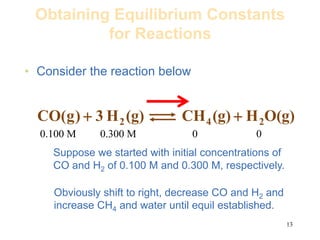
• Consider the reaction below
O(g)
H
(g)
CH
(g)
H
3
)
g
(
CO 2
4
2 

Suppose we started with initial concentrations of
CO and H2 of 0.100 M and 0.300 M, respectively.
0.100 M 0.300 M 0 0
Obviously shift to right, decrease CO and H2 and
increase CH4 and water until equil established.
14
– When the system finally settled into equilibrium we
determined the equilibrium concentrations to be as
follows.
Reactants Products
[CO]eq = 0.0613 M
[H2] eq = 0.1839 M
[CH4] eq = 0.0387 M
[H2O] eq = 0.0387 M
Obtaining Equilibrium Constants
for Reactions
O(g)
H
(g)
CH
(g)
H
3
)
g
(
CO 2
4
2 

15
– If we substitute the equilibrium concentrations,
we obtain:
93
.
3
)
1839
.
0
)(
0613
.
0
(
)
0387
.
0
)(
0387
.
0
(
3


c
K
Obtaining Equilibrium Constants
for Reactions
O(g)
H
(g)
CH
(g)
H
3
)
g
(
CO 2
4
2 

eq
eq
eq
eq
c
H
CO
O
H
CH
K 3
2
2
4
]
[
]
[
]
[
]
[

16
– Regardless of the initial concentrations (whether
they are reactants or products or mixture), the law
of mass action dictates that the reaction will
always settle into an equilibrium where the
equilibrium-constant expression equals Kc.
Obtaining Equilibrium Constants
for Reactions
O(g)
H
(g)
CH
(g)
H
3
)
g
(
CO 2
4
2 

17
As an example, let’s repeat the previous
experiment, only this time starting with initial
concentrations of products (note: if only products
to start shift left until equil established):
[CH4]initial = 0.2000 M and [H2O]initial = 0.2000 M
Obviously shift to left decrease CH4 and H2O and
increase CO and H2 until equil established.
Obtaining Equilibrium Constants
for Reactions
O(g)
H
(g)
CH
(g)
H
3
)
g
(
CO 2
4
2 

0 0 0.2000 M 0.2000 M
18
– We find that these initial concentrations result in
the following equilibrium concentrations.
Reactants Products
[CO] eq = 0.0990 M
[H2] eq = 0.2970 M
[CH4] eq = 0.1010 M
[H2O] eq = 0.1010 M
Obtaining Equilibrium Constants
for Reactions
O(g)
H
(g)
CH
(g)
H
3
)
g
(
CO 2
4
2 

19
– Substituting these values into the equilibrium-
constant expression, we obtain the same result.
93
.
3
)
2970
.
0
)(
0990
.
0
(
)
1010
.
0
)(
1010
.
0
(
3


c
K
– Whether we start with reactants or products at any
initial conc, the system establishes the same ratio
at same temperature.
Obtaining Equilibrium Constants
for Reactions
O(g)
H
(g)
CH
(g)
H
3
)
g
(
CO 2
4
2 

eq
eq
eq
eq
c
H
CO
O
H
CH
K 3
2
2
4
]
[
]
[
]
[
]
[

20
The Equilibrium Constant
• The equilibrium constant, K, is the value obtained
for the equilibrium-constant expression when
equilibrium concentrations (not just any conc but
equil conc) are substituted.
– A large K, K>1, indicates large concentrations of
products at equilibrium.
– A small K, K<1, indicates large concentrations of
unreacted reactants at equilibrium.
HW 14
code: horse
21
The Equilibrium Constant
– Do same set up for all equil equations (future chapters), just
different subscript describing the reaction in question: i.e.
acid hydrolysis - acid + water - Ka, Kb, Kc, Kp, Ksp
– Kc is based on conc (M) and Kp is based on pressures (atm).
There is a difference between Kc and Kp and to jump
between these two, there is an equation to use. Let's show
how to jump between.
22
31.1.1 The Equilibrium Constant in
Terms of Pressure, Kp
• In discussing gas-phase equilibria, it is often
more convenient to express concentrations in
terms of partial pressures rather than
molarities.
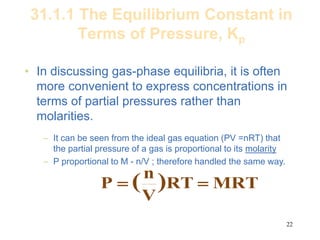
– It can be seen from the ideal gas equation (PV =nRT) that
the partial pressure of a gas is proportional to its molarity
– P proportional to M - n/V ; therefore handled the same way.
MRT
RT
V
n
P )
( 

23
The Equilibrium Constant, Kp
– Consider the reaction below.
O(g)
H
(g)
CH
(g)
H
3
)
g
(
CO 2
4
2 

– The equilibrium-constant expression in terms of partial
pressures becomes (same way but partial pressures instead
of M):
3
)
( 2
2
4
H
CO
O
H
CH
p
K
P
P
P
P
 3
2
2
4
]
[H
]
[
O]
[
]
[
CO
H
CH
Kc 
24
The Equilibrium Constant, Kp
• In general if you need to jump between
K's, the numerical value of Kp differs
from that of Kc.
where Dng is the sum of the moles of gaseous
products in a reaction minus the sum of the moles
of gaseous reactants.
ng
c
p RT
K
K D
 )
(
25
A Problem to Consider
• Consider the reaction
– Kc for the reaction is 280 at 1000. K . Calculate Kp
for the reaction at this temperature.
(g)
SO
2
)
g
(
O
)
g
(
SO
2 3
2
2 
26
A Problem to Consider
– We know that
From the equation we see that Dng = 2 – 3 = -1. We
can simply substitute the given reaction temperature
and the value of R (0.0821 L.atm/mol.K) to obtain Kp.
• Consider the reaction at 1000. K and Kc
= 280
(g)
SO
2
)
g
(
O
)
g
(
SO
2 3
2
2 
ng
c
p RT
K
K D
 )
(
27
A Problem to Consider
– Since
3.4
K)
1000
0821
.
0
(
280 -1


 

K
mol
atm
L
p
K
• Consider the reaction
(g)
SO
2
)
g
(
O
)
g
(
SO
2 3
2
2 
ng
c
p RT
K
K D
 )
(
28
A Problem to Consider
• Applying Stoichiometry to an Equilibrium Mixture
(basic setup for future problems).
– What is the composition of the equilibrium mixture
if it contains 0.080 mol NH3 at equilibrium?
– Suppose we place 1.000 mol N2 and 3.000 mol H2
in a reaction vessel at 450 oC and 10.0
atmospheres of pressure. The reaction is
(g)
2NH
)
g
(
H
3
)
g
(
N 3
2
2 
3
2
2
2
3
c
]
H
][
N
[
]
NH
[
K 
29
– This procedure for many types of problems, however in
this problem given equil quantity of NH3 ;therefore, figure
out rest.
• Using the information given, set up the
following table. (ratio works for atm, M, mols,
etc.)
(g)
2NH
)
g
(
H
3
)
g
(
N 3
2
2 
Initial, no
Change,
Dn
Equil, neq
1.000 3.000 0
- - +
– The equilibrium amount of NH3 was given as 0.080 mol.
Therefore, 2x = 0.080 mol NH3 (x = 0.040 mol).
x 3x 2x
1.000 - x 3.000 - 3x 2x = 0.080 mol
30
A Problem to Consider
• Using the information given, set up the
following table.
Equilibrium amount of N2 = 1.000 - 0.040 = 0.960 mol N2
Equilibrium amount of H2 = 3.000 - (3 x 0.040) = 2.880 mol H2
Equilibrium amount of NH3 = 2x = 0.080 mol NH3
(g)
2NH
)
g
(
H
3
)
g
(
N 3
2
2 
Initial 1.000 3.000 0
Change -x -3x +2x
Equilibrium1.000 - x 3.000 - 3x 2x = 0.080 mol
HW 15
x = 0.040 mol
code: rhino
31
31.2 Changing the Chemical
Equation
• Similar to the method of combining reactions
that we saw using Hess’s law in
thermochemistry, we can combine equilibrium
reactions whose K values are known to
obtain K for the overall reaction.
– With Hess’s law, when we reversed reactions
(change sign) or multiplied them prior to adding them
together (mult by factor). We had to manipulate the
DH’s values to reflect what we had done.
– The rules are a bit different for manipulating K.
32
2. If you multiply/divide each of the coefficients in an
equation by the same factor (2, 1/2, …), raise Kc to the
same power (2, 1/2, …). (known as coefficient rule, Kn)
3. When you finally combine (that is, add) the individual
equations together, take the product of the equilibrium
constants to obtain the overall K.(rule of multiple
equilibria, K1 x K2 x K3… = KT)
1. If you reverse a reaction, invert the value of K.
(reciprocal rule, 1/K)
Equilibrium Constant for the Sum
of Reactions
33
• For example, nitrogen and oxygen can
combine to form either NO(g) or N2O (g)
according to the following equilibria.
NO(g)
)
g
(
O
2
1
)
g
(
N
2
1
2
2 
O(g)
N
)
g
(
O
)
g
(
N 2
2
2
1
2 
Kc = 6.4 x 10⁻¹⁶
Kc = 2.4 x 10⁻¹⁸
(1)
(2)
Kc = ?
– Using these two equations, we can obtain K for
the formation of NO(g) from N2O(g):
NO(g)
2
)
g
(
O
)
g
(
O
N 2
2
1
2 
overall
Equilibrium Constant for the Sum
of Reactions
reverse and multiply by factor of 1
same and multiply by factor of 2
34
NO(g)
2
)
g
(
O
)
g
(
O
N 2
2
1
2 
NO(g)
2
)
g
(
O
)
g
(
N 2
2  Kc = (6.4 x 10⁻¹⁶)2 =
4.1 x 10⁻³¹
(1)
)
g
(
O
(g)
N
O(g)
N 2
2
1
2
2  Kc =
(2)
overall

 18
-
10
4
.
2
1
13
17
31
10
7
.
1
)
10
2
.
4
(
)
10
1
.
4
(
)
( 







overall
Kc
HW 16
NO(g)
)
g
(
O
2
1
)
g
(
N
2
1
2
2 
O(g)
N
)
g
(
O
)
g
(
N 2
2
2
1
2 
Kc = 6.4 x 10⁻¹⁶
Kc = 2.4 x 10-18
= 4.2 x 10¹⁷
code: ally
35
31.1.2 Heterogeneous Equilibria
• A heterogeneous equilibrium is an equilibrium that
involves reactants and products in more than one
phase. Up to now all our reactions have been
homogeneous - all gases or aqueous solutions.
– The equilibrium of a heterogeneous system is
unaffected by the amounts of pure solids or liquids
present, as long as some of each is present.
– The concentrations of pure solids and liquids are
always considered to be “1 activity” and therefore, do
not appear in the equilibrium expression. Solids and
pure liquids have no effect on conc or pressure.
36
Heterogeneous Equilibria
• Consider the reaction below.
(g)
H
CO(g)
)
(
)
( 2
2 
 l
O
H
s
C
2
2 ]
][
[
H
CO
p
c
P
P
K
H
CO
K


HW 17
code: mike
37
31.3 Direction of Reaction
• How could we predict the direction in which a
reaction at non-equilibrium conditions will shift to
reestablish equilibrium? Remember did example
with only reactants, obviously had to go right and if
only products obviously must go left but what if have
some of R and P?
– To answer this question, substitute the current
concentrations into the reaction quotient
expression and compare it to Kc.
– The reaction quotient, Qc, is an expression that
has the same form as the equilibrium-constant
expression but whose concentrations are not
necessarily at equilibrium.
38
Predicting the Direction of Reaction
• For the general reaction
dD
cC
bB
aA 

the Qc expresssion would be (i=initial):
b
a
d
c
c
]
B
[
]
A
[
]
D
[
]
C
[
Q
i
i
i
i

b
a
d
c
c
B
A
D
C
K
eq
eq
eq
eq
]
[
]
[
]
[
]
[

39
Predicting the Direction of Reaction
• For the general reaction
dD
cC
bB
aA 

– If Qc = Kc, then the reaction is at equilibrium.
– If Qc > Kc, the reaction will shift left toward reactants until equil
reached.
– If Qc < Kc, the reaction will shift right toward products until equil
reached.
b
a
d
c
c
]
B
[
]
A
[
]
D
[
]
C
[
Q
i
i
i
i

b
a
d
c
c
]
B
[
]
A
[
]
D
[
]
C
[
Q
i
i
i
i

40
A Problem to Consider
– Consider the following equilibrium.
– A 50.0 L vessel contains 1.00 mol N2, 3.00 mol
H2, and 0.500 mol NH3. Is the sytem at equil? If
not, in which direction (toward reactants or
toward products) will the system shift to
reestablish equilibrium at 400 oC?
– Kc for the reaction at 400 oC is 0.500.
(g)
2NH
)
g
(
H
3
)
g
(
N 3
2
2 
41
A Problem to Consider
First, calculate concentrations from moles
of substances.
(g)
2NH
)
g
(
H
3
)
g
(
N 3
2
2 
3
2
2
2
3
]
[
]
[
]
[
i
i
i
c
H
N
NH
Q 
Next, plug into Q expression
42
A Problem to Consider
(g)
2NH
)
g
(
H
3
)
g
(
N 3
2
2 
– Substituting these concentrations into the reaction
quotient gives:
1
.
23
)
0600
.
0
)(
0200
.
0
(
)
0100
.
0
(
Q 3
2
c 

Note: you cannot just look at number of mols or molarity to decide direction of reaction
because must account for the size of K.
43
0.0100 M
0.0600 M
0.0200 M
A Problem to Consider
(g)
2NH
)
g
(
H
3
)
g
(
N 3
2
2 
– Because Qc = 23.1 is greater than Kc = 0.500,
the reaction will go to the left (toward
reactants - consume products, produce
reactants) as it approaches equilibrium.
HW 18
code: josh
44
31.4 Calculating K and Equilibrium
Quantities
• Once you have determined the
equilibrium constant, K, for a reaction,
you can use it to calculate the
concentrations of substances in the
equilibrium mixture.
45
Calculating Equilibrium
Concentrations
– Suppose a gaseous mixture contained 0.30 mol CO,
0.10 mol H2, 0.020 mol H2O, and an unknown
amount of CH4 per liter at equilibrium.
– What is the concentration of CH4 at equilibrium in this
mixture? The equilibrium constant Kc equals 3.92.
– Note: the amounts given are equil amounts; therefore
can plug into K eq.
O(g)
H
(g)
CH
(g)
H
3
)
g
(
CO 2
4
2 

– For example, consider the following equilibrium
mixture.
46
Calculating Equilibrium
Concentrations
– First, calculate concentrations from moles of substances
then plug into K expression.
O(g)
H
(g)
CH
(g)
H
3
)
( 2
4
2 

g
CO
eq
eq
eq
eq
c
H
CO
O
H
CH
K 3
2
2
4
]
[
]
[
]
[
]
[

47
Calculating Equilibrium
Concentrations
– Substituting the known concentrations and the value
of Kc gives:
3
4
)
10
.
0
)(
30
.
0
(
)
020
.
0
](
[
92
.
3
CH

??
0.30 M 0.10 M 0.020 M
O(g)
H
(g)
CH
(g)
H
3
)
g
(
CO 2
4
2 

48
Calculating Equilibrium
Concentrations
– You can now solve for [CH4].
M
CH 059
.
0
)
020
.
0
(
)
10
.
0
)(
30
.
0
)(
92
.
3
(
]
[
3
4 

– The concentration of CH4 in the equil mixture is
0.059 mol/L.
??
0.30 M 0.10 M 0.020 M
O(g)
H
(g)
CH
(g)
H
3
)
g
(
CO 2
4
2 

49
31.4.1 Calculating Equilibrium Quantities
from Initial Values (Perfect Square)
• Suppose we begin a reaction with
known amounts of starting materials
and want to calculate the quantities at
equilibrium.
50
Calculating Equilibrium
Concentrations
– Consider the following equilibrium.
• Suppose you start with 1.000 mol each of carbon
monoxide and water in a 50.0 L container.
Calculate the molarity of each substance in the
equilibrium mixture at 1000 oC.
• Kc for the reaction is 0.58 at 1000 oC.
(g)
H
(g)
CO
)
g
(
O
H
)
g
(
CO 2
2
2 

0 0
- +
Which way will reaction shift?
51
Calculating Equilibrium
Concentrations
– First, calculate the initial molarities of CO and H2O.
(g)
H
(g)
CO
)
g
(
O
H
)
g
(
CO 2
2
2 

0 0
52
Calculating Equilibrium
Concentrations
• The starting concentrations of the products are 0.
• We must now set up a table of concentrations (initial, change,
and equilibrium expressions in x, ICE table).
0.0200 M 0.0200 M 0 M 0 M
(g)
H
(g)
CO
)
g
(
O
H
)
g
(
CO 2
2
2 

53
Calculating Equilibrium
Concentrations
– Let x be the moles per liter of product formed.
Initial 0.0200 0.0200 0 0
Change
Equil
– The equilibrium-constant expression is:
]
O
H
][
CO
[
]
H
][
CO
[
K
2
2
2
c 
(g)
H
(g)
CO
)
g
(
O
H
)
g
(
CO 2
2
2 

- - + +
x x x x
0.0200-x 0.0200-x x x
54
– Solving for x.
Initial 0.0200 0.0200 0 0
Change -x -x +x +x
Equilibrium0.0200-x 0.0200-x x x
– Substituting the values for equilibrium concentrations, we
get:
)
x
0200
.
0
)(
x
0200
.
0
(
)
x
)(
x
(
58
.
0



(g)
H
(g)
CO
)
g
(
O
H
)
g
(
CO 2
2
2 

]
O
H
][
CO
[
]
H
][
CO
[
K
2
2
2
c 
55
Calculating Equilibrium
Concentrations
– Solving for x.
Initial 0.0200 0.0200 0 0
Change -x -x +x +x
Equilibrium0.0200-x 0.0200-x x x
2
2
)
x
0200
.
0
(
x
58
.
0


(g)
H
(g)
CO
)
g
(
O
H
)
g
(
CO 2
2
2 

56
Calculating Equilibrium
Concentrations
– Solving for x.
Initial 0.0200 0.0200 0 0
Change -x -x +x +x
Equilibrium0.0200-x 0.0200-x x x
– Taking the square root of both sides
because perfect square, we get:
x
x
x
x
x
x
x
76
.
1
0152
.
0
76
.
0
0152
.
0
)
0200
.
0
(
76
.
0
)
0200
.
0
(
76
.
0







(g)
H
(g)
CO
)
g
(
O
H
)
g
(
CO 2
2
2 

2
2
)
0200
.
0
(
58
.
0
x
x


M
x 0086
.
0
76
.
1
0152
.
0


57
Calculating Equilibrium
Concentrations
– Solving for equilibrium concentrations.
Initial 0.0200 0.0200 0 0
Change -x -x +x +x
Equilibrium0.0200-x 0.0200-x x x
– If you substitute for x in the last line of the table you obtain the
following equilibrium concentrations. If plug into Keq, should
equal K or close to it because of sign fig for a check
(g)
H
(g)
CO
)
g
(
O
H
)
g
(
CO 2
2
2 

HW 19
[CO]eq = 0.0200 – x = 0.0200 – 0.0086 = 0.0114 M
[H2O]eq = 0.0200 – x = 0.0200 – 0.0086 = 0.0114 M
[CO2]eq = x = 0.0086 M
[H2]eq = x = 0.0086 M
code: katie
58
Calculating Equilibrium
Concentrations
• The preceding example illustrates the
three steps in solving for equilibrium
concentrations.
1. Set up a table of concentrations (initial, change, and
equilibrium expressions in x – ICE table).
2. Substitute the expressions in x for the equilibrium
concentrations into the equilibrium-constant equation.
3. Solve the equilibrium-constant equation for the values
of the equilibrium concentrations.
59
Another example: If the initial pressure of C is 1.0 atm, what
would be the partial pressures of each species at equil.
Initial, Po 0 0 1.0
Change, DP
Equil, Peq
HW 20
A + B 2C
Kp = 9.0
+ + -
x x 2x
x x 1.0-2x
code: chris
60
Another example: If the initial pressure of C is 0.10 atm and A
and B are 1.00 atm, what would be the partial pressures of each
species at equil.
Initial, Po 0.10 1.00 1.00
Change, DP
Equil, Peq
HW 21
2C A + B
Kp = 0.016
Q > K therefore, shift left
+ - -
2x x x
0.10 + 2x 1.00 – x 1.00 - x
code: three
61
31.4.2 Calculating Equilibrium Quantities
from Initial Values (Quadratic Formula)
• In some cases it is necessary to solve a
quadratic equation to obtain equilibrium
concentrations - not a perfect square.
• The next example illustrates how to
solve such an equation.
62
Calculating Equilibrium
Concentrations
– Consider the following equilibrium.
• Suppose 1.00 atm H2 and 2.00 atm I2 are placed in
a 1.00-L vessel. What are the partial pressures of
all species when it comes to equilibrium at 458 oC?
• Kp at this temperature is 49.7.
HI(g)
2
)
g
(
I
)
g
(
H 2
2 
63
Calculating Equilibrium
Concentrations
– The concentrations of substances are as follows.
HI(g)
2
)
g
(
I
)
g
(
H 2
2 
Initial, Po 1.00 2.00 0
Change, DP
Equil, Peq
- - +
x x 2x
1.00 - x 2.00 – x 2x
64
Calculating Equilibrium
Concentrations
– The concentrations of substances are as follows.
Po 1.00 2.00 0
DP -x -x +2x
Peq 1.00-x 2.00-x 2x
– Substituting our equilibrium concentration expressions
gives:
7
.
49
)
x
00
.
2
)(
x
00
.
1
(
)
x
2
(
K
2
p 



HI(g)
2
)
g
(
I
)
g
(
H 2
2 
65
Calculating Equilibrium
Concentrations
– Solving for x.
– Because the right side of this equation is not a perfect square (sq over
sq), you must solve the quadratic equation.
HI(g)
2
)
g
(
I
)
g
(
H 2
2 
Initial 1.00 2.00 0
Change -x -x +2x
Equilibrium 1.00-x 2.00-x 2x
a
ac
b
b
x
c
bx
ax
2
4
0
2
2







66
49.7(1.00-x)(2.00-x) = (2x)2
49.7(2.00 - 3.00x + x2) = 4x2
99.4 - 149.1x + 49.7x2 = 4x2
45.7x2 - 149.1x + 99.4 = 0
7
.
49
)
x
00
.
2
)(
x
00
.
1
(
)
x
2
(
K
2
p 



a b c
a
ac
b
b
x
c
bx
ax
2
4
0
2
2







)
7
.
45
(
2
)
4
.
99
)(
7
.
45
(
4
)
1
.
149
(
)
1
.
149
( 2






x
4
.
91
32
.
18170
)
81
.
22230
(
)
1
.
149
( 




x
4
.
91
49
.
4060
)
1
.
149
( 



x
4
.
91
72
.
63
1
.
149 

x
934
.
0
4
.
91
38
.
85



x
33
.
2
4
.
91
82
.
212



x
67
Calculating Equilibrium
Concentrations
– However, x = 2.33 gives a negative value to 1.00 - x (the
equilibrium concentration of H2), which is not possible.
possible
0.934
Only x 
If you do the shift correctly, you may get a negative and
positive number, take the positive number and if two positive
numbers, take the smaller number. However, if you neglect the
shift and select it incorrectly, you will end up with either a +
and - # or two -#'s. In this case the negative number will be
correct or the smaller of the two negative numbers will be
correct. Bottom line examine numbers carefully when
selecting answer and selecting proper shift makes life easier
(use Q when necessary).
68
Calculating Equilibrium
Concentrations
• Solving for equilibrium pressures.
– If you substitute 0.934 for x in the last line of the table
you obtain the following equilibrium concentrations.
HI(g)
2
)
g
(
I
)
g
(
H 2
2 
Initial 1.00 2.00 0
Change -x -x +2x
Equilibrium 1.00-x 2.00-x 2x
HW 22
code: two
69
31.5 Effect of Changing the Reaction
Conditions Upon Equilibrium
• Obtaining the maximum amount of
product from a reaction depends on the
proper set of reaction conditions which
gets us to:
– Le Chatelier’s principle states that when a
system in a chemical equilibrium is disturbed by a
change of temperature, pressure, or
concentration, the equilibrium will shift in a way
that tends to counteract this change until
equilibrium is established again.
70
31.5.1 Adding or Removing a
Species
• If a chemical system at equilibrium is disturbed by
adding a gaseous or aqueous species (not solid
or liquid R or P), the reaction will proceed in such
a direction as to consume part of the added
species. Conversely, if a gaseous or aqueous
species is removed (complex or escape gas), the
system shifts to restore part of that species. This
shift will occur until equilibrium is re-established.
• A + B C + D add - shift to opposite side,
remove - shift towards that side.
71
31.5.2 Compression or Expansion
• A pressure change caused by changing the volume of the
reaction vessel can affect the yield of products in a gaseous
reaction; only if the reaction involves a change in the total moles
of gas present
• Ex. N2O4 (g) 2NO2 (g)
• Suppose system is compressed by pushing down a piston
(decrease volume of space), which way would the shift be that
would benefit and use the available space wisely?
• Shift to smaller number of gas molecules to pack more
efficiently and relieve the increase in pressure due to piston
coming down.
72
Effects of Pressure Change
• Basically the reactants require less volume
(that is, fewer moles of gaseous reactant) and
by decreasing the volume of the reaction vessel
by increasing the pressure, the rxn would shift
the equilibrium to the left (toward reactants)
until equil is established.
73
Effects of Pressure Change
• Literally “squeezing” the reaction (increase P) will cause a shift
in the equilibrium toward the fewer moles of gas.
• Reducing the pressure in the reaction vessel by increasing its
volume would have the opposite effect.
• Decrease P, increase V, shift larger mols of gas (L &S
not compressible)
• Increase P, decrease V, shift to smaller mols of gas
• In the event that the number of moles of gaseous
product equals the number of moles of gaseous
reactant, vessel volume/pressure will have no effect
on the position of the equilibrium; no advantage to
shift one way over the other.
74
SO2 (g) + 1/2 O2 (g) SO3 (g)
Increase P?
Shift to right toward smaller mols gas
N2 (g) + 3 H2 (g) 2NH3 (g)
Decrease P?
N2 (g) + O2 (g) 2NO (g)
Decrease P?
C (s) + H2O(g) CO (g) + H2 (g)
Increase P?
Shift to left toward larger mols gas
No shift
Shift to left toward smaller mols gas; note
that C is a solid.
75
31.5.3 Temperature
• Temperature has a significant effect on
most reactions.
– Reaction rates generally increase with an increase
in temperature. Consequently, equilibrium is
established sooner.
– However, when you add or remove
reactants/products or change pressure, the result
is that the system establishes new conc of species
but ratio still equal to same K at that temperature.
For temp changes, the numerical value of the
equilibrium constant Kc varies with
temperature. K temp dependent.
76
Effect of Temperature Change
• Let’s look at “heat” as if it were a
product in exothermic reactions and
a reactant in endothermic reactions.
• We see that increasing the temperature is
related to adding more product (in the case of
exothermic reactions) or adding more
reactant (in the case of endothermic
reactions).
• This ultimately has the same effect as if heat
were a physical entity.
A + B  C + D + heat exo
A + B + heat  C + D endo
77
Effect of Temperature Change
• For example, consider the following generic
exothermic reaction.
• Increasing temperature would be like adding
more product, causing the equilibrium to
shift left.
• Since “heat” does not appear in the equilibrium-
constant expression, this change would result
in a smaller numerical value for Kc
(numerator smaller and den larger)
negative)
is
H
(
heat"
"
products
reactants D

78
Effect of Temperature Change
• For an endothermic reaction, the opposite is
true.
• Increasing temperature would be analogous to
adding more reactant, causing the
equilibrium to shift right.
• This change results in more product at
equilibrium, and a larger numerical value for
Kc (larger numerator, smaller den)
positive)
is
H
(
products
reactants
heat"
" D

79
Effect of Temperature Change
• In summary:
– For an exothermic reaction (DH is negative) the
amounts of reactants are increased (shift left) at
equilibrium by an increase in temperature (Kc is
smaller at higher temperatures).
– For an endothermic reaction (DH positive) the
amounts of products are increased (shift right) at
equilibrium by an increase in temperature (Kc is
larger at higher temperatures).
Note: opposite occurs when lower temperature.
80
Effect of a Catalyst
• A catalyst is a substance that increases
the rate of a reaction but is not
consumed by it.
– It is important to understand that a catalyst has
no effect on the equilibrium composition of a
reaction mixture.
– A catalyst merely speeds up the attainment of
equilibrium but does not cause it shift one way or
the other, just get to direction is was going faster.
81
Consider the system I2 (g) 2I (g) DH = 151 kJ
Suppose the system is at equilibrium at 1000oC. In which direction will rxn
occur if
a.) I atoms are added?
b.) the system is compressed?
c.)the temp is increased?
d.)effect increase temp has on K?
e.) add catalyst?
HW 23
Add gas products, shift left until equil established.
Increase P, decrease V, shift towards smaller mols of gas; therefore to the left until equil.
Endo reaction, therefore similar to adding reactants and rxn shifts to the right
Producing more products (shift right) and less reactants, therefore larger K
No effect, if reaction wasn’t at equil just getting there faster.
code: reaction

chapter31.ppt

  • 1.
    1 Chapter 31 Chemical Equilibrium Copyright (c)2011 by Michael A. Janusa, PhD. All rights reserved.
  • 2.
    2 Many chemical reactionsdo not completely convert reactants to products. Stop somewhere between no rxn and complete rxn. A + B C + D some left some formed reversible (both directions) Chemical Equilibrium Previously we have assumed that chemical reactions results in complete conversion of reactants to products: A + B C + D No A or B remaining or possibly an excess of A or B but not both and eventually reaction stops. exchange, constant conc., Ratef = Rater “equilibrium” A + B  C + D A + B  C + D
  • 3.
    4 Chemical Equilibrium • Therefore,many reactions do not go to completion but rather form a mixture of products and unreacted reactants, in a dynamic equilibrium. – A dynamic equilibrium consists of a forward reaction, in which substances react to give products, and a reverse reaction, in which products react to give the original reactants. – Chemical equilibrium is the state reached by a reaction mixture when the rates of the forward and reverse reactions have become equal.
  • 4.
    5 Graphically we canrepresent this A + B C + D The concentrations and reaction rate (less collisions, less component) of A and B decreases over time as the concentrations and reaction rate of C and D increases (more collisions, more component) over time until the rates are equal and the concentrations of each components reaches a constant. This occurs at what we call equilibrium -- Rf = Rr. If the rates are equal, then there must be a relationship to show this.
  • 5.
    3H2 + COCH4 + H2O 3H2 + CO  CH4 + H2O rate decreases over time CH4 + H2O  3H2 + CO rate increases over time Rf=Rr Ebbing, D. D.; Gammon, S. D. General Chemistry, 8th ed., Houghton Mifflin, New York, NY, 2005.
  • 6.
    7 For the reversereaction we have, C + D A + B Rr = kr [C][D] We know at equil that Rf = Rr ;therefore, we can set these two expressions as equal kf [A][B] = kr [C][D] Rearrange to put constants on one side we get ] ][ [ ] ][ [ B A D C k k K r f   If we assume these reactions are elementary rxns (based on collisions), we can write the rate laws directly from the reaction: A + B C + D Rf = kf [A][B]
  • 7.
    8 Constant divided byconstant just call a new constant K. This ratio is given a special name and symbol called equilibrium constant K relating to the equilibrium condition at a certain temperature (temp dependent) for a particular reaction relating conc of each component. This is basically a comparison between forward and reverse reaction rates. At equilibrium, the ratio of conc of species must satisfy K. ] ][ [ ] ][ [ B A D C k k K r f  
  • 8.
    9 The Equilibrium Constant •Every reversible system has its own “position of equilibrium”- K- under any given set of conditions. – The ratio of products produced to unreacted reactants for any given reversible reaction remains constant under constant conditions of pressure and temperature. If the system is disturbed, the system will shift and all the concentrations of the components will change until equilibrium is re-established which occurs when the ratio of the new concentrations equals "K". Different constant conc but ratio same as before. – The numerical value of this ratio is called the equilibrium constant for the given reaction, K.
  • 9.
    10 The Equilibrium Constant •The equilibrium-constant expression for a reaction is obtained by multiplying the equil concentrations ( or partial pressures) of products, dividing by the equil concentrations (or partial pressures) of reactants, and raising each concentration to a power equal to its coefficient in the balanced chemical equation. dD cC bB aA   b a d c B A D C K ] [ ] [ ] [ ] [  b B a A d D c C p P P P P K ) ( ) ( ) ( ) (  c The molar concentration of a substance is denoted by writing its formula in square brackets for aq solutions. For gases can put Pa - atm. As long as use M or atm, K is unitless; liquids and solids = 1; setup same for all K’s (Ka, Kb, etc.) Temp dependent; any changes, ratio will still equal K when equil established
  • 10.
    11 31.1 The EquilibriumConstant, K • The law of mass action states that the value of the equilibrium constant expression K is constant for a particular reaction at a given temperature, whenever equilibrium concentrations are substituted. • When at equil, conc ratio equals K and concs are constant but if disturbed, values change until equil reached, different constant conc but same ratio of K).
  • 11.
    12 Obtaining Equilibrium Constants forReactions • Equilibrium concentrations for a reaction must be obtained experimentally and then substituted into the equilibrium- constant expression in order to calculate Kc.
  • 12.
    13 Obtaining Equilibrium Constants forReactions • Consider the reaction below O(g) H (g) CH (g) H 3 ) g ( CO 2 4 2   Suppose we started with initial concentrations of CO and H2 of 0.100 M and 0.300 M, respectively. 0.100 M 0.300 M 0 0 Obviously shift to right, decrease CO and H2 and increase CH4 and water until equil established.
  • 13.
    14 – When thesystem finally settled into equilibrium we determined the equilibrium concentrations to be as follows. Reactants Products [CO]eq = 0.0613 M [H2] eq = 0.1839 M [CH4] eq = 0.0387 M [H2O] eq = 0.0387 M Obtaining Equilibrium Constants for Reactions O(g) H (g) CH (g) H 3 ) g ( CO 2 4 2  
  • 14.
    15 – If wesubstitute the equilibrium concentrations, we obtain: 93 . 3 ) 1839 . 0 )( 0613 . 0 ( ) 0387 . 0 )( 0387 . 0 ( 3   c K Obtaining Equilibrium Constants for Reactions O(g) H (g) CH (g) H 3 ) g ( CO 2 4 2   eq eq eq eq c H CO O H CH K 3 2 2 4 ] [ ] [ ] [ ] [ 
  • 15.
    16 – Regardless ofthe initial concentrations (whether they are reactants or products or mixture), the law of mass action dictates that the reaction will always settle into an equilibrium where the equilibrium-constant expression equals Kc. Obtaining Equilibrium Constants for Reactions O(g) H (g) CH (g) H 3 ) g ( CO 2 4 2  
  • 16.
    17 As an example,let’s repeat the previous experiment, only this time starting with initial concentrations of products (note: if only products to start shift left until equil established): [CH4]initial = 0.2000 M and [H2O]initial = 0.2000 M Obviously shift to left decrease CH4 and H2O and increase CO and H2 until equil established. Obtaining Equilibrium Constants for Reactions O(g) H (g) CH (g) H 3 ) g ( CO 2 4 2   0 0 0.2000 M 0.2000 M
  • 17.
    18 – We findthat these initial concentrations result in the following equilibrium concentrations. Reactants Products [CO] eq = 0.0990 M [H2] eq = 0.2970 M [CH4] eq = 0.1010 M [H2O] eq = 0.1010 M Obtaining Equilibrium Constants for Reactions O(g) H (g) CH (g) H 3 ) g ( CO 2 4 2  
  • 18.
    19 – Substituting thesevalues into the equilibrium- constant expression, we obtain the same result. 93 . 3 ) 2970 . 0 )( 0990 . 0 ( ) 1010 . 0 )( 1010 . 0 ( 3   c K – Whether we start with reactants or products at any initial conc, the system establishes the same ratio at same temperature. Obtaining Equilibrium Constants for Reactions O(g) H (g) CH (g) H 3 ) g ( CO 2 4 2   eq eq eq eq c H CO O H CH K 3 2 2 4 ] [ ] [ ] [ ] [ 
  • 19.
    20 The Equilibrium Constant •The equilibrium constant, K, is the value obtained for the equilibrium-constant expression when equilibrium concentrations (not just any conc but equil conc) are substituted. – A large K, K>1, indicates large concentrations of products at equilibrium. – A small K, K<1, indicates large concentrations of unreacted reactants at equilibrium. HW 14 code: horse
  • 20.
    21 The Equilibrium Constant –Do same set up for all equil equations (future chapters), just different subscript describing the reaction in question: i.e. acid hydrolysis - acid + water - Ka, Kb, Kc, Kp, Ksp – Kc is based on conc (M) and Kp is based on pressures (atm). There is a difference between Kc and Kp and to jump between these two, there is an equation to use. Let's show how to jump between.
  • 21.
    22 31.1.1 The EquilibriumConstant in Terms of Pressure, Kp • In discussing gas-phase equilibria, it is often more convenient to express concentrations in terms of partial pressures rather than molarities. – It can be seen from the ideal gas equation (PV =nRT) that the partial pressure of a gas is proportional to its molarity – P proportional to M - n/V ; therefore handled the same way. MRT RT V n P ) (  
  • 22.
    23 The Equilibrium Constant,Kp – Consider the reaction below. O(g) H (g) CH (g) H 3 ) g ( CO 2 4 2   – The equilibrium-constant expression in terms of partial pressures becomes (same way but partial pressures instead of M): 3 ) ( 2 2 4 H CO O H CH p K P P P P  3 2 2 4 ] [H ] [ O] [ ] [ CO H CH Kc 
  • 23.
    24 The Equilibrium Constant,Kp • In general if you need to jump between K's, the numerical value of Kp differs from that of Kc. where Dng is the sum of the moles of gaseous products in a reaction minus the sum of the moles of gaseous reactants. ng c p RT K K D  ) (
  • 24.
    25 A Problem toConsider • Consider the reaction – Kc for the reaction is 280 at 1000. K . Calculate Kp for the reaction at this temperature. (g) SO 2 ) g ( O ) g ( SO 2 3 2 2 
  • 25.
    26 A Problem toConsider – We know that From the equation we see that Dng = 2 – 3 = -1. We can simply substitute the given reaction temperature and the value of R (0.0821 L.atm/mol.K) to obtain Kp. • Consider the reaction at 1000. K and Kc = 280 (g) SO 2 ) g ( O ) g ( SO 2 3 2 2  ng c p RT K K D  ) (
  • 26.
    27 A Problem toConsider – Since 3.4 K) 1000 0821 . 0 ( 280 -1      K mol atm L p K • Consider the reaction (g) SO 2 ) g ( O ) g ( SO 2 3 2 2  ng c p RT K K D  ) (
  • 27.
    28 A Problem toConsider • Applying Stoichiometry to an Equilibrium Mixture (basic setup for future problems). – What is the composition of the equilibrium mixture if it contains 0.080 mol NH3 at equilibrium? – Suppose we place 1.000 mol N2 and 3.000 mol H2 in a reaction vessel at 450 oC and 10.0 atmospheres of pressure. The reaction is (g) 2NH ) g ( H 3 ) g ( N 3 2 2  3 2 2 2 3 c ] H ][ N [ ] NH [ K 
  • 28.
    29 – This procedurefor many types of problems, however in this problem given equil quantity of NH3 ;therefore, figure out rest. • Using the information given, set up the following table. (ratio works for atm, M, mols, etc.) (g) 2NH ) g ( H 3 ) g ( N 3 2 2  Initial, no Change, Dn Equil, neq 1.000 3.000 0 - - + – The equilibrium amount of NH3 was given as 0.080 mol. Therefore, 2x = 0.080 mol NH3 (x = 0.040 mol). x 3x 2x 1.000 - x 3.000 - 3x 2x = 0.080 mol
  • 29.
    30 A Problem toConsider • Using the information given, set up the following table. Equilibrium amount of N2 = 1.000 - 0.040 = 0.960 mol N2 Equilibrium amount of H2 = 3.000 - (3 x 0.040) = 2.880 mol H2 Equilibrium amount of NH3 = 2x = 0.080 mol NH3 (g) 2NH ) g ( H 3 ) g ( N 3 2 2  Initial 1.000 3.000 0 Change -x -3x +2x Equilibrium1.000 - x 3.000 - 3x 2x = 0.080 mol HW 15 x = 0.040 mol code: rhino
  • 30.
    31 31.2 Changing theChemical Equation • Similar to the method of combining reactions that we saw using Hess’s law in thermochemistry, we can combine equilibrium reactions whose K values are known to obtain K for the overall reaction. – With Hess’s law, when we reversed reactions (change sign) or multiplied them prior to adding them together (mult by factor). We had to manipulate the DH’s values to reflect what we had done. – The rules are a bit different for manipulating K.
  • 31.
    32 2. If youmultiply/divide each of the coefficients in an equation by the same factor (2, 1/2, …), raise Kc to the same power (2, 1/2, …). (known as coefficient rule, Kn) 3. When you finally combine (that is, add) the individual equations together, take the product of the equilibrium constants to obtain the overall K.(rule of multiple equilibria, K1 x K2 x K3… = KT) 1. If you reverse a reaction, invert the value of K. (reciprocal rule, 1/K) Equilibrium Constant for the Sum of Reactions
  • 32.
    33 • For example,nitrogen and oxygen can combine to form either NO(g) or N2O (g) according to the following equilibria. NO(g) ) g ( O 2 1 ) g ( N 2 1 2 2  O(g) N ) g ( O ) g ( N 2 2 2 1 2  Kc = 6.4 x 10⁻¹⁶ Kc = 2.4 x 10⁻¹⁸ (1) (2) Kc = ? – Using these two equations, we can obtain K for the formation of NO(g) from N2O(g): NO(g) 2 ) g ( O ) g ( O N 2 2 1 2  overall Equilibrium Constant for the Sum of Reactions reverse and multiply by factor of 1 same and multiply by factor of 2
  • 33.
    34 NO(g) 2 ) g ( O ) g ( O N 2 2 1 2  NO(g) 2 ) g ( O ) g ( N2 2  Kc = (6.4 x 10⁻¹⁶)2 = 4.1 x 10⁻³¹ (1) ) g ( O (g) N O(g) N 2 2 1 2 2  Kc = (2) overall   18 - 10 4 . 2 1 13 17 31 10 7 . 1 ) 10 2 . 4 ( ) 10 1 . 4 ( ) (         overall Kc HW 16 NO(g) ) g ( O 2 1 ) g ( N 2 1 2 2  O(g) N ) g ( O ) g ( N 2 2 2 1 2  Kc = 6.4 x 10⁻¹⁶ Kc = 2.4 x 10-18 = 4.2 x 10¹⁷ code: ally
  • 34.
    35 31.1.2 Heterogeneous Equilibria •A heterogeneous equilibrium is an equilibrium that involves reactants and products in more than one phase. Up to now all our reactions have been homogeneous - all gases or aqueous solutions. – The equilibrium of a heterogeneous system is unaffected by the amounts of pure solids or liquids present, as long as some of each is present. – The concentrations of pure solids and liquids are always considered to be “1 activity” and therefore, do not appear in the equilibrium expression. Solids and pure liquids have no effect on conc or pressure.
  • 35.
    36 Heterogeneous Equilibria • Considerthe reaction below. (g) H CO(g) ) ( ) ( 2 2   l O H s C 2 2 ] ][ [ H CO p c P P K H CO K   HW 17 code: mike
  • 36.
    37 31.3 Direction ofReaction • How could we predict the direction in which a reaction at non-equilibrium conditions will shift to reestablish equilibrium? Remember did example with only reactants, obviously had to go right and if only products obviously must go left but what if have some of R and P? – To answer this question, substitute the current concentrations into the reaction quotient expression and compare it to Kc. – The reaction quotient, Qc, is an expression that has the same form as the equilibrium-constant expression but whose concentrations are not necessarily at equilibrium.
  • 37.
    38 Predicting the Directionof Reaction • For the general reaction dD cC bB aA   the Qc expresssion would be (i=initial): b a d c c ] B [ ] A [ ] D [ ] C [ Q i i i i  b a d c c B A D C K eq eq eq eq ] [ ] [ ] [ ] [ 
  • 38.
    39 Predicting the Directionof Reaction • For the general reaction dD cC bB aA   – If Qc = Kc, then the reaction is at equilibrium. – If Qc > Kc, the reaction will shift left toward reactants until equil reached. – If Qc < Kc, the reaction will shift right toward products until equil reached. b a d c c ] B [ ] A [ ] D [ ] C [ Q i i i i  b a d c c ] B [ ] A [ ] D [ ] C [ Q i i i i 
  • 39.
    40 A Problem toConsider – Consider the following equilibrium. – A 50.0 L vessel contains 1.00 mol N2, 3.00 mol H2, and 0.500 mol NH3. Is the sytem at equil? If not, in which direction (toward reactants or toward products) will the system shift to reestablish equilibrium at 400 oC? – Kc for the reaction at 400 oC is 0.500. (g) 2NH ) g ( H 3 ) g ( N 3 2 2 
  • 40.
    41 A Problem toConsider First, calculate concentrations from moles of substances. (g) 2NH ) g ( H 3 ) g ( N 3 2 2  3 2 2 2 3 ] [ ] [ ] [ i i i c H N NH Q  Next, plug into Q expression
  • 41.
    42 A Problem toConsider (g) 2NH ) g ( H 3 ) g ( N 3 2 2  – Substituting these concentrations into the reaction quotient gives: 1 . 23 ) 0600 . 0 )( 0200 . 0 ( ) 0100 . 0 ( Q 3 2 c   Note: you cannot just look at number of mols or molarity to decide direction of reaction because must account for the size of K.
  • 42.
    43 0.0100 M 0.0600 M 0.0200M A Problem to Consider (g) 2NH ) g ( H 3 ) g ( N 3 2 2  – Because Qc = 23.1 is greater than Kc = 0.500, the reaction will go to the left (toward reactants - consume products, produce reactants) as it approaches equilibrium. HW 18 code: josh
  • 43.
    44 31.4 Calculating Kand Equilibrium Quantities • Once you have determined the equilibrium constant, K, for a reaction, you can use it to calculate the concentrations of substances in the equilibrium mixture.
  • 44.
    45 Calculating Equilibrium Concentrations – Supposea gaseous mixture contained 0.30 mol CO, 0.10 mol H2, 0.020 mol H2O, and an unknown amount of CH4 per liter at equilibrium. – What is the concentration of CH4 at equilibrium in this mixture? The equilibrium constant Kc equals 3.92. – Note: the amounts given are equil amounts; therefore can plug into K eq. O(g) H (g) CH (g) H 3 ) g ( CO 2 4 2   – For example, consider the following equilibrium mixture.
  • 45.
    46 Calculating Equilibrium Concentrations – First,calculate concentrations from moles of substances then plug into K expression. O(g) H (g) CH (g) H 3 ) ( 2 4 2   g CO eq eq eq eq c H CO O H CH K 3 2 2 4 ] [ ] [ ] [ ] [ 
  • 46.
    47 Calculating Equilibrium Concentrations – Substitutingthe known concentrations and the value of Kc gives: 3 4 ) 10 . 0 )( 30 . 0 ( ) 020 . 0 ]( [ 92 . 3 CH  ?? 0.30 M 0.10 M 0.020 M O(g) H (g) CH (g) H 3 ) g ( CO 2 4 2  
  • 47.
    48 Calculating Equilibrium Concentrations – Youcan now solve for [CH4]. M CH 059 . 0 ) 020 . 0 ( ) 10 . 0 )( 30 . 0 )( 92 . 3 ( ] [ 3 4   – The concentration of CH4 in the equil mixture is 0.059 mol/L. ?? 0.30 M 0.10 M 0.020 M O(g) H (g) CH (g) H 3 ) g ( CO 2 4 2  
  • 48.
    49 31.4.1 Calculating EquilibriumQuantities from Initial Values (Perfect Square) • Suppose we begin a reaction with known amounts of starting materials and want to calculate the quantities at equilibrium.
  • 49.
    50 Calculating Equilibrium Concentrations – Considerthe following equilibrium. • Suppose you start with 1.000 mol each of carbon monoxide and water in a 50.0 L container. Calculate the molarity of each substance in the equilibrium mixture at 1000 oC. • Kc for the reaction is 0.58 at 1000 oC. (g) H (g) CO ) g ( O H ) g ( CO 2 2 2   0 0 - + Which way will reaction shift?
  • 50.
    51 Calculating Equilibrium Concentrations – First,calculate the initial molarities of CO and H2O. (g) H (g) CO ) g ( O H ) g ( CO 2 2 2   0 0
  • 51.
    52 Calculating Equilibrium Concentrations • Thestarting concentrations of the products are 0. • We must now set up a table of concentrations (initial, change, and equilibrium expressions in x, ICE table). 0.0200 M 0.0200 M 0 M 0 M (g) H (g) CO ) g ( O H ) g ( CO 2 2 2  
  • 52.
    53 Calculating Equilibrium Concentrations – Letx be the moles per liter of product formed. Initial 0.0200 0.0200 0 0 Change Equil – The equilibrium-constant expression is: ] O H ][ CO [ ] H ][ CO [ K 2 2 2 c  (g) H (g) CO ) g ( O H ) g ( CO 2 2 2   - - + + x x x x 0.0200-x 0.0200-x x x
  • 53.
    54 – Solving forx. Initial 0.0200 0.0200 0 0 Change -x -x +x +x Equilibrium0.0200-x 0.0200-x x x – Substituting the values for equilibrium concentrations, we get: ) x 0200 . 0 )( x 0200 . 0 ( ) x )( x ( 58 . 0    (g) H (g) CO ) g ( O H ) g ( CO 2 2 2   ] O H ][ CO [ ] H ][ CO [ K 2 2 2 c 
  • 54.
    55 Calculating Equilibrium Concentrations – Solvingfor x. Initial 0.0200 0.0200 0 0 Change -x -x +x +x Equilibrium0.0200-x 0.0200-x x x 2 2 ) x 0200 . 0 ( x 58 . 0   (g) H (g) CO ) g ( O H ) g ( CO 2 2 2  
  • 55.
    56 Calculating Equilibrium Concentrations – Solvingfor x. Initial 0.0200 0.0200 0 0 Change -x -x +x +x Equilibrium0.0200-x 0.0200-x x x – Taking the square root of both sides because perfect square, we get: x x x x x x x 76 . 1 0152 . 0 76 . 0 0152 . 0 ) 0200 . 0 ( 76 . 0 ) 0200 . 0 ( 76 . 0        (g) H (g) CO ) g ( O H ) g ( CO 2 2 2   2 2 ) 0200 . 0 ( 58 . 0 x x   M x 0086 . 0 76 . 1 0152 . 0  
  • 56.
    57 Calculating Equilibrium Concentrations – Solvingfor equilibrium concentrations. Initial 0.0200 0.0200 0 0 Change -x -x +x +x Equilibrium0.0200-x 0.0200-x x x – If you substitute for x in the last line of the table you obtain the following equilibrium concentrations. If plug into Keq, should equal K or close to it because of sign fig for a check (g) H (g) CO ) g ( O H ) g ( CO 2 2 2   HW 19 [CO]eq = 0.0200 – x = 0.0200 – 0.0086 = 0.0114 M [H2O]eq = 0.0200 – x = 0.0200 – 0.0086 = 0.0114 M [CO2]eq = x = 0.0086 M [H2]eq = x = 0.0086 M code: katie
  • 57.
    58 Calculating Equilibrium Concentrations • Thepreceding example illustrates the three steps in solving for equilibrium concentrations. 1. Set up a table of concentrations (initial, change, and equilibrium expressions in x – ICE table). 2. Substitute the expressions in x for the equilibrium concentrations into the equilibrium-constant equation. 3. Solve the equilibrium-constant equation for the values of the equilibrium concentrations.
  • 58.
    59 Another example: Ifthe initial pressure of C is 1.0 atm, what would be the partial pressures of each species at equil. Initial, Po 0 0 1.0 Change, DP Equil, Peq HW 20 A + B 2C Kp = 9.0 + + - x x 2x x x 1.0-2x code: chris
  • 59.
    60 Another example: Ifthe initial pressure of C is 0.10 atm and A and B are 1.00 atm, what would be the partial pressures of each species at equil. Initial, Po 0.10 1.00 1.00 Change, DP Equil, Peq HW 21 2C A + B Kp = 0.016 Q > K therefore, shift left + - - 2x x x 0.10 + 2x 1.00 – x 1.00 - x code: three
  • 60.
    61 31.4.2 Calculating EquilibriumQuantities from Initial Values (Quadratic Formula) • In some cases it is necessary to solve a quadratic equation to obtain equilibrium concentrations - not a perfect square. • The next example illustrates how to solve such an equation.
  • 61.
    62 Calculating Equilibrium Concentrations – Considerthe following equilibrium. • Suppose 1.00 atm H2 and 2.00 atm I2 are placed in a 1.00-L vessel. What are the partial pressures of all species when it comes to equilibrium at 458 oC? • Kp at this temperature is 49.7. HI(g) 2 ) g ( I ) g ( H 2 2 
  • 62.
    63 Calculating Equilibrium Concentrations – Theconcentrations of substances are as follows. HI(g) 2 ) g ( I ) g ( H 2 2  Initial, Po 1.00 2.00 0 Change, DP Equil, Peq - - + x x 2x 1.00 - x 2.00 – x 2x
  • 63.
    64 Calculating Equilibrium Concentrations – Theconcentrations of substances are as follows. Po 1.00 2.00 0 DP -x -x +2x Peq 1.00-x 2.00-x 2x – Substituting our equilibrium concentration expressions gives: 7 . 49 ) x 00 . 2 )( x 00 . 1 ( ) x 2 ( K 2 p     HI(g) 2 ) g ( I ) g ( H 2 2 
  • 64.
    65 Calculating Equilibrium Concentrations – Solvingfor x. – Because the right side of this equation is not a perfect square (sq over sq), you must solve the quadratic equation. HI(g) 2 ) g ( I ) g ( H 2 2  Initial 1.00 2.00 0 Change -x -x +2x Equilibrium 1.00-x 2.00-x 2x a ac b b x c bx ax 2 4 0 2 2       
  • 65.
    66 49.7(1.00-x)(2.00-x) = (2x)2 49.7(2.00- 3.00x + x2) = 4x2 99.4 - 149.1x + 49.7x2 = 4x2 45.7x2 - 149.1x + 99.4 = 0 7 . 49 ) x 00 . 2 )( x 00 . 1 ( ) x 2 ( K 2 p     a b c a ac b b x c bx ax 2 4 0 2 2        ) 7 . 45 ( 2 ) 4 . 99 )( 7 . 45 ( 4 ) 1 . 149 ( ) 1 . 149 ( 2       x 4 . 91 32 . 18170 ) 81 . 22230 ( ) 1 . 149 (      x 4 . 91 49 . 4060 ) 1 . 149 (     x 4 . 91 72 . 63 1 . 149   x 934 . 0 4 . 91 38 . 85    x 33 . 2 4 . 91 82 . 212    x
  • 66.
    67 Calculating Equilibrium Concentrations – However,x = 2.33 gives a negative value to 1.00 - x (the equilibrium concentration of H2), which is not possible. possible 0.934 Only x  If you do the shift correctly, you may get a negative and positive number, take the positive number and if two positive numbers, take the smaller number. However, if you neglect the shift and select it incorrectly, you will end up with either a + and - # or two -#'s. In this case the negative number will be correct or the smaller of the two negative numbers will be correct. Bottom line examine numbers carefully when selecting answer and selecting proper shift makes life easier (use Q when necessary).
  • 67.
    68 Calculating Equilibrium Concentrations • Solvingfor equilibrium pressures. – If you substitute 0.934 for x in the last line of the table you obtain the following equilibrium concentrations. HI(g) 2 ) g ( I ) g ( H 2 2  Initial 1.00 2.00 0 Change -x -x +2x Equilibrium 1.00-x 2.00-x 2x HW 22 code: two
  • 68.
    69 31.5 Effect ofChanging the Reaction Conditions Upon Equilibrium • Obtaining the maximum amount of product from a reaction depends on the proper set of reaction conditions which gets us to: – Le Chatelier’s principle states that when a system in a chemical equilibrium is disturbed by a change of temperature, pressure, or concentration, the equilibrium will shift in a way that tends to counteract this change until equilibrium is established again.
  • 69.
    70 31.5.1 Adding orRemoving a Species • If a chemical system at equilibrium is disturbed by adding a gaseous or aqueous species (not solid or liquid R or P), the reaction will proceed in such a direction as to consume part of the added species. Conversely, if a gaseous or aqueous species is removed (complex or escape gas), the system shifts to restore part of that species. This shift will occur until equilibrium is re-established. • A + B C + D add - shift to opposite side, remove - shift towards that side.
  • 70.
    71 31.5.2 Compression orExpansion • A pressure change caused by changing the volume of the reaction vessel can affect the yield of products in a gaseous reaction; only if the reaction involves a change in the total moles of gas present • Ex. N2O4 (g) 2NO2 (g) • Suppose system is compressed by pushing down a piston (decrease volume of space), which way would the shift be that would benefit and use the available space wisely? • Shift to smaller number of gas molecules to pack more efficiently and relieve the increase in pressure due to piston coming down.
  • 71.
    72 Effects of PressureChange • Basically the reactants require less volume (that is, fewer moles of gaseous reactant) and by decreasing the volume of the reaction vessel by increasing the pressure, the rxn would shift the equilibrium to the left (toward reactants) until equil is established.
  • 72.
    73 Effects of PressureChange • Literally “squeezing” the reaction (increase P) will cause a shift in the equilibrium toward the fewer moles of gas. • Reducing the pressure in the reaction vessel by increasing its volume would have the opposite effect. • Decrease P, increase V, shift larger mols of gas (L &S not compressible) • Increase P, decrease V, shift to smaller mols of gas • In the event that the number of moles of gaseous product equals the number of moles of gaseous reactant, vessel volume/pressure will have no effect on the position of the equilibrium; no advantage to shift one way over the other.
  • 73.
    74 SO2 (g) +1/2 O2 (g) SO3 (g) Increase P? Shift to right toward smaller mols gas N2 (g) + 3 H2 (g) 2NH3 (g) Decrease P? N2 (g) + O2 (g) 2NO (g) Decrease P? C (s) + H2O(g) CO (g) + H2 (g) Increase P? Shift to left toward larger mols gas No shift Shift to left toward smaller mols gas; note that C is a solid.
  • 74.
    75 31.5.3 Temperature • Temperaturehas a significant effect on most reactions. – Reaction rates generally increase with an increase in temperature. Consequently, equilibrium is established sooner. – However, when you add or remove reactants/products or change pressure, the result is that the system establishes new conc of species but ratio still equal to same K at that temperature. For temp changes, the numerical value of the equilibrium constant Kc varies with temperature. K temp dependent.
  • 75.
    76 Effect of TemperatureChange • Let’s look at “heat” as if it were a product in exothermic reactions and a reactant in endothermic reactions. • We see that increasing the temperature is related to adding more product (in the case of exothermic reactions) or adding more reactant (in the case of endothermic reactions). • This ultimately has the same effect as if heat were a physical entity. A + B  C + D + heat exo A + B + heat  C + D endo
  • 76.
    77 Effect of TemperatureChange • For example, consider the following generic exothermic reaction. • Increasing temperature would be like adding more product, causing the equilibrium to shift left. • Since “heat” does not appear in the equilibrium- constant expression, this change would result in a smaller numerical value for Kc (numerator smaller and den larger) negative) is H ( heat" " products reactants D 
  • 77.
    78 Effect of TemperatureChange • For an endothermic reaction, the opposite is true. • Increasing temperature would be analogous to adding more reactant, causing the equilibrium to shift right. • This change results in more product at equilibrium, and a larger numerical value for Kc (larger numerator, smaller den) positive) is H ( products reactants heat" " D 
  • 78.
    79 Effect of TemperatureChange • In summary: – For an exothermic reaction (DH is negative) the amounts of reactants are increased (shift left) at equilibrium by an increase in temperature (Kc is smaller at higher temperatures). – For an endothermic reaction (DH positive) the amounts of products are increased (shift right) at equilibrium by an increase in temperature (Kc is larger at higher temperatures). Note: opposite occurs when lower temperature.
  • 79.
    80 Effect of aCatalyst • A catalyst is a substance that increases the rate of a reaction but is not consumed by it. – It is important to understand that a catalyst has no effect on the equilibrium composition of a reaction mixture. – A catalyst merely speeds up the attainment of equilibrium but does not cause it shift one way or the other, just get to direction is was going faster.
  • 80.
    81 Consider the systemI2 (g) 2I (g) DH = 151 kJ Suppose the system is at equilibrium at 1000oC. In which direction will rxn occur if a.) I atoms are added? b.) the system is compressed? c.)the temp is increased? d.)effect increase temp has on K? e.) add catalyst? HW 23 Add gas products, shift left until equil established. Increase P, decrease V, shift towards smaller mols of gas; therefore to the left until equil. Endo reaction, therefore similar to adding reactants and rxn shifts to the right Producing more products (shift right) and less reactants, therefore larger K No effect, if reaction wasn’t at equil just getting there faster. code: reaction