Fundamentals of Electrochemistry
Introduction
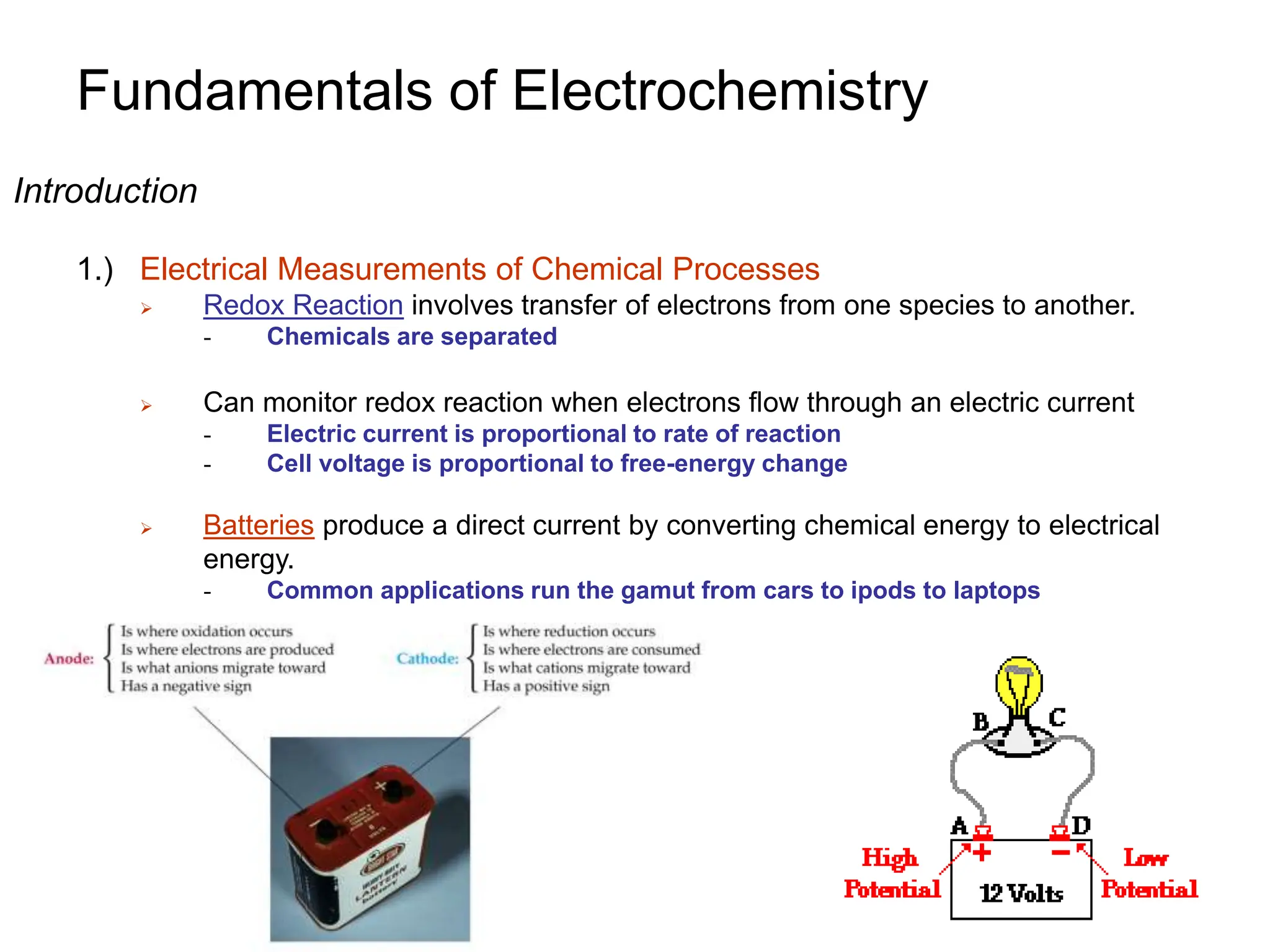
1.) Electrical Measurements of Chemical Processes
 Redox Reaction involves transfer of electrons from one species to another.
- Chemicals are separated
 Can monitor redox reaction when electrons flow through an electric current
- Electric current is proportional to rate of reaction
- Cell voltage is proportional to free-energy change
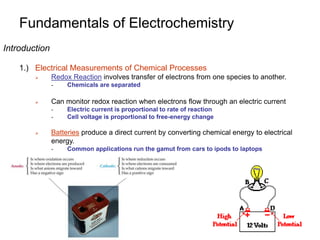
 Batteries produce a direct current by converting chemical energy to electrical
energy.
- Common applications run the gamut from cars to ipods to laptops
Fundamentals of Electrochemistry
Basic Concepts
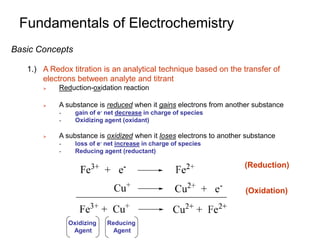
1.) A Redox titration is an analytical technique based on the transfer of
electrons between analyte and titrant
 Reduction-oxidation reaction
 A substance is reduced when it gains electrons from another substance
- gain of e- net decrease in charge of species
- Oxidizing agent (oxidant)
 A substance is oxidized when it loses electrons to another substance
- loss of e- net increase in charge of species
- Reducing agent (reductant)
(Reduction)
(Oxidation)
Oxidizing
Agent
Reducing
Agent
Fundamentals of Electrochemistry
Basic Concepts
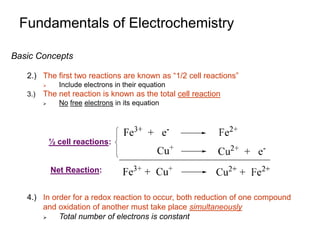
2.) The first two reactions are known as “1/2 cell reactions”
 Include electrons in their equation
3.) The net reaction is known as the total cell reaction
 No free electrons in its equation
4.) In order for a redox reaction to occur, both reduction of one compound
and oxidation of another must take place simultaneously
 Total number of electrons is constant
½ cell reactions:
Net Reaction:
Fundamentals of Electrochemistry
Basic Concepts
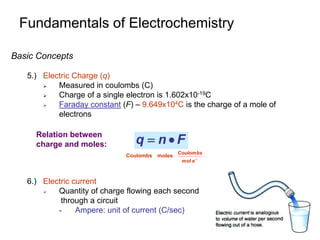
5.) Electric Charge (q)
 Measured in coulombs (C)
 Charge of a single electron is 1.602x10⁻¹⁹C
 Faraday constant (F) – 9.649x10⁴C is the charge of a mole of
electrons
6.) Electric current
 Quantity of charge flowing each second
through a circuit
- Ampere: unit of current (C/sec)
F
n
q 

Relation between
charge and moles:
Coulombs moles

e
mol
Coulombs
Fundamentals of Electrochemistry
Basic Concepts
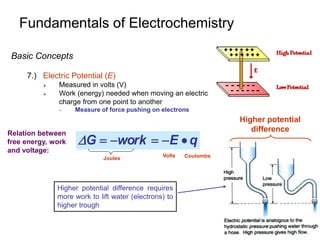
7.) Electric Potential (E)
 Measured in volts (V)
 Work (energy) needed when moving an electric
charge from one point to another
- Measure of force pushing on electrons
q
E
work
G 





Relation between
free energy, work
and voltage:
Joules Volts Coulombs
Higher potential
difference
Higher potential difference requires
more work to lift water (electrons) to
higher trough
Fundamentals of Electrochemistry
Basic Concepts
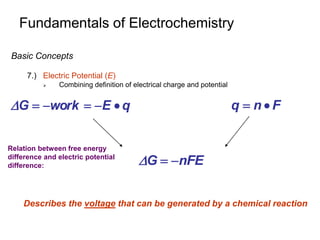
7.) Electric Potential (E)
 Combining definition of electrical charge and potential
q
E
work
G 




 F
n
q 

nFE
G 


Relation between free energy
difference and electric potential
difference:
Describes the voltage that can be generated by a chemical reaction
Fundamentals of Electrochemistry
Basic Concepts
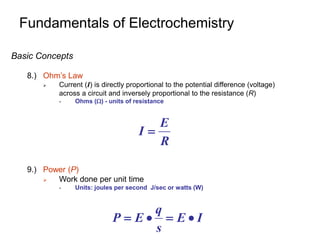
8.) Ohm’s Law
 Current (I) is directly proportional to the potential difference (voltage)
across a circuit and inversely proportional to the resistance (R)
- Ohms (W) - units of resistance
9.) Power (P)
 Work done per unit time
- Units: joules per second J/sec or watts (W)
R
E
I 
I
E
s
q
E
P 



Fundamentals of Electrochemistry
Galvanic Cells
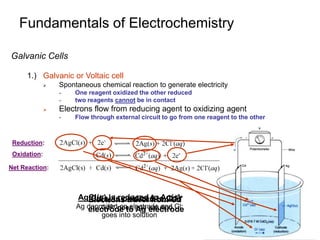
1.) Galvanic or Voltaic cell
 Spontaneous chemical reaction to generate electricity
- One reagent oxidized the other reduced
- two reagents cannot be in contact
 Electrons flow from reducing agent to oxidizing agent
- Flow through external circuit to go from one reagent to the other
Net Reaction:
Reduction:
Oxidation:
AgCl(s) is reduced to Ag(s)
Ag deposited on electrode and Cl-
goes into solution
Electrons travel from Cd
electrode to Ag electrode
Cd(s) is oxidized to Cd2+
Cd2+ goes into solution
Fundamentals of Electrochemistry
Galvanic Cells
1.) Galvanic or Voltaic cell
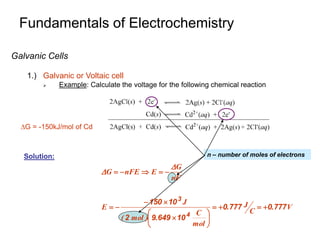
 Example: Calculate the voltage for the following chemical reaction
G = -150kJ/mol of Cd
V
.
C
J
.
mol
C
.
)
mol
(
J
E
nF
G
E
nFE
G
777
0
777
0
10
649
9
2
10
150
4
3






















Solution: n – number of moles of electrons
Fundamentals of Electrochemistry
Galvanic Cells
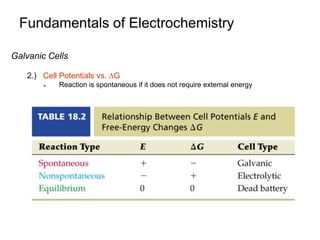
2.) Cell Potentials vs. G
 Reaction is spontaneous if it does not require external energy
Fundamentals of Electrochemistry
Galvanic Cells
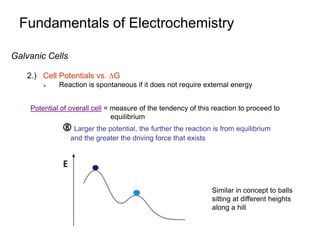
2.) Cell Potentials vs. G
 Reaction is spontaneous if it does not require external energy
Potential of overall cell = measure of the tendency of this reaction to proceed to
equilibrium
 Larger the potential, the further the reaction is from equilibrium
and the greater the driving force that exists
Similar in concept to balls
sitting at different heights
along a hill
Fundamentals of Electrochemistry
Galvanic Cells
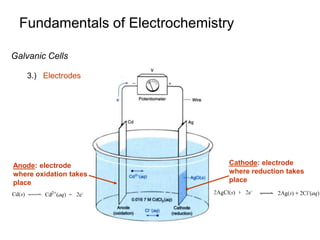
3.) Electrodes
Cathode: electrode
where reduction takes
place
Anode: electrode
where oxidation takes
place
Fundamentals of Electrochemistry
Galvanic Cells
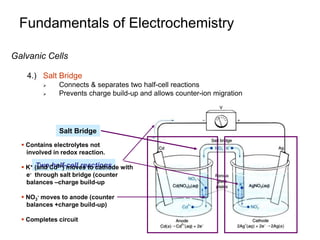
4.) Salt Bridge
 Connects & separates two half-cell reactions
 Prevents charge build-up and allows counter-ion migration
Two half-cell reactions
Salt Bridge
 Contains electrolytes not
involved in redox reaction.
 K+ (and Cd2+) moves to cathode with
e- through salt bridge (counter
balances –charge build-up
 NO3
- moves to anode (counter
balances +charge build-up)
 Completes circuit
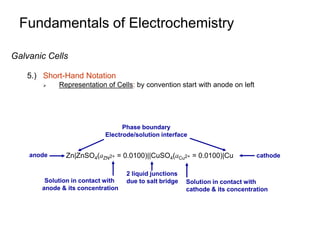
Zn|ZnSO4(aZN2+ = 0.0100)||CuSO4(aCu2+ = 0.0100)|Cu
anode
Phase boundary
Electrode/solution interface
Solution in contact with
anode & its concentration
Solution in contact with
cathode & its concentration
2 liquid junctions
due to salt bridge
cathode
Fundamentals of Electrochemistry
Galvanic Cells
5.) Short-Hand Notation
 Representation of Cells: by convention start with anode on left
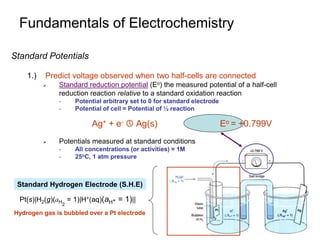
Ag+ + e-  Ag(s) Eo = +0.799V
Fundamentals of Electrochemistry
Standard Hydrogen Electrode (S.H.E)
Hydrogen gas is bubbled over a Pt electrode
Pt(s)|H2(g)(aH
2
= 1)|H+(aq)(aH+ = 1)||
Standard Potentials
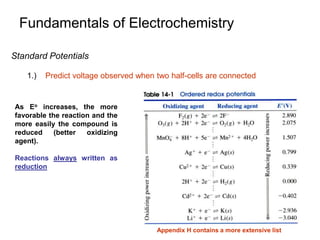
1.) Predict voltage observed when two half-cells are connected
 Standard reduction potential (Eo) the measured potential of a half-cell
reduction reaction relative to a standard oxidation reaction
- Potential arbitrary set to 0 for standard electrode
- Potential of cell = Potential of ½ reaction
 Potentials measured at standard conditions
- All concentrations (or activities) = 1M
- 25oC, 1 atm pressure
Fundamentals of Electrochemistry
Standard Potentials
1.) Predict voltage observed when two half-cells are connected
As Eo increases, the more
favorable the reaction and the
more easily the compound is
reduced (better oxidizing
agent).
Reactions always written as
reduction
Appendix H contains a more extensive list
Fundamentals of Electrochemistry
Standard Potentials
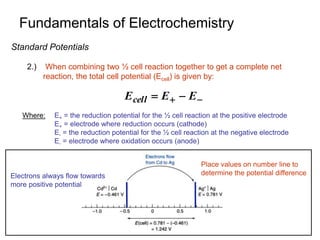
2.) When combining two ½ cell reaction together to get a complete net
reaction, the total cell potential (Ecell) is given by:

 
 E
E
Ecell
Where: E+ = the reduction potential for the ½ cell reaction at the positive electrode
E+ = electrode where reduction occurs (cathode)
E- = the reduction potential for the ½ cell reaction at the negative electrode
E- = electrode where oxidation occurs (anode)
Electrons always flow towards
more positive potential
Place values on number line to
determine the potential difference
Fundamentals of Electrochemistry
Standard Potentials
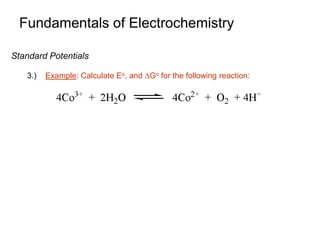
3.) Example: Calculate Eo, and Go for the following reaction:
Fundamentals of Electrochemistry
Nernst Equation
1.) Reduction Potential under Non-standard Conditions
 E determined using Nernst Equation
 Concentrations not-equal to 1M
aA + ne-  bB Eo
For the given reaction:
The ½ cell reduction potential is given by:
a
b
o
a
A
b
B
o
]
A
[
]
B
[
log
n
V
E
E
A
A
ln
nF
RT
E
E
0.05916





Where: E = actual ½ cell reduction potential
Eo = standard ½ cell reduction potential
n = number of electrons in reaction
T = temperature (K)
R = ideal gas law constant (8.314J/(K-mol)
F = Faraday’s constant (9.649x10⁴ C/mol)
A = activity of A or B
at 25oC
Fundamentals of Electrochemistry
Nernst Equation
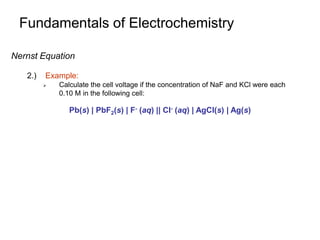
2.) Example:
 Calculate the cell voltage if the concentration of NaF and KCl were each
0.10 M in the following cell:
Pb(s) | PbF2(s) | F- (aq) || Cl- (aq) | AgCl(s) | Ag(s)
Fundamentals of Electrochemistry
Eo and the Equilibrium Constant
1.) A Galvanic Cell Produces Electricity because the Cell Reaction is
NOT at Equilibrium
 Concentration in two cells change with current
 Concentration will continue to change until Equilibrium is reached
- E = 0V at equilibrium
- Battery is “dead”













 


 d
b
o
a
c
o
cell
]
D
[
]
B
[
log
n
.
E
]
A
[
]
C
[
log
n
.
E
E
E
E
05916
0
05916
0
aA + ne-  cC E+
o
dD + ne-  bB E-
o
Consider the following ½ cell reactions:
Cell potential in terms of Nernst Equation is:
b
a
d
c
o
o
cell
]
B
[
]
A
[
]
D
[
]
C
[
log
n
.
)
E
E
(
E
05916
0


 

Simplify:
b
a
d
c
o
cell
]
B
[
]
A
[
]
D
[
]
C
[
log
n
.
E
E
05916
0


Fundamentals of Electrochemistry
Eo and the Equilibrium Constant
1.) A Galvanic Cell Produces Electricity because the Cell Reaction is
NOT at Equilibrium
Since Eo=E+
o- E-
o:
At equilibrium Ecell =0:
K
log
n
.
Eo 05916
0

Definition of
equilibrium constant
05916
0
10 .
nEo
K 
at 25oC
at 25oC
Fundamentals of Electrochemistry
Eo and the Equilibrium Constant
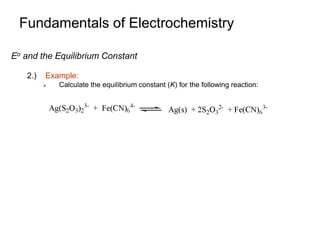
2.) Example:
 Calculate the equilibrium constant (K) for the following reaction:
Fundamentals of Electrochemistry
Cells as Chemical Probes
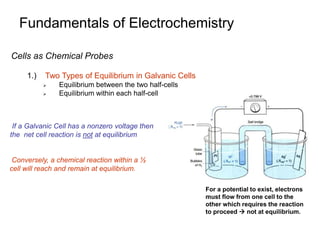
1.) Two Types of Equilibrium in Galvanic Cells
 Equilibrium between the two half-cells
 Equilibrium within each half-cell
If a Galvanic Cell has a nonzero voltage then
the net cell reaction is not at equilibrium
For a potential to exist, electrons
must flow from one cell to the
other which requires the reaction
to proceed  not at equilibrium.
Conversely, a chemical reaction within a ½
cell will reach and remain at equilibrium.
Fundamentals of Electrochemistry
Ni(s)|NiSO4(0.0025M)||KIO3(0.10 M)|Cu(IO3)2(s)|Cu(s)
Cells as Chemical Probes
2.) Example:
 If the voltage for the following cell is 0.512V, find Ksp for Cu(IO3)2:
Fundamentals of Electrochemistry
Biochemists Use Eo´
1.) Redox Potentials Containing Acids or Bases are pH Dependent
 Standard potential  all concentrations = 1 M
 pH=0 for [H+] = 1M
2.) pH Inside of a Plant or Animal Cell is ~ 7
 Standard potentials at pH =0 not appropriate for biological systems
- Reduction or oxidation strength may be reversed at pH 0 compared to pH 7
Metabolic Pathways
Fundamentals of Electrochemistry
Biochemists Use Eo´
3.) Formal Potential
 Reduction potential that applies
under a specified set of
conditions
 Formal potential at pH 7 is Eo´
b
a
d
c
o
cell
]
B
[
]
A
[
]
D
[
]
C
[
log
n
.
E
E
05916
0


Need to express concentrations as
function of Ka and [H+].
Cannot use formal concentrations!
Eo´ (V)

chapter-14.ppt

  • 1.
    Fundamentals of Electrochemistry Introduction 1.)Electrical Measurements of Chemical Processes  Redox Reaction involves transfer of electrons from one species to another. - Chemicals are separated  Can monitor redox reaction when electrons flow through an electric current - Electric current is proportional to rate of reaction - Cell voltage is proportional to free-energy change  Batteries produce a direct current by converting chemical energy to electrical energy. - Common applications run the gamut from cars to ipods to laptops
  • 2.
    Fundamentals of Electrochemistry BasicConcepts 1.) A Redox titration is an analytical technique based on the transfer of electrons between analyte and titrant  Reduction-oxidation reaction  A substance is reduced when it gains electrons from another substance - gain of e- net decrease in charge of species - Oxidizing agent (oxidant)  A substance is oxidized when it loses electrons to another substance - loss of e- net increase in charge of species - Reducing agent (reductant) (Reduction) (Oxidation) Oxidizing Agent Reducing Agent
  • 3.
    Fundamentals of Electrochemistry BasicConcepts 2.) The first two reactions are known as “1/2 cell reactions”  Include electrons in their equation 3.) The net reaction is known as the total cell reaction  No free electrons in its equation 4.) In order for a redox reaction to occur, both reduction of one compound and oxidation of another must take place simultaneously  Total number of electrons is constant ½ cell reactions: Net Reaction:
  • 4.
    Fundamentals of Electrochemistry BasicConcepts 5.) Electric Charge (q)  Measured in coulombs (C)  Charge of a single electron is 1.602x10⁻¹⁹C  Faraday constant (F) – 9.649x10⁴C is the charge of a mole of electrons 6.) Electric current  Quantity of charge flowing each second through a circuit - Ampere: unit of current (C/sec) F n q   Relation between charge and moles: Coulombs moles  e mol Coulombs
  • 5.
    Fundamentals of Electrochemistry BasicConcepts 7.) Electric Potential (E)  Measured in volts (V)  Work (energy) needed when moving an electric charge from one point to another - Measure of force pushing on electrons q E work G       Relation between free energy, work and voltage: Joules Volts Coulombs Higher potential difference Higher potential difference requires more work to lift water (electrons) to higher trough
  • 6.
    Fundamentals of Electrochemistry BasicConcepts 7.) Electric Potential (E)  Combining definition of electrical charge and potential q E work G       F n q   nFE G    Relation between free energy difference and electric potential difference: Describes the voltage that can be generated by a chemical reaction
  • 7.
    Fundamentals of Electrochemistry BasicConcepts 8.) Ohm’s Law  Current (I) is directly proportional to the potential difference (voltage) across a circuit and inversely proportional to the resistance (R) - Ohms (W) - units of resistance 9.) Power (P)  Work done per unit time - Units: joules per second J/sec or watts (W) R E I  I E s q E P    
  • 8.
    Fundamentals of Electrochemistry GalvanicCells 1.) Galvanic or Voltaic cell  Spontaneous chemical reaction to generate electricity - One reagent oxidized the other reduced - two reagents cannot be in contact  Electrons flow from reducing agent to oxidizing agent - Flow through external circuit to go from one reagent to the other Net Reaction: Reduction: Oxidation: AgCl(s) is reduced to Ag(s) Ag deposited on electrode and Cl- goes into solution Electrons travel from Cd electrode to Ag electrode Cd(s) is oxidized to Cd2+ Cd2+ goes into solution
  • 9.
    Fundamentals of Electrochemistry GalvanicCells 1.) Galvanic or Voltaic cell  Example: Calculate the voltage for the following chemical reaction G = -150kJ/mol of Cd V . C J . mol C . ) mol ( J E nF G E nFE G 777 0 777 0 10 649 9 2 10 150 4 3                       Solution: n – number of moles of electrons
  • 10.
    Fundamentals of Electrochemistry GalvanicCells 2.) Cell Potentials vs. G  Reaction is spontaneous if it does not require external energy
  • 11.
    Fundamentals of Electrochemistry GalvanicCells 2.) Cell Potentials vs. G  Reaction is spontaneous if it does not require external energy Potential of overall cell = measure of the tendency of this reaction to proceed to equilibrium  Larger the potential, the further the reaction is from equilibrium and the greater the driving force that exists Similar in concept to balls sitting at different heights along a hill
  • 12.
    Fundamentals of Electrochemistry GalvanicCells 3.) Electrodes Cathode: electrode where reduction takes place Anode: electrode where oxidation takes place
  • 13.
    Fundamentals of Electrochemistry GalvanicCells 4.) Salt Bridge  Connects & separates two half-cell reactions  Prevents charge build-up and allows counter-ion migration Two half-cell reactions Salt Bridge  Contains electrolytes not involved in redox reaction.  K+ (and Cd2+) moves to cathode with e- through salt bridge (counter balances –charge build-up  NO3 - moves to anode (counter balances +charge build-up)  Completes circuit
  • 14.
    Zn|ZnSO4(aZN2+ = 0.0100)||CuSO4(aCu2+= 0.0100)|Cu anode Phase boundary Electrode/solution interface Solution in contact with anode & its concentration Solution in contact with cathode & its concentration 2 liquid junctions due to salt bridge cathode Fundamentals of Electrochemistry Galvanic Cells 5.) Short-Hand Notation  Representation of Cells: by convention start with anode on left
  • 15.
    Ag+ + e- Ag(s) Eo = +0.799V Fundamentals of Electrochemistry Standard Hydrogen Electrode (S.H.E) Hydrogen gas is bubbled over a Pt electrode Pt(s)|H2(g)(aH 2 = 1)|H+(aq)(aH+ = 1)|| Standard Potentials 1.) Predict voltage observed when two half-cells are connected  Standard reduction potential (Eo) the measured potential of a half-cell reduction reaction relative to a standard oxidation reaction - Potential arbitrary set to 0 for standard electrode - Potential of cell = Potential of ½ reaction  Potentials measured at standard conditions - All concentrations (or activities) = 1M - 25oC, 1 atm pressure
  • 16.
    Fundamentals of Electrochemistry StandardPotentials 1.) Predict voltage observed when two half-cells are connected As Eo increases, the more favorable the reaction and the more easily the compound is reduced (better oxidizing agent). Reactions always written as reduction Appendix H contains a more extensive list
  • 17.
    Fundamentals of Electrochemistry StandardPotentials 2.) When combining two ½ cell reaction together to get a complete net reaction, the total cell potential (Ecell) is given by:     E E Ecell Where: E+ = the reduction potential for the ½ cell reaction at the positive electrode E+ = electrode where reduction occurs (cathode) E- = the reduction potential for the ½ cell reaction at the negative electrode E- = electrode where oxidation occurs (anode) Electrons always flow towards more positive potential Place values on number line to determine the potential difference
  • 18.
    Fundamentals of Electrochemistry StandardPotentials 3.) Example: Calculate Eo, and Go for the following reaction:
  • 19.
    Fundamentals of Electrochemistry NernstEquation 1.) Reduction Potential under Non-standard Conditions  E determined using Nernst Equation  Concentrations not-equal to 1M aA + ne-  bB Eo For the given reaction: The ½ cell reduction potential is given by: a b o a A b B o ] A [ ] B [ log n V E E A A ln nF RT E E 0.05916      Where: E = actual ½ cell reduction potential Eo = standard ½ cell reduction potential n = number of electrons in reaction T = temperature (K) R = ideal gas law constant (8.314J/(K-mol) F = Faraday’s constant (9.649x10⁴ C/mol) A = activity of A or B at 25oC
  • 20.
    Fundamentals of Electrochemistry NernstEquation 2.) Example:  Calculate the cell voltage if the concentration of NaF and KCl were each 0.10 M in the following cell: Pb(s) | PbF2(s) | F- (aq) || Cl- (aq) | AgCl(s) | Ag(s)
  • 21.
    Fundamentals of Electrochemistry Eoand the Equilibrium Constant 1.) A Galvanic Cell Produces Electricity because the Cell Reaction is NOT at Equilibrium  Concentration in two cells change with current  Concentration will continue to change until Equilibrium is reached - E = 0V at equilibrium - Battery is “dead”                   d b o a c o cell ] D [ ] B [ log n . E ] A [ ] C [ log n . E E E E 05916 0 05916 0 aA + ne-  cC E+ o dD + ne-  bB E- o Consider the following ½ cell reactions: Cell potential in terms of Nernst Equation is: b a d c o o cell ] B [ ] A [ ] D [ ] C [ log n . ) E E ( E 05916 0      Simplify:
  • 22.
    b a d c o cell ] B [ ] A [ ] D [ ] C [ log n . E E 05916 0   Fundamentals of Electrochemistry Eoand the Equilibrium Constant 1.) A Galvanic Cell Produces Electricity because the Cell Reaction is NOT at Equilibrium Since Eo=E+ o- E- o: At equilibrium Ecell =0: K log n . Eo 05916 0  Definition of equilibrium constant 05916 0 10 . nEo K  at 25oC at 25oC
  • 23.
    Fundamentals of Electrochemistry Eoand the Equilibrium Constant 2.) Example:  Calculate the equilibrium constant (K) for the following reaction:
  • 24.
    Fundamentals of Electrochemistry Cellsas Chemical Probes 1.) Two Types of Equilibrium in Galvanic Cells  Equilibrium between the two half-cells  Equilibrium within each half-cell If a Galvanic Cell has a nonzero voltage then the net cell reaction is not at equilibrium For a potential to exist, electrons must flow from one cell to the other which requires the reaction to proceed  not at equilibrium. Conversely, a chemical reaction within a ½ cell will reach and remain at equilibrium.
  • 25.
    Fundamentals of Electrochemistry Ni(s)|NiSO4(0.0025M)||KIO3(0.10M)|Cu(IO3)2(s)|Cu(s) Cells as Chemical Probes 2.) Example:  If the voltage for the following cell is 0.512V, find Ksp for Cu(IO3)2:
  • 26.
    Fundamentals of Electrochemistry BiochemistsUse Eo´ 1.) Redox Potentials Containing Acids or Bases are pH Dependent  Standard potential  all concentrations = 1 M  pH=0 for [H+] = 1M 2.) pH Inside of a Plant or Animal Cell is ~ 7  Standard potentials at pH =0 not appropriate for biological systems - Reduction or oxidation strength may be reversed at pH 0 compared to pH 7 Metabolic Pathways
  • 27.
    Fundamentals of Electrochemistry BiochemistsUse Eo´ 3.) Formal Potential  Reduction potential that applies under a specified set of conditions  Formal potential at pH 7 is Eo´ b a d c o cell ] B [ ] A [ ] D [ ] C [ log n . E E 05916 0   Need to express concentrations as function of Ka and [H+]. Cannot use formal concentrations! Eo´ (V)