



03.21.2022
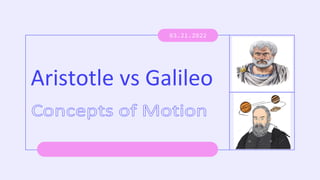
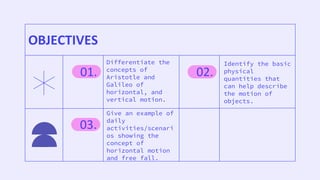
Aristotle vs Galileo
01.
Differentiate the
concepts of
Aristotle and
Galileo of
horizontal, and
vertical motion.
02.
Identify the basic
physical
quantities that
can help describe
the motion of
objects.
03.
OBJECTIVES
Give an example of
daily
activities/scenari
os showing the
concept of
horizontal motion
and free fall.
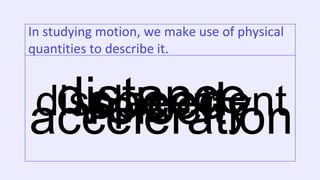
In studying motion, we make use of physical
quantities to describe it.
distance
displacement
speed
Velocity
acceleration
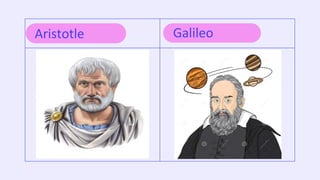
Aristotle Galileo
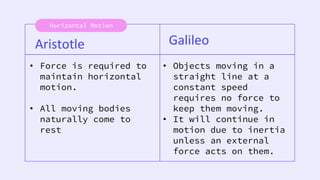
Horizontal Motion
Galileo
Aristotle
• Force is required to
maintain horizontal
motion.
• All moving bodies
naturally come to
rest
• Objects moving in a
straight line at a
constant speed
requires no force to
keep them moving.
• It will continue in
motion due to inertia
unless an external
force acts on them.
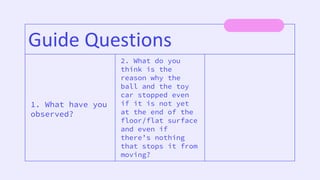
Guide Questions
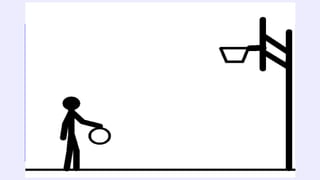
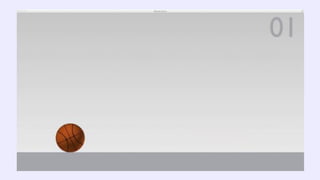
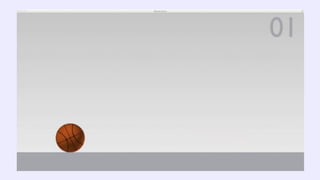
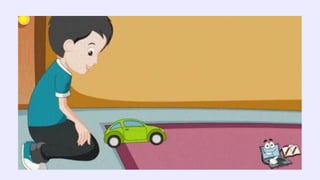
1. What have you
observed?
2. What do you
think is the
reason why the
ball and the toy
car stopped even
if it is not yet
at the end of the
floor/flat surface
and even if
there’s nothing
that stops it from
moving?
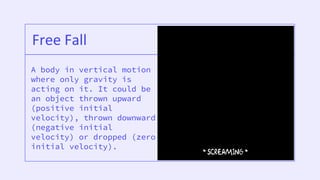
A body in vertical motion
where only gravity is
acting on it. It could be
an object thrown upward
(positive initial
velocity), thrown downward
(negative initial
velocity) or dropped (zero
initial velocity).
Free Fall
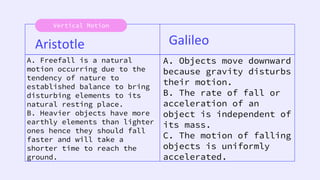
Vertical Motion
Galileo
Aristotle
A. Freefall is a natural
motion occurring due to the
tendency of nature to
established balance to bring
disturbing elements to its
natural resting place.
B. Heavier objects have more
earthly elements than lighter
ones hence they should fall
faster and will take a
shorter time to reach the
ground.
A. Objects move downward
because gravity disturbs
their motion.
B. The rate of fall or
acceleration of an
object is independent of
its mass.
C. The motion of falling
objects is uniformly
accelerated.
• Between the two scientists, which of them is right with
their concept about vertical motion?
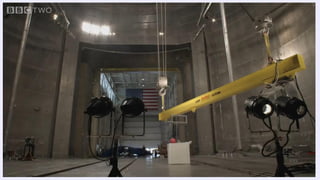
• At the first part of the video, which of the two objects hit
the ground first?
• After doing the first trial of the experiment, what did they
do to the place where they conduct their experiment?
• For the second trial, which of the two objects hit the
ground first? Why?
• What is the reason why the feather sways as it falls down
during the first trial?
• Is the motion of the two objects examples of free fall? What
is free fall then?
Guide Questions
• Between the two scientists, which of them is right with
their concept about vertical motion?
• At the first part of the video, which of the two objects hit
the ground first?
• After doing the first trial of the experiment, what did they
do to the place where they conduct their experiment?
• For the second trial, which of the two objects hit the
ground first? Why?
• What is the reason why the feather sways as it falls down
during the first trial?
• Is the motion of the two objects examples of free fall? What
is free fall then?
Guide Questions
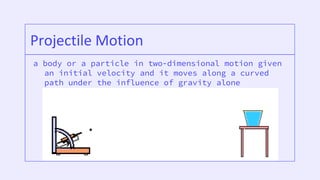
a body or a particle in two-dimensional motion given
an initial velocity and it moves along a curved
path under the influence of gravity alone
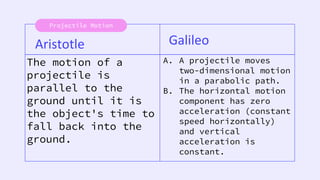
Projectile Motion
Projectile Motion
Galileo
Aristotle
The motion of a
projectile is
parallel to the
ground until it is
the object's time to
fall back into the
ground.
A. A projectile moves
two-dimensional motion
in a parabolic path.
B. The horizontal motion
component has zero
acceleration (constant
speed horizontally)
and vertical
acceleration is
constant.
How important for
us to study about
motion and to
know the concepts
of motion?
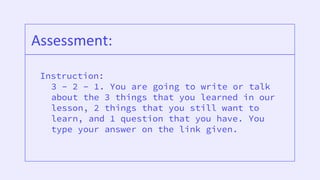
Instruction:
3 – 2 – 1. You are going to write or talk
about the 3 things that you learned in our
lesson, 2 things that you still want to
learn, and 1 question that you have. You
type your answer on the link given.
Assessment:
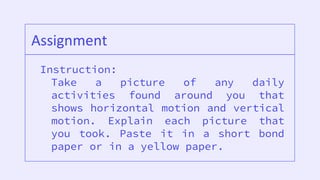
Instruction:
Take a picture of any daily
activities found around you that
shows horizontal motion and vertical
motion. Explain each picture that
you took. Paste it in a short bond
paper or in a yellow paper.
Assignment

Week 2 Topic 2 - Aristotle vs Galileo - Motion.pdf

  • 1.
  • 2.
    01. Differentiate the concepts of Aristotleand Galileo of horizontal, and vertical motion. 02. Identify the basic physical quantities that can help describe the motion of objects. 03. OBJECTIVES Give an example of daily activities/scenari os showing the concept of horizontal motion and free fall.
  • 7.
    In studying motion,we make use of physical quantities to describe it. distance displacement speed Velocity acceleration
  • 8.
  • 9.
    Horizontal Motion Galileo Aristotle • Forceis required to maintain horizontal motion. • All moving bodies naturally come to rest • Objects moving in a straight line at a constant speed requires no force to keep them moving. • It will continue in motion due to inertia unless an external force acts on them.
  • 10.
    Guide Questions 1. Whathave you observed? 2. What do you think is the reason why the ball and the toy car stopped even if it is not yet at the end of the floor/flat surface and even if there’s nothing that stops it from moving?
  • 14.
    A body invertical motion where only gravity is acting on it. It could be an object thrown upward (positive initial velocity), thrown downward (negative initial velocity) or dropped (zero initial velocity). Free Fall
  • 15.
    Vertical Motion Galileo Aristotle A. Freefallis a natural motion occurring due to the tendency of nature to established balance to bring disturbing elements to its natural resting place. B. Heavier objects have more earthly elements than lighter ones hence they should fall faster and will take a shorter time to reach the ground. A. Objects move downward because gravity disturbs their motion. B. The rate of fall or acceleration of an object is independent of its mass. C. The motion of falling objects is uniformly accelerated.
  • 16.
    • Between thetwo scientists, which of them is right with their concept about vertical motion? • At the first part of the video, which of the two objects hit the ground first? • After doing the first trial of the experiment, what did they do to the place where they conduct their experiment? • For the second trial, which of the two objects hit the ground first? Why? • What is the reason why the feather sways as it falls down during the first trial? • Is the motion of the two objects examples of free fall? What is free fall then? Guide Questions
  • 18.
    • Between thetwo scientists, which of them is right with their concept about vertical motion? • At the first part of the video, which of the two objects hit the ground first? • After doing the first trial of the experiment, what did they do to the place where they conduct their experiment? • For the second trial, which of the two objects hit the ground first? Why? • What is the reason why the feather sways as it falls down during the first trial? • Is the motion of the two objects examples of free fall? What is free fall then? Guide Questions
  • 19.
    a body ora particle in two-dimensional motion given an initial velocity and it moves along a curved path under the influence of gravity alone Projectile Motion
  • 20.
    Projectile Motion Galileo Aristotle The motionof a projectile is parallel to the ground until it is the object's time to fall back into the ground. A. A projectile moves two-dimensional motion in a parabolic path. B. The horizontal motion component has zero acceleration (constant speed horizontally) and vertical acceleration is constant.
  • 22.
    How important for usto study about motion and to know the concepts of motion?
  • 23.
    Instruction: 3 – 2– 1. You are going to write or talk about the 3 things that you learned in our lesson, 2 things that you still want to learn, and 1 question that you have. You type your answer on the link given. Assessment:
  • 24.
    Instruction: Take a pictureof any daily activities found around you that shows horizontal motion and vertical motion. Explain each picture that you took. Paste it in a short bond paper or in a yellow paper. Assignment