Forces cause
changes in motion.
A ball at rest in the
middle of a flat field is
in equilibrium. No net
force acts on it.
If you saw it begin to
move across the
ground, you’d look for
forces that don’t
balance to zero.
We don’t believe that
changes in motion
occur without cause.
Aristotle, studied
motion and divided it
into two types:
natural motion
violent motion.
3.1 Aristotle on Motion
Natural motion on Earth was thought
to be either straight up or straight
down.
• Objects seek their natural resting
places: boulders on the ground
and smoke high in the air like the
clouds.
• Heavy things fall and very light
things rise.
• These motions were considered
natural–not caused by forces.
Violent motion, on the other hand, was
imposed motion.
• It was the result of forces that
pushed or pulled.
• The important thing about defining
violent motion was that it had an
external cause.
• Objects in their natural resting
places could not move by
themselves.
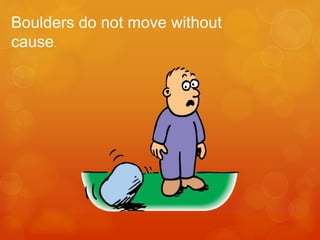
Boulders do not move without
cause.
It was commonly thought for nearly 2000 years
that a force was responsible for an object moving
“against its nature.”
• The state of objects was one of rest unless
they were being pushed or pulled or moving
toward their natural resting place.
• Most thinkers before the 1500s considered it
obvious that Earth must be in its natural
resting place.
• A force large enough to move it was
unthinkable.
• Earth did not move.
Copernicus reasoned that the
simplest way to interpret
astronomical observations was
to assume that Earth and the
other planets move around the
sun.
3.2 Copernicus and the Moving Earth
The astronomer Nicolaus Copernicus
(1473–1543) formulated a theory of the
moving Earth.
• Idea was extremely controversial,
People preferred to believe that Earth
was at the center of the universe.
• Copernicus worked on his ideas in
secret.
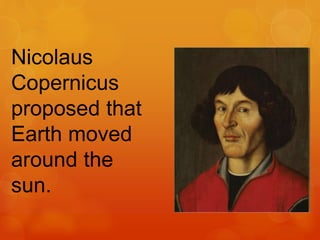
Nicolaus
Copernicus
proposed that
Earth moved
around the
sun.
Galileo argued that
only when friction is
present—as it usually
is—is a force needed to
keep an object
moving.
3.3 Galileo on Motion
Galileo, was outspoken in his
support of Copernicus.
One of Galileo’s great contributions
to physics was demolishing the
notion that a force is necessary to
keep an object moving.
3.3 Galileo on Motion
Friction is the name given to the force that
acts between materials that touch as they
move past each other.
• Friction is caused by the irregularities in
the surfaces of objects that are
touching.
• If friction were absent, a moving object
would need no force whatever to
remain in motion.
3.3 Galileo on Motion
Galileo tested his idea by rolling
balls along plane surfaces tilted at
different angles.
• A ball rolling down an inclined
plane speeds up.
• A ball rolling up an inclined
plane—in a direction opposed by
gravity—slows down.
• A ball rolling on a smooth
horizontal plane has almost
constant velocity.
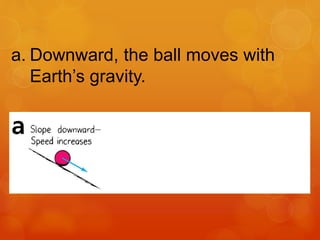
a. Downward, the ball moves with
Earth’s gravity.
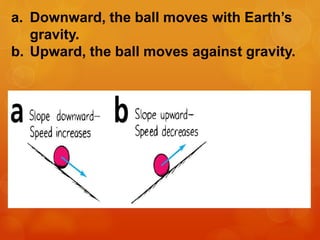
a. Downward, the ball moves with Earth’s
gravity.
b. Upward, the ball moves against gravity.
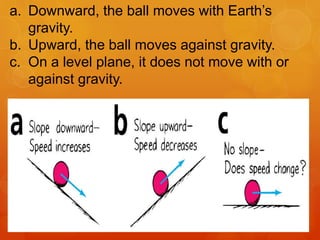
a. Downward, the ball moves with Earth’s
gravity.
b. Upward, the ball moves against gravity.
c. On a level plane, it does not move with or
against gravity.
Galileo stated that if friction
were entirely absent, a ball
moving horizontally would
move forever.
No push or pull would be
required to keep it moving
once it is set in motion.
Galileo’s conclusion was supported
by another line of reasoning.
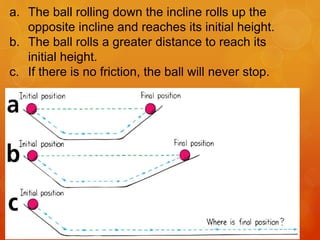
• He described two inclined planes
facing each other.
• A ball released to roll down one
plane would roll up the other to
reach nearly the same height.
• The ball tended to attain the same
height, even when the second
plane was longer and inclined at a
smaller angle than the first plane.
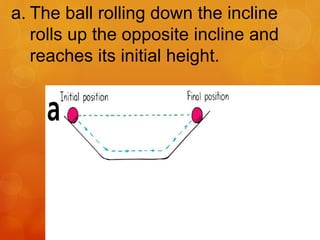
a. The ball rolling down the incline
rolls up the opposite incline and
reaches its initial height.
a. The ball rolling down the incline rolls up
the opposite incline and reaches its initial
height.
b. The ball rolls a greater distance to reach
its initial height.
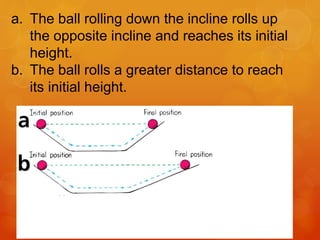
a. The ball rolling down the incline rolls up the
opposite incline and reaches its initial height.
b. The ball rolls a greater distance to reach its
initial height.
c. If there is no friction, the ball will never stop.
If the angle of incline of the second
plane were reduced to zero so that
the plane was perfectly horizontal,
only friction would keep it from
rolling forever.
It was not the nature of the ball to
come to rest as Aristotle had
claimed.
Galileo stated that this tendency
of a moving body to keep
moving is natural and that every
material object resists changes
to its state of motion.
The property of a body to
resist changes to its state of
motion is called inertia.
think!
A ball is rolled across a counter
top and rolls slowly to a stop.
How would Aristotle interpret
this behavior? How would Galileo
interpret it? How would you
interpret it?
Answer:
Aristotle would probably say that
the ball stops because it seeks its
natural state of rest. Galileo would
probably say that the friction
between the ball and the table
overcomes the ball’s natural
tendency to continue rolling—
overcomes the ball’s inertia—and
brings it to a stop. Only you can
answer the last question!

Aristotle, Copurnacus, Galaleo.pptx

  • 1.
  • 2.
    A ball atrest in the middle of a flat field is in equilibrium. No net force acts on it. If you saw it begin to move across the ground, you’d look for forces that don’t balance to zero. We don’t believe that changes in motion occur without cause.
  • 3.
    Aristotle, studied motion anddivided it into two types: natural motion violent motion. 3.1 Aristotle on Motion
  • 4.
    Natural motion onEarth was thought to be either straight up or straight down. • Objects seek their natural resting places: boulders on the ground and smoke high in the air like the clouds. • Heavy things fall and very light things rise. • These motions were considered natural–not caused by forces.
  • 5.
    Violent motion, onthe other hand, was imposed motion. • It was the result of forces that pushed or pulled. • The important thing about defining violent motion was that it had an external cause. • Objects in their natural resting places could not move by themselves.
  • 6.
    Boulders do notmove without cause.
  • 7.
    It was commonlythought for nearly 2000 years that a force was responsible for an object moving “against its nature.” • The state of objects was one of rest unless they were being pushed or pulled or moving toward their natural resting place. • Most thinkers before the 1500s considered it obvious that Earth must be in its natural resting place. • A force large enough to move it was unthinkable. • Earth did not move.
  • 8.
    Copernicus reasoned thatthe simplest way to interpret astronomical observations was to assume that Earth and the other planets move around the sun. 3.2 Copernicus and the Moving Earth
  • 9.
    The astronomer NicolausCopernicus (1473–1543) formulated a theory of the moving Earth. • Idea was extremely controversial, People preferred to believe that Earth was at the center of the universe. • Copernicus worked on his ideas in secret.
  • 10.
  • 11.
    Galileo argued that onlywhen friction is present—as it usually is—is a force needed to keep an object moving. 3.3 Galileo on Motion
  • 12.
    Galileo, was outspokenin his support of Copernicus. One of Galileo’s great contributions to physics was demolishing the notion that a force is necessary to keep an object moving. 3.3 Galileo on Motion
  • 13.
    Friction is thename given to the force that acts between materials that touch as they move past each other. • Friction is caused by the irregularities in the surfaces of objects that are touching. • If friction were absent, a moving object would need no force whatever to remain in motion. 3.3 Galileo on Motion
  • 14.
    Galileo tested hisidea by rolling balls along plane surfaces tilted at different angles. • A ball rolling down an inclined plane speeds up. • A ball rolling up an inclined plane—in a direction opposed by gravity—slows down. • A ball rolling on a smooth horizontal plane has almost constant velocity.
  • 15.
    a. Downward, theball moves with Earth’s gravity.
  • 16.
    a. Downward, theball moves with Earth’s gravity. b. Upward, the ball moves against gravity.
  • 17.
    a. Downward, theball moves with Earth’s gravity. b. Upward, the ball moves against gravity. c. On a level plane, it does not move with or against gravity.
  • 18.
    Galileo stated thatif friction were entirely absent, a ball moving horizontally would move forever. No push or pull would be required to keep it moving once it is set in motion.
  • 19.
    Galileo’s conclusion wassupported by another line of reasoning. • He described two inclined planes facing each other. • A ball released to roll down one plane would roll up the other to reach nearly the same height. • The ball tended to attain the same height, even when the second plane was longer and inclined at a smaller angle than the first plane.
  • 20.
    a. The ballrolling down the incline rolls up the opposite incline and reaches its initial height.
  • 21.
    a. The ballrolling down the incline rolls up the opposite incline and reaches its initial height. b. The ball rolls a greater distance to reach its initial height.
  • 22.
    a. The ballrolling down the incline rolls up the opposite incline and reaches its initial height. b. The ball rolls a greater distance to reach its initial height. c. If there is no friction, the ball will never stop.
  • 23.
    If the angleof incline of the second plane were reduced to zero so that the plane was perfectly horizontal, only friction would keep it from rolling forever. It was not the nature of the ball to come to rest as Aristotle had claimed.
  • 24.
    Galileo stated thatthis tendency of a moving body to keep moving is natural and that every material object resists changes to its state of motion.
  • 25.
    The property ofa body to resist changes to its state of motion is called inertia.
  • 26.
    think! A ball isrolled across a counter top and rolls slowly to a stop. How would Aristotle interpret this behavior? How would Galileo interpret it? How would you interpret it?
  • 27.
    Answer: Aristotle would probablysay that the ball stops because it seeks its natural state of rest. Galileo would probably say that the friction between the ball and the table overcomes the ball’s natural tendency to continue rolling— overcomes the ball’s inertia—and brings it to a stop. Only you can answer the last question!