Physics 1809 Minilab 2: Heat and Temperature
Physics 1809: The Relationship Between Heat and Temperature
Purpose
• Understand how the total energy in a closed system
is conserved during heat exchange.
• Learn how to determine specific heat capacities of
certain materials.
Physics 1809 Minilab 2: Heat and Temperature
Physics 1809: The Relationship Between Heat and Temperature
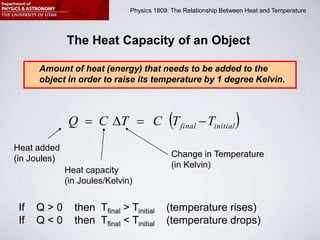
The Heat Capacity of an Object
Amount of heat (energy) that needs to be added to the
object in order to raise its temperature by 1 degree Kelvin.
 
initial
final T
T
C
T
C
Q 



Heat added
(in Joules)
Heat capacity
(in Joules/Kelvin)
Change in Temperature
(in Kelvin)
If Q > 0 then Tfinal > Tinitial (temperature rises)
If Q < 0 then Tfinal < Tinitial (temperature drops)
Physics 1809 Minilab 2: Heat and Temperature
Physics 1809: The Relationship Between Heat and Temperature
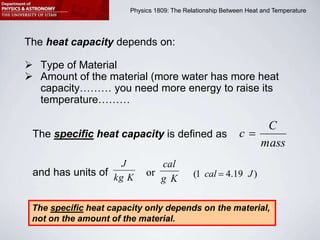
The heat capacity depends on:
 Type of Material
 Amount of the material (more water has more heat
capacity……… you need more energy to raise its
temperature………
The specific heat capacity is defined as
and has units of or
mass
C
c 
K
kg
J
K
g
cal
)
19
.
4
1
( J
cal 
The specific heat capacity only depends on the material,
not on the amount of the material.
Physics 1809 Minilab 2: Heat and Temperature
Physics 1809: The Relationship Between Heat and Temperature
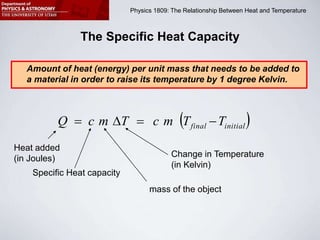
The Specific Heat Capacity
Amount of heat (energy) per unit mass that needs to be added to
a material in order to raise its temperature by 1 degree Kelvin.
 
initial
final T
T
m
c
T
m
c
Q 



Heat added
(in Joules)
Specific Heat capacity
Change in Temperature
(in Kelvin)
mass of the object
Physics 1809 Minilab 2: Heat and Temperature
Physics 1809: The Relationship Between Heat and Temperature
Example and Implications of Specific Heat Capacity
K
g
J
K
g
cal
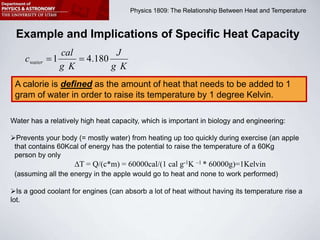
cwater 180
.
4
1 

A calorie is defined as the amount of heat that needs to be added to 1
gram of water in order to raise its temperature by 1 degree Kelvin.
Water has a relatively high heat capacity, which is important in biology and engineering:
Prevents your body (= mostly water) from heating up too quickly during exercise (an apple
that contains 60Kcal of energy has the potential to raise the temperature of a 60Kg
person by only
T = Q/(c*m) = 60000cal/(1 cal g-1K –1 * 60000g)=1Kelvin
(assuming all the energy in the apple would go to heat and none to work performed)
Is a good coolant for engines (can absorb a lot of heat without having its temperature rise a
lot.
Physics 1809 Minilab 2: Heat and Temperature
Physics 1809: The Relationship Between Heat and Temperature
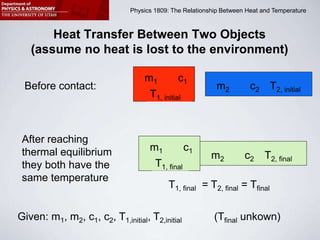
Heat Transfer Between Two Objects
(assume no heat is lost to the environment)
m1 c1
T1, initial
T2, initial
m2 c2
Before contact:
After reaching
thermal equilibrium
they both have the
same temperature
m1 c1
T1, final
T2, final
m2 c2
T1, final = T2, final = Tfinal
Given: m1, m2, c1, c2, T1,initial, T2,initial (Tfinal unkown)
Physics 1809 Minilab 2: Heat and Temperature
Physics 1809: The Relationship Between Heat and Temperature
 
initial
final T
T
m
c
Q ,
1
1
1
1 

 
initial
final T
T
m
c
Q ,
2
2
2
2 

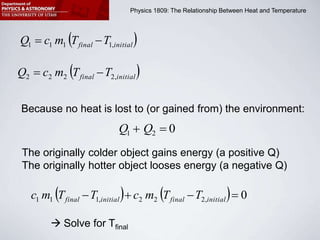
Because no heat is lost to (or gained from) the environment:
0
2
1 
 Q
Q
The originally colder object gains energy (a positive Q)
The originally hotter object looses energy (a negative Q)
    0
,
2
2
2
,
1
1
1 


 initial
final
initial
final T
T
m
c
T
T
m
c
 Solve for Tfinal
Physics 1809 Minilab 2: Heat and Temperature
Physics 1809: The Relationship Between Heat and Temperature
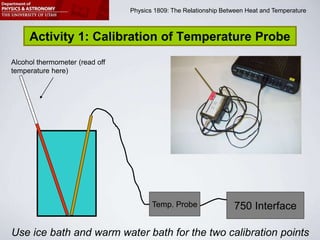
Activity 1: Calibration of Temperature Probe
Alcohol thermometer (read off
temperature here)
Temp. Probe 750 Interface
Use ice bath and warm water bath for the two calibration points
Physics 1809 Minilab 2: Heat and Temperature
Physics 1809: The Relationship Between Heat and Temperature
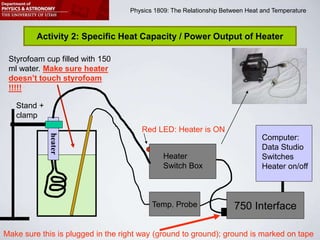
Activity 2: Specific Heat Capacity / Power Output of Heater
Temp. Probe 750 Interface
Styrofoam cup filled with 150
ml water. Make sure heater
doesn’t touch styrofoam
!!!!!
Computer:
Data Studio
Switches
Heater on/off
Heater
Switch Box
Red LED: Heater is ON
Make sure this is plugged in the right way (ground to ground); ground is marked on tape
Stand +
clamp
heater
Physics 1809 Minilab 2: Heat and Temperature
Physics 1809: The Relationship Between Heat and Temperature
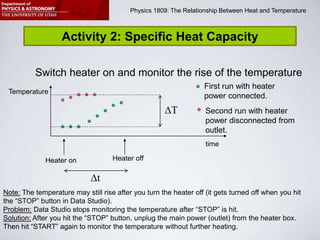
Activity 2: Specific Heat Capacity
Switch heater on and monitor the rise of the temperature
time
Temperature
Heater on Heater off
T
t
Note: The temperature may still rise after you turn the heater off (it gets turned off when you hit
the “STOP” button in Data Studio).
Problem: Data Studio stops monitoring the temperature after “STOP” is hit.
Solution: After you hit the “STOP” button, unplug the main power (outlet) from the heater box.
Then hit “START” again to monitor the temperature without further heating.
Second run with heater
power disconnected from
outlet.
First run with heater
power connected.
Physics 1809 Minilab 2: Heat and Temperature
Physics 1809: The Relationship Between Heat and Temperature
Activity 2: Specific Heat Capacity
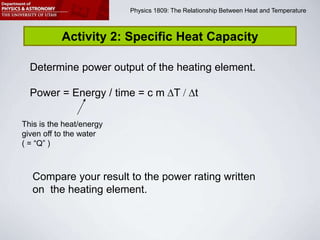
Determine power output of the heating element.
Power = Energy / time = c m T / t
Compare your result to the power rating written
on the heating element.
This is the heat/energy
given off to the water
( = “Q” )
Physics 1809 Minilab 2: Heat and Temperature
Physics 1809: The Relationship Between Heat and Temperature
Activity 3: Measure Specific Heat Capacity
of Isopropyl Alcohol
Design an experiment to measure c isopropyl
alcohol
Use your measured power rating of the heating element.
• DO NOT DRAIN THE ISOPROPYL ALCOHOL INTO THE
SINK !!!!! It is illegal to do that and we also do not want to waste
the alcohol – it costs money.
• Instead, please pour it back into the container from which you
got it.
Physics 1809 Minilab 2: Heat and Temperature
Physics 1809: The Relationship Between Heat and Temperature
Activity 4: The Transfer of Heat
Caution: This experiment uses liquid nitrogen, which is extremely
cold. Follow the safety instructions in your lab manual!!!!
Liquid nitrogen (LN2)
Water at Room
Temperature
Brass disc
on a string
Step 1:
Cool brass in the LN2
(wait until bubbling stops)
Step 2:
Put cold brass (-197ºC)
into water.
Step 3:
Monitor
temperature
Physics 1809 Minilab 2: Heat and Temperature
Physics 1809: The Relationship Between Heat and Temperature
Activity 4: The Transfer of Heat
Step 4: Determine the specific heat capacity of brass
Step 5: Compare your value of cbrass to that in the literature
(you can surely find that value on the internet)
Physics 1809 Minilab 2: Heat and Temperature
Physics 1809: The Relationship Between Heat and Temperature
Hints
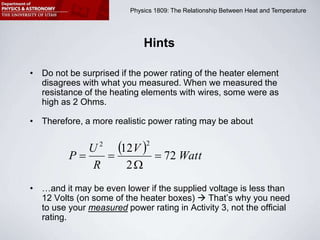
• Do not be surprised if the power rating of the heater element
disagrees with what you measured. When we measured the
resistance of the heating elements with wires, some were as
high as 2 Ohms.
• Therefore, a more realistic power rating may be about
• …and it may be even lower if the supplied voltage is less than
12 Volts (on some of the heater boxes)  That’s why you need
to use your measured power rating in Activity 3, not the official
rating.
  Watt
V
R
U
P 72
2
12
2
2





Physics 1809 Fall 2012 Heat and Temperature.ppt

  • 1.
    Physics 1809 Minilab2: Heat and Temperature Physics 1809: The Relationship Between Heat and Temperature Purpose • Understand how the total energy in a closed system is conserved during heat exchange. • Learn how to determine specific heat capacities of certain materials.
  • 2.
    Physics 1809 Minilab2: Heat and Temperature Physics 1809: The Relationship Between Heat and Temperature The Heat Capacity of an Object Amount of heat (energy) that needs to be added to the object in order to raise its temperature by 1 degree Kelvin.   initial final T T C T C Q     Heat added (in Joules) Heat capacity (in Joules/Kelvin) Change in Temperature (in Kelvin) If Q > 0 then Tfinal > Tinitial (temperature rises) If Q < 0 then Tfinal < Tinitial (temperature drops)
  • 3.
    Physics 1809 Minilab2: Heat and Temperature Physics 1809: The Relationship Between Heat and Temperature The heat capacity depends on:  Type of Material  Amount of the material (more water has more heat capacity……… you need more energy to raise its temperature……… The specific heat capacity is defined as and has units of or mass C c  K kg J K g cal ) 19 . 4 1 ( J cal  The specific heat capacity only depends on the material, not on the amount of the material.
  • 4.
    Physics 1809 Minilab2: Heat and Temperature Physics 1809: The Relationship Between Heat and Temperature The Specific Heat Capacity Amount of heat (energy) per unit mass that needs to be added to a material in order to raise its temperature by 1 degree Kelvin.   initial final T T m c T m c Q     Heat added (in Joules) Specific Heat capacity Change in Temperature (in Kelvin) mass of the object
  • 5.
    Physics 1809 Minilab2: Heat and Temperature Physics 1809: The Relationship Between Heat and Temperature Example and Implications of Specific Heat Capacity K g J K g cal cwater 180 . 4 1   A calorie is defined as the amount of heat that needs to be added to 1 gram of water in order to raise its temperature by 1 degree Kelvin. Water has a relatively high heat capacity, which is important in biology and engineering: Prevents your body (= mostly water) from heating up too quickly during exercise (an apple that contains 60Kcal of energy has the potential to raise the temperature of a 60Kg person by only T = Q/(c*m) = 60000cal/(1 cal g-1K –1 * 60000g)=1Kelvin (assuming all the energy in the apple would go to heat and none to work performed) Is a good coolant for engines (can absorb a lot of heat without having its temperature rise a lot.
  • 6.
    Physics 1809 Minilab2: Heat and Temperature Physics 1809: The Relationship Between Heat and Temperature Heat Transfer Between Two Objects (assume no heat is lost to the environment) m1 c1 T1, initial T2, initial m2 c2 Before contact: After reaching thermal equilibrium they both have the same temperature m1 c1 T1, final T2, final m2 c2 T1, final = T2, final = Tfinal Given: m1, m2, c1, c2, T1,initial, T2,initial (Tfinal unkown)
  • 7.
    Physics 1809 Minilab2: Heat and Temperature Physics 1809: The Relationship Between Heat and Temperature   initial final T T m c Q , 1 1 1 1     initial final T T m c Q , 2 2 2 2   Because no heat is lost to (or gained from) the environment: 0 2 1   Q Q The originally colder object gains energy (a positive Q) The originally hotter object looses energy (a negative Q)     0 , 2 2 2 , 1 1 1     initial final initial final T T m c T T m c  Solve for Tfinal
  • 8.
    Physics 1809 Minilab2: Heat and Temperature Physics 1809: The Relationship Between Heat and Temperature Activity 1: Calibration of Temperature Probe Alcohol thermometer (read off temperature here) Temp. Probe 750 Interface Use ice bath and warm water bath for the two calibration points
  • 9.
    Physics 1809 Minilab2: Heat and Temperature Physics 1809: The Relationship Between Heat and Temperature Activity 2: Specific Heat Capacity / Power Output of Heater Temp. Probe 750 Interface Styrofoam cup filled with 150 ml water. Make sure heater doesn’t touch styrofoam !!!!! Computer: Data Studio Switches Heater on/off Heater Switch Box Red LED: Heater is ON Make sure this is plugged in the right way (ground to ground); ground is marked on tape Stand + clamp heater
  • 10.
    Physics 1809 Minilab2: Heat and Temperature Physics 1809: The Relationship Between Heat and Temperature Activity 2: Specific Heat Capacity Switch heater on and monitor the rise of the temperature time Temperature Heater on Heater off T t Note: The temperature may still rise after you turn the heater off (it gets turned off when you hit the “STOP” button in Data Studio). Problem: Data Studio stops monitoring the temperature after “STOP” is hit. Solution: After you hit the “STOP” button, unplug the main power (outlet) from the heater box. Then hit “START” again to monitor the temperature without further heating. Second run with heater power disconnected from outlet. First run with heater power connected.
  • 11.
    Physics 1809 Minilab2: Heat and Temperature Physics 1809: The Relationship Between Heat and Temperature Activity 2: Specific Heat Capacity Determine power output of the heating element. Power = Energy / time = c m T / t Compare your result to the power rating written on the heating element. This is the heat/energy given off to the water ( = “Q” )
  • 12.
    Physics 1809 Minilab2: Heat and Temperature Physics 1809: The Relationship Between Heat and Temperature Activity 3: Measure Specific Heat Capacity of Isopropyl Alcohol Design an experiment to measure c isopropyl alcohol Use your measured power rating of the heating element. • DO NOT DRAIN THE ISOPROPYL ALCOHOL INTO THE SINK !!!!! It is illegal to do that and we also do not want to waste the alcohol – it costs money. • Instead, please pour it back into the container from which you got it.
  • 13.
    Physics 1809 Minilab2: Heat and Temperature Physics 1809: The Relationship Between Heat and Temperature Activity 4: The Transfer of Heat Caution: This experiment uses liquid nitrogen, which is extremely cold. Follow the safety instructions in your lab manual!!!! Liquid nitrogen (LN2) Water at Room Temperature Brass disc on a string Step 1: Cool brass in the LN2 (wait until bubbling stops) Step 2: Put cold brass (-197ºC) into water. Step 3: Monitor temperature
  • 14.
    Physics 1809 Minilab2: Heat and Temperature Physics 1809: The Relationship Between Heat and Temperature Activity 4: The Transfer of Heat Step 4: Determine the specific heat capacity of brass Step 5: Compare your value of cbrass to that in the literature (you can surely find that value on the internet)
  • 15.
    Physics 1809 Minilab2: Heat and Temperature Physics 1809: The Relationship Between Heat and Temperature Hints • Do not be surprised if the power rating of the heater element disagrees with what you measured. When we measured the resistance of the heating elements with wires, some were as high as 2 Ohms. • Therefore, a more realistic power rating may be about • …and it may be even lower if the supplied voltage is less than 12 Volts (on some of the heater boxes)  That’s why you need to use your measured power rating in Activity 3, not the official rating.   Watt V R U P 72 2 12 2 2    