FORMATIVE TEST NO.2
TEST I. TRUE OR FALSE
Directions: Read each of the statements carefully. Write TRUE if the statement is
true and write FALSE if the statement is false. Do this in your activity notebook.
COPY AND ANSWER. NO ERASURES
1. When an object is stationary, all of the forces acting on it are balanced.
2. The only way to slow down a moving object is to apply a force to it.
3. An object in motion will slow down if acted on by an force in the direction of
motion.
4. According to Galileo the ball would decrease in speed when rolling in a
horizontal plane.
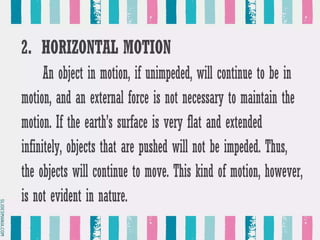
5. Law of inertia states that gravity is needed in order for a body to move.
6. Galileo observed that a ball released down from an inclined plane will reached
exactly the same height as it simultaneously rolls up in another inclined plane.
7. According to Galileo, heavier objects fall faster than lighter ones.
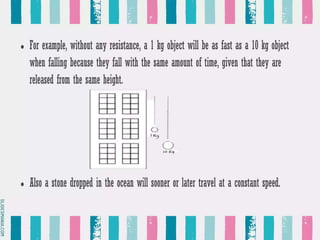
8. In the absence of air resistance, a dry cotton ball would fall faster than a stone.
9. In a vacuum, a feather falls faster than a metal ball.
10. If an object is moved by gravity alone, is called free falling.
19.
FORMATIVE TEST NO.2
TEST II. MULTIPLE CHOICE
Directions: Encircle the letter of the Best Answer. Do this in your activity notebook.
COPY AND ANSWER. NO ERASURES.
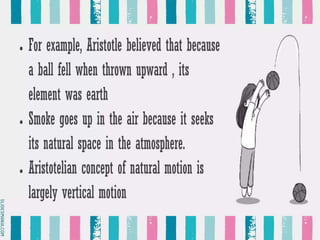
1. According to Aristotle, what type of motion is considered "natural motion"?
A. Vertical motion
B. Horizontal motion
C. Circular motion
D. Diagonal motion
2. In Aristotle's view, why does smoke rise upward?
A. Because it is pushed by air currents
B. Because of temperature differences
C. Because it contains fire elements
D. Because it seeks its natural space in the atmosphere
3. What did Aristotle believe about horizontal motion?
A. It continues indefinitely without force
B. It is faster than vertical motion
C. It only occurs in nature
D. It requires constant push or pull to maintain
20.
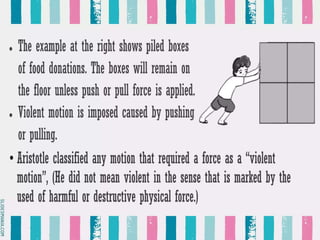
4. How didAristotle classify motion that required a force?
A. Natural motion
B. Vertical motion
C. Violent motion
D. Circular motion
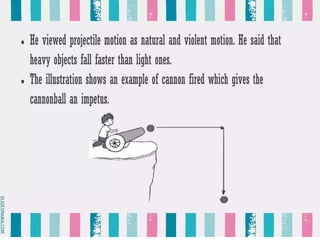
5. What was Aristotle's belief about falling objects of different weights?
A. Heavy objects fall faster than light ones
B. All objects fall at the same rate
C. Light objects fall faster than heavy ones
D. Weight doesn't affect falling speed
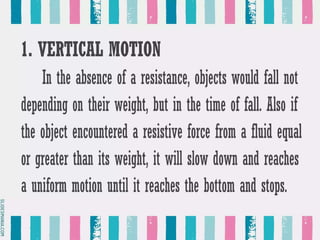
6. According to Galileo, how do objects fall in the absence of resistance?
A. Heavy objects fall faster
B. Light objects fall faster
C. Objects fall at different speeds based on size
D. Objects fall at the same rate regardless of weight
7. What did Galileo conclude about horizontal motion?
A. It requires constant force
B. It stops immediately without force
C. It always changes direction
D. It continues if unimpeded
21.
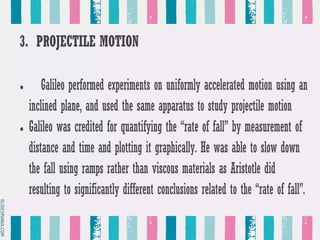
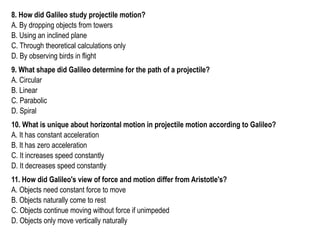
8. How didGalileo study projectile motion?
A. By dropping objects from towers
B. Using an inclined plane
C. Through theoretical calculations only
D. By observing birds in flight
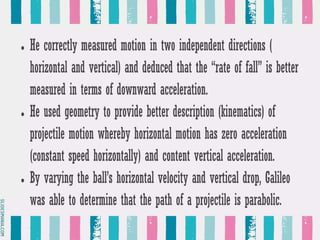
9. What shape did Galileo determine for the path of a projectile?
A. Circular
B. Linear
C. Parabolic
D. Spiral
10. What is unique about horizontal motion in projectile motion according to Galileo?
A. It has constant acceleration
B. It has zero acceleration
C. It increases speed constantly
D. It decreases speed constantly
11. How did Galileo's view of force and motion differ from Aristotle's?
A. Objects need constant force to move
B. Objects naturally come to rest
C. Objects continue moving without force if unimpeded
D. Objects only move vertically naturally
22.
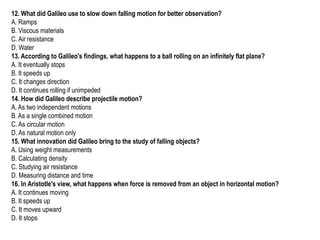
12. What didGalileo use to slow down falling motion for better observation?
A. Ramps
B. Viscous materials
C. Air resistance
D. Water
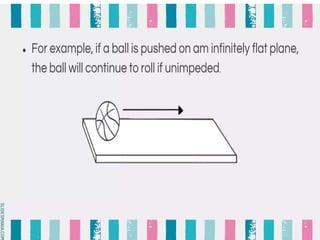
13. According to Galileo's findings, what happens to a ball rolling on an infinitely flat plane?
A. It eventually stops
B. It speeds up
C. It changes direction
D. It continues rolling if unimpeded
14. How did Galileo describe projectile motion?
A. As two independent motions
B. As a single combined motion
C. As circular motion
D. As natural motion only
15. What innovation did Galileo bring to the study of falling objects?
A. Using weight measurements
B. Calculating density
C. Studying air resistance
D. Measuring distance and time
16. In Aristotle's view, what happens when force is removed from an object in horizontal motion?
A. It continues moving
B. It speeds up
C. It moves upward
D. It stops
23.
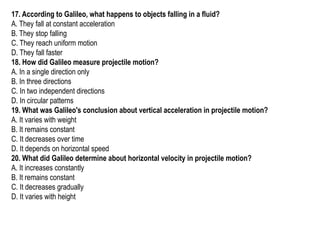
17. According toGalileo, what happens to objects falling in a fluid?
A. They fall at constant acceleration
B. They stop falling
C. They reach uniform motion
D. They fall faster
18. How did Galileo measure projectile motion?
A. In a single direction only
B. In three directions
C. In two independent directions
D. In circular patterns
19. What was Galileo's conclusion about vertical acceleration in projectile motion?
A. It varies with weight
B. It remains constant
C. It decreases over time
D. It depends on horizontal speed
20. What did Galileo determine about horizontal velocity in projectile motion?
A. It increases constantly
B. It remains constant
C. It decreases gradually
D. It varies with height