INSTRUCTOR: LE NGUYEN NHU ANH
LINGUISTICS 2
M1 LESSON 5.1
5.1 SENTENCES WITHIN SENTENCES
• Contents:
– Complementisers: that and whether
– The functions of that- and whether-clauses
– Adverbial clauses
5.1 SENTENCES WITHIN SENTENCES
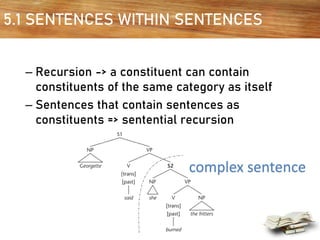
– Recursion -> a constituent can contain
constituents of the same category as itself
– Sentences that contain sentences as
constituents => sentential recursion
complex sentence
5.1 SENTENCES WITHIN SENTENCES
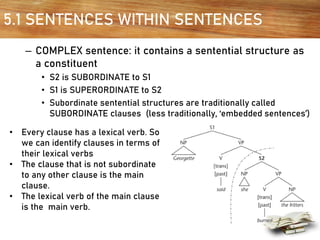
– COMPLEX sentence: it contains a sentential structure as
a constituent
• S2 is SUBORDINATE to S1
• S1 is SUPERORDINATE to S2
• Subordinate sentential structures are traditionally called
SUBORDINATE clauses (less traditionally, ‘embedded sentences’)
• Every clause has a lexical verb. So
we can identify clauses in terms of
their lexical verbs
• The clause that is not subordinate
to any other clause is the main
clause.
• The lexical verb of the main clause
is the main verb.
5.1 SENTENCES WITHIN SENTENCES
– Abbreviated Clausal Analysis (ACA)
S1[I thought S2[Georgette said S3[she burned the fritters] ] ]
5.1 SENTENCES WITHIN SENTENCES
– He reminded the men that he was in command at
every opportunity.
S1[He reminded the men that S2[he was in command] at every opportunity]
5.1 SENTENCES WITHIN SENTENCES
– The fact that you received no greeting from Mars
doesn’t mean that it is uninhabited.
S1[the fact that S2[you received no greeting from Mars] doesn’t mean that
S3[it is uninhabited] ] ]
5.1 SENTENCES WITHIN SENTENCES
• Complementisers: that and whether
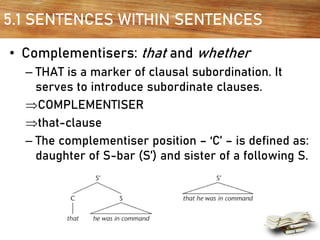
– THAT is a marker of clausal subordination. It
serves to introduce subordinate clauses.
COMPLEMENTISER
that-clause
– The complementiser position – ‘C’ – is defined as:
daughter of S-bar (S’) and sister of a following S.
5.1 SENTENCES WITHIN SENTENCES
• Complementisers: that and whether
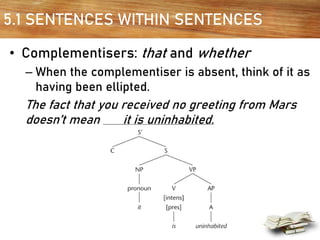
– When the complementiser is absent, think of it as
having been ellipted.
The fact that you received no greeting from Mars
doesn’t mean it is uninhabited.
5.1 SENTENCES WITHIN SENTENCES
• Complementisers: that and whether
– Auxiliary-fronting is possible only in main
clauses, never in subordinate clauses
because complementiser that and fronted
auxiliaries occupy the same position and
auxiliaries can’t be fronted to a position already
occupied by a complementiser.
5.1 SENTENCES WITHIN SENTENCES
• The functions of that- and whether- clauses
1. Subject – and extraposed subject.
2. Complement of V (within VP).
3. Complement of A (within AP).
4. Complement of N (within NP).
5. Complement of P (within PP).
5.1 SENTENCES WITHIN SENTENCES
• The functions of that- and whether- clauses
1. Subject – and extraposed subject.
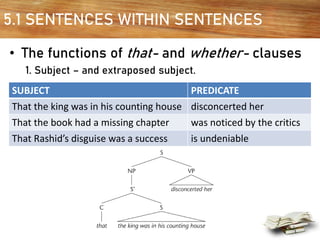
SUBJECT PREDICATE
That the king was in his counting house disconcerted her
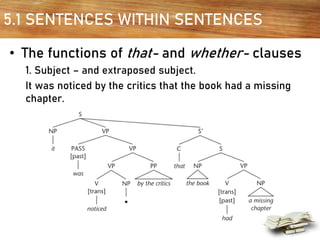
That the book had a missing chapter was noticed by the critics
That Rashid’s disguise was a success is undeniable
5.1 SENTENCES WITHIN SENTENCES
• The functions of that- and whether- clauses
1. Subject – and extraposed subject.
- A characteristic of CLAUSAL SUBJECTS is that they can
be EXTRAPOSED from under the subject NP node to the
end of the sentence.
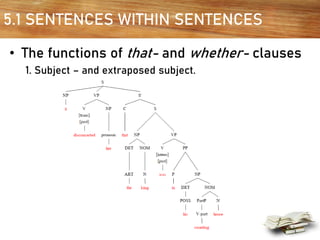
– It disconcerted her [that the king was in his counting
house].
– It was noticed by the critics [that the book had a missing
chapter].
– It is undeniable [that Rashid’s disguise was a success].
– IT is empty of meaning => ‘dummy’ subject.
=> EXPLETIVE IT
A syntactic expletive (abbreviated EXPL) is a form
of expletive: a word that in itself contributes nothing
to the semantic meaning of a sentence, yet does
perform a syntactic role.
5.1 SENTENCES WITHIN SENTENCES
• The functions of that- and whether- clauses
1. Subject – and extraposed subject.
5.1 SENTENCES WITHIN SENTENCES
• The functions of that- and whether- clauses
1. Subject – and extraposed subject.
- When the verb is TRANSITIVE or INTENSIVE,
extraposition of the clause subject was OPTIONAL
It disconcerted her that the king was in his counting house. (trans)
=> That the king was in his counting house disconcerted her.
It was worrying them whether Rory should be fired. (intens)
=> Whether Rory should be fired was worrying.
- When the verb is INTRANSITIVE, extraposition is
OBLIGATORY
It seems [that the recipe involves some dubious ingredients]
(intrans)
5.1 SENTENCES WITHIN SENTENCES
• The functions of that- and whether- clauses
1. Subject – and extraposed subject.
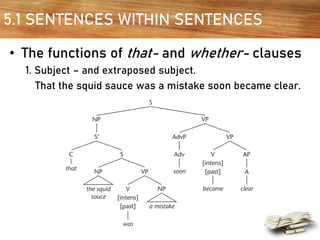
That the squid sauce was a mistake soon became clear.
5.1 SENTENCES WITHIN SENTENCES
• The functions of that- and whether- clauses
1. Subject – and extraposed subject.
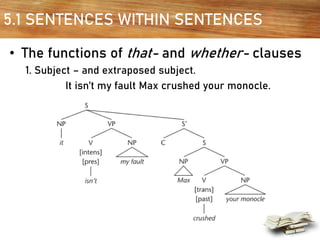
It isn’t my fault Max crushed your monocle.
5.1 SENTENCES WITHIN SENTENCES
• The functions of that- and whether- clauses
1. Subject – and extraposed subject.
It was noticed by the critics that the book had a missing
chapter.
5.1 SENTENCES WITHIN SENTENCES
• The functions of that- and whether- clauses
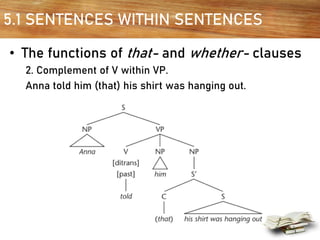
2. Complement of V within VP.
I thought S2[Georgette said
S3[she burned the fritters]]
5.1 SENTENCES WITHIN SENTENCES
• The functions of that- and whether- clauses
2. Complement of V within VP.
Anna told him (that) his shirt was hanging out.
5.1 SENTENCES WITHIN SENTENCES
• The functions of that- and whether- clauses
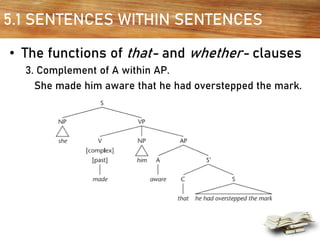
3. Complement of A within AP.
She made him aware that he had overstepped the mark.
5.1 SENTENCES WITHIN SENTENCES
• The functions of that- and whether- clauses
3. Complement of A within AP.
The men seemed AP[happy [they had not been chosen]].
Hassan was AP[unsure [whether he should sacrifice that pawn]].
She made him AP[aware [that he had overstepped the mark]].
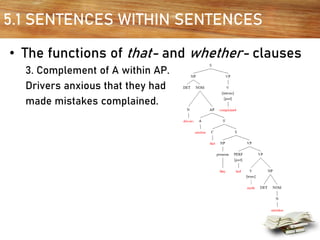
Drivers AP[anxious [that they had made mistakes]] complained.
5.1 SENTENCES WITHIN SENTENCES
• The functions of that- and whether- clauses
3. Complement of A within AP.
Drivers anxious that they had
made mistakes complained.
5.1 SENTENCES WITHIN SENTENCES
• The functions of that- and whether- clauses
3. Complement of A within AP.
Compare
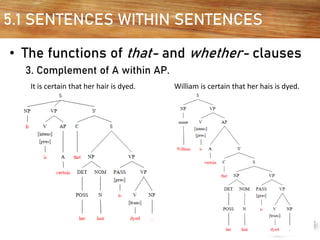
It is certain that her hair is dyed.
And
William is certain that her hais is dyed.
5.1 SENTENCES WITHIN SENTENCES
• The functions of that- and whether- clauses
3. Complement of A within AP.
It is certain that her hair is dyed. William is certain that her hais is dyed.
5.1 SENTENCES WITHIN SENTENCES
• The functions of that- and whether- clauses
4. Complement of N within NP.
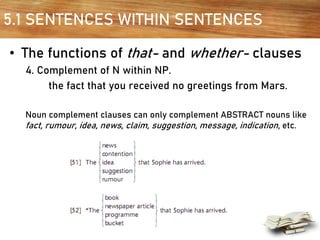
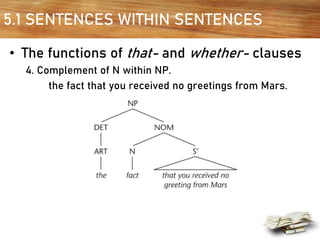
the fact that you received no greetings from Mars.
Noun complement clauses can only complement ABSTRACT nouns like
fact, rumour, idea, news, claim, suggestion, message, indication, etc.
5.1 SENTENCES WITHIN SENTENCES
• The functions of that- and whether- clauses
4. Complement of N within NP.
The clause is said to ‘complement the noun’ because it’s in
the same relation to the N within NP as clauses that
complement the V in VP.
Compare the following:
• His absence [INDICATES that he disapproves]. (VP)
• His absence is [INDICATIVE that he disapproves]. (AP)
• His absence is [an INDICATION that he disapproves]. (NP)
5.1 SENTENCES WITHIN SENTENCES
• The functions of that- and whether- clauses
4. Complement of N within NP.
the fact that you received no greetings from Mars.
5.1 SENTENCES WITHIN SENTENCES
• The functions of that- and whether- clauses
4. Complement of N within NP.
The following sentences include a that-clause following a
noun, but only in two of them does that clause function as
noun-complement clause within an NP. Identify them.
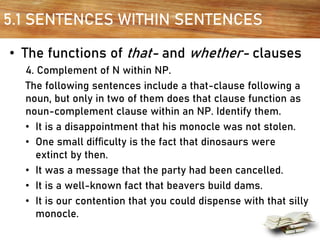
• It is a disappointment that his monocle was not stolen.
• One small difficulty is the fact that dinosaurs were
extinct by then.
• It was a message that the party had been cancelled.
• It is a well-known fact that beavers build dams.
• It is our contention that you could dispense with that silly
monocle.
5.1 SENTENCES WITHIN SENTENCES
• The functions of that- and whether- clauses
4. Complement of N within NP.
The following sentences include a that-clause following a
noun, but only in two of them does that clause function as
noun-complement clause within an NP. Identify them.
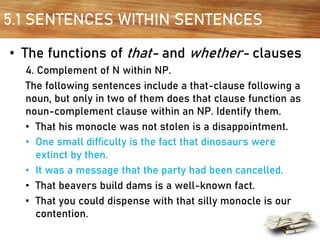
• That his monocle was not stolen is a disappointment.
• One small difficulty is the fact that dinosaurs were
extinct by then.
• It was a message that the party had been cancelled.
• That beavers build dams is a well-known fact.
• That you could dispense with that silly monocle is our
contention.
5.1 SENTENCES WITHIN SENTENCES
• The functions of that- and whether- clauses
5. Complement of P within PP.
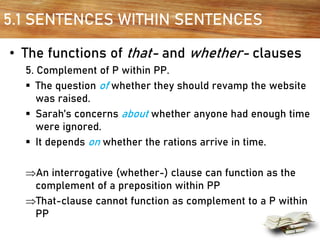
▪ The question of whether they should revamp the website
was raised.
▪ Sarah’s concerns about whether anyone had enough time
were ignored.
▪ It depends on whether the rations arrive in time.
An interrogative (whether-) clause can function as the
complement of a preposition within PP
That-clause cannot function as complement to a P within
PP
5.1 SENTENCES WITHIN SENTENCES
• The functions of that- and whether- clauses
5. Complement of P within PP.
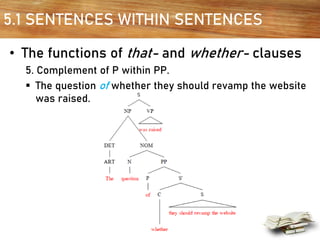
▪ The question of whether they should revamp the website
was raised.
5.1 SENTENCES WITHIN SENTENCES
• The functions of that- and whether- clauses
5. Complement of P within PP.
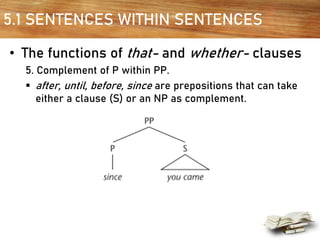
▪ after, until, before, since are prepositions that can take
either a clause (S) or an NP as complement.
5.1 SENTENCES WITHIN SENTENCES
• Adverbial clauses
▪ Abverbial clauses are introduced by SUBORDINATING
CONJUNCTIONS.
▪ Subordinating conjuctions: although, unless, if, because,
once, as, now, so, while, since.
▪ These are subordinating conjunctions – rather than
prepositions – because they can only introduce clauses
(not NPs).
▪ Subordinating conjunctions occupy the complementiser
position, C. They carry extra meaning that allows the
clause they introduce to function as an adverbial.
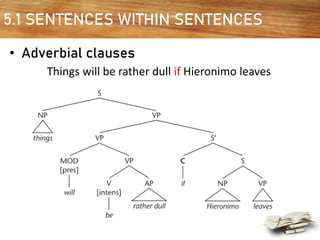
Things will be rather dull if Hieronimo leaves
5.1 SENTENCES WITHIN SENTENCES
• Adverbial clauses
Things will be rather dull if Hieronimo leaves
5.1 SENTENCES WITHIN SENTENCES
• Adverbial clauses
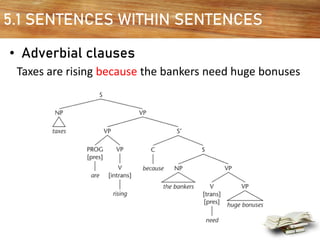
Taxes are rising because the bankers need huge bonuses
5.1 SENTENCES WITHIN SENTENCES
• Adverbial clauses
▪ IF makes the subordinate clause function as a
CONDITIONAL adverbial clause (same with UNLESS)
▪ BECAUSE => adverbial clause of REASON/RESULT
▪ SO => adverbial clause of PURPOSE
▪ Adverbials can’t modify N or NOM
▪ Now that, so that, except that, as if, in case, in order that,
as soon as => Complementiser (use triangle to represent
them in phrase markers)
5.1 SENTENCES WITHIN SENTENCES
• Adverbial clauses
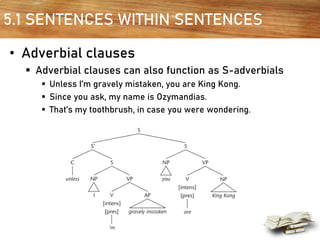
▪ Adverbial clauses can also function as S-adverbials
▪ Unless I’m gravely mistaken, you are King Kong.
▪ Since you ask, my name is Ozymandias.
▪ That’s my toothbrush, in case you were wondering.
5.1 SENTENCES WITHIN SENTENCES
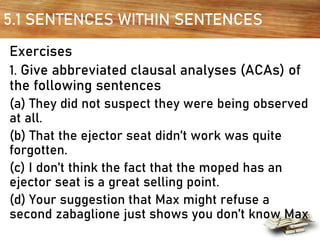
Exercises
1. Give abbreviated clausal analyses (ACAs) of
the following sentences
(a) They did not suspect they were being observed
at all.
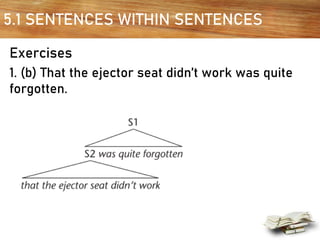
(b) That the ejector seat didn’t work was quite
forgotten.
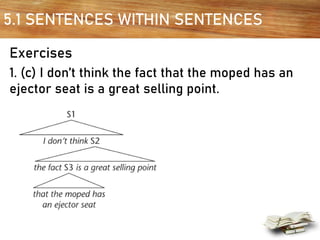
(c) I don’t think the fact that the moped has an
ejector seat is a great selling point.
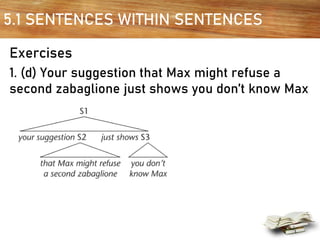
(d) Your suggestion that Max might refuse a
second zabaglione just shows you don’t know Max
5.1 SENTENCES WITHIN SENTENCES
Exercises
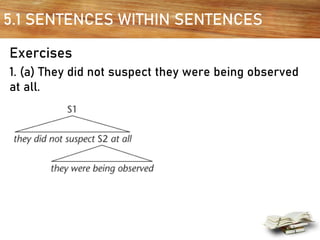
1. (a) They did not suspect they were being observed
at all.
5.1 SENTENCES WITHIN SENTENCES
Exercises
1. (b) That the ejector seat didn’t work was quite
forgotten.
5.1 SENTENCES WITHIN SENTENCES
Exercises
1. (c) I don’t think the fact that the moped has an
ejector seat is a great selling point.
5.1 SENTENCES WITHIN SENTENCES
Exercises
1. (d) Your suggestion that Max might refuse a
second zabaglione just shows you don’t know Max
5.1 SENTENCES WITHIN SENTENCES
Exercises
1.
(a) S1[They did not suspect S2[they were being observed]S2 at
all]S1.
(b) S1[S2[That the ejector seat didn’t work]S2 was quite
forgotten]S1.
(c) S1[I don’t think S2[the fact S3[that the moped has an ejector
seat]S3 is a great selling point]S2]S1.
(d) S1[Your suggestion =[that Max might refuse a second
zabaglione]= just shows S3[you don’t know Max]S3]S1
5.1 SENTENCES WITHIN SENTENCES
Exercises
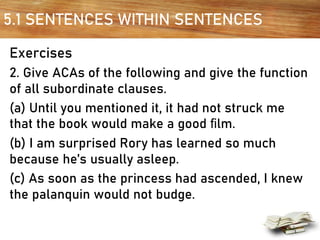
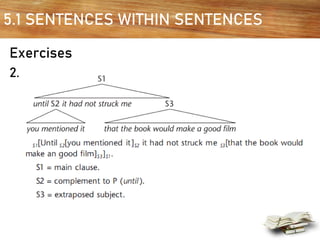
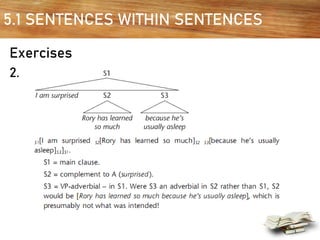
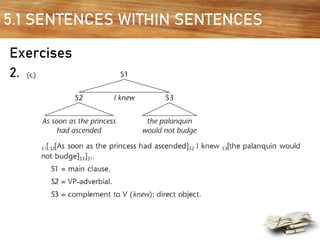
2. Give ACAs of the following and give the function
of all subordinate clauses.
(a) Until you mentioned it, it had not struck me
that the book would make a good film.
(b) I am surprised Rory has learned so much
because he’s usually asleep.
(c) As soon as the princess had ascended, I knew
the palanquin would not budge.
5.1 SENTENCES WITHIN SENTENCES
Exercises
2.
5.1 SENTENCES WITHIN SENTENCES
Exercises
2.
5.1 SENTENCES WITHIN SENTENCES
Exercises
2.

M1 lesson 5.1 slides

  • 1.
    INSTRUCTOR: LE NGUYENNHU ANH LINGUISTICS 2 M1 LESSON 5.1
  • 2.
    5.1 SENTENCES WITHINSENTENCES • Contents: – Complementisers: that and whether – The functions of that- and whether-clauses – Adverbial clauses
  • 3.
    5.1 SENTENCES WITHINSENTENCES – Recursion -> a constituent can contain constituents of the same category as itself – Sentences that contain sentences as constituents => sentential recursion complex sentence
  • 4.
    5.1 SENTENCES WITHINSENTENCES – COMPLEX sentence: it contains a sentential structure as a constituent • S2 is SUBORDINATE to S1 • S1 is SUPERORDINATE to S2 • Subordinate sentential structures are traditionally called SUBORDINATE clauses (less traditionally, ‘embedded sentences’) • Every clause has a lexical verb. So we can identify clauses in terms of their lexical verbs • The clause that is not subordinate to any other clause is the main clause. • The lexical verb of the main clause is the main verb.
  • 5.
    5.1 SENTENCES WITHINSENTENCES – Abbreviated Clausal Analysis (ACA) S1[I thought S2[Georgette said S3[she burned the fritters] ] ]
  • 6.
    5.1 SENTENCES WITHINSENTENCES – He reminded the men that he was in command at every opportunity. S1[He reminded the men that S2[he was in command] at every opportunity]
  • 7.
    5.1 SENTENCES WITHINSENTENCES – The fact that you received no greeting from Mars doesn’t mean that it is uninhabited. S1[the fact that S2[you received no greeting from Mars] doesn’t mean that S3[it is uninhabited] ] ]
  • 8.
    5.1 SENTENCES WITHINSENTENCES • Complementisers: that and whether – THAT is a marker of clausal subordination. It serves to introduce subordinate clauses. COMPLEMENTISER that-clause – The complementiser position – ‘C’ – is defined as: daughter of S-bar (S’) and sister of a following S.
  • 9.
    5.1 SENTENCES WITHINSENTENCES • Complementisers: that and whether – When the complementiser is absent, think of it as having been ellipted. The fact that you received no greeting from Mars doesn’t mean it is uninhabited.
  • 10.
    5.1 SENTENCES WITHINSENTENCES • Complementisers: that and whether – Auxiliary-fronting is possible only in main clauses, never in subordinate clauses because complementiser that and fronted auxiliaries occupy the same position and auxiliaries can’t be fronted to a position already occupied by a complementiser.
  • 11.
    5.1 SENTENCES WITHINSENTENCES • The functions of that- and whether- clauses 1. Subject – and extraposed subject. 2. Complement of V (within VP). 3. Complement of A (within AP). 4. Complement of N (within NP). 5. Complement of P (within PP).
  • 12.
    5.1 SENTENCES WITHINSENTENCES • The functions of that- and whether- clauses 1. Subject – and extraposed subject. SUBJECT PREDICATE That the king was in his counting house disconcerted her That the book had a missing chapter was noticed by the critics That Rashid’s disguise was a success is undeniable
  • 13.
    5.1 SENTENCES WITHINSENTENCES • The functions of that- and whether- clauses 1. Subject – and extraposed subject. - A characteristic of CLAUSAL SUBJECTS is that they can be EXTRAPOSED from under the subject NP node to the end of the sentence. – It disconcerted her [that the king was in his counting house]. – It was noticed by the critics [that the book had a missing chapter]. – It is undeniable [that Rashid’s disguise was a success]. – IT is empty of meaning => ‘dummy’ subject. => EXPLETIVE IT A syntactic expletive (abbreviated EXPL) is a form of expletive: a word that in itself contributes nothing to the semantic meaning of a sentence, yet does perform a syntactic role.
  • 14.
    5.1 SENTENCES WITHINSENTENCES • The functions of that- and whether- clauses 1. Subject – and extraposed subject.
  • 15.
    5.1 SENTENCES WITHINSENTENCES • The functions of that- and whether- clauses 1. Subject – and extraposed subject. - When the verb is TRANSITIVE or INTENSIVE, extraposition of the clause subject was OPTIONAL It disconcerted her that the king was in his counting house. (trans) => That the king was in his counting house disconcerted her. It was worrying them whether Rory should be fired. (intens) => Whether Rory should be fired was worrying. - When the verb is INTRANSITIVE, extraposition is OBLIGATORY It seems [that the recipe involves some dubious ingredients] (intrans)
  • 16.
    5.1 SENTENCES WITHINSENTENCES • The functions of that- and whether- clauses 1. Subject – and extraposed subject. That the squid sauce was a mistake soon became clear.
  • 17.
    5.1 SENTENCES WITHINSENTENCES • The functions of that- and whether- clauses 1. Subject – and extraposed subject. It isn’t my fault Max crushed your monocle.
  • 18.
    5.1 SENTENCES WITHINSENTENCES • The functions of that- and whether- clauses 1. Subject – and extraposed subject. It was noticed by the critics that the book had a missing chapter.
  • 19.
    5.1 SENTENCES WITHINSENTENCES • The functions of that- and whether- clauses 2. Complement of V within VP. I thought S2[Georgette said S3[she burned the fritters]]
  • 20.
    5.1 SENTENCES WITHINSENTENCES • The functions of that- and whether- clauses 2. Complement of V within VP. Anna told him (that) his shirt was hanging out.
  • 21.
    5.1 SENTENCES WITHINSENTENCES • The functions of that- and whether- clauses 3. Complement of A within AP. She made him aware that he had overstepped the mark.
  • 22.
    5.1 SENTENCES WITHINSENTENCES • The functions of that- and whether- clauses 3. Complement of A within AP. The men seemed AP[happy [they had not been chosen]]. Hassan was AP[unsure [whether he should sacrifice that pawn]]. She made him AP[aware [that he had overstepped the mark]]. Drivers AP[anxious [that they had made mistakes]] complained.
  • 23.
    5.1 SENTENCES WITHINSENTENCES • The functions of that- and whether- clauses 3. Complement of A within AP. Drivers anxious that they had made mistakes complained.
  • 24.
    5.1 SENTENCES WITHINSENTENCES • The functions of that- and whether- clauses 3. Complement of A within AP. Compare It is certain that her hair is dyed. And William is certain that her hais is dyed.
  • 25.
    5.1 SENTENCES WITHINSENTENCES • The functions of that- and whether- clauses 3. Complement of A within AP. It is certain that her hair is dyed. William is certain that her hais is dyed.
  • 26.
    5.1 SENTENCES WITHINSENTENCES • The functions of that- and whether- clauses 4. Complement of N within NP. the fact that you received no greetings from Mars. Noun complement clauses can only complement ABSTRACT nouns like fact, rumour, idea, news, claim, suggestion, message, indication, etc.
  • 27.
    5.1 SENTENCES WITHINSENTENCES • The functions of that- and whether- clauses 4. Complement of N within NP. The clause is said to ‘complement the noun’ because it’s in the same relation to the N within NP as clauses that complement the V in VP. Compare the following: • His absence [INDICATES that he disapproves]. (VP) • His absence is [INDICATIVE that he disapproves]. (AP) • His absence is [an INDICATION that he disapproves]. (NP)
  • 28.
    5.1 SENTENCES WITHINSENTENCES • The functions of that- and whether- clauses 4. Complement of N within NP. the fact that you received no greetings from Mars.
  • 29.
    5.1 SENTENCES WITHINSENTENCES • The functions of that- and whether- clauses 4. Complement of N within NP. The following sentences include a that-clause following a noun, but only in two of them does that clause function as noun-complement clause within an NP. Identify them. • It is a disappointment that his monocle was not stolen. • One small difficulty is the fact that dinosaurs were extinct by then. • It was a message that the party had been cancelled. • It is a well-known fact that beavers build dams. • It is our contention that you could dispense with that silly monocle.
  • 30.
    5.1 SENTENCES WITHINSENTENCES • The functions of that- and whether- clauses 4. Complement of N within NP. The following sentences include a that-clause following a noun, but only in two of them does that clause function as noun-complement clause within an NP. Identify them. • That his monocle was not stolen is a disappointment. • One small difficulty is the fact that dinosaurs were extinct by then. • It was a message that the party had been cancelled. • That beavers build dams is a well-known fact. • That you could dispense with that silly monocle is our contention.
  • 31.
    5.1 SENTENCES WITHINSENTENCES • The functions of that- and whether- clauses 5. Complement of P within PP. ▪ The question of whether they should revamp the website was raised. ▪ Sarah’s concerns about whether anyone had enough time were ignored. ▪ It depends on whether the rations arrive in time. An interrogative (whether-) clause can function as the complement of a preposition within PP That-clause cannot function as complement to a P within PP
  • 32.
    5.1 SENTENCES WITHINSENTENCES • The functions of that- and whether- clauses 5. Complement of P within PP. ▪ The question of whether they should revamp the website was raised.
  • 33.
    5.1 SENTENCES WITHINSENTENCES • The functions of that- and whether- clauses 5. Complement of P within PP. ▪ after, until, before, since are prepositions that can take either a clause (S) or an NP as complement.
  • 34.
    5.1 SENTENCES WITHINSENTENCES • Adverbial clauses ▪ Abverbial clauses are introduced by SUBORDINATING CONJUNCTIONS. ▪ Subordinating conjuctions: although, unless, if, because, once, as, now, so, while, since. ▪ These are subordinating conjunctions – rather than prepositions – because they can only introduce clauses (not NPs). ▪ Subordinating conjunctions occupy the complementiser position, C. They carry extra meaning that allows the clause they introduce to function as an adverbial. Things will be rather dull if Hieronimo leaves
  • 35.
    5.1 SENTENCES WITHINSENTENCES • Adverbial clauses Things will be rather dull if Hieronimo leaves
  • 36.
    5.1 SENTENCES WITHINSENTENCES • Adverbial clauses Taxes are rising because the bankers need huge bonuses
  • 37.
    5.1 SENTENCES WITHINSENTENCES • Adverbial clauses ▪ IF makes the subordinate clause function as a CONDITIONAL adverbial clause (same with UNLESS) ▪ BECAUSE => adverbial clause of REASON/RESULT ▪ SO => adverbial clause of PURPOSE ▪ Adverbials can’t modify N or NOM ▪ Now that, so that, except that, as if, in case, in order that, as soon as => Complementiser (use triangle to represent them in phrase markers)
  • 38.
    5.1 SENTENCES WITHINSENTENCES • Adverbial clauses ▪ Adverbial clauses can also function as S-adverbials ▪ Unless I’m gravely mistaken, you are King Kong. ▪ Since you ask, my name is Ozymandias. ▪ That’s my toothbrush, in case you were wondering.
  • 39.
    5.1 SENTENCES WITHINSENTENCES Exercises 1. Give abbreviated clausal analyses (ACAs) of the following sentences (a) They did not suspect they were being observed at all. (b) That the ejector seat didn’t work was quite forgotten. (c) I don’t think the fact that the moped has an ejector seat is a great selling point. (d) Your suggestion that Max might refuse a second zabaglione just shows you don’t know Max
  • 40.
    5.1 SENTENCES WITHINSENTENCES Exercises 1. (a) They did not suspect they were being observed at all.
  • 41.
    5.1 SENTENCES WITHINSENTENCES Exercises 1. (b) That the ejector seat didn’t work was quite forgotten.
  • 42.
    5.1 SENTENCES WITHINSENTENCES Exercises 1. (c) I don’t think the fact that the moped has an ejector seat is a great selling point.
  • 43.
    5.1 SENTENCES WITHINSENTENCES Exercises 1. (d) Your suggestion that Max might refuse a second zabaglione just shows you don’t know Max
  • 44.
    5.1 SENTENCES WITHINSENTENCES Exercises 1. (a) S1[They did not suspect S2[they were being observed]S2 at all]S1. (b) S1[S2[That the ejector seat didn’t work]S2 was quite forgotten]S1. (c) S1[I don’t think S2[the fact S3[that the moped has an ejector seat]S3 is a great selling point]S2]S1. (d) S1[Your suggestion =[that Max might refuse a second zabaglione]= just shows S3[you don’t know Max]S3]S1
  • 45.
    5.1 SENTENCES WITHINSENTENCES Exercises 2. Give ACAs of the following and give the function of all subordinate clauses. (a) Until you mentioned it, it had not struck me that the book would make a good film. (b) I am surprised Rory has learned so much because he’s usually asleep. (c) As soon as the princess had ascended, I knew the palanquin would not budge.
  • 46.
    5.1 SENTENCES WITHINSENTENCES Exercises 2.
  • 47.
    5.1 SENTENCES WITHINSENTENCES Exercises 2.
  • 48.
    5.1 SENTENCES WITHINSENTENCES Exercises 2.