KIỂM TRA ĐÁNH GIÁ
NGOẠI NGỮ
LANGUAGE ASSESSMENT
FOR TEACHERS OF
ENGLISH
Giảng viên tập huấn: ThS Lê Nguyễn Như Anh
Trường Đại Học Sư Phạm TPHCM
Khoa Tiếng Anh
Tập huấn:
MODULE 3
REAL-LIFE LANGUAGE
ASSESSMENT
TARGETS
After learning module 3, you can:
• Understand real-life examples of
assessment targets from English
competence standards and famous
tests
• Further understand the knowledge in
module 2 in how to write assessment
targets for different levels of students
• Apply the knowledge to write and revise
learning/assessment targets.
THE CEFR AND
LANGUAGE
PROFICIENCY
ASSESSMENT
TARGETS
Problems
• In language teaching, different European
countries used many different syllabuses and
examinations
→Levels may vary even among institutions in
the same area.
→Comparing levels becomes more difficult.
7/40
The CEFR
The CEFR ~ the Common European Framework
of Reference for Languages
• published by the council of Europe in 2001
• to establish international standards for
learning, teaching, and assessment for all
modern European languages
8/40
The CEFR
The CEFR describes “what language learners
have to learn to do in order to use a language
for communication and what knowledge and
skills they have to develop so as to be able to
act effectively” (Council of Europe 2001, p. 1).
9/40
The CEFR
• provides a common basis for the elaboration
of language syllabuses, curricula,
examinations, and textbooks.
• is widely used by test developers and other
stakeholders to interpret test scores and
make decisions.
10/40
Reference levels
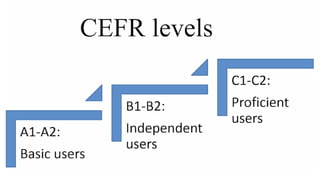
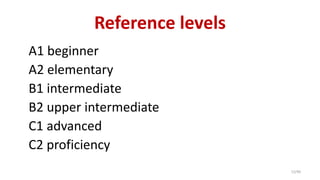
A1 beginner
A2 elementary
B1 intermediate
B2 upper intermediate
C1 advanced
C2 proficiency
12/40
Reference levels
• The levels match general concepts of basic,
intermediate, and advanced and are often referred to as
the Global Scale.
• For each level, the full CEFR document complements this
by describing in depth:
– Competencies necessary for effective communication.
– Skills and knowledge related to language learning and
competencies.
– Situations (people, place, time, organization, etc.) and
contexts (study, work, social, tourism, etc.) in which
communication takes place. 13/40
“Can do” statements
• describe what a learner can do at each level.
• are always positive: not what a learner cannot do
or does wrong.
• do not deliberately refer to grammar or
structures
• are designed to describe how language users
communicate and how they understand written
and spoken texts.
14/40
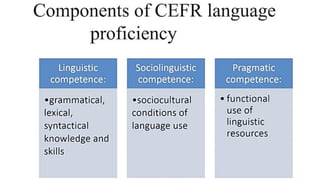
PERFORMANCE CONTENTS
CONDITIONS
LANGUAGE
ASSESSMENT
TARGETS IN MAJOR
ENGLISH TESTS
THAT’S ALL
Thank you for your attention

Assessment Module 3

  • 1.
    KIỂM TRA ĐÁNHGIÁ NGOẠI NGỮ LANGUAGE ASSESSMENT FOR TEACHERS OF ENGLISH Giảng viên tập huấn: ThS Lê Nguyễn Như Anh Trường Đại Học Sư Phạm TPHCM Khoa Tiếng Anh Tập huấn:
  • 2.
  • 3.
    After learning module3, you can: • Understand real-life examples of assessment targets from English competence standards and famous tests • Further understand the knowledge in module 2 in how to write assessment targets for different levels of students • Apply the knowledge to write and revise learning/assessment targets.
  • 4.
  • 7.
    Problems • In languageteaching, different European countries used many different syllabuses and examinations →Levels may vary even among institutions in the same area. →Comparing levels becomes more difficult. 7/40
  • 8.
    The CEFR The CEFR~ the Common European Framework of Reference for Languages • published by the council of Europe in 2001 • to establish international standards for learning, teaching, and assessment for all modern European languages 8/40
  • 9.
    The CEFR The CEFRdescribes “what language learners have to learn to do in order to use a language for communication and what knowledge and skills they have to develop so as to be able to act effectively” (Council of Europe 2001, p. 1). 9/40
  • 10.
    The CEFR • providesa common basis for the elaboration of language syllabuses, curricula, examinations, and textbooks. • is widely used by test developers and other stakeholders to interpret test scores and make decisions. 10/40
  • 12.
    Reference levels A1 beginner A2elementary B1 intermediate B2 upper intermediate C1 advanced C2 proficiency 12/40
  • 13.
    Reference levels • Thelevels match general concepts of basic, intermediate, and advanced and are often referred to as the Global Scale. • For each level, the full CEFR document complements this by describing in depth: – Competencies necessary for effective communication. – Skills and knowledge related to language learning and competencies. – Situations (people, place, time, organization, etc.) and contexts (study, work, social, tourism, etc.) in which communication takes place. 13/40
  • 14.
    “Can do” statements •describe what a learner can do at each level. • are always positive: not what a learner cannot do or does wrong. • do not deliberately refer to grammar or structures • are designed to describe how language users communicate and how they understand written and spoken texts. 14/40
  • 16.
  • 20.
  • 25.
    THAT’S ALL Thank youfor your attention