1.
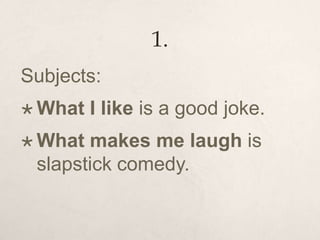
Subjects:
 What I like is a good joke.
 What makes me laugh is
slapstick comedy.
1.
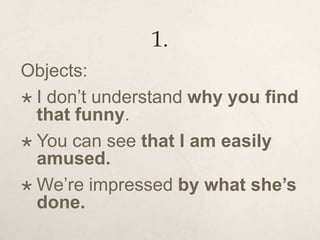
Objects:
 I don’t understand why you find
that funny.
 You can see that I am easily
amused.
 We’re impressed by what she’s
done.
1.
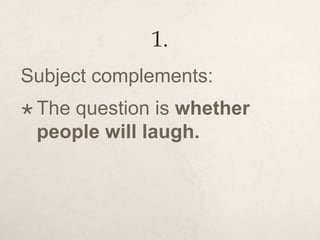
Subject complements:
 The question is whether
people will laugh.
1.
Adjective complements:
 It’s clear that laughter
involves an emotion.
1.
Noun clauses begin with that,
question words, words formed
from –ever (whatever, whoever,
whomever, whichever) or
whether or if.
1.
 We realize that she was joking.
 We don’t understand what it
means.
 Whatever you decide is fine with
me.
 He doesn’t know if/whether it’s
true or not.
2.
We use the word that to introduce
some noun clauses. In such
cases, that is a grammatical word
that simply introduces a clause. It
has no concrete meaning.
 That she was a funny person
was apparent.
2. Teacher’s Note:
The word that has different uses:
Who is that?
Can I please have that paper?
I don’t like movies that are too scary.
That the boys competed for their
mother’s attention was apparent.
2.
That can be omitted when it
introduces an object noun
clause or a complement noun
clause, especially in speaking:
2.
 I believe (that) humor is
healthy.
 I told Sue (that) she was a
funny person.
 It’s odd (that) you laugh so
little.
2.
When that introduces a subject
noun clause, it is never omitted.
That Joe has a good sense of
humor is obvious.
NOT **Joe has a good sense of
humor is obvious.
2.
Subject noun clauses beginning with that
are very formal.
Teacher’s note: it is really not important
to be able to use subject noun clauses
because it is very formal and not
common. It is important to be able to
understand a sentence with a subject
noun clause when you are reading.
2.
BE CAREFUL! Do not confuse that
and what. The word that simply
introduces a noun clause. The word
what refers to something definite. It
serves as the object in the noun
clause and cannot be omitted
(Teacher’s note: a noun clause that
begins with what is an embedded
question.)
2.
I know (that) she is coming.
I don’t know what she is
bringing.
3.
The fact that is sometimes
used in place of that in subject
noun clauses.
That you can laugh is good. =
The fact that you can laugh is
good.
3.
The fact that must be used in place of
that in noun clauses that are objects
of prepositions:
I’m impressed by the fact that Bob is
here.
NOT
** I’m impressed by that Bob is here.
3.
It often functions as the subject of
a sentence, with the noun clause
coming at the end. Like the word
that, it, when used with a noun
clause, is a grammatical word with
no concrete meaning.
 It’s funny (that) you should say
that.
3. Teacher’s Note
This kind of sentence beginning
with it is very, very common,
and people who are learning
English often don’t know how to
use it. Here are some more
examples:
3. Teacher’s Note
 It’s hard to understand this
lesson.
 It’s easy to talk about, but it’s
hard to do.
 It’s too bad he wasn’t at the
meeting.
 It’s beautiful outside today.
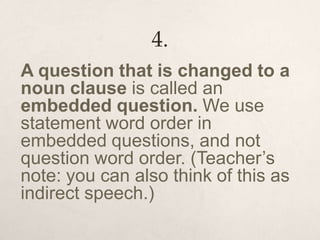
4.
A question that is changed to a
noun clause is called an
embedded question. We use
statement word order in
embedded questions, and not
question word order. (Teacher’s
note: you can also think of this as
indirect speech.)
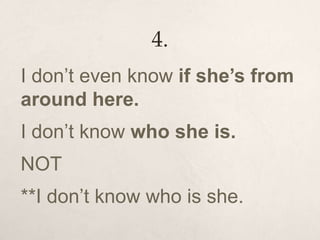
4.
I don’t even know if she’s from
around here.
I don’t know who she is.
NOT
**I don’t know who is she.
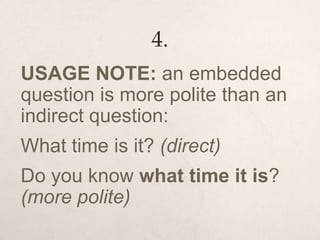
4.
USAGE NOTE: an embedded
question is more polite than an
indirect question:
What time is it? (direct)
Do you know what time it is?
(more polite)
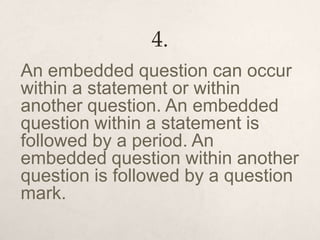
4.
An embedded question can occur
within a statement or within
another question. An embedded
question within a statement is
followed by a period. An
embedded question within another
question is followed by a question
mark.
4.
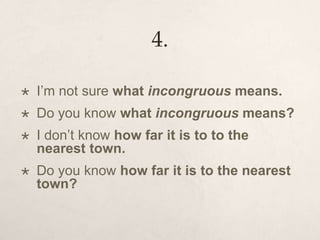
 I’m not sure what incongruous means.
 Do you know what incongruous means?
 I don’t know how far it is to to the
nearest town.
 Do you know how far it is to the nearest
town?
5.
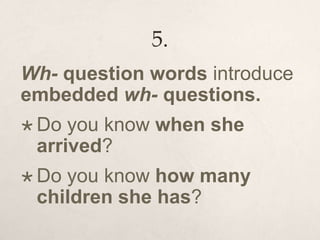
Wh- question words introduce
embedded wh- questions.
 Do you know when she
arrived?
 Do you know how many
children she has?
5.
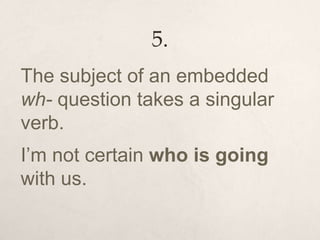
The subject of an embedded
wh- question takes a singular
verb.
I’m not certain who is going
with us.
5.
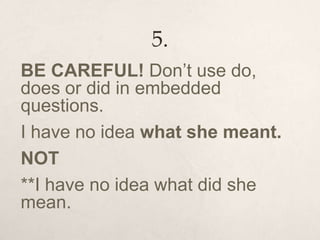
BE CAREFUL! Don’t use do,
does or did in embedded
questions.
I have no idea what she meant.
NOT
**I have no idea what did she
mean.
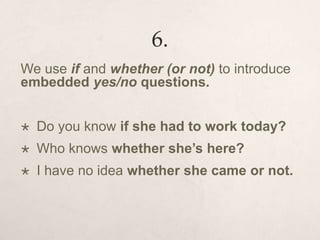
6.
We use if and whether (or not) to introduce
embedded yes/no questions.
 Do you know if she had to work today?
 Who knows whether she’s here?
 I have no idea whether she came or not.
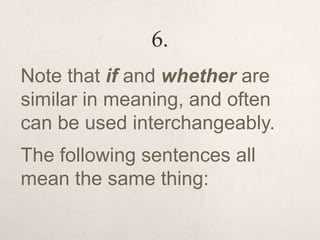
6.
Note that if and whether are
similar in meaning, and often
can be used interchangeably.
The following sentences all
mean the same thing:
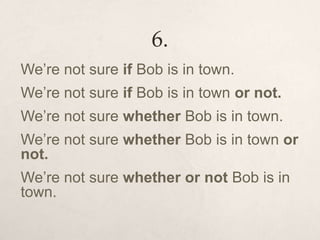
6.
We’re not sure if Bob is in town.
We’re not sure if Bob is in town or not.
We’re not sure whether Bob is in town.
We’re not sure whether Bob is in town or
not.
We’re not sure whether or not Bob is in
town.
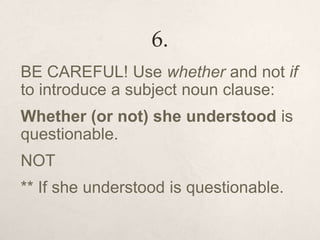
6.
BE CAREFUL! Use whether and not if
to introduce a subject noun clause:
Whether (or not) she understood is
questionable.
NOT
** If she understood is questionable.
6.
BE CAREFUL! Do not omit if or whether
(or not) in embedded yes-no questions.
It is difficult to say if his plan will work.
It is difficult to say whether or not his
plan will work.
NOT
**It is difficult to say his plan will work.
7.
Whether … or not can replace
whether in all noun clauses.
We don’t know whether she got
the job =
We don’t know whether she got
the job or not.
7.
If … or not can replace whether in all but subject noun
clauses.
No one has told me whether she received the letter or not
=
No one has told me if she received the letter or not =
Whether she received it isn’t known.
NOT
**If she received it or not isn’t known.

Unit 10 grammar notes

  • 2.
    1. Subjects:  What Ilike is a good joke.  What makes me laugh is slapstick comedy.
  • 3.
    1. Objects:  I don’tunderstand why you find that funny.  You can see that I am easily amused.  We’re impressed by what she’s done.
  • 4.
    1. Subject complements:  Thequestion is whether people will laugh.
  • 5.
    1. Adjective complements:  It’sclear that laughter involves an emotion.
  • 6.
    1. Noun clauses beginwith that, question words, words formed from –ever (whatever, whoever, whomever, whichever) or whether or if.
  • 7.
    1.  We realizethat she was joking.  We don’t understand what it means.  Whatever you decide is fine with me.  He doesn’t know if/whether it’s true or not.
  • 8.
    2. We use theword that to introduce some noun clauses. In such cases, that is a grammatical word that simply introduces a clause. It has no concrete meaning.  That she was a funny person was apparent.
  • 9.
    2. Teacher’s Note: Theword that has different uses: Who is that? Can I please have that paper? I don’t like movies that are too scary. That the boys competed for their mother’s attention was apparent.
  • 10.
    2. That can beomitted when it introduces an object noun clause or a complement noun clause, especially in speaking:
  • 11.
    2.  I believe(that) humor is healthy.  I told Sue (that) she was a funny person.  It’s odd (that) you laugh so little.
  • 12.
    2. When that introducesa subject noun clause, it is never omitted. That Joe has a good sense of humor is obvious. NOT **Joe has a good sense of humor is obvious.
  • 13.
    2. Subject noun clausesbeginning with that are very formal. Teacher’s note: it is really not important to be able to use subject noun clauses because it is very formal and not common. It is important to be able to understand a sentence with a subject noun clause when you are reading.
  • 14.
    2. BE CAREFUL! Donot confuse that and what. The word that simply introduces a noun clause. The word what refers to something definite. It serves as the object in the noun clause and cannot be omitted (Teacher’s note: a noun clause that begins with what is an embedded question.)
  • 15.
    2. I know (that)she is coming. I don’t know what she is bringing.
  • 16.
    3. The fact thatis sometimes used in place of that in subject noun clauses. That you can laugh is good. = The fact that you can laugh is good.
  • 17.
    3. The fact thatmust be used in place of that in noun clauses that are objects of prepositions: I’m impressed by the fact that Bob is here. NOT ** I’m impressed by that Bob is here.
  • 18.
    3. It often functionsas the subject of a sentence, with the noun clause coming at the end. Like the word that, it, when used with a noun clause, is a grammatical word with no concrete meaning.  It’s funny (that) you should say that.
  • 19.
    3. Teacher’s Note Thiskind of sentence beginning with it is very, very common, and people who are learning English often don’t know how to use it. Here are some more examples:
  • 20.
    3. Teacher’s Note It’s hard to understand this lesson.  It’s easy to talk about, but it’s hard to do.  It’s too bad he wasn’t at the meeting.  It’s beautiful outside today.
  • 21.
    4. A question thatis changed to a noun clause is called an embedded question. We use statement word order in embedded questions, and not question word order. (Teacher’s note: you can also think of this as indirect speech.)
  • 22.
    4. I don’t evenknow if she’s from around here. I don’t know who she is. NOT **I don’t know who is she.
  • 23.
    4. USAGE NOTE: anembedded question is more polite than an indirect question: What time is it? (direct) Do you know what time it is? (more polite)
  • 24.
    4. An embedded questioncan occur within a statement or within another question. An embedded question within a statement is followed by a period. An embedded question within another question is followed by a question mark.
  • 25.
    4.  I’m notsure what incongruous means.  Do you know what incongruous means?  I don’t know how far it is to to the nearest town.  Do you know how far it is to the nearest town?
  • 26.
    5. Wh- question wordsintroduce embedded wh- questions.  Do you know when she arrived?  Do you know how many children she has?
  • 27.
    5. The subject ofan embedded wh- question takes a singular verb. I’m not certain who is going with us.
  • 28.
    5. BE CAREFUL! Don’tuse do, does or did in embedded questions. I have no idea what she meant. NOT **I have no idea what did she mean.
  • 29.
    6. We use ifand whether (or not) to introduce embedded yes/no questions.  Do you know if she had to work today?  Who knows whether she’s here?  I have no idea whether she came or not.
  • 30.
    6. Note that ifand whether are similar in meaning, and often can be used interchangeably. The following sentences all mean the same thing:
  • 31.
    6. We’re not sureif Bob is in town. We’re not sure if Bob is in town or not. We’re not sure whether Bob is in town. We’re not sure whether Bob is in town or not. We’re not sure whether or not Bob is in town.
  • 32.
    6. BE CAREFUL! Usewhether and not if to introduce a subject noun clause: Whether (or not) she understood is questionable. NOT ** If she understood is questionable.
  • 33.
    6. BE CAREFUL! Donot omit if or whether (or not) in embedded yes-no questions. It is difficult to say if his plan will work. It is difficult to say whether or not his plan will work. NOT **It is difficult to say his plan will work.
  • 34.
    7. Whether … ornot can replace whether in all noun clauses. We don’t know whether she got the job = We don’t know whether she got the job or not.
  • 35.
    7. If … ornot can replace whether in all but subject noun clauses. No one has told me whether she received the letter or not = No one has told me if she received the letter or not = Whether she received it isn’t known. NOT **If she received it or not isn’t known.