INSTRUCTOR: LE NGUYEN NHU ANH
LINGUISTICS 2
M1 LESSON 1.3
ALLPPT.com _ Free PowerPoint Templates, Diagrams and Charts
1.3 Sentence structure: Categories
• Contents:
– Nouns
– Lexical and phrasal categories (noun and noun
phrase)
– Adjectives and Adverbs
– Adjective Phrase and Adverb Phrases
– Prepositions and Prepositional Phrases
– Co-ordinate Phrases
1.3 Sentence structure: Categories
Why do we need to categorize words?
By assigning a word to a particular category,
we make a general statement about its
DISTRIBUTION – i.e. about its possible
syntactic positions and functions.
1.3 Sentence structure: Categories
• Lexical categories: categories of single
words
• Phrasal categories: categories of phrases
• When two words or phrases have the same
DISTRIBUTION, they can occupy the same
positions in sentence structure and have the
same range of functions.
1.3 Sentence structure: Categories
• Nouns:
– A noun is the name of a person, place, or thing.
– One morphological identifying feature of all
nouns is that they have a GENITIVE (or
POSSESSIVE) form. For example, Bill’s (as in
Bill’s pancakes or those are Bill’s.
– 4 sub-categories: ROPER vs. COMMON and
COUNT vs. MASS.
1.3 Sentence structure: Categories
• Nouns:
– PROPER NOUNS are names, spelt with an initial
capital. Examples: January, Frankenstein, Bugsy,
Jessica, Java, Portsmouth.
• Proper nouns, because they anyway stand for single,
identifiable individuals, do not normally have any
modifiers at all or appear in a plural form.
– All other nouns are COMMON NOUNS.
• All common nouns can combine with the word the
(THE DEFINITE ARTICLE) to form a Noun Phrase (e.g.
the accident, the mud, the cutlery). In any two-word
phrase (w1 + w2) of the form [the + w2], w2 will
always be a Noun (N).
1.3 Sentence structure: Categories
• Nouns:
– common nouns that refer to things that can be
counted – COUNT NOUNS –
– (a) can combine with a/an (THE INDEFINITE ARTICLE)
to form a Noun Phrase (e.g. a stream, an accident).
In all two-word phrases of the form [a/an + w], w
will always be a Noun.
– (b) can combine with numerals (one, two, three . . . )
to form a Noun Phrase, and with expressions like
several, many, etc..
– (c) can be marked for plural. The regular marking for
plural is the suffix –s (singular nouns lack this
suffix). There are several irregular plural markers.
1.3 Sentence structure: Categories
• Nouns:
– mass nouns refer to ‘things’ that cannot be
counted (so they are sometimes called non-
count nouns). Examples are butter, foam, cutlery,
furniture, honesty, grace.
– Mass nouns don’t normally display any of the
above possibilities. They can’t normally appear in
a plural form.
– But they do follow some (some foam, some
furniture). In a two-word phrase of the form
[some + w], w will be a noun. Also, they combine
with the.
1.3 Sentence structure: Categories
• Nouns:
– It is often possible to turn a mass noun into a
count noun precisely by preceding it with a/an, or
a numeral, and/or giving it a plural form. This
usually involves a change of meaning: a mud, two
butters (a kind of mud, two kinds of butter); a
beer, three beers (a kind of beer, or a drink of
beer).
– Many nouns are both mass and count. Ex:
• Theory (mass noun) => we need to do some theory.
• Theory (count noun) => a theory, theories, three
theories.
1.3 Sentence structure: Categories
• Nouns:
– PRONOUNS are used to stand in place of
complete Noun Phrases (NPs).
• definite pronouns: she/her, it, I/me, we/us, you,
they/them
• reflexive (definite) pronouns: myself, itself, ourselves,
etc.
• indefinite pronouns: something, someone, anything,
anyone
• demonstrative pronouns: this, that, these, those
• interrogative (question) pronouns: who, which, what
• possessive pronouns: mine, yours, his, hers, ours,
theirs.
1.3 Sentence structure: Categories
• Lexical and phrasal categories (noun and
Noun Phrase):
Two rather dubious jokes: NP jokes: N
– Why does “two rather dubious jokes” have to be
of the same category as “jokes”?
the HEAD of “two rather dubious jokes” is “jokes”
It is the category of the HEAD word that
determines the category of the phrase as a
whole.
The other words are present only because of the
function they (directly or indirectly) have in
respect of the head noun.
1.3 Sentence structure: Categories
• Lexical and phrasal categories (noun and
Noun Phrase):
– It is the head noun that determines the NUMBER
(singular or plural) and the GENDER (masculine,
feminine, or neutral) of the Noun Phrase as a
whole.
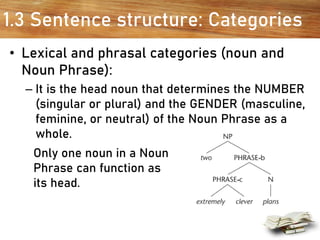
Only one noun in a Noun
Phrase can function as
its head.
1.3 Sentence structure: Categories
• Lexical and phrasal categories (noun and
Noun Phrase):
[8] The man devouring the plums is grinning broadly.
• It is the head noun that
determines what sort of thing or
person the whole NP refers to.
• In an NP, constituents that
modify the head noun are
typically optional
1.3 Sentence structure: Categories
• Lexical and phrasal categories (noun and
Noun Phrase):
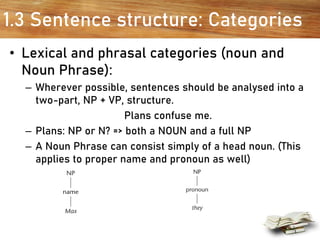
– Wherever possible, sentences should be analysed into a
two-part, NP + VP, structure.
Plans confuse me.
– Plans: NP or N? => both a NOUN and a full NP
– A Noun Phrase can consist simply of a head noun. (This
applies to proper name and pronoun as well)
1.3 Sentence structure: Categories
• Adjectives and adverbs:
– Many adjectives have characteristic endings, such as
-able, -al, -ate, -ful, -ic, -ing, -ish, -ive, -less, -ous, -
y.
– The more common adjectives tend not to have
characteristic endings (e.g. nice, old, hot, dull, short,
tight, full, long, quick) and this goes for the colour
adjectives (blue, yellow, etc.)
– Many adjectives have the morphological possibility
of taking a comparative (-er) and a superlative (-est)
suffix, as in newer and newest, subtler and subtlest.
– Others do not (cf. *beautifuller/*beautifullest,
*dubiouser/*dubiousest) but instead may be modified
by the comparative and superlative DEGREE
ADVERBS more and most, less and least.
1.3 Sentence structure: Categories
• Adjectives and adverbs:
– The main function of DEGREE ADVERBS (DEG) is
to modify adjectives (very, quite, so, too, slightly,
hardly, highly, moderately, completely,
increasingly, incredibly, somewhat, etc.)
– Adjectives that accept the -er/-est inflection or
modification by degree adverbs are called
GRADABLE ADJECTIVES.
– NON-GRADABLE ADJECTIVES do not accept the
-er/-est inflection, or modification by degree
adverb. (atomic, dead, potential, right, main,
consummate, medical, fatal, final, second, third,
supreme, unique.)
1.3 Sentence structure: Categories
• Adjective Phrases and Adverb Phrases:
– Adjective Phrases (AP) are centred on adjectives
(A). An AP can consist of an unmodified head, a
simple adjective.
– Adverb Phrases (AdvPs) are centred on adverb
(Adv). An AdvP can consist of just a simple
(geneal) adverb.
• The vast majority of general adverbs are formed from
adjectives by the addition of –ly
• Like degree adverbs, general adverbs can modify
adjectives within Adjective Phrases
• General adverbs can themselves be modified by
degree adverbs, to form adverb phrases
1.3 Sentence structure: Categories
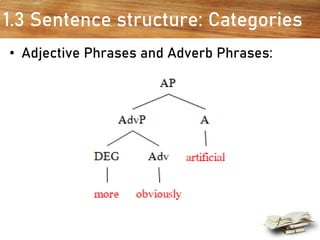
• Adjective Phrases and Adverb Phrases:
more obviously artificial
How will you draw the tree diagram of this phrase?
1.3 Sentence structure: Categories
• Adjective Phrases and Adverb Phrases:
1.3 Sentence structure: Categories
• Prepositions and Prepositional Phrases:
– The head of a Prepositional Phrase (PP) is a preposition
(P).
– Within a PP, the relation between a preposition and the
following Noun Phrase is a head~complement relation.
– Prepositions are generally short words that express
relations, often locational relations in SPACE or TIME (to,
at, from, with, towards, in, off, by, up, down, since, before,
after, during, until, like.
– Prepositions don’t always express locational concepts: in
an accident, in a blue coat, off work, under pressure, at
great speed, on the make, like a maniac.
– The most commonly used preposition in the English
language – of – does not express a location.
1.3 Sentence structure: Categories
• Prepositions and Prepositional Phrases:
– 2 basic forms of PP:
• PPs in which the preposition (P) is complemented by
an NP
• PPs consisting of just a P (here, there, aside, aboard,
abroad, along, etc.)
1.3 Sentence structure: Categories
• Co-ordinate Phrases
– [20a] [Max and Adrian] are being melodramatic.
– [20b] [The clowns and the acrobats] refused to co-operate.
CO-ORDINATE PHRASES
Co-ordinate NPs have as many heads as there are nouns co-
ordinated in them. Other CO-ORDINATORS are but and or.
1.3 Sentence structure: Categories
• Co-ordinate Phrases
– [31] Max and quickly
– [32] the acrobats and quite incomprehensible
– [33] the actress that John met in the foyer and the
acrobats
– [34] in the foundations and under the rafters
– [35] obviously intelligent and to Newcastle
– [36] moderately cheap and extremely nasty
– [37] rather and inconsistent
Which of the following strings are well-formed
phrases and which not?
1.3 Sentence structure: Categories
• Co-ordinate Phrases
– [31] Max and quickly
– [32] the acrobats and quite incomprehensible
– [33] the actress that John met in the foyer and the
acrobats
– [34] in the foundations and under the rafters
– [35] obviously intelligent and to Newcastle
– [36] moderately cheap and extremely nasty
– [37] rather and inconsistent
1.3 Sentence structure: Categories
• Co-ordinate Phrases
– In general, any constituent, of any category, can consist
of a co-ordination of constituents of the same category.
– The principle holds for all categories, including lexical
categories and sentences themselves.
[38] Stuffy and too hot
[39] Too hot and stuffy
1.3 Sentence structure: Categories
• Co-ordinate Phrases
PHRASAL CO-ORDINATION
(of APs)
LEXICAL CO-ORDINATION
(of A)
The MOTHER and the SISTERS of the co-ordinator all have the
same category label.
1.3 Sentence structure: Categories
• Co-ordinate Phrases
– PHRASAL CATEGORIES (NP, VP, AP, PP, and AdvP) have
a variety of functions: subject, predicate, modifier or
complement. But LEXICAL CATEGORIES (N, V, A, P, and
Adv) have only one function – they always function as
HEAD of the appropriate phrasal category.
In any phrase marker, LEXICAL categories must always
be dominated by a node bearing the appropriate
PHRASAL category label (even if those phrases contain
nothing in addition to the head).
1.3 Sentence structure: Categories
EXERCISES
1. Identify the following lexical categories in the passage
below: (a) nouns, (b) adjectives, (c) degree adverbs, (d)
general adverbs, and (e) prepositions.
On the court, she openly displayed a perfectly outrageous
cheek towards officials recently appointed by the club. At
home, on the other hand, she was an incredibly warm and
loving human being, full of sensitivity for people’s feelings.
1.3 Sentence structure: Categories
EXERCISES
1. Identify the following lexical categories in the passage
below: (a) nouns, (b) adjectives, (c) degree adverbs, (d)
general adverbs, and (e) prepositions.
On the court, she openly displayed a perfectly outrageous
cheek towards officials recently appointed by the club. At
home, on the other hand, she was an incredibly warm and
loving human being, full of sensitivity for people’s feelings.
NOUNS: court, cheek, officials, club, home, hand, being, sensitivity, people, feelings
ADJECTIVES: outrageous, other, warm, loving, human, full
DEGREE ADVERBS: perfectly, incredibly
GENERAL ADVERBS: openly, recently
PREPOSITIONS: on, towards, by, at, on, of, for
1.3 Sentence structure: Categories
EXERCISES
2. Identify the NPs in the first sentence of the above passage.
Remember to identify first the largest NPs and only then any
NPs that may be contained within them. Then identify the head
noun of each NP. Which NP is functioning as subject of that
first sentence? Which NPs are functioning as the complement
to a preposition? Is there an NP functioning in some other way
On the court, she openly displayed a perfectly outrageous
cheek towards officials recently appointed by the club.
1.3 Sentence structure: Categories
EXERCISES
2. On the court, she openly displayed a perfectly outrageous cheek
towards officials recently appointed by the club.
NPs: (a) the court (b) she (c) a perfectly outrageous cheek (d)
officials recently appointed by the club (e) the club.
HEADS: (a) court (b) she (c) cheek (d) officials (e) club.
FUNCTIONS:
• the court is functioning as complement of the preposition on.
• she is functioning as the subject.
• a perfectly outrageous cheek is functioning as a complement to
the verb displayed.
• officials recently appointed by the club is complement to the
preposition towards.
• the club is complement to the preposition by
1.3 Sentence structure: Categories
EXERCISES
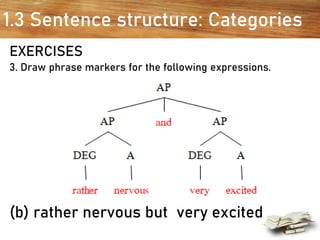
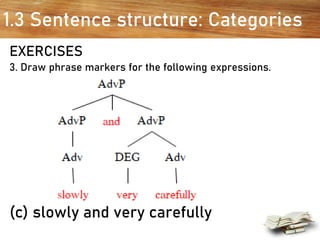
3. Draw phrase markers for the following expressions.
(a) for you and Pete
(b) rather nervous but very excited
(c) slowly and very carefully
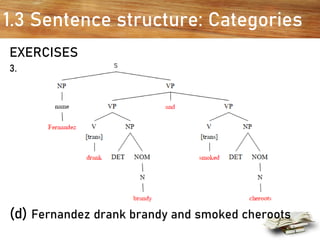
(d) Fernandez drank brandy and smoked cheroots.
(e) Herbert struck the board and I had to mend it.
(f) Now and in the future.
1.3 Sentence structure: Categories
EXERCISES
3. Draw phrase markers for the following expressions.
(a) for you and Pete
1.3 Sentence structure: Categories
EXERCISES
3. Draw phrase markers for the following expressions.
(b) rather nervous but very excited
1.3 Sentence structure: Categories
EXERCISES
3. Draw phrase markers for the following expressions.
(c) slowly and very carefully
1.3 Sentence structure: Categories
EXERCISES
3.
(d) Fernandez drank brandy and smoked cheroots

M1 lesson 1.3 slides

  • 1.
    INSTRUCTOR: LE NGUYENNHU ANH LINGUISTICS 2 M1 LESSON 1.3 ALLPPT.com _ Free PowerPoint Templates, Diagrams and Charts
  • 2.
    1.3 Sentence structure:Categories • Contents: – Nouns – Lexical and phrasal categories (noun and noun phrase) – Adjectives and Adverbs – Adjective Phrase and Adverb Phrases – Prepositions and Prepositional Phrases – Co-ordinate Phrases
  • 3.
    1.3 Sentence structure:Categories Why do we need to categorize words? By assigning a word to a particular category, we make a general statement about its DISTRIBUTION – i.e. about its possible syntactic positions and functions.
  • 4.
    1.3 Sentence structure:Categories • Lexical categories: categories of single words • Phrasal categories: categories of phrases • When two words or phrases have the same DISTRIBUTION, they can occupy the same positions in sentence structure and have the same range of functions.
  • 5.
    1.3 Sentence structure:Categories • Nouns: – A noun is the name of a person, place, or thing. – One morphological identifying feature of all nouns is that they have a GENITIVE (or POSSESSIVE) form. For example, Bill’s (as in Bill’s pancakes or those are Bill’s. – 4 sub-categories: ROPER vs. COMMON and COUNT vs. MASS.
  • 6.
    1.3 Sentence structure:Categories • Nouns: – PROPER NOUNS are names, spelt with an initial capital. Examples: January, Frankenstein, Bugsy, Jessica, Java, Portsmouth. • Proper nouns, because they anyway stand for single, identifiable individuals, do not normally have any modifiers at all or appear in a plural form. – All other nouns are COMMON NOUNS. • All common nouns can combine with the word the (THE DEFINITE ARTICLE) to form a Noun Phrase (e.g. the accident, the mud, the cutlery). In any two-word phrase (w1 + w2) of the form [the + w2], w2 will always be a Noun (N).
  • 7.
    1.3 Sentence structure:Categories • Nouns: – common nouns that refer to things that can be counted – COUNT NOUNS – – (a) can combine with a/an (THE INDEFINITE ARTICLE) to form a Noun Phrase (e.g. a stream, an accident). In all two-word phrases of the form [a/an + w], w will always be a Noun. – (b) can combine with numerals (one, two, three . . . ) to form a Noun Phrase, and with expressions like several, many, etc.. – (c) can be marked for plural. The regular marking for plural is the suffix –s (singular nouns lack this suffix). There are several irregular plural markers.
  • 8.
    1.3 Sentence structure:Categories • Nouns: – mass nouns refer to ‘things’ that cannot be counted (so they are sometimes called non- count nouns). Examples are butter, foam, cutlery, furniture, honesty, grace. – Mass nouns don’t normally display any of the above possibilities. They can’t normally appear in a plural form. – But they do follow some (some foam, some furniture). In a two-word phrase of the form [some + w], w will be a noun. Also, they combine with the.
  • 9.
    1.3 Sentence structure:Categories • Nouns: – It is often possible to turn a mass noun into a count noun precisely by preceding it with a/an, or a numeral, and/or giving it a plural form. This usually involves a change of meaning: a mud, two butters (a kind of mud, two kinds of butter); a beer, three beers (a kind of beer, or a drink of beer). – Many nouns are both mass and count. Ex: • Theory (mass noun) => we need to do some theory. • Theory (count noun) => a theory, theories, three theories.
  • 10.
    1.3 Sentence structure:Categories • Nouns: – PRONOUNS are used to stand in place of complete Noun Phrases (NPs). • definite pronouns: she/her, it, I/me, we/us, you, they/them • reflexive (definite) pronouns: myself, itself, ourselves, etc. • indefinite pronouns: something, someone, anything, anyone • demonstrative pronouns: this, that, these, those • interrogative (question) pronouns: who, which, what • possessive pronouns: mine, yours, his, hers, ours, theirs.
  • 11.
    1.3 Sentence structure:Categories • Lexical and phrasal categories (noun and Noun Phrase): Two rather dubious jokes: NP jokes: N – Why does “two rather dubious jokes” have to be of the same category as “jokes”? the HEAD of “two rather dubious jokes” is “jokes” It is the category of the HEAD word that determines the category of the phrase as a whole. The other words are present only because of the function they (directly or indirectly) have in respect of the head noun.
  • 12.
    1.3 Sentence structure:Categories • Lexical and phrasal categories (noun and Noun Phrase): – It is the head noun that determines the NUMBER (singular or plural) and the GENDER (masculine, feminine, or neutral) of the Noun Phrase as a whole. Only one noun in a Noun Phrase can function as its head.
  • 13.
    1.3 Sentence structure:Categories • Lexical and phrasal categories (noun and Noun Phrase): [8] The man devouring the plums is grinning broadly. • It is the head noun that determines what sort of thing or person the whole NP refers to. • In an NP, constituents that modify the head noun are typically optional
  • 14.
    1.3 Sentence structure:Categories • Lexical and phrasal categories (noun and Noun Phrase): – Wherever possible, sentences should be analysed into a two-part, NP + VP, structure. Plans confuse me. – Plans: NP or N? => both a NOUN and a full NP – A Noun Phrase can consist simply of a head noun. (This applies to proper name and pronoun as well)
  • 15.
    1.3 Sentence structure:Categories • Adjectives and adverbs: – Many adjectives have characteristic endings, such as -able, -al, -ate, -ful, -ic, -ing, -ish, -ive, -less, -ous, - y. – The more common adjectives tend not to have characteristic endings (e.g. nice, old, hot, dull, short, tight, full, long, quick) and this goes for the colour adjectives (blue, yellow, etc.) – Many adjectives have the morphological possibility of taking a comparative (-er) and a superlative (-est) suffix, as in newer and newest, subtler and subtlest. – Others do not (cf. *beautifuller/*beautifullest, *dubiouser/*dubiousest) but instead may be modified by the comparative and superlative DEGREE ADVERBS more and most, less and least.
  • 16.
    1.3 Sentence structure:Categories • Adjectives and adverbs: – The main function of DEGREE ADVERBS (DEG) is to modify adjectives (very, quite, so, too, slightly, hardly, highly, moderately, completely, increasingly, incredibly, somewhat, etc.) – Adjectives that accept the -er/-est inflection or modification by degree adverbs are called GRADABLE ADJECTIVES. – NON-GRADABLE ADJECTIVES do not accept the -er/-est inflection, or modification by degree adverb. (atomic, dead, potential, right, main, consummate, medical, fatal, final, second, third, supreme, unique.)
  • 17.
    1.3 Sentence structure:Categories • Adjective Phrases and Adverb Phrases: – Adjective Phrases (AP) are centred on adjectives (A). An AP can consist of an unmodified head, a simple adjective. – Adverb Phrases (AdvPs) are centred on adverb (Adv). An AdvP can consist of just a simple (geneal) adverb. • The vast majority of general adverbs are formed from adjectives by the addition of –ly • Like degree adverbs, general adverbs can modify adjectives within Adjective Phrases • General adverbs can themselves be modified by degree adverbs, to form adverb phrases
  • 18.
    1.3 Sentence structure:Categories • Adjective Phrases and Adverb Phrases: more obviously artificial How will you draw the tree diagram of this phrase?
  • 19.
    1.3 Sentence structure:Categories • Adjective Phrases and Adverb Phrases:
  • 20.
    1.3 Sentence structure:Categories • Prepositions and Prepositional Phrases: – The head of a Prepositional Phrase (PP) is a preposition (P). – Within a PP, the relation between a preposition and the following Noun Phrase is a head~complement relation. – Prepositions are generally short words that express relations, often locational relations in SPACE or TIME (to, at, from, with, towards, in, off, by, up, down, since, before, after, during, until, like. – Prepositions don’t always express locational concepts: in an accident, in a blue coat, off work, under pressure, at great speed, on the make, like a maniac. – The most commonly used preposition in the English language – of – does not express a location.
  • 21.
    1.3 Sentence structure:Categories • Prepositions and Prepositional Phrases: – 2 basic forms of PP: • PPs in which the preposition (P) is complemented by an NP • PPs consisting of just a P (here, there, aside, aboard, abroad, along, etc.)
  • 22.
    1.3 Sentence structure:Categories • Co-ordinate Phrases – [20a] [Max and Adrian] are being melodramatic. – [20b] [The clowns and the acrobats] refused to co-operate. CO-ORDINATE PHRASES Co-ordinate NPs have as many heads as there are nouns co- ordinated in them. Other CO-ORDINATORS are but and or.
  • 23.
    1.3 Sentence structure:Categories • Co-ordinate Phrases – [31] Max and quickly – [32] the acrobats and quite incomprehensible – [33] the actress that John met in the foyer and the acrobats – [34] in the foundations and under the rafters – [35] obviously intelligent and to Newcastle – [36] moderately cheap and extremely nasty – [37] rather and inconsistent Which of the following strings are well-formed phrases and which not?
  • 24.
    1.3 Sentence structure:Categories • Co-ordinate Phrases – [31] Max and quickly – [32] the acrobats and quite incomprehensible – [33] the actress that John met in the foyer and the acrobats – [34] in the foundations and under the rafters – [35] obviously intelligent and to Newcastle – [36] moderately cheap and extremely nasty – [37] rather and inconsistent
  • 25.
    1.3 Sentence structure:Categories • Co-ordinate Phrases – In general, any constituent, of any category, can consist of a co-ordination of constituents of the same category. – The principle holds for all categories, including lexical categories and sentences themselves. [38] Stuffy and too hot [39] Too hot and stuffy
  • 26.
    1.3 Sentence structure:Categories • Co-ordinate Phrases PHRASAL CO-ORDINATION (of APs) LEXICAL CO-ORDINATION (of A) The MOTHER and the SISTERS of the co-ordinator all have the same category label.
  • 27.
    1.3 Sentence structure:Categories • Co-ordinate Phrases – PHRASAL CATEGORIES (NP, VP, AP, PP, and AdvP) have a variety of functions: subject, predicate, modifier or complement. But LEXICAL CATEGORIES (N, V, A, P, and Adv) have only one function – they always function as HEAD of the appropriate phrasal category. In any phrase marker, LEXICAL categories must always be dominated by a node bearing the appropriate PHRASAL category label (even if those phrases contain nothing in addition to the head).
  • 28.
    1.3 Sentence structure:Categories EXERCISES 1. Identify the following lexical categories in the passage below: (a) nouns, (b) adjectives, (c) degree adverbs, (d) general adverbs, and (e) prepositions. On the court, she openly displayed a perfectly outrageous cheek towards officials recently appointed by the club. At home, on the other hand, she was an incredibly warm and loving human being, full of sensitivity for people’s feelings.
  • 29.
    1.3 Sentence structure:Categories EXERCISES 1. Identify the following lexical categories in the passage below: (a) nouns, (b) adjectives, (c) degree adverbs, (d) general adverbs, and (e) prepositions. On the court, she openly displayed a perfectly outrageous cheek towards officials recently appointed by the club. At home, on the other hand, she was an incredibly warm and loving human being, full of sensitivity for people’s feelings. NOUNS: court, cheek, officials, club, home, hand, being, sensitivity, people, feelings ADJECTIVES: outrageous, other, warm, loving, human, full DEGREE ADVERBS: perfectly, incredibly GENERAL ADVERBS: openly, recently PREPOSITIONS: on, towards, by, at, on, of, for
  • 30.
    1.3 Sentence structure:Categories EXERCISES 2. Identify the NPs in the first sentence of the above passage. Remember to identify first the largest NPs and only then any NPs that may be contained within them. Then identify the head noun of each NP. Which NP is functioning as subject of that first sentence? Which NPs are functioning as the complement to a preposition? Is there an NP functioning in some other way On the court, she openly displayed a perfectly outrageous cheek towards officials recently appointed by the club.
  • 31.
    1.3 Sentence structure:Categories EXERCISES 2. On the court, she openly displayed a perfectly outrageous cheek towards officials recently appointed by the club. NPs: (a) the court (b) she (c) a perfectly outrageous cheek (d) officials recently appointed by the club (e) the club. HEADS: (a) court (b) she (c) cheek (d) officials (e) club. FUNCTIONS: • the court is functioning as complement of the preposition on. • she is functioning as the subject. • a perfectly outrageous cheek is functioning as a complement to the verb displayed. • officials recently appointed by the club is complement to the preposition towards. • the club is complement to the preposition by
  • 32.
    1.3 Sentence structure:Categories EXERCISES 3. Draw phrase markers for the following expressions. (a) for you and Pete (b) rather nervous but very excited (c) slowly and very carefully (d) Fernandez drank brandy and smoked cheroots. (e) Herbert struck the board and I had to mend it. (f) Now and in the future.
  • 33.
    1.3 Sentence structure:Categories EXERCISES 3. Draw phrase markers for the following expressions. (a) for you and Pete
  • 34.
    1.3 Sentence structure:Categories EXERCISES 3. Draw phrase markers for the following expressions. (b) rather nervous but very excited
  • 35.
    1.3 Sentence structure:Categories EXERCISES 3. Draw phrase markers for the following expressions. (c) slowly and very carefully
  • 36.
    1.3 Sentence structure:Categories EXERCISES 3. (d) Fernandez drank brandy and smoked cheroots