RELATIVE CLAUSES
DEFINING, NON-DEFINING and CONNECTIVE
           RELATIVE CLAUSES
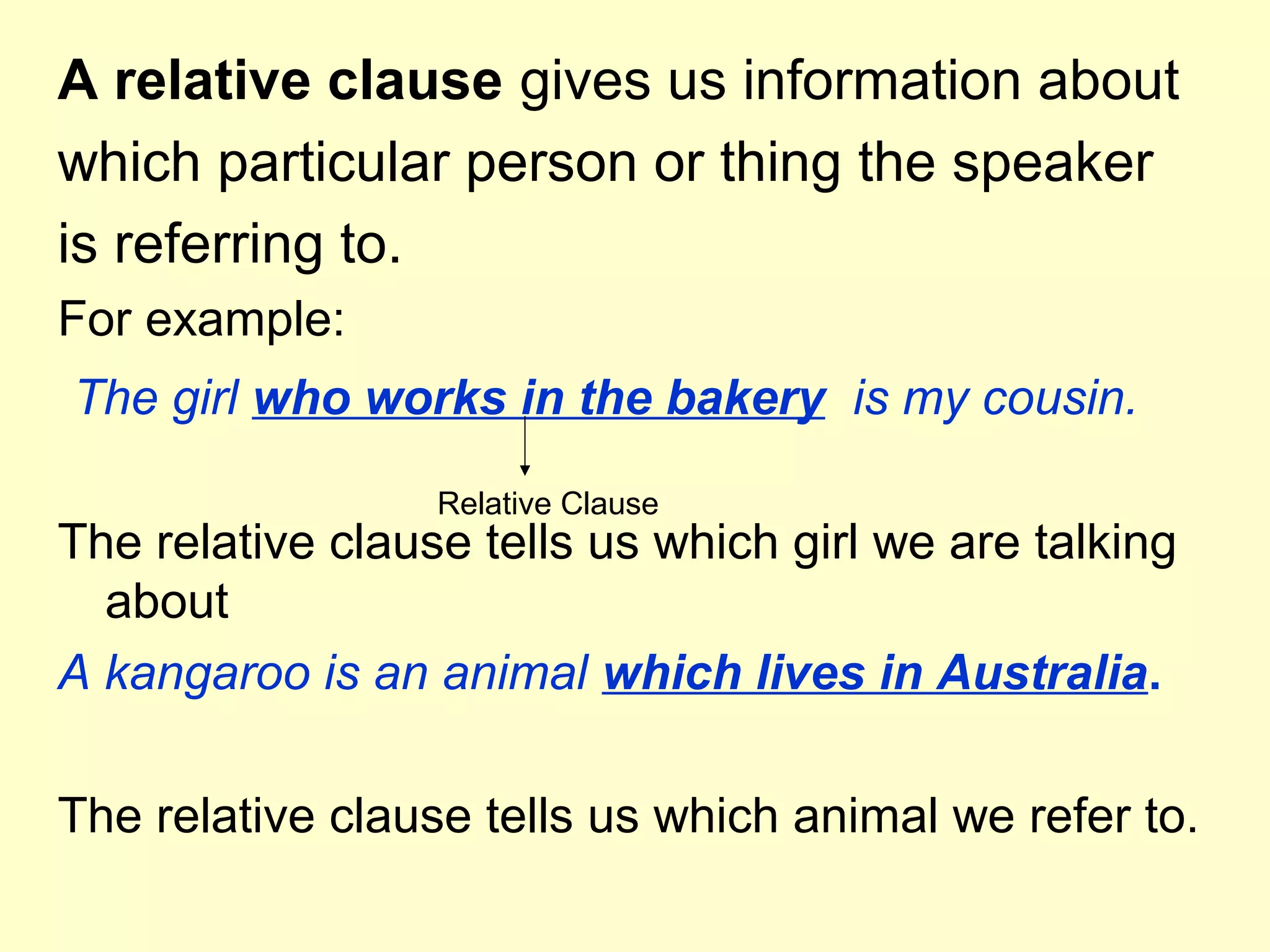
A relative clause gives us information about
which particular person or thing the speaker
is referring to.
For example:
The girl who works in the bakery is my cousin.

                  Relative Clause
The relative clause tells us which girl we are talking
  about
A kangaroo is an animal which lives in Australia.

The relative clause tells us which animal we refer to.
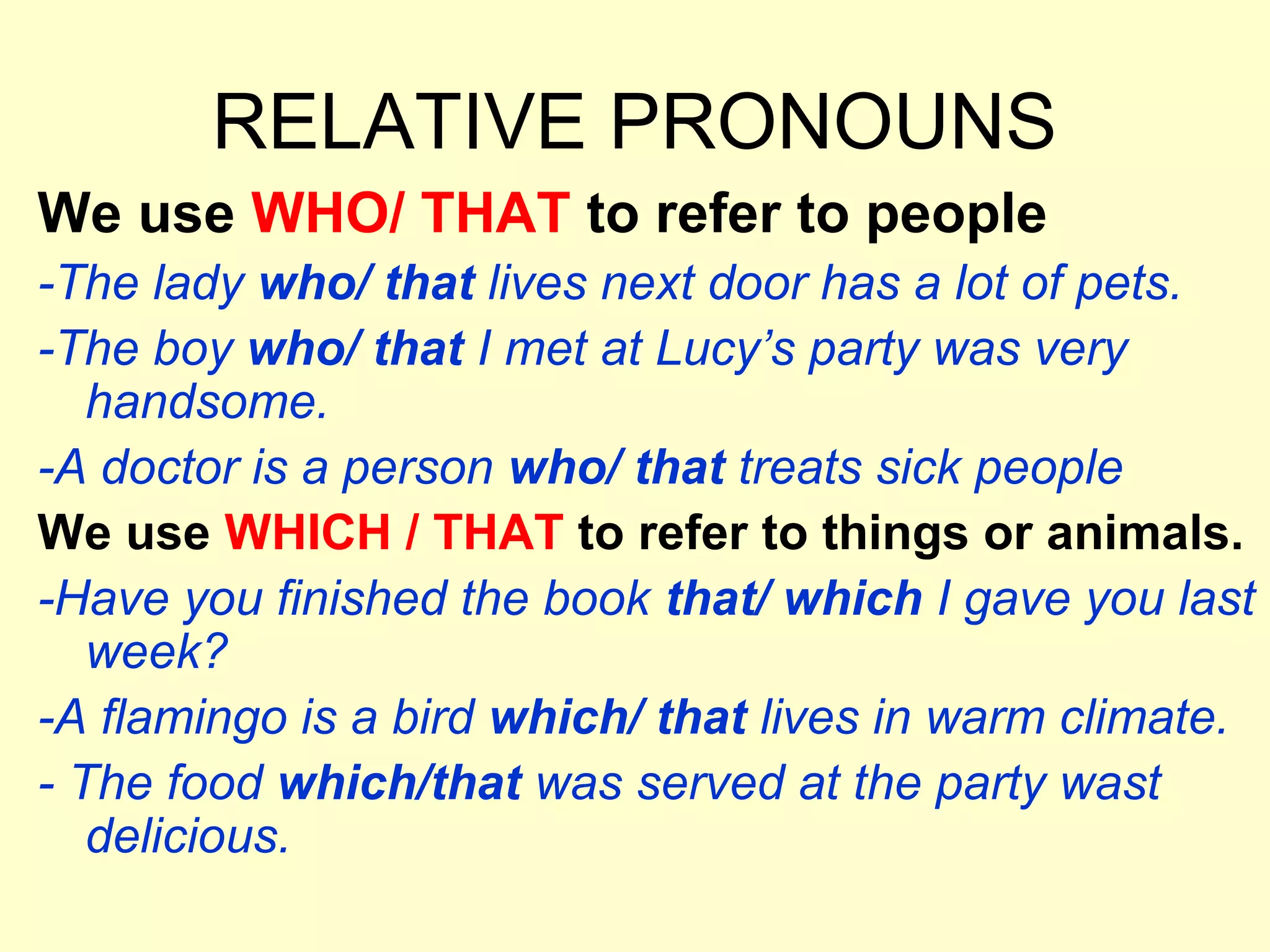
RELATIVE PRONOUNS
We use WHO/ THAT to refer to people
-The lady who/ that lives next door has a lot of pets.
-The boy who/ that I met at Lucy’s party was very
   handsome.
-A doctor is a person who/ that treats sick people
We use WHICH / THAT to refer to things or animals.
-Have you finished the book that/ which I gave you last
   week?
-A flamingo is a bird which/ that lives in warm climate.
- The food which/that was served at the party wast
   delicious.
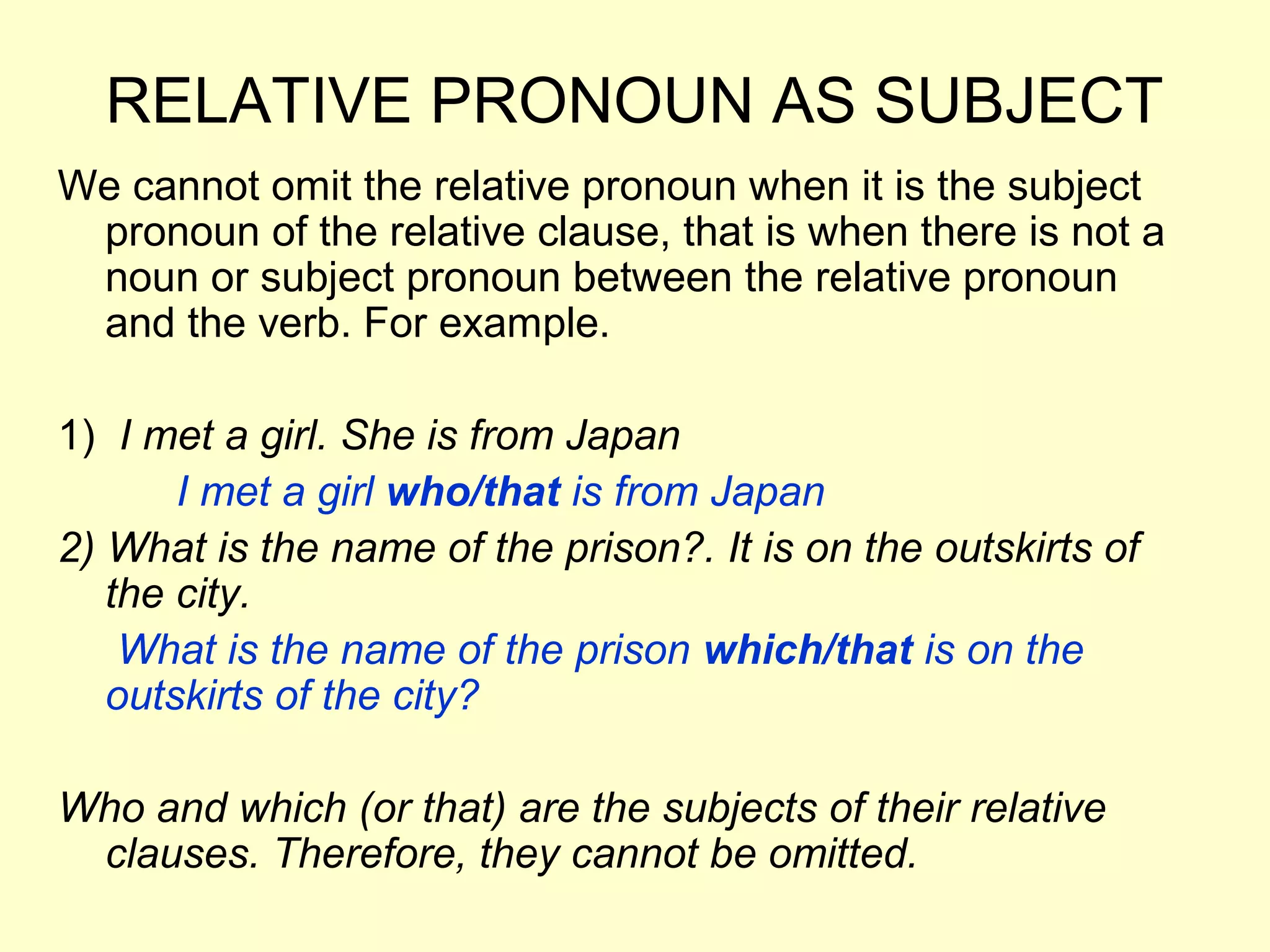
RELATIVE PRONOUN AS SUBJECT
We cannot omit the relative pronoun when it is the subject
 pronoun of the relative clause, that is when there is not a
 noun or subject pronoun between the relative pronoun
 and the verb. For example.

1) I met a girl. She is from Japan
       I met a girl who/that is from Japan
2) What is the name of the prison?. It is on the outskirts of
   the city.
    What is the name of the prison which/that is on the
   outskirts of the city?

Who and which (or that) are the subjects of their relative
 clauses. Therefore, they cannot be omitted.
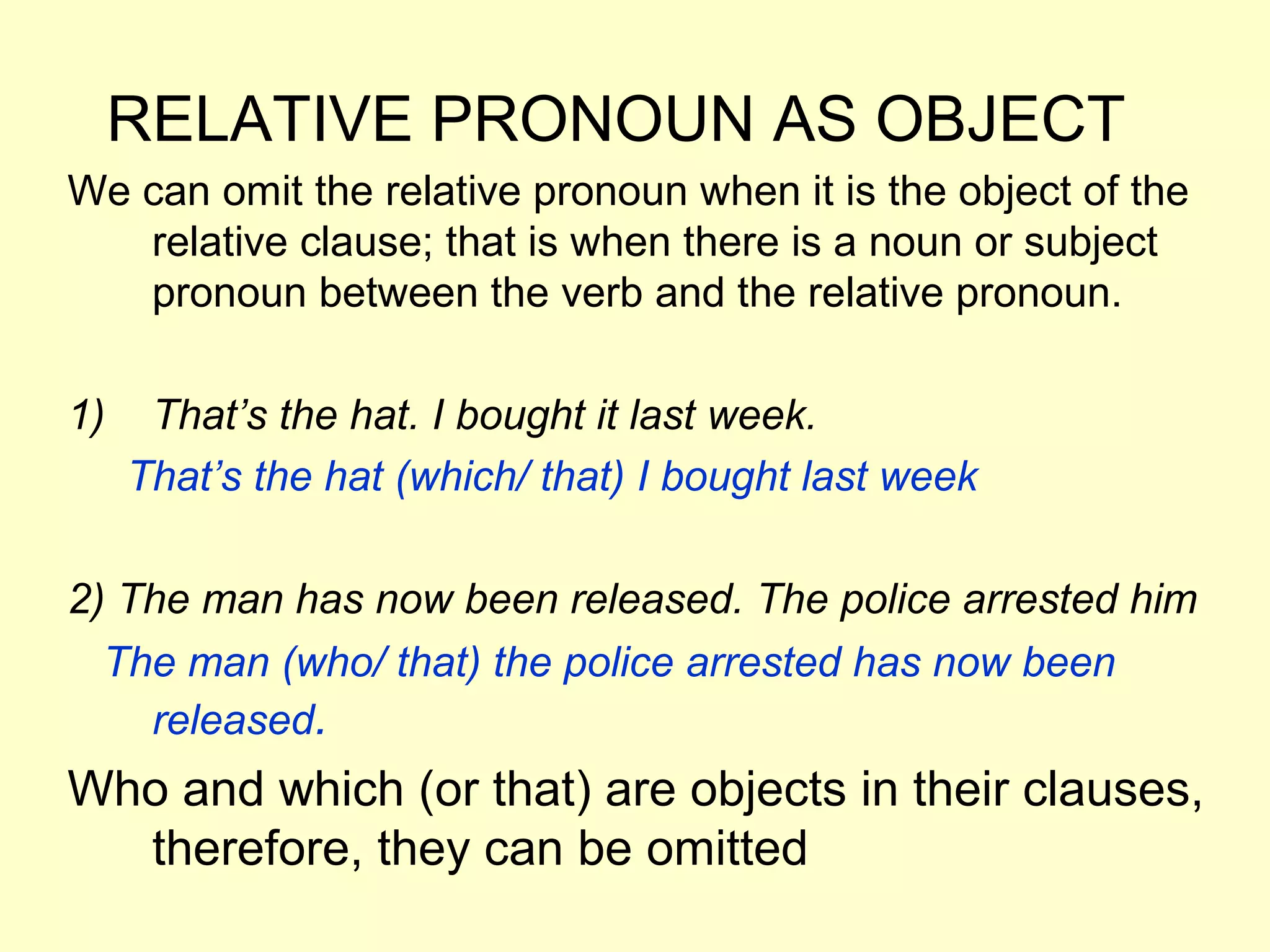
RELATIVE PRONOUN AS OBJECT
We can omit the relative pronoun when it is the object of the
   relative clause; that is when there is a noun or subject
   pronoun between the verb and the relative pronoun.

1)    That’s the hat. I bought it last week.
     That’s the hat (which/ that) I bought last week

2) The man has now been released. The police arrested him
  The man (who/ that) the police arrested has now been
    released.
Who and which (or that) are objects in their clauses,
  therefore, they can be omitted
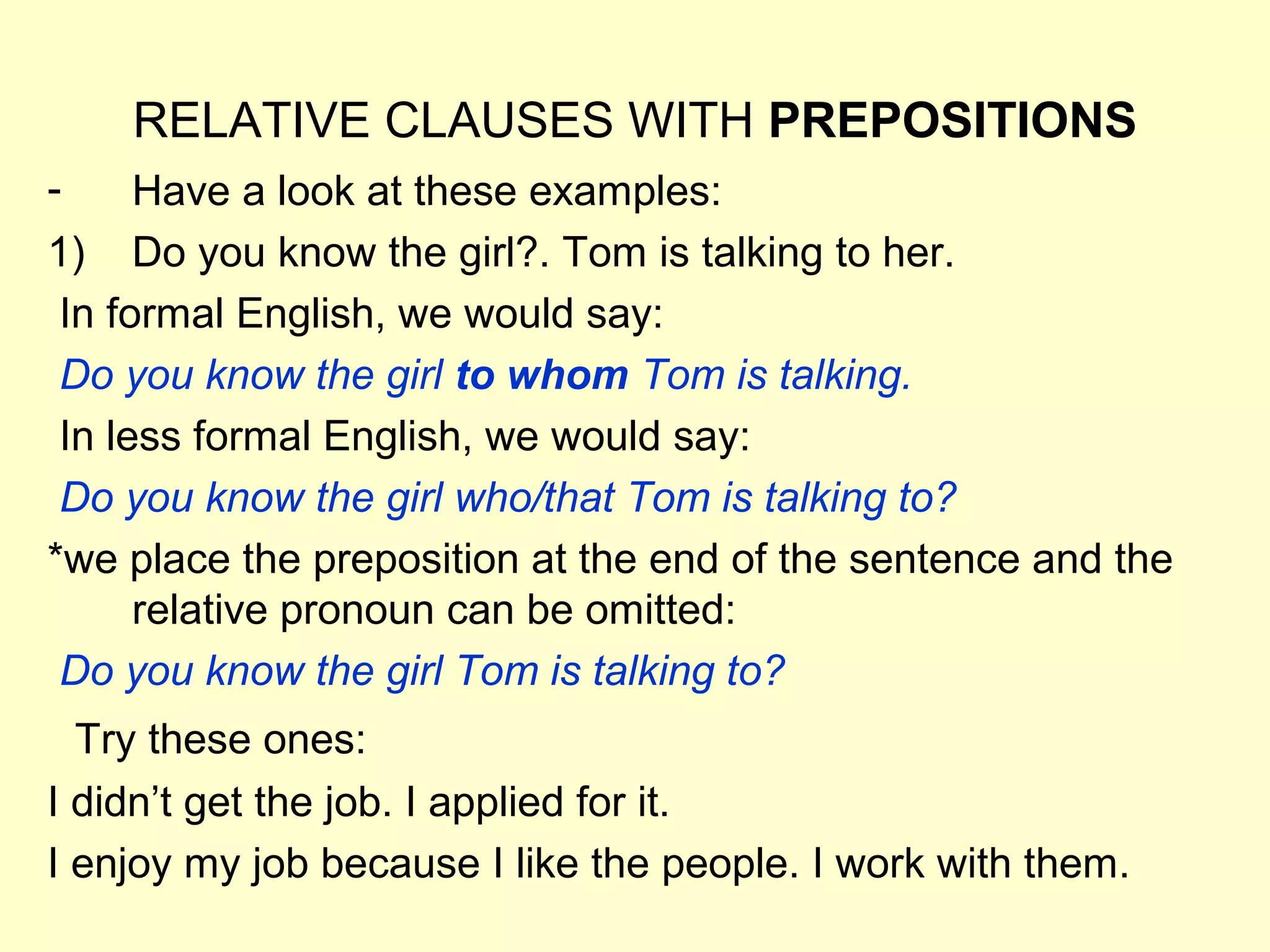
RELATIVE CLAUSES WITH PREPOSITIONS
-     Have a look at these examples:
1) Do you know the girl?. Tom is talking to her.
 In formal English, we would say:
 Do you know the girl to whom Tom is talking.
 In less formal English, we would say:
 Do you know the girl who/that Tom is talking to?
*we place the preposition at the end of the sentence and the
      relative pronoun can be omitted:
 Do you know the girl Tom is talking to?
  Try these ones:
I didn’t get the job. I applied for it.
I enjoy my job because I like the people. I work with them.
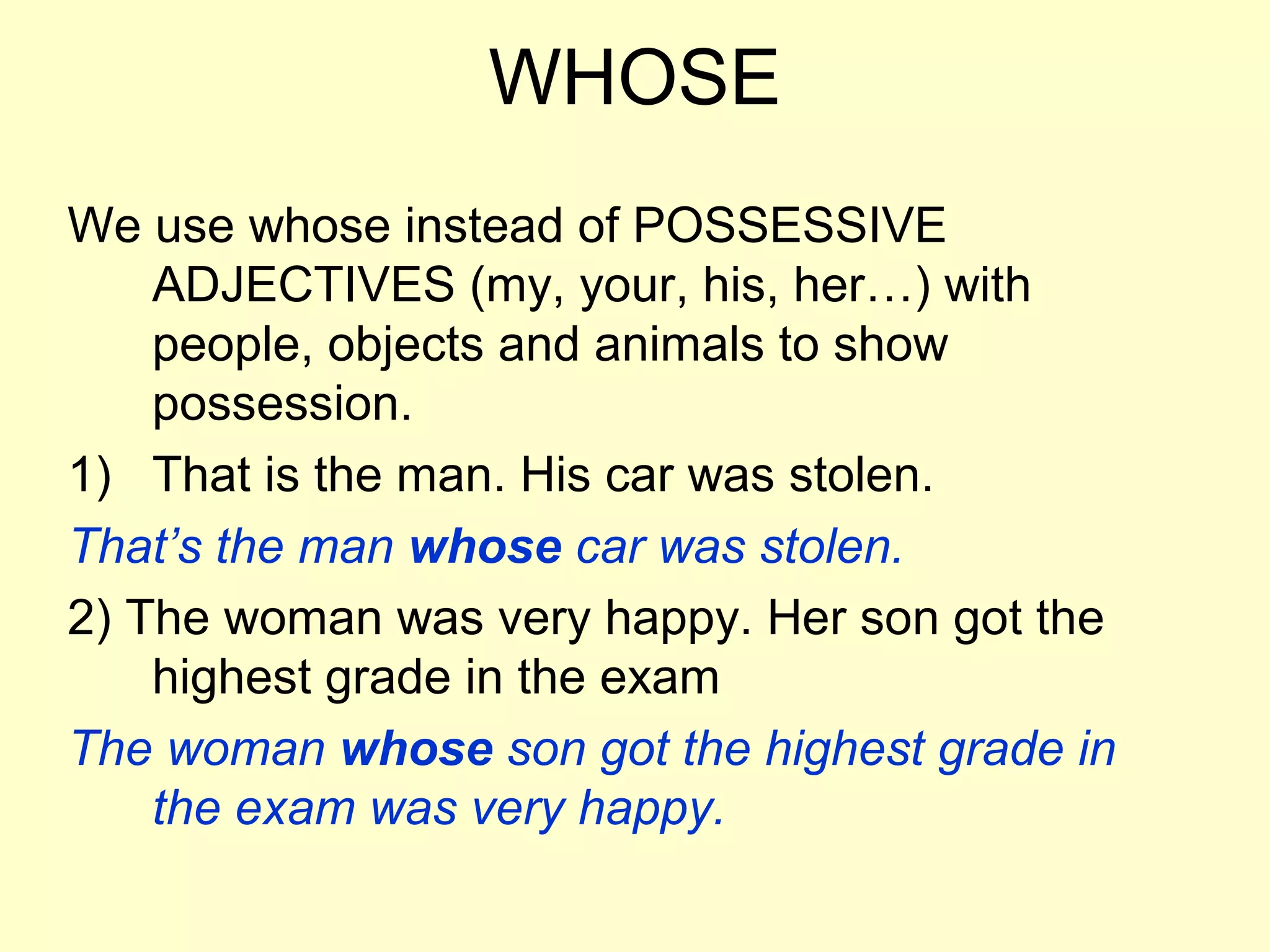
WHOSE
We use whose instead of POSSESSIVE
    ADJECTIVES (my, your, his, her…) with
    people, objects and animals to show
    possession.
1) That is the man. His car was stolen.
That’s the man whose car was stolen.
2) The woman was very happy. Her son got the
    highest grade in the exam
The woman whose son got the highest grade in
    the exam was very happy.
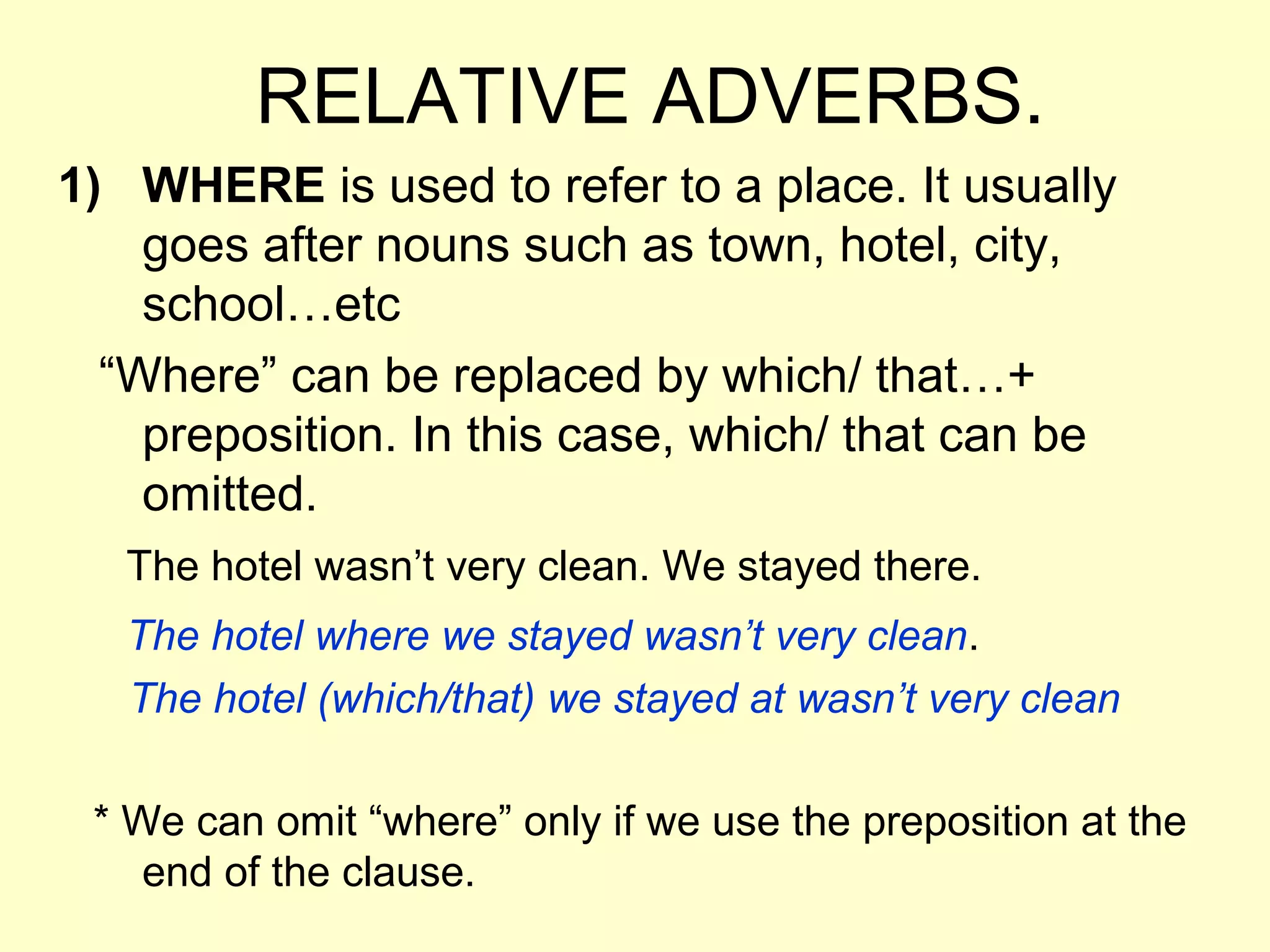
RELATIVE ADVERBS.
1) WHERE is used to refer to a place. It usually
    goes after nouns such as town, hotel, city,
    school…etc
  “Where” can be replaced by which/ that…+
    preposition. In this case, which/ that can be
    omitted.
   The hotel wasn’t very clean. We stayed there.
   The hotel where we stayed wasn’t very clean.
   The hotel (which/that) we stayed at wasn’t very clean

 * We can omit “where” only if we use the preposition at the
    end of the clause.
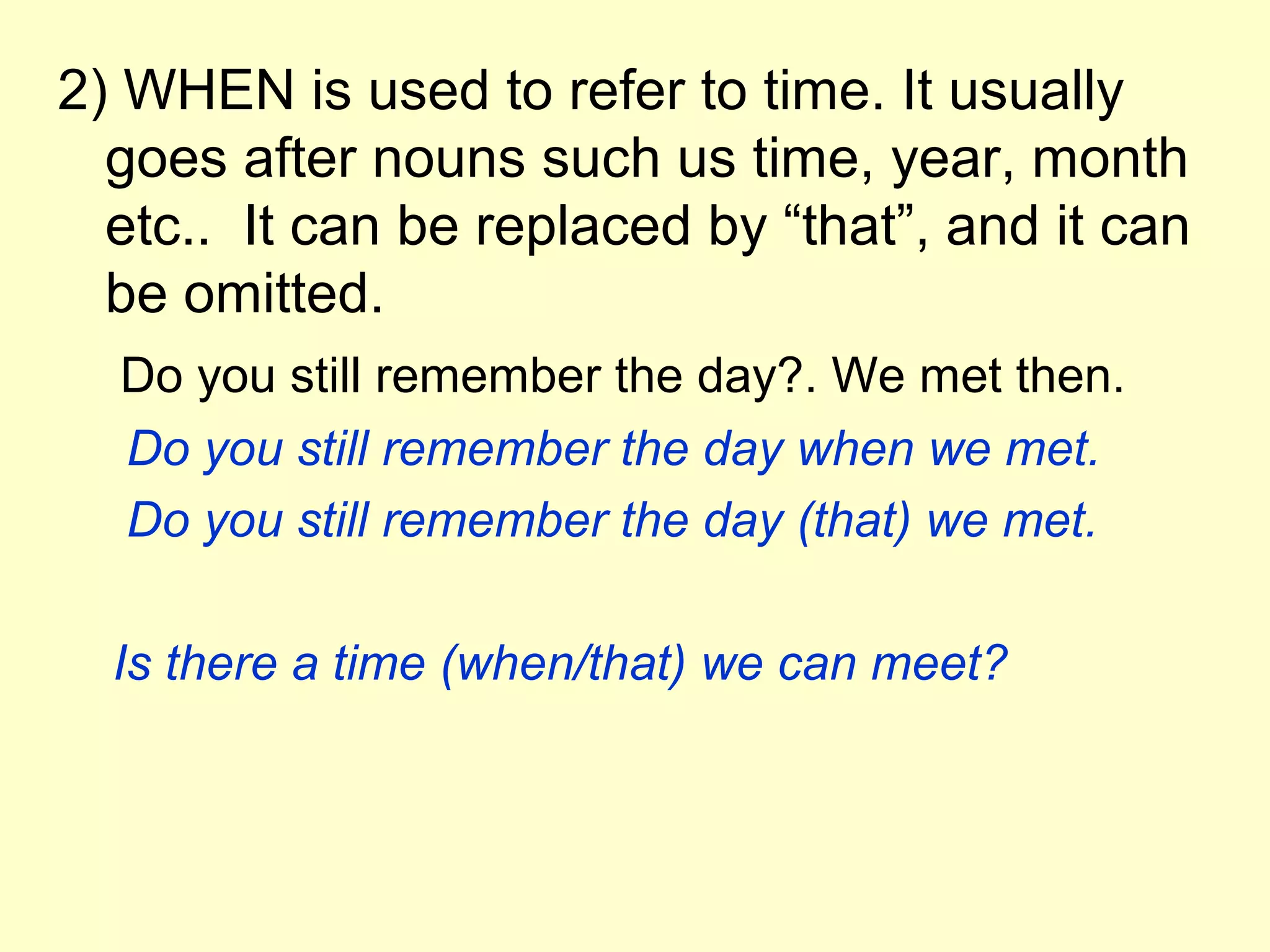
2) WHEN is used to refer to time. It usually
  goes after nouns such us time, year, month
  etc.. It can be replaced by “that”, and it can
  be omitted.
  Do you still remember the day?. We met then.
  Do you still remember the day when we met.
  Do you still remember the day (that) we met.

  Is there a time (when/that) we can meet?
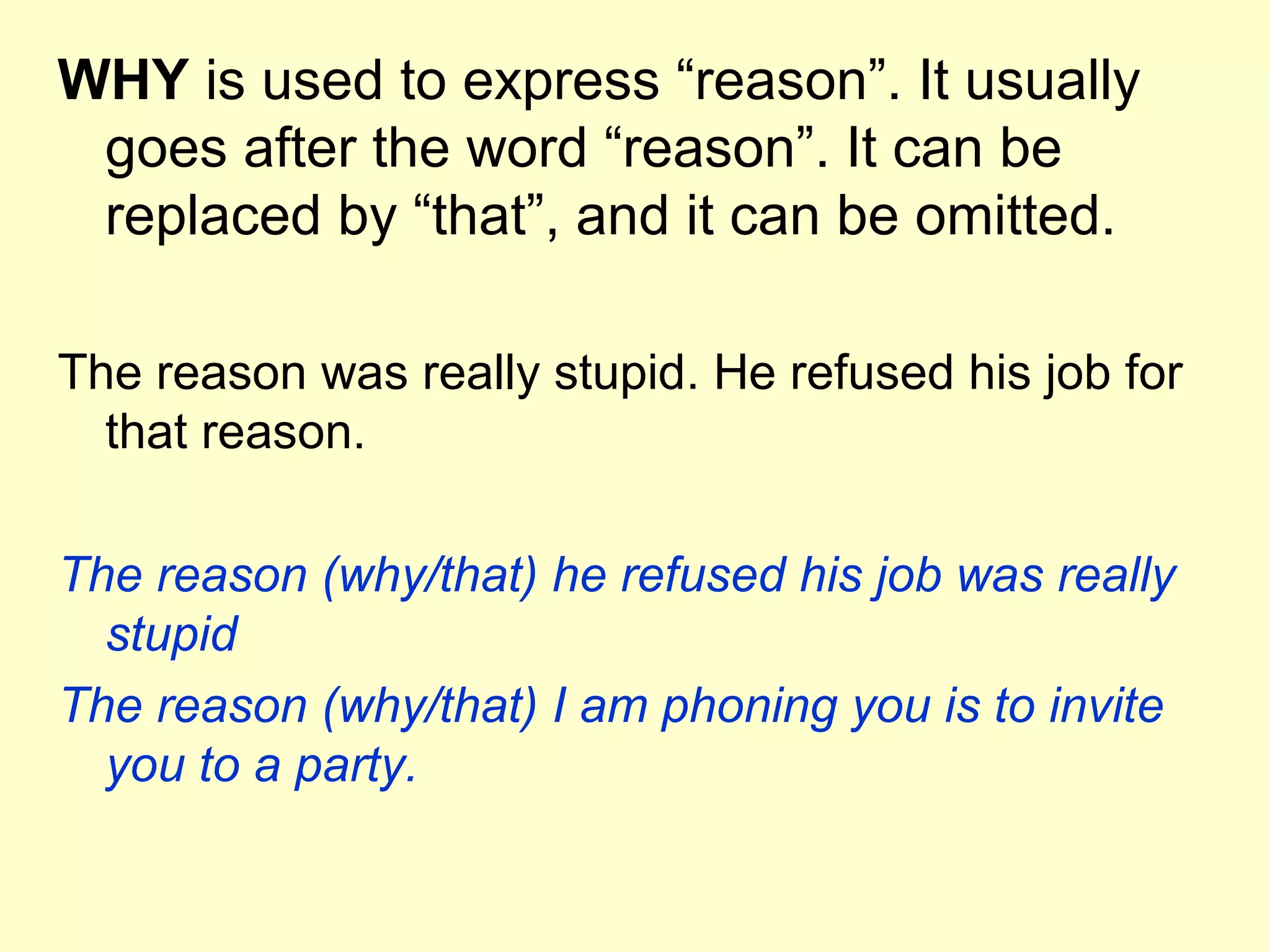
WHY is used to express “reason”. It usually
 goes after the word “reason”. It can be
 replaced by “that”, and it can be omitted.

The reason was really stupid. He refused his job for
  that reason.

The reason (why/that) he refused his job was really
  stupid
The reason (why/that) I am phoning you is to invite
  you to a party.
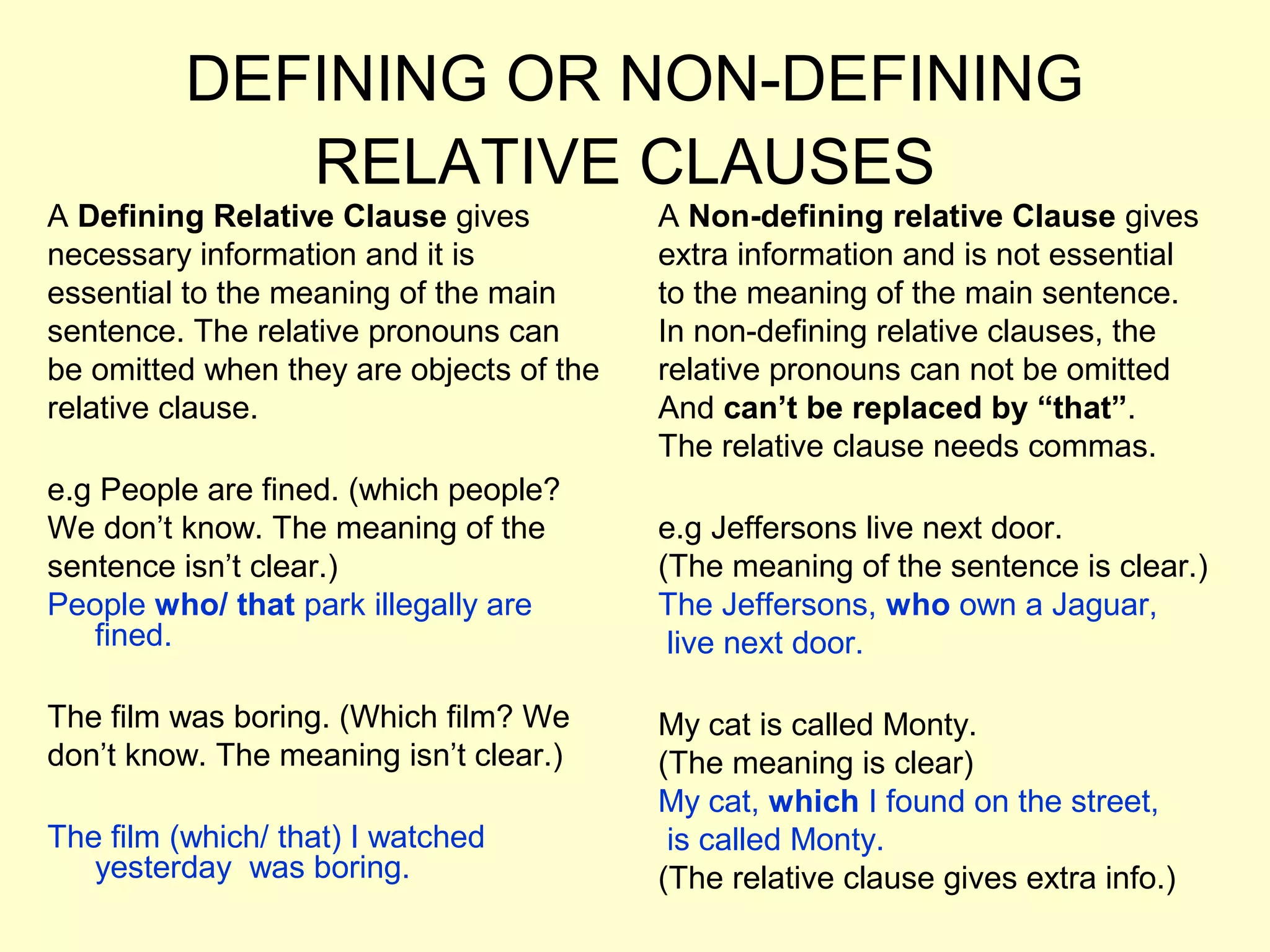
DEFINING OR NON-DEFINING
             RELATIVE CLAUSES
A Defining Relative Clause gives          A Non-defining relative Clause gives
necessary information and it is           extra information and is not essential
essential to the meaning of the main      to the meaning of the main sentence.
sentence. The relative pronouns can       In non-defining relative clauses, the
be omitted when they are objects of the   relative pronouns can not be omitted
relative clause.                          And can’t be replaced by “that”.
                                          The relative clause needs commas.
e.g People are fined. (which people?
We don’t know. The meaning of the         e.g Jeffersons live next door.
sentence isn’t clear.)                    (The meaning of the sentence is clear.)
People who/ that park illegally are       The Jeffersons, who own a Jaguar,
   fined.                                  live next door.

The film was boring. (Which film? We      My cat is called Monty.
don’t know. The meaning isn’t clear.)     (The meaning is clear)
                                          My cat, which I found on the street,
The film (which/ that) I watched           is called Monty.
   yesterday was boring.                  (The relative clause gives extra info.)
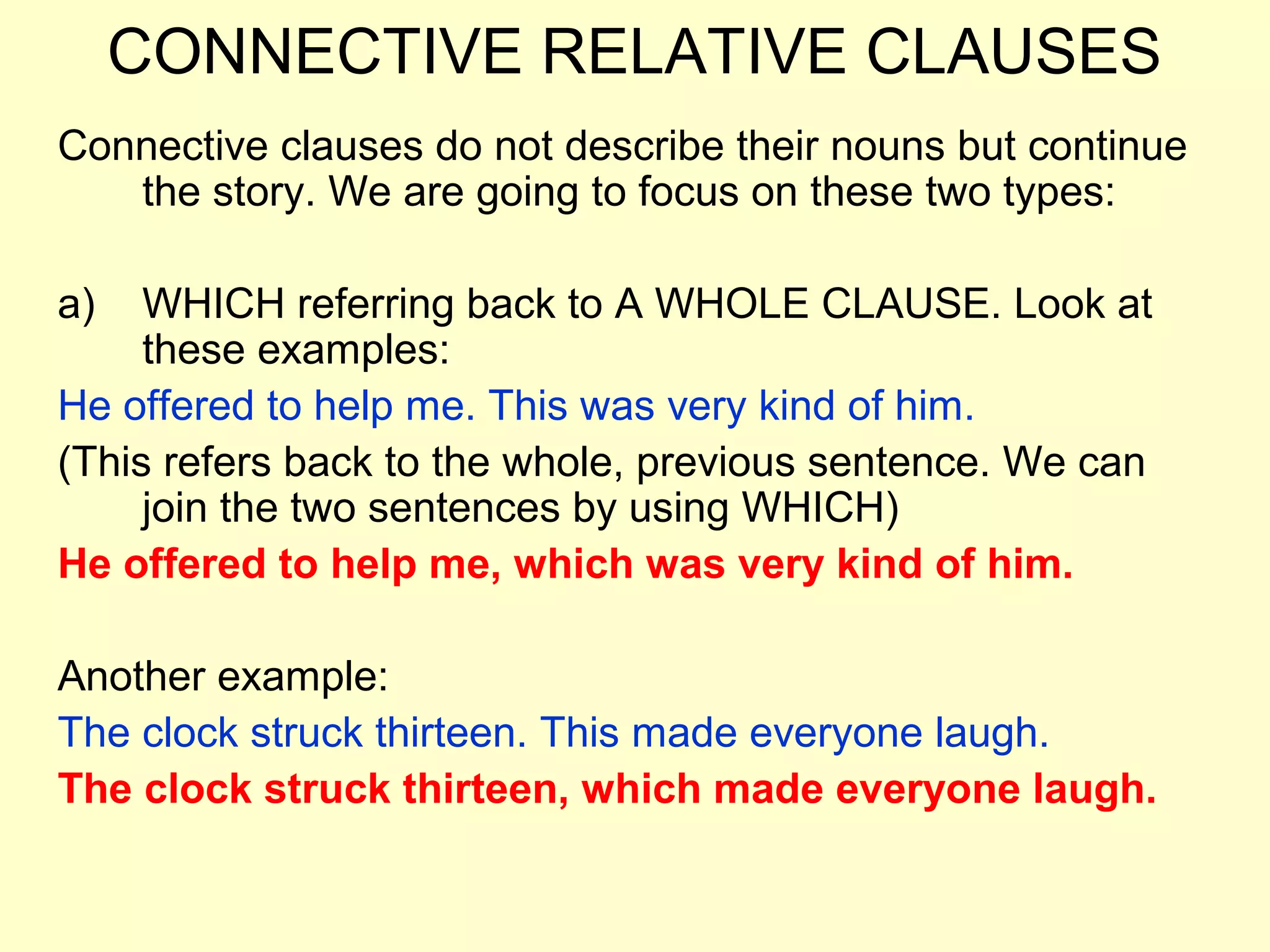
CONNECTIVE RELATIVE CLAUSES
Connective clauses do not describe their nouns but continue
   the story. We are going to focus on these two types:

a)   WHICH referring back to A WHOLE CLAUSE. Look at
     these examples:
He offered to help me. This was very kind of him.
(This refers back to the whole, previous sentence. We can
     join the two sentences by using WHICH)
He offered to help me, which was very kind of him.

Another example:
The clock struck thirteen. This made everyone laugh.
The clock struck thirteen, which made everyone laugh.
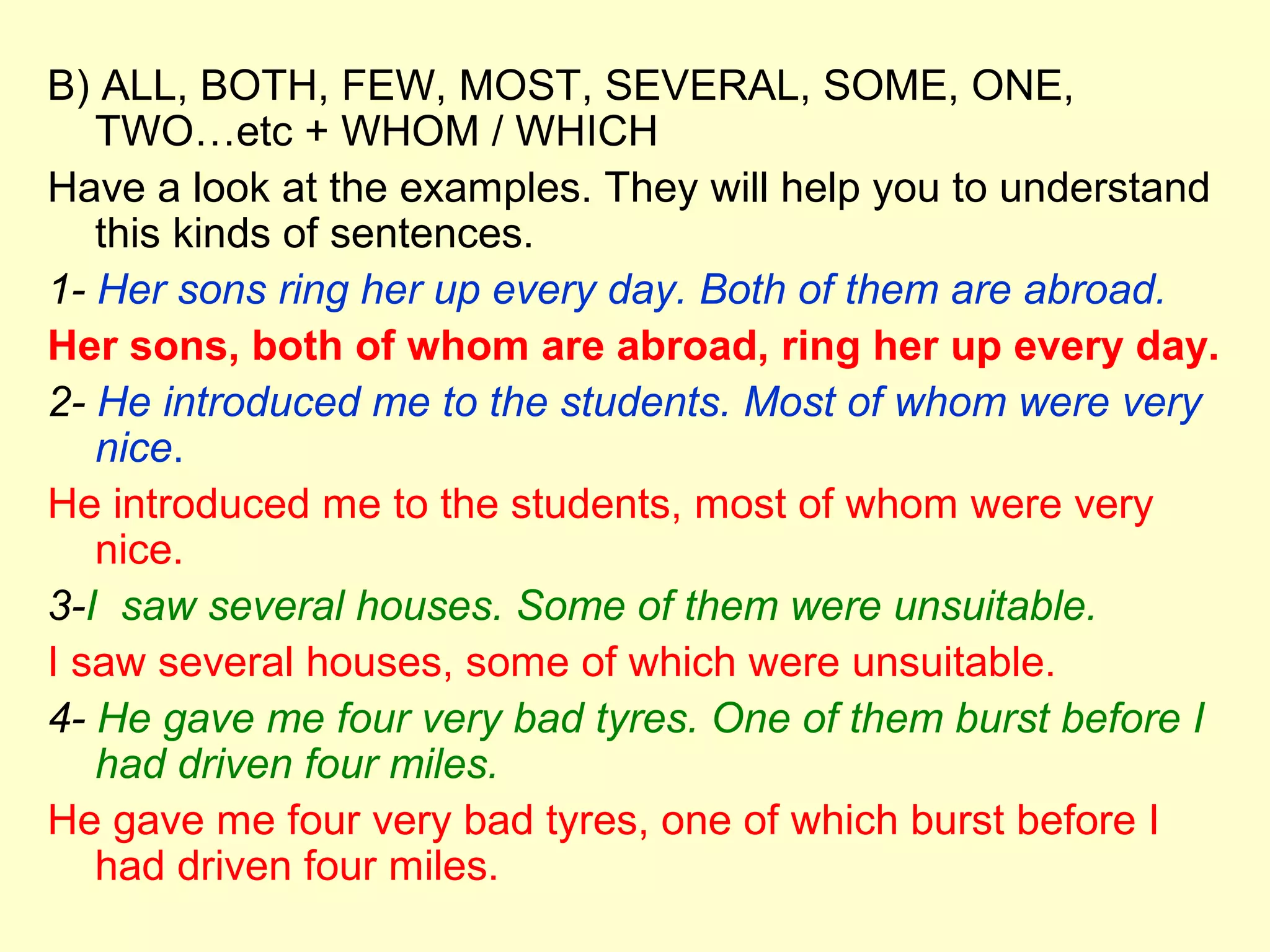
B) ALL, BOTH, FEW, MOST, SEVERAL, SOME, ONE,
   TWO…etc + WHOM / WHICH
Have a look at the examples. They will help you to understand
   this kinds of sentences.
1- Her sons ring her up every day. Both of them are abroad.
Her sons, both of whom are abroad, ring her up every day.
2- He introduced me to the students. Most of whom were very
   nice.
He introduced me to the students, most of whom were very
   nice.
3-I saw several houses. Some of them were unsuitable.
I saw several houses, some of which were unsuitable.
4- He gave me four very bad tyres. One of them burst before I
   had driven four miles.
He gave me four very bad tyres, one of which burst before I
   had driven four miles.

Relative clauses

  • 1.
    RELATIVE CLAUSES DEFINING, NON-DEFININGand CONNECTIVE RELATIVE CLAUSES
  • 2.
    A relative clausegives us information about which particular person or thing the speaker is referring to. For example: The girl who works in the bakery is my cousin. Relative Clause The relative clause tells us which girl we are talking about A kangaroo is an animal which lives in Australia. The relative clause tells us which animal we refer to.
  • 3.
    RELATIVE PRONOUNS We useWHO/ THAT to refer to people -The lady who/ that lives next door has a lot of pets. -The boy who/ that I met at Lucy’s party was very handsome. -A doctor is a person who/ that treats sick people We use WHICH / THAT to refer to things or animals. -Have you finished the book that/ which I gave you last week? -A flamingo is a bird which/ that lives in warm climate. - The food which/that was served at the party wast delicious.
  • 4.
    RELATIVE PRONOUN ASSUBJECT We cannot omit the relative pronoun when it is the subject pronoun of the relative clause, that is when there is not a noun or subject pronoun between the relative pronoun and the verb. For example. 1) I met a girl. She is from Japan I met a girl who/that is from Japan 2) What is the name of the prison?. It is on the outskirts of the city. What is the name of the prison which/that is on the outskirts of the city? Who and which (or that) are the subjects of their relative clauses. Therefore, they cannot be omitted.
  • 5.
    RELATIVE PRONOUN ASOBJECT We can omit the relative pronoun when it is the object of the relative clause; that is when there is a noun or subject pronoun between the verb and the relative pronoun. 1) That’s the hat. I bought it last week. That’s the hat (which/ that) I bought last week 2) The man has now been released. The police arrested him The man (who/ that) the police arrested has now been released. Who and which (or that) are objects in their clauses, therefore, they can be omitted
  • 6.
    RELATIVE CLAUSES WITHPREPOSITIONS - Have a look at these examples: 1) Do you know the girl?. Tom is talking to her. In formal English, we would say: Do you know the girl to whom Tom is talking. In less formal English, we would say: Do you know the girl who/that Tom is talking to? *we place the preposition at the end of the sentence and the relative pronoun can be omitted: Do you know the girl Tom is talking to? Try these ones: I didn’t get the job. I applied for it. I enjoy my job because I like the people. I work with them.
  • 7.
    WHOSE We use whoseinstead of POSSESSIVE ADJECTIVES (my, your, his, her…) with people, objects and animals to show possession. 1) That is the man. His car was stolen. That’s the man whose car was stolen. 2) The woman was very happy. Her son got the highest grade in the exam The woman whose son got the highest grade in the exam was very happy.
  • 8.
    RELATIVE ADVERBS. 1) WHEREis used to refer to a place. It usually goes after nouns such as town, hotel, city, school…etc “Where” can be replaced by which/ that…+ preposition. In this case, which/ that can be omitted. The hotel wasn’t very clean. We stayed there. The hotel where we stayed wasn’t very clean. The hotel (which/that) we stayed at wasn’t very clean * We can omit “where” only if we use the preposition at the end of the clause.
  • 9.
    2) WHEN isused to refer to time. It usually goes after nouns such us time, year, month etc.. It can be replaced by “that”, and it can be omitted. Do you still remember the day?. We met then. Do you still remember the day when we met. Do you still remember the day (that) we met. Is there a time (when/that) we can meet?
  • 10.
    WHY is usedto express “reason”. It usually goes after the word “reason”. It can be replaced by “that”, and it can be omitted. The reason was really stupid. He refused his job for that reason. The reason (why/that) he refused his job was really stupid The reason (why/that) I am phoning you is to invite you to a party.
  • 11.
    DEFINING OR NON-DEFINING RELATIVE CLAUSES A Defining Relative Clause gives A Non-defining relative Clause gives necessary information and it is extra information and is not essential essential to the meaning of the main to the meaning of the main sentence. sentence. The relative pronouns can In non-defining relative clauses, the be omitted when they are objects of the relative pronouns can not be omitted relative clause. And can’t be replaced by “that”. The relative clause needs commas. e.g People are fined. (which people? We don’t know. The meaning of the e.g Jeffersons live next door. sentence isn’t clear.) (The meaning of the sentence is clear.) People who/ that park illegally are The Jeffersons, who own a Jaguar, fined. live next door. The film was boring. (Which film? We My cat is called Monty. don’t know. The meaning isn’t clear.) (The meaning is clear) My cat, which I found on the street, The film (which/ that) I watched is called Monty. yesterday was boring. (The relative clause gives extra info.)
  • 12.
    CONNECTIVE RELATIVE CLAUSES Connectiveclauses do not describe their nouns but continue the story. We are going to focus on these two types: a) WHICH referring back to A WHOLE CLAUSE. Look at these examples: He offered to help me. This was very kind of him. (This refers back to the whole, previous sentence. We can join the two sentences by using WHICH) He offered to help me, which was very kind of him. Another example: The clock struck thirteen. This made everyone laugh. The clock struck thirteen, which made everyone laugh.
  • 13.
    B) ALL, BOTH,FEW, MOST, SEVERAL, SOME, ONE, TWO…etc + WHOM / WHICH Have a look at the examples. They will help you to understand this kinds of sentences. 1- Her sons ring her up every day. Both of them are abroad. Her sons, both of whom are abroad, ring her up every day. 2- He introduced me to the students. Most of whom were very nice. He introduced me to the students, most of whom were very nice. 3-I saw several houses. Some of them were unsuitable. I saw several houses, some of which were unsuitable. 4- He gave me four very bad tyres. One of them burst before I had driven four miles. He gave me four very bad tyres, one of which burst before I had driven four miles.