LEXICAL SEMANTICS : FIELDS
AND COLLOCATION
NAME OF GROUP :
Siti Khodrotun Nikmah
Rofi’atul Azizah
Madzkur
Nila Wijayanti
Paradigmatic and Syntagmatic
 Roland Barthes (1967) outlined the paradigmatic and syntagmatic
elements of the 'garment system' in similar terms. The paradigmatic
elements are the items which cannot be worn at the same time on the
same part of the body (such as hats, trousers, shoes). The syntagmatic
dimension is the juxtaposition of different elements at the same time in a
complete ensemble from hat to shoes.
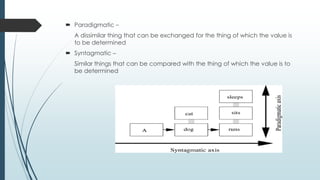
 Paradigmatic –
A dissimilar thing that can be exchanged for the thing of which the value is
to be determined
 Syntagmatic –
Similar things that can be compared with the thing of which the value is to
be determined
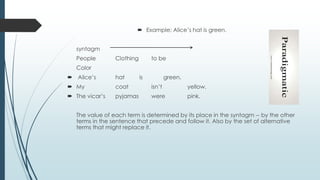
 Example: Alice’s hat is green.
syntagm
People Clothing to be
Color
 Alice’s hat is green.
 My coat isn’t yellow.
 The vicar’s pyjamas were pink.
The value of each term is determined by its place in the syntagm -- by the other
terms in the sentence that precede and follow it. Also by the set of alternative
terms that might replace it.
Semantic Fields
 A semantic field is a group of words that belong together - like sheep in a
field. You can find it in a poem, play, novel or any other type of text.
 In studying the lexicon of English (or any language) we may group together
lexemes which inter-relate, in the sense that we need them to define or
describe each other.
 For example we can see how such lexemes as cat, feline, moggy, puss,
kitten, tom, queen and miaow occupy the same semantic field. We can
also see that some lexemes will occupy many fields: noise will appear in
semantic fields for acoustics, pain or discomfort and electronics (noise =
“interference”).
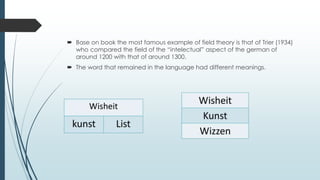
 Base on book the most famous example of field theory is that of Trier (1934)
who compared the field of the “intelectual” aspect of the german of
around 1200 with that of around 1300.
 The word that remained in the language had different meanings.
 Around 1200 wisheit was a general term convering the whole field of
knowledge. A century later the meaning narrowed to “religious or mystical
knowledge”. Kunst at the earlier time reffered to courtly knowledge and
later to mundane skill and knowledge. List, which was used for technical
skills, moved out of the field, and wizzen, relating to art, moved in.
Colour System
 A completely opposite view of colour terms is presented by Berlin & Kay
(1969).
 On the basis of investigation into nine-eight languanges, with detailed
research into twenty of them, they claim that there is a universal inventoy of
only eleven colour categories : white, black, red, green, yellow, blue, brown,
purple, pink, orange, and grey.
 There is a simple rule of colour :
white green purple
[red] [blue] [brown] pink
black yellow orange
grey
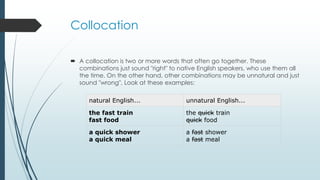
Collocation
 A collocation is two or more words that often go together. These
combinations just sound "right" to native English speakers, who use them all
the time. On the other hand, other combinations may be unnatural and just
sound "wrong". Look at these examples:
natural English... unnatural English...
the fast train
fast food
the quick train
quick food
a quick shower
a quick meal
a fast shower
a fast meal
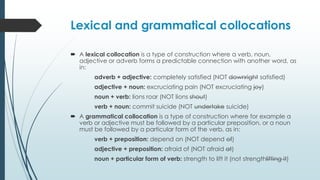
Lexical and grammatical collocations
 A lexical collocation is a type of construction where a verb, noun,
adjective or adverb forms a predictable connection with another word, as
in:
adverb + adjective: completely satisfied (NOT downright satisfied)
adjective + noun: excruciating pain (NOT excruciating joy)
noun + verb: lions roar (NOT lions shout)
verb + noun: commit suicide (NOT undertake suicide)
 A grammatical collocation is a type of construction where for example a
verb or adjective must be followed by a particular preposition, or a noun
must be followed by a particular form of the verb, as in:
verb + preposition: depend on (NOT depend of)
adjective + preposition: afraid of (NOT afraid at)
noun + particular form of verb: strength to lift it (not strengthlifting it)
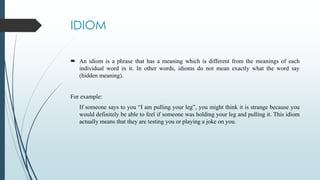
IDIOM
 An idiom is a phrase that has a meaning which is different from the meanings of each
individual word in it. In other words, idioms do not mean exactly what the word say
(hidden meaning).
For example:
If someone says to you “I am pulling your leg”, you might think it is strange because you
would definitely be able to feel if someone was holding your leg and pulling it. This idiom
actually means that they are testing you or playing a joke on you.
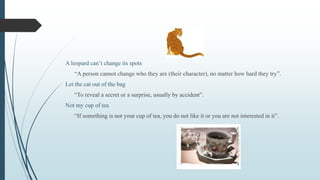
A leopard can’t change its spots
“A person cannot change who they are (their character), no matter how hard they try”.
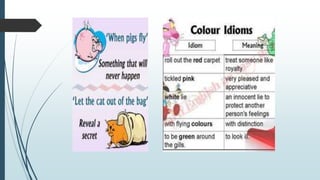
Let the cat out of the bag
“To reveal a secret or a surprise, usually by accident”.
Not my cup of tea
“If something is not your cup of tea, you do not like it or you are not interested in it”.
Lexical semantics
Lexical semantics
Lexical semantics
Lexical semantics

Lexical semantics

  • 1.
    LEXICAL SEMANTICS :FIELDS AND COLLOCATION NAME OF GROUP : Siti Khodrotun Nikmah Rofi’atul Azizah Madzkur Nila Wijayanti
  • 2.
    Paradigmatic and Syntagmatic Roland Barthes (1967) outlined the paradigmatic and syntagmatic elements of the 'garment system' in similar terms. The paradigmatic elements are the items which cannot be worn at the same time on the same part of the body (such as hats, trousers, shoes). The syntagmatic dimension is the juxtaposition of different elements at the same time in a complete ensemble from hat to shoes.
  • 3.
     Paradigmatic – Adissimilar thing that can be exchanged for the thing of which the value is to be determined  Syntagmatic – Similar things that can be compared with the thing of which the value is to be determined
  • 4.
     Example: Alice’shat is green. syntagm People Clothing to be Color  Alice’s hat is green.  My coat isn’t yellow.  The vicar’s pyjamas were pink. The value of each term is determined by its place in the syntagm -- by the other terms in the sentence that precede and follow it. Also by the set of alternative terms that might replace it.
  • 5.
    Semantic Fields  Asemantic field is a group of words that belong together - like sheep in a field. You can find it in a poem, play, novel or any other type of text.  In studying the lexicon of English (or any language) we may group together lexemes which inter-relate, in the sense that we need them to define or describe each other.  For example we can see how such lexemes as cat, feline, moggy, puss, kitten, tom, queen and miaow occupy the same semantic field. We can also see that some lexemes will occupy many fields: noise will appear in semantic fields for acoustics, pain or discomfort and electronics (noise = “interference”).
  • 6.
     Base onbook the most famous example of field theory is that of Trier (1934) who compared the field of the “intelectual” aspect of the german of around 1200 with that of around 1300.  The word that remained in the language had different meanings.
  • 7.
     Around 1200wisheit was a general term convering the whole field of knowledge. A century later the meaning narrowed to “religious or mystical knowledge”. Kunst at the earlier time reffered to courtly knowledge and later to mundane skill and knowledge. List, which was used for technical skills, moved out of the field, and wizzen, relating to art, moved in.
  • 8.
    Colour System  Acompletely opposite view of colour terms is presented by Berlin & Kay (1969).  On the basis of investigation into nine-eight languanges, with detailed research into twenty of them, they claim that there is a universal inventoy of only eleven colour categories : white, black, red, green, yellow, blue, brown, purple, pink, orange, and grey.  There is a simple rule of colour : white green purple [red] [blue] [brown] pink black yellow orange grey
  • 9.
    Collocation  A collocationis two or more words that often go together. These combinations just sound "right" to native English speakers, who use them all the time. On the other hand, other combinations may be unnatural and just sound "wrong". Look at these examples: natural English... unnatural English... the fast train fast food the quick train quick food a quick shower a quick meal a fast shower a fast meal
  • 10.
    Lexical and grammaticalcollocations  A lexical collocation is a type of construction where a verb, noun, adjective or adverb forms a predictable connection with another word, as in: adverb + adjective: completely satisfied (NOT downright satisfied) adjective + noun: excruciating pain (NOT excruciating joy) noun + verb: lions roar (NOT lions shout) verb + noun: commit suicide (NOT undertake suicide)  A grammatical collocation is a type of construction where for example a verb or adjective must be followed by a particular preposition, or a noun must be followed by a particular form of the verb, as in: verb + preposition: depend on (NOT depend of) adjective + preposition: afraid of (NOT afraid at) noun + particular form of verb: strength to lift it (not strengthlifting it)
  • 11.
    IDIOM  An idiomis a phrase that has a meaning which is different from the meanings of each individual word in it. In other words, idioms do not mean exactly what the word say (hidden meaning). For example: If someone says to you “I am pulling your leg”, you might think it is strange because you would definitely be able to feel if someone was holding your leg and pulling it. This idiom actually means that they are testing you or playing a joke on you.
  • 12.
    A leopard can’tchange its spots “A person cannot change who they are (their character), no matter how hard they try”. Let the cat out of the bag “To reveal a secret or a surprise, usually by accident”. Not my cup of tea “If something is not your cup of tea, you do not like it or you are not interested in it”.