LANE 334 -EA: Syntax
                                                     2011 – Term 2


 Syntactic Categories                                     2

        By:                http://SBANJAR.kau.edu.sa/
Dr. Shadia Y. Banjar       http://wwwdrshadiabanjar.blogspot.com

Dr. Shadia Yousef Banjar                                             1
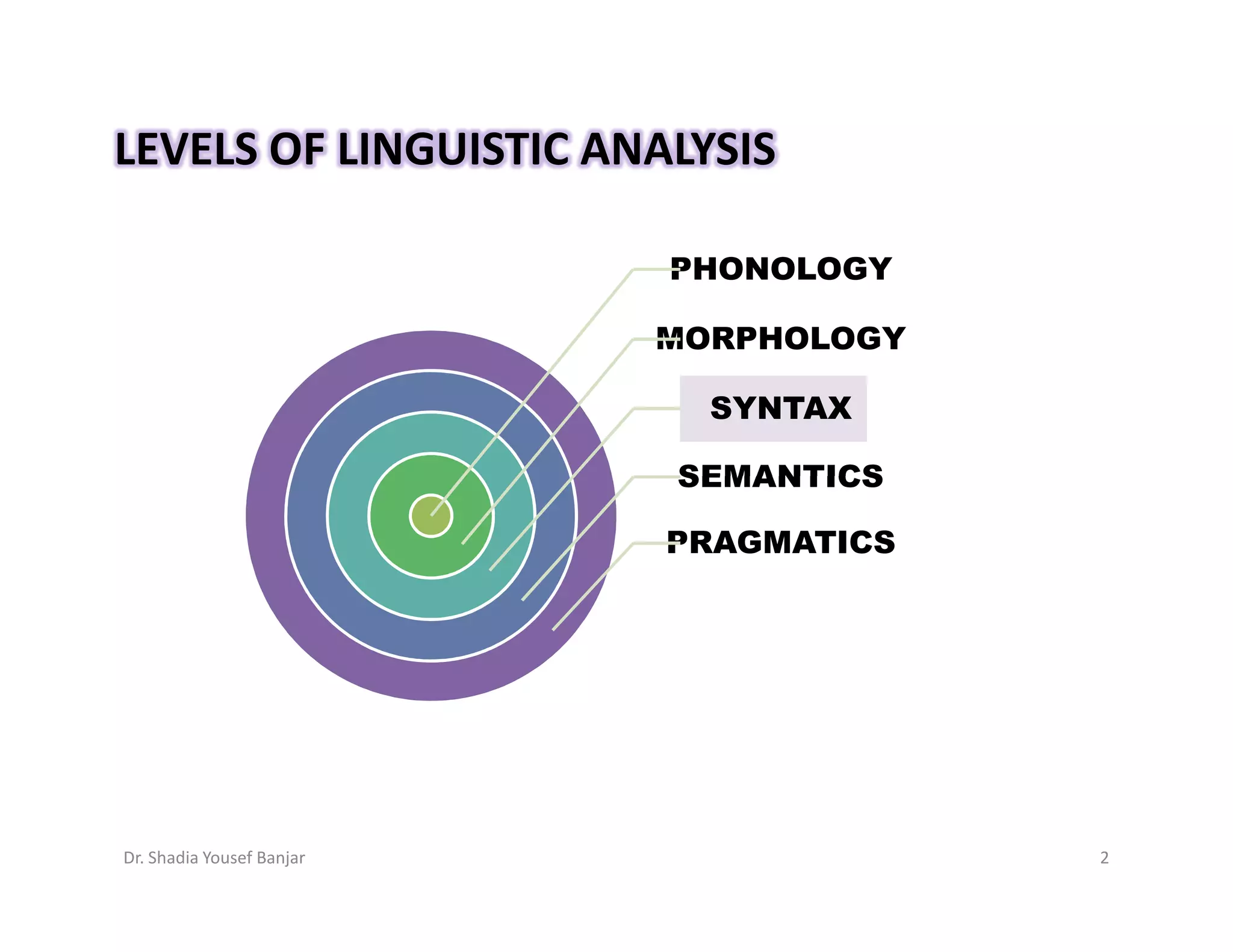
LEVELS OF LINGUISTIC ANALYSIS

                           PHONOLOGY

                           MORPHOLOGY

                             SYNTAX

                           SEMANTICS

                           PRAGMATICS


Dr. Shadia Yousef Banjar                2
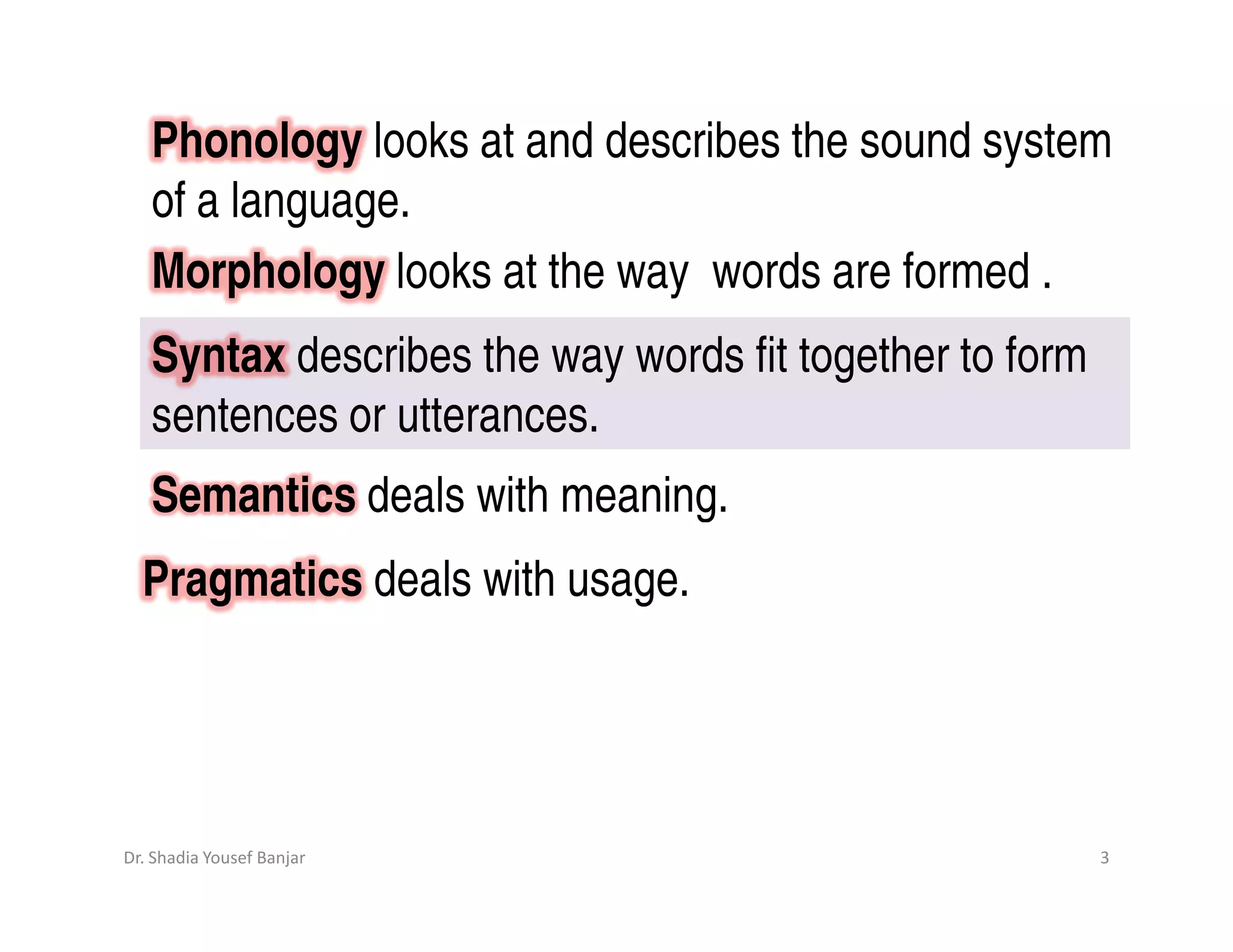
Phonology looks at and describes the sound system
   of a language.
   Morphology looks at the way words are formed .
   Syntax describes the way words fit together to form
   sentences or utterances.
   Semantics deals with meaning.
  Pragmatics deals with usage.


Dr. Shadia Yousef Banjar                                 3
Syntax
 • Syntax: is the branch of
   linguistics deals with sentence
   structure.
 • In order to study the structure of
   sentences, we have to know the
   grammatical rules governing the
   way words are combined to form
   ‘well-formed’ sentences.
Dr. Shadia Yousef Banjar            4
√√√√√√√                      a ‘well-formed’
                                                sentence

       1. I shot the sheriff.
                                               Native
           XXXXXXX                             speaker

        2. *the shot sheriff I.
                             an ‘ill-formed’
                             sentence


                           Native
                           speaker
Dr. Shadia Yousef Banjar                                      5
(consist of)
       S                               word + word + word + …….
(sentence)                                   word order


                                               rules


 Dr. Shadia Yousef Banjar                                     6
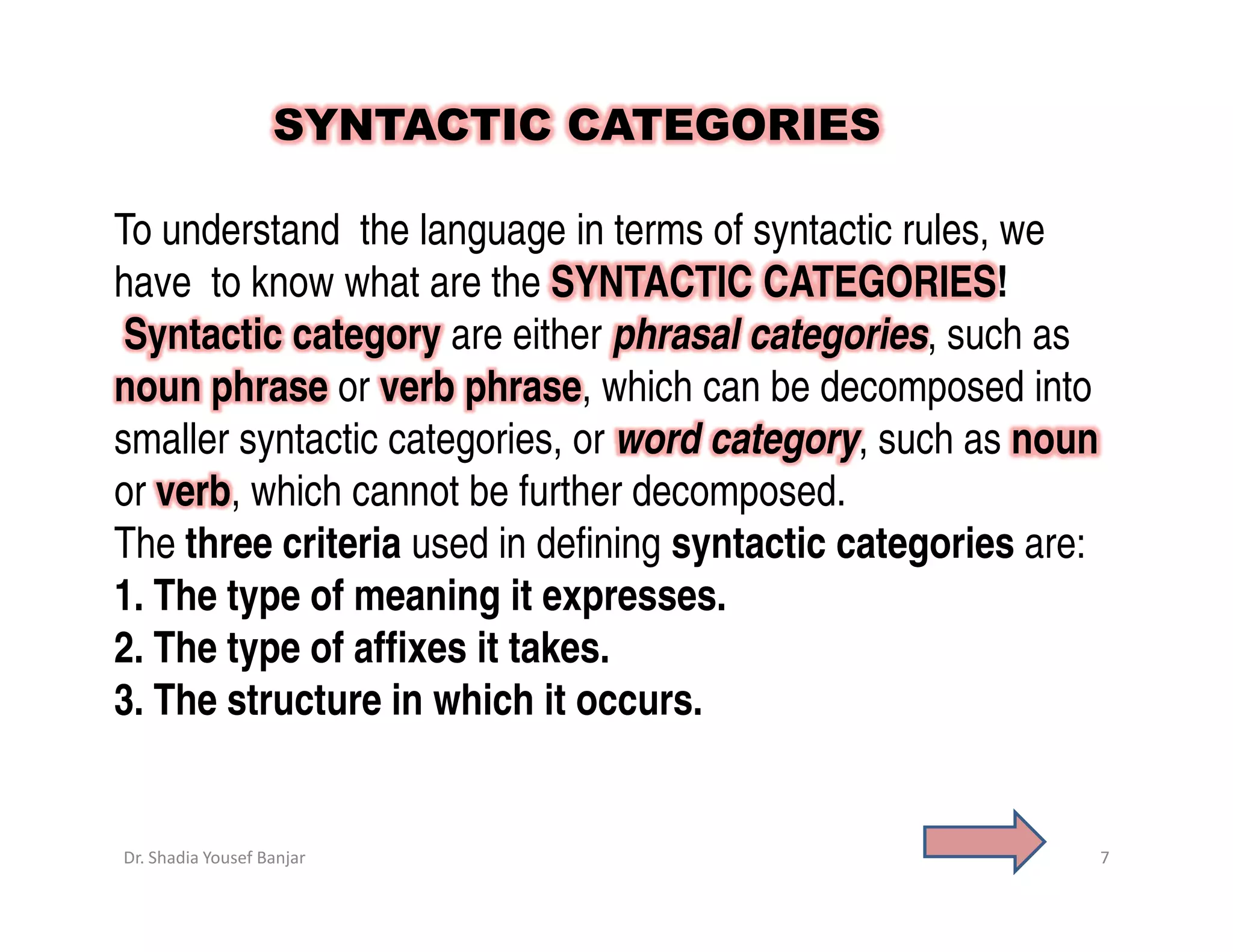
SYNTACTIC CATEGORIES

To understand the language in terms of syntactic rules, we
have to know what are the SYNTACTIC CATEGORIES!
 Syntactic category are either phrasal categories, such as
noun phrase or verb phrase, which can be decomposed into
smaller syntactic categories, or word category, such as noun
or verb, which cannot be further decomposed.
The three criteria used in defining syntactic categories are:
1. The type of meaning it expresses.
2. The type of affixes it takes.
3. The structure in which it occurs.


Dr. Shadia Yousef Banjar                                        7
A family of expressions that can substitute for one
     another without loss of grammaticality is called a
     syntactic category.
      1. The cat                   chases the mouse.
      2. The dog                   chases the mouse
      3. The policeman             chases the mouse.
      4. The mother mouse          chases the mouse.
     If words and phrases could not be assigned to a
     small group of categories, it would be very hard to
     learn or use a language.
Dr. Shadia Yousef Banjar                               8
– In the given examples: 1-4,
           – every word is a member of a category.
           – a word’s category type determines the
             kind of phrase it can form.
           – a phrase is a word or string of words
             that functions as a unit in a sentence,
             built around a head.
           – Every language has specific phrase
             structure rules determining how phrases
             can be combined to form sentences.


Dr. Shadia Yousef Banjar                               9
WORD CATEGORIES


                              WORD
                           CATEGORIES

                   FUNCTIONAL         LEXICAL
                      WORD             WORD
                   CATEGORIES       CATEGORIES


Dr. Shadia Yousef Banjar                         10
LEXICAL WORD CATEGORIES
           Lexical word categories are:
           Words that have some sort of inherent meaning
         are called lexical words (or content words).
           Categories related to such words are called
         lexical categories e.g. NOUN, VERB, ADJECTIVE.
           Open-class in the sense that new words can be
         added, and thus have a large number of class
         members.


Dr. Shadia Yousef Banjar                                   11
NOUN
Morphological properties
   it can take a plural -s morpheme;
   Exceptions: children, deer, mice, fish, . . .
  it can be modified by a possessive (apostrophe: ’s)
   it contains morphemes like the following: -ity, -ness, -
action, -er, -ion, -ment, -ance, -hood.
  These are all NOUN- OR NOMINAL SUFFIXES e.g
friendliness, writer, government, neighborhood.


Dr. Shadia Yousef Banjar                                 12
Syntactic properties of the class of NOUN
 • preceded by articles like: the, demonstrative
 pronouns like: this, that, these, those and
 numerals like: one, two, three.
 •preceded by an ADJECTIVE or several
 ADJECTIVES.
 •followed by a PREPOSITION.
 •preceded by a PREPOSITION.


Dr. Shadia Yousef Banjar                      13
Verb

Morphological properties
• takes a past tense –ed1 form e.g. He walked.
• takes the –s form of the verb for third-person
singular agreement e.g. He goes to work daily.
• takes the –ing form to express the progressive
aspect e.g. he is running.
• takes the –ed2 form to express the perfective aspect
e.g. I have finished my work.


Dr. Shadia Yousef Banjar                             14
Syntactic properties of the class of VERB
 • preceded by AUXILIARIES. These are words like
 do and have e.g. has come, does like.
 •preceded by MODAL VERBS. These are words like
 can, must, will and should e.g. can
 cook, must work, will sleep, and should eat.
 •preceded by negation words like not and never
 e.g. Do not cry, Never shouts.
 • preceded by an ADVERB or ADVERBS e.g.
 quickly run.
 • can be followed by a NOUN e.g. They hate John.

Dr. Shadia Yousef Banjar                        15
ADJECTIVE


Morphological properties
• has morphemes like -ous, -y, -ish, e.g. furious,
angry, brownish, friendly.
•able to form comparatives and superlatives with -er
and -est. e.g. bigger , biggest.


Dr. Shadia Yousef Banjar                           16
Syntactic properties of the adjective class:
 • can be preceded by ADVERBS e.g. very
 angry, more hard-working.
 •can occur after determiners like the, a, this,
 these, those and numerals and before
 NOUNS e.g. the angry boy, those twelve small
 monkeys.
 • modifies a NOUN.
 •cannot immediately follow PREPOSITIONS
 e.g. *in angry. XXXXXXX
 •can follow VERBS. E.g. He is angry.
Dr. Shadia Yousef Banjar                       17
ADVERB
      Morphological properties
      • often followed by the morpheme –ly, e.g. swiftly,
      quickly, angrily.
       Exceptions: abroad, now, fast, often, well, also, very,
      too, never, so, ...
      Syntactic properties
      • modifies a VERB; e.g. walks quickly.
      •modifies an ADJECTIVE; e.g. swiftly angry.
      •modifies another ADVERB; e.g. very angrily.


Dr. Shadia Yousef Banjar                                         18
Functional word categories
Functional word categories are:
  Words that don’t have (an easily detectable) inherent
meaning are called functional words because such words
perform some function in the sentence.
 Functional word categories tend to be CLOSED-CLASS (new
words may not be added) and have a small number of class
members.
 functional word categories like the following:
• DETERMINERS/QUANTIFIERS
•AUXILIARIES
•CONJUNCTIONS
•COMPLEMENTIZERS

 Dr. Shadia Yousef Banjar                            19
Determiners/Quantifiers
This is a general term for articles (a, an, the),
demonstratives (these, those, this), possessive
pronouns (his, her, their, her), some quantifiers and
interrogatives (how many, what, where, which, how,
why), numerals (one, two, . . . ).
 Morphological properties: Invariable; i.e. cannot
take affixes
Syntactic properties: occur before adjectives and
nouns.


Dr. Shadia Yousef Banjar                          20
Auxiliaries
This is a general term for the so-called “helping verbs”. These
are auxiliary verbs like: do, have, be and modal verbs like:
can, must, should, will, ought.
 Morphological properties: can be inflected for tense, voice
(active, passive), mood (subjunctive, indicative, . . . ), aspect
(progressive, perfective). e.g. can, could, could have, was
sent, . . . .
 Syntactic properties:
– typically occur either immediately before the main verb or
before an adverb modifying the main verb. e.g. can work, can
always work.
– can also occur before other auxiliary verbs. e.g. could have
come.
– can undergo inversion in questions. e.g. You can speak
Spanish vs. Can you speak Spanish?
 Dr. Shadia Yousef Banjar                                     21
Conjunction

   This refers to words like and, or, both, either,
   neither...
    Morphological properties: invariable; don’t
   take affixes.
    Syntactic properties: typically connect words
   of the same category. e.g. two or more nouns,
   two or more verbs, two or more sentences, two
   or more adjectives, . . .


Dr. Shadia Yousef Banjar                              22
Complementizer

  This includes words like: whether, so that,
  in that, because, if, since, that, . . .
   Morphological properties: invariable; don’t
  take affixes.
   Syntactic properties: create embedded
  sentences. That is, they create sentences
  within sentences.
  e.g.
   [John likes Sue because [she is pretty]].

Dr. Shadia Yousef Banjar                         23
Phrasal Categories
Phrasal Categories: Just as words have word
categories, phrases have phrasal categories.
• Phrasal categories, are ultimately much more
useful than just individual phrases, for the study of
sentence structure. A phrasal category is directly
determined by the category of the word which the
phrase is about. Such a word is called the head of
the phrase.


 Dr. Shadia Yousef Banjar                         24
•How to determine a phrasal category:
The concept of a “head”:
• The head of a phrase is the main word of that phrase.
• It is essentially what the entire phrase is about.
• The category of a phrase is directly determined from the
category of its head.
To see how this works, consider the following example with the
phrases marked out in brackets:
[[The tiny woman] [went [to [the store ]] ] ]
Sentence (S) = The tiny woman went to the store
Phrase 1 = the tiny woman :Noun Phrase (NP, for short).
Phrase 2 = went to the store: Verb Phrase (VP).
Phrase 3 = to the store: Prepositional Phrase (PP).
Phrase 4 = the store : Noun Phrase (NP).


 Dr. Shadia Yousef Banjar                                  25
Constituents
      A constituent is a grammatical unit which
     is part of a larger grammatical unit.
     in example (1):
   •     The cat = noun phrase
   • Noun Phrase =determiner + noun
   • "determiner" and "noun“ are the
     constituents of the noun phrase.


Dr. Shadia Yousef Banjar                      26
TREE DIAGRAMS
 Three aspects of a speaker’s syntactic
 knowledge are explicitly represented in tree
 diagrams:
1. The linear order of the words in the
    sentence,
2. the groupings of words into syntactic
    categories, and
3. the hierarchical structure of the syntactic
    categories.
 Dr. Shadia Yousef Banjar                   27
The Tree Diagram For:
                  Juliet loves Romeo
                                    S


                                            VP
                            NP


                                        V        NP
                            N
                                                 N


                           Juliet       loves    Romeo
Dr. Shadia Yousef Banjar                                 28
Form and Function

  •Words can be grouped in certain patterns to form
  sentences.
  •In terms of forms, a sentence consists of a noun
  phrase and a verb phrase.
  •In terms of function, a sentence consists of a
  subject and a predicate. A predicate must contain
  a predicator which is a verb.
  •The class of a constituent indicates its form and
  what the form does or act as a grammatical unit
  indicates its function.
Dr. Shadia Yousef Banjar                               29
Dr. Shadia Yousef Banjar   30

Syntactic categories, by dr. shadia yousef banjar.ppt [compatibility mode]

  • 1.
    LANE 334 -EA:Syntax 2011 – Term 2 Syntactic Categories 2 By: http://SBANJAR.kau.edu.sa/ Dr. Shadia Y. Banjar http://wwwdrshadiabanjar.blogspot.com Dr. Shadia Yousef Banjar 1
  • 2.
    LEVELS OF LINGUISTICANALYSIS PHONOLOGY MORPHOLOGY SYNTAX SEMANTICS PRAGMATICS Dr. Shadia Yousef Banjar 2
  • 3.
    Phonology looks atand describes the sound system of a language. Morphology looks at the way words are formed . Syntax describes the way words fit together to form sentences or utterances. Semantics deals with meaning. Pragmatics deals with usage. Dr. Shadia Yousef Banjar 3
  • 4.
    Syntax • Syntax:is the branch of linguistics deals with sentence structure. • In order to study the structure of sentences, we have to know the grammatical rules governing the way words are combined to form ‘well-formed’ sentences. Dr. Shadia Yousef Banjar 4
  • 5.
    √√√√√√√ a ‘well-formed’ sentence 1. I shot the sheriff. Native XXXXXXX speaker 2. *the shot sheriff I. an ‘ill-formed’ sentence Native speaker Dr. Shadia Yousef Banjar 5
  • 6.
    (consist of) S word + word + word + ……. (sentence) word order rules Dr. Shadia Yousef Banjar 6
  • 7.
    SYNTACTIC CATEGORIES To understandthe language in terms of syntactic rules, we have to know what are the SYNTACTIC CATEGORIES! Syntactic category are either phrasal categories, such as noun phrase or verb phrase, which can be decomposed into smaller syntactic categories, or word category, such as noun or verb, which cannot be further decomposed. The three criteria used in defining syntactic categories are: 1. The type of meaning it expresses. 2. The type of affixes it takes. 3. The structure in which it occurs. Dr. Shadia Yousef Banjar 7
  • 8.
    A family ofexpressions that can substitute for one another without loss of grammaticality is called a syntactic category. 1. The cat chases the mouse. 2. The dog chases the mouse 3. The policeman chases the mouse. 4. The mother mouse chases the mouse. If words and phrases could not be assigned to a small group of categories, it would be very hard to learn or use a language. Dr. Shadia Yousef Banjar 8
  • 9.
    – In thegiven examples: 1-4, – every word is a member of a category. – a word’s category type determines the kind of phrase it can form. – a phrase is a word or string of words that functions as a unit in a sentence, built around a head. – Every language has specific phrase structure rules determining how phrases can be combined to form sentences. Dr. Shadia Yousef Banjar 9
  • 10.
    WORD CATEGORIES WORD CATEGORIES FUNCTIONAL LEXICAL WORD WORD CATEGORIES CATEGORIES Dr. Shadia Yousef Banjar 10
  • 11.
    LEXICAL WORD CATEGORIES Lexical word categories are: Words that have some sort of inherent meaning are called lexical words (or content words). Categories related to such words are called lexical categories e.g. NOUN, VERB, ADJECTIVE. Open-class in the sense that new words can be added, and thus have a large number of class members. Dr. Shadia Yousef Banjar 11
  • 12.
    NOUN Morphological properties it can take a plural -s morpheme; Exceptions: children, deer, mice, fish, . . . it can be modified by a possessive (apostrophe: ’s) it contains morphemes like the following: -ity, -ness, - action, -er, -ion, -ment, -ance, -hood. These are all NOUN- OR NOMINAL SUFFIXES e.g friendliness, writer, government, neighborhood. Dr. Shadia Yousef Banjar 12
  • 13.
    Syntactic properties ofthe class of NOUN • preceded by articles like: the, demonstrative pronouns like: this, that, these, those and numerals like: one, two, three. •preceded by an ADJECTIVE or several ADJECTIVES. •followed by a PREPOSITION. •preceded by a PREPOSITION. Dr. Shadia Yousef Banjar 13
  • 14.
    Verb Morphological properties • takesa past tense –ed1 form e.g. He walked. • takes the –s form of the verb for third-person singular agreement e.g. He goes to work daily. • takes the –ing form to express the progressive aspect e.g. he is running. • takes the –ed2 form to express the perfective aspect e.g. I have finished my work. Dr. Shadia Yousef Banjar 14
  • 15.
    Syntactic properties ofthe class of VERB • preceded by AUXILIARIES. These are words like do and have e.g. has come, does like. •preceded by MODAL VERBS. These are words like can, must, will and should e.g. can cook, must work, will sleep, and should eat. •preceded by negation words like not and never e.g. Do not cry, Never shouts. • preceded by an ADVERB or ADVERBS e.g. quickly run. • can be followed by a NOUN e.g. They hate John. Dr. Shadia Yousef Banjar 15
  • 16.
    ADJECTIVE Morphological properties • hasmorphemes like -ous, -y, -ish, e.g. furious, angry, brownish, friendly. •able to form comparatives and superlatives with -er and -est. e.g. bigger , biggest. Dr. Shadia Yousef Banjar 16
  • 17.
    Syntactic properties ofthe adjective class: • can be preceded by ADVERBS e.g. very angry, more hard-working. •can occur after determiners like the, a, this, these, those and numerals and before NOUNS e.g. the angry boy, those twelve small monkeys. • modifies a NOUN. •cannot immediately follow PREPOSITIONS e.g. *in angry. XXXXXXX •can follow VERBS. E.g. He is angry. Dr. Shadia Yousef Banjar 17
  • 18.
    ADVERB Morphological properties • often followed by the morpheme –ly, e.g. swiftly, quickly, angrily. Exceptions: abroad, now, fast, often, well, also, very, too, never, so, ... Syntactic properties • modifies a VERB; e.g. walks quickly. •modifies an ADJECTIVE; e.g. swiftly angry. •modifies another ADVERB; e.g. very angrily. Dr. Shadia Yousef Banjar 18
  • 19.
    Functional word categories Functionalword categories are: Words that don’t have (an easily detectable) inherent meaning are called functional words because such words perform some function in the sentence. Functional word categories tend to be CLOSED-CLASS (new words may not be added) and have a small number of class members. functional word categories like the following: • DETERMINERS/QUANTIFIERS •AUXILIARIES •CONJUNCTIONS •COMPLEMENTIZERS Dr. Shadia Yousef Banjar 19
  • 20.
    Determiners/Quantifiers This is ageneral term for articles (a, an, the), demonstratives (these, those, this), possessive pronouns (his, her, their, her), some quantifiers and interrogatives (how many, what, where, which, how, why), numerals (one, two, . . . ). Morphological properties: Invariable; i.e. cannot take affixes Syntactic properties: occur before adjectives and nouns. Dr. Shadia Yousef Banjar 20
  • 21.
    Auxiliaries This is ageneral term for the so-called “helping verbs”. These are auxiliary verbs like: do, have, be and modal verbs like: can, must, should, will, ought. Morphological properties: can be inflected for tense, voice (active, passive), mood (subjunctive, indicative, . . . ), aspect (progressive, perfective). e.g. can, could, could have, was sent, . . . . Syntactic properties: – typically occur either immediately before the main verb or before an adverb modifying the main verb. e.g. can work, can always work. – can also occur before other auxiliary verbs. e.g. could have come. – can undergo inversion in questions. e.g. You can speak Spanish vs. Can you speak Spanish? Dr. Shadia Yousef Banjar 21
  • 22.
    Conjunction This refers to words like and, or, both, either, neither... Morphological properties: invariable; don’t take affixes. Syntactic properties: typically connect words of the same category. e.g. two or more nouns, two or more verbs, two or more sentences, two or more adjectives, . . . Dr. Shadia Yousef Banjar 22
  • 23.
    Complementizer Thisincludes words like: whether, so that, in that, because, if, since, that, . . . Morphological properties: invariable; don’t take affixes. Syntactic properties: create embedded sentences. That is, they create sentences within sentences. e.g. [John likes Sue because [she is pretty]]. Dr. Shadia Yousef Banjar 23
  • 24.
    Phrasal Categories Phrasal Categories:Just as words have word categories, phrases have phrasal categories. • Phrasal categories, are ultimately much more useful than just individual phrases, for the study of sentence structure. A phrasal category is directly determined by the category of the word which the phrase is about. Such a word is called the head of the phrase. Dr. Shadia Yousef Banjar 24
  • 25.
    •How to determinea phrasal category: The concept of a “head”: • The head of a phrase is the main word of that phrase. • It is essentially what the entire phrase is about. • The category of a phrase is directly determined from the category of its head. To see how this works, consider the following example with the phrases marked out in brackets: [[The tiny woman] [went [to [the store ]] ] ] Sentence (S) = The tiny woman went to the store Phrase 1 = the tiny woman :Noun Phrase (NP, for short). Phrase 2 = went to the store: Verb Phrase (VP). Phrase 3 = to the store: Prepositional Phrase (PP). Phrase 4 = the store : Noun Phrase (NP). Dr. Shadia Yousef Banjar 25
  • 26.
    Constituents A constituent is a grammatical unit which is part of a larger grammatical unit. in example (1): • The cat = noun phrase • Noun Phrase =determiner + noun • "determiner" and "noun“ are the constituents of the noun phrase. Dr. Shadia Yousef Banjar 26
  • 27.
    TREE DIAGRAMS Threeaspects of a speaker’s syntactic knowledge are explicitly represented in tree diagrams: 1. The linear order of the words in the sentence, 2. the groupings of words into syntactic categories, and 3. the hierarchical structure of the syntactic categories. Dr. Shadia Yousef Banjar 27
  • 28.
    The Tree DiagramFor: Juliet loves Romeo S VP NP V NP N N Juliet loves Romeo Dr. Shadia Yousef Banjar 28
  • 29.
    Form and Function •Words can be grouped in certain patterns to form sentences. •In terms of forms, a sentence consists of a noun phrase and a verb phrase. •In terms of function, a sentence consists of a subject and a predicate. A predicate must contain a predicator which is a verb. •The class of a constituent indicates its form and what the form does or act as a grammatical unit indicates its function. Dr. Shadia Yousef Banjar 29
  • 30.