E_English Grammar Course  Chapter I Elements of grammar
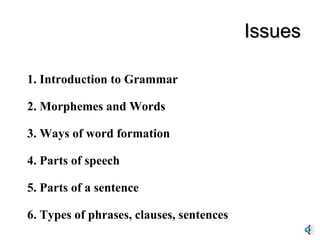
Issues 1. Introduction to Grammar 2. Morphemes and Words 3. Ways of word formation 4. Parts of speech 5. Parts of a sentence 6. Types of phrases, clauses, sentences
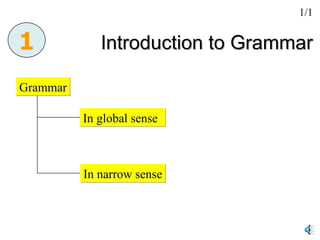
Introduction to Grammar Grammar In global sense In narrow sense 1 1/1
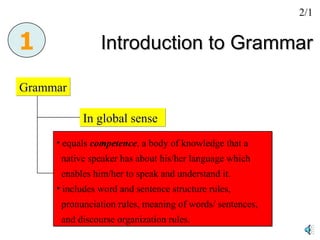
Introduction to Grammar Grammar In global sense In narrow sense equals  competence , a body of knowledge that a  native speaker has about his/her language which  enables him/her to speak and understand it.  includes word and sentence structure rules,  pronunciation rules, meaning of words/ sentences,  and discourse organization rules. 1 2/1
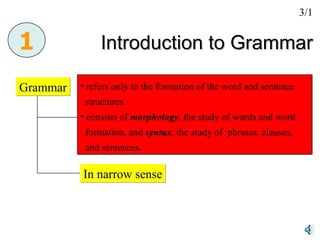
Introduction to Grammar Grammar In global sense In narrow sense refers only to the formation of the word and sentence  structures.  consists of  morphology , the study of words and word  formation, and  syntax , the study of  phrases, clauses,  and sentences. 1 3/1
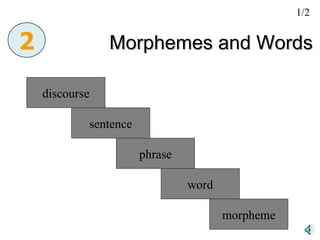
Morphemes and Words 2 1/2 discourse sentence phrase word morpheme
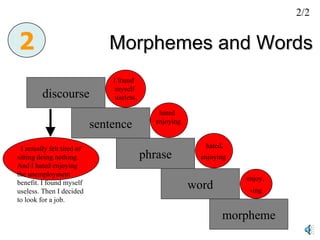
Morphemes and Words I actually felt tired of sitting doing nothing. And I hated enjoying the unemployment benefit. I found myself useless. Then I decided to look for a job.  I found  myself  useless.  hated enjoying  hated, enjoying  enjoy,  -ing 2 2/2 discourse sentence phrase word morpheme
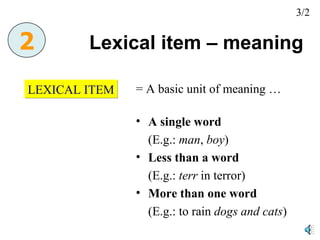
Lexical item – meaning  LEXICAL ITEM = A basic unit of meaning … A single word   (E.g.:  man ,  boy ) Less than a word (E.g.:  terr  in terror) More than one word (E.g.: to rain  dogs and cats ) 2 3/2
Lexical item – meaning  LEXICAL ITEM MEANING & Lexical item and meaning has arbitrary relationship.  2 4/2
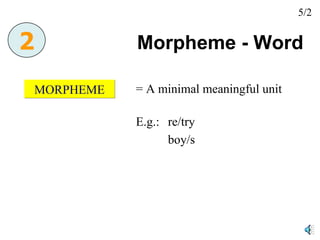
Morpheme - Word  MORPHEME = A minimal meaningful unit E.g.:  re/try boy/s 5/2 2
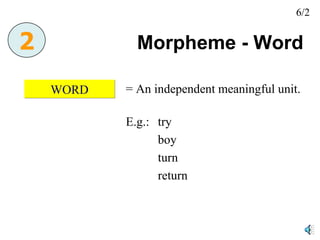
Morpheme - Word  WORD = An independent meaningful unit. E.g.:  try boy turn return 2 6/2
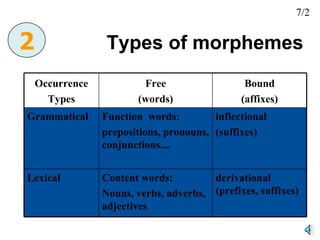
Types of morphemes   2 7/2 Occurrence Types Free (words) Bound (affixes) Grammatical Function  words: prepositions, pronouns, conjunctions.... inflectional  (suffixes) Lexical Content words: Nouns, verbs, adverbs, adjectives derivational (prefixes, suffixes)
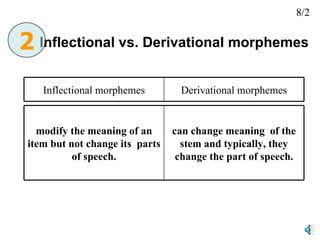
Inflectional vs. Derivational morphemes 2 8/2 Inflectional morphemes Derivational morphemes modify the meaning of an item but not change its  parts of speech. can change meaning  of the stem and typically, they change the part of speech.
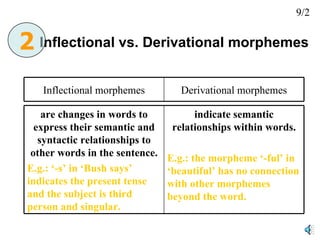
Inflectional vs. Derivational morphemes 2 9/2 Inflectional morphemes Derivational morphemes are changes in words to express their semantic and syntactic relationships to other words in the sentence. E.g.: ‘-s’ in ‘Bush says’ indicates the present tense  and the subject is third person and singular. indicate semantic relationships within words. E.g.: the morpheme ‘-ful’ in ‘beautiful’ has no connection with other morphemes beyond the word.
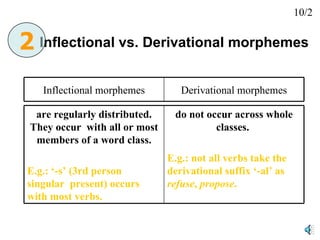
Inflectional vs. Derivational morphemes 2 10/2 Inflectional morphemes Derivational morphemes are regularly distributed. They occur  with all or most members of a word class. E.g.: ‘-s’ (3rd person singular  present) occurs with most verbs. do not occur across whole classes.  E.g.: not all verbs take the derivational suffix ‘-al’ as  refuse ,  propose .
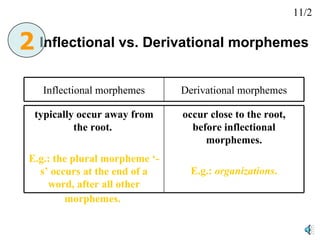
Inflectional vs. Derivational morphemes 2 11/2 Inflectional morphemes Derivational morphemes typically occur away from the root.  E.g.: the plural morpheme ‘-s’ occurs at the end of a word, after all other morphemes.   occur close to the root, before inflectional morphemes. E.g.:  organizations .
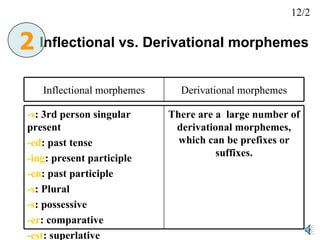
Inflectional vs. Derivational morphemes 2 12/2 Inflectional morphemes Derivational morphemes -s : 3rd person singular present -ed : past tense -ing : present participle -en : past participle -s : Plural -s : possessive -er : comparative -est : superlative There are a  large number of derivational morphemes, which can be prefixes or suffixes.
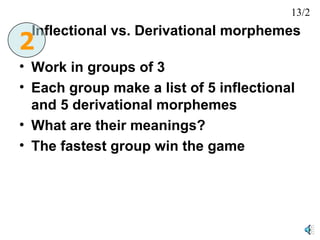
Inflectional vs. Derivational morphemes Work in groups of 3 Each group make a list of 5 inflectional and 5 derivational morphemes What are their meanings? The fastest group win the game 2 13/2
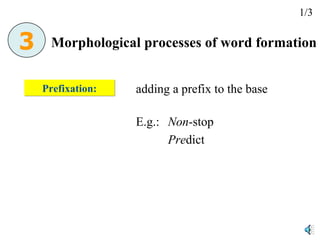
Prefixation: adding a prefix to the base E.g.:  Non -stop Pre dict Morphological processes of word formation 1/3 3
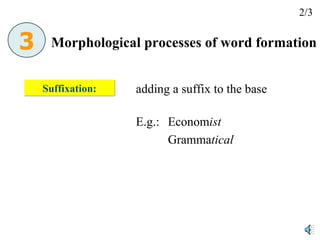
Suffixation: adding a suffix to the base   E.g.:  Econom ist Gramma tical Morphological processes of word formation 2/3 3
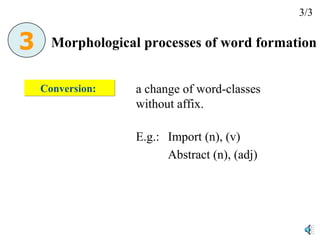
Conversion:  a change of word-classes without affix.  E.g.:  Import (n), (v) Abstract (n), (adj) Morphological processes of word formation 3/3 3
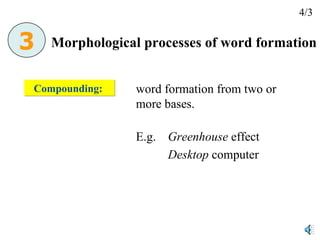
Compounding:  word formation from two or more bases. E.g.  Greenhouse  effect Desktop  computer Morphological processes of word formation 4/3 3
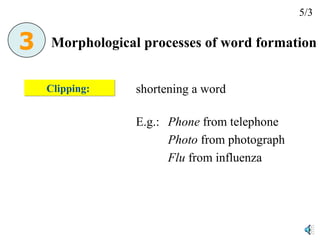
Clipping:  shortening a word E.g.:  Phone  from telephone Photo  from photograph Flu  from influenza Morphological processes of word formation 5/3 3
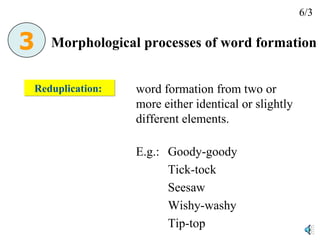
Reduplication:  word formation from two or more either identical or slightly different elements.  E.g.:  Goody-goody Tick-tock Seesaw Wishy-washy Tip-top Morphological processes of word formation 6/3 3
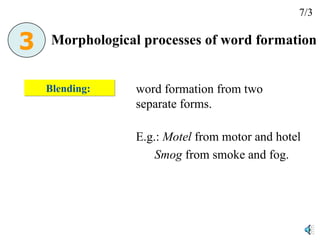
Blending:  word formation from two separate forms. E.g.:  Motel  from motor and hotel Smog  from smoke and fog. Morphological processes of word formation 7/3 3
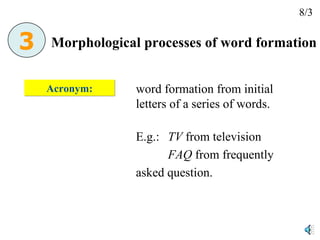
Acronym: word formation from initial letters of a series of words. E.g.:  TV  from television FAQ  from frequently  asked question. Morphological processes of word formation 8/3 3
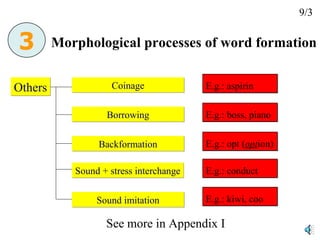
Others Coinage Borrowing Morphological processes of word formation Backformation Sound + stress interchange Sound imitation E.g.: aspirin E.g.: boss, piano E.g.: opt ( opt ion) E.g.: conduct E.g.: kiwi, coo 3 9/3 See more in Appendix I
Each student receives an affix Group yourselves into prefixes and suffixes Each student gives an example of his/her affix Morphological processes of word formation 3 10/3
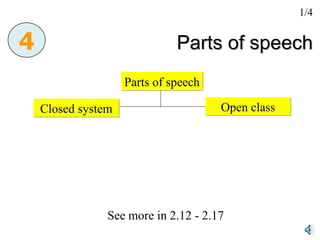
Parts of speech Parts of speech Closed system Open class 4 1/4 See more in 2.12 - 2.17
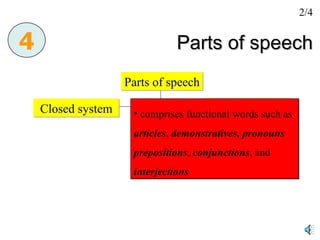
Parts of speech Parts of speech Closed system Open class 4 comprises functional words such as  articles ,  demonstratives,   pronouns   prepositions ,  conjunctions , and  interjections 2/4
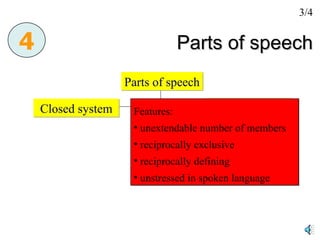
Parts of speech Parts of speech Closed system Open class 4 Features: unextendable number of members reciprocally exclusive reciprocally defining unstressed in spoken language 3/4
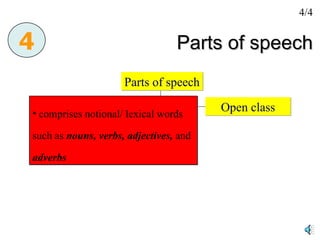
Parts of speech Parts of speech Closed system Open class 4 comprises notional/ lexical words such as  nouns, verbs, adjectives,  and  adverbs 4/4
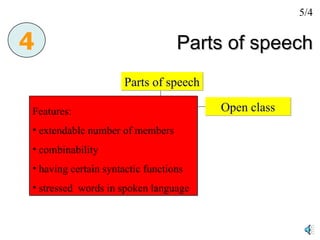
Parts of speech Parts of speech Closed system Open class 4 Features: extendable number of members combinability having certain syntactic functions stressed  words in spoken language 5/4
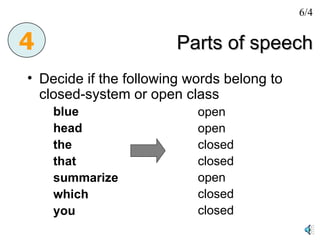
Parts of speech Decide if the following words belong to closed-system or open class blue head the that summarize which you 4 6/4 open open closed closed open closed closed
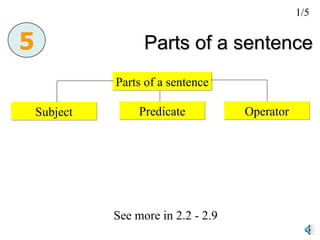
Parts of a sentence Parts of a sentence Subject Predicate 5 Operator 1/5 See more in 2.2 - 2.9
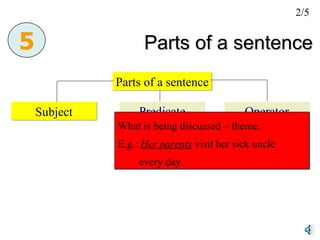
Parts of a sentence Parts of a sentence Subject Predicate 5 Operator What is being discussed – theme. E.g.:  Her parents  visit her sick uncle  every day. 2/5
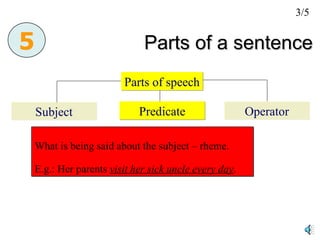
Parts of a sentence Parts of speech Subject Predicate 5 Operator What is being said about the subject – rheme. E.g.: Her parents  visit her sick uncle every day . 3/5
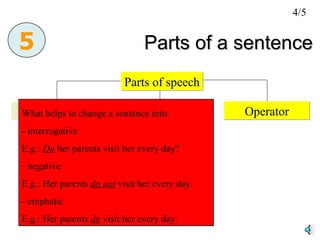
Parts of a sentence Parts of speech Subject Predicate 5 Operator What helps to change a sentence into: - interrogative E.g.:  Do  her parents visit her every day? negative E.g.: Her parents  do not  visit her every day. - emphatic E.g.: Her parents  do  visit her every day. 4/5
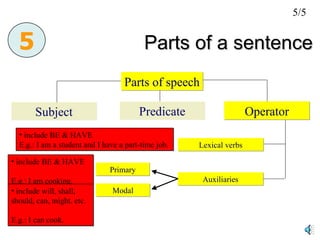
Parts of a sentence Parts of speech Subject Predicate 5 Operator 5/5 Lexical verbs Auxiliaries Primary Modal include BE & HAVE E.g.: I am a student and I have a part-time job. include BE & HAVE  E.g.: I am cooking. include will, shall, should, can, might, etc.  E.g.: I can cook.
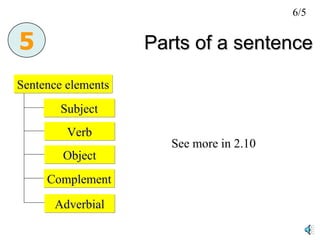
Parts of a sentence Sentence elements 5 Subject Verb Object Complement Adverbial 6/5 See more in 2.10
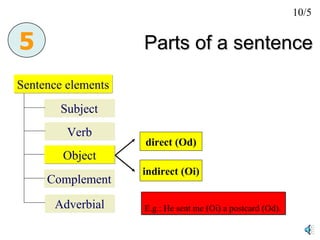
Parts of a sentence Sentence elements 5 Subject Verb Object Complement Adverbial E.g.: He sent me (Oi) a postcard (Od). 10/5 indirect (Oi) direct (Od)
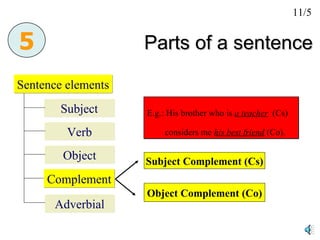
Parts of a sentence Sentence elements 5 Subject Verb Object Complement Adverbial E.g.: His brother who is  a teacher   (Cs)  considers me  his best friend  (Co). 11/5 Object Complement (Co) Subject Complement (Cs)
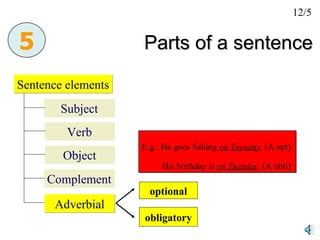
Parts of a sentence Sentence elements 5 Subject Verb Object Complement Adverbial E.g.: He goes fishing  on Tuesday . (A opt) His birthday is  on Tuesday . (A obli) 12/5 obligatory optional
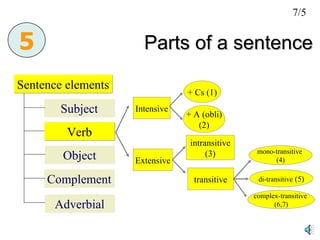
Parts of a sentence Sentence elements 5 Subject Verb Object Complement Adverbial 7/5 Intensive Extensive + Cs (1) + A (obli) (2) intransitive (3) transitive mono-transitive  (4) di-transitive  (5) complex-transitive  (6,7)
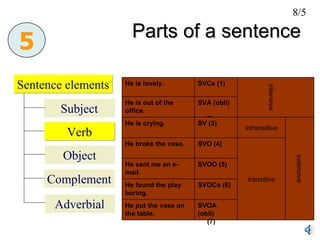
Parts of a sentence Sentence elements 5 Subject Verb Object Complement Adverbial 8/5 He is lovely.  SVCs (1) intensive He is out of the office.  SVA (obli)  (2) He is crying.  SV (3) intransitive extensive He broke the vase. SVO (4) transitive He sent me an e-mail. SVOO (5) He found the play boring.  SVOCo (6) He put the vase on the table. SVOA (obli)  (7)
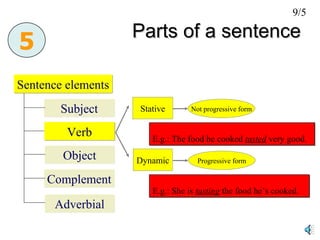
Parts of a sentence Sentence elements 5 Subject Verb Object Complement Adverbial Stative Dynamic Not progressive form Progressive form E.g.: The food he cooked  tasted  very good.  E.g.: She is  tasting  the food he’s cooked.  9/5
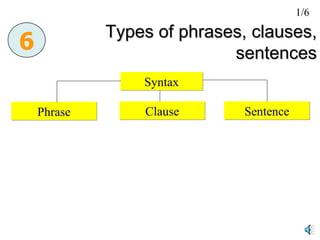
Types of phrases, clauses, sentences Syntax Phrase Clause 6 Sentence 1/6
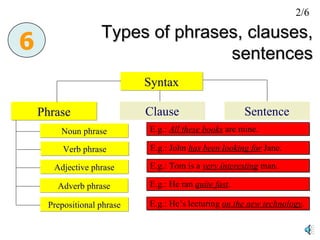
Types of phrases, clauses, sentences Syntax Phrase Clause 6 Sentence Adverb phrase Adjective phrase Verb phrase Noun phrase Prepositional phrase E.g.:  All these books  are mine. E.g.: John  has been looking for  Jane. E.g.: Tom is a  very interesting  man. E.g.: He ran  quite fast . E.g.: He’s lecturing  on the new technology . 2/6
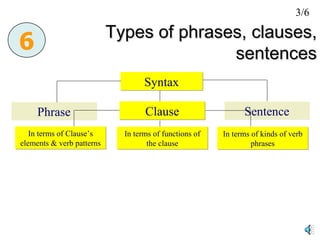
Types of phrases, clauses, sentences Syntax Phrase Clause 6 Sentence In terms of Clause’s elements & verb patterns In terms of kinds of verb phrases In terms of functions of the clause 3/6
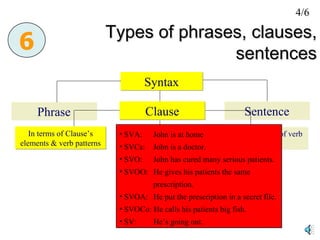
Types of phrases, clauses, sentences Syntax Phrase Clause 6 Sentence In terms of Clause’s elements & verb patterns In terms of kinds of verb phrases In terms of functions of the clause SVA:   John is at home SVCs:   John is a doctor. SVO:   John has cured many serious patients. SVOO:   He gives his patients the same    prescription. SVOA:   He put the prescription in a secret file. SVOCo: He calls his patients big fish. SV:   He’s going out. 4/6
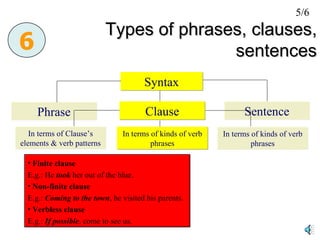
Types of phrases, clauses, sentences Syntax Phrase Clause 6 Sentence In terms of Clause’s elements & verb patterns In terms of kinds of verb phrases In terms of kinds of verb phrases Finite clause E.g.: He  took  her out of the blue. Non-finite clause E.g.:  Coming to the town , he visited his parents.  Verbless clause E.g.:  If possible , come to see us. 5/6
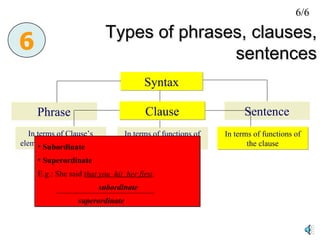
Types of phrases, clauses, sentences Syntax Phrase Clause 6 Sentence In terms of Clause’s elements & verb patterns In terms of functions of the clause In terms of functions of the clause Subordinate Superordinate E.g.: She said  that you  hit  her first . subordinate superordinate 6/6
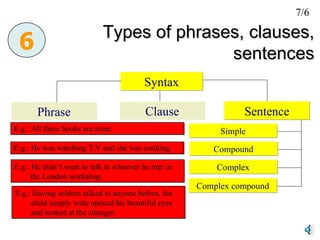
Types of phrases, clauses, sentences Syntax Phrase Clause 6 Sentence Complex compound Complex Compound Simple E.g.: All these books are mine. E.g.: He was watching T.V and she was cooking. E.g.: He didn’t want to talk to whoever he met in  the London workshop.  E.g.: Having seldom talked to anyone before, the  child simply wide opened his beautiful eyes  and looked at the stranger.  7/6
Homework Exercises 4-13 Workbook

Week 1 morphemes and words

  • 1.
    E_English Grammar Course Chapter I Elements of grammar
  • 2.
    Issues 1. Introductionto Grammar 2. Morphemes and Words 3. Ways of word formation 4. Parts of speech 5. Parts of a sentence 6. Types of phrases, clauses, sentences
  • 3.
    Introduction to GrammarGrammar In global sense In narrow sense 1 1/1
  • 4.
    Introduction to GrammarGrammar In global sense In narrow sense equals competence , a body of knowledge that a native speaker has about his/her language which enables him/her to speak and understand it. includes word and sentence structure rules, pronunciation rules, meaning of words/ sentences, and discourse organization rules. 1 2/1
  • 5.
    Introduction to GrammarGrammar In global sense In narrow sense refers only to the formation of the word and sentence structures. consists of morphology , the study of words and word formation, and syntax , the study of phrases, clauses, and sentences. 1 3/1
  • 6.
    Morphemes and Words2 1/2 discourse sentence phrase word morpheme
  • 7.
    Morphemes and WordsI actually felt tired of sitting doing nothing. And I hated enjoying the unemployment benefit. I found myself useless. Then I decided to look for a job. I found myself useless. hated enjoying hated, enjoying enjoy, -ing 2 2/2 discourse sentence phrase word morpheme
  • 8.
    Lexical item –meaning LEXICAL ITEM = A basic unit of meaning … A single word (E.g.: man , boy ) Less than a word (E.g.: terr in terror) More than one word (E.g.: to rain dogs and cats ) 2 3/2
  • 9.
    Lexical item –meaning LEXICAL ITEM MEANING & Lexical item and meaning has arbitrary relationship. 2 4/2
  • 10.
    Morpheme - Word MORPHEME = A minimal meaningful unit E.g.: re/try boy/s 5/2 2
  • 11.
    Morpheme - Word WORD = An independent meaningful unit. E.g.: try boy turn return 2 6/2
  • 12.
    Types of morphemes 2 7/2 Occurrence Types Free (words) Bound (affixes) Grammatical Function words: prepositions, pronouns, conjunctions.... inflectional (suffixes) Lexical Content words: Nouns, verbs, adverbs, adjectives derivational (prefixes, suffixes)
  • 13.
    Inflectional vs. Derivationalmorphemes 2 8/2 Inflectional morphemes Derivational morphemes modify the meaning of an item but not change its parts of speech. can change meaning of the stem and typically, they change the part of speech.
  • 14.
    Inflectional vs. Derivationalmorphemes 2 9/2 Inflectional morphemes Derivational morphemes are changes in words to express their semantic and syntactic relationships to other words in the sentence. E.g.: ‘-s’ in ‘Bush says’ indicates the present tense and the subject is third person and singular. indicate semantic relationships within words. E.g.: the morpheme ‘-ful’ in ‘beautiful’ has no connection with other morphemes beyond the word.
  • 15.
    Inflectional vs. Derivationalmorphemes 2 10/2 Inflectional morphemes Derivational morphemes are regularly distributed. They occur with all or most members of a word class. E.g.: ‘-s’ (3rd person singular present) occurs with most verbs. do not occur across whole classes. E.g.: not all verbs take the derivational suffix ‘-al’ as refuse , propose .
  • 16.
    Inflectional vs. Derivationalmorphemes 2 11/2 Inflectional morphemes Derivational morphemes typically occur away from the root. E.g.: the plural morpheme ‘-s’ occurs at the end of a word, after all other morphemes. occur close to the root, before inflectional morphemes. E.g.: organizations .
  • 17.
    Inflectional vs. Derivationalmorphemes 2 12/2 Inflectional morphemes Derivational morphemes -s : 3rd person singular present -ed : past tense -ing : present participle -en : past participle -s : Plural -s : possessive -er : comparative -est : superlative There are a large number of derivational morphemes, which can be prefixes or suffixes.
  • 18.
    Inflectional vs. Derivationalmorphemes Work in groups of 3 Each group make a list of 5 inflectional and 5 derivational morphemes What are their meanings? The fastest group win the game 2 13/2
  • 19.
    Prefixation: adding aprefix to the base E.g.: Non -stop Pre dict Morphological processes of word formation 1/3 3
  • 20.
    Suffixation: adding asuffix to the base E.g.: Econom ist Gramma tical Morphological processes of word formation 2/3 3
  • 21.
    Conversion: achange of word-classes without affix. E.g.: Import (n), (v) Abstract (n), (adj) Morphological processes of word formation 3/3 3
  • 22.
    Compounding: wordformation from two or more bases. E.g. Greenhouse effect Desktop computer Morphological processes of word formation 4/3 3
  • 23.
    Clipping: shorteninga word E.g.: Phone from telephone Photo from photograph Flu from influenza Morphological processes of word formation 5/3 3
  • 24.
    Reduplication: wordformation from two or more either identical or slightly different elements. E.g.: Goody-goody Tick-tock Seesaw Wishy-washy Tip-top Morphological processes of word formation 6/3 3
  • 25.
    Blending: wordformation from two separate forms. E.g.: Motel from motor and hotel Smog from smoke and fog. Morphological processes of word formation 7/3 3
  • 26.
    Acronym: word formationfrom initial letters of a series of words. E.g.: TV from television FAQ from frequently asked question. Morphological processes of word formation 8/3 3
  • 27.
    Others Coinage BorrowingMorphological processes of word formation Backformation Sound + stress interchange Sound imitation E.g.: aspirin E.g.: boss, piano E.g.: opt ( opt ion) E.g.: conduct E.g.: kiwi, coo 3 9/3 See more in Appendix I
  • 28.
    Each student receivesan affix Group yourselves into prefixes and suffixes Each student gives an example of his/her affix Morphological processes of word formation 3 10/3
  • 29.
    Parts of speechParts of speech Closed system Open class 4 1/4 See more in 2.12 - 2.17
  • 30.
    Parts of speechParts of speech Closed system Open class 4 comprises functional words such as articles , demonstratives, pronouns prepositions , conjunctions , and interjections 2/4
  • 31.
    Parts of speechParts of speech Closed system Open class 4 Features: unextendable number of members reciprocally exclusive reciprocally defining unstressed in spoken language 3/4
  • 32.
    Parts of speechParts of speech Closed system Open class 4 comprises notional/ lexical words such as nouns, verbs, adjectives, and adverbs 4/4
  • 33.
    Parts of speechParts of speech Closed system Open class 4 Features: extendable number of members combinability having certain syntactic functions stressed words in spoken language 5/4
  • 34.
    Parts of speechDecide if the following words belong to closed-system or open class blue head the that summarize which you 4 6/4 open open closed closed open closed closed
  • 35.
    Parts of asentence Parts of a sentence Subject Predicate 5 Operator 1/5 See more in 2.2 - 2.9
  • 36.
    Parts of asentence Parts of a sentence Subject Predicate 5 Operator What is being discussed – theme. E.g.: Her parents visit her sick uncle every day. 2/5
  • 37.
    Parts of asentence Parts of speech Subject Predicate 5 Operator What is being said about the subject – rheme. E.g.: Her parents visit her sick uncle every day . 3/5
  • 38.
    Parts of asentence Parts of speech Subject Predicate 5 Operator What helps to change a sentence into: - interrogative E.g.: Do her parents visit her every day? negative E.g.: Her parents do not visit her every day. - emphatic E.g.: Her parents do visit her every day. 4/5
  • 39.
    Parts of asentence Parts of speech Subject Predicate 5 Operator 5/5 Lexical verbs Auxiliaries Primary Modal include BE & HAVE E.g.: I am a student and I have a part-time job. include BE & HAVE E.g.: I am cooking. include will, shall, should, can, might, etc. E.g.: I can cook.
  • 40.
    Parts of asentence Sentence elements 5 Subject Verb Object Complement Adverbial 6/5 See more in 2.10
  • 41.
    Parts of asentence Sentence elements 5 Subject Verb Object Complement Adverbial E.g.: He sent me (Oi) a postcard (Od). 10/5 indirect (Oi) direct (Od)
  • 42.
    Parts of asentence Sentence elements 5 Subject Verb Object Complement Adverbial E.g.: His brother who is a teacher (Cs) considers me his best friend (Co). 11/5 Object Complement (Co) Subject Complement (Cs)
  • 43.
    Parts of asentence Sentence elements 5 Subject Verb Object Complement Adverbial E.g.: He goes fishing on Tuesday . (A opt) His birthday is on Tuesday . (A obli) 12/5 obligatory optional
  • 44.
    Parts of asentence Sentence elements 5 Subject Verb Object Complement Adverbial 7/5 Intensive Extensive + Cs (1) + A (obli) (2) intransitive (3) transitive mono-transitive (4) di-transitive (5) complex-transitive (6,7)
  • 45.
    Parts of asentence Sentence elements 5 Subject Verb Object Complement Adverbial 8/5 He is lovely. SVCs (1) intensive He is out of the office. SVA (obli) (2) He is crying. SV (3) intransitive extensive He broke the vase. SVO (4) transitive He sent me an e-mail. SVOO (5) He found the play boring. SVOCo (6) He put the vase on the table. SVOA (obli) (7)
  • 46.
    Parts of asentence Sentence elements 5 Subject Verb Object Complement Adverbial Stative Dynamic Not progressive form Progressive form E.g.: The food he cooked tasted very good. E.g.: She is tasting the food he’s cooked. 9/5
  • 47.
    Types of phrases,clauses, sentences Syntax Phrase Clause 6 Sentence 1/6
  • 48.
    Types of phrases,clauses, sentences Syntax Phrase Clause 6 Sentence Adverb phrase Adjective phrase Verb phrase Noun phrase Prepositional phrase E.g.: All these books are mine. E.g.: John has been looking for Jane. E.g.: Tom is a very interesting man. E.g.: He ran quite fast . E.g.: He’s lecturing on the new technology . 2/6
  • 49.
    Types of phrases,clauses, sentences Syntax Phrase Clause 6 Sentence In terms of Clause’s elements & verb patterns In terms of kinds of verb phrases In terms of functions of the clause 3/6
  • 50.
    Types of phrases,clauses, sentences Syntax Phrase Clause 6 Sentence In terms of Clause’s elements & verb patterns In terms of kinds of verb phrases In terms of functions of the clause SVA: John is at home SVCs: John is a doctor. SVO: John has cured many serious patients. SVOO: He gives his patients the same prescription. SVOA: He put the prescription in a secret file. SVOCo: He calls his patients big fish. SV: He’s going out. 4/6
  • 51.
    Types of phrases,clauses, sentences Syntax Phrase Clause 6 Sentence In terms of Clause’s elements & verb patterns In terms of kinds of verb phrases In terms of kinds of verb phrases Finite clause E.g.: He took her out of the blue. Non-finite clause E.g.: Coming to the town , he visited his parents. Verbless clause E.g.: If possible , come to see us. 5/6
  • 52.
    Types of phrases,clauses, sentences Syntax Phrase Clause 6 Sentence In terms of Clause’s elements & verb patterns In terms of functions of the clause In terms of functions of the clause Subordinate Superordinate E.g.: She said that you hit her first . subordinate superordinate 6/6
  • 53.
    Types of phrases,clauses, sentences Syntax Phrase Clause 6 Sentence Complex compound Complex Compound Simple E.g.: All these books are mine. E.g.: He was watching T.V and she was cooking. E.g.: He didn’t want to talk to whoever he met in the London workshop. E.g.: Having seldom talked to anyone before, the child simply wide opened his beautiful eyes and looked at the stranger. 7/6
  • 54.