The term syntax is from the ancient Greek 
“Syntaxis”, a verbal noun which literally 
means “arrangement” or “setting out 
together”. 
It refers to the branch of grammar dealing with 
the ways in which words, with or without 
appropriate inflections, are arranged to show 
connections of meanings within the sentence.
DSGFSDFG 
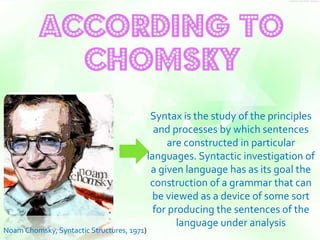
Syntax is the study of the principles 
and processes by which sentences 
are constructed in particular 
languages. Syntactic investigation of 
a given language has as its goal the 
construction of a grammar that can 
be viewed as a device of some sort 
for producing the sentences of the 
language under analysis 
Noam Chomsky, Syntactic Structures, 1971)
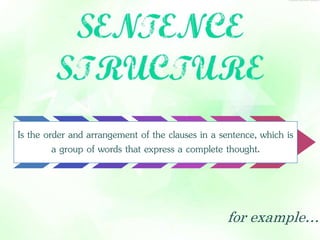
Is the order and arrangement of the clauses in a sentence, which is 
a group of words that express a complete thought. 
for example…
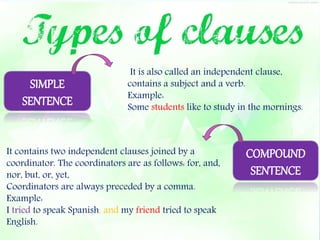
It is also called an independent clause, 
contains a subject and a verb. 
Example: 
Some students like to study in the mornings. 
SIMPLE 
SENTENCE 
It contains two independent clauses joined by a 
coordinator. The coordinators are as follows: for, and, 
nor, but, or, yet, 
Coordinators are always preceded by a comma. 
Example: 
I tried to speak Spanish, and my friend tried to speak 
English. 
COMPOUND 
SENTENCE
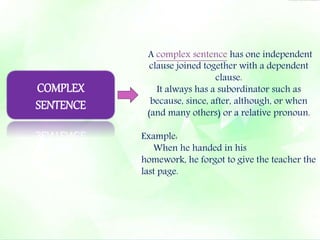
A complex sentence has one independent 
clause joined together with a dependent 
clause. 
It always has a subordinator such as 
because, since, after, although, or when 
(and many others) or a relative pronoun. 
Example: 
When he handed in his 
homework, he forgot to give the teacher the 
last page. 
COMPLEX 
SENTENCE
A family of expressions that can substitute for 
one another without loss of grammatically is 
called a synthetic category. It divides into two 
groups.
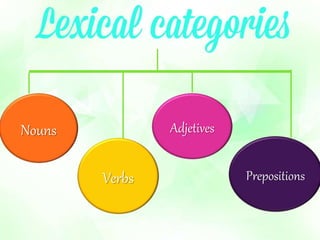
Nouns 
Adjetives 
Verbs Prepositions
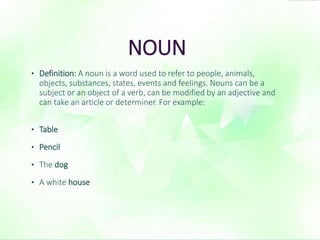
NOUN 
• Definition: A noun is a word used to refer to people, animals, 
objects, substances, states, events and feelings. Nouns can be a 
subject or an object of a verb, can be modified by an adjective and 
can take an article or determiner. For example: 
• Table 
• Pencil 
• The dog 
• A white house
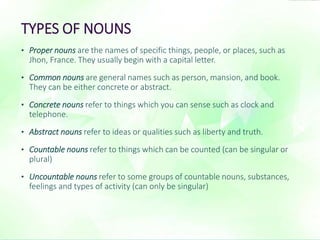
TYPES OF NOUNS 
• Proper nouns are the names of specific things, people, or places, such as 
Jhon, France. They usually begin with a capital letter. 
• Common nouns are general names such as person, mansion, and book. 
They can be either concrete or abstract. 
• Concrete nouns refer to things which you can sense such as clock and 
telephone. 
• Abstract nouns refer to ideas or qualities such as liberty and truth. 
• Countable nouns refer to things which can be counted (can be singular or 
plural) 
• Uncountable nouns refer to some groups of countable nouns, substances, 
feelings and types of activity (can only be singular)
VERB 
The part of speech (or word class) that describes an action or occurrence or indicates 
a state of being. 
DIRECT OBJECT OF A VERB 
Many verbs perform an action on something. This is called the direct object of the 
verb. 
Terry kissed her hand. 
• (her hand - direct object of the verb to kiss) 
Beverly will eat a whole chicken. 
• (a whole chicken - direct object of the verb to eat)
• INTRANSITIVE VERBS 
Some verbs cannot have a direct object. These verbs are said to 
be intransitive verbs. 
The rain fell heavily. 
• (The rain fell, but it did not perform an action on anything. In this example, 
the verb to fall is an intransitive verb.) 
Jack protested in the street. 
• (Jack protested, but he did not perform an action on anything. In this 
example, the verb to protest is an intransitive verb.) 
• 
Verbs that can have a direct object (most of them) are called transitive 
verbs. 
Barney copied the answer. 
• (the answer - direct object of the transitive verb to copy)
• Transitive verbs are action verbs that have an object to 
receive that action. In the first sentence above, the 
direct object ball received the action of the verb hit. 
• Here are some more examples of transitive verbs: 
• I baked some cookies. 
• I rode the bicycle. 
• I moved the chair. 
• I stitched a quilt.
INDIRECT OBJECT OF A VERB 
Some verbs have two objects, a direct object (see above) and an indirect 
object. The indirect object is the person or thing for whom the action was 
performed. 
Jamie read the children a story. 
• (a story - direct object; the children - indirect object) 
I will bake him a cake. 
• (a cake - direct object; him - indirect object) 
The postman gives Anne a letter every day. 
• (a letter - direct object; Anne - indirect object)
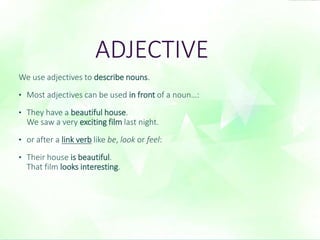
ADJECTIVE 
We use adjectives to describe nouns. 
• Most adjectives can be used in front of a noun…: 
• They have a beautiful house. 
We saw a very exciting film last night. 
• or after a link verb like be, look or feel: 
• Their house is beautiful. 
That film looks interesting.
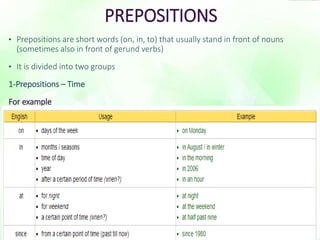
PREPOSITIONS 
• Prepositions are short words (on, in, to) that usually stand in front of nouns 
(sometimes also in front of gerund verbs) 
• It is divided into two groups 
1-Prepositions – Time 
For example
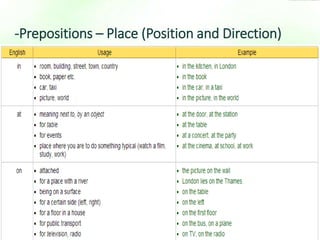
-Prepositions – Place (Position and Direction)
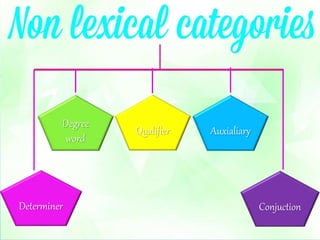
Degree 
word 
Determiner 
Qualifier Auxialiary 
Conjuction
•Determiners 
are words which come at the beginning of the noun phrase. 
They tell us whether the noun phrase is specific or general. 
Determiners are either specific or general 
• Specific determiners: 
• The specific determiners are: 
-the definite article: the 
-possessives: my, your, his, her, its; our, their, whose 
-demonstratives: this, that, these, those
• In general determiner we find 
• A quantifier is a word or phrase which is used 
before a noun to indicate the amount or 
quantity: 
'Some', 'many', 'a lot of' and 'a few' are examples 
of quantifiers. 
• Quantifiers can be used with both countable and 
uncountable nouns. 
-Examples: 
• There are some books on the desk 
He's got only a few dollars.
DEGRE WORDS 
• are words that modify adjectives or adverbs 
and express a degree 
- Very, rather, too 
- For example: 
-It is very funny 
-They are very expensive
QUALIFIER 
• Are word or phrase that follo an adjective or a 
adverb. Qualifier do not modify verb, also it 
can not be made in comparative or superlative 
form. 
• For example 
-The baby is almost asleep
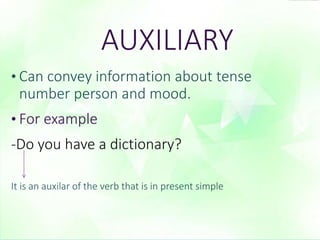
AUXILIARY 
• Can convey information about tense 
number person and mood. 
• For example 
-Do you have a dictionary? 
It is an auxilar of the verb that is in present simple
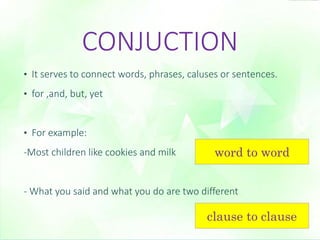
CONJUCTION 
• It serves to connect words, phrases, caluses or sentences. 
• for ,and, but, yet 
• For example: 
-Most children like cookies and milk 
word to word 
- What you said and what you do are two different 
clause to clause
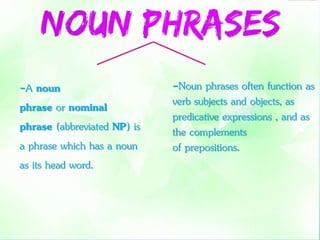
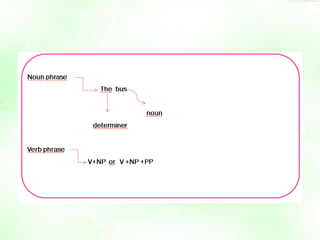
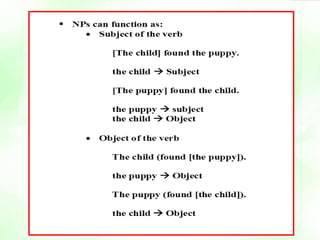
-Noun phrases often function as 
verb subjects and objects, as 
predicative expressions , and as 
the complements 
of prepositions. 
-A noun 
phrase or nominal 
phrase (abbreviated NP) is 
a phrase which has a noun 
as its head word.
• Often a noun phrase is just a noun or a pronoun: 
-People like to have money. 
-I am tired. 
-It is getting late. 
• or a determiner and a noun …: 
-Our friends have bought a house in the village. 
-Those houses are very expensive. 
• … perhaps with an adjective: 
-Our closest friends have just bought a new house in the village.
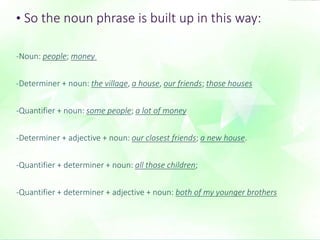
• So the noun phrase is built up in this way: 
-Noun: people; money 
-Determiner + noun: the village, a house, our friends; those houses 
-Quantifier + noun: some people; a lot of money 
-Determiner + adjective + noun: our closest friends; a new house. 
-Quantifier + determiner + noun: all those children; 
-Quantifier + determiner + adjective + noun: both of my younger brothers
In simple words, a verb of more than one word is called a verb 
phrase. It is a phrase consisting of a verb, its auxiliaries (helping 
verbs), its complements, and other modifiers. Auxiliary verbs always 
come before the main verb. 
Examples 
She has taken the job. (Auxiliary has + main verb taken) 
Mom is making the room. (auxiliary is + main verb make)
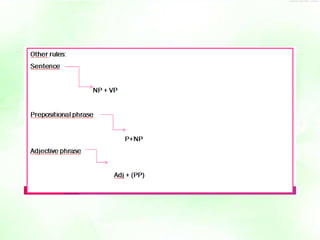
An adjectival phrase is a group of words that describe a noun or 
pronoun in a sentence. The adjective phrase can be placed before, or 
after, the noun or pronoun in the sentence. 
Examples: 
The movie was not too terribly long. 
Mom said the cost of a car is way too high.
A prepositional phrase is a group of words containing 
a preposition, a noun or pronoun object of the preposition, and 
any modifiers of the object. 
Example: 
After several minutes we located the key for the door. 
We drove to the store
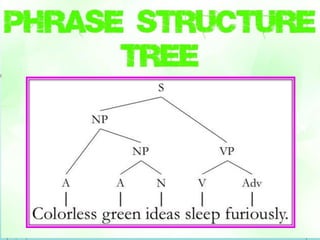
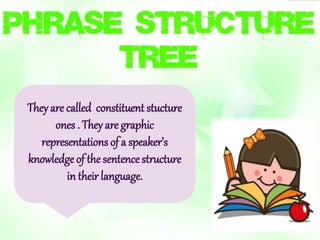
They are called constituent stucture 
ones . They are graphic 
representations of a speaker’s 
knowledge of the sentence structure 
in their language.
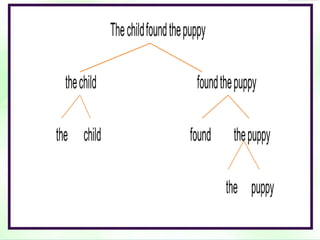
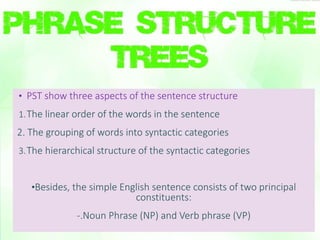
• PST show three aspects of the sentence structure 
1.The linear order of the words in the sentence 
2. The grouping of words into syntactic categories 
3.The hierarchical structure of the syntactic categories 
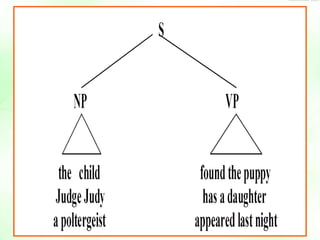
•Besides, the simple English sentence consists of two principal 
constituents: 
-.Noun Phrase (NP) and Verb phrase (VP)
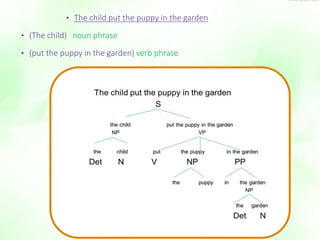
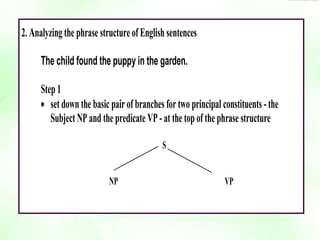
2. Analyzing the phrase structure of English sentences 
The child found the puppy in the garden. 
Step 1 
 set down the basic pair of branches for two principal constituents - the 
Subject NP and the predicate VP - at the top of the phrase structure 
S 
NP VP
• The child put the puppy in the garden 
• (The child) noun phrase 
• (put the puppy in the garden) verb phrase
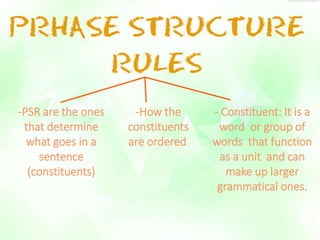
-PSR are the ones 
that determine 
what goes in a 
sentence 
(constituents) 
-How the 
constituents 
are ordered. 
- Constituent: It is a 
word or group of 
words that function 
as a unit and can 
make up larger 
grammatical ones.
Syntax and morphology are both important to the way that people 
derive meaning from language, but they are different in that syntax 
refers to the order and use of words, and morphology refers to the 
parts of words that create meaning. For example, it is possible to 
create a sentence that is grammatically correct, but that makes no 
sense to a speaker of the language.
-(QuickBooks, 2010) 
QuickBooks. (01 de November de 2010). Obtenido de QuickBooks: 
http://www.docstoc.com/docs/21773473/Noam-Chomsky-on-Syntax---Syntactic- 
Structures-_1957__-Aspects-Of 
(Science, 2001) 
Science, E. o. (22 de March de 2001). Macmillan Reference Ltd. Obtenido de 
Macmillan Reference Ltd: 
http://202.194.48.102/englishonline/jxyj/xslw/readings%20in%20syntax/amsa-18- 
0900.pdf 
-(The University of Sheffield, 2012) 
Lightfoot, D. W. (2002). Syntactic Structures. Berlin: Mouton de Gruyter. 
The University of Sheffield. (03 de 06 de 2012). Obtenido de The University of 
Sheffield: https://sites.google.com/a/sheffield.ac.uk/all-about-linguistics/ 
branches/syntax/what-is-syntax 
-Chomsky, N. (1988). Syntax. En N. Chomsky, Aspects of the Theory of Syntax 
(pág. 251 pg). MIT Press.
GROUP 
-Brigitte Cruz Rojas. 
-Leslie Chavarría Quiroz. 
-Karolayn Gomez Blanco. 
-Carolina Gutiérrez Castillón. 
-Marleni Ortiz Vilca. 
.

syntax

  • 2.
    The term syntaxis from the ancient Greek “Syntaxis”, a verbal noun which literally means “arrangement” or “setting out together”. It refers to the branch of grammar dealing with the ways in which words, with or without appropriate inflections, are arranged to show connections of meanings within the sentence.
  • 3.
    DSGFSDFG Syntax isthe study of the principles and processes by which sentences are constructed in particular languages. Syntactic investigation of a given language has as its goal the construction of a grammar that can be viewed as a device of some sort for producing the sentences of the language under analysis Noam Chomsky, Syntactic Structures, 1971)
  • 4.
    Is the orderand arrangement of the clauses in a sentence, which is a group of words that express a complete thought. for example…
  • 6.
    It is alsocalled an independent clause, contains a subject and a verb. Example: Some students like to study in the mornings. SIMPLE SENTENCE It contains two independent clauses joined by a coordinator. The coordinators are as follows: for, and, nor, but, or, yet, Coordinators are always preceded by a comma. Example: I tried to speak Spanish, and my friend tried to speak English. COMPOUND SENTENCE
  • 7.
    A complex sentencehas one independent clause joined together with a dependent clause. It always has a subordinator such as because, since, after, although, or when (and many others) or a relative pronoun. Example: When he handed in his homework, he forgot to give the teacher the last page. COMPLEX SENTENCE
  • 8.
    A family ofexpressions that can substitute for one another without loss of grammatically is called a synthetic category. It divides into two groups.
  • 9.
  • 10.
    NOUN • Definition:A noun is a word used to refer to people, animals, objects, substances, states, events and feelings. Nouns can be a subject or an object of a verb, can be modified by an adjective and can take an article or determiner. For example: • Table • Pencil • The dog • A white house
  • 11.
    TYPES OF NOUNS • Proper nouns are the names of specific things, people, or places, such as Jhon, France. They usually begin with a capital letter. • Common nouns are general names such as person, mansion, and book. They can be either concrete or abstract. • Concrete nouns refer to things which you can sense such as clock and telephone. • Abstract nouns refer to ideas or qualities such as liberty and truth. • Countable nouns refer to things which can be counted (can be singular or plural) • Uncountable nouns refer to some groups of countable nouns, substances, feelings and types of activity (can only be singular)
  • 12.
    VERB The partof speech (or word class) that describes an action or occurrence or indicates a state of being. DIRECT OBJECT OF A VERB Many verbs perform an action on something. This is called the direct object of the verb. Terry kissed her hand. • (her hand - direct object of the verb to kiss) Beverly will eat a whole chicken. • (a whole chicken - direct object of the verb to eat)
  • 13.
    • INTRANSITIVE VERBS Some verbs cannot have a direct object. These verbs are said to be intransitive verbs. The rain fell heavily. • (The rain fell, but it did not perform an action on anything. In this example, the verb to fall is an intransitive verb.) Jack protested in the street. • (Jack protested, but he did not perform an action on anything. In this example, the verb to protest is an intransitive verb.) • Verbs that can have a direct object (most of them) are called transitive verbs. Barney copied the answer. • (the answer - direct object of the transitive verb to copy)
  • 14.
    • Transitive verbsare action verbs that have an object to receive that action. In the first sentence above, the direct object ball received the action of the verb hit. • Here are some more examples of transitive verbs: • I baked some cookies. • I rode the bicycle. • I moved the chair. • I stitched a quilt.
  • 15.
    INDIRECT OBJECT OFA VERB Some verbs have two objects, a direct object (see above) and an indirect object. The indirect object is the person or thing for whom the action was performed. Jamie read the children a story. • (a story - direct object; the children - indirect object) I will bake him a cake. • (a cake - direct object; him - indirect object) The postman gives Anne a letter every day. • (a letter - direct object; Anne - indirect object)
  • 16.
    ADJECTIVE We useadjectives to describe nouns. • Most adjectives can be used in front of a noun…: • They have a beautiful house. We saw a very exciting film last night. • or after a link verb like be, look or feel: • Their house is beautiful. That film looks interesting.
  • 17.
    PREPOSITIONS • Prepositionsare short words (on, in, to) that usually stand in front of nouns (sometimes also in front of gerund verbs) • It is divided into two groups 1-Prepositions – Time For example
  • 18.
    -Prepositions – Place(Position and Direction)
  • 19.
    Degree word Determiner Qualifier Auxialiary Conjuction
  • 20.
    •Determiners are wordswhich come at the beginning of the noun phrase. They tell us whether the noun phrase is specific or general. Determiners are either specific or general • Specific determiners: • The specific determiners are: -the definite article: the -possessives: my, your, his, her, its; our, their, whose -demonstratives: this, that, these, those
  • 21.
    • In generaldeterminer we find • A quantifier is a word or phrase which is used before a noun to indicate the amount or quantity: 'Some', 'many', 'a lot of' and 'a few' are examples of quantifiers. • Quantifiers can be used with both countable and uncountable nouns. -Examples: • There are some books on the desk He's got only a few dollars.
  • 22.
    DEGRE WORDS •are words that modify adjectives or adverbs and express a degree - Very, rather, too - For example: -It is very funny -They are very expensive
  • 23.
    QUALIFIER • Areword or phrase that follo an adjective or a adverb. Qualifier do not modify verb, also it can not be made in comparative or superlative form. • For example -The baby is almost asleep
  • 24.
    AUXILIARY • Canconvey information about tense number person and mood. • For example -Do you have a dictionary? It is an auxilar of the verb that is in present simple
  • 25.
    CONJUCTION • Itserves to connect words, phrases, caluses or sentences. • for ,and, but, yet • For example: -Most children like cookies and milk word to word - What you said and what you do are two different clause to clause
  • 27.
    -Noun phrases oftenfunction as verb subjects and objects, as predicative expressions , and as the complements of prepositions. -A noun phrase or nominal phrase (abbreviated NP) is a phrase which has a noun as its head word.
  • 28.
    • Often anoun phrase is just a noun or a pronoun: -People like to have money. -I am tired. -It is getting late. • or a determiner and a noun …: -Our friends have bought a house in the village. -Those houses are very expensive. • … perhaps with an adjective: -Our closest friends have just bought a new house in the village.
  • 29.
    • So thenoun phrase is built up in this way: -Noun: people; money -Determiner + noun: the village, a house, our friends; those houses -Quantifier + noun: some people; a lot of money -Determiner + adjective + noun: our closest friends; a new house. -Quantifier + determiner + noun: all those children; -Quantifier + determiner + adjective + noun: both of my younger brothers
  • 30.
    In simple words,a verb of more than one word is called a verb phrase. It is a phrase consisting of a verb, its auxiliaries (helping verbs), its complements, and other modifiers. Auxiliary verbs always come before the main verb. Examples She has taken the job. (Auxiliary has + main verb taken) Mom is making the room. (auxiliary is + main verb make)
  • 31.
    An adjectival phraseis a group of words that describe a noun or pronoun in a sentence. The adjective phrase can be placed before, or after, the noun or pronoun in the sentence. Examples: The movie was not too terribly long. Mom said the cost of a car is way too high.
  • 32.
    A prepositional phraseis a group of words containing a preposition, a noun or pronoun object of the preposition, and any modifiers of the object. Example: After several minutes we located the key for the door. We drove to the store
  • 34.
    They are calledconstituent stucture ones . They are graphic representations of a speaker’s knowledge of the sentence structure in their language.
  • 35.
    • PST showthree aspects of the sentence structure 1.The linear order of the words in the sentence 2. The grouping of words into syntactic categories 3.The hierarchical structure of the syntactic categories •Besides, the simple English sentence consists of two principal constituents: -.Noun Phrase (NP) and Verb phrase (VP)
  • 38.
    2. Analyzing thephrase structure of English sentences The child found the puppy in the garden. Step 1  set down the basic pair of branches for two principal constituents - the Subject NP and the predicate VP - at the top of the phrase structure S NP VP
  • 39.
    • The childput the puppy in the garden • (The child) noun phrase • (put the puppy in the garden) verb phrase
  • 40.
    -PSR are theones that determine what goes in a sentence (constituents) -How the constituents are ordered. - Constituent: It is a word or group of words that function as a unit and can make up larger grammatical ones.
  • 44.
    Syntax and morphologyare both important to the way that people derive meaning from language, but they are different in that syntax refers to the order and use of words, and morphology refers to the parts of words that create meaning. For example, it is possible to create a sentence that is grammatically correct, but that makes no sense to a speaker of the language.
  • 46.
    -(QuickBooks, 2010) QuickBooks.(01 de November de 2010). Obtenido de QuickBooks: http://www.docstoc.com/docs/21773473/Noam-Chomsky-on-Syntax---Syntactic- Structures-_1957__-Aspects-Of (Science, 2001) Science, E. o. (22 de March de 2001). Macmillan Reference Ltd. Obtenido de Macmillan Reference Ltd: http://202.194.48.102/englishonline/jxyj/xslw/readings%20in%20syntax/amsa-18- 0900.pdf -(The University of Sheffield, 2012) Lightfoot, D. W. (2002). Syntactic Structures. Berlin: Mouton de Gruyter. The University of Sheffield. (03 de 06 de 2012). Obtenido de The University of Sheffield: https://sites.google.com/a/sheffield.ac.uk/all-about-linguistics/ branches/syntax/what-is-syntax -Chomsky, N. (1988). Syntax. En N. Chomsky, Aspects of the Theory of Syntax (pág. 251 pg). MIT Press.
  • 49.
    GROUP -Brigitte CruzRojas. -Leslie Chavarría Quiroz. -Karolayn Gomez Blanco. -Carolina Gutiérrez Castillón. -Marleni Ortiz Vilca. .