The Analysis of Word Structure
Morphology 
Words like read, language, tall, on, etc. must be 
learned and stored as separate items in the 
lexicon. 
Therefore, part of the linguistic competence is the 
ability to construct and interpret words. 
This system of categories and rules involved in 
word formation and interpretation is called 
morphology.
Word 
definition 
Words are meaningful linguistic units that can 
combine to form larger structures (phrases, clauses, or 
sentences). 
A word is associated with a particular meaning.. 
It is a unit of expression that is intuitively recognizable 
by native speakers.
Morphology 
Identifying Morphemes 
A morpheme can carry info about meaning or function. Haunt 
cannot be broken down into h + aunt because only aunt has meaning. 
Bats can be broken down into 2 morphemes: bat + -s (where the 2nd 
morpheme means more than one). 
The meanings of individual morphemes should contribute to the 
overall meaning of the word. pumpkin cannot be broken down into 
pump + kin because the meaning of pumpkin has nothing to do with 
that. 
Morphology 
Slide 3
Morpheme 
 A morpheme is not the same thing as a syllable. treat = 1 
morpheme and 1 syllable; dracula = 1 morpheme and 3 syllables; - 
s (PLURAL) in English = 1 morpheme and is not even 1 syllable. 
 Often during word formation, changes in pronunciation and/or 
spelling occur. These do not affect a morpheme’s status as a 
morpheme. 
scare + -y = scary (root = scare); scary + -er = scarier (root = scare)
Word 
identification 
Words are the physically definable units one 
encounters in a stretch of writing or speech. 
Words are most stable of all linguistic units, in respect 
of their internal structure. 
Words are uninterruptible.
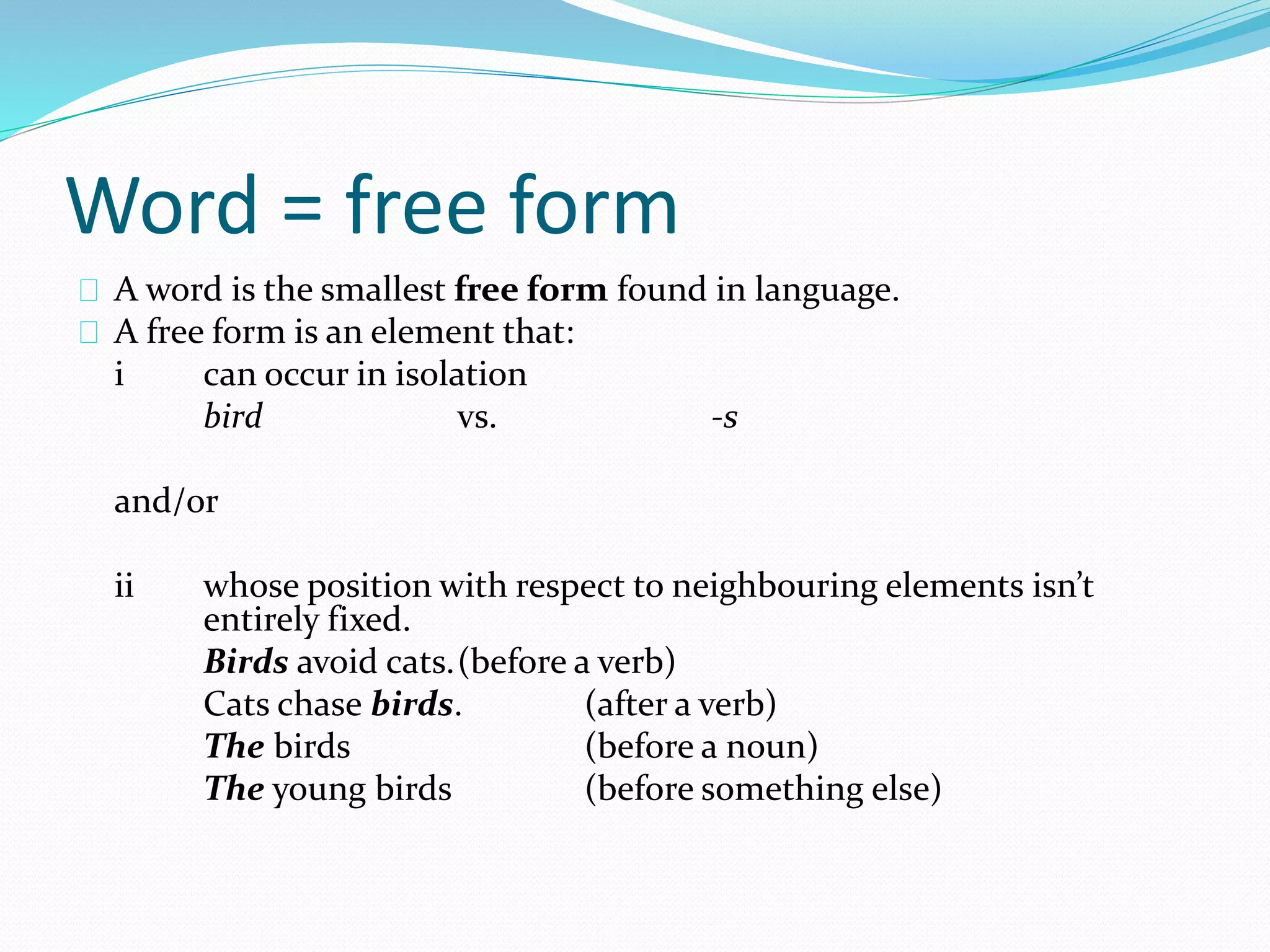
Word = free form 
A word is the smallest free form found in language. 
A free form is an element that: 
i can occur in isolation 
bird vs. -s 
and/or 
ii whose position with respect to neighbouring elements isn’t 
entirely fixed. 
Birds avoid cats.(before a verb) 
Cats chase birds. (after a verb) 
The birds (before a noun) 
The young birds (before something else)
Morpheme 
Words have an internal structure consisting of smaller 
units organized with respect to each other. 
The most important component of word structure is the 
morpheme. 
It is the smallest unit of language that carries information 
about meaning or function: 
builder = build + -er 
‘construct’ ‘one who does’ 
houses = house + -s 
‘dwelling’ ‘more than one’
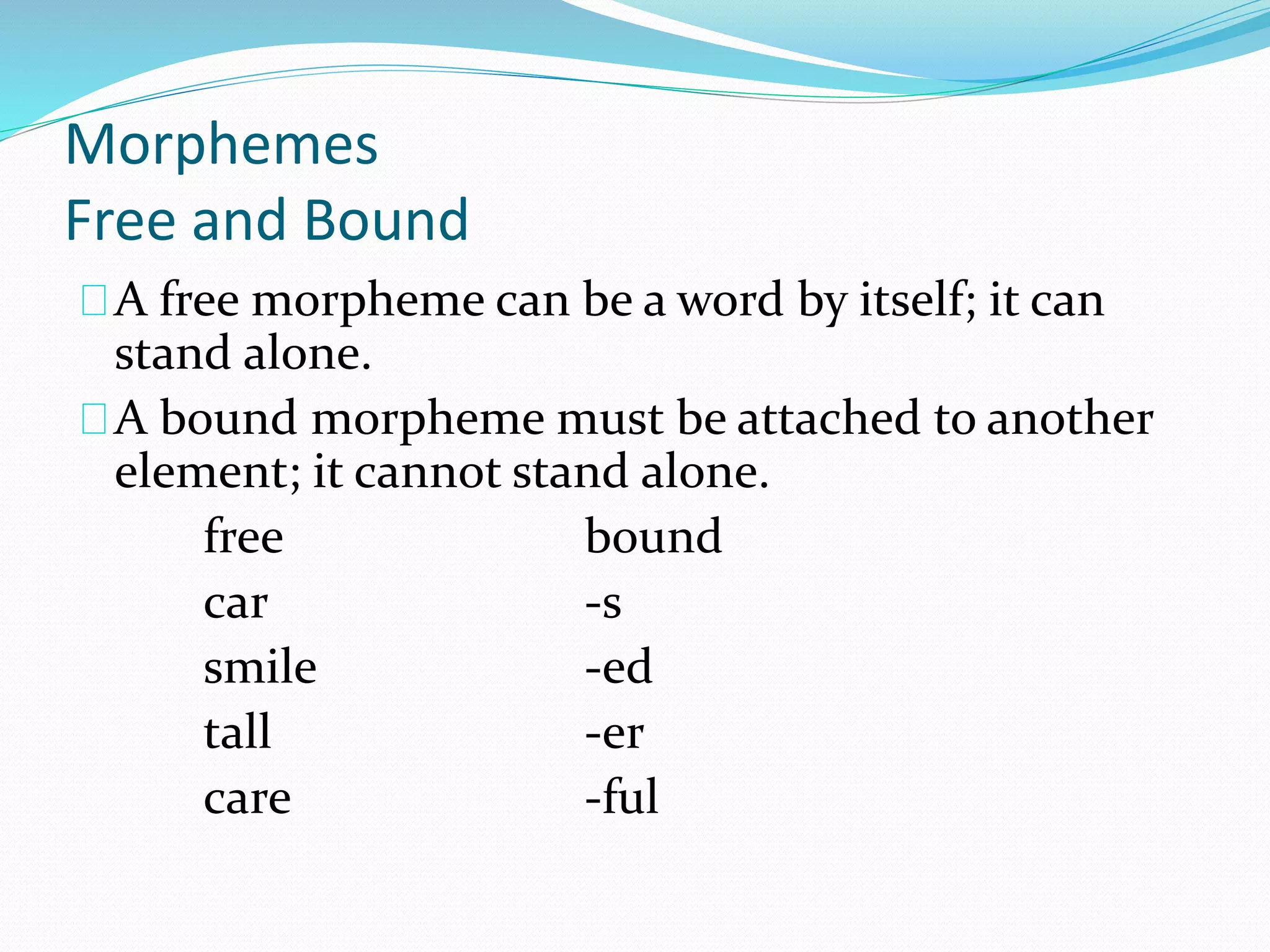
Morphemes 
Free and Bound 
A free morpheme can be a word by itself; it can 
stand alone. 
A bound morpheme must be attached to another 
element; it cannot stand alone. 
free bound 
car -s 
smile -ed 
tall -er 
care -ful
Allomorphs 
Morphemes do not always have an invariant form. 
The variant forms of a morpheme are called its 
allomorphs. 
English indefiniteness: a/an 
English past tense: d, t, әd 
English plural: z (cats), s (dogs), әz (horses)
Morphology 
Morphology 
Slide 2 
 Morpheme - the smallest unit of language that carries information 
about meaning or function (builder has 2 morphemes: build and -er) 
 Simple words - contain only 1 morpheme 
 Complex words - contain more than 1 morpheme 
 Free morpheme - a morpheme that can be a word by itself 
 Bound morpheme - a morpheme that must be attached to another 
element
Now consider the word reconsideration. We 
can break it into three morphemes: re-, 
consider, and -ation. 
Consider is called the stem/root. A 
stem/root is a base unit to which another 
morphological piece is attached.
Morphology Practice 
WORD # of Morphemes FREE BOUND 
2 erase -er 
1 wicked 
2 valid in- 
1 invalid 
2 walk -ed 
2 Jack -s 
5 act re-, -ive, -ate, -tion 
eraser 
wicked 
invalid (A) 
invalid (N) 
walked 
Jack’s 
reactivation 
Morphology 
Practice 
4
Morphology 
Morphology 
Slide 12 
 Word structure 
 Root/stem - the core of the word and carries the major component of 
meaning 
 Lexical category - Noun (N), Adjective (A), Verb (V), Preposition (P) 
 Affixes - general term for a morpheme that does not have a lexical 
category, and is always bound 
Base is the form to which an affix is attached (most cases it is the root)
Morphology 
Morphology 
Slide 19 
 Affixes can be suffixes, prefixes or infixes 
Infixes must be morphemes inserted into the root of the word, and not just 
adding another prefix or suffix to an existing one 
freakin’ as an infix: abso-freakin-lutely not *absolute-freakin-ly 
a true English infix? 
 Problems: some words that have an affix no longer allow the root to be 
a free form - unkempt, inept, overwhelmed - any others? 
 Some words appear to have affixes but are considered one morpheme - 
receive, submit, permit (still formed with other affixes like they do have 
affixes though - permission, reception)

Morphology

  • 1.
    The Analysis ofWord Structure
  • 2.
    Morphology Words likeread, language, tall, on, etc. must be learned and stored as separate items in the lexicon. Therefore, part of the linguistic competence is the ability to construct and interpret words. This system of categories and rules involved in word formation and interpretation is called morphology.
  • 3.
    Word definition Wordsare meaningful linguistic units that can combine to form larger structures (phrases, clauses, or sentences). A word is associated with a particular meaning.. It is a unit of expression that is intuitively recognizable by native speakers.
  • 4.
    Morphology Identifying Morphemes A morpheme can carry info about meaning or function. Haunt cannot be broken down into h + aunt because only aunt has meaning. Bats can be broken down into 2 morphemes: bat + -s (where the 2nd morpheme means more than one). The meanings of individual morphemes should contribute to the overall meaning of the word. pumpkin cannot be broken down into pump + kin because the meaning of pumpkin has nothing to do with that. Morphology Slide 3
  • 5.
    Morpheme  Amorpheme is not the same thing as a syllable. treat = 1 morpheme and 1 syllable; dracula = 1 morpheme and 3 syllables; - s (PLURAL) in English = 1 morpheme and is not even 1 syllable.  Often during word formation, changes in pronunciation and/or spelling occur. These do not affect a morpheme’s status as a morpheme. scare + -y = scary (root = scare); scary + -er = scarier (root = scare)
  • 6.
    Word identification Wordsare the physically definable units one encounters in a stretch of writing or speech. Words are most stable of all linguistic units, in respect of their internal structure. Words are uninterruptible.
  • 7.
    Word = freeform A word is the smallest free form found in language. A free form is an element that: i can occur in isolation bird vs. -s and/or ii whose position with respect to neighbouring elements isn’t entirely fixed. Birds avoid cats.(before a verb) Cats chase birds. (after a verb) The birds (before a noun) The young birds (before something else)
  • 8.
    Morpheme Words havean internal structure consisting of smaller units organized with respect to each other. The most important component of word structure is the morpheme. It is the smallest unit of language that carries information about meaning or function: builder = build + -er ‘construct’ ‘one who does’ houses = house + -s ‘dwelling’ ‘more than one’
  • 9.
    Morphemes Free andBound A free morpheme can be a word by itself; it can stand alone. A bound morpheme must be attached to another element; it cannot stand alone. free bound car -s smile -ed tall -er care -ful
  • 10.
    Allomorphs Morphemes donot always have an invariant form. The variant forms of a morpheme are called its allomorphs. English indefiniteness: a/an English past tense: d, t, әd English plural: z (cats), s (dogs), әz (horses)
  • 11.
    Morphology Morphology Slide2  Morpheme - the smallest unit of language that carries information about meaning or function (builder has 2 morphemes: build and -er)  Simple words - contain only 1 morpheme  Complex words - contain more than 1 morpheme  Free morpheme - a morpheme that can be a word by itself  Bound morpheme - a morpheme that must be attached to another element
  • 12.
    Now consider theword reconsideration. We can break it into three morphemes: re-, consider, and -ation. Consider is called the stem/root. A stem/root is a base unit to which another morphological piece is attached.
  • 13.
    Morphology Practice WORD# of Morphemes FREE BOUND 2 erase -er 1 wicked 2 valid in- 1 invalid 2 walk -ed 2 Jack -s 5 act re-, -ive, -ate, -tion eraser wicked invalid (A) invalid (N) walked Jack’s reactivation Morphology Practice 4
  • 14.
    Morphology Morphology Slide12  Word structure  Root/stem - the core of the word and carries the major component of meaning  Lexical category - Noun (N), Adjective (A), Verb (V), Preposition (P)  Affixes - general term for a morpheme that does not have a lexical category, and is always bound Base is the form to which an affix is attached (most cases it is the root)
  • 15.
    Morphology Morphology Slide19  Affixes can be suffixes, prefixes or infixes Infixes must be morphemes inserted into the root of the word, and not just adding another prefix or suffix to an existing one freakin’ as an infix: abso-freakin-lutely not *absolute-freakin-ly a true English infix?  Problems: some words that have an affix no longer allow the root to be a free form - unkempt, inept, overwhelmed - any others?  Some words appear to have affixes but are considered one morpheme - receive, submit, permit (still formed with other affixes like they do have affixes though - permission, reception)