


RATE LIMITING STEPS IN DRUG
ABSORPTION
Presented to Submitted by
Prof R. Nagaraju Ch. Neeharika
M.pharm,1st year
2018MPH40AO14
CONTENTS
 Introduction
 Rate limiting factors
 Conclusion
 References
INTRODUCTION
DRUG ABSORPTION
It is defined as the process of movement of unchanged
drug from the site of administration to the site of measurement i.e.,
plasma.
 A drug that is completely but slowly absorbed may fail to show
therapeutic response as the plasma concentration for desired
effect is never achieved.
 On the contrary, a rapidly absorbed drug attains the therapeutic
level easily to elicit pharmacological effect.
 In a series of kinetic or rate processes, the rate at which the drug
reaches the systemic circulation is determined by the slowest of the
various steps involved in the sequence. Such a step is called as the
rate-determining or rate-limiting step.
 Systemic drug absorption from a drug product consists of a succession
of rate processes.
 For solid oral, immediate release drug products (eg: tablets, capsules)
the rate processes include
 Disintegration of drug product and its release
 Dissolution of drug in aqueous environment
 Absorption across cell membranes into systemic circulation
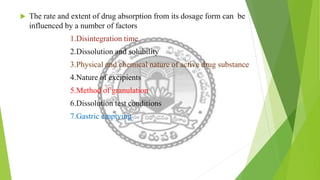
 The rate and extent of drug absorption from its dosage form can be
influenced by a number of factors
1.Disintegration time
2.Dissolution and solubility
3.Physical and chemical nature of active drug substance
4.Nature of excipients
5.Method of granulation
6.Dissolution test conditions
7.Gastric emptying
DISINTEGRATION TIME
 In vitro disintegration test is by no means a guarantee of drugs
bioavailability because if the disintegrated drug particles do not
dissolve, absorption is not possible.
 The process of disintegration does not imply complete dissolution
of the tablet or the drug.
 The official apparatus used for disintegration test and procedure is
described in the USP
 Separate specifications are given for drug products that are
designed not to disintegrate such as troches, chewable tablets etc.
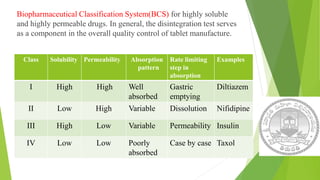
Biopharmaceutical Classification System(BCS) for highly soluble
and highly permeable drugs. In general, the disintegration test serves
as a component in the overall quality control of tablet manufacture.
Class Solubility Permeability Absorption
pattern
Rate limiting
step in
absorption
Examples
I High High Well
absorbed
Gastric
emptying
Diltiazem
II Low High Variable Dissolution Nifidipine
III High Low Variable Permeability Insulin
IV Low Low Poorly
absorbed
Case by case Taxol
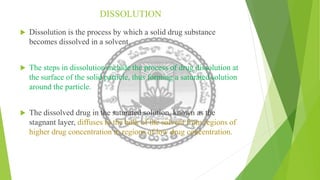
DISSOLUTION
 Dissolution is the process by which a solid drug substance
becomes dissolved in a solvent.
 The steps in dissolution include the process of drug dissolution at
the surface of the solid particle, thus forming a saturated solution
around the particle.
 The dissolved drug in the saturated solution, known as the
stagnant layer, diffuses to the bulk of the solvent from regions of
higher drug concentration to regions of low drug concentration.
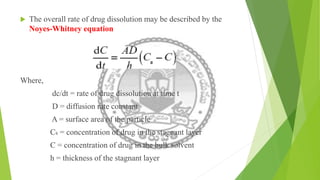
 The overall rate of drug dissolution may be described by the
Noyes-Whitney equation
Where,
dc/dt = rate of drug dissolution at time t
D = diffusion rate constant
A = surface area of the particle
Cs = concentration of drug in the stagnant layer
C = concentration of drug in the bulk solvent
h = thickness of the stagnant layer
 This equation shows that dissolution in a flask may be influenced by
the physicochemical characteristics of the drug, formulation and
solvent.
 The dissolution of drug in the body, particularly in the
gastrointestinal tract, is considered to be dissolving in an aqueous
environment.
 Permeation of drug across the gut wall is affected by the ability of
the drug to diffuse and to partition between the lipid membranes.
 A favourable partition coefficient (K oil/water) will facilitate drug
absorption.
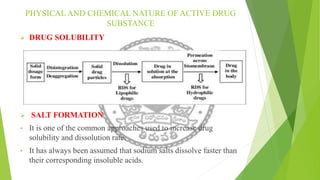
PHYSICAL AND CHEMICAL NATURE OF ACTIVE DRUG
SUBSTANCE
 DRUG SOLUBILITY
 SALT FORMATION
• It is one of the common approaches used to increase drug
solubility and dissolution rate.
• It has always been assumed that sodium salts dissolve faster than
their corresponding insoluble acids.
E.G :- sodium and potassium salts of Pencillin G, phenytoin,
barbiturates, tolbutamide etc.
• Hydrochlorides and sulphates of weak bases are commonly used
due to high solubility.
E.G :- epinephrine, tetracycline
 PARTICLE SIZE
• Surface area increases with decrease in particle size, higher
dissolution rates may be achieved through reduction of particle
size.
• Micronization of sparingly soluble drug to reduce particle size,
there is no guarantee of better dissolution and bioavailability.
NATURE OF EXCIPIENTS
 DILUENTS
studies of starch on dissolution rate of salicylic acid tablet by
dry double compression process.
 DISINTEGRANTS
Studies of various disintegrating agents on Phenobarbital
tablet showed that when Copagel(low viscosity grade of sodium
CMC) added before granulation decreased dissolution rate but
added after did not had any effect on dissolution rate
• Eg :- Microcrystalline cellulose
Starch
 BINDERS AND GRANULATING AGENTS
 Hydrophilic binder increase dissolution rate of poorly wettable
drug.
 Large amount of binder increase hardness and decrease
disintegration/dissolution rate of tablet.
 SURFACTANTS
 They enhance the dissolution rate of poorly soluble drugs.
Eg :- Non-ionic surfactant polysorbate 80 increase dissolution rate of
phenacetin granules.
METHOD OF MANUFACTURE
 METHOD OF GRANUALATION
A newer technology called as APOC
“Agglomerative Phase of Comminution” was found to produce
mechanically stronger tablets with higher dissolution rates than
those made by wet granulation. A possible mechanism is increased
internal surface area of granules produced by APOC method.
 DRUG EXCIPIENT INTERACTION
These interactions occur during any unit operation such as mixing,
milling, blending, drying or granulating results in change in
dissolution.
Eg :- Prednisolone
 COMPRESSION FORCE
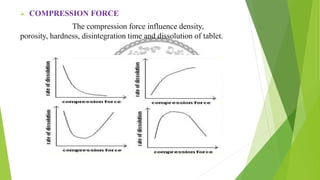
The compression force influence density,
porosity, hardness, disintegration time and dissolution of tablet.
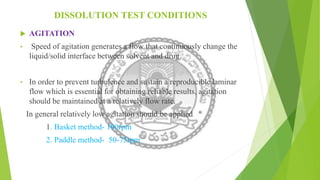
DISSOLUTION TEST CONDITIONS
 AGITATION
• Speed of agitation generates a flow that continuously change the
liquid/solid interface between solvent and drug.
• In order to prevent turbulence and sustain a reproducible laminar
flow which is essential for obtaining reliable results, agitation
should be maintained at a relatively flow rate.
In general relatively low agitation should be applied
1. Basket method- 100rpm
2. Paddle method- 50-75rpm
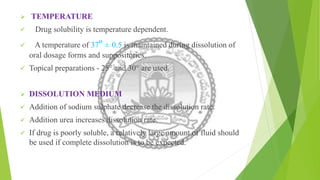
 TEMPERATURE
 Drug solubility is temperature dependent.
 A temperature of 37º ± 0.5 is maintained during dissolution of
oral dosage forms and suppositories.
 Topical preparations - 25° and 30° are used.
 DISSOLUTION MEDIUM
 Addition of sodium sulphate decrease the dissolution rate.
 Addition urea increases dissolution rate.
 If drug is poorly soluble, a relatively large amount of fluid should
be used if complete dissolution is to be expected.
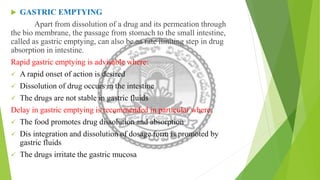
 GASTRIC EMPTYING
Apart from dissolution of a drug and its permeation through
the bio membrane, the passage from stomach to the small intestine,
called as gastric emptying, can also be aa rate limiting step in drug
absorption in intestine.
Rapid gastric emptying is advisable where:
 A rapid onset of action is desired
 Dissolution of drug occurs in the intestine
 The drugs are not stable in gastric fluids
Delay in gastric emptying is recommended in particular where:
 The food promotes drug dissolution and absorption
 Dis integration and dissolution of dosage form is promoted by
gastric fluids
 The drugs irritate the gastric mucosa
Factors influence gastric emptying are
• Volume of meal
• Composition of meal
• Physical state and viscosity of meal
• Temperature of the meal
• Gastrointestinal pH
• Body posture
• Emotional state
• Exercise
• Drugs
CONCLUSION
 In this process the drug disintegration and rate of drug reaches the
circulatory system can be determined.
 The rate and extent of the drug absorption is determined.
REFERENCES
 Applied Biopharmaceutics and pharmacokinetics by Shargel
 Biopharmaceutics and Pharmacokinetics A Treatise by D.M.
Brahmankar
 www.google.com
Rate limiting steps in drug absorption [autosaved]

Rate limiting steps in drug absorption [autosaved]

  • 1.
    RATE LIMITING STEPSIN DRUG ABSORPTION Presented to Submitted by Prof R. Nagaraju Ch. Neeharika M.pharm,1st year 2018MPH40AO14
  • 2.
    CONTENTS  Introduction  Ratelimiting factors  Conclusion  References
  • 3.
    INTRODUCTION DRUG ABSORPTION It isdefined as the process of movement of unchanged drug from the site of administration to the site of measurement i.e., plasma.  A drug that is completely but slowly absorbed may fail to show therapeutic response as the plasma concentration for desired effect is never achieved.  On the contrary, a rapidly absorbed drug attains the therapeutic level easily to elicit pharmacological effect.
  • 4.
     In aseries of kinetic or rate processes, the rate at which the drug reaches the systemic circulation is determined by the slowest of the various steps involved in the sequence. Such a step is called as the rate-determining or rate-limiting step.  Systemic drug absorption from a drug product consists of a succession of rate processes.  For solid oral, immediate release drug products (eg: tablets, capsules) the rate processes include  Disintegration of drug product and its release  Dissolution of drug in aqueous environment  Absorption across cell membranes into systemic circulation
  • 5.
     The rateand extent of drug absorption from its dosage form can be influenced by a number of factors 1.Disintegration time 2.Dissolution and solubility 3.Physical and chemical nature of active drug substance 4.Nature of excipients 5.Method of granulation 6.Dissolution test conditions 7.Gastric emptying
  • 6.
    DISINTEGRATION TIME  Invitro disintegration test is by no means a guarantee of drugs bioavailability because if the disintegrated drug particles do not dissolve, absorption is not possible.  The process of disintegration does not imply complete dissolution of the tablet or the drug.  The official apparatus used for disintegration test and procedure is described in the USP  Separate specifications are given for drug products that are designed not to disintegrate such as troches, chewable tablets etc.
  • 7.
    Biopharmaceutical Classification System(BCS)for highly soluble and highly permeable drugs. In general, the disintegration test serves as a component in the overall quality control of tablet manufacture. Class Solubility Permeability Absorption pattern Rate limiting step in absorption Examples I High High Well absorbed Gastric emptying Diltiazem II Low High Variable Dissolution Nifidipine III High Low Variable Permeability Insulin IV Low Low Poorly absorbed Case by case Taxol
  • 8.
    DISSOLUTION  Dissolution isthe process by which a solid drug substance becomes dissolved in a solvent.  The steps in dissolution include the process of drug dissolution at the surface of the solid particle, thus forming a saturated solution around the particle.  The dissolved drug in the saturated solution, known as the stagnant layer, diffuses to the bulk of the solvent from regions of higher drug concentration to regions of low drug concentration.
  • 9.
     The overallrate of drug dissolution may be described by the Noyes-Whitney equation Where, dc/dt = rate of drug dissolution at time t D = diffusion rate constant A = surface area of the particle Cs = concentration of drug in the stagnant layer C = concentration of drug in the bulk solvent h = thickness of the stagnant layer
  • 10.
     This equationshows that dissolution in a flask may be influenced by the physicochemical characteristics of the drug, formulation and solvent.  The dissolution of drug in the body, particularly in the gastrointestinal tract, is considered to be dissolving in an aqueous environment.  Permeation of drug across the gut wall is affected by the ability of the drug to diffuse and to partition between the lipid membranes.  A favourable partition coefficient (K oil/water) will facilitate drug absorption.
  • 11.
    PHYSICAL AND CHEMICALNATURE OF ACTIVE DRUG SUBSTANCE  DRUG SOLUBILITY  SALT FORMATION • It is one of the common approaches used to increase drug solubility and dissolution rate. • It has always been assumed that sodium salts dissolve faster than their corresponding insoluble acids.
  • 12.
    E.G :- sodiumand potassium salts of Pencillin G, phenytoin, barbiturates, tolbutamide etc. • Hydrochlorides and sulphates of weak bases are commonly used due to high solubility. E.G :- epinephrine, tetracycline  PARTICLE SIZE • Surface area increases with decrease in particle size, higher dissolution rates may be achieved through reduction of particle size. • Micronization of sparingly soluble drug to reduce particle size, there is no guarantee of better dissolution and bioavailability.
  • 13.
    NATURE OF EXCIPIENTS DILUENTS studies of starch on dissolution rate of salicylic acid tablet by dry double compression process.  DISINTEGRANTS Studies of various disintegrating agents on Phenobarbital tablet showed that when Copagel(low viscosity grade of sodium CMC) added before granulation decreased dissolution rate but added after did not had any effect on dissolution rate • Eg :- Microcrystalline cellulose Starch
  • 14.
     BINDERS ANDGRANULATING AGENTS  Hydrophilic binder increase dissolution rate of poorly wettable drug.  Large amount of binder increase hardness and decrease disintegration/dissolution rate of tablet.  SURFACTANTS  They enhance the dissolution rate of poorly soluble drugs. Eg :- Non-ionic surfactant polysorbate 80 increase dissolution rate of phenacetin granules.
  • 15.
    METHOD OF MANUFACTURE METHOD OF GRANUALATION A newer technology called as APOC “Agglomerative Phase of Comminution” was found to produce mechanically stronger tablets with higher dissolution rates than those made by wet granulation. A possible mechanism is increased internal surface area of granules produced by APOC method.  DRUG EXCIPIENT INTERACTION These interactions occur during any unit operation such as mixing, milling, blending, drying or granulating results in change in dissolution. Eg :- Prednisolone
  • 16.
     COMPRESSION FORCE Thecompression force influence density, porosity, hardness, disintegration time and dissolution of tablet.
  • 17.
    DISSOLUTION TEST CONDITIONS AGITATION • Speed of agitation generates a flow that continuously change the liquid/solid interface between solvent and drug. • In order to prevent turbulence and sustain a reproducible laminar flow which is essential for obtaining reliable results, agitation should be maintained at a relatively flow rate. In general relatively low agitation should be applied 1. Basket method- 100rpm 2. Paddle method- 50-75rpm
  • 18.
     TEMPERATURE  Drugsolubility is temperature dependent.  A temperature of 37º ± 0.5 is maintained during dissolution of oral dosage forms and suppositories.  Topical preparations - 25° and 30° are used.  DISSOLUTION MEDIUM  Addition of sodium sulphate decrease the dissolution rate.  Addition urea increases dissolution rate.  If drug is poorly soluble, a relatively large amount of fluid should be used if complete dissolution is to be expected.
  • 19.
     GASTRIC EMPTYING Apartfrom dissolution of a drug and its permeation through the bio membrane, the passage from stomach to the small intestine, called as gastric emptying, can also be aa rate limiting step in drug absorption in intestine. Rapid gastric emptying is advisable where:  A rapid onset of action is desired  Dissolution of drug occurs in the intestine  The drugs are not stable in gastric fluids Delay in gastric emptying is recommended in particular where:  The food promotes drug dissolution and absorption  Dis integration and dissolution of dosage form is promoted by gastric fluids  The drugs irritate the gastric mucosa
  • 20.
    Factors influence gastricemptying are • Volume of meal • Composition of meal • Physical state and viscosity of meal • Temperature of the meal • Gastrointestinal pH • Body posture • Emotional state • Exercise • Drugs
  • 21.
    CONCLUSION  In thisprocess the drug disintegration and rate of drug reaches the circulatory system can be determined.  The rate and extent of the drug absorption is determined.
  • 22.
    REFERENCES  Applied Biopharmaceuticsand pharmacokinetics by Shargel  Biopharmaceutics and Pharmacokinetics A Treatise by D.M. Brahmankar  www.google.com