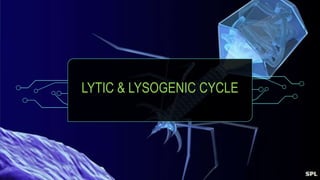
LYTIC & LYSOGENIC CYCLE
LYTIC CYCLE:
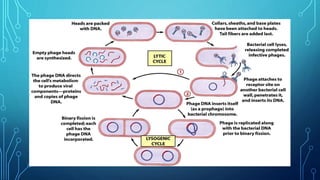
• It is commonly referred as the reproductive cycle of the
bacteriophage.
• A virus undergoes lytic and lysogenic cycles to reproduce.
• It is relatively more common, wherein a virus infects a host cell,
use its metabolism to multiply and destroy the cell completely.
STEPS OF THE LYTIC CYCLE
1.ATTACHMENT 2.PENETRATION
3.SYNTHESIS 4.ASSEMBLY 5.RELEASE
1.ATTACHMENT
• A virus requires a host cell for multiplication.
• In a first step, a virus attaches itself onto the host cell.
• The virus may attach itself on the receptor of the cell, or simply
any other part on its surface.
• In some cases, a small part of the viruses attaches to the host,
instead of the virus itself.
2.PENETRATION
• Once attached, the virus the gains access to the cell body by
breaking through the cell’s plasma membrane.
• In some cases, the cell wall tail fibres of the virus and enzymes
released by it help in breaking through the same.
• The virus then release its genetic material into the host cell.
• The cell is now said to be infected.
3.SEIZURE OF CELL MECHANISM
• The infected DNA or RNA then hijacks the host cell’s genetic
material and mangles with its gene expression.
If DNA is injected:
• The virus DNA transcribes itself into mRNA molecules.
• This molecules can control the host’s ribosome.
• Thus, the virus gains control of the host cell’s mechanism.
 If RNA is injected:
• An enzyme called reverse transcriptase transcribes the virus’s
RNA into DNA.
• This DNA is again transcribed into mRNA molecules.
• Thus it take over the mechanism.
• The virus takes over the cell machinery to produce multiple viral
components.
• Simply put the virus infects the host to produce more virus parts.
• Also virus puts the host nucleotides to work and replicate its own
genetic material.
4.VIRUS MULTIPLICATION AND CELL DESTRUCTION
• Now that the genetic material as well as viral parts are replicated,
the host metabolism assembles new viruses from scratch.
• The capsid are assembled, followed by the genetic material in the
head and finally the tail fibre is attached to the end portion.
• Eventually, the host cell is filled with viruses.
• Once the assembly is completed, the virus releases an enzyme that
disintegrates the cell wall from within.
• Thus, destructing the host cell.
• The virus are individual and free now.
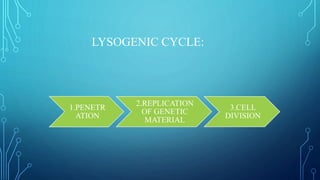
LYSOGENIC CYCLE:
1.PENETR
ATION
2.REPLICATION
OF GENETIC
MATERIAL
3.CELL
DIVISION
1.PENETRATION:
• Once the virus’s genetic material is inserted, it attaches itself to
that of the host’s.
• Some viruses may not immediately start multiplying or replicating
after infecting the cell.
• In case it does not start replicating, the virus is said to be dormant.
• The virus genetic material is known as Prophage, while it is in the
dormant stage.
2.REPLICATION OF GENETIC MATERIAL
• Thereafter, the cell will fall back into its regular metabolic
activities and eventually prepare for cell division.
• The genetic material or nucleic acid replicates, and the nucleus
divided into two parts.
• Each part having the same genetic information.
3.CELL DIVISION
• The cell organelles will be replicated (in some cells) followed by
division of the cell body, resulting in two daughter cells.
• Each having virus’s genetic information incorporated to their
genetic material.
• The cells have utter normally until the virus is triggered.
• This daughter cells carrying the viral genetic material are known
as Lysogenic cycle
REFERENCE:
1.DAVID FREIFELDER,
TEXTBOOK OF
MOLECULAR BIOLOGY,
PAGE NO: 553-560.
This Photo by Unknown Author is licensed under CC BY
THANK YOU
This Photo by Unknown Author is licensed under CC BY-SA

Lytic & Lysogenic Cycle

  • 1.
  • 2.
    LYTIC CYCLE: • Itis commonly referred as the reproductive cycle of the bacteriophage. • A virus undergoes lytic and lysogenic cycles to reproduce. • It is relatively more common, wherein a virus infects a host cell, use its metabolism to multiply and destroy the cell completely.
  • 3.
    STEPS OF THELYTIC CYCLE 1.ATTACHMENT 2.PENETRATION 3.SYNTHESIS 4.ASSEMBLY 5.RELEASE
  • 4.
    1.ATTACHMENT • A virusrequires a host cell for multiplication. • In a first step, a virus attaches itself onto the host cell. • The virus may attach itself on the receptor of the cell, or simply any other part on its surface. • In some cases, a small part of the viruses attaches to the host, instead of the virus itself.
  • 5.
    2.PENETRATION • Once attached,the virus the gains access to the cell body by breaking through the cell’s plasma membrane. • In some cases, the cell wall tail fibres of the virus and enzymes released by it help in breaking through the same. • The virus then release its genetic material into the host cell. • The cell is now said to be infected.
  • 6.
    3.SEIZURE OF CELLMECHANISM • The infected DNA or RNA then hijacks the host cell’s genetic material and mangles with its gene expression. If DNA is injected: • The virus DNA transcribes itself into mRNA molecules. • This molecules can control the host’s ribosome. • Thus, the virus gains control of the host cell’s mechanism.
  • 7.
     If RNAis injected: • An enzyme called reverse transcriptase transcribes the virus’s RNA into DNA. • This DNA is again transcribed into mRNA molecules. • Thus it take over the mechanism. • The virus takes over the cell machinery to produce multiple viral components. • Simply put the virus infects the host to produce more virus parts. • Also virus puts the host nucleotides to work and replicate its own genetic material.
  • 8.
    4.VIRUS MULTIPLICATION ANDCELL DESTRUCTION • Now that the genetic material as well as viral parts are replicated, the host metabolism assembles new viruses from scratch. • The capsid are assembled, followed by the genetic material in the head and finally the tail fibre is attached to the end portion. • Eventually, the host cell is filled with viruses. • Once the assembly is completed, the virus releases an enzyme that disintegrates the cell wall from within. • Thus, destructing the host cell. • The virus are individual and free now.
  • 10.
  • 11.
    1.PENETRATION: • Once thevirus’s genetic material is inserted, it attaches itself to that of the host’s. • Some viruses may not immediately start multiplying or replicating after infecting the cell. • In case it does not start replicating, the virus is said to be dormant. • The virus genetic material is known as Prophage, while it is in the dormant stage.
  • 12.
    2.REPLICATION OF GENETICMATERIAL • Thereafter, the cell will fall back into its regular metabolic activities and eventually prepare for cell division. • The genetic material or nucleic acid replicates, and the nucleus divided into two parts. • Each part having the same genetic information.
  • 13.
    3.CELL DIVISION • Thecell organelles will be replicated (in some cells) followed by division of the cell body, resulting in two daughter cells. • Each having virus’s genetic information incorporated to their genetic material. • The cells have utter normally until the virus is triggered. • This daughter cells carrying the viral genetic material are known as Lysogenic cycle
  • 14.
    REFERENCE: 1.DAVID FREIFELDER, TEXTBOOK OF MOLECULARBIOLOGY, PAGE NO: 553-560. This Photo by Unknown Author is licensed under CC BY
  • 15.
    THANK YOU This Photoby Unknown Author is licensed under CC BY-SA