By: Sanjay kumar
LYMPHATIC SYSTEM
LYMPHATIC SYSTEM OF MAN
 The lymphatic system
includes
 lymph, lymphocytes,
 lymphatic vessels,
 lymph nodes,
 tonsils, spleen and thymus
gland.
What is lymph ?
 Literally mean spring
water
 A colourless body fluid,
that contains
lymphocytes, small
proteins, ions and Fats.
 Lymph is an alkaline (pH
> 7.0)
 Lymph is formed by
filtration of Blood
 All the cells bathed in this fluid receive their
nutrients and oxygen from it.
 Tubular vessels transport lymph back to the
blood, ultimately replacing the volume lost
during the formation of the interstitial fluid.
 Lymph movement occurs despite low
pressure due to peristalsis, valves, and
compression during contraction of adjacent
skeletal muscle and arterial pulsation
What is lymphatic vessels
 The lymphatic system unlike the circulatory
system only carries fluid away from tissue.
 lymph capillaries lack a basement membrane.
 lymph capillaries are far more permeable than
blood capillaries
 lymph capillary epithelium functions as a series of
one-way valve that allows fluid to enter the
capillary but prevent it from passing back into the
interstitial spaces
 Return to the blood of any fluids that have
escaped from the circulation.
 Lymphatic vessels are intimately connected
with blood vessels so that they can perform
this function.
 Distribution of lymphatic vessels
◦ Lymphatic vessels travel alongside blood vessels
◦ Lymphatic vessels are absent from bones, teeth,
bone marrow, and the central nervous system
Lymph vessels:-
Continue:
 The lymph capillaries join to form larger lymph
vessels that resemble small veins.
 Small lymphatic vessels have a beaded
appearance because of the presence of one-way
valves along their lengths that are similar to the
valves of veins.
 Larger vessels lead to lymph nodes and then to
larger lymphatic trunks
Right Lymphatic Duct
• The right lymphatic duct is much short and smaller in
diameter than the thoracic duct.
• It drains the right thorax, right upper limb, and right side of
the head and neck.
• It opens into the right subclavian vein and right internal
juglar vein.
Thoracic Duct
 The thoracic duct drains the lower limbs, abdomen, the
left thorax, the left upper extremity, and the left side of
the head and neck.
 The duct ends by entering the left subclavian vein and
left internal juglar vein
Lymph nodes:-
 They are widely distributed throughout the
body along the lymphatic pathways.
 Lymph nodes are not present in the central
nervous system.
 Composed of lymphoid tissue.
 Small bean-shaped structures
• Size microscopic to 1inch in length.
• They are found every where but their
number is different
• Maximum number in Neck axial and Groin
region.
 Filter the lymph before it is returned to the
blood.
 Preventing foreign particles from entering the
bloodstream
 They also produce lymphocytes
Role of Lacteal Present in Villi
 Each villus contains a lymph capillary called lacteal.
The lymphatic system absorbs fats and other substances
from the digestive tract.
 Fat enters the lacteals and pass through these
lymphatic vessels to venous circulation.
 The lymph passing through these lacteals has a milky
appearance because of its fat contents. Chylomicrons
(these are proteins, triglycerol 90% phospholipids 4%
and cholesterol 5%) enter the lacteal.
 Chylomicrons enter the lymph capillaries because
lymph capillaries lack basement membrane and are more
permeable to large particles.
Functions of the Lymphatic System
24-
17
 Reabsorbs excess interstitial fluid:
 returns it to the venous circulation
 maintain blood volume levels
 Act as blood filtration
 Transport dietary lipids:
 transported through lacteals
 Protect by synthesize lymphocytes like B-
cells and T-cells
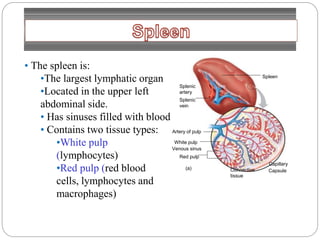
• The spleen is:
•The largest lymphatic organ
•Located in the upper left
abdominal side.
• Has sinuses filled with blood
• Contains two tissue types:
•White pulp
(lymphocytes)
•Red pulp (red blood
cells, lymphocytes and
macrophages)
Spleen
Artery of pulp
White pulp
Red pulp
(a)
Capillary
Capsule
Splenic
artery
Splenic
vein
Connective
tissue
Venous sinus

Lymphatic system

  • 1.
  • 2.
    LYMPHATIC SYSTEM OFMAN  The lymphatic system includes  lymph, lymphocytes,  lymphatic vessels,  lymph nodes,  tonsils, spleen and thymus gland.
  • 4.
    What is lymph?  Literally mean spring water  A colourless body fluid, that contains lymphocytes, small proteins, ions and Fats.  Lymph is an alkaline (pH > 7.0)  Lymph is formed by filtration of Blood
  • 5.
     All thecells bathed in this fluid receive their nutrients and oxygen from it.  Tubular vessels transport lymph back to the blood, ultimately replacing the volume lost during the formation of the interstitial fluid.  Lymph movement occurs despite low pressure due to peristalsis, valves, and compression during contraction of adjacent skeletal muscle and arterial pulsation
  • 7.
    What is lymphaticvessels  The lymphatic system unlike the circulatory system only carries fluid away from tissue.  lymph capillaries lack a basement membrane.  lymph capillaries are far more permeable than blood capillaries  lymph capillary epithelium functions as a series of one-way valve that allows fluid to enter the capillary but prevent it from passing back into the interstitial spaces
  • 8.
     Return tothe blood of any fluids that have escaped from the circulation.  Lymphatic vessels are intimately connected with blood vessels so that they can perform this function.  Distribution of lymphatic vessels ◦ Lymphatic vessels travel alongside blood vessels ◦ Lymphatic vessels are absent from bones, teeth, bone marrow, and the central nervous system Lymph vessels:-
  • 9.
    Continue:  The lymphcapillaries join to form larger lymph vessels that resemble small veins.  Small lymphatic vessels have a beaded appearance because of the presence of one-way valves along their lengths that are similar to the valves of veins.  Larger vessels lead to lymph nodes and then to larger lymphatic trunks
  • 10.
    Right Lymphatic Duct •The right lymphatic duct is much short and smaller in diameter than the thoracic duct. • It drains the right thorax, right upper limb, and right side of the head and neck. • It opens into the right subclavian vein and right internal juglar vein. Thoracic Duct  The thoracic duct drains the lower limbs, abdomen, the left thorax, the left upper extremity, and the left side of the head and neck.  The duct ends by entering the left subclavian vein and left internal juglar vein
  • 11.
    Lymph nodes:-  Theyare widely distributed throughout the body along the lymphatic pathways.  Lymph nodes are not present in the central nervous system.  Composed of lymphoid tissue.
  • 12.
     Small bean-shapedstructures • Size microscopic to 1inch in length. • They are found every where but their number is different • Maximum number in Neck axial and Groin region.
  • 14.
     Filter thelymph before it is returned to the blood.  Preventing foreign particles from entering the bloodstream  They also produce lymphocytes
  • 15.
    Role of LactealPresent in Villi  Each villus contains a lymph capillary called lacteal. The lymphatic system absorbs fats and other substances from the digestive tract.  Fat enters the lacteals and pass through these lymphatic vessels to venous circulation.  The lymph passing through these lacteals has a milky appearance because of its fat contents. Chylomicrons (these are proteins, triglycerol 90% phospholipids 4% and cholesterol 5%) enter the lacteal.  Chylomicrons enter the lymph capillaries because lymph capillaries lack basement membrane and are more permeable to large particles.
  • 17.
    Functions of theLymphatic System 24- 17  Reabsorbs excess interstitial fluid:  returns it to the venous circulation  maintain blood volume levels  Act as blood filtration  Transport dietary lipids:  transported through lacteals  Protect by synthesize lymphocytes like B- cells and T-cells
  • 18.
    • The spleenis: •The largest lymphatic organ •Located in the upper left abdominal side. • Has sinuses filled with blood • Contains two tissue types: •White pulp (lymphocytes) •Red pulp (red blood cells, lymphocytes and macrophages) Spleen Artery of pulp White pulp Red pulp (a) Capillary Capsule Splenic artery Splenic vein Connective tissue Venous sinus