
Vascular Compressions of the Airways
Introduction
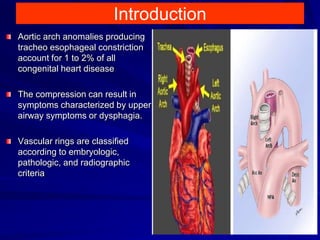
Aortic arch anomalies producing
tracheo esophageal constriction
account for 1 to 2% of all
congenital heart disease
The compression can result in
symptoms characterized by upper
airway symptoms or dysphagia.
Vascular rings are classified
according to embryologic,
pathologic, and radiographic
criteria
2
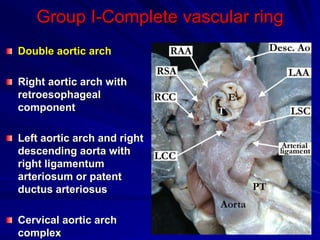
Group I-Complete vascular ring
Double aortic arch
Right aortic arch with
retroesophageal
component
Left aortic arch and right
descending aorta with
right ligamentum
arteriosum or patent
ductus arteriosus
Cervical aortic arch
complex
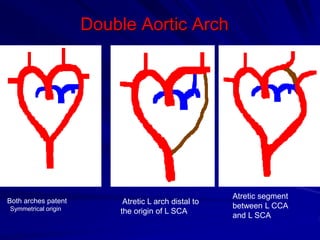
Double Aortic Arch
Both arches patent
Symmetrical origin
Atretic L arch distal to
the origin of L SCA
Atretic segment
between L CCA
and L SCA
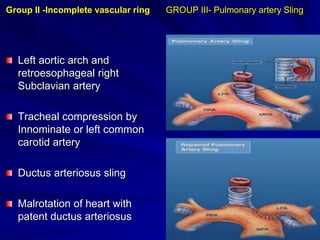
Group II -Incomplete vascular ring
Left aortic arch and
retroesophageal right
Subclavian artery
Tracheal compression by
Innominate or left common
carotid artery
Ductus arteriosus sling
Malrotation of heart with
patent ductus arteriosus
GROUP III- Pulmonary artery Sling
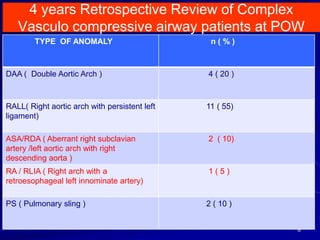
4 years Retrospective Review of Complex
Vasculo compressive airway patients at POW
6
TYPE OF ANOMALY n ( % )
DAA ( Double Aortic Arch ) 4 ( 20 )
RALL( Right aortic arch with persistent left
ligament)
11 ( 55)
ASA/RDA ( Aberrant right subclavian
artery /left aortic arch with right
descending aorta )
2 ( 10)
RA / RLIA ( Right arch with a
retroesophageal left innominate artery)
1 ( 5 )
PS ( Pulmonary sling ) 2 ( 10 )
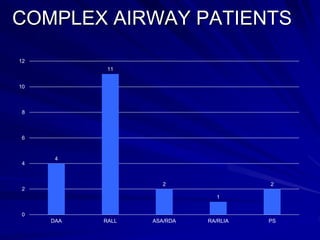
COMPLEX AIRWAY PATIENTS
4
11
2
1
2
0
2
4
6
8
10
12
DAA RALL ASA/RDA RA/RLIA PS
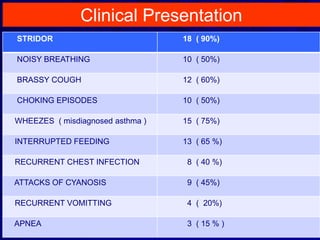
Clinical Presentation
8
STRIDOR 18 ( 90%)
NOISY BREATHING 10 ( 50%)
BRASSY COUGH 12 ( 60%)
CHOKING EPISODES 10 ( 50%)
WHEEZES ( misdiagnosed asthma ) 15 ( 75%)
INTERRUPTED FEEDING 13 ( 65 %)
RECURRENT CHEST INFECTION 8 ( 40 %)
ATTACKS OF CYANOSIS 9 ( 45%)
RECURRENT VOMITTING 4 ( 20%)
APNEA 3 ( 15 % )
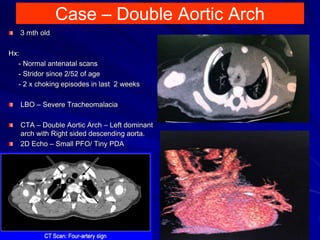
Case – Double Aortic Arch
3 mth old
Hx:
- Normal antenatal scans
- Stridor since 2/52 of age
- 2 x choking episodes in last 2 weeks
LBO – Severe Tracheomalacia
CTA – Double Aortic Arch – Left dominant
arch with Right sided descending aorta.
2D Echo – Small PFO/ Tiny PDA
9
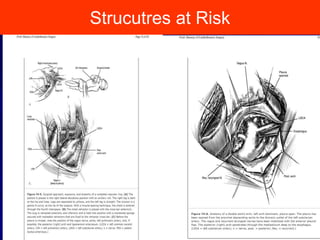
Strucutres at Risk
10
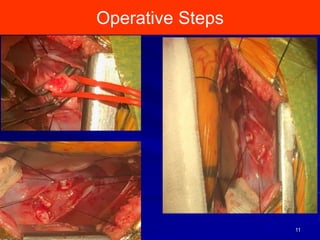
Operative Steps
11
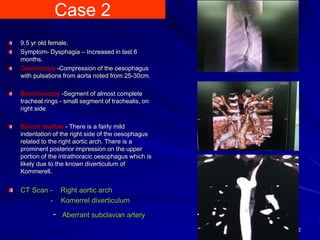
Case 2
9.5 yr old female.
Symptom- Dysphagia – Increased in last 6
months.
Gastroscopy -Compression of the oesophagus
with pulsations from aorta noted from 25-30cm.
Bronchoscopy -Segment of almost complete
tracheal rings - small segment of trachealis, on
right side
Barium swallow - There is a fairly mild
indentation of the right side of the oesophagus
related to the right aortic arch. There is a
prominent posterior impression on the upper
portion of the intrathoracic oesophagus which is
likely due to the known diverticulum of
Kommerell.
CT Scan - Right aortic arch
- Komerrel diverticulum
- Aberrant subclavian artery
12
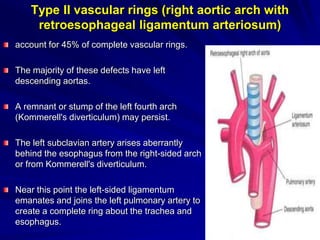
Type II vascular rings (right aortic arch with
retroesophageal ligamentum arteriosum)
account for 45% of complete vascular rings.
The majority of these defects have left
descending aortas.
A remnant or stump of the left fourth arch
(Kommerell's diverticulum) may persist.
The left subclavian artery arises aberrantly
behind the esophagus from the right-sided arch
or from Kommerell's diverticulum.
Near this point the left-sided ligamentum
emanates and joins the left pulmonary artery to
create a complete ring about the trachea and
esophagus.
13
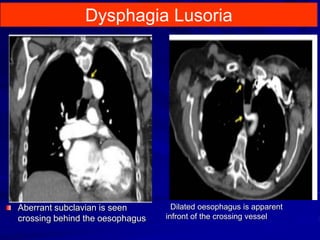
Aberrant subclavian is seen
crossing behind the oesophagus
Dilated oesophagus is apparent
infront of the crossing vessel
Dysphagia Lusoria
CASE 3
8 week old baby transferred to SCH post resp. arrest.
Chest Xray – Hyperinflation of right lung with complete collapse of left lung.
LBO – Significant Tracheobronchomalacia
Echo – Moderate ASD , Aberrant RSCA, Interrupted IVC with azygous
continuation.
CT Scan - Collapsed left lung and mediastinal shift to left. The right main
bronchus is narrowed from the carina to its branching point.
Surgical discussion – Aortopexy vs Posterior
tracheopexy. Timing of ASD repair.
15
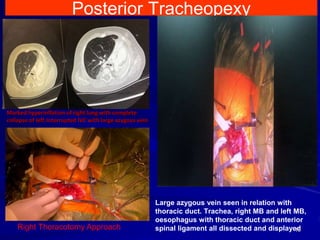
Posterior Tracheopexy
Marked hyperinflation of right lung with complete
collapse of left.Interrupted IVC with large azygous vein
Large azygous vein seen in relation with
thoracic duct. Trachea, right MB and left MB,
oesophagus with thoracic duct and anterior
spinal ligament all dissected and displayed16Right Thoracotomy Approach
negative pressure during respiration.
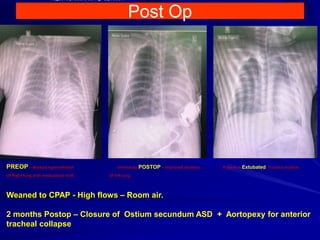
Post Op
PREOP – Marked hyperinflation Immediate POSTOP – Improved aeration Patient is Extubated. Trachea midline.
Of Right lung with mediastinal shift. Of left lung
Weaned to CPAP - High flows – Room air.
2 months Postop – Closure of Ostium secundum ASD + Aortopexy for anterior
tracheal collapse
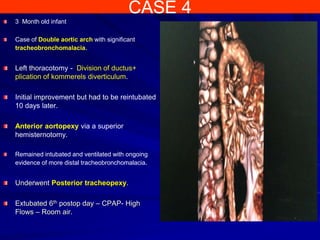
CASE 4
3 Month old infant
Case of Double aortic arch with significant
tracheobronchomalacia.
Left thoracotomy - Division of ductus+
plication of kommerels diverticulum.
Initial improvement but had to be reintubated
10 days later.
Anterior aortopexy via a superior
hemisternotomy.
Remained intubated and ventilated with ongoing
evidence of more distal tracheobronchomalacia.
Underwent Posterior tracheopexy.
Extubated 6th postop day – CPAP- High
Flows – Room air.
SURGICAL APPROACH & PRINCIPLE
Surgical approach is determined by which arch is dominant.
When the right arch is dominant (75%)- left thoracotomy.
When the left arch is dominant (18%)- right thoracotomy.
When the arches are balanced (7%), - left thoracotomy is preferred.
If the patient has a significant intracardiac lesion-median sternotomy.
MRI / CT scan shows Right posterior arch is smaller- Right thoracotomy
MultiDisciplinary Approach
To have a robust system for managing airway
patients one needs to work closely with
- Gen Paediatric
- ENT
- Gen Paediatric Surgery
- Anethesist/ Intensivist
- Respiratory
- Cardiology
- Radiology
- Sleep Team
Thank You

Vascular rings & slings

  • 1.
  • 2.
    Introduction Aortic arch anomaliesproducing tracheo esophageal constriction account for 1 to 2% of all congenital heart disease The compression can result in symptoms characterized by upper airway symptoms or dysphagia. Vascular rings are classified according to embryologic, pathologic, and radiographic criteria 2
  • 3.
    Group I-Complete vascularring Double aortic arch Right aortic arch with retroesophageal component Left aortic arch and right descending aorta with right ligamentum arteriosum or patent ductus arteriosus Cervical aortic arch complex
  • 4.
    Double Aortic Arch Botharches patent Symmetrical origin Atretic L arch distal to the origin of L SCA Atretic segment between L CCA and L SCA
  • 5.
    Group II -Incompletevascular ring Left aortic arch and retroesophageal right Subclavian artery Tracheal compression by Innominate or left common carotid artery Ductus arteriosus sling Malrotation of heart with patent ductus arteriosus GROUP III- Pulmonary artery Sling
  • 6.
    4 years RetrospectiveReview of Complex Vasculo compressive airway patients at POW 6 TYPE OF ANOMALY n ( % ) DAA ( Double Aortic Arch ) 4 ( 20 ) RALL( Right aortic arch with persistent left ligament) 11 ( 55) ASA/RDA ( Aberrant right subclavian artery /left aortic arch with right descending aorta ) 2 ( 10) RA / RLIA ( Right arch with a retroesophageal left innominate artery) 1 ( 5 ) PS ( Pulmonary sling ) 2 ( 10 )
  • 7.
  • 8.
    Clinical Presentation 8 STRIDOR 18( 90%) NOISY BREATHING 10 ( 50%) BRASSY COUGH 12 ( 60%) CHOKING EPISODES 10 ( 50%) WHEEZES ( misdiagnosed asthma ) 15 ( 75%) INTERRUPTED FEEDING 13 ( 65 %) RECURRENT CHEST INFECTION 8 ( 40 %) ATTACKS OF CYANOSIS 9 ( 45%) RECURRENT VOMITTING 4 ( 20%) APNEA 3 ( 15 % )
  • 9.
    Case – DoubleAortic Arch 3 mth old Hx: - Normal antenatal scans - Stridor since 2/52 of age - 2 x choking episodes in last 2 weeks LBO – Severe Tracheomalacia CTA – Double Aortic Arch – Left dominant arch with Right sided descending aorta. 2D Echo – Small PFO/ Tiny PDA 9
  • 10.
  • 11.
  • 12.
    Case 2 9.5 yrold female. Symptom- Dysphagia – Increased in last 6 months. Gastroscopy -Compression of the oesophagus with pulsations from aorta noted from 25-30cm. Bronchoscopy -Segment of almost complete tracheal rings - small segment of trachealis, on right side Barium swallow - There is a fairly mild indentation of the right side of the oesophagus related to the right aortic arch. There is a prominent posterior impression on the upper portion of the intrathoracic oesophagus which is likely due to the known diverticulum of Kommerell. CT Scan - Right aortic arch - Komerrel diverticulum - Aberrant subclavian artery 12
  • 13.
    Type II vascularrings (right aortic arch with retroesophageal ligamentum arteriosum) account for 45% of complete vascular rings. The majority of these defects have left descending aortas. A remnant or stump of the left fourth arch (Kommerell's diverticulum) may persist. The left subclavian artery arises aberrantly behind the esophagus from the right-sided arch or from Kommerell's diverticulum. Near this point the left-sided ligamentum emanates and joins the left pulmonary artery to create a complete ring about the trachea and esophagus. 13
  • 14.
    Aberrant subclavian isseen crossing behind the oesophagus Dilated oesophagus is apparent infront of the crossing vessel Dysphagia Lusoria
  • 15.
    CASE 3 8 weekold baby transferred to SCH post resp. arrest. Chest Xray – Hyperinflation of right lung with complete collapse of left lung. LBO – Significant Tracheobronchomalacia Echo – Moderate ASD , Aberrant RSCA, Interrupted IVC with azygous continuation. CT Scan - Collapsed left lung and mediastinal shift to left. The right main bronchus is narrowed from the carina to its branching point. Surgical discussion – Aortopexy vs Posterior tracheopexy. Timing of ASD repair. 15
  • 16.
    Posterior Tracheopexy Marked hyperinflationof right lung with complete collapse of left.Interrupted IVC with large azygous vein Large azygous vein seen in relation with thoracic duct. Trachea, right MB and left MB, oesophagus with thoracic duct and anterior spinal ligament all dissected and displayed16Right Thoracotomy Approach
  • 17.
    negative pressure duringrespiration. Post Op PREOP – Marked hyperinflation Immediate POSTOP – Improved aeration Patient is Extubated. Trachea midline. Of Right lung with mediastinal shift. Of left lung Weaned to CPAP - High flows – Room air. 2 months Postop – Closure of Ostium secundum ASD + Aortopexy for anterior tracheal collapse
  • 18.
    CASE 4 3 Monthold infant Case of Double aortic arch with significant tracheobronchomalacia. Left thoracotomy - Division of ductus+ plication of kommerels diverticulum. Initial improvement but had to be reintubated 10 days later. Anterior aortopexy via a superior hemisternotomy. Remained intubated and ventilated with ongoing evidence of more distal tracheobronchomalacia. Underwent Posterior tracheopexy. Extubated 6th postop day – CPAP- High Flows – Room air.
  • 19.
    SURGICAL APPROACH &PRINCIPLE Surgical approach is determined by which arch is dominant. When the right arch is dominant (75%)- left thoracotomy. When the left arch is dominant (18%)- right thoracotomy. When the arches are balanced (7%), - left thoracotomy is preferred. If the patient has a significant intracardiac lesion-median sternotomy. MRI / CT scan shows Right posterior arch is smaller- Right thoracotomy
  • 20.
    MultiDisciplinary Approach To havea robust system for managing airway patients one needs to work closely with - Gen Paediatric - ENT - Gen Paediatric Surgery - Anethesist/ Intensivist - Respiratory - Cardiology - Radiology - Sleep Team
  • 21.