GENERAL DISCUSSIONS ONGENERAL DISCUSSIONS ON
LUBRICATING OILSLUBRICATING OILS
FEW QUESTIONSFEW QUESTIONS
 What are Basic Requirements of Lubricants ?What are Basic Requirements of Lubricants ?
 What are Performance Requirements of lubricants ?What are Performance Requirements of lubricants ?
 What are Related Properties ?What are Related Properties ?
 What is Viscosity & How is it measured ?What is Viscosity & How is it measured ?
 What are SAE and ISO VG grades ?What are SAE and ISO VG grades ?
Few questions contdFew questions contd ……
What is meant by 15W/40 Grade ?What is meant by 15W/40 Grade ?
 What is Viscosity Index ?What is Viscosity Index ?
 What are TAN – TBN – Flash Point – Pour Point ?What are TAN – TBN – Flash Point – Pour Point ?
 What is Grease ? What are their properties ?What is Grease ? What are their properties ?
finallyfinally
 How safe is it to use Regenerated Oil ?How safe is it to use Regenerated Oil ?
LUBRICATING OILS
Two basic end use parameters
• Lubrication
• Process
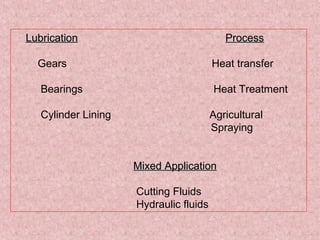
LubricationLubrication ProcessProcess
Gears Heat transfer
Bearings Heat Treatment
Cylinder Lining Agricultural
Spraying
Mixed ApplicationMixed Application
Cutting Fluids
Hydraulic fluids
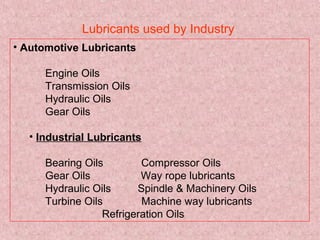
Lubricants used by Industry
• Automotive Lubricants
Engine Oils
Transmission Oils
Hydraulic Oils
Gear Oils
• Industrial Lubricants
Bearing Oils Compressor Oils
Gear Oils Way rope lubricants
Hydraulic Oils Spindle & Machinery Oils
Turbine Oils Machine way lubricants
Refrigeration Oils
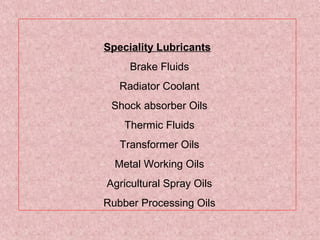
Speciality Lubricants
Brake Fluids
Radiator Coolant
Shock absorber Oils
Thermic Fluids
Transformer Oils
Metal Working Oils
Agricultural Spray Oils
Rubber Processing Oils
What should be basic requirements
of a lubricant ?
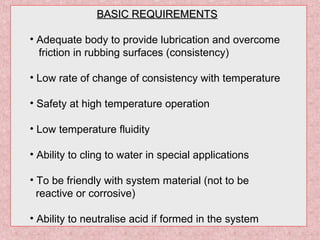
BASIC REQUIREMENTSBASIC REQUIREMENTS
• Adequate body to provide lubrication and overcome
friction in rubbing surfaces (consistency)
• Low rate of change of consistency with temperature
• Safety at high temperature operation
• Low temperature fluidity
• Ability to cling to water in special applications
• To be friendly with system material (not to be
reactive or corrosive)
• Ability to neutralise acid if formed in the system
What should be performance requirements of a
Lubricant ?
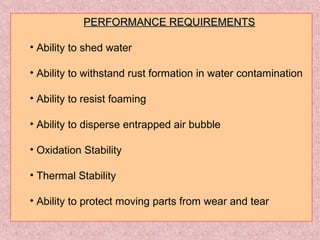
PERFORMANCE REQUIREMENTSPERFORMANCE REQUIREMENTS
• Ability to shed water
• Ability to withstand rust formation in water contamination
• Ability to resist foaming
• Ability to disperse entrapped air bubble
• Oxidation Stability
• Thermal Stability
• Ability to protect moving parts from wear and tear
WHAT ARE RELATED PROPERTIES ?
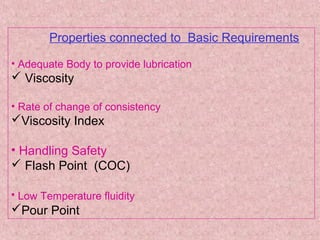
Properties connected to Basic Requirements
• Adequate Body to provide lubrication
 Viscosity
• Rate of change of consistency
Viscosity Index
• Handling Safety
 Flash Point (COC)
• Low Temperature fluidity
Pour Point
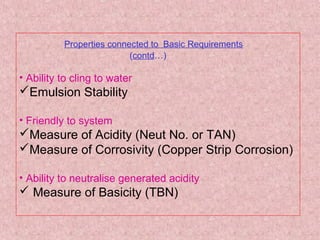
Properties connected to Basic Requirements
(contd…)
• Ability to cling to water
Emulsion Stability
• Friendly to system
Measure of Acidity (Neut No. or TAN)
Measure of Corrosivity (Copper Strip Corrosion)
• Ability to neutralise generated acidity
 Measure of Basicity (TBN)
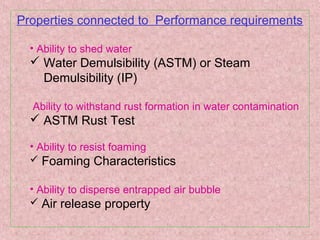
Properties connected to Performance requirements
• Ability to shed water
 Water Demulsibility (ASTM) or Steam
Demulsibility (IP)
Ability to withstand rust formation in water contamination
 ASTM Rust Test
• Ability to resist foaming
 Foaming Characteristics
• Ability to disperse entrapped air bubble
 Air release property
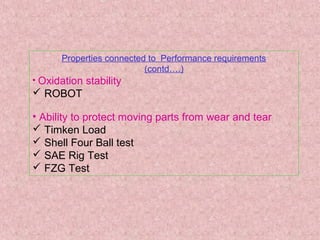
Properties connected to Performance requirements
(contd….)
• Oxidation stability
 ROBOT
• Ability to protect moving parts from wear and tear
 Timken Load
 Shell Four Ball test
 SAE Rig Test
 FZG Test
VISCOSITY AN ALL IMPORTANT
PROPERTY
Different Viscosity Units
America
Saybolt Universal Seconds (SSU or SUS)
Saybolt Furol Seconds (SFS)
United Kingdom
Redwood Seconds
Germany
Engler
Universal
Kinematic
India utilises all these standards depending on Clients’ need
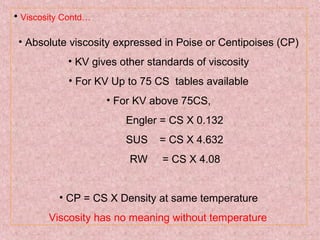
Viscosity Contd…..
• Saybolt or Redwood Viscosity
- Measured volume of oil
- Standard orifice
- Actual time of flow
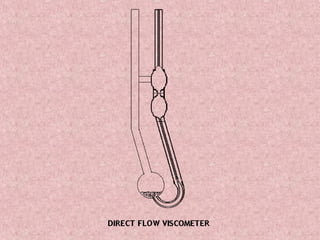
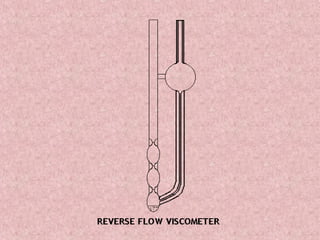
• Viscosity Kinematic (KV)
- Expressed as Centi Stokes (CS)
- Capillary glass tube of appropriate size
Tube Constant X Time of flow
- Minimum time of flow 200 seconds
• Viscosity Contd…
• Absolute viscosity expressed in Poise or Centipoises (CP)
• KV gives other standards of viscosity
• For KV Up to 75 CS tables available
• For KV above 75CS,
Engler = CS X 0.132
SUS = CS X 4.632
RW = CS X 4.08
• CP = CS X Density at same temperature
Viscosity has no meaning without temperature
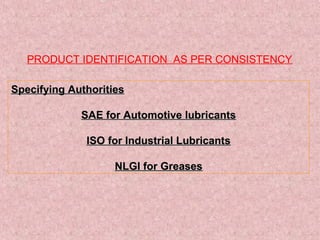
PRODUCT IDENTIFICATION AS PER CONSISTENCY
Specifying AuthoritiesSpecifying Authorities
SAE for Automotive lubricantsSAE for Automotive lubricants
ISO for Industrial LubricantsISO for Industrial Lubricants
NLGI for GreasesNLGI for Greases
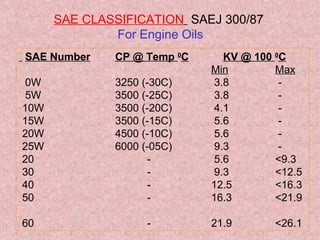
SAE CLASSIFICATION SAEJ 300/87
For Engine Oils
SAE Number CP @ Temp 0
C KV @ 100 0
C
Min Max
0W 3250 (-30C) 3.8 -
5W 3500 (-25C) 3.8 -
10W 3500 (-20C) 4.1 -
15W 3500 (-15C) 5.6 -
20W 4500 (-10C) 5.6 -
25W 6000 (-05C) 9.3 -
20 - 5.6 <9.3
30 - 9.3 <12.5
40 - 12.5 <16.3
50 - 16.3 <21.9
60 - 21.9 <26.1
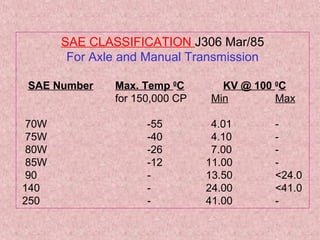
SAE CLASSIFICATION J306 Mar/85
For Axle and Manual Transmission
SAE Number Max. Temp 0
C KV @ 100 0
C
for 150,000 CP Min Max
70W -55 4.01 -
75W -40 4.10 -
80W -26 7.00 -
85W -12 11.00 -
90 - 13.50 <24.0
140 - 24.00 <41.0
250 - 41.00 -
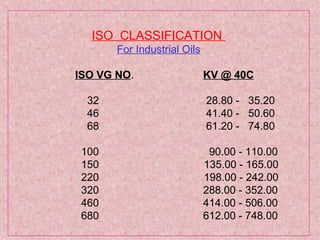
ISO CLASSIFICATION
For Industrial Oils
ISO VG NO. KV @ 40C
32 28.80 - 35.20
46 41.40 - 50.60
68 61.20 - 74.80
100 90.00 - 110.00
150 135.00 - 165.00
220 198.00 - 242.00
320 288.00 - 352.00
460 414.00 - 506.00
680 612.00 - 748.00
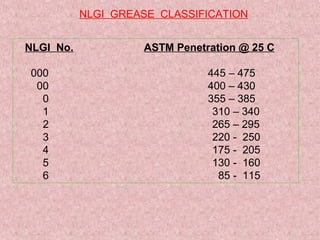
NLGI GREASE CLASSIFICATION
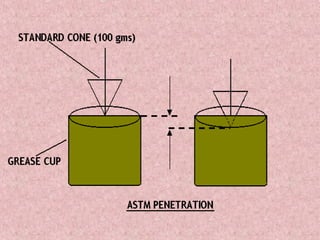
NLGI No. ASTM Penetration @ 25 C
000 445 – 475
00 400 – 430
0 355 – 385
1 310 – 340
2 265 – 295
3 220 - 250
4 175 - 205
5 130 - 160
6 85 - 115
WHAT ARE
MONO GRADE AND MULTI GRADE ENGINE OILS ?
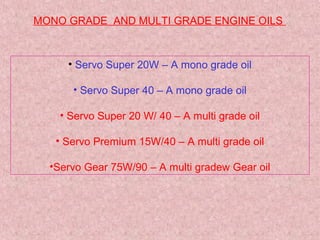
MONO GRADE AND MULTI GRADE ENGINE OILS
• Servo Super 20W – A mono grade oil
• Servo Super 40 – A mono grade oil
• Servo Super 20 W/ 40 – A multi grade oil
• Servo Premium 15W/40 – A multi grade oil
•Servo Gear 75W/90 – A multi gradew Gear oil
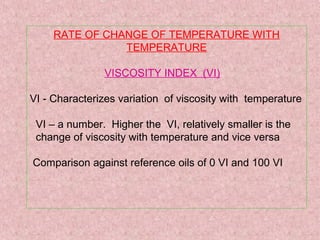
RATE OF CHANGE OF TEMPERATURE WITH
TEMPERATURE
VISCOSITY INDEX (VI)
VI - Characterizes variation of viscosity with temperature
VI – a number. Higher the VI, relatively smaller is the
change of viscosity with temperature and vice versa
Comparison against reference oils of 0 VI and 100 VI
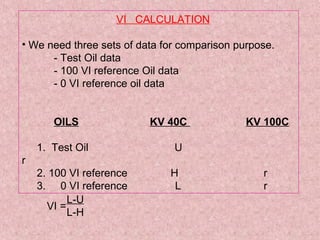
VI CALCULATION
• We need three sets of data for comparison purpose.
- Test Oil data
- 100 VI reference Oil data
- 0 VI reference oil data
OILS KV 40C KV 100C
1. Test Oil U
r
2. 100 VI reference H r
3. 0 VI reference L r
VI =
L-U
L-H
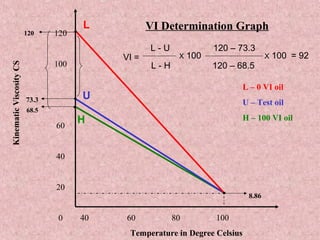
40 60 80 100
120
100
60
40
20
0
Temperature in Degree Celsius
68.5
73.3
8.86
VI Determination Graph
KinematicViscosityCS
120
L – 0 VI oil
U – Test oil
H – 100 VI oil
U
H
L
VI =
L - U
L - H
X 100
120 – 73.3
120 – 68.5
X 100 = 92
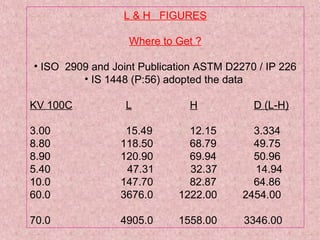
L & H FIGURES
Where to Get ?
• ISO 2909 and Joint Publication ASTM D2270 / IP 226
• IS 1448 (P:56) adopted the data
KV 100C L H D (L-H)
3.00 15.49 12.15 3.334
8.80 118.50 68.79 49.75
8.90 120.90 69.94 50.96
5.40 47.31 32.37 14.94
10.0 147.70 82.87 64.86
60.0 3676.0 1222.00 2454.00
70.0 4905.0 1558.00 3346.00
HOW TO CALCULATE VI 100 AND ABOVE ?
Formula gets altered
Data on 0 VI reference oil not needed
OILS KV 40C KV 100C
1. Test Oil U r
2. 100 VI reference H r
VI = [(antilog N) – 1] / 0.00715 +100
N = (log H – log U) /log r
Example
U=22.83, r = 5.05. From table wrt r=5.05, H=28.97
N = (log 28.97-log 22.83)/ log 5.05 = 0.14708
VI =(antilog 0.14708 –1/0.00715+100 = 156
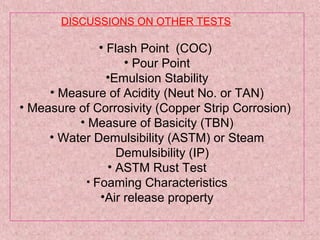
DISCUSSIONS ON OTHER TESTS
• Flash Point (COC)
• Pour Point
•Emulsion Stability
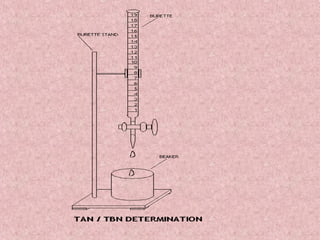
• Measure of Acidity (Neut No. or TAN)
• Measure of Corrosivity (Copper Strip Corrosion)
• Measure of Basicity (TBN)
• Water Demulsibility (ASTM) or Steam
Demulsibility (IP)
• ASTM Rust Test
• Foaming Characteristics
•Air release property
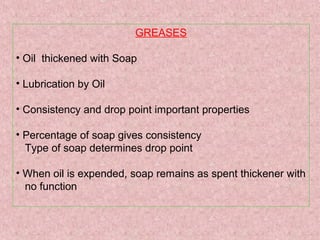
GREASES
• Oil thickened with Soap
• Lubrication by Oil
• Consistency and drop point important properties
• Percentage of soap gives consistency
Type of soap determines drop point
• When oil is expended, soap remains as spent thickener with
no function
TYPES OF GREASES
Lithium soap greases.
Lime or calcium soap greases.
Soda or sodium soap greases.
Aluminium greases.
Mixed soap greases
Complex greases
Non-soap type greases
(Clay thickened, Polymer thickened)
ADVANTAGES OF USING GREASES
• Sealing agent
• Dripping and spattering eliminated.
• Less frequent application – Inaccessible areas
• Method of application is far simpler then in the case of
oils.
DISADVANTAGES
Tendency to harden with age
Susceptible to oil separation both on storage and in use.
Inability to carry away heat.
 Dust and dirt entering the system cannot be flushed
away as in the case of oils
PROPERTIES OF GREASES
 Consistency(ASTM D-217)
 Drop point (ASTM D-566)
 Mechanical stability(ASTM D-1831)
 Water resistance (ASTM D-1264)
 Oil seperation(ASTM D-1742)
 Load carrying characteristics(ASTM D-2596)
Oxidative stability test(ASTM D-942)
HOW SAFE IT IS TO USE
REGENERATED OIL ?
WHAT HAPPENS TO AN OIL IN USE ?
TWO TYPES OF CHANGES IN OIL
• Internal or Chemical change
Due to inherent structural configurations and
transformation
• External change
Due to influence of outside factors
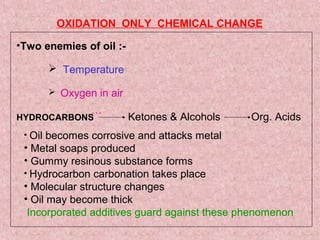
•Two enemies of oil :-
 Temperature
 Oxygen in air
HYDROCARBONS
OXIDATION ONLY CHEMICAL CHANGE
…
Ketones & Alcohols Org. Acids
• Oil becomes corrosive and attacks metal
• Metal soaps produced
• Gummy resinous substance forms
• Hydrocarbon carbonation takes place
• Molecular structure changes
• Oil may become thick
Incorporated additives guard against these phenomenon
EXTERNAL CHANGE (OUTSIDE FACTORS)
• Contamination is the culprit
• Two areas of concern
- Lubricant itself – its degradation products
- Major outside contaminants
CHANGES IN OIL
1. Change in Viscosity ?
• Chemical change has taken place ?
 Increase in TAN ?
 Confirmed by Copper Strip Corrosion ?
3. Reserve Alkalinity O.K. ?
 TBN value abnormally low ?
4. Increase in Sediment level ? Nature of sediment ?
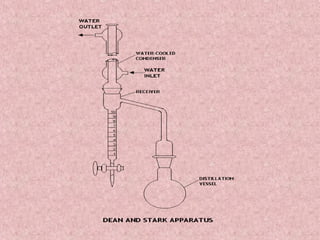
5. Increase in water content ?
• Is rusting taking place ?
• Any foaming problem ?
• Any stable emulsion formation ?
• Excessive Wear ?
Source ? Gear or Bearing or any other parts ?
Changes in oil ( contd...)
1 – Viscosity variation - Can be corrected by make-up
2 & 3 – Causes of Concern
4 – Sediment - Remove by Filtration
5 – Water - Remove by draining & Vacuum filtration
or Centrifuging.
6, 7 & 8 – Rust/ Foam/ Emulsion – Needs Additive
Treatment.
9 – Excessive Wear - Relative to 4
So long Sediment level remains within limit why
to spend time and money on wear metal analysis ?
Exclude gear as a source of wear metal by visual
examination.
Do not take risk on 2 & 3
CHANGES IN OIL ( Contd...)
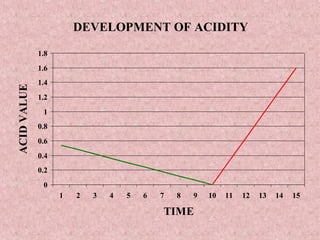
DEVELOPMENT OF ACIDITY
0
0.2
0.4
0.6
0.8
1
1.2
1.4
1.6
1.8
1 2 3 4 5 6 7 8 9 10 11 12 13 14 15
TIME
ACIDVALUE
DISTURBING THOUGHTS
Additive has been depleted in used oil
Where to get Additives to upgrade RO?
Regenerated oil will contaminate Virgin oil
• Why not we look at virgin oil as source ofWhy not we look at virgin oil as source of
Additive replenishment ?Additive replenishment ?
• Are we downgrading our virgin oil ?Are we downgrading our virgin oil ?
oror
• Are we not upgrading our regeneratedAre we not upgrading our regenerated
Oil?Oil?
OEM’s 1000 HOURS
• OEM dictates “Change Oil after 1000 Hours”
• Whose 1000 hours ? Equipment’s ? Or Oil’s ?
• Is it possible to calculate Oil’s 1000 hours ?
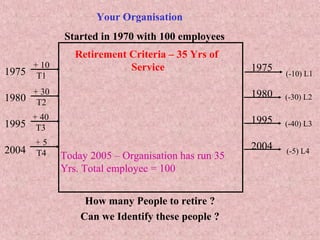
Your Organisation
Started in 1970 with 100 employees
Retirement Criteria – 35 Yrs of
Service
Today 2005 – Organisation has run 35
Yrs. Total employee = 100
How many People to retire ?
Can we Identify these people ?
1975
1980
1995
2004
1975
1980
1995
2004
+ 10
T1
+ 30
T2
+ 40
T3
+ 5
T4
(-10) L1
(-30) L2
(-40) L3
(-5) L4
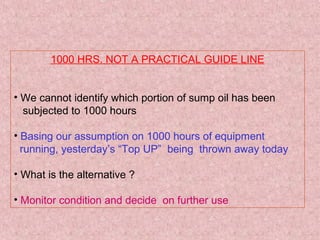
1000 HRS. NOT A PRACTICAL GUIDE LINE
• We cannot identify which portion of sump oil has been
subjected to 1000 hours
• Basing our assumption on 1000 hours of equipment
running, yesterday’s “Top UP” being thrown away today
• What is the alternative ?
• Monitor condition and decide on further use
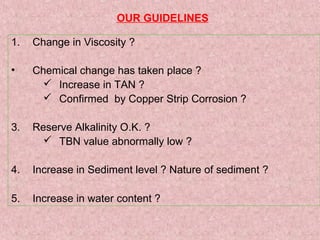
OUR GUIDELINES
1. Change in Viscosity ?
• Chemical change has taken place ?
 Increase in TAN ?
 Confirmed by Copper Strip Corrosion ?
3. Reserve Alkalinity O.K. ?
 TBN value abnormally low ?
4. Increase in Sediment level ? Nature of sediment ?
5. Increase in water content ?
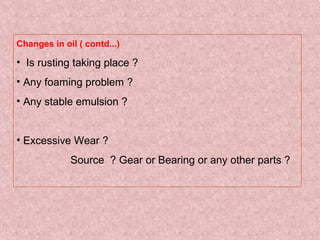
Changes in oil ( contd...)
• Is rusting taking place ?
• Any foaming problem ?
• Any stable emulsion ?
• Excessive Wear ?
Source ? Gear or Bearing or any other parts ?
T H A N K YOU

Lubricants general comments

  • 1.
    GENERAL DISCUSSIONS ONGENERALDISCUSSIONS ON LUBRICATING OILSLUBRICATING OILS
  • 2.
    FEW QUESTIONSFEW QUESTIONS What are Basic Requirements of Lubricants ?What are Basic Requirements of Lubricants ?  What are Performance Requirements of lubricants ?What are Performance Requirements of lubricants ?  What are Related Properties ?What are Related Properties ?  What is Viscosity & How is it measured ?What is Viscosity & How is it measured ?  What are SAE and ISO VG grades ?What are SAE and ISO VG grades ?
  • 3.
    Few questions contdFewquestions contd …… What is meant by 15W/40 Grade ?What is meant by 15W/40 Grade ?  What is Viscosity Index ?What is Viscosity Index ?  What are TAN – TBN – Flash Point – Pour Point ?What are TAN – TBN – Flash Point – Pour Point ?  What is Grease ? What are their properties ?What is Grease ? What are their properties ? finallyfinally  How safe is it to use Regenerated Oil ?How safe is it to use Regenerated Oil ?
  • 4.
    LUBRICATING OILS Two basicend use parameters • Lubrication • Process
  • 5.
    LubricationLubrication ProcessProcess Gears Heattransfer Bearings Heat Treatment Cylinder Lining Agricultural Spraying Mixed ApplicationMixed Application Cutting Fluids Hydraulic fluids
  • 6.
    Lubricants used byIndustry • Automotive Lubricants Engine Oils Transmission Oils Hydraulic Oils Gear Oils • Industrial Lubricants Bearing Oils Compressor Oils Gear Oils Way rope lubricants Hydraulic Oils Spindle & Machinery Oils Turbine Oils Machine way lubricants Refrigeration Oils
  • 7.
    Speciality Lubricants Brake Fluids RadiatorCoolant Shock absorber Oils Thermic Fluids Transformer Oils Metal Working Oils Agricultural Spray Oils Rubber Processing Oils
  • 8.
    What should bebasic requirements of a lubricant ?
  • 9.
    BASIC REQUIREMENTSBASIC REQUIREMENTS •Adequate body to provide lubrication and overcome friction in rubbing surfaces (consistency) • Low rate of change of consistency with temperature • Safety at high temperature operation • Low temperature fluidity • Ability to cling to water in special applications • To be friendly with system material (not to be reactive or corrosive) • Ability to neutralise acid if formed in the system
  • 10.
    What should beperformance requirements of a Lubricant ?
  • 11.
    PERFORMANCE REQUIREMENTSPERFORMANCE REQUIREMENTS •Ability to shed water • Ability to withstand rust formation in water contamination • Ability to resist foaming • Ability to disperse entrapped air bubble • Oxidation Stability • Thermal Stability • Ability to protect moving parts from wear and tear
  • 12.
    WHAT ARE RELATEDPROPERTIES ?
  • 13.
    Properties connected toBasic Requirements • Adequate Body to provide lubrication  Viscosity • Rate of change of consistency Viscosity Index • Handling Safety  Flash Point (COC) • Low Temperature fluidity Pour Point
  • 14.
    Properties connected toBasic Requirements (contd…) • Ability to cling to water Emulsion Stability • Friendly to system Measure of Acidity (Neut No. or TAN) Measure of Corrosivity (Copper Strip Corrosion) • Ability to neutralise generated acidity  Measure of Basicity (TBN)
  • 15.
    Properties connected toPerformance requirements • Ability to shed water  Water Demulsibility (ASTM) or Steam Demulsibility (IP) Ability to withstand rust formation in water contamination  ASTM Rust Test • Ability to resist foaming  Foaming Characteristics • Ability to disperse entrapped air bubble  Air release property
  • 16.
    Properties connected toPerformance requirements (contd….) • Oxidation stability  ROBOT • Ability to protect moving parts from wear and tear  Timken Load  Shell Four Ball test  SAE Rig Test  FZG Test
  • 17.
    VISCOSITY AN ALLIMPORTANT PROPERTY
  • 18.
    Different Viscosity Units America SayboltUniversal Seconds (SSU or SUS) Saybolt Furol Seconds (SFS) United Kingdom Redwood Seconds Germany Engler Universal Kinematic India utilises all these standards depending on Clients’ need
  • 19.
    Viscosity Contd….. • Sayboltor Redwood Viscosity - Measured volume of oil - Standard orifice - Actual time of flow • Viscosity Kinematic (KV) - Expressed as Centi Stokes (CS) - Capillary glass tube of appropriate size Tube Constant X Time of flow - Minimum time of flow 200 seconds
  • 22.
    • Viscosity Contd… •Absolute viscosity expressed in Poise or Centipoises (CP) • KV gives other standards of viscosity • For KV Up to 75 CS tables available • For KV above 75CS, Engler = CS X 0.132 SUS = CS X 4.632 RW = CS X 4.08 • CP = CS X Density at same temperature Viscosity has no meaning without temperature
  • 23.
    PRODUCT IDENTIFICATION ASPER CONSISTENCY Specifying AuthoritiesSpecifying Authorities SAE for Automotive lubricantsSAE for Automotive lubricants ISO for Industrial LubricantsISO for Industrial Lubricants NLGI for GreasesNLGI for Greases
  • 24.
    SAE CLASSIFICATION SAEJ300/87 For Engine Oils SAE Number CP @ Temp 0 C KV @ 100 0 C Min Max 0W 3250 (-30C) 3.8 - 5W 3500 (-25C) 3.8 - 10W 3500 (-20C) 4.1 - 15W 3500 (-15C) 5.6 - 20W 4500 (-10C) 5.6 - 25W 6000 (-05C) 9.3 - 20 - 5.6 <9.3 30 - 9.3 <12.5 40 - 12.5 <16.3 50 - 16.3 <21.9 60 - 21.9 <26.1
  • 25.
    SAE CLASSIFICATION J306Mar/85 For Axle and Manual Transmission SAE Number Max. Temp 0 C KV @ 100 0 C for 150,000 CP Min Max 70W -55 4.01 - 75W -40 4.10 - 80W -26 7.00 - 85W -12 11.00 - 90 - 13.50 <24.0 140 - 24.00 <41.0 250 - 41.00 -
  • 26.
    ISO CLASSIFICATION For IndustrialOils ISO VG NO. KV @ 40C 32 28.80 - 35.20 46 41.40 - 50.60 68 61.20 - 74.80 100 90.00 - 110.00 150 135.00 - 165.00 220 198.00 - 242.00 320 288.00 - 352.00 460 414.00 - 506.00 680 612.00 - 748.00
  • 27.
    NLGI GREASE CLASSIFICATION NLGINo. ASTM Penetration @ 25 C 000 445 – 475 00 400 – 430 0 355 – 385 1 310 – 340 2 265 – 295 3 220 - 250 4 175 - 205 5 130 - 160 6 85 - 115
  • 28.
    WHAT ARE MONO GRADEAND MULTI GRADE ENGINE OILS ?
  • 29.
    MONO GRADE ANDMULTI GRADE ENGINE OILS • Servo Super 20W – A mono grade oil • Servo Super 40 – A mono grade oil • Servo Super 20 W/ 40 – A multi grade oil • Servo Premium 15W/40 – A multi grade oil •Servo Gear 75W/90 – A multi gradew Gear oil
  • 30.
    RATE OF CHANGEOF TEMPERATURE WITH TEMPERATURE VISCOSITY INDEX (VI) VI - Characterizes variation of viscosity with temperature VI – a number. Higher the VI, relatively smaller is the change of viscosity with temperature and vice versa Comparison against reference oils of 0 VI and 100 VI
  • 31.
    VI CALCULATION • Weneed three sets of data for comparison purpose. - Test Oil data - 100 VI reference Oil data - 0 VI reference oil data OILS KV 40C KV 100C 1. Test Oil U r 2. 100 VI reference H r 3. 0 VI reference L r VI = L-U L-H
  • 32.
    40 60 80100 120 100 60 40 20 0 Temperature in Degree Celsius 68.5 73.3 8.86 VI Determination Graph KinematicViscosityCS 120 L – 0 VI oil U – Test oil H – 100 VI oil U H L VI = L - U L - H X 100 120 – 73.3 120 – 68.5 X 100 = 92
  • 33.
    L & HFIGURES Where to Get ? • ISO 2909 and Joint Publication ASTM D2270 / IP 226 • IS 1448 (P:56) adopted the data KV 100C L H D (L-H) 3.00 15.49 12.15 3.334 8.80 118.50 68.79 49.75 8.90 120.90 69.94 50.96 5.40 47.31 32.37 14.94 10.0 147.70 82.87 64.86 60.0 3676.0 1222.00 2454.00 70.0 4905.0 1558.00 3346.00
  • 34.
    HOW TO CALCULATEVI 100 AND ABOVE ? Formula gets altered Data on 0 VI reference oil not needed OILS KV 40C KV 100C 1. Test Oil U r 2. 100 VI reference H r VI = [(antilog N) – 1] / 0.00715 +100 N = (log H – log U) /log r Example U=22.83, r = 5.05. From table wrt r=5.05, H=28.97 N = (log 28.97-log 22.83)/ log 5.05 = 0.14708 VI =(antilog 0.14708 –1/0.00715+100 = 156
  • 35.
    DISCUSSIONS ON OTHERTESTS • Flash Point (COC) • Pour Point •Emulsion Stability • Measure of Acidity (Neut No. or TAN) • Measure of Corrosivity (Copper Strip Corrosion) • Measure of Basicity (TBN) • Water Demulsibility (ASTM) or Steam Demulsibility (IP) • ASTM Rust Test • Foaming Characteristics •Air release property
  • 38.
    GREASES • Oil thickenedwith Soap • Lubrication by Oil • Consistency and drop point important properties • Percentage of soap gives consistency Type of soap determines drop point • When oil is expended, soap remains as spent thickener with no function
  • 39.
    TYPES OF GREASES Lithiumsoap greases. Lime or calcium soap greases. Soda or sodium soap greases. Aluminium greases. Mixed soap greases Complex greases Non-soap type greases (Clay thickened, Polymer thickened)
  • 40.
    ADVANTAGES OF USINGGREASES • Sealing agent • Dripping and spattering eliminated. • Less frequent application – Inaccessible areas • Method of application is far simpler then in the case of oils. DISADVANTAGES Tendency to harden with age Susceptible to oil separation both on storage and in use. Inability to carry away heat.  Dust and dirt entering the system cannot be flushed away as in the case of oils
  • 41.
    PROPERTIES OF GREASES Consistency(ASTM D-217)  Drop point (ASTM D-566)  Mechanical stability(ASTM D-1831)  Water resistance (ASTM D-1264)  Oil seperation(ASTM D-1742)  Load carrying characteristics(ASTM D-2596) Oxidative stability test(ASTM D-942)
  • 43.
    HOW SAFE ITIS TO USE REGENERATED OIL ?
  • 44.
    WHAT HAPPENS TOAN OIL IN USE ?
  • 45.
    TWO TYPES OFCHANGES IN OIL • Internal or Chemical change Due to inherent structural configurations and transformation • External change Due to influence of outside factors
  • 46.
    •Two enemies ofoil :-  Temperature  Oxygen in air HYDROCARBONS OXIDATION ONLY CHEMICAL CHANGE … Ketones & Alcohols Org. Acids • Oil becomes corrosive and attacks metal • Metal soaps produced • Gummy resinous substance forms • Hydrocarbon carbonation takes place • Molecular structure changes • Oil may become thick Incorporated additives guard against these phenomenon
  • 47.
    EXTERNAL CHANGE (OUTSIDEFACTORS) • Contamination is the culprit • Two areas of concern - Lubricant itself – its degradation products - Major outside contaminants
  • 48.
    CHANGES IN OIL 1.Change in Viscosity ? • Chemical change has taken place ?  Increase in TAN ?  Confirmed by Copper Strip Corrosion ? 3. Reserve Alkalinity O.K. ?  TBN value abnormally low ? 4. Increase in Sediment level ? Nature of sediment ? 5. Increase in water content ?
  • 49.
    • Is rustingtaking place ? • Any foaming problem ? • Any stable emulsion formation ? • Excessive Wear ? Source ? Gear or Bearing or any other parts ? Changes in oil ( contd...)
  • 50.
    1 – Viscosityvariation - Can be corrected by make-up 2 & 3 – Causes of Concern 4 – Sediment - Remove by Filtration 5 – Water - Remove by draining & Vacuum filtration or Centrifuging. 6, 7 & 8 – Rust/ Foam/ Emulsion – Needs Additive Treatment. 9 – Excessive Wear - Relative to 4 So long Sediment level remains within limit why to spend time and money on wear metal analysis ? Exclude gear as a source of wear metal by visual examination. Do not take risk on 2 & 3 CHANGES IN OIL ( Contd...)
  • 51.
    DEVELOPMENT OF ACIDITY 0 0.2 0.4 0.6 0.8 1 1.2 1.4 1.6 1.8 12 3 4 5 6 7 8 9 10 11 12 13 14 15 TIME ACIDVALUE
  • 52.
    DISTURBING THOUGHTS Additive hasbeen depleted in used oil Where to get Additives to upgrade RO? Regenerated oil will contaminate Virgin oil
  • 53.
    • Why notwe look at virgin oil as source ofWhy not we look at virgin oil as source of Additive replenishment ?Additive replenishment ? • Are we downgrading our virgin oil ?Are we downgrading our virgin oil ? oror • Are we not upgrading our regeneratedAre we not upgrading our regenerated Oil?Oil?
  • 54.
    OEM’s 1000 HOURS •OEM dictates “Change Oil after 1000 Hours” • Whose 1000 hours ? Equipment’s ? Or Oil’s ? • Is it possible to calculate Oil’s 1000 hours ?
  • 55.
    Your Organisation Started in1970 with 100 employees Retirement Criteria – 35 Yrs of Service Today 2005 – Organisation has run 35 Yrs. Total employee = 100 How many People to retire ? Can we Identify these people ? 1975 1980 1995 2004 1975 1980 1995 2004 + 10 T1 + 30 T2 + 40 T3 + 5 T4 (-10) L1 (-30) L2 (-40) L3 (-5) L4
  • 56.
    1000 HRS. NOTA PRACTICAL GUIDE LINE • We cannot identify which portion of sump oil has been subjected to 1000 hours • Basing our assumption on 1000 hours of equipment running, yesterday’s “Top UP” being thrown away today • What is the alternative ? • Monitor condition and decide on further use
  • 57.
    OUR GUIDELINES 1. Changein Viscosity ? • Chemical change has taken place ?  Increase in TAN ?  Confirmed by Copper Strip Corrosion ? 3. Reserve Alkalinity O.K. ?  TBN value abnormally low ? 4. Increase in Sediment level ? Nature of sediment ? 5. Increase in water content ?
  • 58.
    Changes in oil( contd...) • Is rusting taking place ? • Any foaming problem ? • Any stable emulsion ? • Excessive Wear ? Source ? Gear or Bearing or any other parts ?
  • 59.
    T H AN K YOU