Stork Thermeq B.V.
®
Presentation
Stork
Thermeq BV
Start
Spray-type
Deaerator
Stork Thermeq B.V.
®
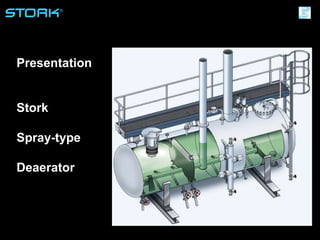
Presentation
Stork
Spray-type
Deaerator
Stork Thermeq B.V.
®
Application ConstructionGeneral
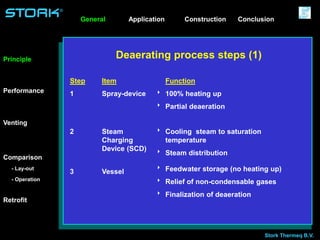
Deaerating process steps (1)Principle
Venting
Performance
Step Item
1 Spray-device
2 Steam
Charging
Device (SCD)
3 Vessel
Function
 100% heating up
 Partial deaeration
 Cooling steam to saturation
temperature
 Steam distribution
 Feedwater storage (no heating up)
 Relief of non-condensable gases
 Finalization of deaeration
Comparison
Retrofit
- Lay-out
- Operation
Conclusion
Stork Thermeq B.V.
®
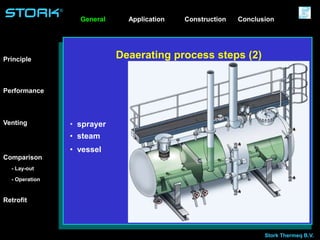
• sprayer
• steam
• vessel
Deaerating process steps (2)Principle
Venting
Performance
Comparison
Retrofit
- Operation
Application ConstructionGeneral
- Lay-out
Conclusion
Stork Thermeq B.V.
®
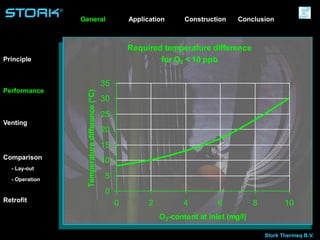
Required temperature difference
for O2 < 10 ppb
0
5
10
15
20
25
30
35
0 2 4 6 8 10
O2-content at inlet (mg/l)
Temperaturedifference(°C)
Application ConstructionGeneral
Principle
Venting
Performance
Comparison
Retrofit
- Operation
- Lay-out
Conclusion
Stork Thermeq B.V.
®
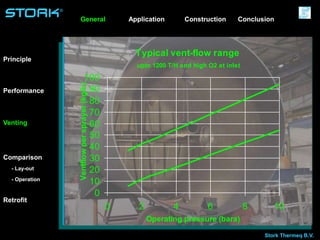
Typical vent-flow range
upto 1200 T/H and high O2 at inlet
0
10
20
30
40
50
60
70
80
90
100
0 2 4 6 8 10
Operating pressure (bara)
Ventflowpersprayer(kg/h)
Application ConstructionGeneral
Principle
Venting
Performance
Comparison
Retrofit
- Operation
- Lay-out
Conclusion
Stork Thermeq B.V.
®
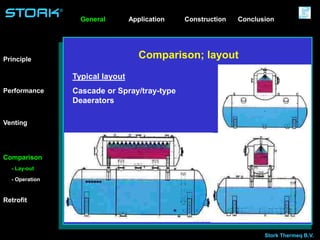
Comparison; layout
Typical layout
Cascade or Spray/tray-type
Deaerators
Application ConstructionGeneral
Principle
Venting
Performance
Comparison
Retrofit
- Lay-out
- Operation
Conclusion
Stork Thermeq B.V.
®
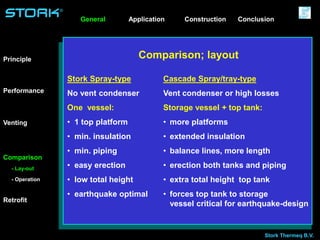
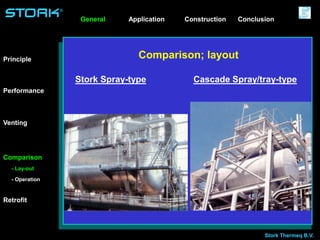
Comparison; layout
Stork Spray-type
No vent condenser
One vessel:
• 1 top platform
• min. insulation
• min. piping
• easy erection
• low total height
• earthquake optimal
Cascade Spray/tray-type
Vent condenser or high losses
Storage vessel + top tank:
• more platforms
• extended insulation
• balance lines, more length
• erection both tanks and piping
• extra total height top tank
• forces top tank to storage
vessel critical for earthquake-design
Application ConstructionGeneral
Principle
Venting
Performance
Comparison
Retrofit
- Lay-out
- Operation
Conclusion
Stork Thermeq B.V.
®
Comparison; layout
Stork Spray-type Cascade Spray/tray-type
Application ConstructionGeneral
Principle
Venting
Performance
Comparison
Retrofit
- Lay-out
- Operation
Conclusion
Stork Thermeq B.V.
®
Comparison; operation
Stork Spray-type
• heating-up with
standard steamrake
• operating range > 1:30
• no pressure difference
in steam area
Cascade Spray/tray-type
• additional heating
storage tank required
• operating range max. 1:4
• pressure difference
storage vessel and top tank
at high loads
Application ConstructionGeneral
Principle
Venting
Performance
Comparison
Retrofit
- Lay-out
- Operation
Conclusion
Stork Thermeq B.V.
®
Comparison; operation
Stork Spray-type
• water saturated with
rising pressure; easy
control
• simple pressure
control
• rate pressure decrease
limited by NPSH
feedwater pump
Cascade Spray/tray-type
• water subcooled with rising
pressure; sensitive control
• pressure control + feedforward
• rate pressure decrease is a
critical item in design top
tank
Application ConstructionGeneral
Principle
Venting
Performance
Comparison
Retrofit
- Lay-out
- Operation
Conclusion
Stork Thermeq B.V.
®
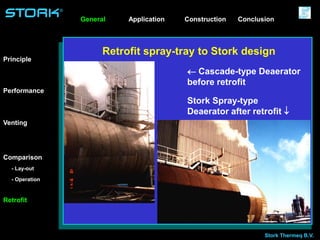
Retrofit spray-tray to Stork design
Stork Spray-type
Deaerator after retrofit 
 Cascade-type Deaerator
before retrofit
Application ConstructionGeneral
Principle
Venting
Performance
Comparison
Retrofit
- Operation
- Lay-out
Conclusion
Stork Thermeq B.V.
®
MediaMedia
Conventional
HRSG
Ranges
Vacuum
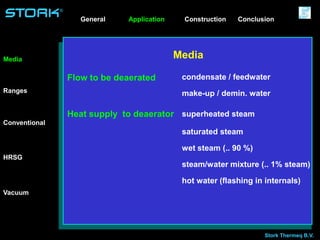
Flow to be deaerated
Heat supply to deaerator
condensate / feedwater
make-up / demin. water
superheated steam
saturated steam
wet steam (.. 90 %)
steam/water mixture (.. 1% steam)
hot water (flashing in internals)
Application ConstructionGeneral Conclusion
Stork Thermeq B.V.
®
Ranges
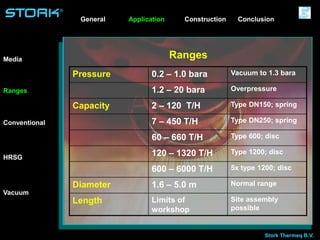
Pressure 0.2 – 1.0 bara Vacuum to 1.3 bara
1.2 – 20 bara Overpressure
Capacity 2 – 120 T/H Type DN150; spring
7 – 450 T/H Type DN250; spring
60 – 660 T/H Type 600; disc
120 – 1320 T/H Type 1200; disc
600 – 6000 T/H 5x type 1200; disc
Diameter 1.6 – 5.0 m Normal range
Length Limits of
workshop
Site assembly
possible
Application ConstructionGeneral
Media
Conventional
HRSG
Ranges
Vacuum
Conclusion
Stork Thermeq B.V.
®
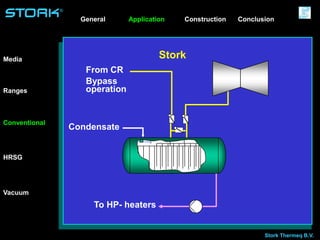
Stork
From CR
Bypass
operation
Condensate
To HP- heaters
Application ConstructionGeneral
Media
Conventional
HRSG
Ranges
Vacuum
Conclusion
Stork Thermeq B.V.
®
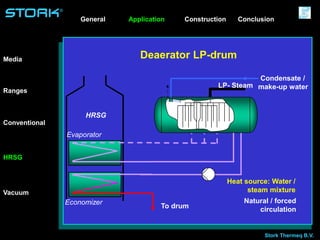
Deaerator LP-drum
Condensate /
make-up water
To drum
HRSG
Economizer
Heat source: Water /
steam mixture
LP- Steam
Natural / forced
circulation
Evaporator
Application ConstructionGeneral
Media
Conventional
HRSG
Ranges
Vacuum
Conclusion
Stork Thermeq B.V.
®
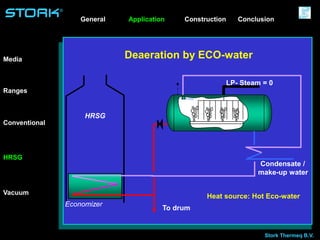
Deaeration by ECO-water
LP- Steam = 0
Condensate /
make-up water
To drum
HRSG
Economizer
Heat source: Hot Eco-water
Application ConstructionGeneral
Media
Conventional
HRSG
Ranges
Vacuum
Conclusion
Stork Thermeq B.V.
®
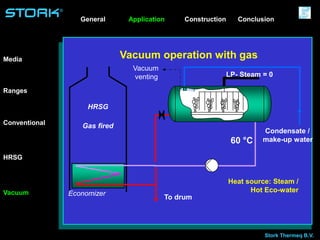
Vacuum operation with gas
Condensate /
make-up water
To drum
HRSG
LP- Steam = 0
60 °C
Gas fired
Economizer
Heat source: Steam /
Hot Eco-water
Vacuum
venting
Application ConstructionGeneral
Media
Conventional
HRSG
Ranges
Vacuum
Conclusion
Stork Thermeq B.V.
®
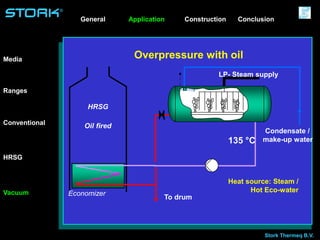
Overpressure with oil
Condensate /
make-up water
To drum
HRSG
LP- Steam supply
135 °C
Oil fired
Economizer
Heat source: Steam /
Hot Eco-water
Application ConstructionGeneral
Media
Conventional
HRSG
Ranges
Vacuum
Conclusion
Stork Thermeq B.V.
®
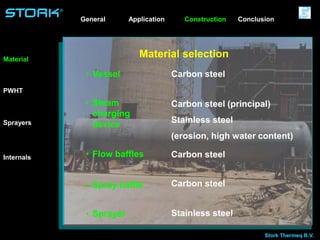
Material selectionMaterial
Sprayers
Internals
PWHT
• Vessel
• Steam
charging
device
• Flow baffles
• Spray baffle
• Sprayer
Carbon steel
Carbon steel (principal)
Stainless steel
(erosion, high water content)
Carbon steel
Carbon steel
Stainless steel
Application ConstructionGeneral Conclusion
Stork Thermeq B.V.
®
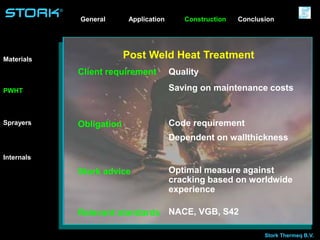
Post Weld Heat Treatment
Quality
Saving on maintenance costs
Code requirement
Dependent on wallthickness
Optimal measure against
cracking based on worldwide
experience
NACE, VGB, S42
Client requirement
Obligation
Stork advice
Relevant standards
Application ConstructionGeneral
Materials
Sprayers
Internals
PWHT
Conclusion
Stork Thermeq B.V.
®
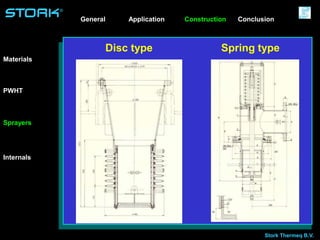
Disc type Spring type
Application ConstructionGeneral
Materials
Sprayers
Internals
PWHT
Conclusion
Stork Thermeq B.V.
®
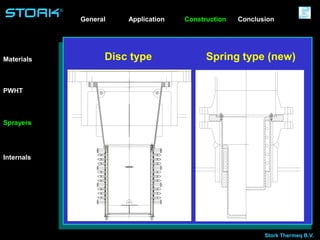
Disc type Spring type (new)
Application ConstructionGeneral
Materials
Sprayers
Internals
PWHT
Conclusion
Stork Thermeq B.V.
®
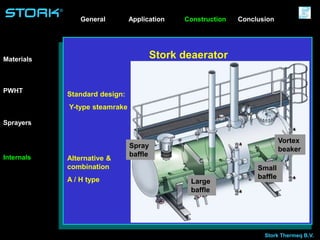
Large
baffle
Small
baffle
Vortex
beakerSpray
baffle
Standard design:
Y-type steamrake
Alternative &
combination
A / H type
Application ConstructionGeneral
Materials
Sprayers
Internals
PWHT
Stork deaerator
Conclusion
Stork Thermeq B.V.
®
Stork spray-type Deaerators
Attractive prices
Flexible design, minimum height
Minimize the maintenance budget
Satisfaction on your decision for years and years
Investing in deaerators you want
Stork Thermeq B.V.
®
End of Presentation
Stork
Thermeq BV
End

Deaerator -thermal power plants

  • 1.
  • 2.
  • 3.
    Stork Thermeq B.V. ® ApplicationConstructionGeneral Deaerating process steps (1)Principle Venting Performance Step Item 1 Spray-device 2 Steam Charging Device (SCD) 3 Vessel Function  100% heating up  Partial deaeration  Cooling steam to saturation temperature  Steam distribution  Feedwater storage (no heating up)  Relief of non-condensable gases  Finalization of deaeration Comparison Retrofit - Lay-out - Operation Conclusion
  • 4.
    Stork Thermeq B.V. ® •sprayer • steam • vessel Deaerating process steps (2)Principle Venting Performance Comparison Retrofit - Operation Application ConstructionGeneral - Lay-out Conclusion
  • 5.
    Stork Thermeq B.V. ® Requiredtemperature difference for O2 < 10 ppb 0 5 10 15 20 25 30 35 0 2 4 6 8 10 O2-content at inlet (mg/l) Temperaturedifference(°C) Application ConstructionGeneral Principle Venting Performance Comparison Retrofit - Operation - Lay-out Conclusion
  • 6.
    Stork Thermeq B.V. ® Typicalvent-flow range upto 1200 T/H and high O2 at inlet 0 10 20 30 40 50 60 70 80 90 100 0 2 4 6 8 10 Operating pressure (bara) Ventflowpersprayer(kg/h) Application ConstructionGeneral Principle Venting Performance Comparison Retrofit - Operation - Lay-out Conclusion
  • 7.
    Stork Thermeq B.V. ® Comparison;layout Typical layout Cascade or Spray/tray-type Deaerators Application ConstructionGeneral Principle Venting Performance Comparison Retrofit - Lay-out - Operation Conclusion
  • 8.
    Stork Thermeq B.V. ® Comparison;layout Stork Spray-type No vent condenser One vessel: • 1 top platform • min. insulation • min. piping • easy erection • low total height • earthquake optimal Cascade Spray/tray-type Vent condenser or high losses Storage vessel + top tank: • more platforms • extended insulation • balance lines, more length • erection both tanks and piping • extra total height top tank • forces top tank to storage vessel critical for earthquake-design Application ConstructionGeneral Principle Venting Performance Comparison Retrofit - Lay-out - Operation Conclusion
  • 9.
    Stork Thermeq B.V. ® Comparison;layout Stork Spray-type Cascade Spray/tray-type Application ConstructionGeneral Principle Venting Performance Comparison Retrofit - Lay-out - Operation Conclusion
  • 10.
    Stork Thermeq B.V. ® Comparison;operation Stork Spray-type • heating-up with standard steamrake • operating range > 1:30 • no pressure difference in steam area Cascade Spray/tray-type • additional heating storage tank required • operating range max. 1:4 • pressure difference storage vessel and top tank at high loads Application ConstructionGeneral Principle Venting Performance Comparison Retrofit - Lay-out - Operation Conclusion
  • 11.
    Stork Thermeq B.V. ® Comparison;operation Stork Spray-type • water saturated with rising pressure; easy control • simple pressure control • rate pressure decrease limited by NPSH feedwater pump Cascade Spray/tray-type • water subcooled with rising pressure; sensitive control • pressure control + feedforward • rate pressure decrease is a critical item in design top tank Application ConstructionGeneral Principle Venting Performance Comparison Retrofit - Lay-out - Operation Conclusion
  • 12.
    Stork Thermeq B.V. ® Retrofitspray-tray to Stork design Stork Spray-type Deaerator after retrofit   Cascade-type Deaerator before retrofit Application ConstructionGeneral Principle Venting Performance Comparison Retrofit - Operation - Lay-out Conclusion
  • 13.
    Stork Thermeq B.V. ® MediaMedia Conventional HRSG Ranges Vacuum Flowto be deaerated Heat supply to deaerator condensate / feedwater make-up / demin. water superheated steam saturated steam wet steam (.. 90 %) steam/water mixture (.. 1% steam) hot water (flashing in internals) Application ConstructionGeneral Conclusion
  • 14.
    Stork Thermeq B.V. ® Ranges Pressure0.2 – 1.0 bara Vacuum to 1.3 bara 1.2 – 20 bara Overpressure Capacity 2 – 120 T/H Type DN150; spring 7 – 450 T/H Type DN250; spring 60 – 660 T/H Type 600; disc 120 – 1320 T/H Type 1200; disc 600 – 6000 T/H 5x type 1200; disc Diameter 1.6 – 5.0 m Normal range Length Limits of workshop Site assembly possible Application ConstructionGeneral Media Conventional HRSG Ranges Vacuum Conclusion
  • 15.
    Stork Thermeq B.V. ® Stork FromCR Bypass operation Condensate To HP- heaters Application ConstructionGeneral Media Conventional HRSG Ranges Vacuum Conclusion
  • 16.
    Stork Thermeq B.V. ® DeaeratorLP-drum Condensate / make-up water To drum HRSG Economizer Heat source: Water / steam mixture LP- Steam Natural / forced circulation Evaporator Application ConstructionGeneral Media Conventional HRSG Ranges Vacuum Conclusion
  • 17.
    Stork Thermeq B.V. ® Deaerationby ECO-water LP- Steam = 0 Condensate / make-up water To drum HRSG Economizer Heat source: Hot Eco-water Application ConstructionGeneral Media Conventional HRSG Ranges Vacuum Conclusion
  • 18.
    Stork Thermeq B.V. ® Vacuumoperation with gas Condensate / make-up water To drum HRSG LP- Steam = 0 60 °C Gas fired Economizer Heat source: Steam / Hot Eco-water Vacuum venting Application ConstructionGeneral Media Conventional HRSG Ranges Vacuum Conclusion
  • 19.
    Stork Thermeq B.V. ® Overpressurewith oil Condensate / make-up water To drum HRSG LP- Steam supply 135 °C Oil fired Economizer Heat source: Steam / Hot Eco-water Application ConstructionGeneral Media Conventional HRSG Ranges Vacuum Conclusion
  • 20.
    Stork Thermeq B.V. ® MaterialselectionMaterial Sprayers Internals PWHT • Vessel • Steam charging device • Flow baffles • Spray baffle • Sprayer Carbon steel Carbon steel (principal) Stainless steel (erosion, high water content) Carbon steel Carbon steel Stainless steel Application ConstructionGeneral Conclusion
  • 21.
    Stork Thermeq B.V. ® PostWeld Heat Treatment Quality Saving on maintenance costs Code requirement Dependent on wallthickness Optimal measure against cracking based on worldwide experience NACE, VGB, S42 Client requirement Obligation Stork advice Relevant standards Application ConstructionGeneral Materials Sprayers Internals PWHT Conclusion
  • 22.
    Stork Thermeq B.V. ® Disctype Spring type Application ConstructionGeneral Materials Sprayers Internals PWHT Conclusion
  • 23.
    Stork Thermeq B.V. ® Disctype Spring type (new) Application ConstructionGeneral Materials Sprayers Internals PWHT Conclusion
  • 24.
    Stork Thermeq B.V. ® Large baffle Small baffle Vortex beakerSpray baffle Standarddesign: Y-type steamrake Alternative & combination A / H type Application ConstructionGeneral Materials Sprayers Internals PWHT Stork deaerator Conclusion
  • 25.
    Stork Thermeq B.V. ® Storkspray-type Deaerators Attractive prices Flexible design, minimum height Minimize the maintenance budget Satisfaction on your decision for years and years Investing in deaerators you want
  • 26.
    Stork Thermeq B.V. ® Endof Presentation Stork Thermeq BV End