Lubricants
&
Greases
By A.Antony Peter
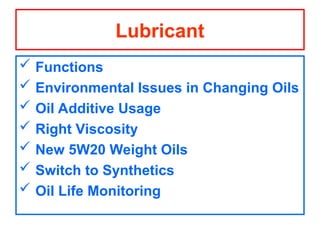
Lubricant
 Functions
 Environmental Issues in Changing Oils
 Oil Additive Usage
 Right Viscosity
 New 5W20 Weight Oils
 Switch to Synthetics
 Oil Life Monitoring
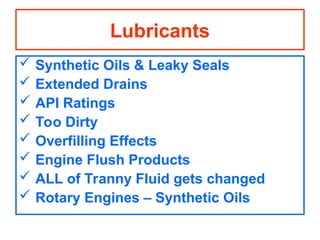
Lubricants
 Synthetic Oils & Leaky Seals
 Extended Drains
 API Ratings
 Too Dirty
 Overfilling Effects
 Engine Flush Products
 ALL of Tranny Fluid gets changed
 Rotary Engines – Synthetic Oils
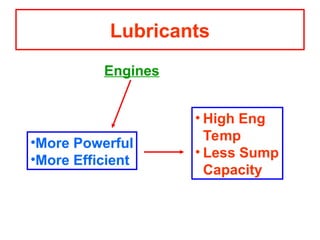
Engines
•More Powerful
•More Efficient
• High Eng
Temp
• Less Sump
Capacity
Lubricants
Functions
 Lubricate
 Less Loss of Power
 Protect through Thin Film
 From Metal to Metal Contact
 From Corrosion by Acid Formation
i. Oxidation & Condensation of Oil
ii.Condensation of By Products
Functions
 Dispersant
 Washing away the Particles
 Clean
 To be Filter out Particles < 20 µ
 Cool
 Combustion - Passing away Hot Components
viz Cr Shaft, Cam Shaft, TGs, Piston, M&BE
Brg, etc.
 Heat from Friction
 Base Fluid
 Bulk of the Oil
 Additive Package
 To Enhance Positive Quality of Base
Stock
Main Components
I. Petroleum
 Refined from Crude Oil
II. Synthetic
 Chemically Engineered in Labs
 No Contaminants (Removed via
Purification)
Base Fluid
Viscosity Index
 The viscosity of an oil refers to its relative
resistance to flow at differing temperatures
 Ability to maintain Viscosity over Wide Temp
Range. High the number Lesser the Change
Low Temp Performance
 Better Flow in Low Temp
 Eng Protection at Start-Up in Cold Weather
Condition
Petroleum Base
Crude refined for ….
 High Temp Performance
 More Effective at Extreme Hot
 Burn Resistant
 Metal to Metal Contact – Viscosity Loss
 Oxidation Resistant
 Oxygen when Reacts with Oil forms
Sludge & Other Eng Deposits
 Results in Viscosity Increase – Low Oil
Flow
Petroleum Base
Crude refined for ….
 Desalting
 Removing the Salt Contamination
 Partial Vapourisation
 To remove Differing Boiling Point
Components
 To contain High Boiling Point
Components except Asphaltic
Materials
Petroleum Base
Crude refining Process ….
 Vacuum Distillation
 Separated for Differing Molecular
Weights
 Differing Viscosity Index
 Solvent Extraction
 To extract Aromatic Compounds (80%
Extcd)
 To Improve
 Thermal & Oxidative Stability
 Viscosity Index
Petroleum Base
Crude refining Process ….
 Dewaxing
 Low temp Fluidity
 Hydrofinishing / Clay Treatment
 To remove Unstable Components viz
Sulphur & Nitrogen
 To Improve Oxidation Stability, Thermal
Stability & Colour
Petroleum Base
Crude refining Process ….
 Hydroheating
 99% removal of Aromatic Components
 Used in Place of Solvent Extraction
and/or in Addition to Solvent Extraction
Petroleum Base
Crude refining Process ….
Quality
 Depends on Crude Oil Selection
 Tremendous Care to be Exercised in
Selecting Crude Oil Stock
Petroleum Base
Petroleum Base Stocks put through
Super Extreme refining process called
Hydrocracking
Hydrocracking involves in Breaking &
Fragmenting different Molecular
Structures into far more stable one
Better Oxidative & Thermal Stability
Better Viscosity Index
Pseudo – Synthetic Base Stocks
Polyalphaolefins (PAO's)
Diesters
Polyolesters
Synthetic Base Stocks
These are the most common synthetic
basestocks used in the US and in
Europe.
PAO's are also called synthesized
hydrocarbons and contain absolutely
no wax, metals, sulfur or phosphorous.
Viscosity indexes for nearly all PAO's
are around 150, and they have
extremely low pour points (normally
below -40 degrees F)
Polyalphaolefins (PAO's)
Disadvantages
Although PAO's are also very thermally
stable, they are not as oxidatively stable as
other synthetics.
when properly additized, oxidative stability
can be achieved.
PAO's also tend to shrink seals
Quality
Their final lubricating characteristics depend
on the chemical reactions used to create
them.
Polyalphaolefins (PAO's)
Less commonly used
If chosen carefully, Diesters generally
provide better pour points than PAO's
(about -60 to -80 degrees F)
A little more oxidatively stable when
properly additized.
Diesters also have very good solvency
characteristics even without the aid of
detergency additives.
Diesters
Advantage
Like PAO's, Diesters can affect seals.
However, they generally cause seal
swell
Chemically resistant seals are
recommended if using synthetic base
oils manufactured with diesters.
Diesters
Similar to Diesters, but slightly more
complex
Advantages over Diesters
Greater range of pour points as low as -90
degrees F
Viscosity indexes as high as 160 (without VI
additive improvers)
The same seal swell characteristics exist
with polyolesters as with diesters.
Polyolesters
Each chemical within an oils additive
package plays a different role in
boosting the beneficial properties of
it's host lubricant (basestock)
Chemical Additives
IMPROVE VISCOSITY
CHARACTERISTICS (VC)
Pour Point Depressants
Viscosity Index Improvers
Chemical Additives
Pour Point Depressants
To improve the flow characteristics of a
lubricant basestock at low
temperatures
They are normally only used in
conjunction with petroleum basestock
lubricants
The only exception might be
hydrocracked petroleum basestocks
Chemical Additives – (VC)
Viscosity Index Improvers
So, as the basestock loses viscosity
with increases in temperature, VI
improvers
negate that viscosity drop by
increasing their size.
Chemical Additives – (VC)
MAINTAIN LUBRICANT STABILITY (LS)
They are susceptible to breakdown due
to contamination and/or oxidation
which decreases the useful life of an
oil.
Additives are used to inhibit the
susceptibility
Chemical Additives
MAINTAIN LUBRICANT STABILITY
Detergents and Dispersants
Anti-Foaming Agents
Oxidation Inhibitors
Corrosion Inhibitors
Anti-Wear Agents
Chemical Additives
Detergents and Dispersants
Attracted to sludge and varnish
contaminants
Contain and suspend those particles
so that they do not come together to
form deposits.
Chemical Additives – (LS)
Detergents and Dispersants
Detergents are all metallic in nature.
Ashless dispersants are more effective
at controlling sludge and varnish
contamination
Ashless dispersants are actually long
chain polymers that serve a dual
purpose as VI improvers in multi-grade
oils.
Chemical Additives – (LS)
Anti-Foaming Agents
Detergents and dispersants can have a
negative effect of oil foaming.
These air bubbles will reduce the
lubricating qualities of the motor oil.
Anti-foaming agents such as small
amounts of silicone or other compounds
are used to control
Chemical Additives – (LS)
Oxidation Inhibitors
They are also called antioxidants
Oxidation inhibitors are additives that
manage to reduce the tendency of an
oil to oxidize (chemically react with
oxygen)
Chemical Additives – (LS)
Corrosion Inhibitors
Antioxidants prevent the acids caused
by oxidation, they do nothing to
neutralize the acids caused by
combustion by-products
Chemical Additives – (LS)
Corrosion Inhibitors
To protect non-ferrous metals by
coating them so they cannot come in
contact with acids within the oil.
To actually neutralize the acids within
the oil. The acid neutralizing capability
of an oil is expressed by its Total Base
Number (TBN)
Chemical Additives – (LS)
Corrosion Inhibitors
For Diesel engines these oils generally
have TBN between 9 and 14. Gasoline
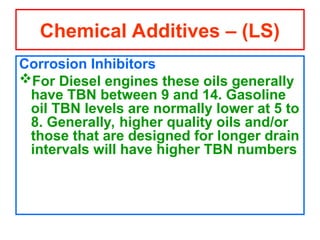
oil TBN levels are normally lower at 5 to
8. Generally, higher quality oils and/or
those that are designed for longer drain
intervals will have higher TBN numbers
Chemical Additives – (LS)
Anti-Wear Agents
Anti-wear additives are used to minimize the
engine component wear
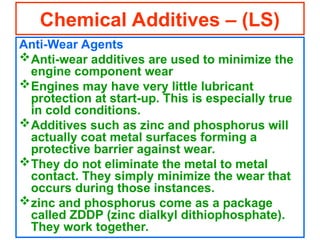
Engines may have very little lubricant
protection at start-up. This is especially true
in cold conditions.
Additives such as zinc and phosphorus will
actually coat metal surfaces forming a
protective barrier against wear.
They do not eliminate the metal to metal
contact. They simply minimize the wear that
occurs during those instances.
zinc and phosphorus come as a package
called ZDDP (zinc dialkyl dithiophosphate).
They work together.
Chemical Additives – (LS)
Anti-Wear Agents
Anti-wear additives are used to minimize the
engine component wear
Engines may have very little lubricant
protection at start-up. This is especially true
in cold conditions.
Additives such as zinc and phosphorus will
actually coat metal surfaces forming a
protective barrier against wear.
They do not eliminate the metal to metal
contact. They simply minimize the wear that
occurs during those instances.
zinc and phosphorus come as a package
called ZDDP (zinc dialkyl dithiophosphate).
They work together.
Chemical Additives – (LS)
Viscosity as per SAE J300 standards
 an oil is heated to 100 degrees C (212
degrees F)
 It's kinematic viscosity at this
temperature is measured.
 If it falls within a certain range it is
classified as a particular viscosity
 For instance, an SAE 30 oil must have a
kinematic viscosity at 100 degrees C of
between 9.3 and 12.5 cSt (centistokes).
Mono-Grade Oil
5W30
In the last number - the "30" in 5w30
indicates
 the kinematic viscosity of a 5w30 multi-
viscosity oil falls within the same range
at 100 degrees C as a monograde SAE
30 weight oil does.
Multi-Grade Oil
5W40 Vs 10W40
 Think of the "W" as a "winter" classification
instead of a "weight" classification.
 5w30 motor oil will be thinner than a
10w30 motor oil
 when subjected to the same low
temperature conditions because the
"W" number is lower
 This is an indication of better cold
weather performance.
Multi-Grade Oil
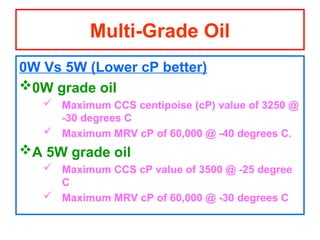
0W Vs 5W (Lower cP better)
0W grade oil
 Maximum CCS centipoise (cP) value of 3250 @
-30 degrees C
 Maximum MRV cP of 60,000 @ -40 degrees C.
A 5W grade oil
 Maximum CCS cP value of 3500 @ -25 degree
C
 Maximum MRV cP of 60,000 @ -30 degrees C
Multi-Grade Oil
Unfortunately, long chain polymers (VI
improvers) are more unstable
In turn, over a short period of time, a
5w30 petroleum oil may actually "shear
back" to a 5w20 (or lower) as these
polymers break down
This can lead to a decrease in engine
protection
Multi-Grade Oil - Problems
 For this reason the SAE J300 describes
another requirement that a multi-viscosity oil
must meet in order to be given its multi-
viscosity classification
 It must maintain a certain cP level on the
High Temperature/High Shear (HT/HS) test
(ASTM D 4683)
 The higher the HT/HS number the better
because this indicates less shearing
Multi-Grade Oil - Problems
Not all multi-viscosity oils shear back
so easily
The result is that very little shearing
occurs within synthetic oils will
generally have significantly higher
HT/HS numbers
Oil remains "in grade" for a much
longer period of time for better engine
protection and longer oil life.
Multi-Grade Oil - Solution
 16 useful specifications on the
technical data sheet for any given oil.
These include:
I. Kinematic Viscosity @ 100 degrees C (ASTM
D-445)
II. Kinematic Viscosity @ 40 degrees C (ASTM
D-445)
III. Viscosity Index (VI) (ASTM D-2270)
IV. Cold Crank Simulator Apparent Viscosity
(ASTM D-2602 or 5293)
Multi-Grade Oil - Spec
V. Mini-Rotary Viscometer (ASTM D-4684)
VI. Borderline Pumping Temperature (ASTM D-3829)

VII. Pour Point (ASTM D-97)
VIII. Flash Point (ASTM D-92)
IX. Fire Point (ASTM D-92)
X. NOACK Volatility (DIN 51581)
XI. High Temperature/High Sheer Viscosity (ASTM D-
4683)
XII. Four Ball Wear Test
XIII. Total Base Number (TBN) (ASTM D-2896)
Multi-Grade Oil - Spec
XII. Phosphorus % or PPM
XIII. Zinc % or PPM
XIV. Sulfated Ash Content
Multi-Grade Oil - Spec
 The Cold Crank Simulator measures the
"startability" of an oil by measuring the speed
at which a shaft can turn within an oil that is
cooled to a certain temperature
 When reading CCS numbers be careful
not to assume that the score is a
measurement of the speed of rotation of
the shaft
 The lower score on the CCS test is the
better
Multi-Grade Oil - CCS
 This is important when comparing two oils a
judgement call as to which is the better oil
for cold temperature operation
 An oil that scores a 3250 at -25 degrees C is
probably better than
 An oil that scores a 3200 at -20 degrees C
 Even though the CCS score is lower for the
second oil, it was tested at a temperature 5
degrees warmer than the first oil. That can
make a huge difference
Multi-Grade Oil - CCS
 Mini-Rotary Viscometer (MRV) tests the
pumpability of the oil. In other words, how
easily will the oil flow through the engine
instead of how easily will engine
components turn through the oil.
 This test is a companion to the CCS test
 The combination of the results of both
of these tests determine whether an oil
is classified with a certain "W" rating
 A lower cP value on the MRV is better.
Multi-Grade Oil - MRV
The Pour Point of an oil is
 A temperature 5 degrees F above the
temperature at which an oil shows no
movement when its container is inclined for 5
seconds
 the lowest temperature at which an oil will
actually flow
 This does not mean that it would easily pump
through an engine at this temperature - just
that the oil still acts somewhat like a liquid at
this temperature.
Multi-Grade Oil - PP
Borderline Pumping Temperature of an
oil is the lowest temperature at which it
will adequately flow through your
engine to provide the necessary
lubrication and protection.
 For instance, those living in northern
climates might want an oil with a
borderline pumping temperature of -20
degrees F or lower.
Multi-Grade Oil - BPT
 Flash Point of an oil is the temperature at
which the oil vaporizes enough for the gas to
become momentarily flammable in the
presence of a small flame
 In today's modern engines a flash point under
400 degrees F is unacceptable
 Flash point of at least 420 degrees F if you
want the good stuff
 A good quality synthetic should be
significantly higher than this.
Multi-Grade Oil - FP
Fire Point is
 Similar to flash point
 This test determines the point at which
an oil gives off enough vapor to provide
a continuous flame as opposed to a
momentary one
 Expect a fire point of at least
 420 to 450 degrees for petroleum oils
 Near or over 500 for a synthetic oil.
Multi-Grade Oil - FP
Total Base Number
 An oil is a relative indication
 How well it can neutralize acid
build-up within an oil
 How long it can do it
 The higher the number the better
equipped an oil is to neutralize
acids
 from condensation
 oxidation processes
 combustion by-products.
Multi-Grade Oil - TBN
High-Temperature/High-Shear test
Hoping for the least loss of viscosity with
an increase in heat and stress the cP
value to remain high
An oil must achieve an HT/HS cP value of
3.7 or higher in order to be classified at
the 15w40 viscosity grade.
Multi-Grade Oil – HT/HS
 Noack Volatility Test (DIN 51581) is designed to
determine the amount of evaporation that will
occur over the course of High Temp in one hour
time period
 The NOACK test exposes an oil to a high
temperature environment of 250 degrees C
for one hour
 Diesel oils must have a NOACK score of
17% or lower to meet API CH-4 standards.
Multi-Grade Oil - Noack
For instance, an SAE 30 will evaporate
more quickly than an SAE 60 motor oil
0w30 will evaporate more quickly than a
10w30
The difference may not be much, but there
will almost certainly be a difference.
Multi-Grade Oil - Noack
Four Ball Wear Test method
 Covers a procedure for making a
preliminary evaluation of
 The anti-wear properties of fluid
lubricants
 in sliding contact by means of the
Four-Ball Wear Test Machine
Multi-Grade Oil - FBW
It is performed by rotating one ball
bearing on three fixed bearings
 The motor oil is used to form a film
between the bearings
 The test can be done at a variety of
 temperatures
 pressures and RPM.
Multi-Grade Oil - FBW
 Some tests will be done by placing
more stress on the lubricant
 40 kg of pressure, 75 degrees C and 1200
RPM
 60 kg of pressure, 150 degrees C and 1800
RPM
 At the end of the test, the wear scar is
measured
 on each of the three stationary balls
 averaged for a final "wear scar
measurement" in millimeters
Multi-Grade Oil - FBW
The smaller this number, the better
an oil will protect an engine at any
point of sliding contact.
Multi-Grade Oil - FBW
The most commonly found specs
I. kinematic viscosity at 100 degrees
and 40 degrees C
II. VI (viscosity index)
III. Cold crank simulator apparent
viscosity
IV. Mini-rotary Viscometer
V. pour point
Multi-Grade Oil - Spec
VI. pumping temperature
VII. Flash point
VIII. Fire point
IX. TBN
X. Borderline
XI. High temperature / High shear
Multi-Grade Oil - Spec
 There are five main areas where
synthetic oils surpass their
petroleum counterparts:
 Oil drains can be extended
 Vehicle life can be extended
 Costly repairs can be reduced
 Fuel mileage can be improved
 Performance can be improved
Multi-Grade Oil - Spec
GASOLINE SPECIFICATIONS
Gasoline motor oil if it begins with an
“S” some second letter after it is a
specification for a gasoline motor oil
SJ, SH, SG, SF and so on
 Best specification is look for the one
that has the "highest" second letter
 In other words, the most current - most
stringent, specification is the API SL
rating.
Multi-Grade Oil - Spec
GASOLINE SPECIFICATIONS
All API ratings are backward
compatible
 Therefore, an SJ rated oil will be just
fine for an SH, SG or SF rated vehicle
 However, on a newer vehicle that
calls for an SJ rated oil
 It is not recommended that you use
an oil of SF, SG or SH Grade
Multi-Grade Oil - Spec
DIESEL SPECIFICATIONS
Any specification that begins with a C is an
API motor oil rating for diesel powered
engines
 CD, CF, CG, CH, CH-4 and so on are all diesel
oil ratings
 The higher the second letter, the better the oil
(meets more stringent API requirements)
 Also, when a number follows the letter
specification, it is a reference to whether the
engine is a 4 cycle or 2 cycle specification
Multi-Grade Oil - Spec
DIESEL SPECIFICATIONS
Motor oil specs are backward
compatible
 A CH oil will be just fine if manual calls
for a CF rated oil
The specifications are not forward
compatible
 Don't use an oil that only meets the CF
spec in an engine that calls for a CH
spec oil
Multi-Grade Oil - Spec
GEAR LUBES & DIFFERENTIALS
For the differential
To translate power from the driveshaft to the
wheels
The gears within the differential must operate
at a severe angle to each other
 results in high loads on small areas of
the gears
 In many cases there will not be a full
lubricating film separating the gears
Multi-Grade Oil - Spec
Maintaining proper protection within this
type of environment requires that can
 stand up to the extreme temperature
and pressure generated within your
differential
 without breaking down too quickly
 able to properly lubricate, protect and
cool
 Carrying wear debris away from the
gears.
Multi-Grade Oil - Spec
RANKING SCORES
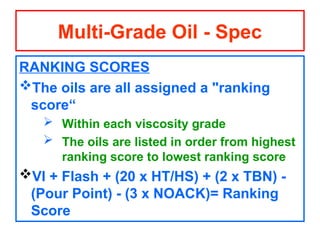
The oils are all assigned a "ranking
score“
 Within each viscosity grade
 The oils are listed in order from highest
ranking score to lowest ranking score
VI + Flash + (20 x HT/HS) + (2 x TBN) -
(Pour Point) - (3 x NOACK)= Ranking
Score
Multi-Grade Oil - Spec
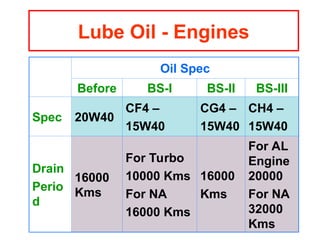
Lube Oil - Engines
Oil Spec
Before BS-I BS-II BS-III
Spec 20W40
CF4 –
15W40
CG4 –
15W40
CH4 –
15W40
Drain
Perio
d
16000
Kms
For Turbo
10000 Kms
For NA
16000 Kms
16000
Kms
For AL
Engine
20000
For NA
32000
Kms
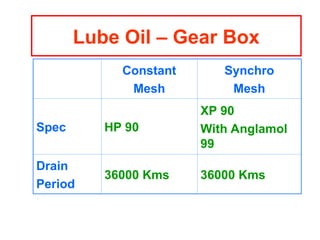
Lube Oil – Gear Box
Constant
Mesh
Synchro
Mesh
Spec HP 90
XP 90
With Anglamol
99
Drain
Period
36000 Kms 36000 Kms
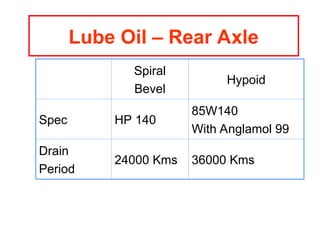
Lube Oil – Rear Axle
Spiral
Bevel
Hypoid
Spec HP 140
85W140
With Anglamol 99
Drain
Period
24000 Kms 36000 Kms
FUNDAMENTALS OF
GREASES
COMPONENTS
The components of a Grease are:
– Base Oil. (70% - 95%)
• Mineral or Synthetic.
– Thickener (soap or non soap)
• Metallic or non metallic i.e. clay).
– Additives.
• Bring up, Improve and give special properties to
the grease.
GREASES
• Man’s oldest and most widely
applied lubricant
• Originally- Tallow Rendered From
Animal Fat
• Today- Complex Blends Of Oils,
Thickeners, Other Additives, Etc
GREASE- DEFINITION
A Solid To Semi-fluid Product of a
Dispersion of a Thickening Agent in
a Liquid Lubricant. Other Ingredients
are Added Which Impart Special
Properties.
GREASE- USAGE
• Greases are generally used instead
of oil where:
• A lubricant must act as a seal to
prevent entry of contaminants
• A lubricant must maintain its
position in a mechanism
( relubrication limited or impossible)
GREASE – DESIRABLE
PROPERTIES
• Reduce Friction and Wear
• Protect against rust and corrosion
• Prevent dirt, water, and other
contaminants from entering the parts
being lubricated
• Resist leakage, dripping, and throwoff
• Maintain structure and consistency during
long periods of use
GREASE – DESIRABLE
PROPERTIES (Contd.)
• Be compatible with elastomer seals
and other materials associated with
the parts being lubricated
• Tolerate some degree of moisture
contamination without significant
loss of performance
GREASES- COMPONENTS
• Thickeners- Transform Oil into Grease
(Simple metal soaps, complex soaps, etc.)
• Soaps- Salt of a Fatty Acid
• Metal Soaps- Obtained from the reaction
of an alkali base of animal or vegetable
origin and a metallic component (
lithium, calcium, sodium, etc.)
GREASE- TYPES
• According to the type of Thickener
which they contain. E.g. Calcium
soap base grease, Calcium Complex
grease, Sodium Base Grease,
Lithium Base Grease, , Polyurea
Grease, etc.
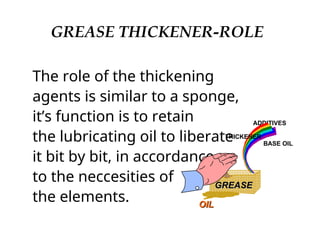
GREASE THICKENER-ROLE
The role of the thickening
agents is similar to a sponge,
it’s function is to retain
the lubricating oil to liberate
it bit by bit, in accordance
to the neccesities of
the elements.
ADDITIVES
BASE OIL
THICKENER
GREASE
GREASE
OIL
OIL
GREASES- IMPORTANT PROPERTIES
• Penetration- Arbitary measure of
grease hardness ranging from semi-
fluid to hard block greases.
Classified as per NLGI Consistency
No. :000 (very fluid) to 6 (very hard)
• Dropping Point- The temperature at
which the grease passes from semi-
solid to liquid state
GREASES- IMPORTANT PROPERTIES
(Contd.)
• Load Carrying Capacity- Refers to
the EP protection afforded by a
grease
• Rust and Corrosion Protection-
Corrosion Preventive properties of
greases under wet conditions
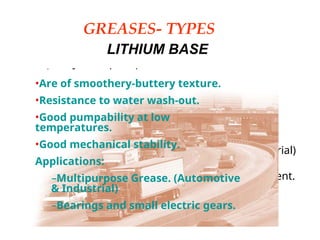
GREASES- TYPES
LITHIUM BASE
• Are of smoothery-buttery texture.
• Resistance to water wash-out.
• Great pumpeability at low temperatures.
• Great mechanical stability.
• Applications:
– Multipurpose Grease. (Automotive & Industrial)
– Bearings and small electric gears.
– Centralized systems where humidity is present.
•Are of smoothery-buttery texture.
•Resistance to water wash-out.
•Good pumpability at low
temperatures.
•Good mechanical stability.
Applications:
–Multipurpose Grease. (Automotive
& Industrial)
–Bearings and small electric gears.
GREASES- TYPES
NON SOAP THICKENER
• The metallic soap is substituted by
• a thickener which commonly
• Is bentonite.
• Characteristics:
 They have great resistance to
 water wash out.
 Very stable at high temperatures.
 Mechanical Stability.
Future Grease Trends
• Decline in demand for calcium & sodium
base greases
• Increase in demand for Lithium base greases
• Development of new types of greases like
Aluminium complex, lithium complex &
polyurea greases and its constant growth.
These are the developments that have taken
place to meet the stringent requirements of
the Industry
Future requirements
• The following are the market drivers
– The first and probably the most important
market driver is Grease Economics
– The second is extended life. This needs improved
durability & oxidation stability
– Third driver is comprised of environmental social
issues and concerns which will require the usage of
additives which are ash-less or heavy metal free
– The usage of non- leaded greases will be mandated
although Lead which is a very good Extreme
Pressure agent, is an environmental hazard
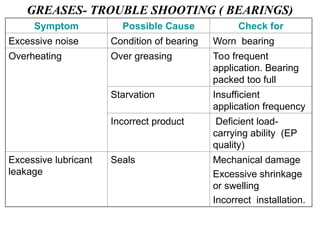
Symptom Possible Cause Check for
Excessive noise Condition of bearing Worn bearing
Overheating Over greasing Too frequent
application. Bearing
packed too full
Starvation Insufficient
application frequency
Incorrect product Deficient load-
carrying ability (EP
quality)
Excessive lubricant
leakage
Seals Mechanical damage
Excessive shrinkage
or swelling
Incorrect installation.
GREASES- TROUBLE SHOOTING ( BEARINGS)
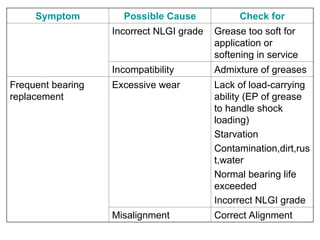
Symptom Possible Cause Check for
Incorrect NLGI grade Grease too soft for
application or
softening in service
Incompatibility Admixture of greases
Frequent bearing
replacement
Excessive wear Lack of load-carrying
ability (EP of grease
to handle shock
loading)
Starvation
Contamination,dirt,rus
t,water
Normal bearing life
exceeded
Incorrect NLGI grade
Misalignment Correct Alignment
USED OIL ANALYSIS
GULF OIL INTERNATIONAL
Maintenance
Strategy
Technique
needed
Human body
parallel
Proactive
Maintenance
Monitoring and
correction of failure
root causes, eg.,
contamination
Cholesterol and
blood pressure
monitoring with
diet control
Predictive
Maintenance
Monitoring of
vibration, wear
debris
Detection of heart
disease using ECG
or ultrasonics
Preventive
Maintenance
Periodic component
replacement
By-pass or
transplant surgery
Breakdown
Maintenance
Large maintenance
budget
Heart attack or
stroke
The Human Body Parallel to Machine
Maintenance
Which contaminant causes the most
problem?
Dirt 37%
Water 24%
Water particles 9%
Rust & corrosion products 7%
Process chemicals 5%
Air (foam and air entrainment) 5%
Biological growth 5%
Other 8%
WHY TEST LUBRICANTS?
• To ascertain whether the right oil is being used
• To ensure that the equipment/ machinery is
clean and in good shape
• To establish effectiveness of maintenance
practices
• To ward off major mishaps & break downs
• To guarantee longer service life for both
lubricant and machine
WHEN TO TEST?
• Before Charging – To ensure lubricant as per
the specified standards is being charged
• After Charging - To ensure proper flushing
and rule out contaminants; Base/ Reference
Sample
• In Service – Routine condition monitoring, To
assess deterioration
• Investigation – When abrupt changes in
colour, clarity and odour is observed
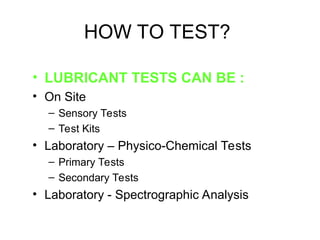
HOW TO TEST?
• LUBRICANT TESTS CAN BE :
• On Site
– Sensory Tests
– Test Kits
• Laboratory – Physico-Chemical Tests
– Primary Tests
– Secondary Tests
• Laboratory - Spectrographic Analysis
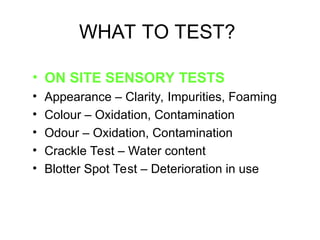
WHAT TO TEST?
• ON SITE SENSORY TESTS
• Appearance – Clarity, Impurities, Foaming
• Colour – Oxidation, Contamination
• Odour – Oxidation, Contamination
• Crackle Test – Water content
• Blotter Spot Test – Deterioration in use
WHAT TO TEST?
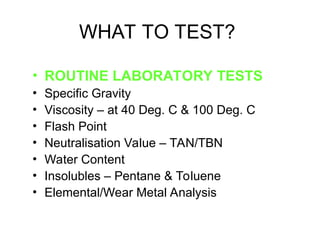
• ROUTINE LABORATORY TESTS
• Specific Gravity
• Viscosity – at 40 Deg. C & 100 Deg. C
• Flash Point
• Neutralisation Value – TAN/TBN
• Water Content
• Insolubles – Pentane & Toluene
• Elemental/Wear Metal Analysis
INTERPRETATION OF TEST
RESULTS
• After any evaluation, the questions asked are :
– What is the condition now?
– How much has changed from new?
– What is the rate of change now?
– What condition is acceptable?
– What are the critical parameters/features
identified and why?
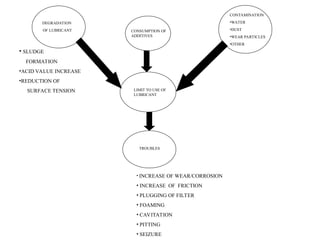
DEGRADATION
OF LUBRICANT CONSUMPTION OF
ADDITIVES
CONTAMINATION
•WATER
•DUST
•WEAR PARTICLES
•OTHER
LIMIT TO USE OF
LUBRICANT
TROUBLES
• SLUDGE
FORMATION
•ACID VALUE INCREASE
•REDUCTION OF
SURFACE TENSION
• INCREASE OF WEAR/CORROSION
• INCREASE OF FRICTION
• PLUGGING OF FILTER
• FOAMING
• CAVITATION
• PITTING
• SEIZURE
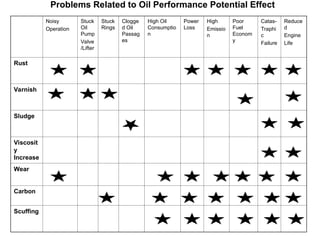
Problems Related to Oil Performance Potential Effect
Noisy
Operation
Stuck
Oil
Pump
Valve
/Lifter
Stuck
Rings
Clogge
d Oil
Passag
es
High Oil
Consumptio
n
Power
Loss
High
Emissio
n
Poor
Fuel
Econom
y
Catas-
Traphi
c
Failure
Reduce
d
Engine
Life
Rust
Varnish
Sludge
Viscosit
y
Increase
Wear
Carbon
Scuffing
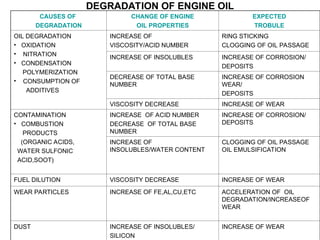
DEGRADATION OF ENGINE OIL
CAUSES OF
DEGRADATION
CHANGE OF ENGINE
OIL PROPERTIES
EXPECTED
TROBULE
OIL DEGRADATION
• OXIDATION
• NITRATION
• CONDENSATION
POLYMERIZATION
• CONSUMPTION OF
ADDITIVES
INCREASE OF
VISCOSITY/ACID NUMBER
RING STICKING
CLOGGING OF OIL PASSAGE
INCREASE OF INSOLUBLES INCREASE OF CORROSION/
DEPOSITS
DECREASE OF TOTAL BASE
NUMBER
INCREASE OF CORROSION
WEAR/
DEPOSITS
VISCOSITY DECREASE INCREASE OF WEAR
CONTAMINATION
• COMBUSTION
PRODUCTS
(ORGANIC ACIDS,
WATER SULFONIC
ACID,SOOT)
INCREASE OF ACID NUMBER
DECREASE OF TOTAL BASE
NUMBER
INCREASE OF CORROSION/
DEPOSITS
INCREASE OF
INSOLUBLES/WATER CONTENT
CLOGGING OF OIL PASSAGE
OIL EMULSIFICATION
FUEL DILUTION VISCOSITY DECREASE INCREASE OF WEAR
WEAR PARTICLES INCREASE OF FE,AL,CU,ETC ACCELERATION OF OIL
DEGRADATION/INCREASEOF
WEAR
DUST INCREASE OF INSOLUBLES/
SILICON
INCREASE OF WEAR
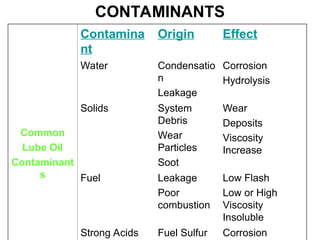
CONTAMINANTS
Common
Lube Oil
Contaminant
s
Contamina
nt
Origin Effect
Water Condensatio
n
Leakage
Corrosion
Hydrolysis
Solids System
Debris
Wear
Particles
Soot
Wear
Deposits
Viscosity
Increase
Fuel Leakage
Poor
combustion
Low Flash
Low or High
Viscosity
Insoluble
Strong Acids Fuel Sulfur Corrosion
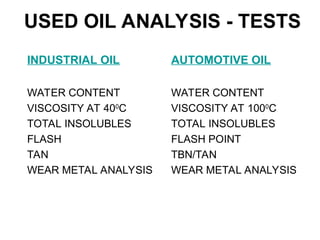
USED OIL ANALYSIS - TESTS
INDUSTRIAL OIL
WATER CONTENT
VISCOSITY AT 400
C
TOTAL INSOLUBLES
FLASH
TAN
WEAR METAL ANALYSIS
AUTOMOTIVE OIL
WATER CONTENT
VISCOSITY AT 1000
C
TOTAL INSOLUBLES
FLASH POINT
TBN/TAN
WEAR METAL ANALYSIS
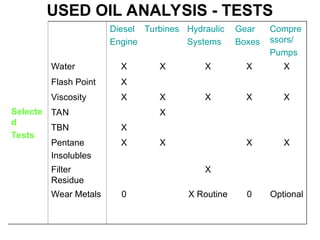
USED OIL ANALYSIS - TESTS
Selecte
d
Tests
Diesel
Engine
Turbines Hydraulic
Systems
Gear
Boxes
Compre
ssors/
Pumps
Water X X X X X
Flash Point X
Viscosity X X X X X
TAN X
TBN X
Pentane
Insolubles
X X X X
Filter
Residue
X
Wear Metals 0 X Routine 0 Optional
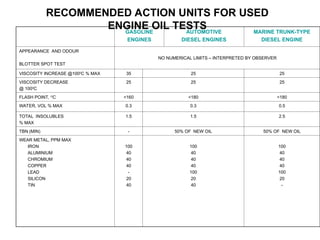
RECOMMENDED ACTION UNITS FOR USED
ENGINE OIL TESTS
GASOLINE
ENGINES
AUTOMOTIVE
DIESEL ENGINES
MARINE TRUNK-TYPE
DIESEL ENGINE
APPEARANCE AND ODOUR
BLOTTER SPOT TEST
NO NUMERICAL LIMITS – INTERPRETED BY OBSERVER
VISCOSITY INCREASE @1000
C % MAX 35 25 25
VISCOSITY DECREASE
@ 1000
C
25 25 25
FLASH POINT, O
C <160 <180 <180
WATER, VOL % MAX 0.3 0.3 0.5
TOTAL INSOLUBLES
% MAX
1.5 1.5 2.5
TBN (MIN) - 50% OF NEW OIL 50% OF NEW OIL
WEAR METAL, PPM MAX
IRON
ALUMINIUM
CHROMIUM
COPPER
LEAD
SILICON
TIN
100
40
40
40
-
20
40
100
40
40
40
100
20
40
100
40
40
40
100
20
-
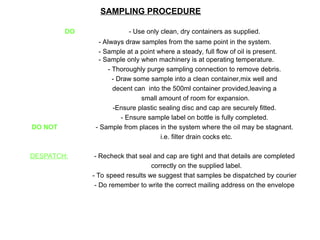
SAMPLING PROCEDURE
DO - Use only clean, dry containers as supplied.
- Always draw samples from the same point in the system.
- Sample at a point where a steady, full flow of oil is present.
- Sample only when machinery is at operating temperature.
- Thoroughly purge sampling connection to remove debris.
- Draw some sample into a clean container,mix well and
decent can into the 500ml container provided,leaving a
small amount of room for expansion.
-Ensure plastic sealing disc and cap are securely fitted.
- Ensure sample label on bottle is fully completed.
DO NOT - Sample from places in the system where the oil may be stagnant.
i.e. filter drain cocks etc.
DESPATCH: - Recheck that seal and cap are tight and that details are completed
correctly on the supplied label.
- To speed results we suggest that samples be dispatched by courier
- Do remember to write the correct mailing address on the envelope
THANK YOU !!!

Details about Lubricant & grease uses & application

  • 1.
  • 2.
    Lubricant  Functions  EnvironmentalIssues in Changing Oils  Oil Additive Usage  Right Viscosity  New 5W20 Weight Oils  Switch to Synthetics  Oil Life Monitoring
  • 3.
    Lubricants  Synthetic Oils& Leaky Seals  Extended Drains  API Ratings  Too Dirty  Overfilling Effects  Engine Flush Products  ALL of Tranny Fluid gets changed  Rotary Engines – Synthetic Oils
  • 4.
    Engines •More Powerful •More Efficient •High Eng Temp • Less Sump Capacity Lubricants
  • 5.
    Functions  Lubricate  LessLoss of Power  Protect through Thin Film  From Metal to Metal Contact  From Corrosion by Acid Formation i. Oxidation & Condensation of Oil ii.Condensation of By Products
  • 6.
    Functions  Dispersant  Washingaway the Particles  Clean  To be Filter out Particles < 20 µ  Cool  Combustion - Passing away Hot Components viz Cr Shaft, Cam Shaft, TGs, Piston, M&BE Brg, etc.  Heat from Friction
  • 7.
     Base Fluid Bulk of the Oil  Additive Package  To Enhance Positive Quality of Base Stock Main Components
  • 8.
    I. Petroleum  Refinedfrom Crude Oil II. Synthetic  Chemically Engineered in Labs  No Contaminants (Removed via Purification) Base Fluid
  • 9.
    Viscosity Index  Theviscosity of an oil refers to its relative resistance to flow at differing temperatures  Ability to maintain Viscosity over Wide Temp Range. High the number Lesser the Change Low Temp Performance  Better Flow in Low Temp  Eng Protection at Start-Up in Cold Weather Condition Petroleum Base Crude refined for ….
  • 10.
     High TempPerformance  More Effective at Extreme Hot  Burn Resistant  Metal to Metal Contact – Viscosity Loss  Oxidation Resistant  Oxygen when Reacts with Oil forms Sludge & Other Eng Deposits  Results in Viscosity Increase – Low Oil Flow Petroleum Base Crude refined for ….
  • 11.
     Desalting  Removingthe Salt Contamination  Partial Vapourisation  To remove Differing Boiling Point Components  To contain High Boiling Point Components except Asphaltic Materials Petroleum Base Crude refining Process ….
  • 12.
     Vacuum Distillation Separated for Differing Molecular Weights  Differing Viscosity Index  Solvent Extraction  To extract Aromatic Compounds (80% Extcd)  To Improve  Thermal & Oxidative Stability  Viscosity Index Petroleum Base Crude refining Process ….
  • 13.
     Dewaxing  Lowtemp Fluidity  Hydrofinishing / Clay Treatment  To remove Unstable Components viz Sulphur & Nitrogen  To Improve Oxidation Stability, Thermal Stability & Colour Petroleum Base Crude refining Process ….
  • 14.
     Hydroheating  99%removal of Aromatic Components  Used in Place of Solvent Extraction and/or in Addition to Solvent Extraction Petroleum Base Crude refining Process ….
  • 15.
    Quality  Depends onCrude Oil Selection  Tremendous Care to be Exercised in Selecting Crude Oil Stock Petroleum Base
  • 16.
    Petroleum Base Stocksput through Super Extreme refining process called Hydrocracking Hydrocracking involves in Breaking & Fragmenting different Molecular Structures into far more stable one Better Oxidative & Thermal Stability Better Viscosity Index Pseudo – Synthetic Base Stocks
  • 17.
  • 18.
    These are themost common synthetic basestocks used in the US and in Europe. PAO's are also called synthesized hydrocarbons and contain absolutely no wax, metals, sulfur or phosphorous. Viscosity indexes for nearly all PAO's are around 150, and they have extremely low pour points (normally below -40 degrees F) Polyalphaolefins (PAO's)
  • 19.
    Disadvantages Although PAO's arealso very thermally stable, they are not as oxidatively stable as other synthetics. when properly additized, oxidative stability can be achieved. PAO's also tend to shrink seals Quality Their final lubricating characteristics depend on the chemical reactions used to create them. Polyalphaolefins (PAO's)
  • 20.
    Less commonly used Ifchosen carefully, Diesters generally provide better pour points than PAO's (about -60 to -80 degrees F) A little more oxidatively stable when properly additized. Diesters also have very good solvency characteristics even without the aid of detergency additives. Diesters
  • 21.
    Advantage Like PAO's, Diesterscan affect seals. However, they generally cause seal swell Chemically resistant seals are recommended if using synthetic base oils manufactured with diesters. Diesters
  • 22.
    Similar to Diesters,but slightly more complex Advantages over Diesters Greater range of pour points as low as -90 degrees F Viscosity indexes as high as 160 (without VI additive improvers) The same seal swell characteristics exist with polyolesters as with diesters. Polyolesters
  • 23.
    Each chemical withinan oils additive package plays a different role in boosting the beneficial properties of it's host lubricant (basestock) Chemical Additives
  • 24.
    IMPROVE VISCOSITY CHARACTERISTICS (VC) PourPoint Depressants Viscosity Index Improvers Chemical Additives
  • 25.
    Pour Point Depressants Toimprove the flow characteristics of a lubricant basestock at low temperatures They are normally only used in conjunction with petroleum basestock lubricants The only exception might be hydrocracked petroleum basestocks Chemical Additives – (VC)
  • 26.
    Viscosity Index Improvers So,as the basestock loses viscosity with increases in temperature, VI improvers negate that viscosity drop by increasing their size. Chemical Additives – (VC)
  • 27.
    MAINTAIN LUBRICANT STABILITY(LS) They are susceptible to breakdown due to contamination and/or oxidation which decreases the useful life of an oil. Additives are used to inhibit the susceptibility Chemical Additives
  • 28.
    MAINTAIN LUBRICANT STABILITY Detergentsand Dispersants Anti-Foaming Agents Oxidation Inhibitors Corrosion Inhibitors Anti-Wear Agents Chemical Additives
  • 29.
    Detergents and Dispersants Attractedto sludge and varnish contaminants Contain and suspend those particles so that they do not come together to form deposits. Chemical Additives – (LS)
  • 30.
    Detergents and Dispersants Detergentsare all metallic in nature. Ashless dispersants are more effective at controlling sludge and varnish contamination Ashless dispersants are actually long chain polymers that serve a dual purpose as VI improvers in multi-grade oils. Chemical Additives – (LS)
  • 31.
    Anti-Foaming Agents Detergents anddispersants can have a negative effect of oil foaming. These air bubbles will reduce the lubricating qualities of the motor oil. Anti-foaming agents such as small amounts of silicone or other compounds are used to control Chemical Additives – (LS)
  • 32.
    Oxidation Inhibitors They arealso called antioxidants Oxidation inhibitors are additives that manage to reduce the tendency of an oil to oxidize (chemically react with oxygen) Chemical Additives – (LS)
  • 33.
    Corrosion Inhibitors Antioxidants preventthe acids caused by oxidation, they do nothing to neutralize the acids caused by combustion by-products Chemical Additives – (LS)
  • 34.
    Corrosion Inhibitors To protectnon-ferrous metals by coating them so they cannot come in contact with acids within the oil. To actually neutralize the acids within the oil. The acid neutralizing capability of an oil is expressed by its Total Base Number (TBN) Chemical Additives – (LS)
  • 35.
    Corrosion Inhibitors For Dieselengines these oils generally have TBN between 9 and 14. Gasoline oil TBN levels are normally lower at 5 to 8. Generally, higher quality oils and/or those that are designed for longer drain intervals will have higher TBN numbers Chemical Additives – (LS)
  • 36.
    Anti-Wear Agents Anti-wear additivesare used to minimize the engine component wear Engines may have very little lubricant protection at start-up. This is especially true in cold conditions. Additives such as zinc and phosphorus will actually coat metal surfaces forming a protective barrier against wear. They do not eliminate the metal to metal contact. They simply minimize the wear that occurs during those instances. zinc and phosphorus come as a package called ZDDP (zinc dialkyl dithiophosphate). They work together. Chemical Additives – (LS)
  • 37.
    Anti-Wear Agents Anti-wear additivesare used to minimize the engine component wear Engines may have very little lubricant protection at start-up. This is especially true in cold conditions. Additives such as zinc and phosphorus will actually coat metal surfaces forming a protective barrier against wear. They do not eliminate the metal to metal contact. They simply minimize the wear that occurs during those instances. zinc and phosphorus come as a package called ZDDP (zinc dialkyl dithiophosphate). They work together. Chemical Additives – (LS)
  • 38.
    Viscosity as perSAE J300 standards  an oil is heated to 100 degrees C (212 degrees F)  It's kinematic viscosity at this temperature is measured.  If it falls within a certain range it is classified as a particular viscosity  For instance, an SAE 30 oil must have a kinematic viscosity at 100 degrees C of between 9.3 and 12.5 cSt (centistokes). Mono-Grade Oil
  • 39.
    5W30 In the lastnumber - the "30" in 5w30 indicates  the kinematic viscosity of a 5w30 multi- viscosity oil falls within the same range at 100 degrees C as a monograde SAE 30 weight oil does. Multi-Grade Oil
  • 40.
    5W40 Vs 10W40 Think of the "W" as a "winter" classification instead of a "weight" classification.  5w30 motor oil will be thinner than a 10w30 motor oil  when subjected to the same low temperature conditions because the "W" number is lower  This is an indication of better cold weather performance. Multi-Grade Oil
  • 41.
    0W Vs 5W(Lower cP better) 0W grade oil  Maximum CCS centipoise (cP) value of 3250 @ -30 degrees C  Maximum MRV cP of 60,000 @ -40 degrees C. A 5W grade oil  Maximum CCS cP value of 3500 @ -25 degree C  Maximum MRV cP of 60,000 @ -30 degrees C Multi-Grade Oil
  • 42.
    Unfortunately, long chainpolymers (VI improvers) are more unstable In turn, over a short period of time, a 5w30 petroleum oil may actually "shear back" to a 5w20 (or lower) as these polymers break down This can lead to a decrease in engine protection Multi-Grade Oil - Problems
  • 43.
     For thisreason the SAE J300 describes another requirement that a multi-viscosity oil must meet in order to be given its multi- viscosity classification  It must maintain a certain cP level on the High Temperature/High Shear (HT/HS) test (ASTM D 4683)  The higher the HT/HS number the better because this indicates less shearing Multi-Grade Oil - Problems
  • 44.
    Not all multi-viscosityoils shear back so easily The result is that very little shearing occurs within synthetic oils will generally have significantly higher HT/HS numbers Oil remains "in grade" for a much longer period of time for better engine protection and longer oil life. Multi-Grade Oil - Solution
  • 45.
     16 usefulspecifications on the technical data sheet for any given oil. These include: I. Kinematic Viscosity @ 100 degrees C (ASTM D-445) II. Kinematic Viscosity @ 40 degrees C (ASTM D-445) III. Viscosity Index (VI) (ASTM D-2270) IV. Cold Crank Simulator Apparent Viscosity (ASTM D-2602 or 5293) Multi-Grade Oil - Spec
  • 46.
    V. Mini-Rotary Viscometer(ASTM D-4684) VI. Borderline Pumping Temperature (ASTM D-3829) VII. Pour Point (ASTM D-97) VIII. Flash Point (ASTM D-92) IX. Fire Point (ASTM D-92) X. NOACK Volatility (DIN 51581) XI. High Temperature/High Sheer Viscosity (ASTM D- 4683) XII. Four Ball Wear Test XIII. Total Base Number (TBN) (ASTM D-2896) Multi-Grade Oil - Spec
  • 47.
    XII. Phosphorus %or PPM XIII. Zinc % or PPM XIV. Sulfated Ash Content Multi-Grade Oil - Spec
  • 48.
     The ColdCrank Simulator measures the "startability" of an oil by measuring the speed at which a shaft can turn within an oil that is cooled to a certain temperature  When reading CCS numbers be careful not to assume that the score is a measurement of the speed of rotation of the shaft  The lower score on the CCS test is the better Multi-Grade Oil - CCS
  • 49.
     This isimportant when comparing two oils a judgement call as to which is the better oil for cold temperature operation  An oil that scores a 3250 at -25 degrees C is probably better than  An oil that scores a 3200 at -20 degrees C  Even though the CCS score is lower for the second oil, it was tested at a temperature 5 degrees warmer than the first oil. That can make a huge difference Multi-Grade Oil - CCS
  • 50.
     Mini-Rotary Viscometer(MRV) tests the pumpability of the oil. In other words, how easily will the oil flow through the engine instead of how easily will engine components turn through the oil.  This test is a companion to the CCS test  The combination of the results of both of these tests determine whether an oil is classified with a certain "W" rating  A lower cP value on the MRV is better. Multi-Grade Oil - MRV
  • 51.
    The Pour Pointof an oil is  A temperature 5 degrees F above the temperature at which an oil shows no movement when its container is inclined for 5 seconds  the lowest temperature at which an oil will actually flow  This does not mean that it would easily pump through an engine at this temperature - just that the oil still acts somewhat like a liquid at this temperature. Multi-Grade Oil - PP
  • 52.
    Borderline Pumping Temperatureof an oil is the lowest temperature at which it will adequately flow through your engine to provide the necessary lubrication and protection.  For instance, those living in northern climates might want an oil with a borderline pumping temperature of -20 degrees F or lower. Multi-Grade Oil - BPT
  • 53.
     Flash Pointof an oil is the temperature at which the oil vaporizes enough for the gas to become momentarily flammable in the presence of a small flame  In today's modern engines a flash point under 400 degrees F is unacceptable  Flash point of at least 420 degrees F if you want the good stuff  A good quality synthetic should be significantly higher than this. Multi-Grade Oil - FP
  • 54.
    Fire Point is Similar to flash point  This test determines the point at which an oil gives off enough vapor to provide a continuous flame as opposed to a momentary one  Expect a fire point of at least  420 to 450 degrees for petroleum oils  Near or over 500 for a synthetic oil. Multi-Grade Oil - FP
  • 55.
    Total Base Number An oil is a relative indication  How well it can neutralize acid build-up within an oil  How long it can do it  The higher the number the better equipped an oil is to neutralize acids  from condensation  oxidation processes  combustion by-products. Multi-Grade Oil - TBN
  • 56.
    High-Temperature/High-Shear test Hoping forthe least loss of viscosity with an increase in heat and stress the cP value to remain high An oil must achieve an HT/HS cP value of 3.7 or higher in order to be classified at the 15w40 viscosity grade. Multi-Grade Oil – HT/HS
  • 57.
     Noack VolatilityTest (DIN 51581) is designed to determine the amount of evaporation that will occur over the course of High Temp in one hour time period  The NOACK test exposes an oil to a high temperature environment of 250 degrees C for one hour  Diesel oils must have a NOACK score of 17% or lower to meet API CH-4 standards. Multi-Grade Oil - Noack
  • 58.
    For instance, anSAE 30 will evaporate more quickly than an SAE 60 motor oil 0w30 will evaporate more quickly than a 10w30 The difference may not be much, but there will almost certainly be a difference. Multi-Grade Oil - Noack
  • 59.
    Four Ball WearTest method  Covers a procedure for making a preliminary evaluation of  The anti-wear properties of fluid lubricants  in sliding contact by means of the Four-Ball Wear Test Machine Multi-Grade Oil - FBW
  • 60.
    It is performedby rotating one ball bearing on three fixed bearings  The motor oil is used to form a film between the bearings  The test can be done at a variety of  temperatures  pressures and RPM. Multi-Grade Oil - FBW
  • 61.
     Some testswill be done by placing more stress on the lubricant  40 kg of pressure, 75 degrees C and 1200 RPM  60 kg of pressure, 150 degrees C and 1800 RPM  At the end of the test, the wear scar is measured  on each of the three stationary balls  averaged for a final "wear scar measurement" in millimeters Multi-Grade Oil - FBW
  • 62.
    The smaller thisnumber, the better an oil will protect an engine at any point of sliding contact. Multi-Grade Oil - FBW
  • 63.
    The most commonlyfound specs I. kinematic viscosity at 100 degrees and 40 degrees C II. VI (viscosity index) III. Cold crank simulator apparent viscosity IV. Mini-rotary Viscometer V. pour point Multi-Grade Oil - Spec
  • 64.
    VI. pumping temperature VII.Flash point VIII. Fire point IX. TBN X. Borderline XI. High temperature / High shear Multi-Grade Oil - Spec
  • 65.
     There arefive main areas where synthetic oils surpass their petroleum counterparts:  Oil drains can be extended  Vehicle life can be extended  Costly repairs can be reduced  Fuel mileage can be improved  Performance can be improved Multi-Grade Oil - Spec
  • 66.
    GASOLINE SPECIFICATIONS Gasoline motoroil if it begins with an “S” some second letter after it is a specification for a gasoline motor oil SJ, SH, SG, SF and so on  Best specification is look for the one that has the "highest" second letter  In other words, the most current - most stringent, specification is the API SL rating. Multi-Grade Oil - Spec
  • 67.
    GASOLINE SPECIFICATIONS All APIratings are backward compatible  Therefore, an SJ rated oil will be just fine for an SH, SG or SF rated vehicle  However, on a newer vehicle that calls for an SJ rated oil  It is not recommended that you use an oil of SF, SG or SH Grade Multi-Grade Oil - Spec
  • 68.
    DIESEL SPECIFICATIONS Any specificationthat begins with a C is an API motor oil rating for diesel powered engines  CD, CF, CG, CH, CH-4 and so on are all diesel oil ratings  The higher the second letter, the better the oil (meets more stringent API requirements)  Also, when a number follows the letter specification, it is a reference to whether the engine is a 4 cycle or 2 cycle specification Multi-Grade Oil - Spec
  • 69.
    DIESEL SPECIFICATIONS Motor oilspecs are backward compatible  A CH oil will be just fine if manual calls for a CF rated oil The specifications are not forward compatible  Don't use an oil that only meets the CF spec in an engine that calls for a CH spec oil Multi-Grade Oil - Spec
  • 70.
    GEAR LUBES &DIFFERENTIALS For the differential To translate power from the driveshaft to the wheels The gears within the differential must operate at a severe angle to each other  results in high loads on small areas of the gears  In many cases there will not be a full lubricating film separating the gears Multi-Grade Oil - Spec
  • 71.
    Maintaining proper protectionwithin this type of environment requires that can  stand up to the extreme temperature and pressure generated within your differential  without breaking down too quickly  able to properly lubricate, protect and cool  Carrying wear debris away from the gears. Multi-Grade Oil - Spec
  • 72.
    RANKING SCORES The oilsare all assigned a "ranking score“  Within each viscosity grade  The oils are listed in order from highest ranking score to lowest ranking score VI + Flash + (20 x HT/HS) + (2 x TBN) - (Pour Point) - (3 x NOACK)= Ranking Score Multi-Grade Oil - Spec
  • 73.
    Lube Oil -Engines Oil Spec Before BS-I BS-II BS-III Spec 20W40 CF4 – 15W40 CG4 – 15W40 CH4 – 15W40 Drain Perio d 16000 Kms For Turbo 10000 Kms For NA 16000 Kms 16000 Kms For AL Engine 20000 For NA 32000 Kms
  • 74.
    Lube Oil –Gear Box Constant Mesh Synchro Mesh Spec HP 90 XP 90 With Anglamol 99 Drain Period 36000 Kms 36000 Kms
  • 75.
    Lube Oil –Rear Axle Spiral Bevel Hypoid Spec HP 140 85W140 With Anglamol 99 Drain Period 24000 Kms 36000 Kms
  • 76.
  • 77.
    COMPONENTS The components ofa Grease are: – Base Oil. (70% - 95%) • Mineral or Synthetic. – Thickener (soap or non soap) • Metallic or non metallic i.e. clay). – Additives. • Bring up, Improve and give special properties to the grease.
  • 78.
    GREASES • Man’s oldestand most widely applied lubricant • Originally- Tallow Rendered From Animal Fat • Today- Complex Blends Of Oils, Thickeners, Other Additives, Etc
  • 79.
    GREASE- DEFINITION A SolidTo Semi-fluid Product of a Dispersion of a Thickening Agent in a Liquid Lubricant. Other Ingredients are Added Which Impart Special Properties.
  • 80.
    GREASE- USAGE • Greasesare generally used instead of oil where: • A lubricant must act as a seal to prevent entry of contaminants • A lubricant must maintain its position in a mechanism ( relubrication limited or impossible)
  • 81.
    GREASE – DESIRABLE PROPERTIES •Reduce Friction and Wear • Protect against rust and corrosion • Prevent dirt, water, and other contaminants from entering the parts being lubricated • Resist leakage, dripping, and throwoff • Maintain structure and consistency during long periods of use
  • 82.
    GREASE – DESIRABLE PROPERTIES(Contd.) • Be compatible with elastomer seals and other materials associated with the parts being lubricated • Tolerate some degree of moisture contamination without significant loss of performance
  • 83.
    GREASES- COMPONENTS • Thickeners-Transform Oil into Grease (Simple metal soaps, complex soaps, etc.) • Soaps- Salt of a Fatty Acid • Metal Soaps- Obtained from the reaction of an alkali base of animal or vegetable origin and a metallic component ( lithium, calcium, sodium, etc.)
  • 84.
    GREASE- TYPES • Accordingto the type of Thickener which they contain. E.g. Calcium soap base grease, Calcium Complex grease, Sodium Base Grease, Lithium Base Grease, , Polyurea Grease, etc.
  • 85.
    GREASE THICKENER-ROLE The roleof the thickening agents is similar to a sponge, it’s function is to retain the lubricating oil to liberate it bit by bit, in accordance to the neccesities of the elements. ADDITIVES BASE OIL THICKENER GREASE GREASE OIL OIL
  • 86.
    GREASES- IMPORTANT PROPERTIES •Penetration- Arbitary measure of grease hardness ranging from semi- fluid to hard block greases. Classified as per NLGI Consistency No. :000 (very fluid) to 6 (very hard) • Dropping Point- The temperature at which the grease passes from semi- solid to liquid state
  • 87.
    GREASES- IMPORTANT PROPERTIES (Contd.) •Load Carrying Capacity- Refers to the EP protection afforded by a grease • Rust and Corrosion Protection- Corrosion Preventive properties of greases under wet conditions
  • 88.
    GREASES- TYPES LITHIUM BASE •Are of smoothery-buttery texture. • Resistance to water wash-out. • Great pumpeability at low temperatures. • Great mechanical stability. • Applications: – Multipurpose Grease. (Automotive & Industrial) – Bearings and small electric gears. – Centralized systems where humidity is present. •Are of smoothery-buttery texture. •Resistance to water wash-out. •Good pumpability at low temperatures. •Good mechanical stability. Applications: –Multipurpose Grease. (Automotive & Industrial) –Bearings and small electric gears.
  • 89.
    GREASES- TYPES NON SOAPTHICKENER • The metallic soap is substituted by • a thickener which commonly • Is bentonite. • Characteristics:  They have great resistance to  water wash out.  Very stable at high temperatures.  Mechanical Stability.
  • 90.
    Future Grease Trends •Decline in demand for calcium & sodium base greases • Increase in demand for Lithium base greases • Development of new types of greases like Aluminium complex, lithium complex & polyurea greases and its constant growth. These are the developments that have taken place to meet the stringent requirements of the Industry
  • 91.
    Future requirements • Thefollowing are the market drivers – The first and probably the most important market driver is Grease Economics – The second is extended life. This needs improved durability & oxidation stability – Third driver is comprised of environmental social issues and concerns which will require the usage of additives which are ash-less or heavy metal free – The usage of non- leaded greases will be mandated although Lead which is a very good Extreme Pressure agent, is an environmental hazard
  • 92.
    Symptom Possible CauseCheck for Excessive noise Condition of bearing Worn bearing Overheating Over greasing Too frequent application. Bearing packed too full Starvation Insufficient application frequency Incorrect product Deficient load- carrying ability (EP quality) Excessive lubricant leakage Seals Mechanical damage Excessive shrinkage or swelling Incorrect installation. GREASES- TROUBLE SHOOTING ( BEARINGS)
  • 93.
    Symptom Possible CauseCheck for Incorrect NLGI grade Grease too soft for application or softening in service Incompatibility Admixture of greases Frequent bearing replacement Excessive wear Lack of load-carrying ability (EP of grease to handle shock loading) Starvation Contamination,dirt,rus t,water Normal bearing life exceeded Incorrect NLGI grade Misalignment Correct Alignment
  • 94.
    USED OIL ANALYSIS GULFOIL INTERNATIONAL GULF OIL INTERNATIONAL
  • 95.
    Maintenance Strategy Technique needed Human body parallel Proactive Maintenance Monitoring and correctionof failure root causes, eg., contamination Cholesterol and blood pressure monitoring with diet control Predictive Maintenance Monitoring of vibration, wear debris Detection of heart disease using ECG or ultrasonics Preventive Maintenance Periodic component replacement By-pass or transplant surgery Breakdown Maintenance Large maintenance budget Heart attack or stroke The Human Body Parallel to Machine Maintenance
  • 96.
    Which contaminant causesthe most problem? Dirt 37% Water 24% Water particles 9% Rust & corrosion products 7% Process chemicals 5% Air (foam and air entrainment) 5% Biological growth 5% Other 8%
  • 97.
    WHY TEST LUBRICANTS? •To ascertain whether the right oil is being used • To ensure that the equipment/ machinery is clean and in good shape • To establish effectiveness of maintenance practices • To ward off major mishaps & break downs • To guarantee longer service life for both lubricant and machine
  • 98.
    WHEN TO TEST? •Before Charging – To ensure lubricant as per the specified standards is being charged • After Charging - To ensure proper flushing and rule out contaminants; Base/ Reference Sample • In Service – Routine condition monitoring, To assess deterioration • Investigation – When abrupt changes in colour, clarity and odour is observed
  • 99.
    HOW TO TEST? •LUBRICANT TESTS CAN BE : • On Site – Sensory Tests – Test Kits • Laboratory – Physico-Chemical Tests – Primary Tests – Secondary Tests • Laboratory - Spectrographic Analysis
  • 100.
    WHAT TO TEST? •ON SITE SENSORY TESTS • Appearance – Clarity, Impurities, Foaming • Colour – Oxidation, Contamination • Odour – Oxidation, Contamination • Crackle Test – Water content • Blotter Spot Test – Deterioration in use
  • 101.
    WHAT TO TEST? •ROUTINE LABORATORY TESTS • Specific Gravity • Viscosity – at 40 Deg. C & 100 Deg. C • Flash Point • Neutralisation Value – TAN/TBN • Water Content • Insolubles – Pentane & Toluene • Elemental/Wear Metal Analysis
  • 102.
    INTERPRETATION OF TEST RESULTS •After any evaluation, the questions asked are : – What is the condition now? – How much has changed from new? – What is the rate of change now? – What condition is acceptable? – What are the critical parameters/features identified and why?
  • 103.
    DEGRADATION OF LUBRICANT CONSUMPTIONOF ADDITIVES CONTAMINATION •WATER •DUST •WEAR PARTICLES •OTHER LIMIT TO USE OF LUBRICANT TROUBLES • SLUDGE FORMATION •ACID VALUE INCREASE •REDUCTION OF SURFACE TENSION • INCREASE OF WEAR/CORROSION • INCREASE OF FRICTION • PLUGGING OF FILTER • FOAMING • CAVITATION • PITTING • SEIZURE
  • 104.
    Problems Related toOil Performance Potential Effect Noisy Operation Stuck Oil Pump Valve /Lifter Stuck Rings Clogge d Oil Passag es High Oil Consumptio n Power Loss High Emissio n Poor Fuel Econom y Catas- Traphi c Failure Reduce d Engine Life Rust Varnish Sludge Viscosit y Increase Wear Carbon Scuffing
  • 105.
    DEGRADATION OF ENGINEOIL CAUSES OF DEGRADATION CHANGE OF ENGINE OIL PROPERTIES EXPECTED TROBULE OIL DEGRADATION • OXIDATION • NITRATION • CONDENSATION POLYMERIZATION • CONSUMPTION OF ADDITIVES INCREASE OF VISCOSITY/ACID NUMBER RING STICKING CLOGGING OF OIL PASSAGE INCREASE OF INSOLUBLES INCREASE OF CORROSION/ DEPOSITS DECREASE OF TOTAL BASE NUMBER INCREASE OF CORROSION WEAR/ DEPOSITS VISCOSITY DECREASE INCREASE OF WEAR CONTAMINATION • COMBUSTION PRODUCTS (ORGANIC ACIDS, WATER SULFONIC ACID,SOOT) INCREASE OF ACID NUMBER DECREASE OF TOTAL BASE NUMBER INCREASE OF CORROSION/ DEPOSITS INCREASE OF INSOLUBLES/WATER CONTENT CLOGGING OF OIL PASSAGE OIL EMULSIFICATION FUEL DILUTION VISCOSITY DECREASE INCREASE OF WEAR WEAR PARTICLES INCREASE OF FE,AL,CU,ETC ACCELERATION OF OIL DEGRADATION/INCREASEOF WEAR DUST INCREASE OF INSOLUBLES/ SILICON INCREASE OF WEAR
  • 106.
    CONTAMINANTS Common Lube Oil Contaminant s Contamina nt Origin Effect WaterCondensatio n Leakage Corrosion Hydrolysis Solids System Debris Wear Particles Soot Wear Deposits Viscosity Increase Fuel Leakage Poor combustion Low Flash Low or High Viscosity Insoluble Strong Acids Fuel Sulfur Corrosion
  • 107.
    USED OIL ANALYSIS- TESTS INDUSTRIAL OIL WATER CONTENT VISCOSITY AT 400 C TOTAL INSOLUBLES FLASH TAN WEAR METAL ANALYSIS AUTOMOTIVE OIL WATER CONTENT VISCOSITY AT 1000 C TOTAL INSOLUBLES FLASH POINT TBN/TAN WEAR METAL ANALYSIS
  • 108.
    USED OIL ANALYSIS- TESTS Selecte d Tests Diesel Engine Turbines Hydraulic Systems Gear Boxes Compre ssors/ Pumps Water X X X X X Flash Point X Viscosity X X X X X TAN X TBN X Pentane Insolubles X X X X Filter Residue X Wear Metals 0 X Routine 0 Optional
  • 110.
    RECOMMENDED ACTION UNITSFOR USED ENGINE OIL TESTS GASOLINE ENGINES AUTOMOTIVE DIESEL ENGINES MARINE TRUNK-TYPE DIESEL ENGINE APPEARANCE AND ODOUR BLOTTER SPOT TEST NO NUMERICAL LIMITS – INTERPRETED BY OBSERVER VISCOSITY INCREASE @1000 C % MAX 35 25 25 VISCOSITY DECREASE @ 1000 C 25 25 25 FLASH POINT, O C <160 <180 <180 WATER, VOL % MAX 0.3 0.3 0.5 TOTAL INSOLUBLES % MAX 1.5 1.5 2.5 TBN (MIN) - 50% OF NEW OIL 50% OF NEW OIL WEAR METAL, PPM MAX IRON ALUMINIUM CHROMIUM COPPER LEAD SILICON TIN 100 40 40 40 - 20 40 100 40 40 40 100 20 40 100 40 40 40 100 20 -
  • 111.
    SAMPLING PROCEDURE DO -Use only clean, dry containers as supplied. - Always draw samples from the same point in the system. - Sample at a point where a steady, full flow of oil is present. - Sample only when machinery is at operating temperature. - Thoroughly purge sampling connection to remove debris. - Draw some sample into a clean container,mix well and decent can into the 500ml container provided,leaving a small amount of room for expansion. -Ensure plastic sealing disc and cap are securely fitted. - Ensure sample label on bottle is fully completed. DO NOT - Sample from places in the system where the oil may be stagnant. i.e. filter drain cocks etc. DESPATCH: - Recheck that seal and cap are tight and that details are completed correctly on the supplied label. - To speed results we suggest that samples be dispatched by courier - Do remember to write the correct mailing address on the envelope
  • 112.