Lubrication Fundamentals
OUTLINE OF TOPICS
01
● Lubricants Defined
● Function of Lubricants
● What is Friction?
● Lubrication Regimes
● Importance of Viscosity
● Understanding API Ratings
● Lubricant Formulations
● Additives Overview
● International Standards
● API Service category
● Phoenix Product Portfolio
Lubricant Defined
02
Lubricant
-A substance that is
primarily used to reduce
the effect of friction and
wear between surfaces
of bodies in contact.
-
Types of Lubricants:
1.Liquid – oils, water
2.Solid – graphite
3.Gaseous – air
4.Semisolid - greases
Functions of Lubricant
03
Functions of Lubricant
04
Functions of Lubricant
05
Functions of Lubricant
06
Functions of Lubricant
07
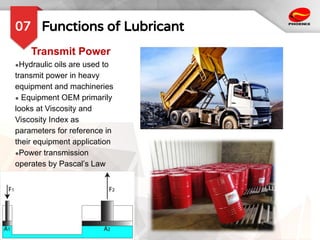
Transmit Power
●Hydraulic oils are used to
transmit power in heavy
equipment and machineries
● Equipment OEM primarily
looks at Viscosity and
Viscosity Index as
parameters for reference in
their equipment application
●Power transmission
operates by Pascal’s Law
What is friction?
08
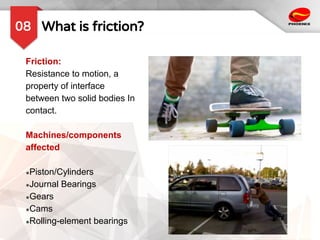
Friction:
Resistance to motion, a
property of interface
between two solid bodies In
contact.
Machines/components
affected
●Piston/Cylinders
●Journal Bearings
●Gears
●Cams
●Rolling-element bearings
Types of friction
09
1.Static Friction
– resistance to the start of motion
2.Sliding Friction
– resistance to one object sliding
over another object
3.Rolling Friction
– resistance to one object rolling
over another object
- about 100-1000 time less than
static/sliding
Static > Sliding >
Rolling
4.Fluid Friction
- Air Resistance
- Moving through water
Lubrication Regimes
10
Protection essentially
dependent on boundary
anti-wear film
Starts, stops, slow moving
conditions, and shock load
conditions
Both the bulk lubricant
and boundary film play a
role
Surfaces separated by
bulk lubricant film,
affected by viscosity, load
and speed
Full-speed Conditions
(most desired)
Boundary Film
(anti-wear additive protection)
Bulk Lubricant
(viscosity protection)
Asperities
(microscopic projections on
Metal surfaces)
Legend
Boundary
Lubrication
Mixed-film
Lubrication
Full-fluid
Film
Lubrication
Importance of Viscosity
11
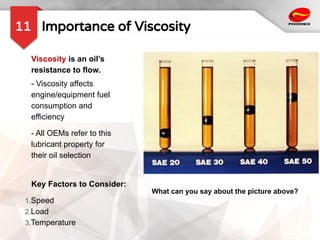
Viscosity is an oil’s
resistance to flow.
- Viscosity affects
engine/equipment fuel
consumption and
efficiency
- All OEMs refer to this
lubricant property for
their oil selection
What can you say about the picture above?
Key Factors to Consider:
1.Speed
2.Load
3.Temperature
Viscosity Index (VI)
12
Viscosity Index is a parameter for lubricants that shows its sensitivity to
temperature fluctuations. Some OEMs, usually for hydraulic oil application,
are particular for the lubricant Viscosity Index (VI) specs
Viscosity Classification
13
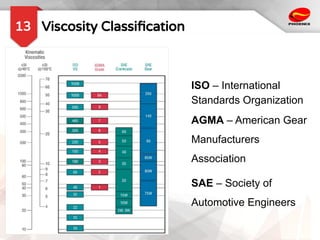
ISO – International
Standards Organization
AGMA – American Gear
Manufacturers
Association
SAE – Society of
Automotive Engineers
Speed and Load Effects on Viscosity
Selection
14
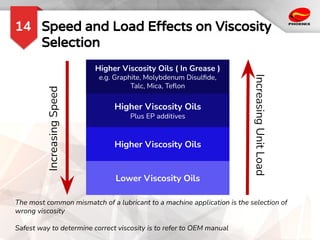
Higher Viscosity Oils ( In Grease )
e.g. Graphite, Molybdenum Disulfide,
Talc, Mica, Teflon
Higher Viscosity Oils
Plus EP additives
Higher Viscosity Oils
Lower Viscosity Oils
Increasing
Speed
Increasing
Unit
Load
The most common mismatch of a lubricant to a machine application is the selection of
wrong viscosity
Safest way to determine correct viscosity is to refer to OEM manual
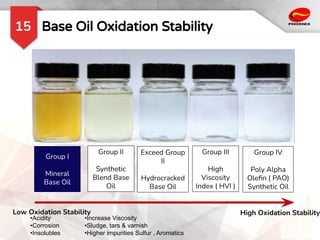
Base Oil Oxidation Stability
15
Group I
Mineral
Base Oil
Group II
Synthetic
Blend Base
Oil
Exceed Group
II
Hydrocracked
Base Oil
Group III
High
Viscosity
Index ( HVI )
Group IV
Poly Alpha
Olefin ( PAO)
Synthetic Oil
High Oxidation Stability
Low Oxidation Stability
•Acidity
•Corrosion
•Insolubles
•Increase Viscosity
•Sludge, tars & varnish
•Higher impurities Sulfur , Aromatics
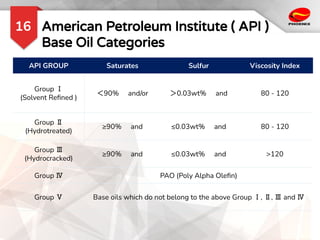
American Petroleum Institute ( API )
Base Oil Categories
16
API GROUP Saturates Sulfur Viscosity Index
Group Ⅰ
(Solvent Refined )
<90% and/or >0.03wt% and 80 - 120
Group Ⅱ
(Hydrotreated)
≥90% and ≤0.03wt% and 80 - 120
Group Ⅲ
(Hydrocracked)
≥90% and ≤0.03wt% and >120
Group Ⅳ PAO (Poly Alpha Olefin)
Group Ⅴ Base oils which do not belong to the above Group Ⅰ, Ⅱ, Ⅲ and Ⅳ
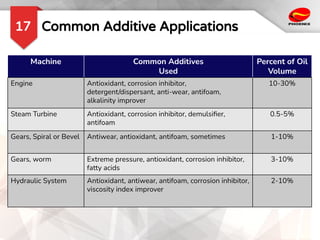
Common Additive Applications
17
Machine Common Additives
Used
Percent of Oil
Volume
Engine Antioxidant, corrosion inhibitor,
detergent/dispersant, anti-wear, antifoam,
alkalinity improver
10-30%
Steam Turbine Antioxidant, corrosion inhibitor, demulsifier,
antifoam
0.5-5%
Gears, Spiral or Bevel Antiwear, antioxidant, antifoam, sometimes 1-10%
Gears, worm Extreme pressure, antioxidant, corrosion inhibitor,
fatty acids
3-10%
Hydraulic System Antioxidant, antiwear, antifoam, corrosion inhibitor,
viscosity index improver
2-10%
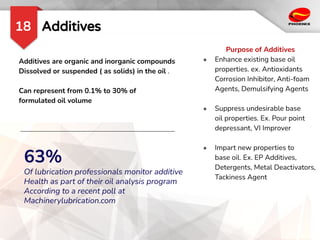
Additives
18
Additives are organic and inorganic compounds
Dissolved or suspended ( as solids) in the oil .
Can represent from 0.1% to 30% of
formulated oil volume
63%
Of lubrication professionals monitor additive
Health as part of their oil analysis program
According to a recent poll at
Machinerylubrication.com
Purpose of Additives
● Enhance existing base oil
properties. ex. Antioxidants
Corrosion Inhibitor, Anti-foam
Agents, Demulsifying Agents
● Suppress undesirable base
oil properties. Ex. Pour point
depressant, VI Improver
● Impart new properties to
base oil. Ex. EP Additives,
Detergents, Metal Deactivators,
Tackiness Agent
Additives Overview
19
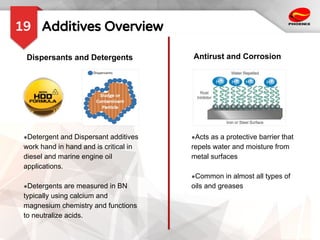
Dispersants and Detergents Antirust and Corrosion
●Detergent and Dispersant additives
work hand in hand and is critical in
diesel and marine engine oil
applications.
●Detergents are measured in BN
typically using calcium and
magnesium chemistry and functions
to neutralize acids.
●Acts as a protective barrier that
repels water and moisture from
metal surfaces
●Common in almost all types of
oils and greases
Additives Overview
20
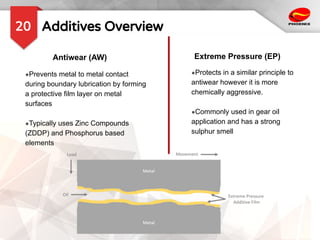
Antiwear (AW) Extreme Pressure (EP)
●Prevents metal to metal contact
during boundary lubrication by forming
a protective film layer on metal
surfaces
●Typically uses Zinc Compounds
(ZDDP) and Phosphorus based
elements
●Protects in a similar principle to
antiwear however it is more
chemically aggressive.
●Commonly used in gear oil
application and has a strong
sulphur smell
Additives Overview
21
Antioxidants Foam Inhibitors
●Minimize lubricant thickening and
degradation when oxygen reacts with
lubricants at high temperatures.
●Oxidation of oils are determined by
its AN levels where acceptable levels
are generally recommended within an
increase of 0.2-0.3 mg KOH/gm from
fresh oil levels
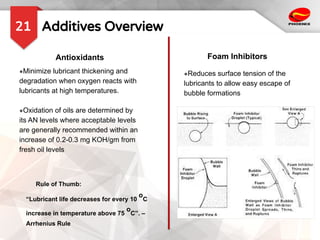
●Reduces surface tension of the
lubricants to allow easy escape of
bubble formations
Rule of Thumb:
“Lubricant life decreases for every 10
o
C
increase in temperature above 75
o
C”. –
Arrhenius Rule
How to choose the correct engine oil
22
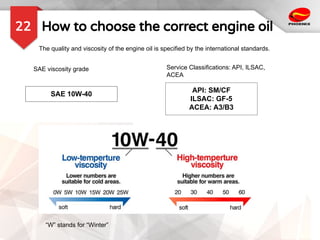
The quality and viscosity of the engine oil is specified by the international standards.
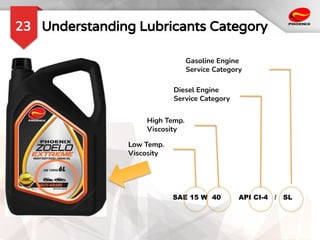
SAE viscosity grade Service Classifications: API, ILSAC,
ACEA
SAE 10W-40
API: SM/CF
ILSAC: GF-5
ACEA: A3/B3
“W” stands for “Winter”
SAE 15 W 40 API CI-4 / SL
Low Temp.
Viscosity
High Temp.
Viscosity
Diesel Engine
Service Category
Gasoline Engine
Service Category
Understanding Lubricants Category
23
International Standards
24
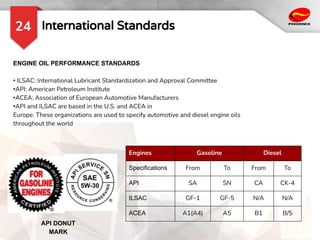
ENGINE OIL PERFORMANCE STANDARDS
• ILSAC: International Lubricant Standardization and Approval Committee
•API: American Petroleum Institute
•ACEA: Association of European Automotive Manufacturers
•API and ILSAC are based in the U.S. and ACEA in
Europe. These organizations are used to specify automotive and diesel engine oils
throughout the world
Engines Gasoline Diesel
Specifications From To From To
API SA SN CA CK-4
ILSAC GF-1 GF-5 N/A N/A
ACEA A1(A4) A5 B1 B/5
API DONUT
MARK
API Service Classifications
25
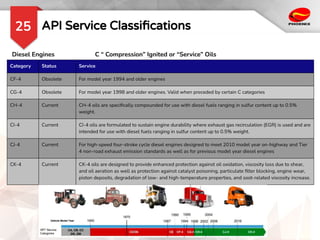
Category Status Service
CF-4 Obsolete For model year 1994 and older engines
CG-4 Obsolete For model year 1998 and older engines. Valid when preceded by certain C categories
CH-4 Current CH-4 oils are specifically compounded for use with diesel fuels ranging in sulfur content up to 0.5%
weight.
CI-4 Current CI-4 oils are formulated to sustain engine durability where exhaust gas recirculation (EGR) is used and are
intended for use with diesel fuels ranging in sulfur content up to 0.5% weight.
CJ-4 Current For high-speed four-stroke cycle diesel engines designed to meet 2010 model year on-highway and Tier
4 non-road exhaust emission standards as well as for previous model year diesel engines
CK-4 Current CK-4 oils are designed to provide enhanced protection against oil oxidation, viscosity loss due to shear,
and oil aeration as well as protection against catalyst poisoning, particulate filter blocking, engine wear,
piston deposits, degradation of low- and high-temperature properties, and soot-related viscosity increase.
Diesel Engines C “ Compression” Ignited or “Service” Oils
API Service Classifications
26
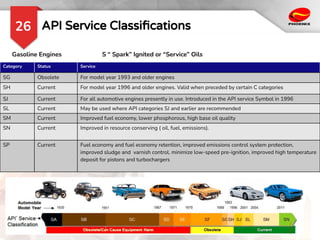
Gasoline Engines S “ Spark” Ignited or “Service” Oils
Category Status Service
SG Obsolete For model year 1993 and older engines
SH Current For model year 1996 and older engines. Valid when preceded by certain C categories
SJ Current For all automotive engines presently in use. Introduced in the API service Symbol in 1996
SL Current May be used where API categories SJ and earlier are recommended
SM Current Improved fuel economy, lower phosphorous, high base oil quality
SN Current Improved in resource conserving ( oil, fuel, emissions).
SP Current Fuel economy and fuel economy retention, improved emissions control system protection,
improved sludge and varnish control, minimize low-speed pre-ignition, improved high temperature
deposit for pistons and turbochargers
Phoenix Lubricants
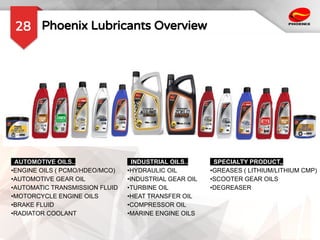
Phoenix Lubricants Overview
28
AUTOMOTIVE OILS..
•ENGINE OILS ( PCMO/HDEO/MCO)
•AUTOMOTIVE GEAR OIL
•AUTOMATIC TRANSMISSION FLUID
•MOTORCYCLE ENGINE OILS
•BRAKE FLUID
•RADIATOR COOLANT
INDUSTRIAL OILS..
•HYDRAULIC OIL
•INDUSTRIAL GEAR OIL
•TURBINE OIL
•HEAT TRANSFER OIL
•COMPRESSOR OIL
•MARINE ENGINE OILS
SPECIALTY PRODUCT,,
•GREASES ( LITHIUM/LITHIUM CMP)
•SCOOTER GEAR OILS
•DEGREASER
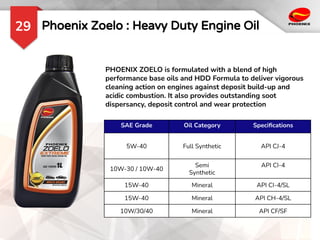
Phoenix Zoelo : Heavy Duty Engine Oil
29
SAE Grade Oil Category Specifications
5W-40 Full Synthetic API CJ-4
10W-30 / 10W-40
Semi
Synthetic
API CI-4
15W-40 Mineral API CI-4/SL
15W-40 Mineral API CH-4/SL
10W/30/40 Mineral API CF/SF
PHOENIX ZOELO is formulated with a blend of high
performance base oils and HDD Formula to deliver vigorous
cleaning action on engines against deposit build-up and
acidic combustion. It also provides outstanding soot
dispersancy, deposit control and wear protection
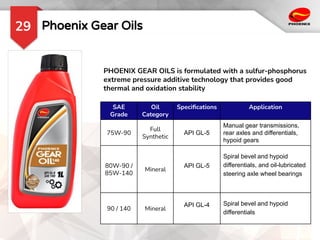
Phoenix Gear Oils
29
SAE
Grade
Oil
Category
Specifications Application
75W-90
Full
Synthetic
API GL-5
Manual gear transmissions,
rear axles and differentials,
hypoid gears
80W-90 /
85W-140
Mineral
API GL-5
Spiral bevel and hypoid
differentials, and oil-lubricated
steering axle wheel bearings
90 / 140 Mineral
API GL-4 Spiral bevel and hypoid
differentials
PHOENIX GEAR OILS is formulated with a sulfur-phosphorus
extreme pressure additive technology that provides good
thermal and oxidation stability
Phoenix Radiator Coolant
29
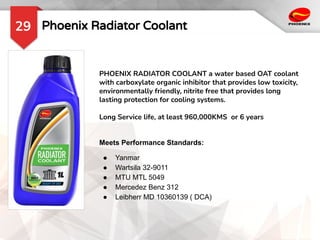
PHOENIX RADIATOR COOLANT a water based OAT coolant
with carboxylate organic inhibitor that provides low toxicity,
environmentally friendly, nitrite free that provides long
lasting protection for cooling systems.
Long Service life, at least 960,000KMS or 6 years
Meets Performance Standards:
● Yanmar
● Wartsila 32-9011
● MTU MTL 5049
● Mercedez Benz 312
● Leibherr MD 10360139 ( DCA)
Phoenix Hydraulic Oils
35
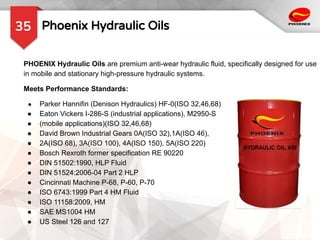
PHOENIX Hydraulic Oils are premium anti-wear hydraulic fluid, specifically designed for use
in mobile and stationary high-pressure hydraulic systems.
Meets Performance Standards:
● Parker Hannifin (Denison Hydraulics) HF-0(ISO 32,46,68)
● Eaton Vickers I-286-S (industrial applications), M2950-S
● (mobile applications)(ISO 32,46,68)
● David Brown Industrial Gears 0A(ISO 32),1A(ISO 46),
● 2A(ISO 68), 3A(ISO 100), 4A(ISO 150), 5A(ISO 220)
● Bosch Rexroth former specification RE 90220
● DIN 51502:1990, HLP Fluid
● DIN 51524:2006-04 Part 2 HLP
● Cincinnati Machine P-68, P-60, P-70
● ISO 6743:1999 Part 4 HM Fluid
● ISO 11158:2009, HM
● SAE MS1004 HM
● US Steel 126 and 127
Phoenix Industrial Gear Oils
35
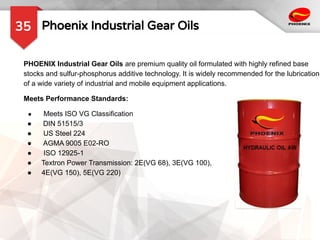
PHOENIX Industrial Gear Oils are premium quality oil formulated with highly refined base
stocks and sulfur-phosphorus additive technology. It is widely recommended for the lubrication
of a wide variety of industrial and mobile equipment applications.
Meets Performance Standards:
● Meets ISO VG Classification
● DIN 51515/3
● US Steel 224
● AGMA 9005 E02-RO
● ISO 12925-1
● Textron Power Transmission: 2E(VG 68), 3E(VG 100),
● 4E(VG 150), 5E(VG 220)
Phoenix Turbine Oils
35
PHOENIX Turbine Oils are premium quality turbine oil formulated from highly refined base
stocks and special rust, oxidation and foam inhibitors designed to use for steam and hydraulic
turbines operating under all service conditions
Meets Performance Standards:
● DIN 51515
● Alstom Power HTGD 90117
● Siemens TLV 901305
● General Electric GEK 32568, GEK 107395, GEK 46506
● Five Cincinnati P-38, P-55, P-54 and P-57
● Solar Turbines ES9-224
● AIST 125
● ISO 8068
● AGMA 9005 E02-RO
● Parker Denison HF-0 Bench Tests
● MAG P-38, P-55, P-54 and P-57
PHOENIX TURBINE OIL
PERFORMANCE
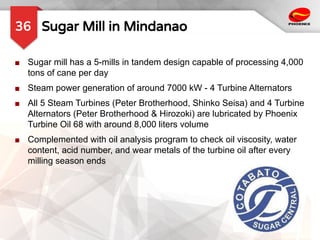
Sugar Mill in Mindanao
36
■ Sugar mill has a 5-mills in tandem design capable of processing 4,000
tons of cane per day
■ Steam power generation of around 7000 kW - 4 Turbine Alternators
■ All 5 Steam Turbines (Peter Brotherhood, Shinko Seisa) and 4 Turbine
Alternators (Peter Brotherhood & Hirozoki) are lubricated by Phoenix
Turbine Oil 68 with around 8,000 liters volume
■ Complemented with oil analysis program to check oil viscosity, water
content, acid number, and wear metals of the turbine oil after every
milling season ends
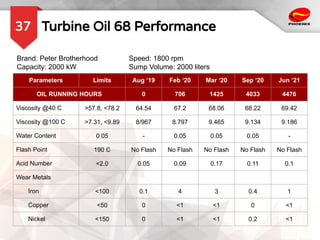
Turbine Oil 68 Performance
37
Brand: Peter Brotherhood Speed: 1800 rpm
Capacity: 2000 kW Sump Volume: 2000 liters
Parameters Limits Aug ‘19 Feb ‘20 Mar ‘20 Sep ‘20 Jun ‘21
OIL RUNNING HOURS 0 706 1425 4033 4476
Viscosity @40 C >57.8, <78.2 64.54 67.2 68.06 68.22 69.42
Viscosity @100 C >7.31, <9.89 8/967 8.797 9.465 9.134 9.186
Water Content 0.05 - 0.05 0.05 0.05 -
Flash Point 190 C No Flash No Flash No Flash No Flash No Flash
Acid Number <2.0 0.05 0.09 0.17 0.11 0.1
Wear Metals
Iron <100 0.1 4 3 0.4 1
Copper <50 0 <1 <1 0 <1
Nickel <150 0 <1 <1 0.2 <1
Steam Power Plant in Mindanao
38
■ FDC Misamis Power Corporation, a 405 MW Coal-Fired Power Plant in Villanueva,
Misamis Oriental.
■ The power plant consists of 3 units of 135 MW Alstom Turbines and 2 out of 3 units
are currently lubricated by Phoenix Turbine Oil ISO VG 46
■ In 2018, FDC approved the use of Phoenix Turbine 46 after warranty period has
ended for its Alstom Turbines. After a series of performance test were carried out
for 1 turbine with satisfied results, another turbine was converted to Phoenix in
2020.
■ Oil performance monitoring are checked semi-annually to evaluate the condition of
oils
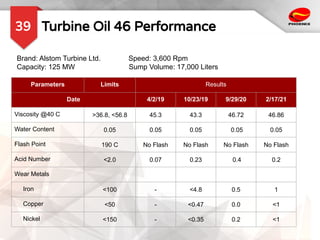
Turbine Oil 46 Performance
39
Brand: Alstom Turbine Ltd. Speed: 3,600 Rpm
Capacity: 125 MW Sump Volume: 17,000 Liters
Parameters Limits Results
Date 4/2/19 10/23/19 9/29/20 2/17/21
Viscosity @40 C >36.8, <56.8 45.3 43.3 46.72 46.86
Water Content 0.05 0.05 0.05 0.05 0.05
Flash Point 190 C No Flash No Flash No Flash No Flash
Acid Number <2.0 0.07 0.23 0.4 0.2
Wear Metals
Iron <100 - <4.8 0.5 1
Copper <50 - <0.47 0.0 <1
Nickel <150 - <0.35 0.2 <1
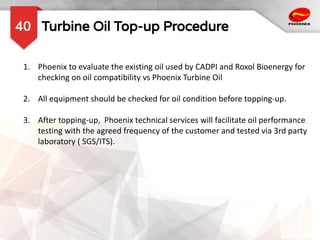
Turbine Oil Top-up Procedure
40
1. Phoenix to evaluate the existing oil used by CADPI and Roxol Bioenergy for
checking on oil compatibility vs Phoenix Turbine Oil
2. All equipment should be checked for oil condition before topping-up.
3. After topping-up, Phoenix technical services will facilitate oil performance
testing with the agreed frequency of the customer and tested via 3rd party
laboratory ( SGS/ITS).
Thank you