Belt conveyorBelt conveyor
Ashish kumar jain
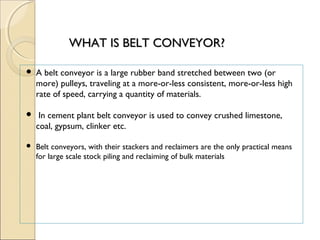
WHAT IS BELT CONVEYOR?WHAT IS BELT CONVEYOR?
 A belt conveyor is a large rubber band stretched between two (or
more) pulleys, traveling at a more-or-less consistent, more-or-less high
rate of speed, carrying a quantity of materials.
 In cement plant belt conveyor is used to convey crushed limestone,
coal, gypsum, clinker etc.
 Belt conveyors, with their stackers and reclaimers are the only practical means
for large scale stock piling and reclaiming of bulk materials
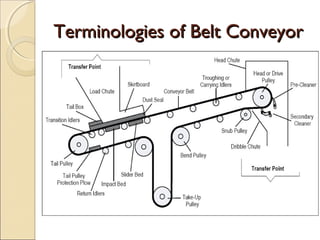
Terminologies of Belt ConveyorTerminologies of Belt Conveyor
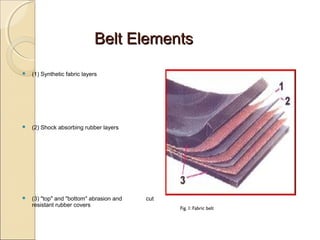
Belt ElementsBelt Elements
 (1) Synthetic fabric layers
 (2) Shock absorbing rubber layers
 (3) "top" and "bottom" abrasion and cut
resistant rubber covers
Fig. 1: Fabric belt
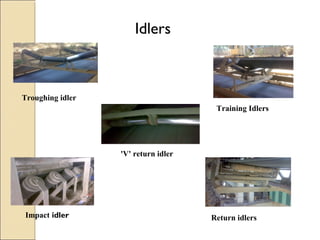
Idlers
Troughing idler
Training Idlers
Impact idler Return idlers
'V' return idler
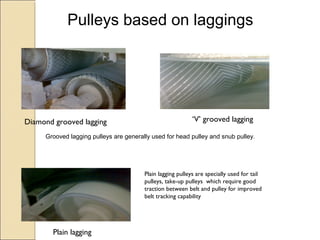
Pulleys based on laggings
Diamond grooved lagging ‘V’ grooved lagging
Grooved lagging pulleys are generally used for head pulley and snub pulley.
Plain lagging pulleys are specially used for tail
pulleys, take-up pulleys which require good
traction between belt and pulley for improved
belt tracking capability
Plain lagging
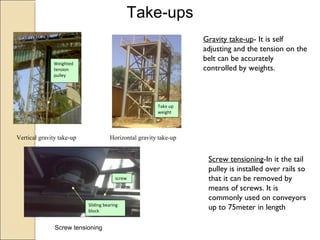
Weighted
tension
pulley
Take up
weight
screw
Sliding bearing
block
Screw tensioning-In it the tail
pulley is installed over rails so
that it can be removed by
means of screws. It is
commonly used on conveyors
up to 75meter in length
Screw tensioning
Vertical gravity take-up Horizontal gravity take-up
Take-ups
Gravity take-up- It is self
adjusting and the tension on the
belt can be accurately
controlled by weights.
Selection of belt conveyorSelection of belt conveyor
 1. Tension Rating (Tensile strength of the belt)
 2. Load Support (Min no of plies)
 3. Troughability
 4. Pulley Diameters
 5. Belt thickness
Good Loading ConditionsGood Loading Conditions
When in service, belt wear occurs mainly at loading points, so to prevent wear:
 Loading should be central with material feeding at same speed and in same direction as belt
travel
 Reduce the free fall of material at loading point.
 Cushion lumps by screening out fines in front of the toe of the chute.
 Use impact idlers to absorb the impact energy of the lumps.
 Boards and the belt clearance should increase in the direction of travel to prevent trapping.
 Ensure that the delivery chute is not choked.
Loading chutesLoading chutes
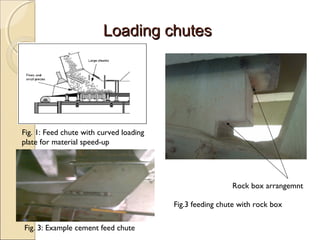
Fig. 1: Feed chute with curved loading
plate for material speed-up
Fig.3 feeding chute with rock box
Fig. 3: Example cement feed chute
Rock box arrangemnt
MaintenanceMaintenance
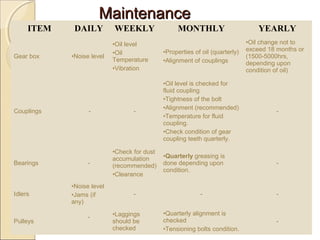
ITEM DAILY WEEKLY MONTHLY YEARLY
Gear box •Noise level
•Oil level
•Oil
Temperature
•Vibration
•Properties of oil (quarterly)
•Alignment of couplings
•Oil change not to
exceed 18 months or
(1500-5000hrs,
depending upon
condition of oil)
Couplings - -
•Oil level is checked for
fluid coupling
•Tightness of the bolt
•Alignment (recommended)
•Temperature for fluid
coupling.
•Check condition of gear
coupling teeth quarterly.
-
Bearings -
•Check for dust
accumulation
(recommended)
•Clearance
•Quarterly greasing is
done depending upon
condition.
-
Idlers
•Noise level
•Jams (if
any)
- - -
Pulleys
- •Laggings
should be
checked
•Quarterly alignment is
checked
•Tensioning bolts condition.
-
TroubleshootingTroubleshooting
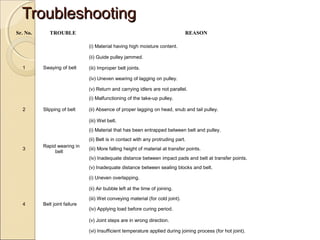
Sr. No. TROUBLE REASON
1 Swaying of belt
(i) Material having high moisture content.
(ii) Guide pulley jammed.
(iii) Improper belt joints.
(iv) Uneven wearing of lagging on pulley.
(v) Return and carrying idlers are not parallel.
2 Slipping of belt
(i) Malfunctioning of the take-up pulley.
(ii) Absence of proper lagging on head, snub and tail pulley.
(iii) Wet belt.
3
Rapid wearing in
belt
(i) Material that has been entrapped between belt and pulley.
(ii) Belt is in contact with any protruding part.
(iii) More falling height of material at transfer points.
(iv) Inadequate distance between impact pads and belt at transfer points.
(v) Inadequate distance between sealing blocks and belt.
4 Belt joint failure
(i) Uneven overlapping.
(ii) Air bubble left at the time of joining.
(iii) Wet conveying material (for cold joint).
(iv) Applying load before curing period.
(v) Joint steps are in wrong direction.
(vi) Insufficient temperature applied during joining process (for hot joint).
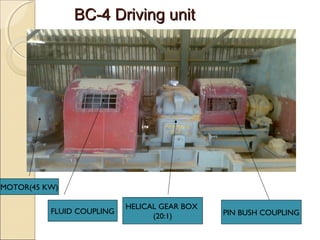
BC-4 Driving unitBC-4 Driving unit
FLUID COUPLING PIN BUSH COUPLING
HELICAL GEAR BOX
(20:1)
MOTOR(45 KW)
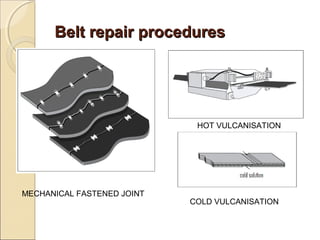
Belt repair proceduresBelt repair procedures
MECHANICAL FASTENED JOINT
HOT VULCANISATION
COLD VULCANISATION
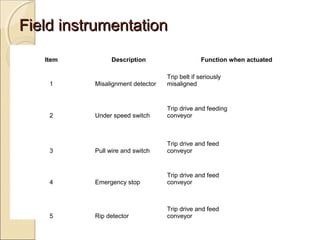
Field instrumentationField instrumentation
Item Description Function when actuated
1 Misalignment detector
Trip belt if seriously
misaligned
2 Under speed switch
Trip drive and feeding
conveyor
3 Pull wire and switch
Trip drive and feed
conveyor
4 Emergency stop
Trip drive and feed
conveyor
5 Rip detector
Trip drive and feed
conveyor
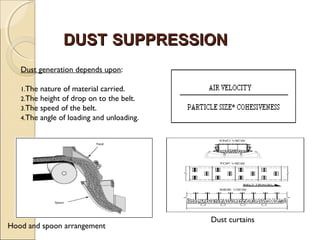
DUSTDUST SUPPRESSIONSUPPRESSION
Dust generation depends upon:
1.The nature of material carried.
2.The height of drop on to the belt.
3.The speed of the belt.
4.The angle of loading and unloading.
Dust curtains
Hood and spoon arrangement
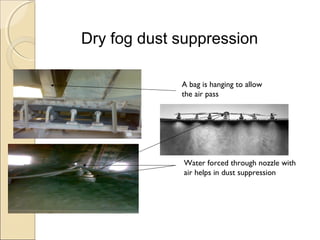
Dry fog dust suppression
A bag is hanging to allow
the air pass
Water forced through nozzle with
air helps in dust suppression
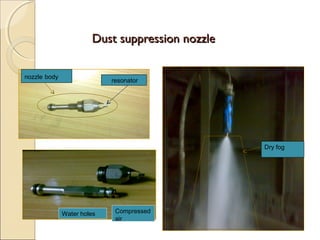
Dust suppression nozzleDust suppression nozzle
resonator
nozzle body
Water holes Compressed
air
Dry fog
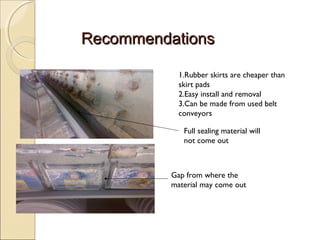
RecommendationsRecommendations
Gap from where the
material may come out
Full sealing material will
not come out
1.Rubber skirts are cheaper than
skirt pads
2.Easy install and removal
3.Can be made from used belt
conveyors
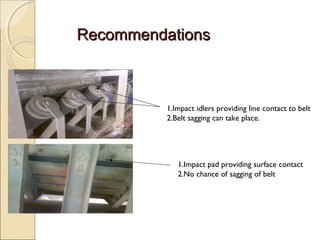
RecommendationsRecommendations
1.Impact idlers providing line contact to belt
2.Belt sagging can take place.
1.Impact pad providing surface contact
2.No chance of sagging of belt
SafetySafety
 Should not load the material on the conveyor above its conveying capacity.
 While lubricating pulleys, idlers, bearings, fluid couplings and balancing the belts, the
conveyors should be stopped.
 It is dangerous to travel or walk across the conveyor (whether above or below it) while it
is running. It will be better to use cross overs and ladders provided for this purpose.
 While walking along the sides of conveyor belt in belt conveyor gallery for inspection purpose,
always ensure that your hands, legs, head and hair are not in touch with the moving belts and
idlers. NO LOOSE GARMENTS TO BE WORN DURING WORK.
 The belt conveyor gallery should be well illuminated. The non burning lamps should be
replaced with new ones immediately.
 The switches like limit switch, belt sway switch, starting and stopping switch and
mechanical/electrical interlocking switches should be checked periodically to know whether
they are in good operating condition
Belt Conveyor System

Belt Conveyor System

  • 1.
  • 2.
    WHAT IS BELTCONVEYOR?WHAT IS BELT CONVEYOR?  A belt conveyor is a large rubber band stretched between two (or more) pulleys, traveling at a more-or-less consistent, more-or-less high rate of speed, carrying a quantity of materials.  In cement plant belt conveyor is used to convey crushed limestone, coal, gypsum, clinker etc.  Belt conveyors, with their stackers and reclaimers are the only practical means for large scale stock piling and reclaiming of bulk materials
  • 3.
    Terminologies of BeltConveyorTerminologies of Belt Conveyor
  • 4.
    Belt ElementsBelt Elements (1) Synthetic fabric layers  (2) Shock absorbing rubber layers  (3) "top" and "bottom" abrasion and cut resistant rubber covers Fig. 1: Fabric belt
  • 5.
    Idlers Troughing idler Training Idlers Impactidler Return idlers 'V' return idler
  • 6.
    Pulleys based onlaggings Diamond grooved lagging ‘V’ grooved lagging Grooved lagging pulleys are generally used for head pulley and snub pulley. Plain lagging pulleys are specially used for tail pulleys, take-up pulleys which require good traction between belt and pulley for improved belt tracking capability Plain lagging
  • 7.
    Weighted tension pulley Take up weight screw Sliding bearing block Screwtensioning-In it the tail pulley is installed over rails so that it can be removed by means of screws. It is commonly used on conveyors up to 75meter in length Screw tensioning Vertical gravity take-up Horizontal gravity take-up Take-ups Gravity take-up- It is self adjusting and the tension on the belt can be accurately controlled by weights.
  • 8.
    Selection of beltconveyorSelection of belt conveyor  1. Tension Rating (Tensile strength of the belt)  2. Load Support (Min no of plies)  3. Troughability  4. Pulley Diameters  5. Belt thickness
  • 9.
    Good Loading ConditionsGoodLoading Conditions When in service, belt wear occurs mainly at loading points, so to prevent wear:  Loading should be central with material feeding at same speed and in same direction as belt travel  Reduce the free fall of material at loading point.  Cushion lumps by screening out fines in front of the toe of the chute.  Use impact idlers to absorb the impact energy of the lumps.  Boards and the belt clearance should increase in the direction of travel to prevent trapping.  Ensure that the delivery chute is not choked.
  • 10.
    Loading chutesLoading chutes Fig.1: Feed chute with curved loading plate for material speed-up Fig.3 feeding chute with rock box Fig. 3: Example cement feed chute Rock box arrangemnt
  • 11.
    MaintenanceMaintenance ITEM DAILY WEEKLYMONTHLY YEARLY Gear box •Noise level •Oil level •Oil Temperature •Vibration •Properties of oil (quarterly) •Alignment of couplings •Oil change not to exceed 18 months or (1500-5000hrs, depending upon condition of oil) Couplings - - •Oil level is checked for fluid coupling •Tightness of the bolt •Alignment (recommended) •Temperature for fluid coupling. •Check condition of gear coupling teeth quarterly. - Bearings - •Check for dust accumulation (recommended) •Clearance •Quarterly greasing is done depending upon condition. - Idlers •Noise level •Jams (if any) - - - Pulleys - •Laggings should be checked •Quarterly alignment is checked •Tensioning bolts condition. -
  • 12.
    TroubleshootingTroubleshooting Sr. No. TROUBLEREASON 1 Swaying of belt (i) Material having high moisture content. (ii) Guide pulley jammed. (iii) Improper belt joints. (iv) Uneven wearing of lagging on pulley. (v) Return and carrying idlers are not parallel. 2 Slipping of belt (i) Malfunctioning of the take-up pulley. (ii) Absence of proper lagging on head, snub and tail pulley. (iii) Wet belt. 3 Rapid wearing in belt (i) Material that has been entrapped between belt and pulley. (ii) Belt is in contact with any protruding part. (iii) More falling height of material at transfer points. (iv) Inadequate distance between impact pads and belt at transfer points. (v) Inadequate distance between sealing blocks and belt. 4 Belt joint failure (i) Uneven overlapping. (ii) Air bubble left at the time of joining. (iii) Wet conveying material (for cold joint). (iv) Applying load before curing period. (v) Joint steps are in wrong direction. (vi) Insufficient temperature applied during joining process (for hot joint).
  • 13.
    BC-4 Driving unitBC-4Driving unit FLUID COUPLING PIN BUSH COUPLING HELICAL GEAR BOX (20:1) MOTOR(45 KW)
  • 14.
    Belt repair proceduresBeltrepair procedures MECHANICAL FASTENED JOINT HOT VULCANISATION COLD VULCANISATION
  • 15.
    Field instrumentationField instrumentation ItemDescription Function when actuated 1 Misalignment detector Trip belt if seriously misaligned 2 Under speed switch Trip drive and feeding conveyor 3 Pull wire and switch Trip drive and feed conveyor 4 Emergency stop Trip drive and feed conveyor 5 Rip detector Trip drive and feed conveyor
  • 16.
    DUSTDUST SUPPRESSIONSUPPRESSION Dust generationdepends upon: 1.The nature of material carried. 2.The height of drop on to the belt. 3.The speed of the belt. 4.The angle of loading and unloading. Dust curtains Hood and spoon arrangement
  • 17.
    Dry fog dustsuppression A bag is hanging to allow the air pass Water forced through nozzle with air helps in dust suppression
  • 18.
    Dust suppression nozzleDustsuppression nozzle resonator nozzle body Water holes Compressed air Dry fog
  • 19.
    RecommendationsRecommendations Gap from wherethe material may come out Full sealing material will not come out 1.Rubber skirts are cheaper than skirt pads 2.Easy install and removal 3.Can be made from used belt conveyors
  • 20.
    RecommendationsRecommendations 1.Impact idlers providingline contact to belt 2.Belt sagging can take place. 1.Impact pad providing surface contact 2.No chance of sagging of belt
  • 21.
    SafetySafety  Should notload the material on the conveyor above its conveying capacity.  While lubricating pulleys, idlers, bearings, fluid couplings and balancing the belts, the conveyors should be stopped.  It is dangerous to travel or walk across the conveyor (whether above or below it) while it is running. It will be better to use cross overs and ladders provided for this purpose.  While walking along the sides of conveyor belt in belt conveyor gallery for inspection purpose, always ensure that your hands, legs, head and hair are not in touch with the moving belts and idlers. NO LOOSE GARMENTS TO BE WORN DURING WORK.  The belt conveyor gallery should be well illuminated. The non burning lamps should be replaced with new ones immediately.  The switches like limit switch, belt sway switch, starting and stopping switch and mechanical/electrical interlocking switches should be checked periodically to know whether they are in good operating condition