
Report Interpretation

By Dwon Ruffin
Normal with PC

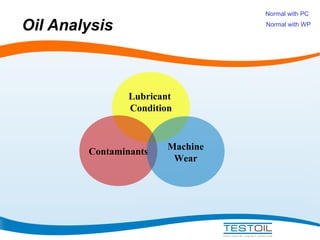
Oil Analysis

Normal with WP

Lubricant
Condition

Contaminants

Machine
Wear
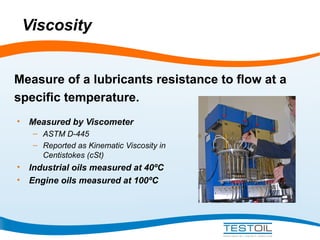
Viscosity
Measure of a lubricants resistance to flow at a
specific temperature.
•

Measured by Viscometer
– ASTM D-445
– Reported as Kinematic Viscosity in
Centistokes (cSt)

•
•

Industrial oils measured at 40ºC
Engine oils measured at 100ºC
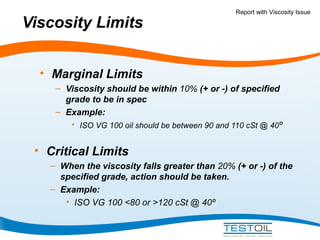
Viscosity Limits

Report with Viscosity Issue

• Marginal Limits
– Viscosity should be within 10% (+ or -) of specified
grade to be in spec
– Example:
• ISO VG 100 oil should be between 90 and 110 cSt @ 40º

• Critical Limits
– When the viscosity falls greater than 20% (+ or -) of the
specified grade, action should be taken.
– Example:
• ISO VG 100 <80 or >120 cSt @ 40º
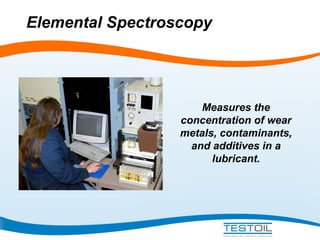
Elemental Spectroscopy

Measures the
concentration of wear
metals, contaminants,
and additives in a
lubricant.
Spectroscopy

• 20 elements measured
– Wear metals
– Contaminants
– Additives

•
•
•
•

Reported in parts per million (ppm)
Measures metals in solution
Solid debris below 7 microns in size
Blind to larger particles
Wear Metal Sources

• Iron (Fe)
– Shafts, Gears, Housings, Piston Rings, Cylinder Walls

• Copper (Cu)
– Brass/Bronze alloys, Bearings, Bushings, Thrust Washers

• Lead (Pb)
– Bearings, Anti-Wear Gear Additive (Rare)

– Tin (Sn)
– Bearing Alloys, Bearing Cages, Solder
Wear Metal Sources

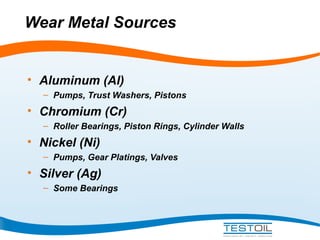
• Aluminum (Al)
– Pumps, Trust Washers, Pistons

• Chromium (Cr)
– Roller Bearings, Piston Rings, Cylinder Walls

• Nickel (Ni)
– Pumps, Gear Platings, Valves

• Silver (Ag)
– Some Bearings
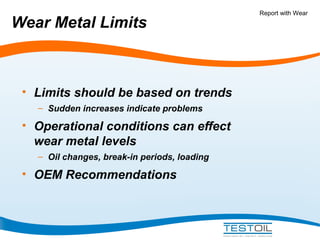
Wear Metal Limits

• Limits should be based on trends
– Sudden increases indicate problems

• Operational conditions can effect
wear metal levels
– Oil changes, break-in periods, loading

• OEM Recommendations

Report with Wear
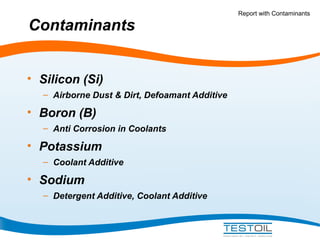
Contaminants
• Silicon (Si)
– Airborne Dust & Dirt, Defoamant Additive

• Boron (B)
– Anti Corrosion in Coolants

• Potassium
– Coolant Additive

• Sodium
– Detergent Additive, Coolant Additive

Report with Contaminants
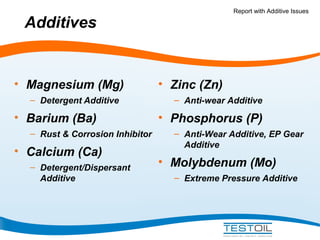
Report with Additive Issues

Additives

• Magnesium (Mg)
– Detergent Additive

• Barium (Ba)
– Rust & Corrosion Inhibitor

• Calcium (Ca)
– Detergent/Dispersant
Additive

• Zinc (Zn)
– Anti-wear Additive

• Phosphorus (P)
– Anti-Wear Additive, EP Gear
Additive

• Molybdenum (Mo)
– Extreme Pressure Additive
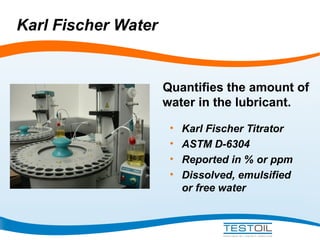
Karl Fischer Water

Quantifies the amount of
water in the lubricant.
•
•
•
•

Karl Fischer Titrator
ASTM D-6304
Reported in % or ppm
Dissolved, emulsified
or free water
Sources of Water
• Condensation
• External contamination
– Breathers
– Seals
– Reservoir covers

• Internal leaks
– Heat exchangers
– Water jackets

Report with Water
Report with Water – V40
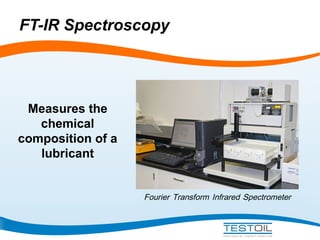
FT-IR Spectroscopy

Measures the
chemical
composition of a
lubricant
Fourier Transform Infrared Spectrometer
FT-IR Spectroscopy

Report with Oxidation

• Oil Degradation by chemical change
– Oxidation
– Nitration

• Contamination
– Soot
– Glycol
FT-IR Spectroscopy

• Additive Depletion
– When additives deplete, they are typically still present
– Atomic Spectroscopy will indicate their presence, yet
they can be chemically inert
– Decreased signal strength in the IR Spectrum will
reveal excess additive depletion
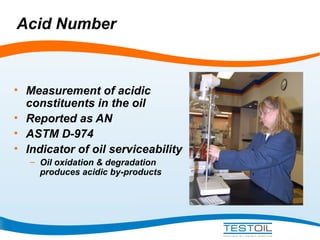
Acid Number

• Measurement of acidic
constituents in the oil
• Reported as AN
• ASTM D-974
• Indicator of oil serviceability
– Oil oxidation & degradation
produces acidic by-products
Report with AN issues

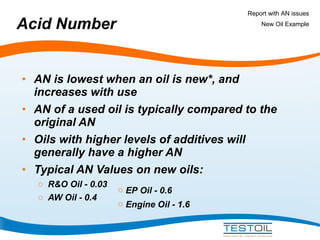
Acid Number

New Oil Example

• AN is lowest when an oil is new*, and
increases with use
• AN of a used oil is typically compared to the
original AN
• Oils with higher levels of additives will
generally have a higher AN
• Typical AN Values on new oils:
o R&O Oil - 0.03
o AW Oil - 0.4

o EP Oil - 0.6
o Engine Oil - 1.6
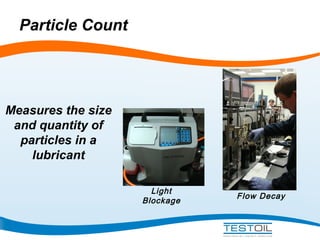
Particle Count

Measures the size
and quantity of
particles in a
lubricant
Light
Blockage

Flow Decay
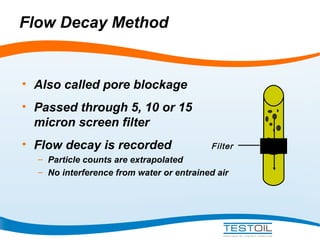
Flow Decay Method

• Also called pore blockage
• Passed through 5, 10 or 15
micron screen filter
• Flow decay is recorded

Filter

– Particle counts are extrapolated
– No interference from water or entrained air
Particle Count

• Particle Counts are broken down into
6 size ranges
> 4 microns
> 6 microns
> 14 microns

> 25 microns
> 50 microns
>100 microns

• Reported as particles per milliliter
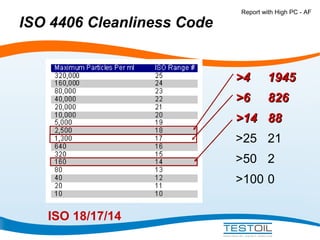
ISO 4406 Cleanliness Code

Report with High PC - AF

>4

1945

>6

826

>14 88
>25 21
>50 2
>100 0
ISO 18/17/14
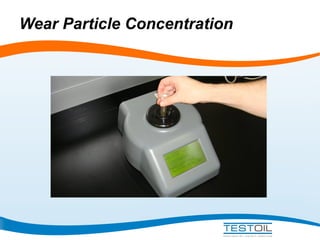
Wear Particle Concentration

• 10ml of sample is placed in a syringe
• Syringe is placed in the analyzer
• Analyzer measures changes in magnetic
flux to measure ferrous content
• No particle size limit
Wear Particle Concentration
Report high WPC

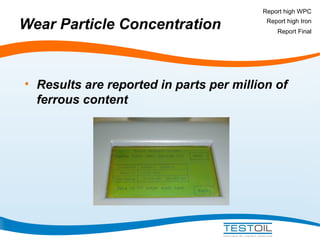
Wear Particle Concentration

Report high Iron
Report Final

• Results are reported in parts per million of
ferrous content
Dwon Ruffin MLA 1
Data Analyst
druffin@testoil.com

&

Questions

Answers

Oil Analysis Report Interpretation

  • 1.
  • 2.
    Normal with PC OilAnalysis Normal with WP Lubricant Condition Contaminants Machine Wear
  • 3.
    Viscosity Measure of alubricants resistance to flow at a specific temperature. • Measured by Viscometer – ASTM D-445 – Reported as Kinematic Viscosity in Centistokes (cSt) • • Industrial oils measured at 40ºC Engine oils measured at 100ºC
  • 4.
    Viscosity Limits Report withViscosity Issue • Marginal Limits – Viscosity should be within 10% (+ or -) of specified grade to be in spec – Example: • ISO VG 100 oil should be between 90 and 110 cSt @ 40º • Critical Limits – When the viscosity falls greater than 20% (+ or -) of the specified grade, action should be taken. – Example: • ISO VG 100 <80 or >120 cSt @ 40º
  • 5.
    Elemental Spectroscopy Measures the concentrationof wear metals, contaminants, and additives in a lubricant.
  • 6.
    Spectroscopy • 20 elementsmeasured – Wear metals – Contaminants – Additives • • • • Reported in parts per million (ppm) Measures metals in solution Solid debris below 7 microns in size Blind to larger particles
  • 7.
    Wear Metal Sources •Iron (Fe) – Shafts, Gears, Housings, Piston Rings, Cylinder Walls • Copper (Cu) – Brass/Bronze alloys, Bearings, Bushings, Thrust Washers • Lead (Pb) – Bearings, Anti-Wear Gear Additive (Rare) – Tin (Sn) – Bearing Alloys, Bearing Cages, Solder
  • 8.
    Wear Metal Sources •Aluminum (Al) – Pumps, Trust Washers, Pistons • Chromium (Cr) – Roller Bearings, Piston Rings, Cylinder Walls • Nickel (Ni) – Pumps, Gear Platings, Valves • Silver (Ag) – Some Bearings
  • 9.
    Wear Metal Limits •Limits should be based on trends – Sudden increases indicate problems • Operational conditions can effect wear metal levels – Oil changes, break-in periods, loading • OEM Recommendations Report with Wear
  • 10.
    Contaminants • Silicon (Si) –Airborne Dust & Dirt, Defoamant Additive • Boron (B) – Anti Corrosion in Coolants • Potassium – Coolant Additive • Sodium – Detergent Additive, Coolant Additive Report with Contaminants
  • 11.
    Report with AdditiveIssues Additives • Magnesium (Mg) – Detergent Additive • Barium (Ba) – Rust & Corrosion Inhibitor • Calcium (Ca) – Detergent/Dispersant Additive • Zinc (Zn) – Anti-wear Additive • Phosphorus (P) – Anti-Wear Additive, EP Gear Additive • Molybdenum (Mo) – Extreme Pressure Additive
  • 12.
    Karl Fischer Water Quantifiesthe amount of water in the lubricant. • • • • Karl Fischer Titrator ASTM D-6304 Reported in % or ppm Dissolved, emulsified or free water
  • 13.
    Sources of Water •Condensation • External contamination – Breathers – Seals – Reservoir covers • Internal leaks – Heat exchangers – Water jackets Report with Water Report with Water – V40
  • 14.
    FT-IR Spectroscopy Measures the chemical compositionof a lubricant Fourier Transform Infrared Spectrometer
  • 15.
    FT-IR Spectroscopy Report withOxidation • Oil Degradation by chemical change – Oxidation – Nitration • Contamination – Soot – Glycol
  • 16.
    FT-IR Spectroscopy • AdditiveDepletion – When additives deplete, they are typically still present – Atomic Spectroscopy will indicate their presence, yet they can be chemically inert – Decreased signal strength in the IR Spectrum will reveal excess additive depletion
  • 17.
    Acid Number • Measurementof acidic constituents in the oil • Reported as AN • ASTM D-974 • Indicator of oil serviceability – Oil oxidation & degradation produces acidic by-products
  • 18.
    Report with ANissues Acid Number New Oil Example • AN is lowest when an oil is new*, and increases with use • AN of a used oil is typically compared to the original AN • Oils with higher levels of additives will generally have a higher AN • Typical AN Values on new oils: o R&O Oil - 0.03 o AW Oil - 0.4 o EP Oil - 0.6 o Engine Oil - 1.6
  • 19.
    Particle Count Measures thesize and quantity of particles in a lubricant Light Blockage Flow Decay
  • 20.
    Flow Decay Method •Also called pore blockage • Passed through 5, 10 or 15 micron screen filter • Flow decay is recorded Filter – Particle counts are extrapolated – No interference from water or entrained air
  • 21.
    Particle Count • ParticleCounts are broken down into 6 size ranges > 4 microns > 6 microns > 14 microns > 25 microns > 50 microns >100 microns • Reported as particles per milliliter
  • 22.
    ISO 4406 CleanlinessCode Report with High PC - AF >4 1945 >6 826 >14 88 >25 21 >50 2 >100 0 ISO 18/17/14
  • 23.
    Wear Particle Concentration •10ml of sample is placed in a syringe • Syringe is placed in the analyzer • Analyzer measures changes in magnetic flux to measure ferrous content • No particle size limit
  • 24.
  • 25.
    Report high WPC WearParticle Concentration Report high Iron Report Final • Results are reported in parts per million of ferrous content
  • 26.
    Dwon Ruffin MLA1 Data Analyst druffin@testoil.com & Questions Answers