Greases
Product Knowledge
Presented by : RAJIV RANJAN
What is a grease ?
 A solid to semi-fluid product
consisting of a fluid lubricant and a
thickener
 It usually contains additives to
enhance performance
 Typical grease contents
 oil 80-87%
 thickener 8-15%
 additives 5%
Oil
Thickener
Additives
Presented by : RAJIV RANJAN
Lubricating greases vs. Oils
Oils
 Fluid
 Run away
 remove heat (cool)
 remove debris (clean)
 remove particles
(clean)
 Classification
 Viscosity (SAE)
Greases
 Semi-fluid / semi-solid
 Stay in place
 Seal
 no cooling / no
cleaning
 Classification
 Consistency (NLGI)
Presented by : RAJIV RANJAN
When to lubricate with grease ?
• To decrease dripping and splattering of lubricant
• To decrease frequency of lubrication
• To seal out contaminants
• For intermittent operation
• To suspend solid additives
• Under extreme operating conditions
• high temperature
• high pressure
• shock loading
• slow speed / high pressure
• Machine badly worn
• When noise reduction is very important
Presented by : RAJIV RANJAN
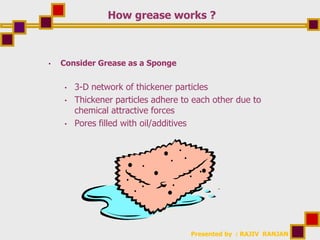
How grease works ?
• Consider Grease as a Sponge
• 3-D network of thickener particles
• Thickener particles adhere to each other due to
chemical attractive forces
• Pores filled with oil/additives
Presented by : RAJIV RANJAN
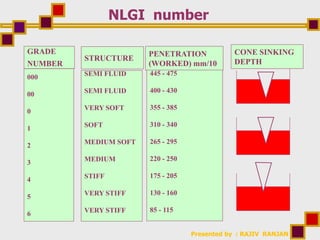
GRADE
NUMBER
STRUCTURE
PENETRATION
(WORKED) mm/10
CONE SINKING
DEPTH
SEMI FLUID
SEMI FLUID
VERY SOFT
SOFT
MEDIUM SOFT
MEDIUM
STIFF
VERY STIFF
VERY STIFF
445 - 475
400 - 430
355 - 385
310 - 340
265 - 295
220 - 250
175 - 205
130 - 160
85 - 115
000
00
0
1
2
3
4
5
6
NLGI number
Presented by : RAJIV RANJAN
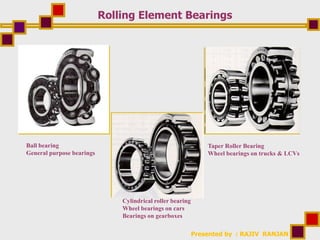
Rolling Element Bearings
Ball bearing
General purpose bearings
Cylindrical roller bearing
Wheel bearings on cars
Bearings on gearboxes
Taper Roller Bearing
Wheel bearings on trucks & LCVs
Presented by : RAJIV RANJAN
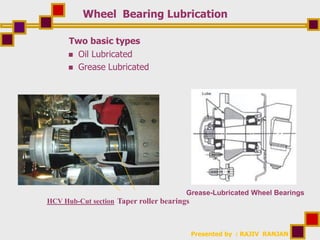
Wheel Bearing Lubrication
Two basic types
 Oil Lubricated
 Grease Lubricated
Grease-Lubricated Wheel Bearings
HCV Hub-Cut section Taper roller bearings
Presented by : RAJIV RANJAN
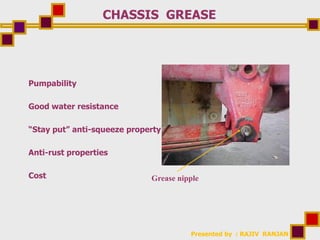
CHASSIS GREASE
Pumpability
Good water resistance
“Stay put” anti-squeeze property
Anti-rust properties
Cost Grease nipple
Presented by : RAJIV RANJAN
Grease formulation
Grease = Base oils + Thickeners +
Additives
The thickeners most used in grease
production:
 Metal soaps (Li, Ca, Na)
 Metal complex soaps (Li, Ca, Al)
 Inorganic thickeners (bentonites,
silicates)
 Others (polymers, polyurea)
Presented by : RAJIV RANJAN
Additives in greases
 Antiwear
 EP additives
 Antioxidants
 Tackiness agents
 Corrosion inhibitors
Compatibility with thickener systems is
of prime importance
Presented by : RAJIV RANJAN
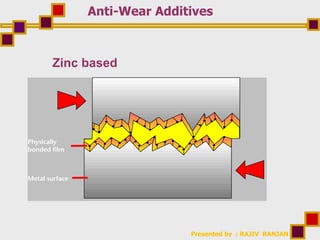
Anti-Wear Additives
Zinc based
Presented by : RAJIV RANJAN
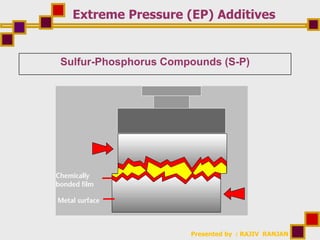
Extreme Pressure (EP) Additives
Sulfur-Phosphorus Compounds (S-P)
Presented by : RAJIV RANJAN
Other Additives
 Anti oxidants
 Reduce ill effects of oxidation
 Tackifiers
 Improve adherence
 Corrosion inhibitors
Presented by : RAJIV RANJAN
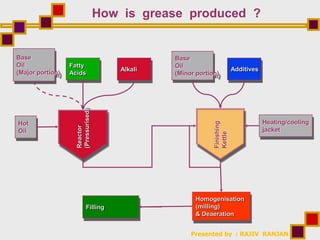
How is grease produced ?
Reactor
(Pressurised)
Homogenisation
(milling)
& Deaeration
Base
Oil
(Major portion)
Fatty
Acids
Alkali
Finishing
Kettle
Base
Oil
(Minor portion)
Additives
Heating/cooling
jacket
Filling
Hot
Oil
Presented by : RAJIV RANJAN
Performance testing
 Penetration
 Mechanical stability
 Oil separation
 Drop point
 Water resistance
 Extreme pressure
performance
Four Ball weld load test
Presented by : RAJIV RANJAN
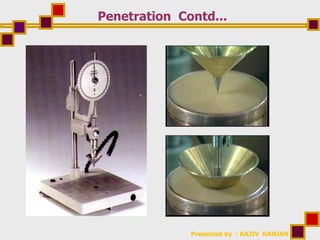
PENETRATION
Penetration is the depth, in tenths of millimeters,
to which a standard cone sinks into the grease under
prescribed conditions.
Presented by : RAJIV RANJAN
Penetration Contd...
Presented by : RAJIV RANJAN
Worked Penetration
 Worked to X strokes
 X – 10,000
Presented by : RAJIV RANJAN
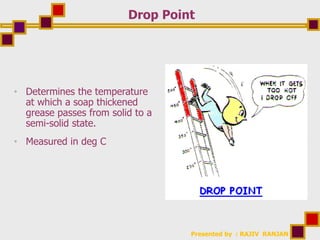
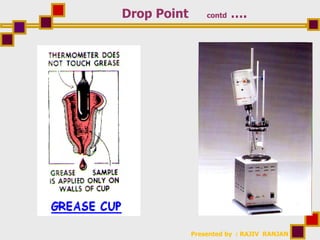
Drop Point
• Determines the temperature
at which a soap thickened
grease passes from solid to a
semi-solid state.
• Measured in deg C
Presented by : RAJIV RANJAN
Drop Point contd ….
Presented by : RAJIV RANJAN
 SIGNIFICANCE
 Directional change in
consistency while in service
 Measure of shear stability
 50 gm grease in a tube with 5
Kg weight and rotated
 2 hrs, 20-35 deg C
 Low shear
 MEASURED AS
 Change in cone penetration
value (in %)before & after
test
Roll stability
Presented by : RAJIV RANJAN
Heat stability -Oil Separation (Conical Sieve) Method)
 SIGNIFICANCE
 Co-relates with oil
separation in storage
 100 deg C, 30 hrs
 MEASURED AS
 Loss of oil mass
Presented by : RAJIV RANJAN
Copper Corrosion ASTM
 Temperature 100°C
 Duration 24 h
 Copper strip in a tube with grease ,compare with the
standard
Presented by : RAJIV RANJAN
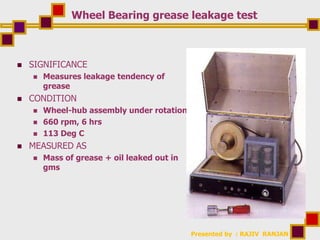
Wheel Bearing grease leakage test
 SIGNIFICANCE
 Measures leakage tendency of
grease
 CONDITION
 Wheel-hub assembly under rotation
 660 rpm, 6 hrs
 113 Deg C
 MEASURED AS
 Mass of grease + oil leaked out in
gms
Presented by : RAJIV RANJAN
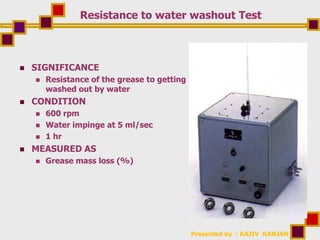
Resistance to water washout Test
 SIGNIFICANCE
 Resistance of the grease to getting
washed out by water
 CONDITION
 600 rpm
 Water impinge at 5 ml/sec
 1 hr
 MEASURED AS
 Grease mass loss (%)
Presented by : RAJIV RANJAN
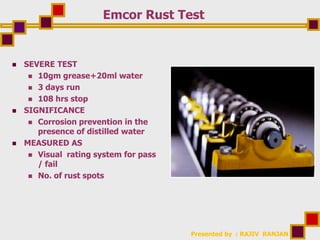
Emcor Rust Test
 SEVERE TEST
 10gm grease+20ml water
 3 days run
 108 hrs stop
 SIGNIFICANCE
 Corrosion prevention in the
presence of distilled water
 MEASURED AS
 Visual rating system for pass
/ fail
 No. of rust spots
Presented by : RAJIV RANJAN
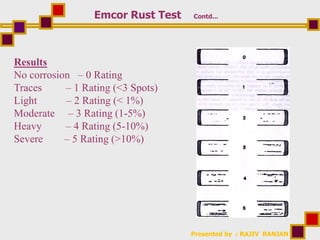
Results
No corrosion – 0 Rating
Traces – 1 Rating (<3 Spots)
Light – 2 Rating (< 1%)
Moderate – 3 Rating (1-5%)
Heavy – 4 Rating (5-10%)
Severe – 5 Rating (>10%)
Emcor Rust Test Contd...
Presented by : RAJIV RANJAN
Extreme Pressure & Anti-wear Properties
 4 ball weld load test
 Wear Scar Dia
Presented by : RAJIV RANJAN
Key selling points -
• Superior shock load protection and Better anti-wear
performance
• Superior corrosion protection
• Better lubricity
• Excellent resistance to water washout
• Superior control on oil bleeding under operation
• Superior heat stability
• Extremely high structural strength
• Lower leakage tendency under storage
• Longer life
Presented by : RAJIV RANJAN
STORAGE AND HANDLING
Storage of barrels-Inside storage ideal
Grease surface in barrels to be convex
Contamination
Water
Solids
Other Lubricants
Dust – the largest enemy of grease
Presented by : RAJIV RANJAN
Market Practices
• Poor quality hub grease
• Frequent breakdown
• Bearing failure
• Frequent re greasing
• Used grease/’Batata Grease’ for chassis
greasing
Thank You !
RAJIV RANJAN
rajivranjan926@gmail.com

Grease product knowledge

  • 1.
  • 2.
    Presented by :RAJIV RANJAN What is a grease ?  A solid to semi-fluid product consisting of a fluid lubricant and a thickener  It usually contains additives to enhance performance  Typical grease contents  oil 80-87%  thickener 8-15%  additives 5% Oil Thickener Additives
  • 3.
    Presented by :RAJIV RANJAN Lubricating greases vs. Oils Oils  Fluid  Run away  remove heat (cool)  remove debris (clean)  remove particles (clean)  Classification  Viscosity (SAE) Greases  Semi-fluid / semi-solid  Stay in place  Seal  no cooling / no cleaning  Classification  Consistency (NLGI)
  • 4.
    Presented by :RAJIV RANJAN When to lubricate with grease ? • To decrease dripping and splattering of lubricant • To decrease frequency of lubrication • To seal out contaminants • For intermittent operation • To suspend solid additives • Under extreme operating conditions • high temperature • high pressure • shock loading • slow speed / high pressure • Machine badly worn • When noise reduction is very important
  • 5.
    Presented by :RAJIV RANJAN How grease works ? • Consider Grease as a Sponge • 3-D network of thickener particles • Thickener particles adhere to each other due to chemical attractive forces • Pores filled with oil/additives
  • 6.
    Presented by :RAJIV RANJAN GRADE NUMBER STRUCTURE PENETRATION (WORKED) mm/10 CONE SINKING DEPTH SEMI FLUID SEMI FLUID VERY SOFT SOFT MEDIUM SOFT MEDIUM STIFF VERY STIFF VERY STIFF 445 - 475 400 - 430 355 - 385 310 - 340 265 - 295 220 - 250 175 - 205 130 - 160 85 - 115 000 00 0 1 2 3 4 5 6 NLGI number
  • 7.
    Presented by :RAJIV RANJAN Rolling Element Bearings Ball bearing General purpose bearings Cylindrical roller bearing Wheel bearings on cars Bearings on gearboxes Taper Roller Bearing Wheel bearings on trucks & LCVs
  • 8.
    Presented by :RAJIV RANJAN Wheel Bearing Lubrication Two basic types  Oil Lubricated  Grease Lubricated Grease-Lubricated Wheel Bearings HCV Hub-Cut section Taper roller bearings
  • 9.
    Presented by :RAJIV RANJAN CHASSIS GREASE Pumpability Good water resistance “Stay put” anti-squeeze property Anti-rust properties Cost Grease nipple
  • 10.
    Presented by :RAJIV RANJAN Grease formulation Grease = Base oils + Thickeners + Additives The thickeners most used in grease production:  Metal soaps (Li, Ca, Na)  Metal complex soaps (Li, Ca, Al)  Inorganic thickeners (bentonites, silicates)  Others (polymers, polyurea)
  • 11.
    Presented by :RAJIV RANJAN Additives in greases  Antiwear  EP additives  Antioxidants  Tackiness agents  Corrosion inhibitors Compatibility with thickener systems is of prime importance
  • 12.
    Presented by :RAJIV RANJAN Anti-Wear Additives Zinc based
  • 13.
    Presented by :RAJIV RANJAN Extreme Pressure (EP) Additives Sulfur-Phosphorus Compounds (S-P)
  • 14.
    Presented by :RAJIV RANJAN Other Additives  Anti oxidants  Reduce ill effects of oxidation  Tackifiers  Improve adherence  Corrosion inhibitors
  • 15.
    Presented by :RAJIV RANJAN How is grease produced ? Reactor (Pressurised) Homogenisation (milling) & Deaeration Base Oil (Major portion) Fatty Acids Alkali Finishing Kettle Base Oil (Minor portion) Additives Heating/cooling jacket Filling Hot Oil
  • 16.
    Presented by :RAJIV RANJAN Performance testing  Penetration  Mechanical stability  Oil separation  Drop point  Water resistance  Extreme pressure performance Four Ball weld load test
  • 17.
    Presented by :RAJIV RANJAN PENETRATION Penetration is the depth, in tenths of millimeters, to which a standard cone sinks into the grease under prescribed conditions.
  • 18.
    Presented by :RAJIV RANJAN Penetration Contd...
  • 19.
    Presented by :RAJIV RANJAN Worked Penetration  Worked to X strokes  X – 10,000
  • 20.
    Presented by :RAJIV RANJAN Drop Point • Determines the temperature at which a soap thickened grease passes from solid to a semi-solid state. • Measured in deg C
  • 21.
    Presented by :RAJIV RANJAN Drop Point contd ….
  • 22.
    Presented by :RAJIV RANJAN  SIGNIFICANCE  Directional change in consistency while in service  Measure of shear stability  50 gm grease in a tube with 5 Kg weight and rotated  2 hrs, 20-35 deg C  Low shear  MEASURED AS  Change in cone penetration value (in %)before & after test Roll stability
  • 23.
    Presented by :RAJIV RANJAN Heat stability -Oil Separation (Conical Sieve) Method)  SIGNIFICANCE  Co-relates with oil separation in storage  100 deg C, 30 hrs  MEASURED AS  Loss of oil mass
  • 24.
    Presented by :RAJIV RANJAN Copper Corrosion ASTM  Temperature 100°C  Duration 24 h  Copper strip in a tube with grease ,compare with the standard
  • 25.
    Presented by :RAJIV RANJAN Wheel Bearing grease leakage test  SIGNIFICANCE  Measures leakage tendency of grease  CONDITION  Wheel-hub assembly under rotation  660 rpm, 6 hrs  113 Deg C  MEASURED AS  Mass of grease + oil leaked out in gms
  • 26.
    Presented by :RAJIV RANJAN Resistance to water washout Test  SIGNIFICANCE  Resistance of the grease to getting washed out by water  CONDITION  600 rpm  Water impinge at 5 ml/sec  1 hr  MEASURED AS  Grease mass loss (%)
  • 27.
    Presented by :RAJIV RANJAN Emcor Rust Test  SEVERE TEST  10gm grease+20ml water  3 days run  108 hrs stop  SIGNIFICANCE  Corrosion prevention in the presence of distilled water  MEASURED AS  Visual rating system for pass / fail  No. of rust spots
  • 28.
    Presented by :RAJIV RANJAN Results No corrosion – 0 Rating Traces – 1 Rating (<3 Spots) Light – 2 Rating (< 1%) Moderate – 3 Rating (1-5%) Heavy – 4 Rating (5-10%) Severe – 5 Rating (>10%) Emcor Rust Test Contd...
  • 29.
    Presented by :RAJIV RANJAN Extreme Pressure & Anti-wear Properties  4 ball weld load test  Wear Scar Dia
  • 30.
    Presented by :RAJIV RANJAN Key selling points - • Superior shock load protection and Better anti-wear performance • Superior corrosion protection • Better lubricity • Excellent resistance to water washout • Superior control on oil bleeding under operation • Superior heat stability • Extremely high structural strength • Lower leakage tendency under storage • Longer life
  • 31.
    Presented by :RAJIV RANJAN STORAGE AND HANDLING Storage of barrels-Inside storage ideal Grease surface in barrels to be convex Contamination Water Solids Other Lubricants Dust – the largest enemy of grease
  • 32.
    Presented by :RAJIV RANJAN Market Practices • Poor quality hub grease • Frequent breakdown • Bearing failure • Frequent re greasing • Used grease/’Batata Grease’ for chassis greasing
  • 33.
    Thank You ! RAJIVRANJAN rajivranjan926@gmail.com