An Introduction of 
3GPP Long Term Evolution (LTE) 
Speaker:Tsung-Yin 
Lee
2 
Reference 
 http://www.tcs.com “LTE-Advanced: Future of Mobile Broadband,” 
TATA Consultancy Services 
 Takehiro Nakamura ,“Proposal for Candidate Radio Interface Technol 
ogies for IMT Advanced Bas d on ‐ LTE Release 10 and Beyond,” 
3GPP TSG‐RAN Chairman 
 “3GPP LTE Channels and MAC Layer,” EventHelix.com Inc. 2009 
 Ahmed Hamza, Network Systems Laboratory Simon Fraser 
University, “Long Term Evolution (LTE) - A Tutorial,” October 13, 
2009 
 Jim Zyren, “Overview of the 3GPP Long Term Evolution Physical 
Layer,” Document Number: 3GPP EVOLUTIONWP Rev0 07/2007 
 David Astély, Erik Dahlman, Anders Furuskär, Ylva Jading, Magnus 
Lindström, and Stefan Parkvall, Ericsson Research, “LTE: The 
Evolution of Mobile Broadband” , IEEE Communications Magazine, 
April 2009
3 
Outline 
 History of 3GPP LTE 
 Basic Concepts of LTE 
 Introduction of LTE Protocol 
 Compare with LTE and LTE-Advanced 
 Conclusion
4 
What is LTE ? 
 In Nov. 2004, 3GPP began a project to 
define the long-term evolution (LTE) of 
Universal Mobile Telecommunications 
System (UMTS) cellular technology 
 Higher performance 
 Backwards compatible 
 Wide application
5 
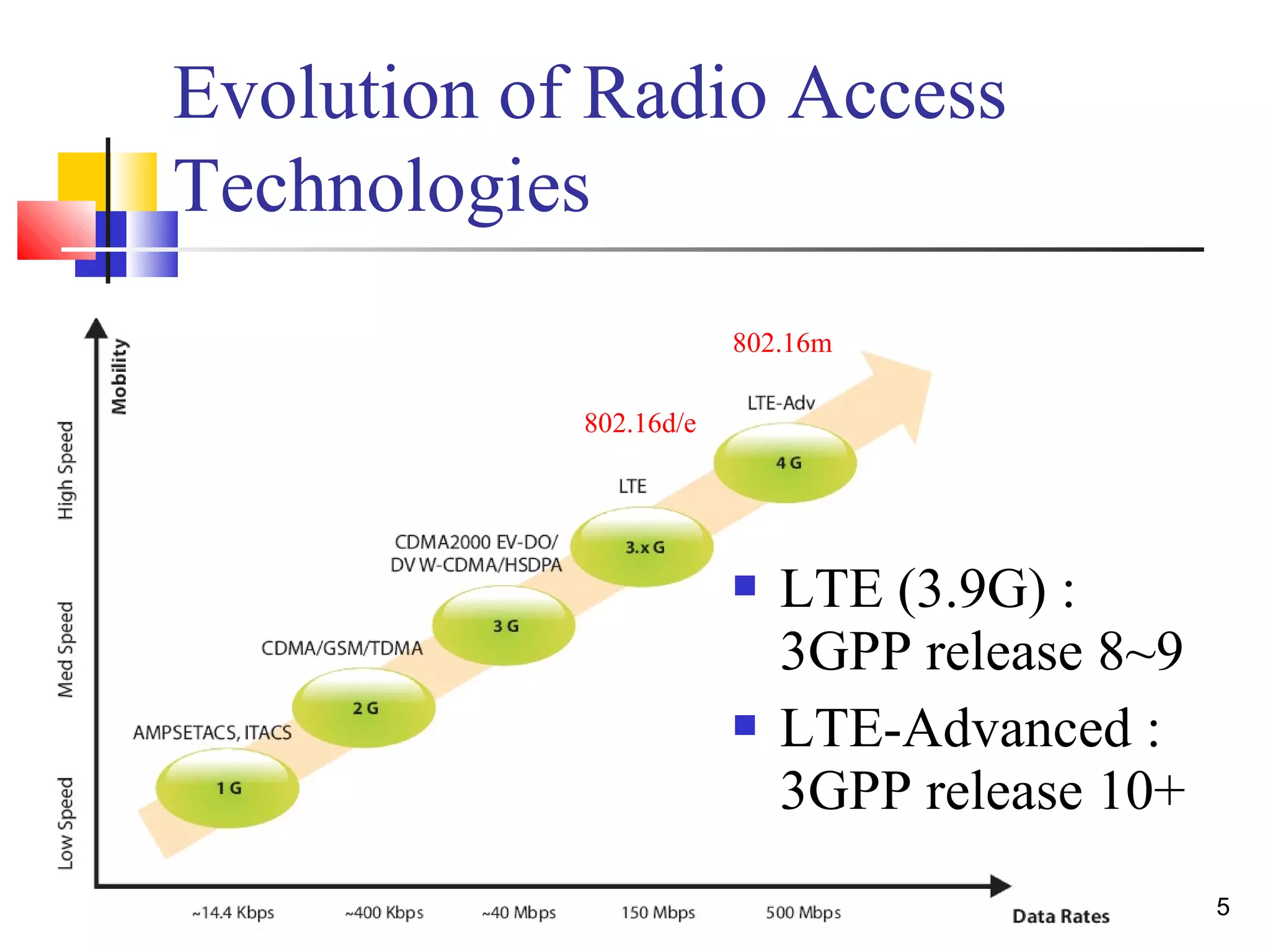
Evolution of Radio Access 
Technologies 
 LTE (3.9G) : 
3GPP release 8~9 
 LTE-Advanced : 
3GPP release 10+ 
802.16d/e 
802.16m
6 
LTE Basic Concepts 
 LTE employs Orthogonal Frequency 
Division Multiple Access (OFDMA) for 
downlink data transmission and Single 
Carrier FDMA (SC-FDMA) for uplink 
transmission
7 
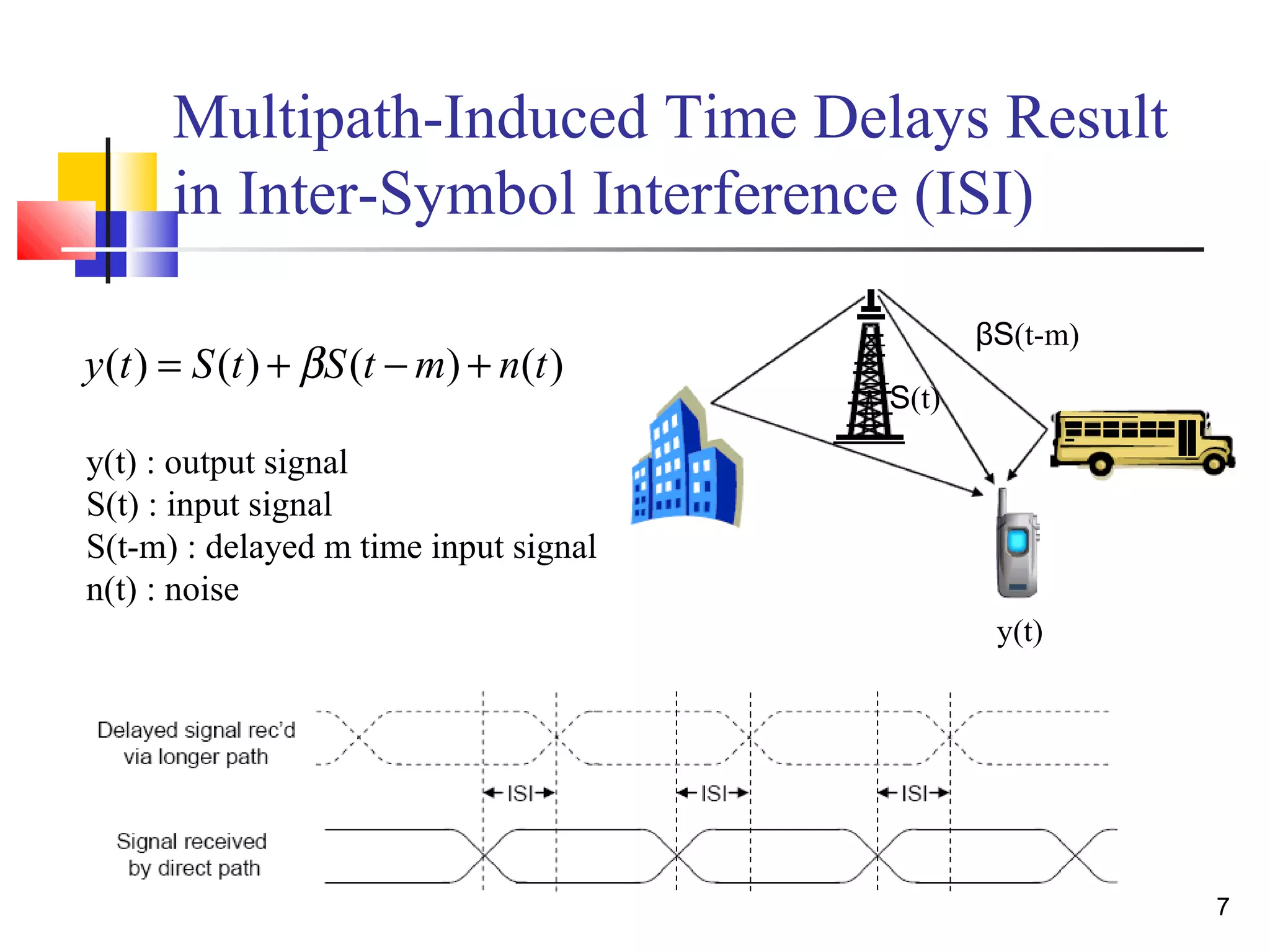
Multipath-Induced Time Delays Result 
in Inter-Symbol Interference (ISI) 
y(t) = S(t) +bS(t -m) + n(t) 
y(t) : output signal 
S(t) : input signal 
S(t-m) : delayed m time input signal 
n(t) : noise 
βS(t-m) 
y(t) 
S(t)
8 
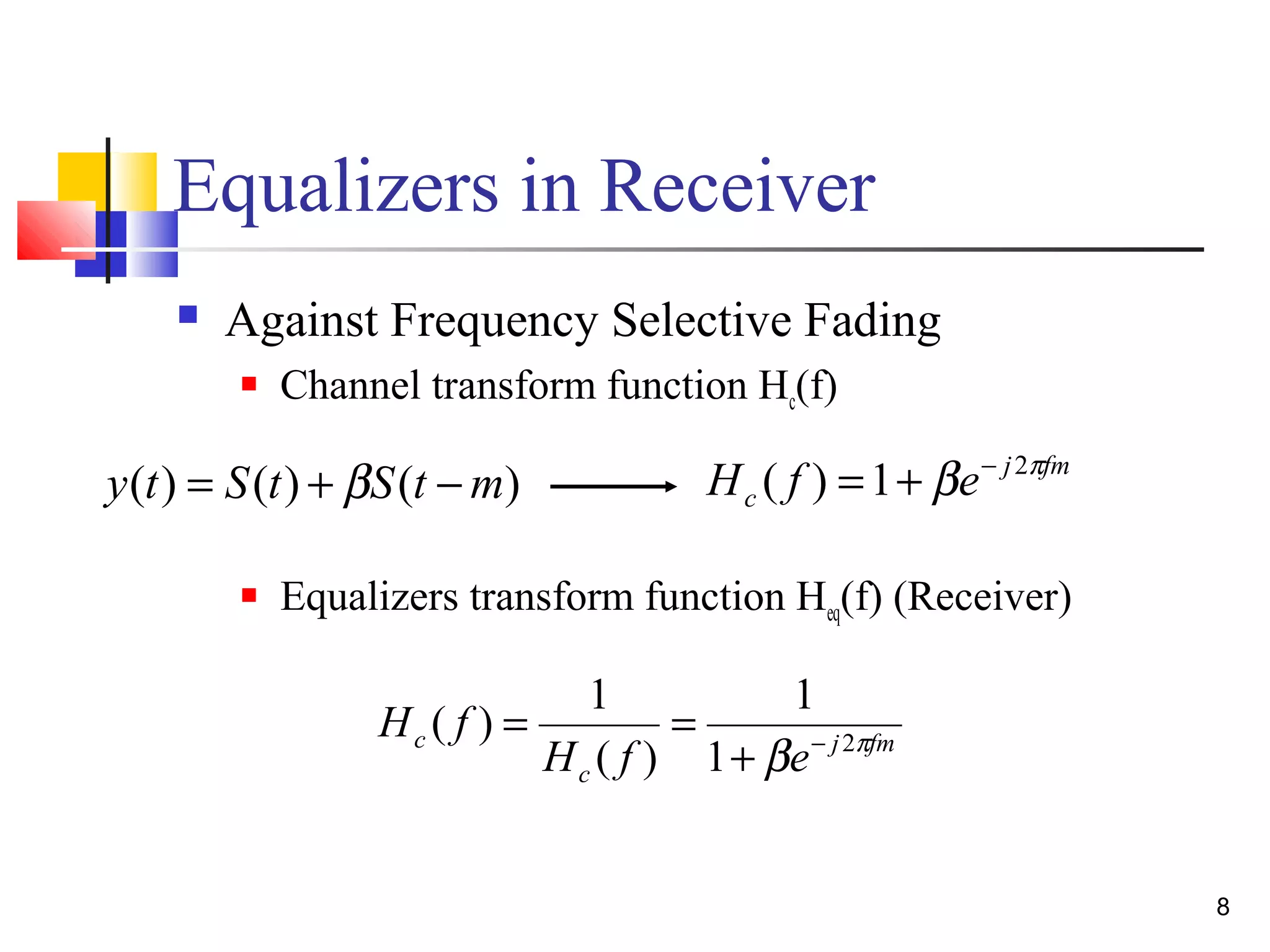
Equalizers in Receiver 
 Against Frequency Selective Fading 
 Channel transform function Hc(f) 
j fm 
c H ( f ) =1+be- 2p 
 Equalizers transform function Heq(f) (Receiver) 
( ) 1 + - 
H f 1 b 2p 
j fm 
= = 
c H f e 
c 
1 
( ) 
y(t) = S(t) +bS(t -m)
9 
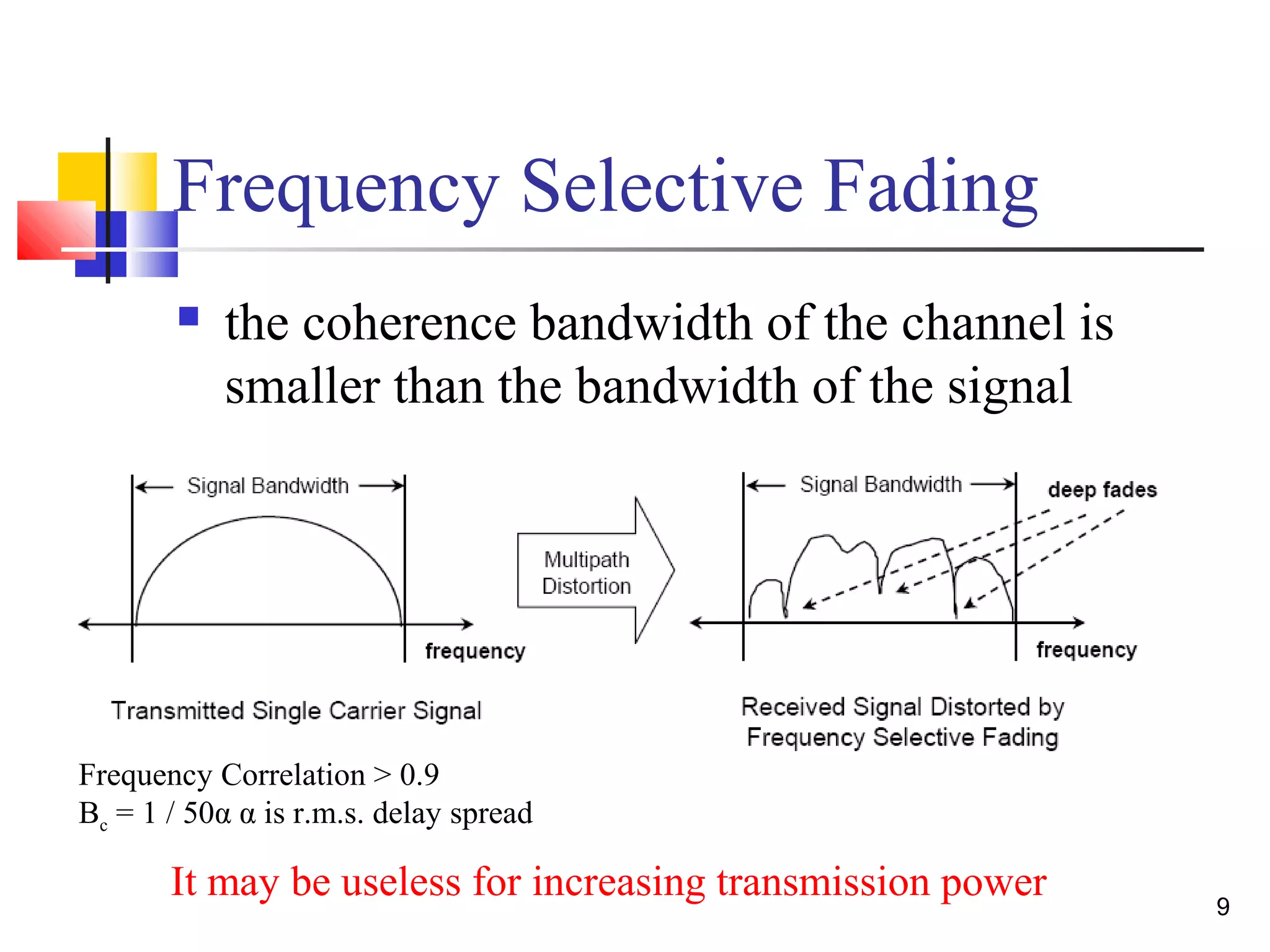
Frequency Selective Fading 
 the coherence bandwidth of the channel is 
smaller than the bandwidth of the signal 
Frequency Correlation > 0.9 
Bc = 1 / 50α α is r.m.s. delay spread 
It may be useless for increasing transmission power
10 
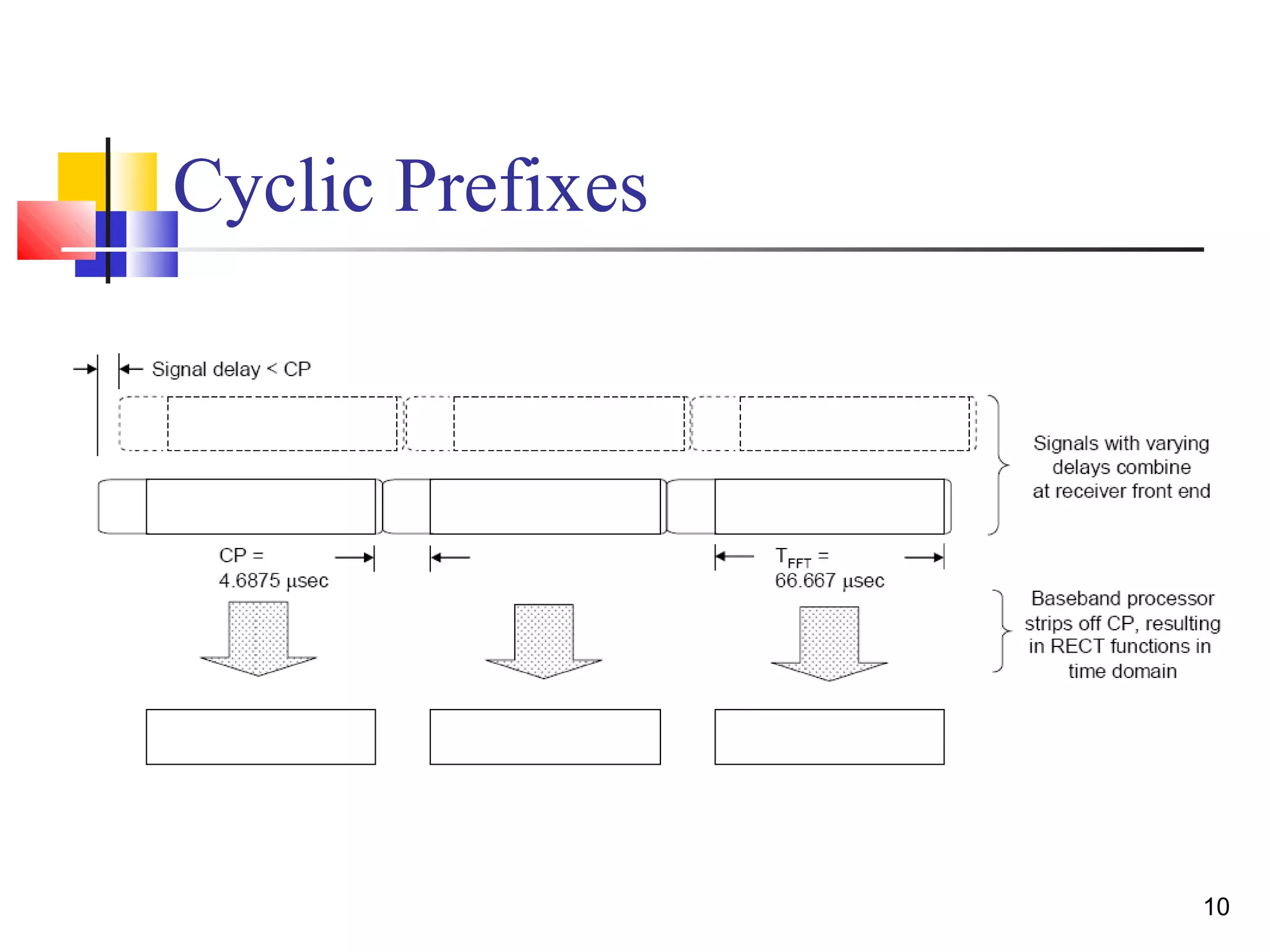
Cyclic Prefixes
11 
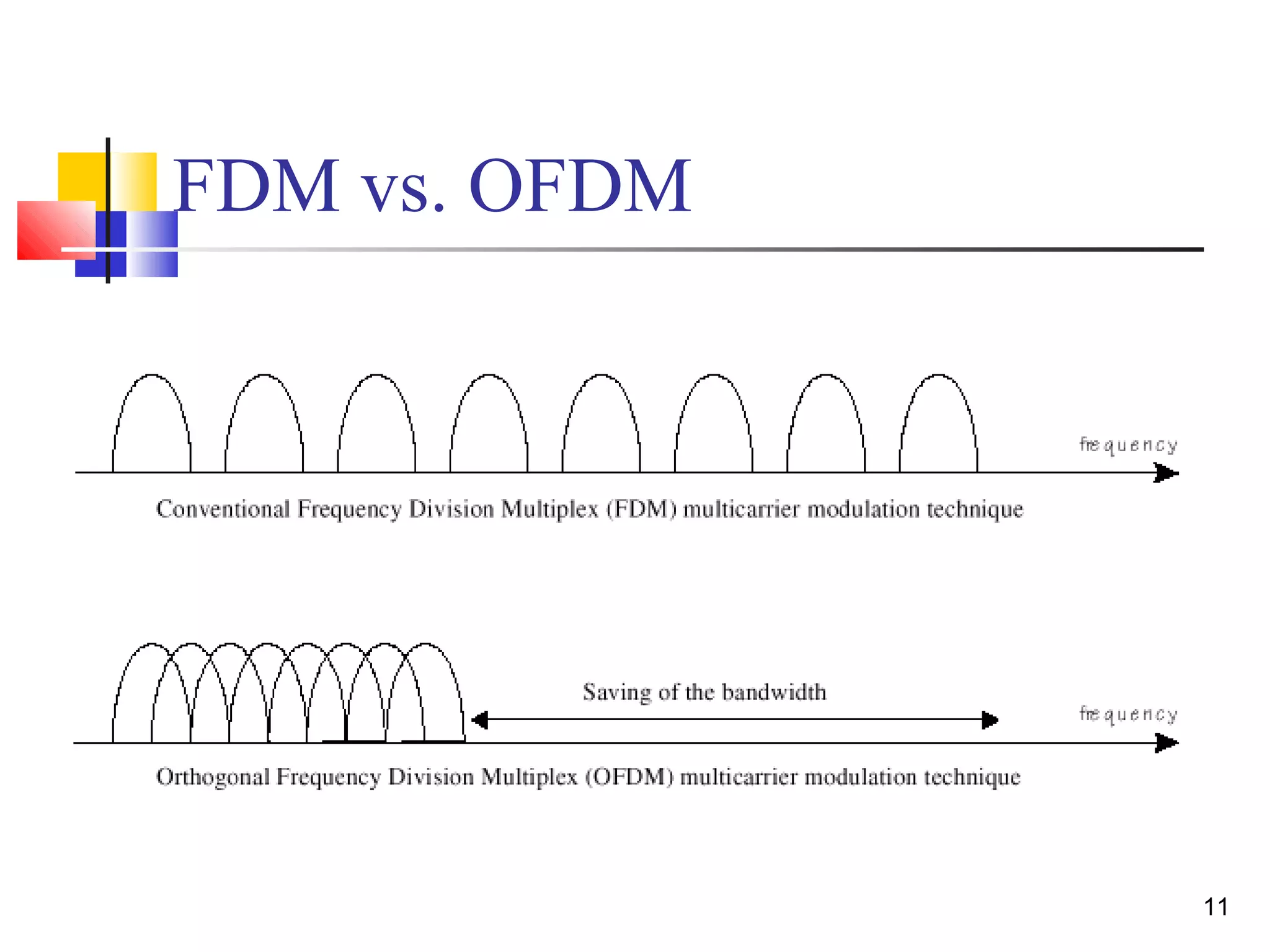
FDM vs. OFDM
12 
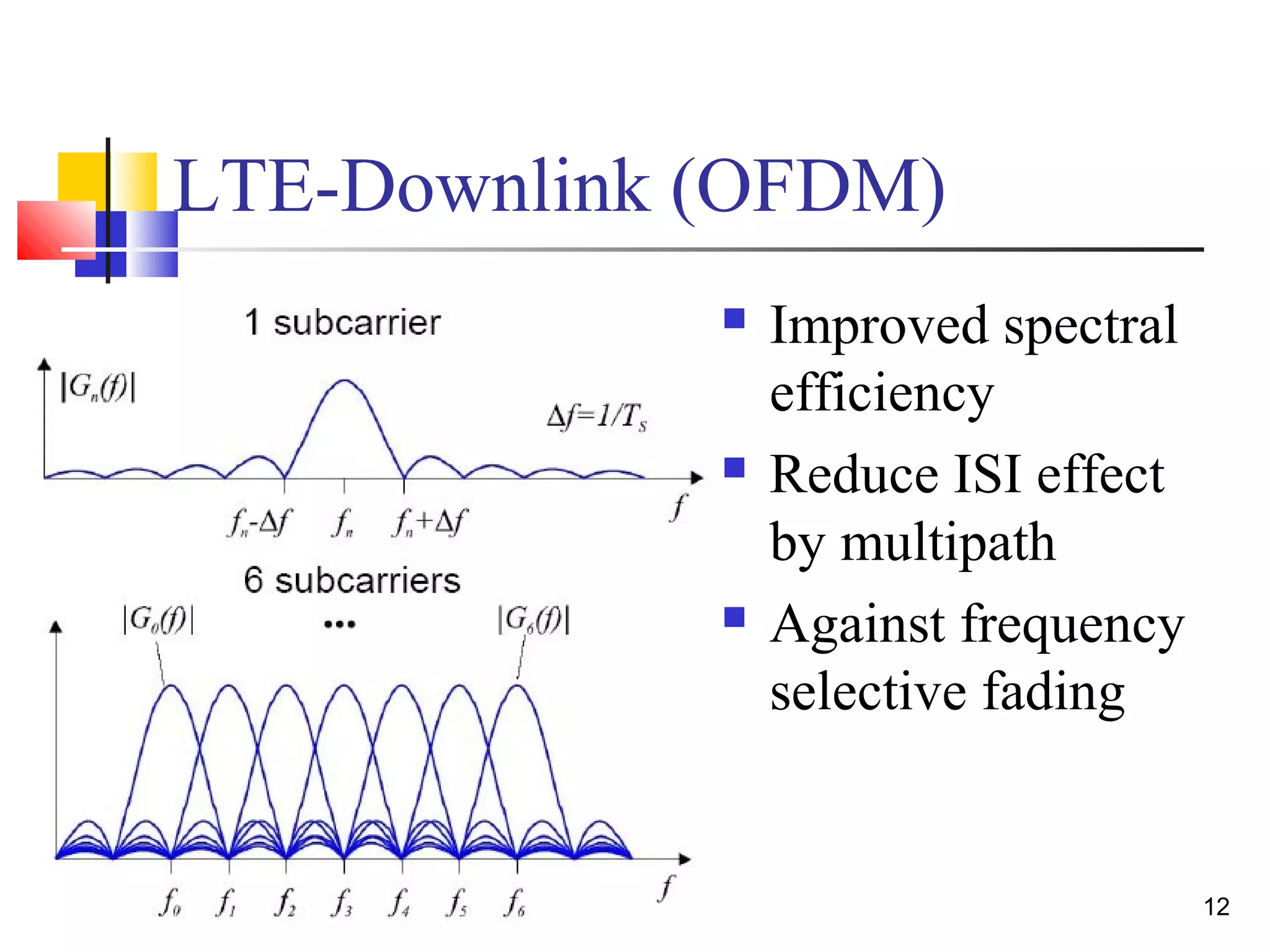
LTE-Downlink (OFDM) 
 Improved spectral 
efficiency 
 Reduce ISI effect 
by multipath 
 Against frequency 
selective fading
13 
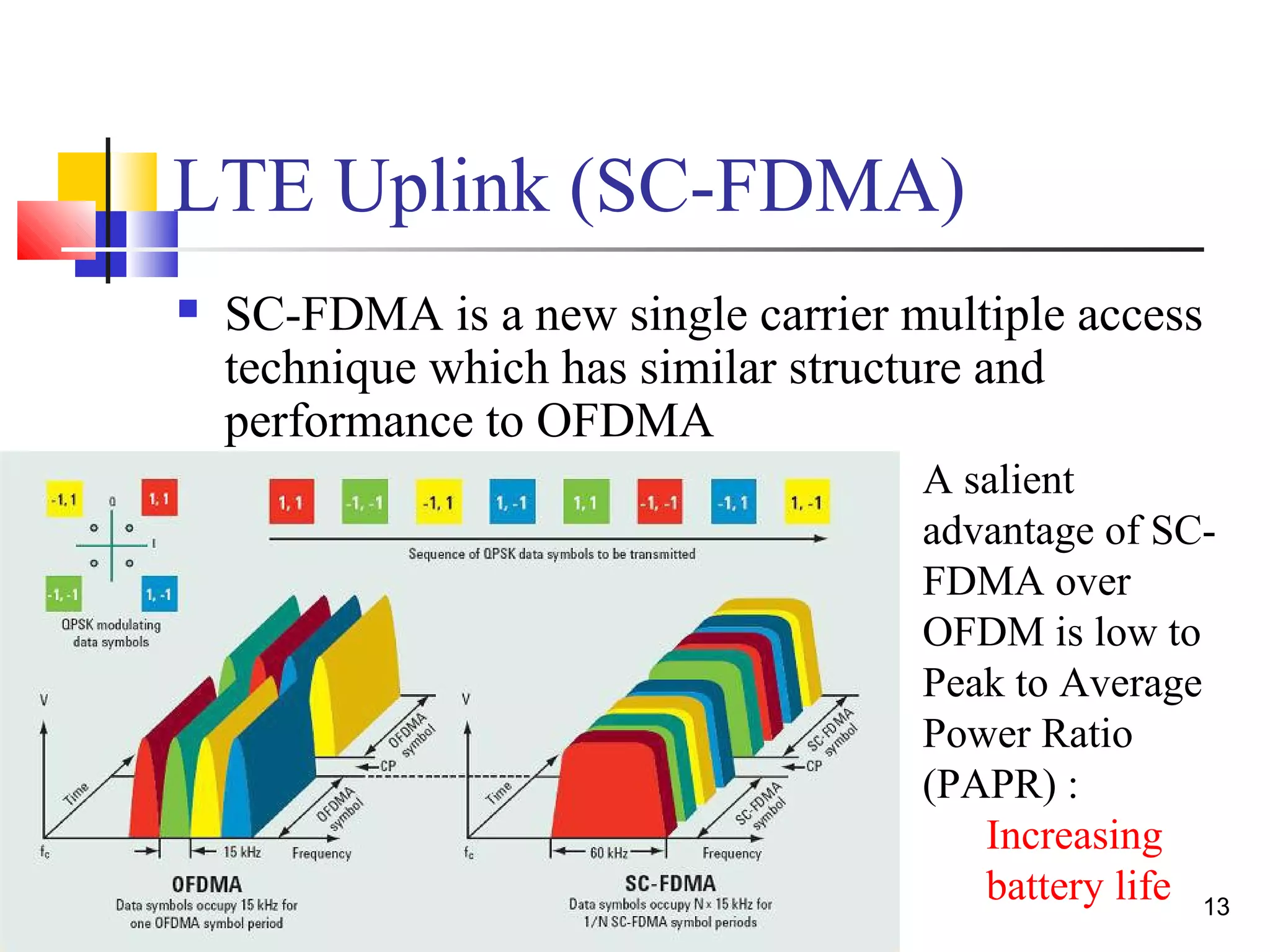
LTE Uplink (SC-FDMA) 
 SC-FDMA is a new single carrier multiple access 
technique which has similar structure and 
performance to OFDMA 
A salient 
advantage of SC-FDMA 
over 
OFDM is low to 
Peak to Average 
Power Ratio 
(PAPR) : 
Increasing 
battery life
14 
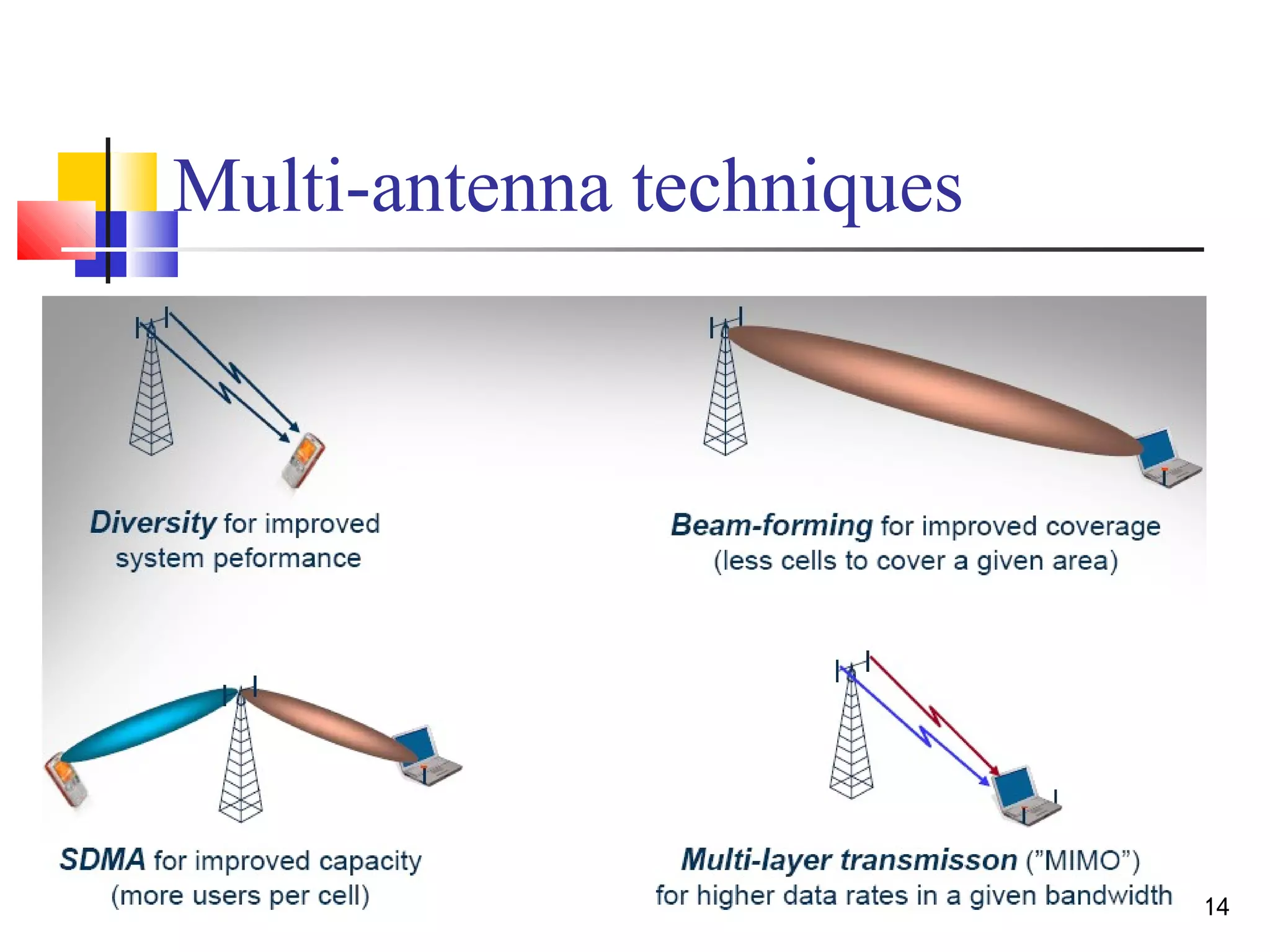
Multi-antenna techniques
15 
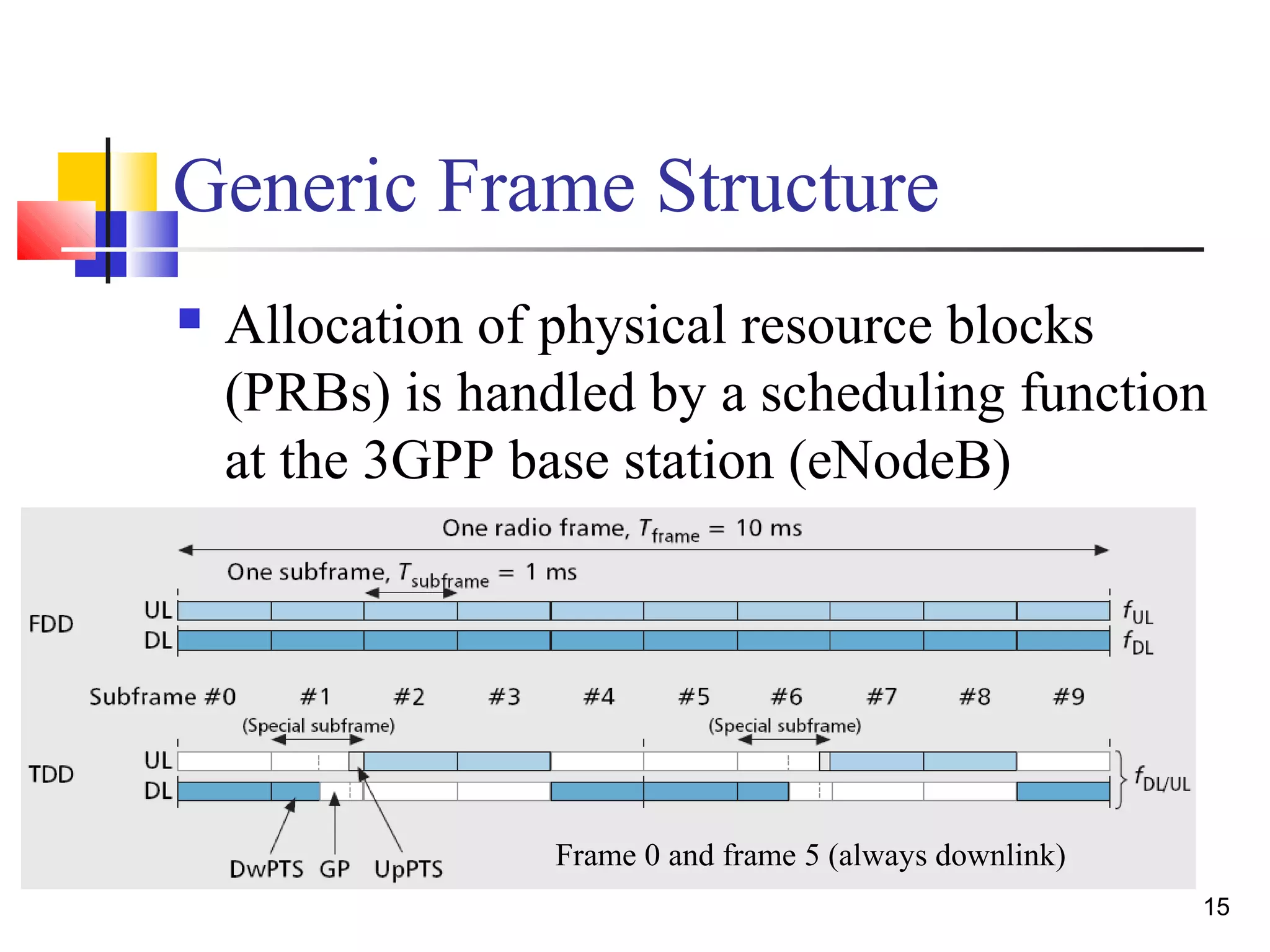
Generic Frame Structure 
 Allocation of physical resource blocks 
(PRBs) is handled by a scheduling function 
at the 3GPP base station (eNodeB) 
Frame 0 and frame 5 (always downlink)
16 
Resource Grid 
 One frame is 10ms 
 10 subframes 
 One subframe is 1ms 
 2 slots 
 One slot is 0.5ms 
 N resource blocks 
[ 6 < N < 110] 
 One resource block is 0.5ms 
and contains 12 subcarriers 
from each OFDM symbol
17 
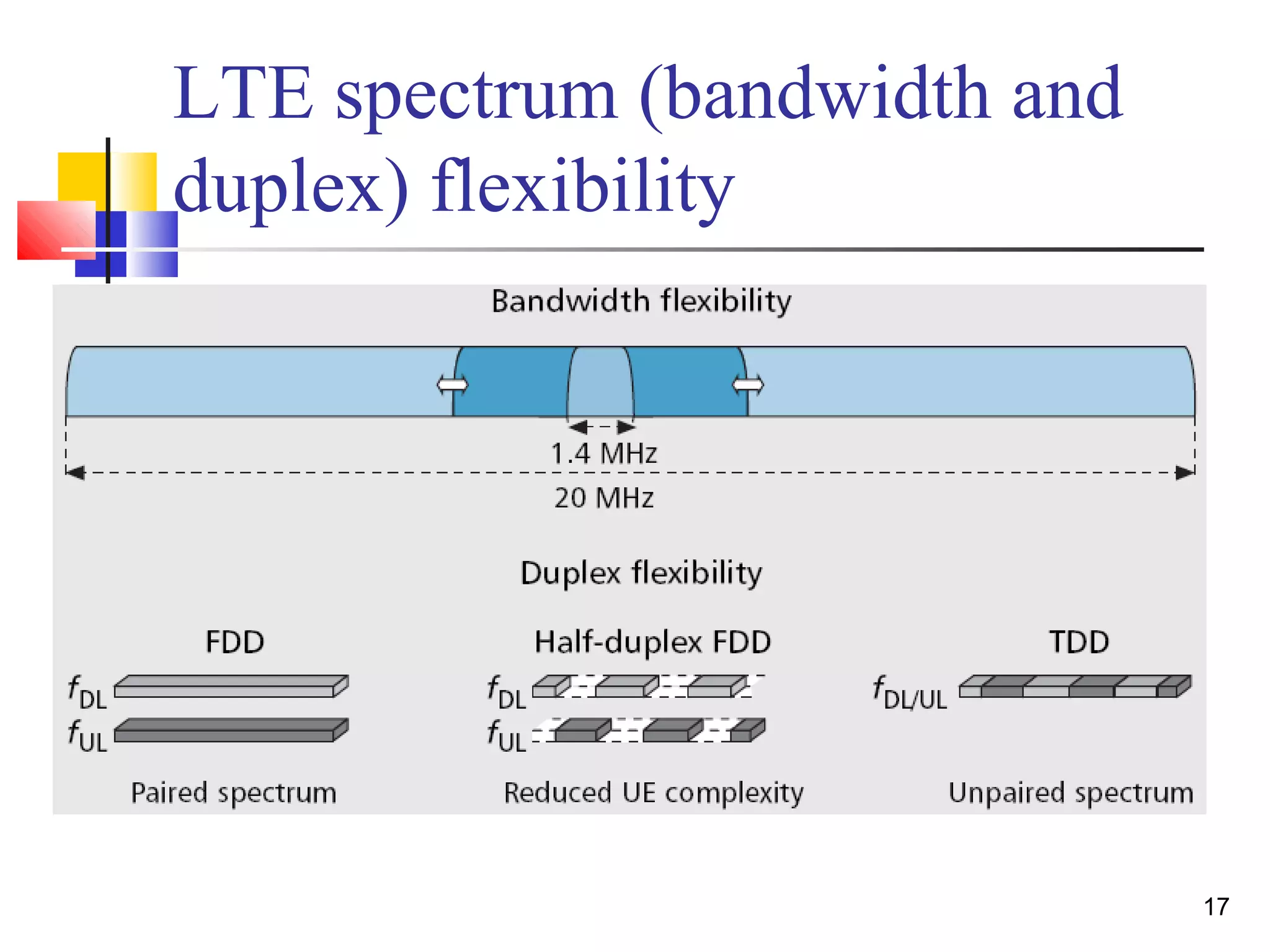
LTE spectrum (bandwidth and 
duplex) flexibility
18 
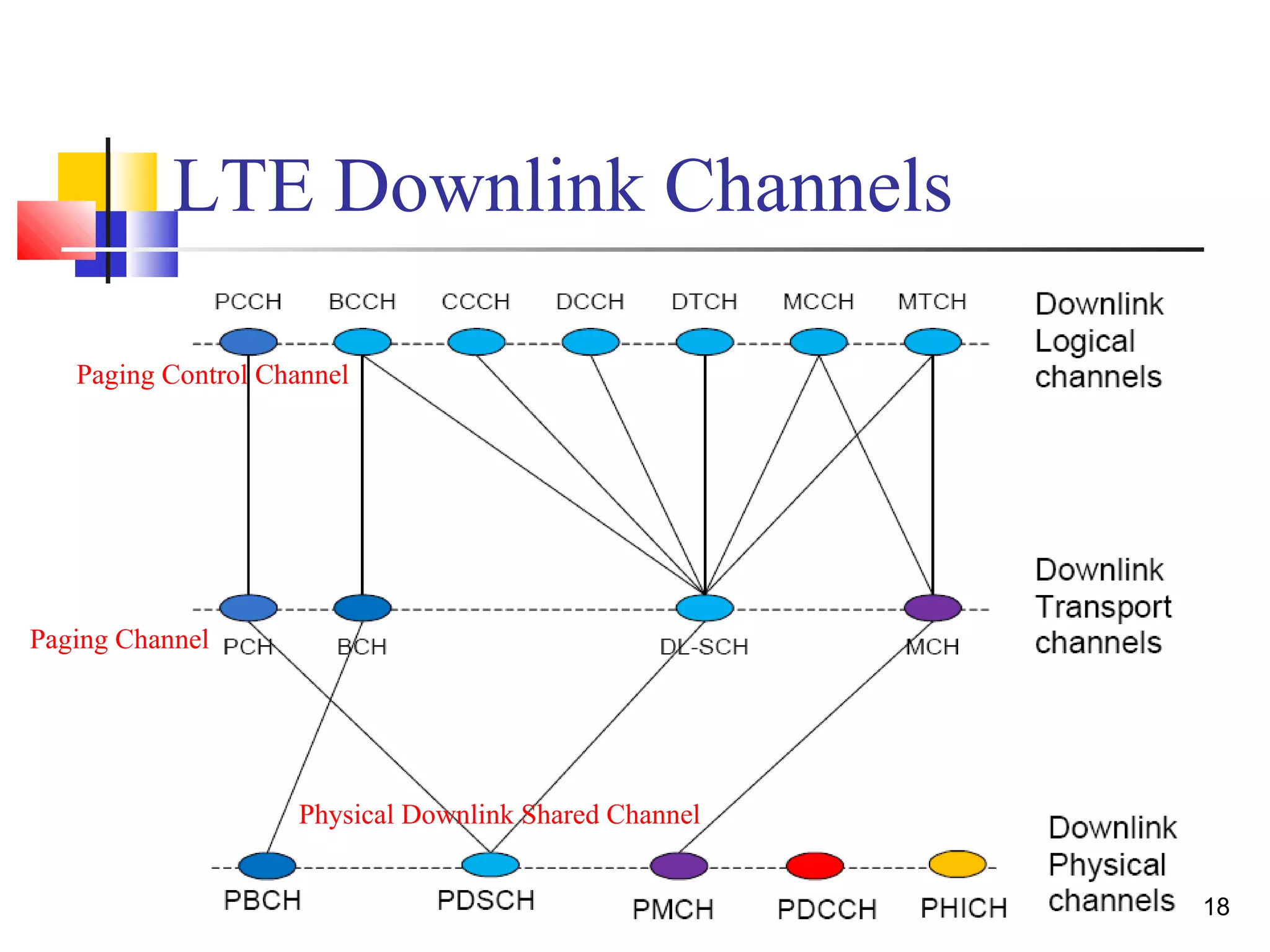
LTE Downlink Channels 
Paging Control Channel 
Paging Channel 
Physical Downlink Shared Channel
19 
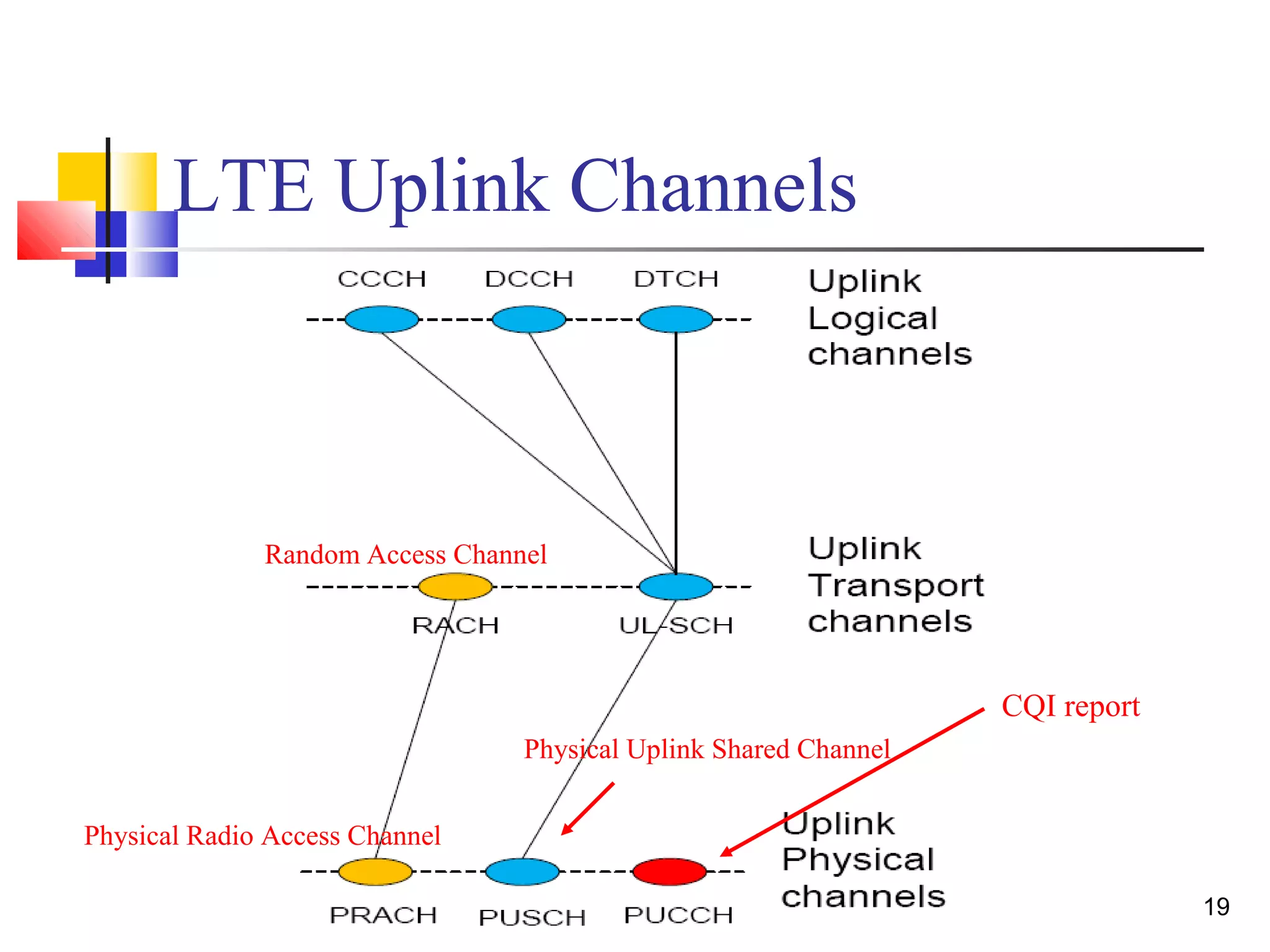
LTE Uplink Channels 
Random Access Channel 
Physical Radio Access Channel 
Physical Uplink Shared Channel 
CQI report
20 
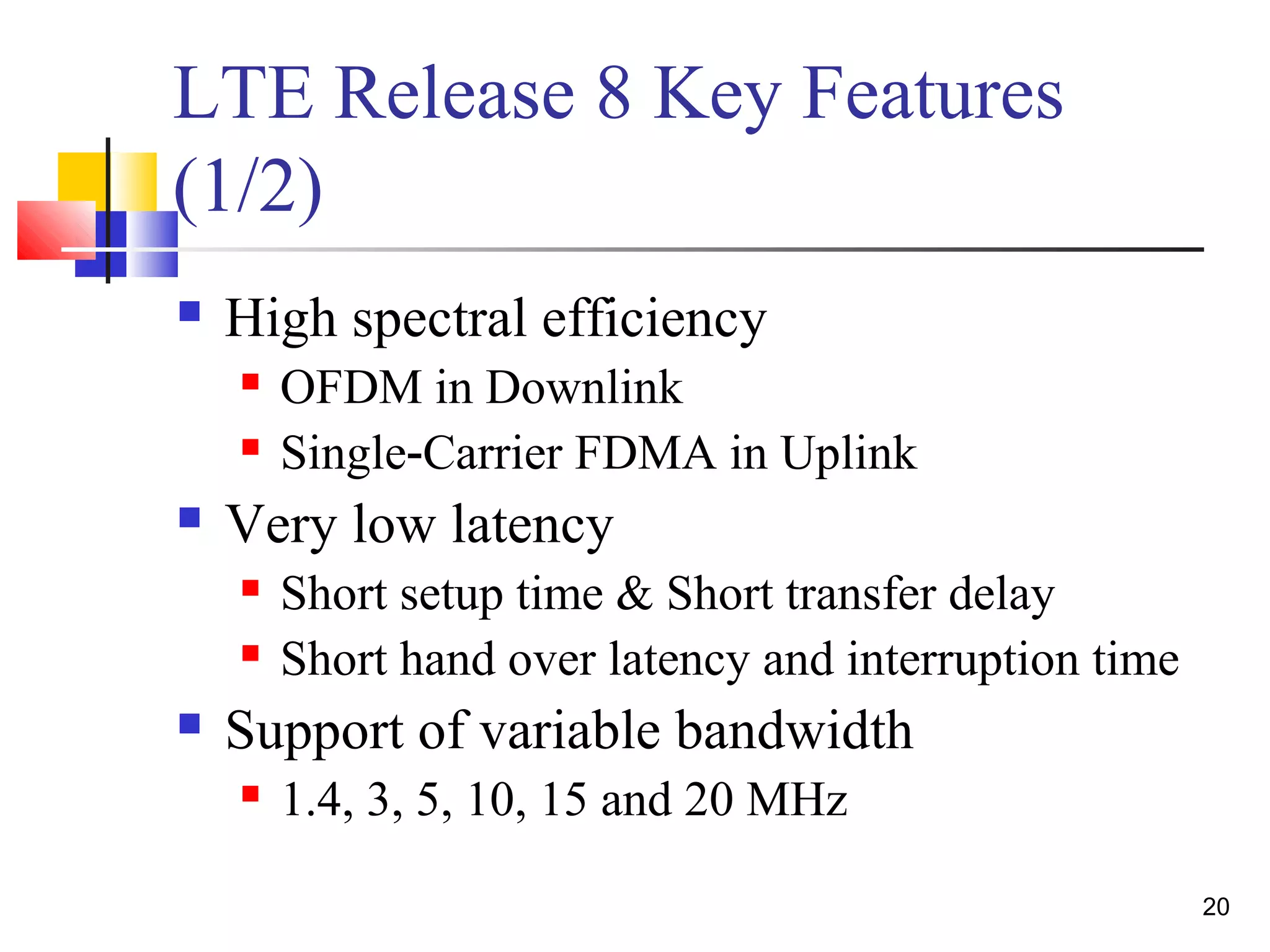
LTE Release 8 Key Features 
(1/2) 
 High spectral efficiency 
 OFDM in Downlink 
 Single‐Carrier FDMA in Uplink 
 Very low latency 
 Short setup time & Short transfer delay 
 Short hand over latency and interruption time 
 Support of variable bandwidth 
 1.4, 3, 5, 10, 15 and 20 MHz
21 
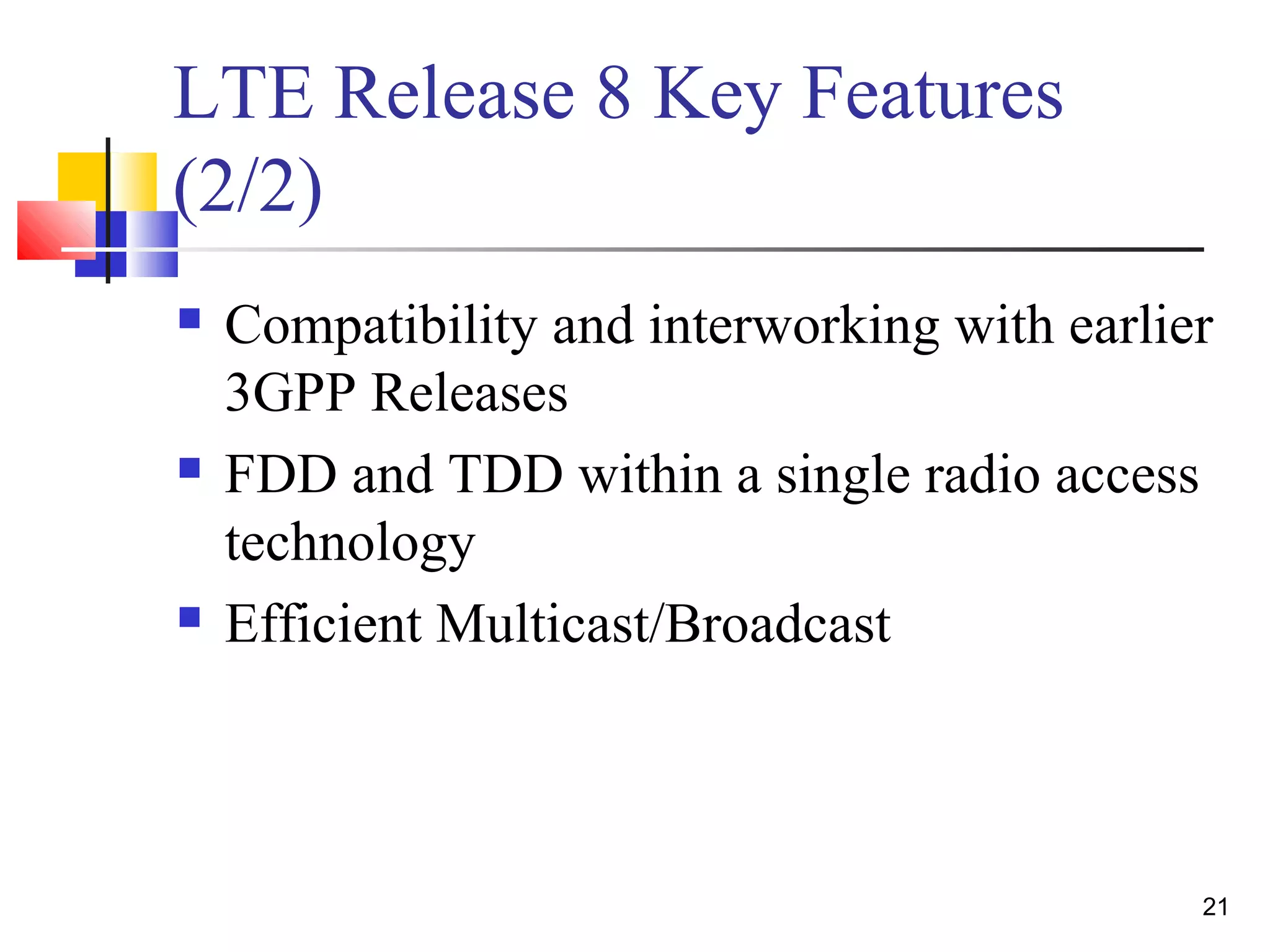
LTE Release 8 Key Features 
(2/2) 
 Compatibility and interworking with earlier 
3GPP Releases 
 FDD and TDD within a single radio access 
technology 
 Efficient Multicast/Broadcast
22 
Evolution of LTE-Advanced 
 Asymmetric transmission bandwidth 
 Layered OFDMA 
 Advanced Multi-cell 
Transmission/Reception Techniques 
 Enhanced Multi-antenna Transmission 
Techniques 
 Support of Larger Bandwidth in LTE-Advanced
23 
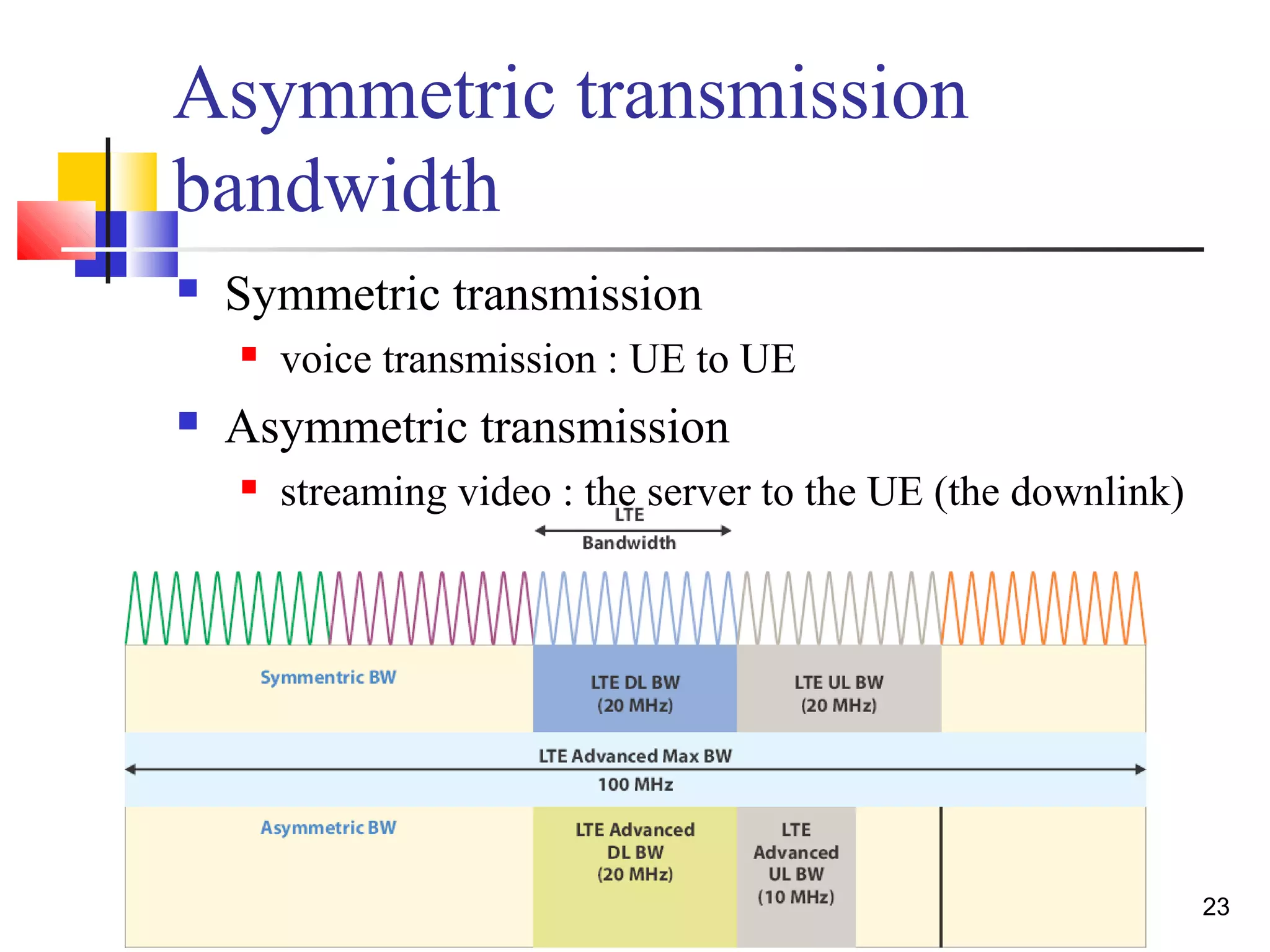
Asymmetric transmission 
bandwidth 
 Symmetric transmission 
 voice transmission : UE to UE 
 Asymmetric transmission 
 streaming video : the server to the UE (the downlink)
24 
Layered OFDMA 
 The bandwidth of basic frequency block is, 
15–20 MHz 
 Layered OFDMA radio access scheme in 
LTE-A will have layered transmission 
bandwidth, support of layered environments 
and control signal formats
25 
Advanced Multi-cell 
Transmission/Reception Techniques 
 In LTE-A, the advanced multi-cell 
transmission/reception processes helps in 
increasing frequency efficiency and cell 
edge user throughput 
 Estimation unit 
 Calculation unit 
 Determination unit 
 Feedback unit
26 
Enhanced Multi-antenna 
Transmission Techniques 
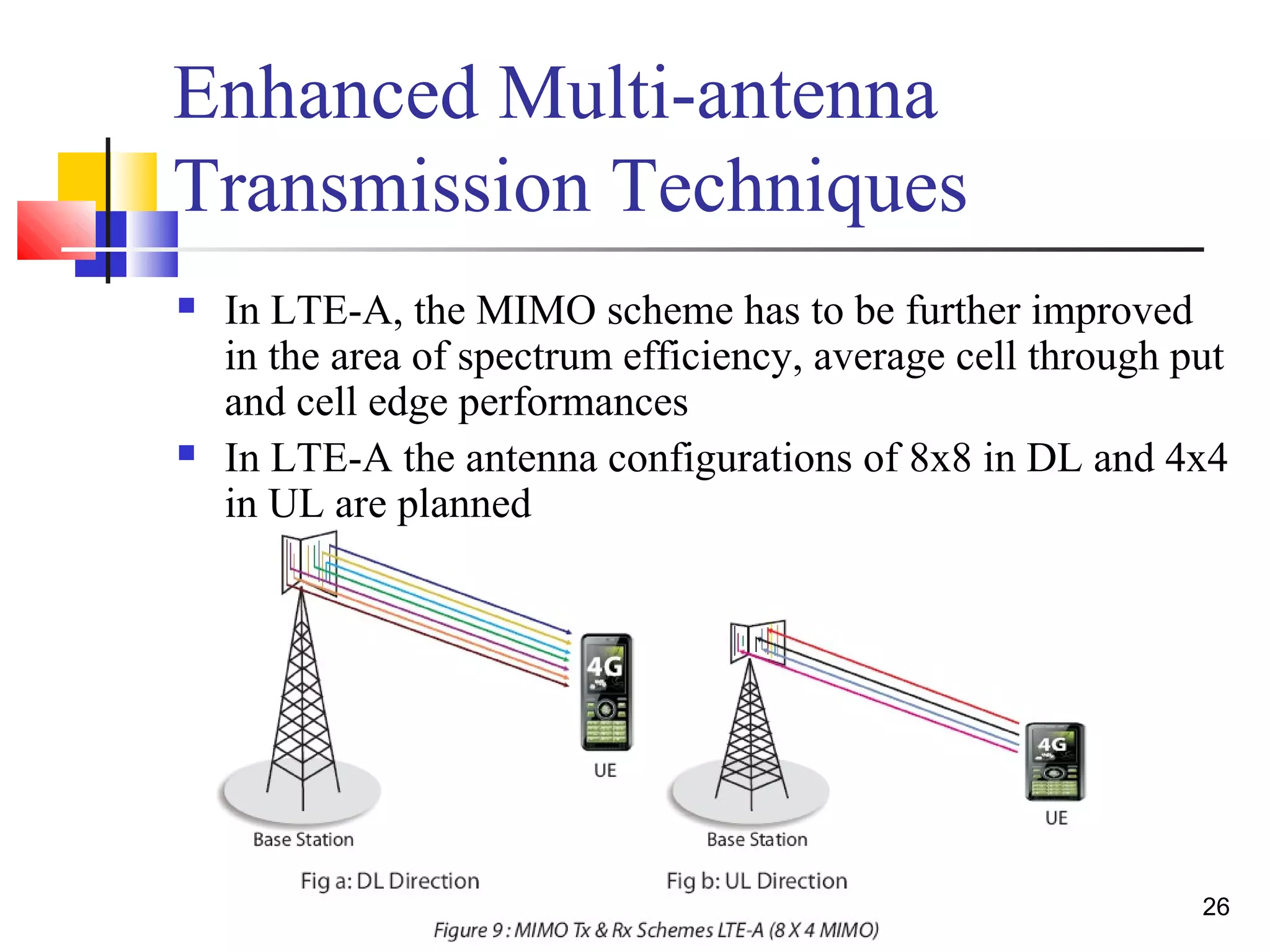
 In LTE-A, the MIMO scheme has to be further improved 
in the area of spectrum efficiency, average cell through put 
and cell edge performances 
 In LTE-A the antenna configurations of 8x8 in DL and 4x4 
in UL are planned
27 
Enhanced Techniques to Extend 
Coverage Area 
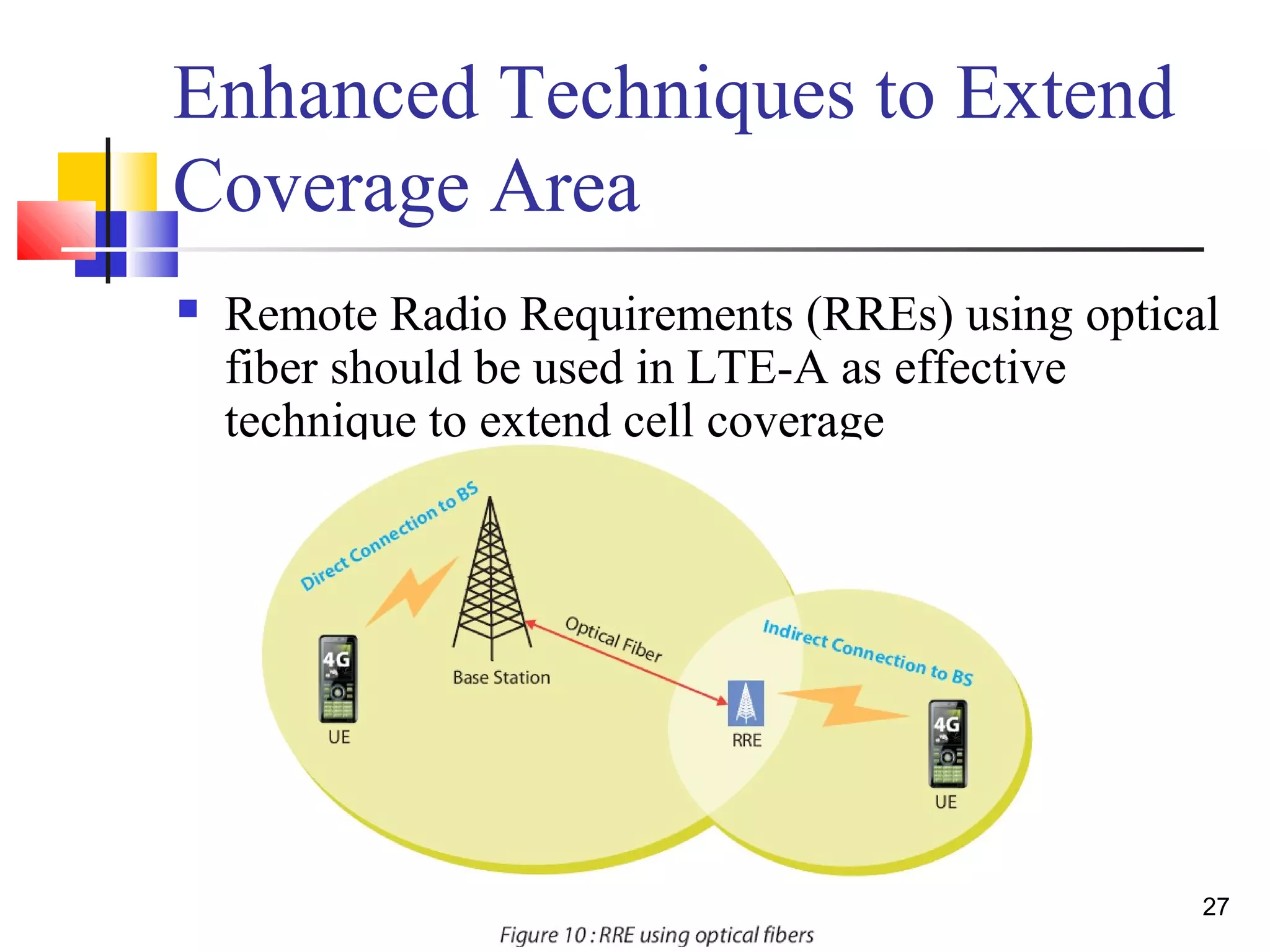
 Remote Radio Requirements (RREs) using optical 
fiber should be used in LTE-A as effective 
technique to extend cell coverage
28 
Support of Larger Bandwidth in 
LTE-Advanced 
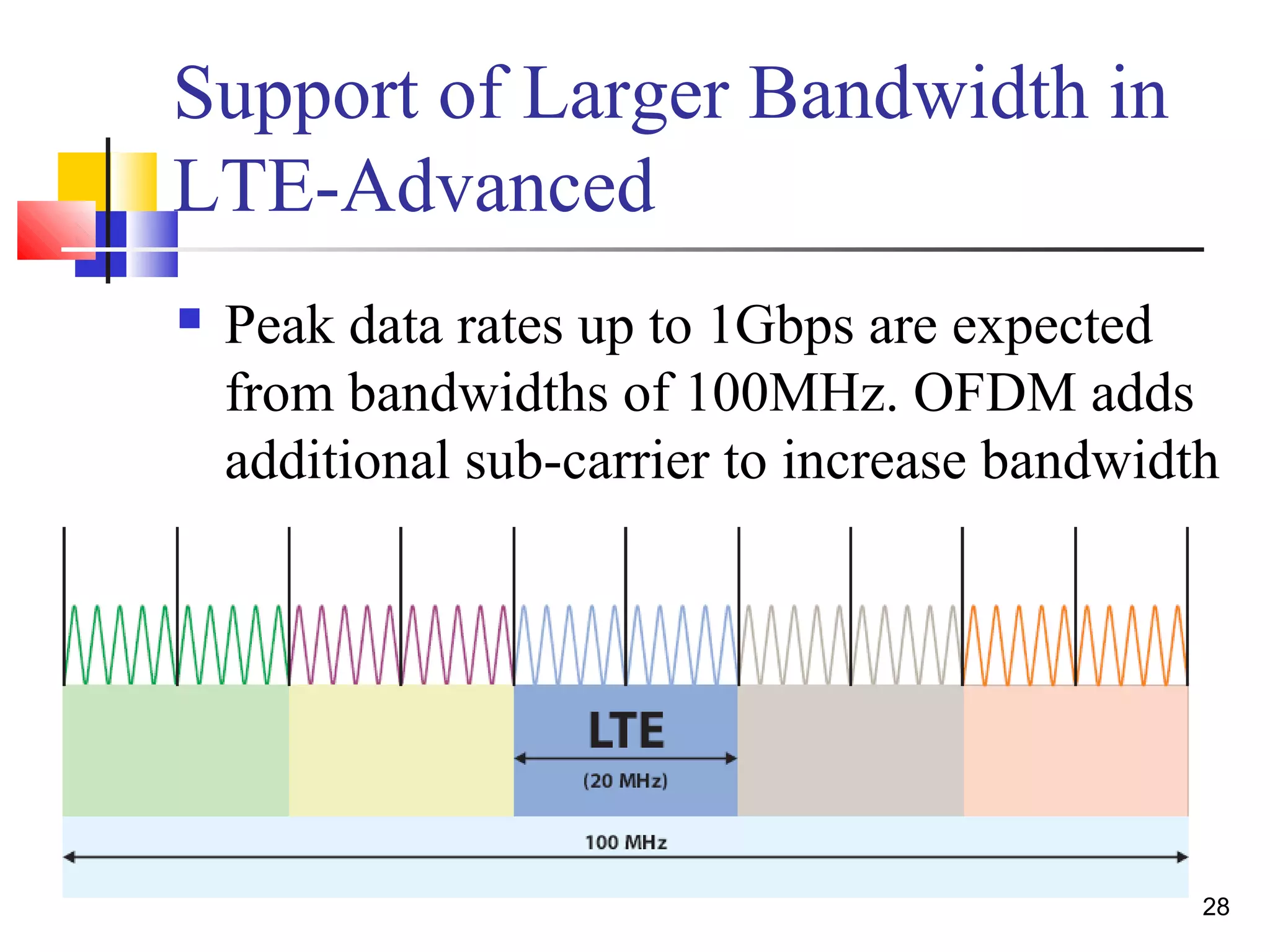
 Peak data rates up to 1Gbps are expected 
from bandwidths of 100MHz. OFDM adds 
additional sub-carrier to increase bandwidth
29 
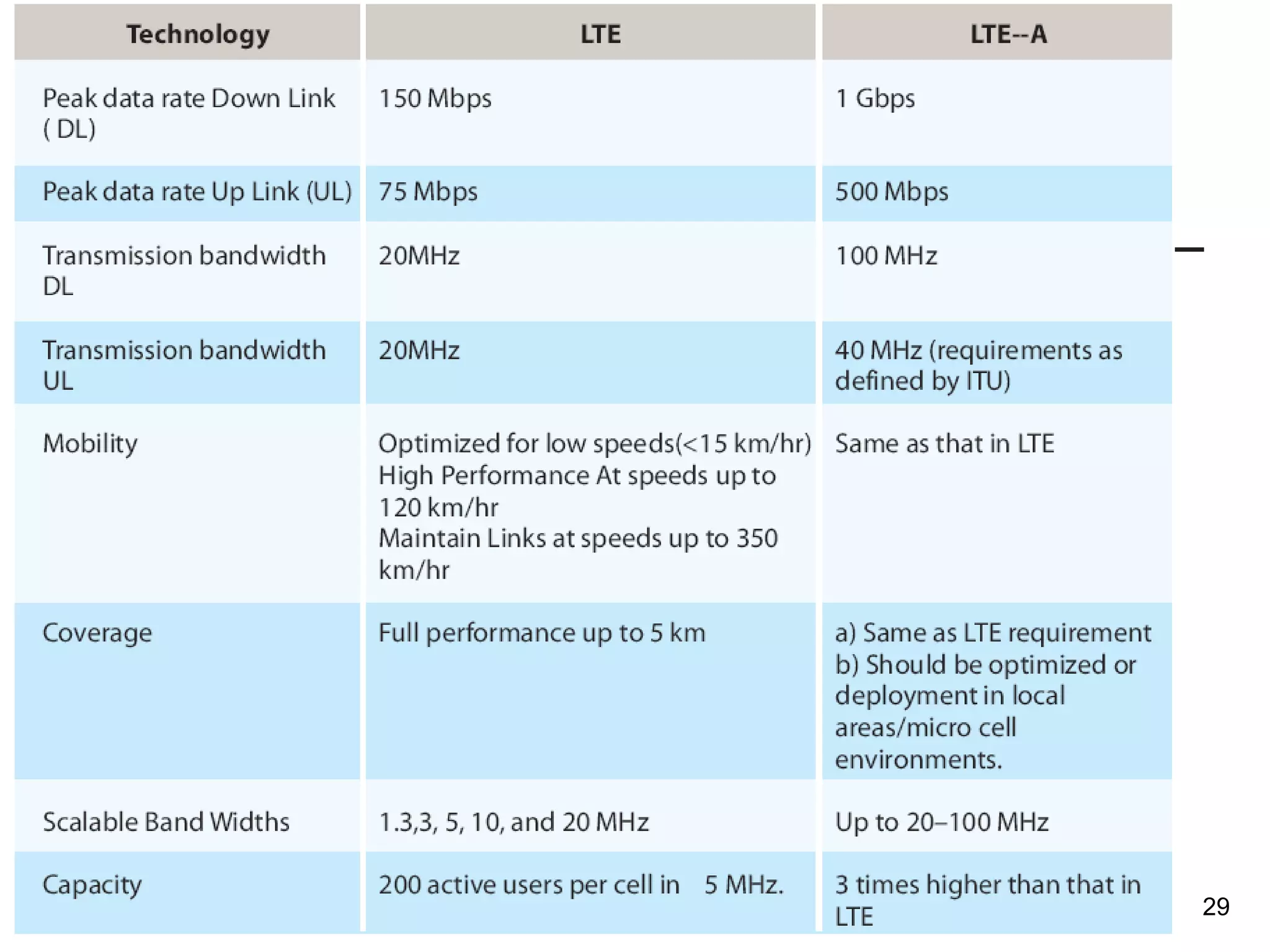
LTE vs. LTE-Advanced
30 
Conclusion 
 LTE-A helps in integrating the existing 
networks, new networks, services and 
terminals to suit the escalating user 
demands 
 LTE-Advanced will be standardized in the 
3GPP specification Release 10 (LTE-A) 
and will be designed to meet the 4G 
requirements as defined by ITU
31 
Backup
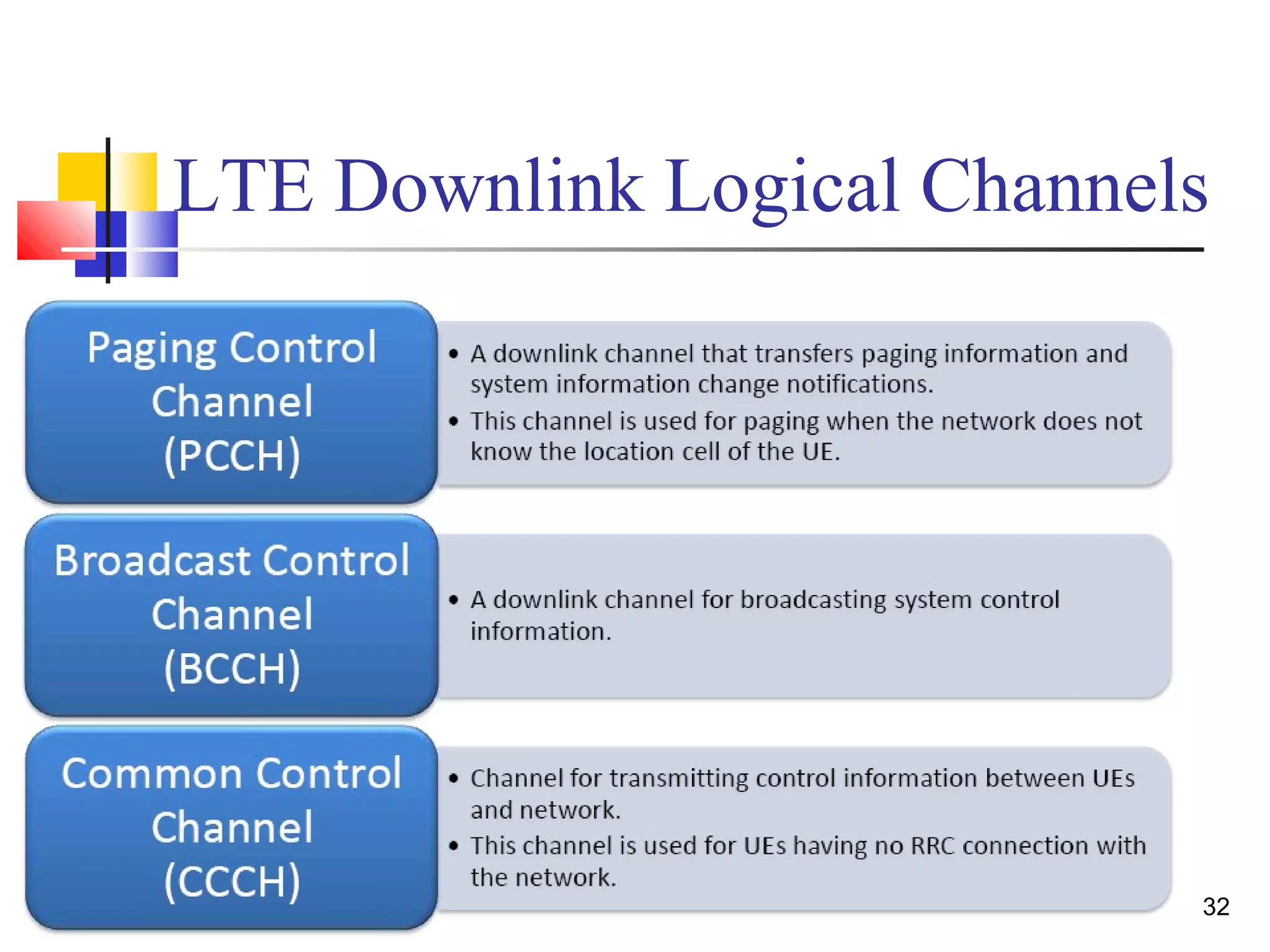
LTE Downlink Logical Channels 
32
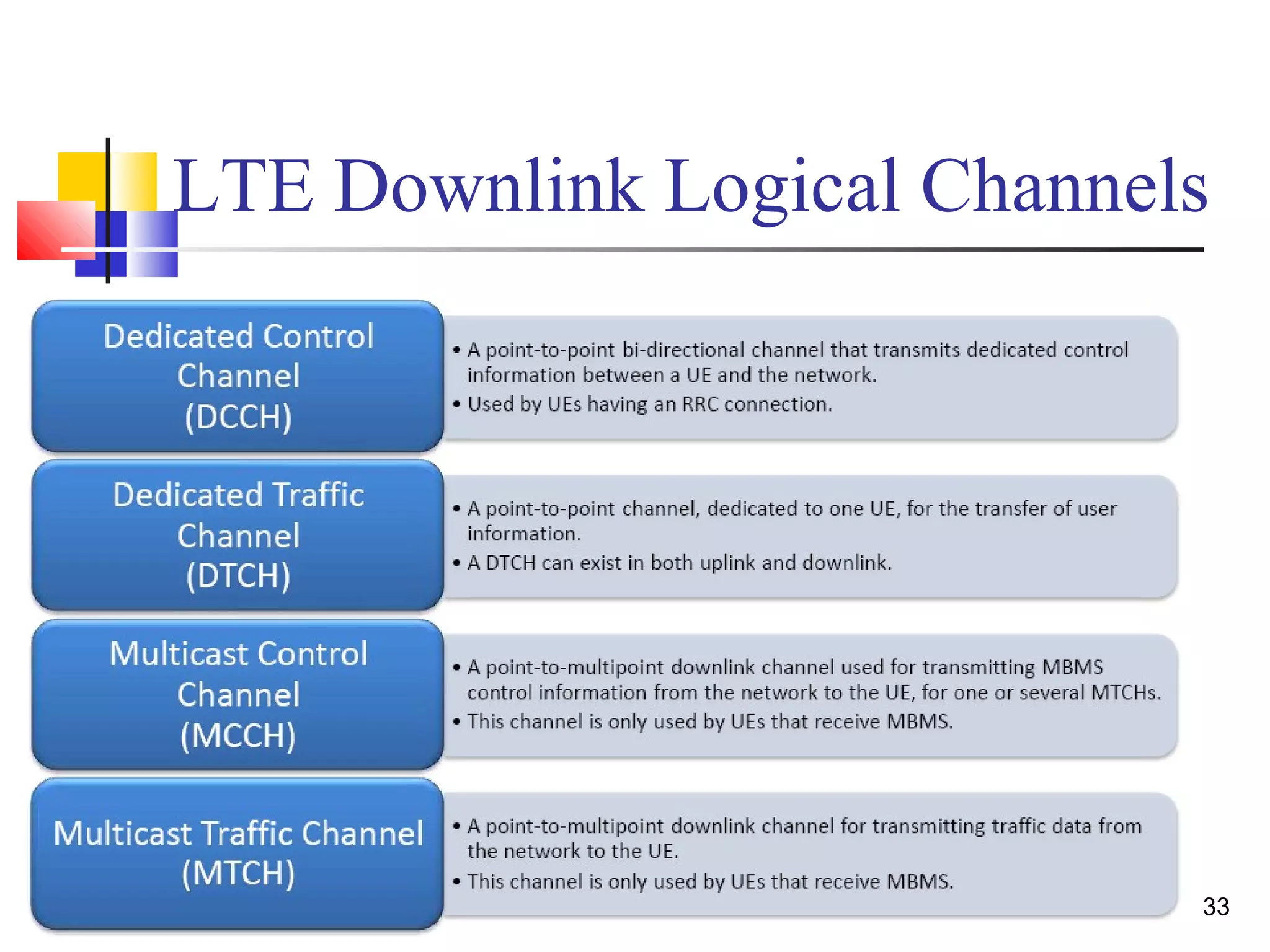
LTE Downlink Logical Channels 
33
34 
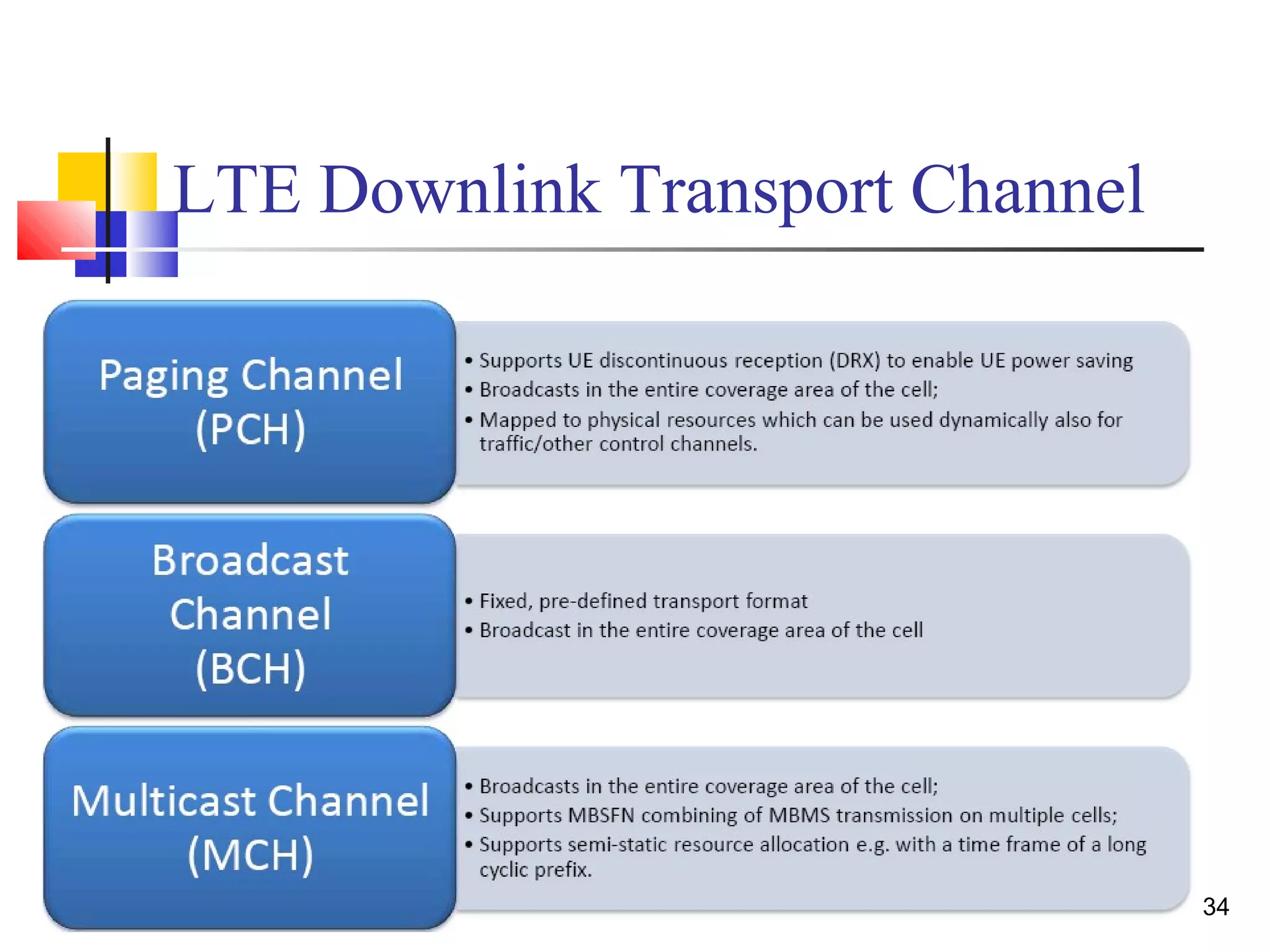
LTE Downlink Transport Channel
35 
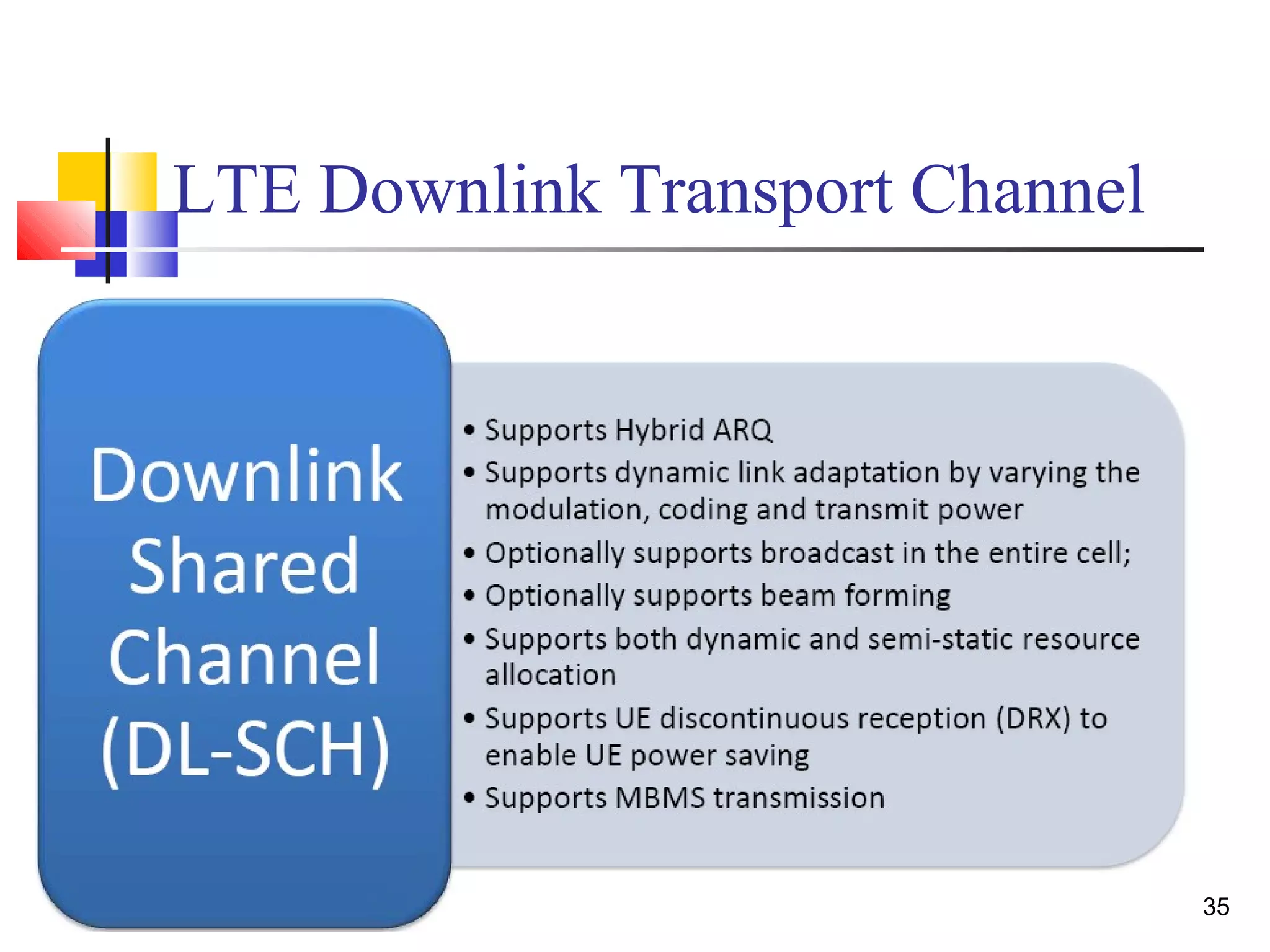
LTE Downlink Transport Channel
36 
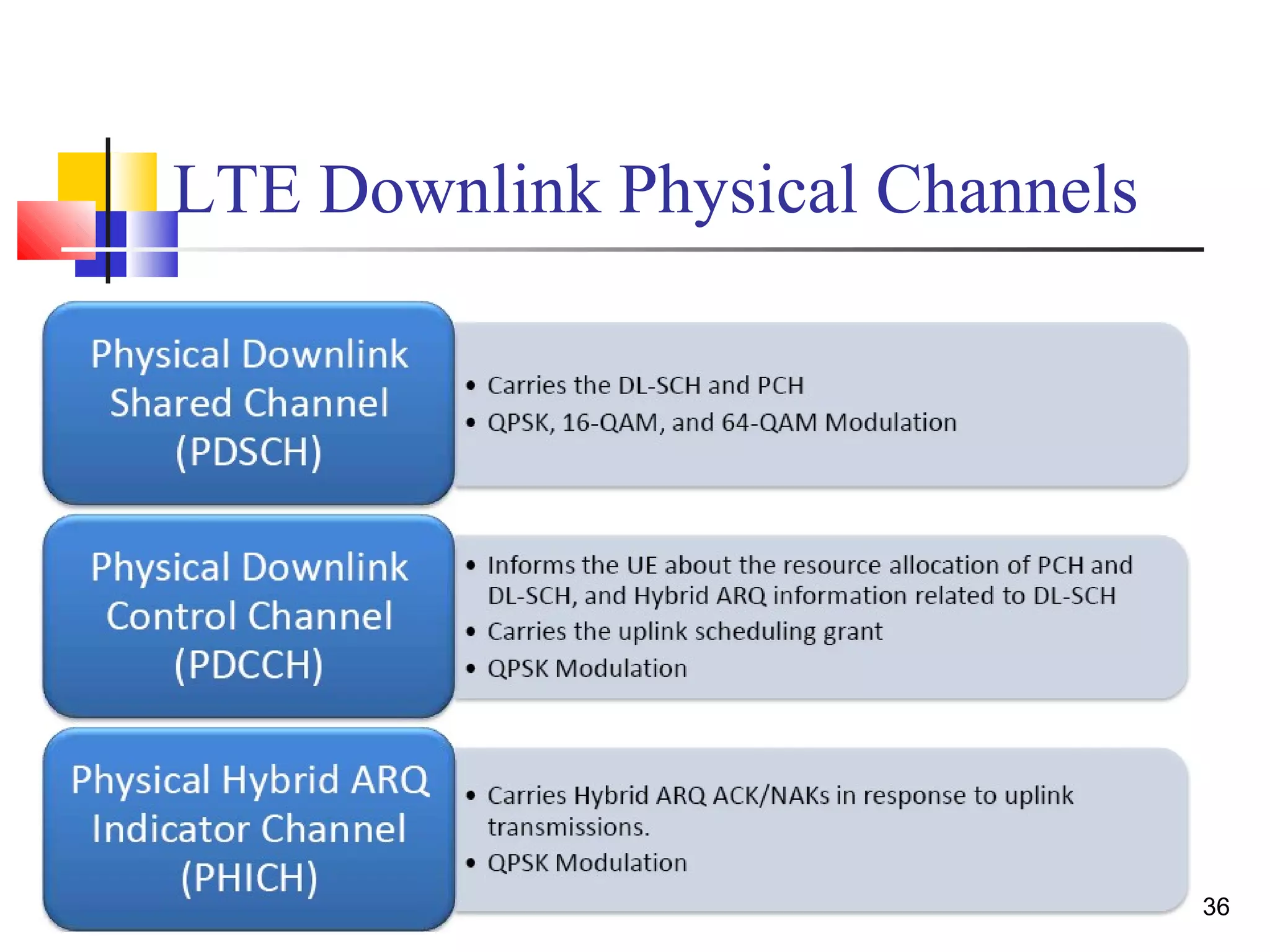
LTE Downlink Physical Channels
37 
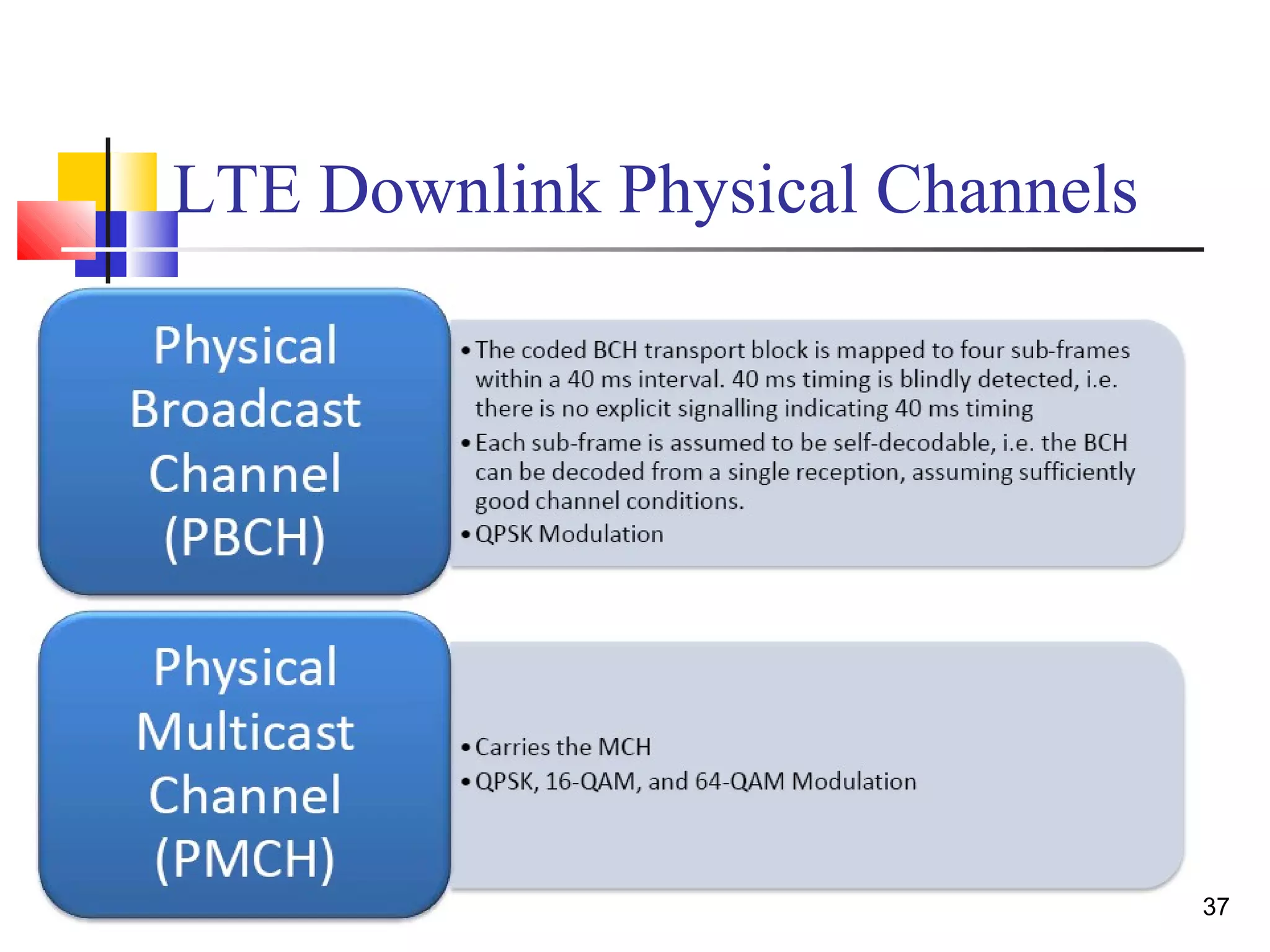
LTE Downlink Physical Channels
38 
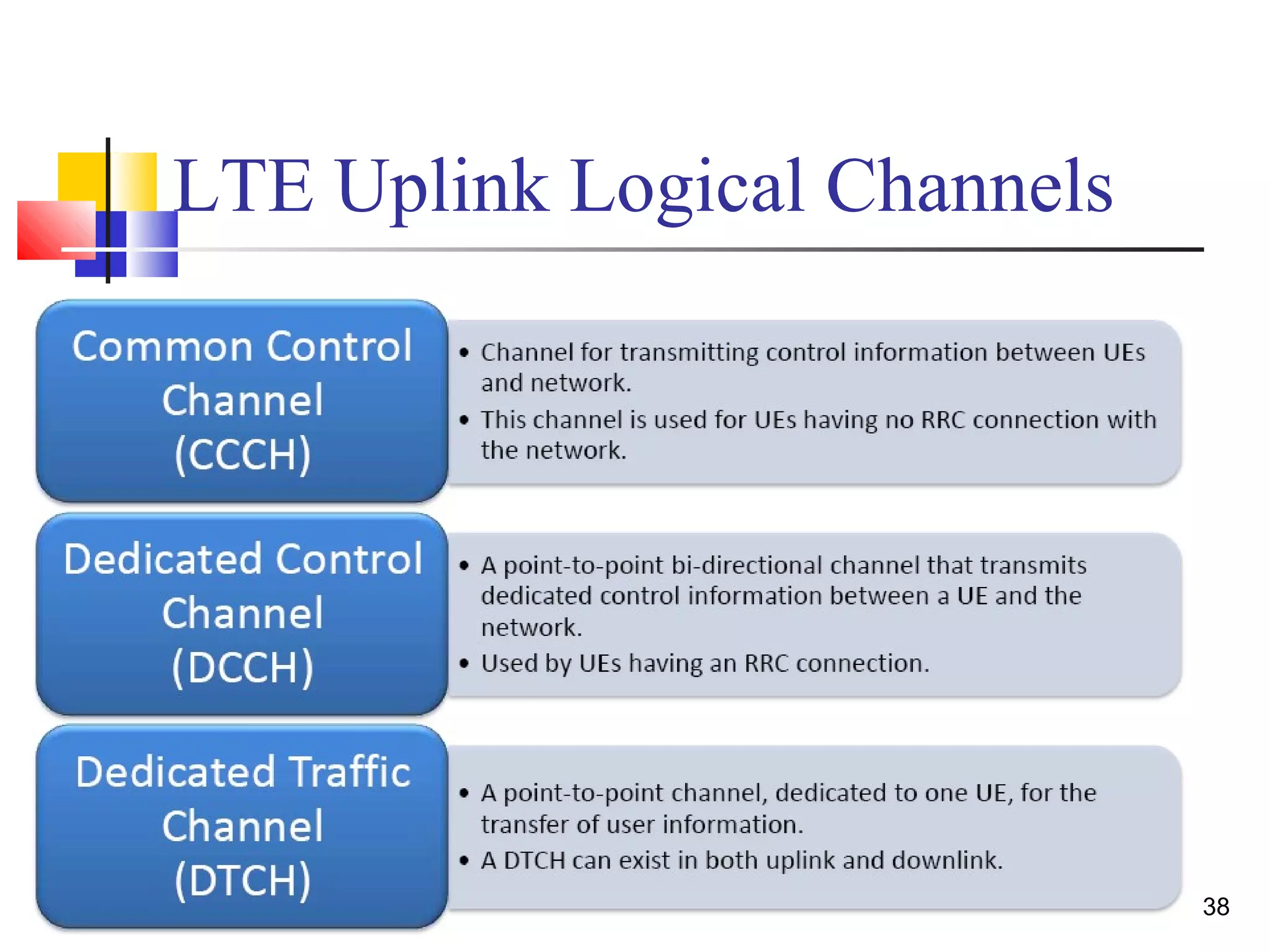
LTE Uplink Logical Channels
39 
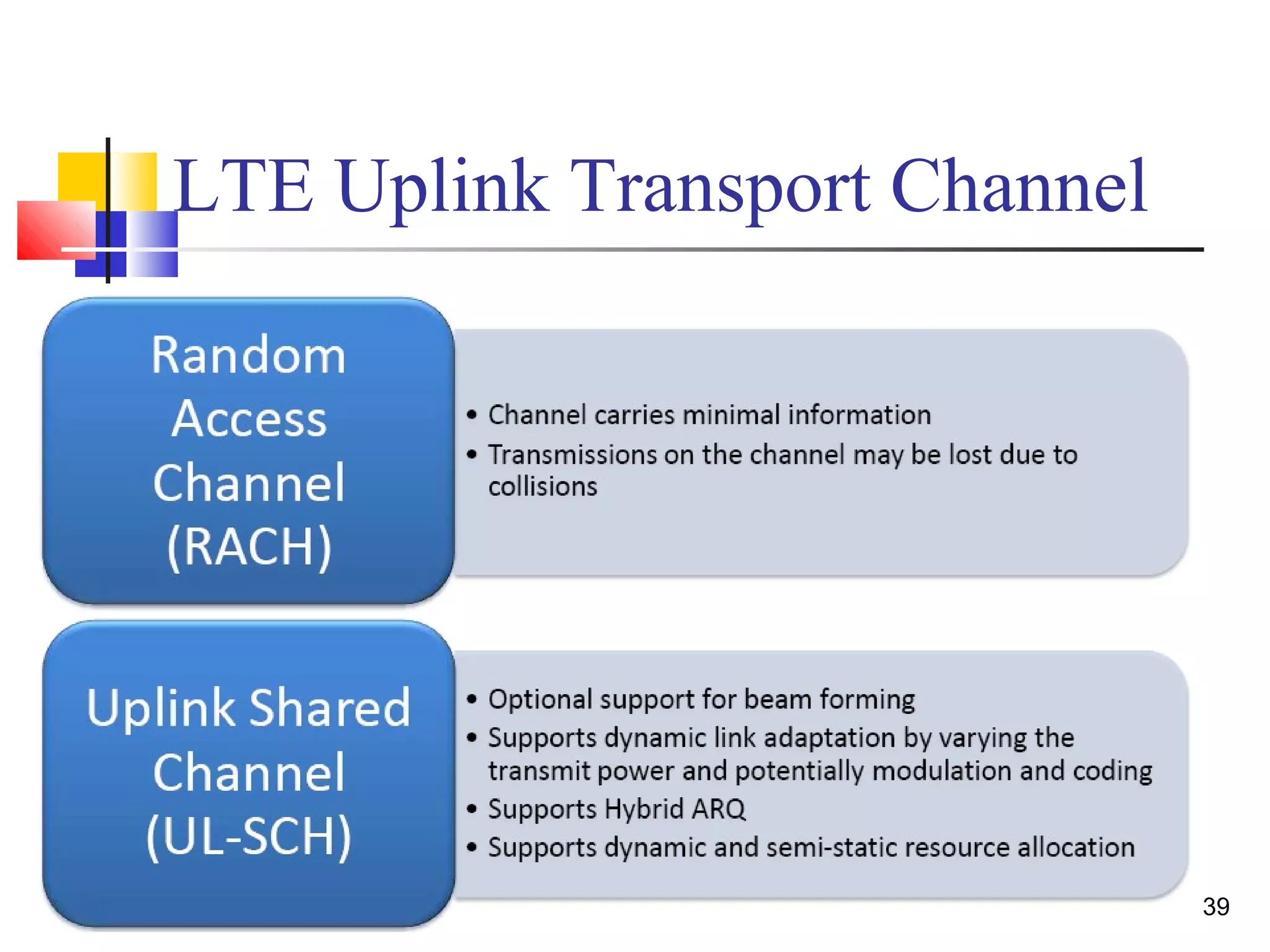
LTE Uplink Transport Channel
40 
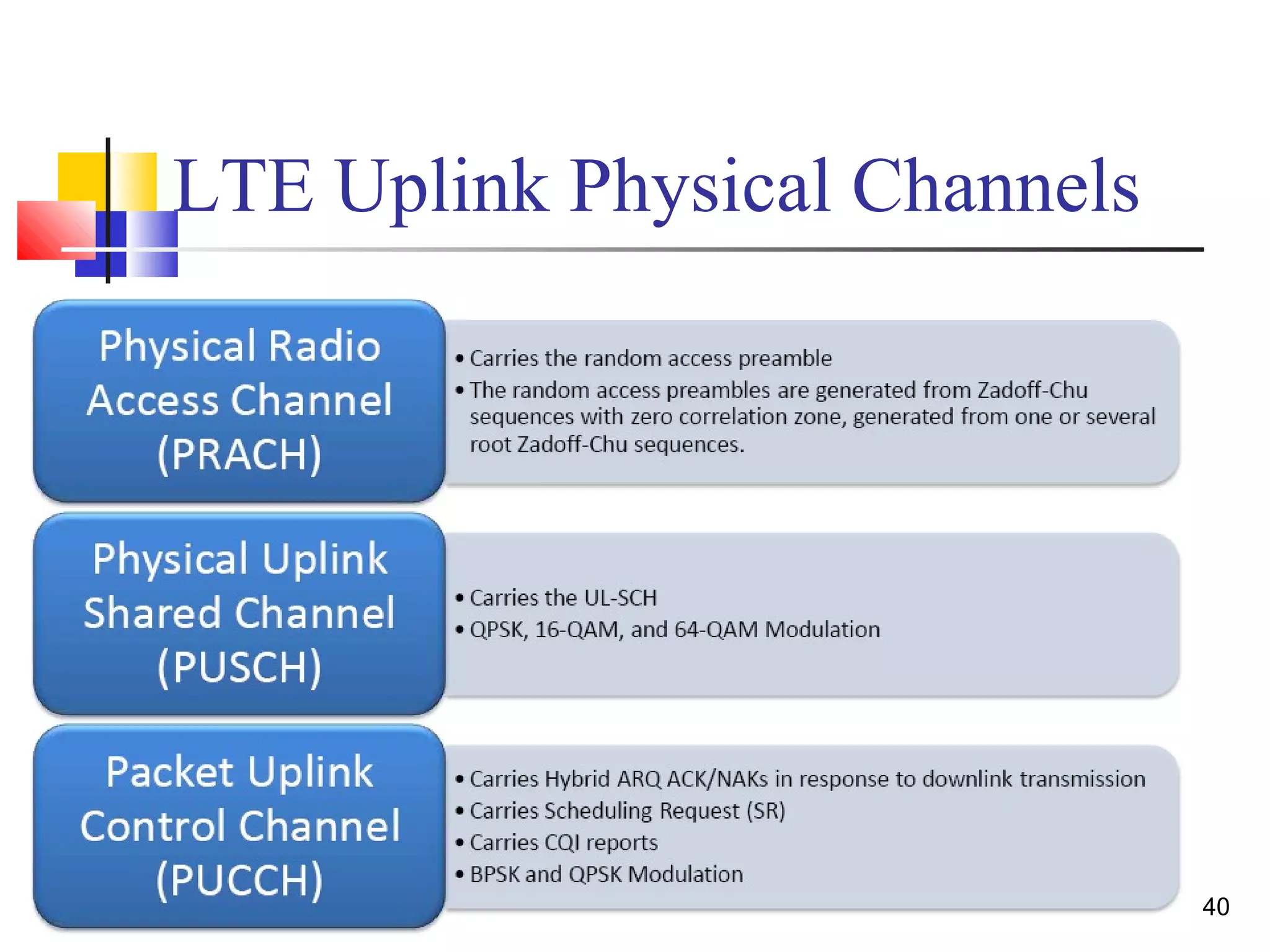
LTE Uplink Physical Channels

An introduction of 3 gpp long term evolution (lte)

  • 1.
    An Introduction of 3GPP Long Term Evolution (LTE) Speaker:Tsung-Yin Lee
  • 2.
    2 Reference http://www.tcs.com “LTE-Advanced: Future of Mobile Broadband,” TATA Consultancy Services  Takehiro Nakamura ,“Proposal for Candidate Radio Interface Technol ogies for IMT Advanced Bas d on ‐ LTE Release 10 and Beyond,” 3GPP TSG‐RAN Chairman  “3GPP LTE Channels and MAC Layer,” EventHelix.com Inc. 2009  Ahmed Hamza, Network Systems Laboratory Simon Fraser University, “Long Term Evolution (LTE) - A Tutorial,” October 13, 2009  Jim Zyren, “Overview of the 3GPP Long Term Evolution Physical Layer,” Document Number: 3GPP EVOLUTIONWP Rev0 07/2007  David Astély, Erik Dahlman, Anders Furuskär, Ylva Jading, Magnus Lindström, and Stefan Parkvall, Ericsson Research, “LTE: The Evolution of Mobile Broadband” , IEEE Communications Magazine, April 2009
  • 3.
    3 Outline History of 3GPP LTE  Basic Concepts of LTE  Introduction of LTE Protocol  Compare with LTE and LTE-Advanced  Conclusion
  • 4.
    4 What isLTE ?  In Nov. 2004, 3GPP began a project to define the long-term evolution (LTE) of Universal Mobile Telecommunications System (UMTS) cellular technology  Higher performance  Backwards compatible  Wide application
  • 5.
    5 Evolution ofRadio Access Technologies  LTE (3.9G) : 3GPP release 8~9  LTE-Advanced : 3GPP release 10+ 802.16d/e 802.16m
  • 6.
    6 LTE BasicConcepts  LTE employs Orthogonal Frequency Division Multiple Access (OFDMA) for downlink data transmission and Single Carrier FDMA (SC-FDMA) for uplink transmission
  • 7.
    7 Multipath-Induced TimeDelays Result in Inter-Symbol Interference (ISI) y(t) = S(t) +bS(t -m) + n(t) y(t) : output signal S(t) : input signal S(t-m) : delayed m time input signal n(t) : noise βS(t-m) y(t) S(t)
  • 8.
    8 Equalizers inReceiver  Against Frequency Selective Fading  Channel transform function Hc(f) j fm c H ( f ) =1+be- 2p  Equalizers transform function Heq(f) (Receiver) ( ) 1 + - H f 1 b 2p j fm = = c H f e c 1 ( ) y(t) = S(t) +bS(t -m)
  • 9.
    9 Frequency SelectiveFading  the coherence bandwidth of the channel is smaller than the bandwidth of the signal Frequency Correlation > 0.9 Bc = 1 / 50α α is r.m.s. delay spread It may be useless for increasing transmission power
  • 10.
  • 11.
  • 12.
    12 LTE-Downlink (OFDM)  Improved spectral efficiency  Reduce ISI effect by multipath  Against frequency selective fading
  • 13.
    13 LTE Uplink(SC-FDMA)  SC-FDMA is a new single carrier multiple access technique which has similar structure and performance to OFDMA A salient advantage of SC-FDMA over OFDM is low to Peak to Average Power Ratio (PAPR) : Increasing battery life
  • 14.
  • 15.
    15 Generic FrameStructure  Allocation of physical resource blocks (PRBs) is handled by a scheduling function at the 3GPP base station (eNodeB) Frame 0 and frame 5 (always downlink)
  • 16.
    16 Resource Grid  One frame is 10ms  10 subframes  One subframe is 1ms  2 slots  One slot is 0.5ms  N resource blocks [ 6 < N < 110]  One resource block is 0.5ms and contains 12 subcarriers from each OFDM symbol
  • 17.
    17 LTE spectrum(bandwidth and duplex) flexibility
  • 18.
    18 LTE DownlinkChannels Paging Control Channel Paging Channel Physical Downlink Shared Channel
  • 19.
    19 LTE UplinkChannels Random Access Channel Physical Radio Access Channel Physical Uplink Shared Channel CQI report
  • 20.
    20 LTE Release8 Key Features (1/2)  High spectral efficiency  OFDM in Downlink  Single‐Carrier FDMA in Uplink  Very low latency  Short setup time & Short transfer delay  Short hand over latency and interruption time  Support of variable bandwidth  1.4, 3, 5, 10, 15 and 20 MHz
  • 21.
    21 LTE Release8 Key Features (2/2)  Compatibility and interworking with earlier 3GPP Releases  FDD and TDD within a single radio access technology  Efficient Multicast/Broadcast
  • 22.
    22 Evolution ofLTE-Advanced  Asymmetric transmission bandwidth  Layered OFDMA  Advanced Multi-cell Transmission/Reception Techniques  Enhanced Multi-antenna Transmission Techniques  Support of Larger Bandwidth in LTE-Advanced
  • 23.
    23 Asymmetric transmission bandwidth  Symmetric transmission  voice transmission : UE to UE  Asymmetric transmission  streaming video : the server to the UE (the downlink)
  • 24.
    24 Layered OFDMA  The bandwidth of basic frequency block is, 15–20 MHz  Layered OFDMA radio access scheme in LTE-A will have layered transmission bandwidth, support of layered environments and control signal formats
  • 25.
    25 Advanced Multi-cell Transmission/Reception Techniques  In LTE-A, the advanced multi-cell transmission/reception processes helps in increasing frequency efficiency and cell edge user throughput  Estimation unit  Calculation unit  Determination unit  Feedback unit
  • 26.
    26 Enhanced Multi-antenna Transmission Techniques  In LTE-A, the MIMO scheme has to be further improved in the area of spectrum efficiency, average cell through put and cell edge performances  In LTE-A the antenna configurations of 8x8 in DL and 4x4 in UL are planned
  • 27.
    27 Enhanced Techniquesto Extend Coverage Area  Remote Radio Requirements (RREs) using optical fiber should be used in LTE-A as effective technique to extend cell coverage
  • 28.
    28 Support ofLarger Bandwidth in LTE-Advanced  Peak data rates up to 1Gbps are expected from bandwidths of 100MHz. OFDM adds additional sub-carrier to increase bandwidth
  • 29.
    29 LTE vs.LTE-Advanced
  • 30.
    30 Conclusion LTE-A helps in integrating the existing networks, new networks, services and terminals to suit the escalating user demands  LTE-Advanced will be standardized in the 3GPP specification Release 10 (LTE-A) and will be designed to meet the 4G requirements as defined by ITU
  • 31.
  • 32.
  • 33.
  • 34.
    34 LTE DownlinkTransport Channel
  • 35.
    35 LTE DownlinkTransport Channel
  • 36.
    36 LTE DownlinkPhysical Channels
  • 37.
    37 LTE DownlinkPhysical Channels
  • 38.
    38 LTE UplinkLogical Channels
  • 39.
    39 LTE UplinkTransport Channel
  • 40.
    40 LTE UplinkPhysical Channels

Editor's Notes

  • #13 frequency selective fading 在正交分頻多工系統中,原來的寬頻通道被分割成N 個子通道,透過使用串列至並行轉換器,將資料送至各個子載波上,由於資料區間被拉長為原本的N倍, 所以這些子載波有著較低的傳輸速率,當子通道數目足夠多時,每個子載波可以視具有平坦的通道頻率響應,進而可以有效的對抗頻率選擇性衰減通道所造成的失真