Proposal for Candidate Radio Interface Technologies for IMT-Advanced Based on LTE Release 10 and Beyond (LTE-Advanced) Takehiro Nakamura 3GPP TSG-RAN Chairman 3GPP IMT-Advanced Evaluation Workshop Beijing, China, 17-18 December, 2009
Introduction In response to the ITU-R Circular Letter 5/LCCE/2 which invites proposals for candidate radio interface technologies for the terrestrial component of IMT-Advanced, the Third Generation Partnership Project (3GPP) is providing  a complete submission  of  LTE Release 10 & beyond (LTE-Advanced)  under Step 3 of the IMT-Advanced process in Document IMT‑ADV/2(Rev.1)  This submission of the 3GPP candidate SRIT (which includes an FDD RIT component and a TDD RIT component) is based on the currently approved work within 3GPP and follows the ITU-R IMT-Advanced submission format and guidelines. The  3GPP Proponent  [1]  has provided all required information within each of required major components either directly or by endorsement of this contribution made by 3GPP individual members on behalf of 3GPP: The submission of LTE-Advanced as a candidate for IMT-Advanced was acknowledged by ITU-R WP5D as a “complete” submission Following slides show overview of this submission together with relevant information [1] The  3GPP Proponent  of the 3GPP submission is collectively the 3GPP Organizational Partners (OPs). The Organizational Partners of 3GPP are ARIB, ATIS, CCSA, ETSI, TTA and TTC  (http://www.3gpp.org/partners)
Contents 3GPP standardisation activities LTE Release 8 LTE-Release 10 and beyond (LTE-Advanced) Self-evaluation ITU-R submission documents
3GPP Standardisation Activities
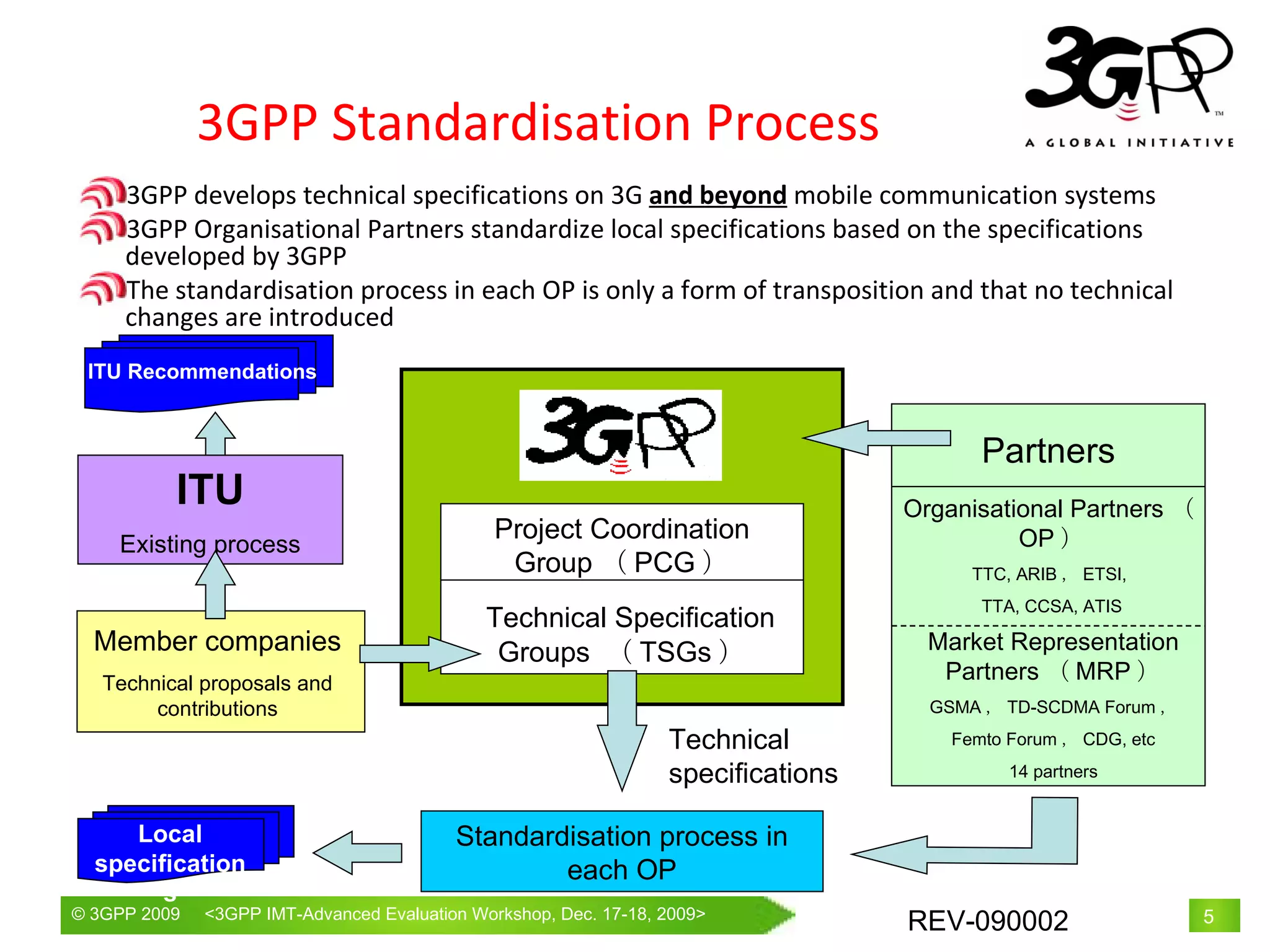
3GPP Standardisation Process 3GPP develops technical specifications on 3G  and beyond  mobile communication systems 3GPP Organisational Partners standardize local specifications based on the specifications developed by 3GPP The standardisation process in each OP is only a form of transposition and that no technical changes are introduced  ITU Existing process Project Coordination Group ( PCG ) Technical Specification Groups  ( TSGs ) Technical specifications Partners Organisational Partners ( OP ) TTC, ARIB , ETSI,  TTA, CCSA, ATIS Market Representation Partners ( MRP ) GSMA , TD-SCDMA Forum , Femto Forum , CDG, etc 14 partners Standardisation process in each OP Member companies Technical proposals and contributions ITU Recommendations Local specifications
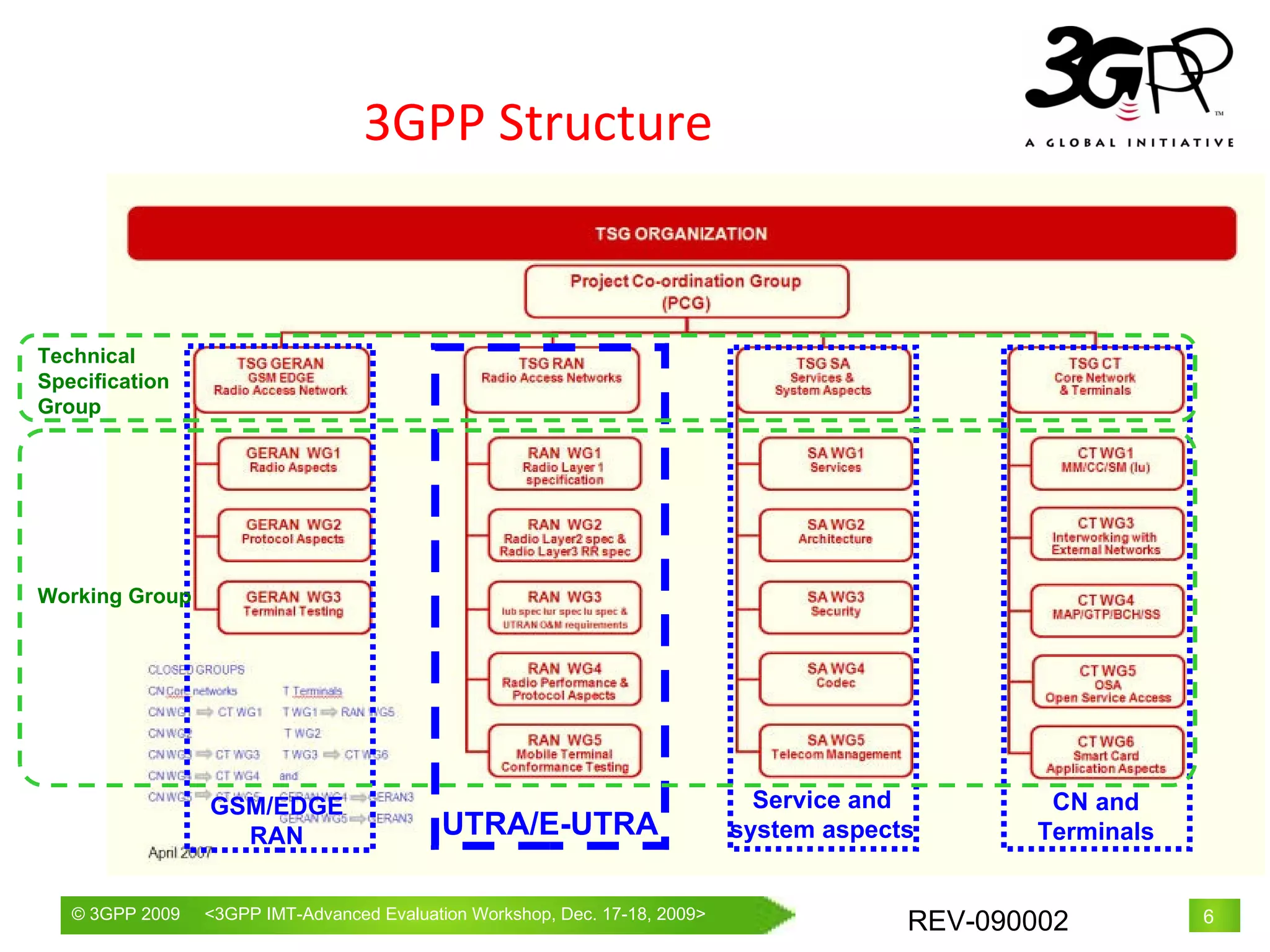
3GPP Structure UTRA/E-UTRA Service and system aspects CN and Terminals GSM/EDGE RAN Technical Specification Group Working Group
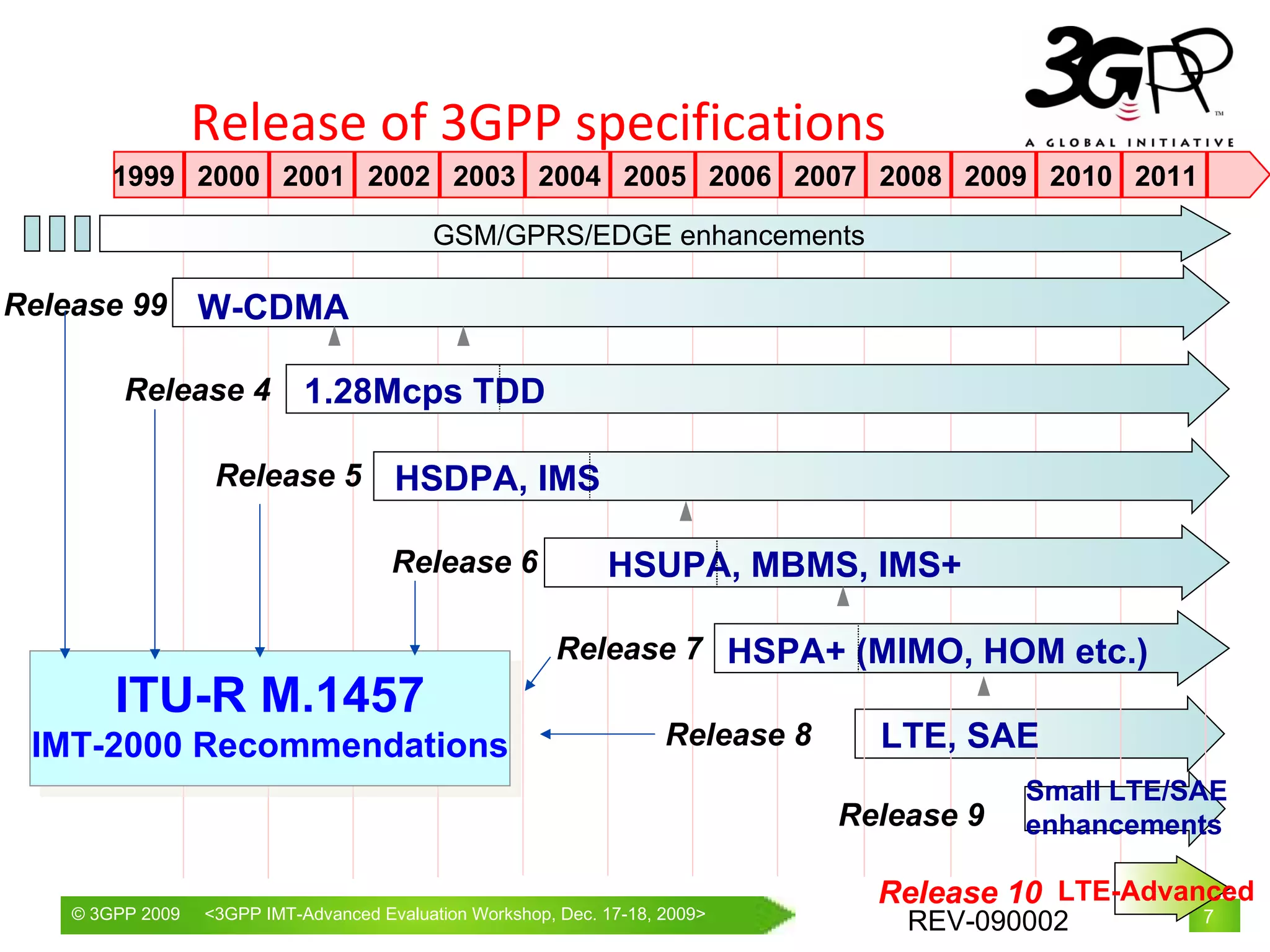
Release of 3GPP specifications 1999 2000 2001 2002 2003 2004 2005 Release 99 Release 4 Release 5 Release 6 1.28Mcps TDD HSDPA, IMS W-CDMA HSUPA, MBMS, IMS+ 2006 2007 2008 2009 Release 7 HSPA+ (MIMO, HOM etc.) Release 8 2010 2011 LTE, SAE ITU-R M.1457 IMT-2000 Recommendations Release 9 LTE-Advanced Release 10 GSM/GPRS/EDGE enhancements Small LTE/SAE enhancements
LTE Release 8
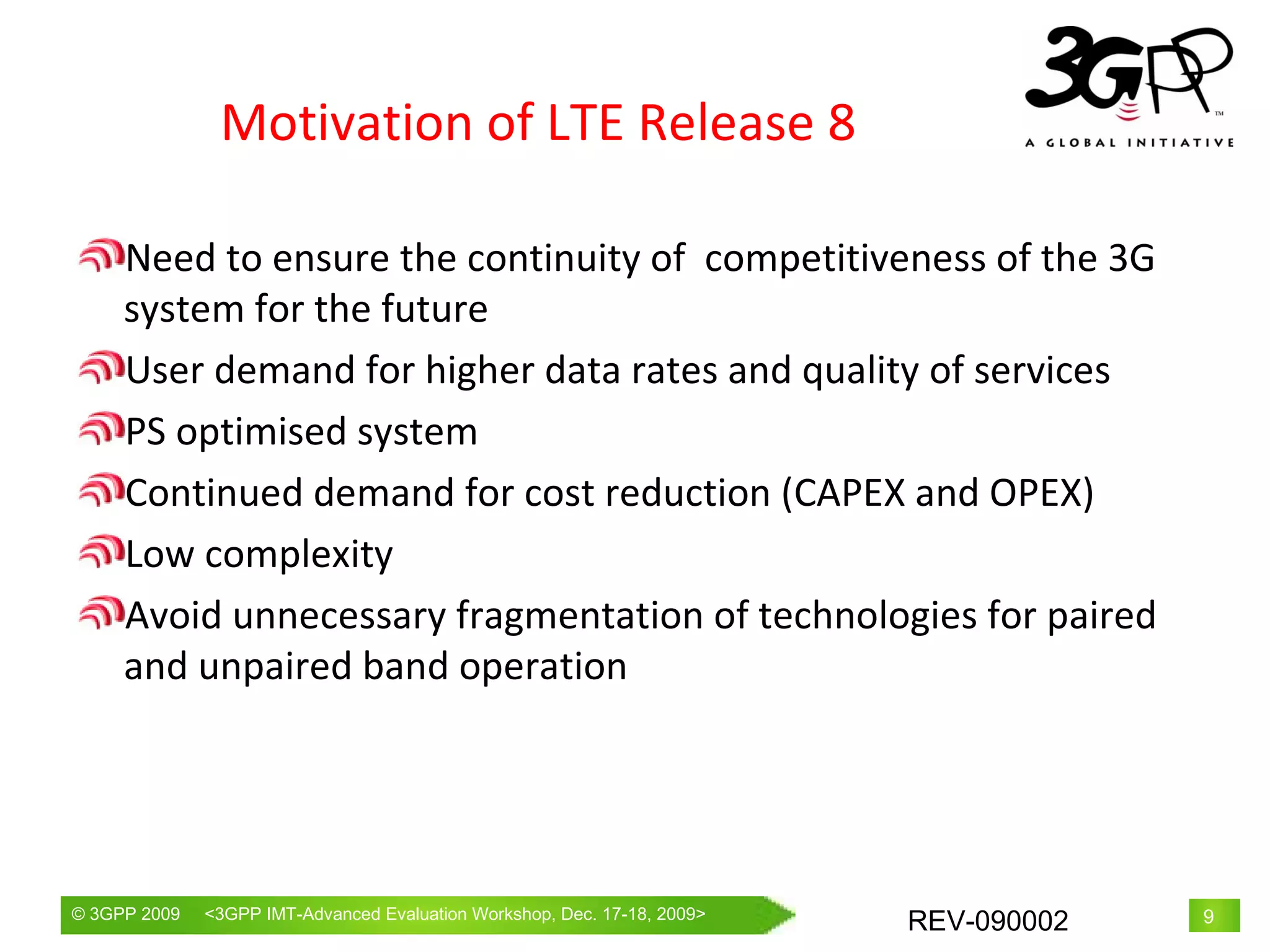
Motivation of LTE Release 8 Need to ensure the continuity of  competitiveness of the 3G system for the future User demand for higher data rates and quality of services PS optimised system Continued demand for cost reduction (CAPEX and OPEX) Low complexity Avoid unnecessary fragmentation of technologies for paired and unpaired band operation
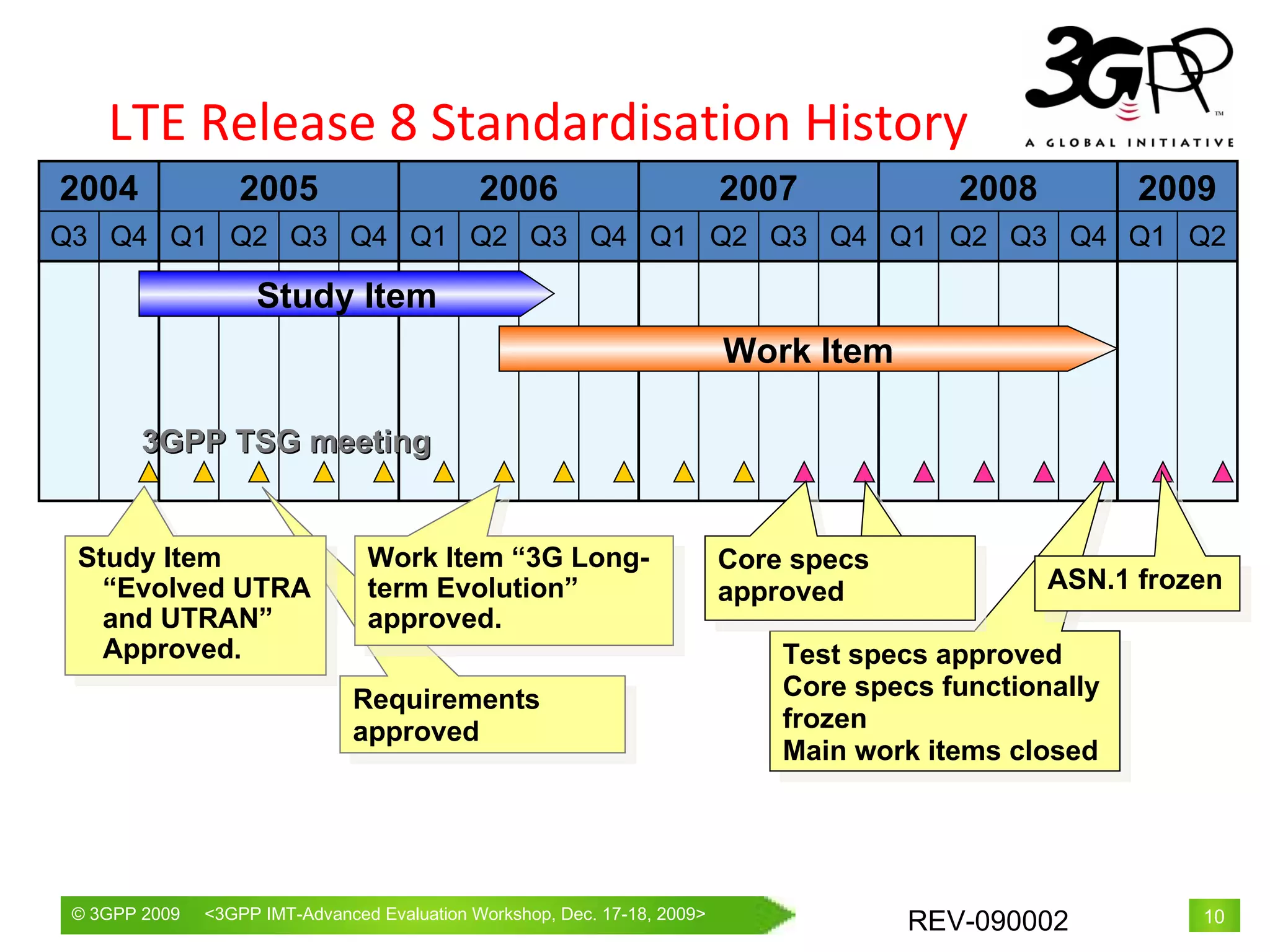
LTE Release 8 Standardisation History 2004 Q3 Q4 2005 Q1 Q2 Q3 Q4 2006 Q1 Q2 Q3 Q4 2007 Q1 Q2 Q3 Q4 2008 Q1 Q2 Q3 Q4 Study Item Work Item 3GPP TSG meeting Test specs approved Core specs functionally frozen Main work items closed Core specs approved Requirements approved Study Item “Evolved UTRA and UTRAN” Approved. Work Item “3G Long-term Evolution” approved. 2009 Q1 Q2 ASN.1 frozen
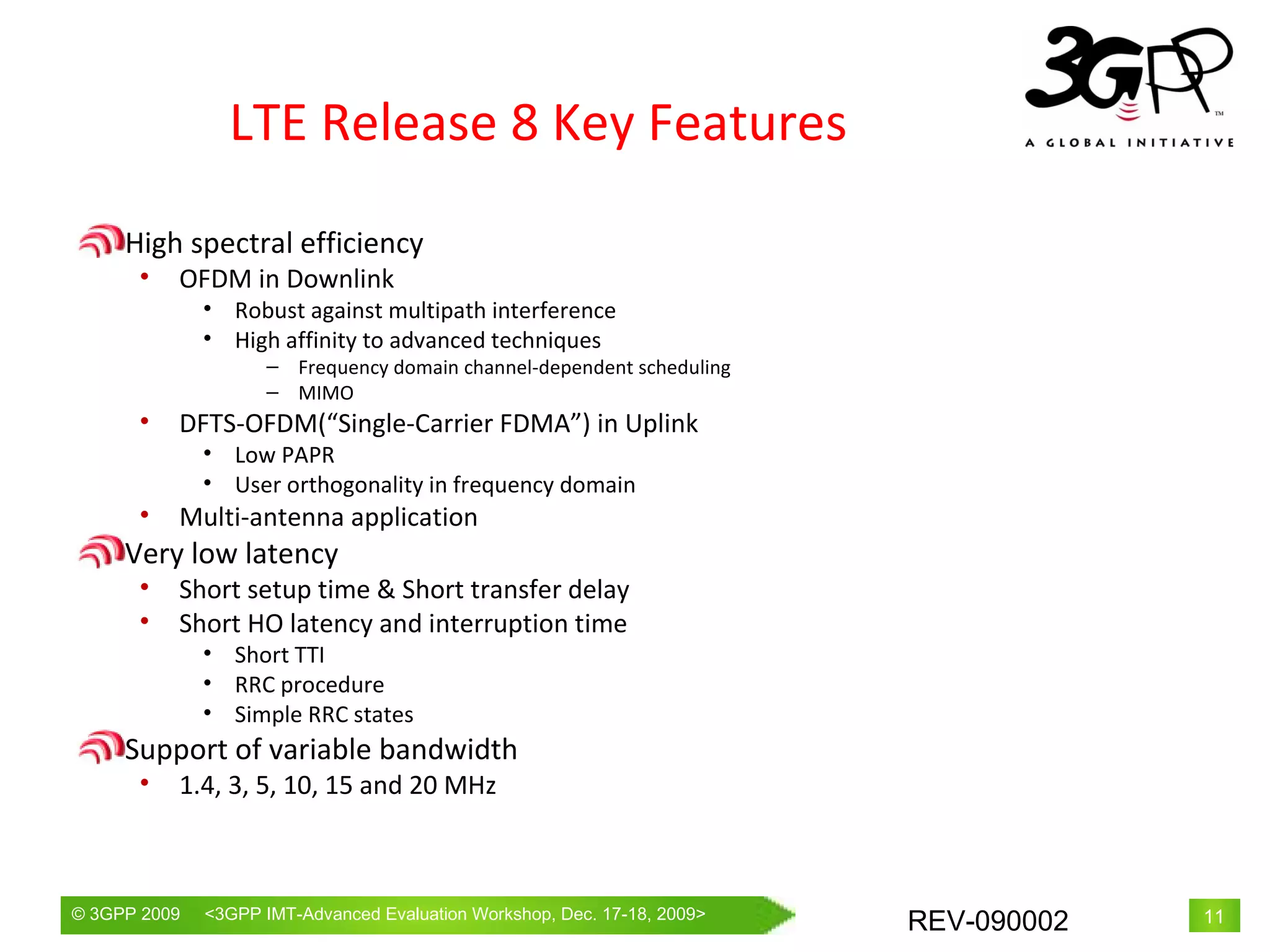
LTE Release 8 Key Features High spectral efficiency OFDM in Downlink Robust against multipath interference High affinity to advanced techniques Frequency domain channel-dependent scheduling   MIMO DFTS-OFDM(“Single-Carrier FDMA”) in Uplink Low PAPR User orthogonality in frequency domain  Multi-antenna application Very low latency Short setup time & Short transfer delay Short HO latency and interruption time Short TTI RRC procedure Simple RRC states Support of variable bandwidth 1.4, 3, 5, 10, 15 and 20 MHz
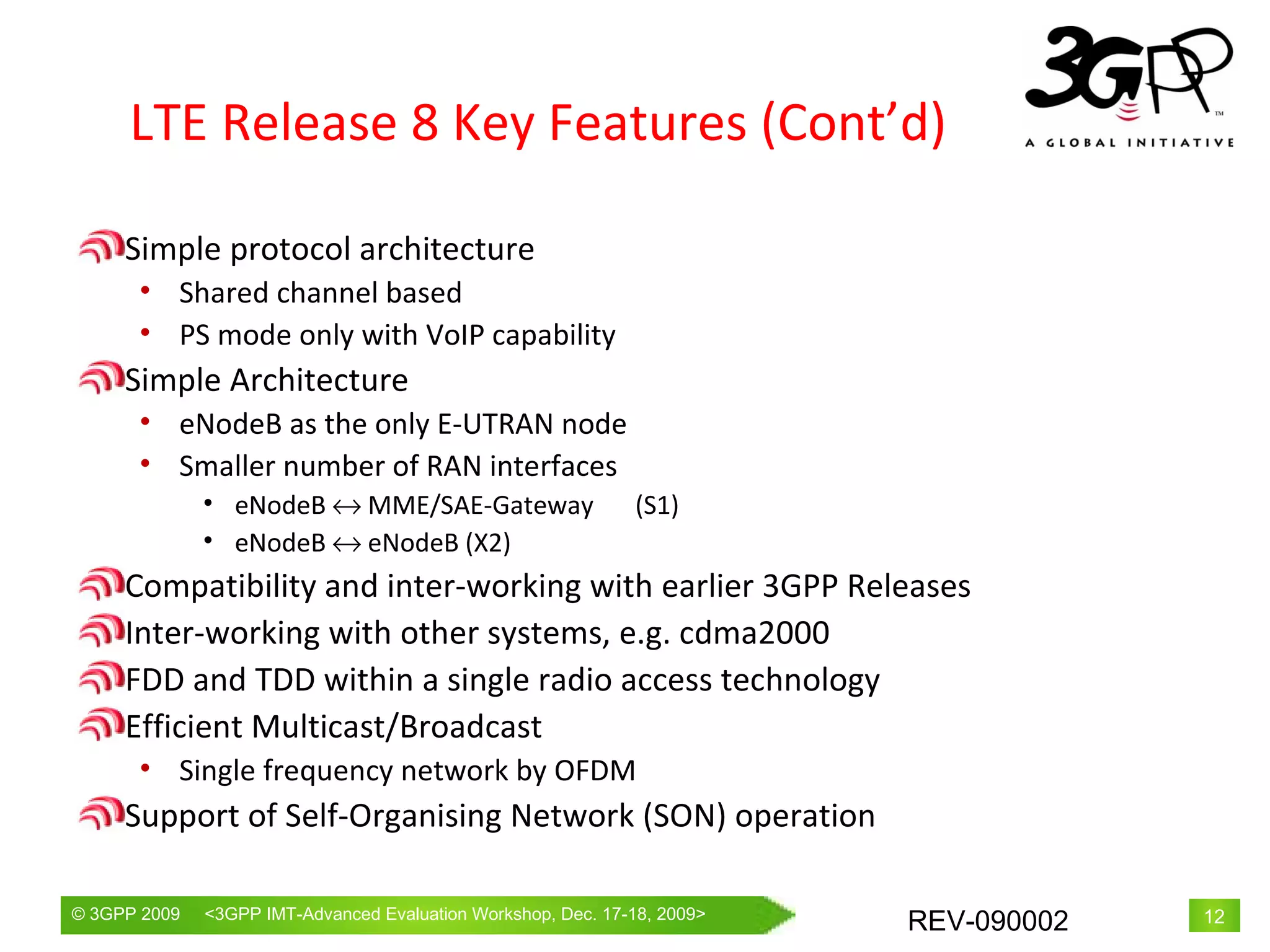
LTE Release 8 Key Features (Cont’d) Simple protocol architecture Shared channel based PS mode only with VoIP capability Simple Architecture eNodeB as the only E-UTRAN node Smaller number of RAN interfaces eNodeB    MME/SAE-Gateway   (S1) eNodeB    eNodeB (X2) Compatibility and inter-working with earlier 3GPP Releases Inter-working with other systems, e.g. cdma2000 FDD and TDD within a single radio access technology Efficient Multicast/Broadcast Single frequency network by OFDM Support of Self-Organising Network (SON) operation
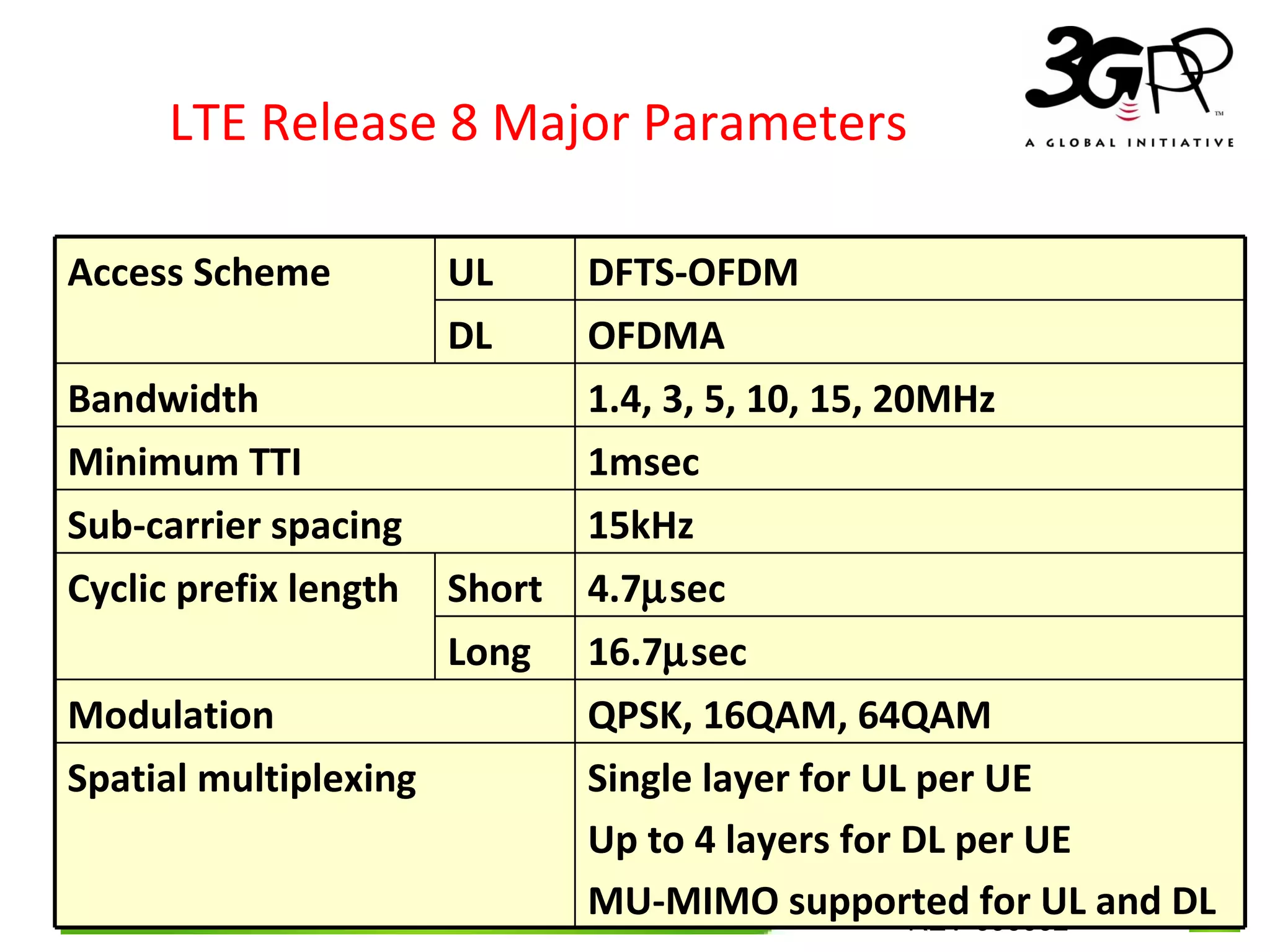
LTE Release 8 Major Parameters Single layer for UL per UE Up to 4 layers for DL per UE MU-MIMO supported for UL and DL Spatial multiplexing 16.7  sec Long OFDMA DL Short UL QPSK, 16QAM, 64QAM Modulation 4.7  sec Cyclic prefix length 15kHz Sub-carrier spacing 1msec Minimum TTI 1.4, 3, 5, 10, 15, 20MHz Bandwidth DFTS-OFDM Access Scheme
LTE Release 10 and Beyond (LTE-Advanced)
Overview of LTE-Advanced Motivation of LTE-Advanced IMT-Advanced standardisation process in ITU-R Additional IMT spectrum band identified in WRC07 Further evolution of LTE Release 8 and 9 to meet: Requirements for IMT-Advanced of ITU-R Future operator and end-user requirements 3GPP status Feasibility study is ongoing under study item, “Further advancements for E-UTRA(LTE-Advanced)” Requirements and targets for LTE-Advanced were agreed and possible technologies to meet the requirements and the targets were identified Self-evaluations were conducted and confirmed that LTE-Advanced meet the all requirements of IMT-Advanced All necessary documents to be submitted to ITU-R WP 5D#6 as the complete submission were approved in 3GPP In 3GPP TSG-RAN#46 meeting in December 2009, some work items, based on the study results of the study item, were agreed to develop specifications for LTE-Advanced Proposal of LTE-Advanced is an SRIT including FDD RIT and TDD RIT
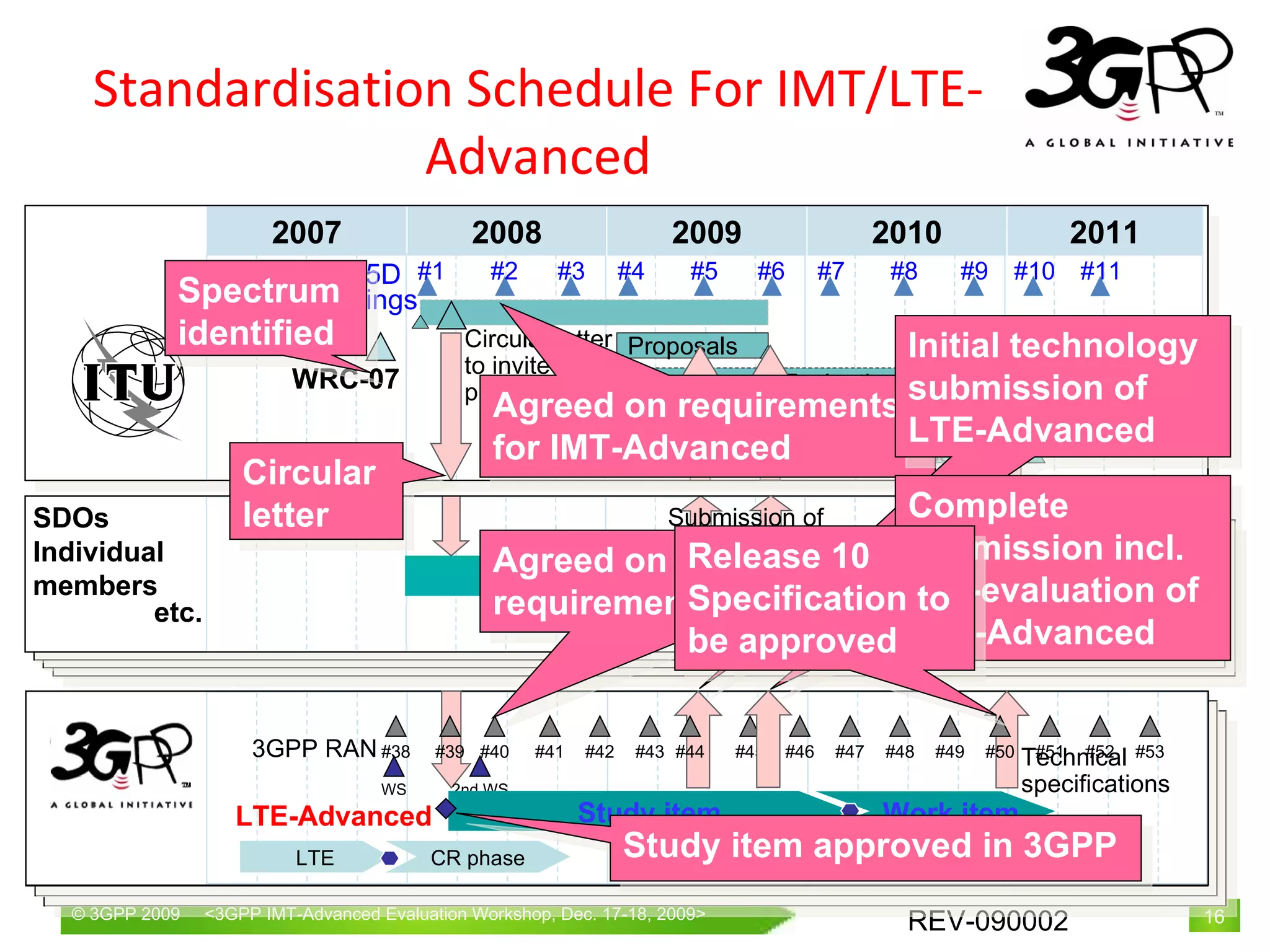
Standardisation Schedule For IMT/LTE-Advanced SDOs Individual members etc. 3GPP RAN LTE CR phase #38 #39 #40 #41 #42 #43 #44 #45 #46 #47 #48 #49 #50 #51 #52 #53 WS 2nd WS Work item Study item LTE-Advanced Technical specifications 2009 2010 2011 2007 2008 ITU-R WP5D meetings Proposals Evaluation Consensus Specification WRC-07 Circular letter to invite proposals  Study item approved in 3GPP Submission of candidate RIT  Initial technology submission of LTE-Advanced Complete submission incl. self-evaluation of LTE-Advanced #1 #2 #3 #4 #5 #6 #7 #8 #9 #10 #11 Release 10 Specification to be approved Spectrum identified Circular letter Agreed on requirements for IMT-Advanced Agreed on LTE-Advanced requirements
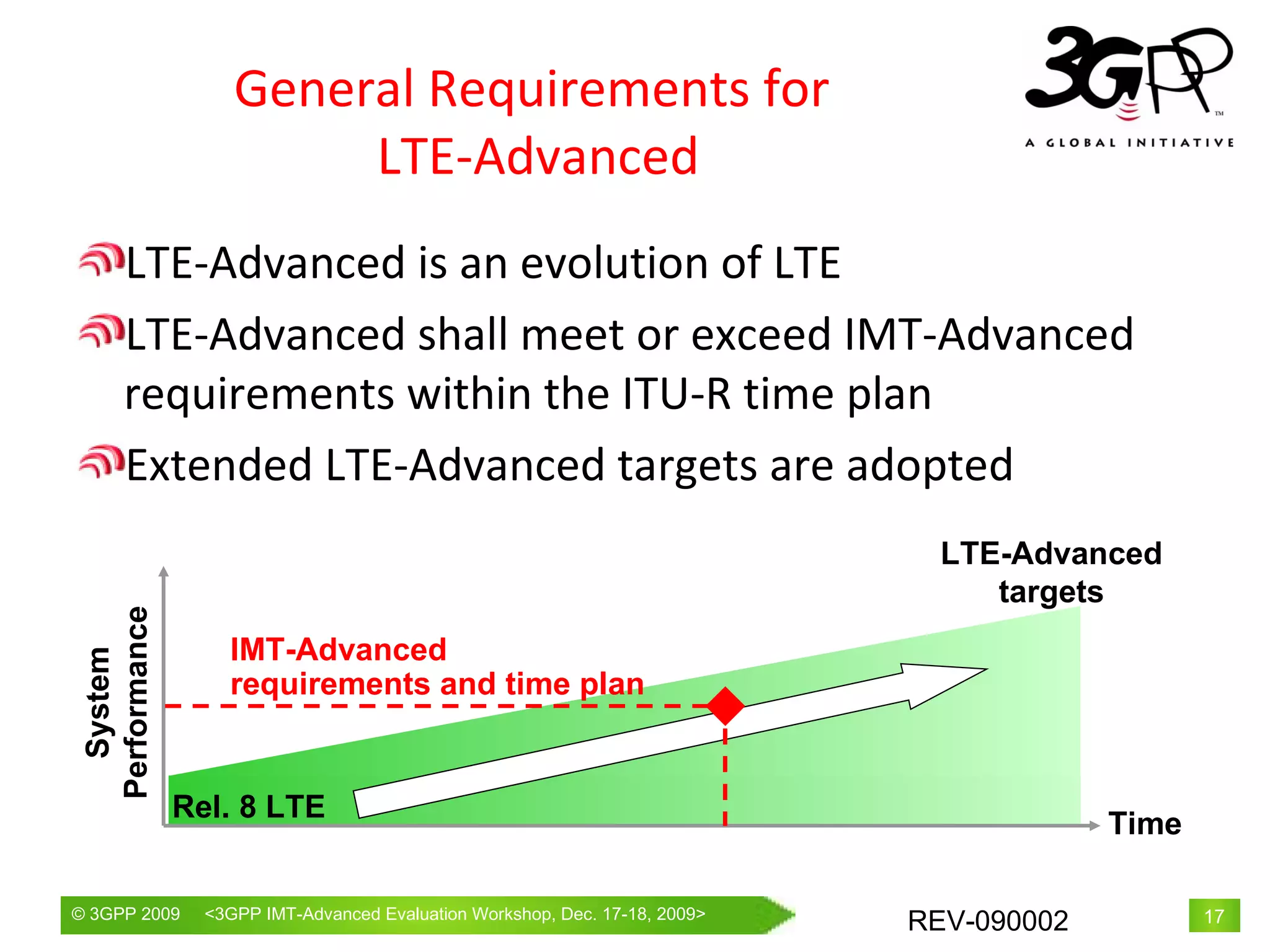
General Requirements for  LTE-Advanced LTE-Advanced is an evolution of LTE LTE-Advanced shall meet or exceed IMT-Advanced requirements within the ITU-R time plan Extended LTE-Advanced targets are adopted System Performance IMT-Advanced requirements and time plan Rel. 8 LTE LTE-Advanced targets Time
Peak data rate 1 Gbps data rate will be achieved by 4-by-4 MIMO and transmission bandwidth wider than approximately 70 MHz Peak spectrum efficiency DL: Rel. 8 LTE satisfies IMT-Advanced requirement UL: Need to double from Release 8 to satisfy IMT-Advanced requirement System Performance Requirements  *“100 Mbps for high mobility and 1 Gbps for low mobility” is one of the key features as written in Circular Letter (CL) Rel. 8 LTE LTE-Advanced IMT-Advanced Peak data rate DL 300 Mbps 1 Gbps 1 Gbps (*) UL 75 Mbps 500 Mbps Peak spectrum efficiency [bps/Hz] DL 15 30 15 UL 3.75 15 6.75
System Performance Requirements (Cont’d) x1.4-1.6 *1 See TR25.912(Case 1 scenario)  *2 See TR36.913(Case 1 scenario) *3 See ITU-R M.2135(Base Coverage Urban scenario) Capacity and cell-edge user throughput Target for LTE-Advanced was set considering gain of 1.4 to 1.6 from Release 8 LTE performance Cell-edge user throughput [bps/Hz/cell/user] DL 2-by-2 0.05 0.07 – 4-by-2 0.06 0.09 0.06 4-by-4 0.08 0.12 – UL 1-by-2 0.024 0.04 – 2-by-4 –  0.07 0.03 Ant. Config. Rel. 8 LTE* 1 LTE-Advanced* 2 IMT-Advanced *3 Capacity [bps/Hz/cell] DL 2-by-2 1.69 2.4 – 4-by-2 1.87 2.6 2.2 4-by-4 2.67 3.7 – UL 1-by-2 0.74 1.2 – 2-by-4 –  2.0 1.4
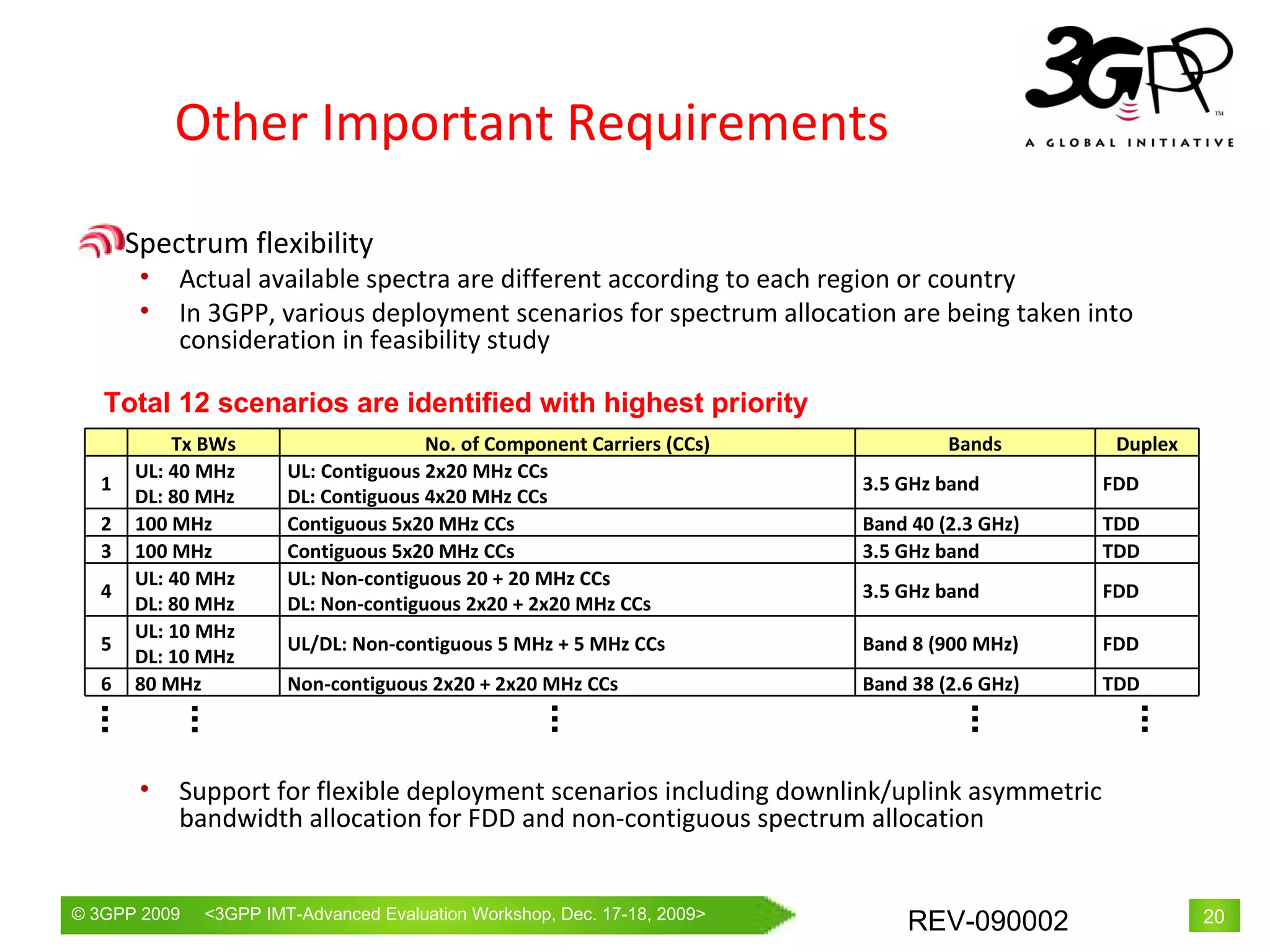
Spectrum flexibility Actual available spectra are different according to each region or country In 3GPP, various deployment scenarios for spectrum allocation are being taken into consideration in feasibility study Support for flexible deployment scenarios including downlink/uplink asymmetric bandwidth allocation for FDD and non-contiguous spectrum allocation Other Important Requirements  Total 12 scenarios are identified with highest priority Tx BWs No. of Component Carriers (CCs) Bands Duplex 1 UL: 40 MHz DL: 80 MHz UL: Contiguous 2x20 MHz CCs DL: Contiguous 4x20 MHz CCs 3.5 GHz band FDD 2 100 MH z Contiguous 5x20 MHz CCs Band 40 (2.3 GHz) TDD 3 100 MH z Contiguous 5x20 MHz CCs 3.5 GHz band T DD 4 UL: 40 MHz DL: 80 MHz UL: Non-contiguous 20 + 20 MHz CCs DL: Non-contiguous 2x20 + 2x20 MHz CCs 3.5 GHz band FDD 5 UL: 10 MHz DL: 10 MHz UL/DL: Non-contiguous 5 MHz + 5 MHz CCs Band 8 (900 MHz) FDD 6 80 MHz Non-contiguous 2x20 + 2x20 MHz CCs Band 38 (2.6 GHz) TDD
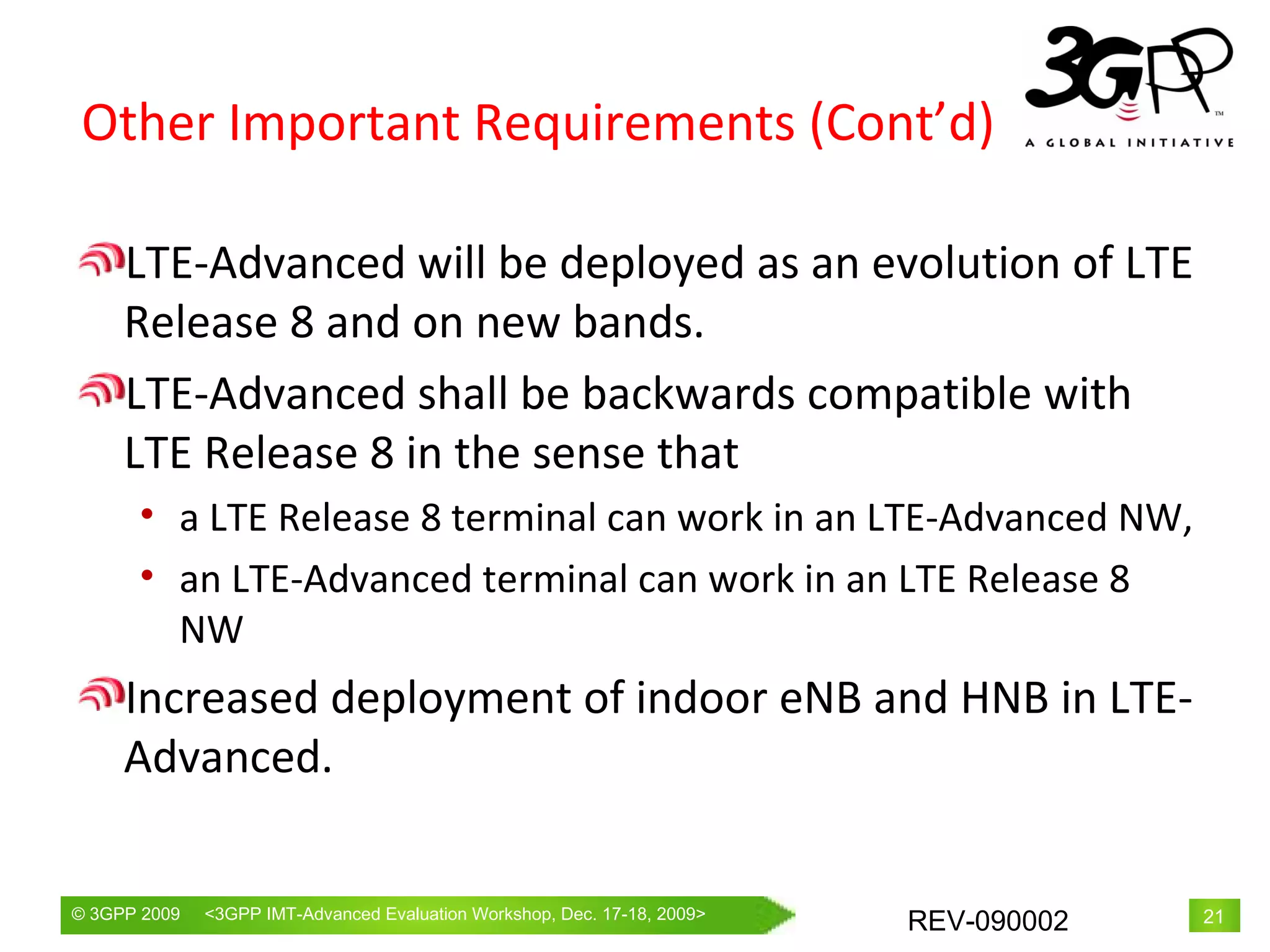
Other Important Requirements (Cont’d) LTE-Advanced will be deployed as an evolution of LTE Release 8 and on new bands.  LTE-Advanced shall be backwards compatible with LTE Release 8 in the sense that a LTE Release 8 terminal can work in an LTE-Advanced NW,  an LTE-Advanced terminal can work in an LTE Release 8 NW Increased deployment of indoor eNB and HNB in LTE-Advanced.
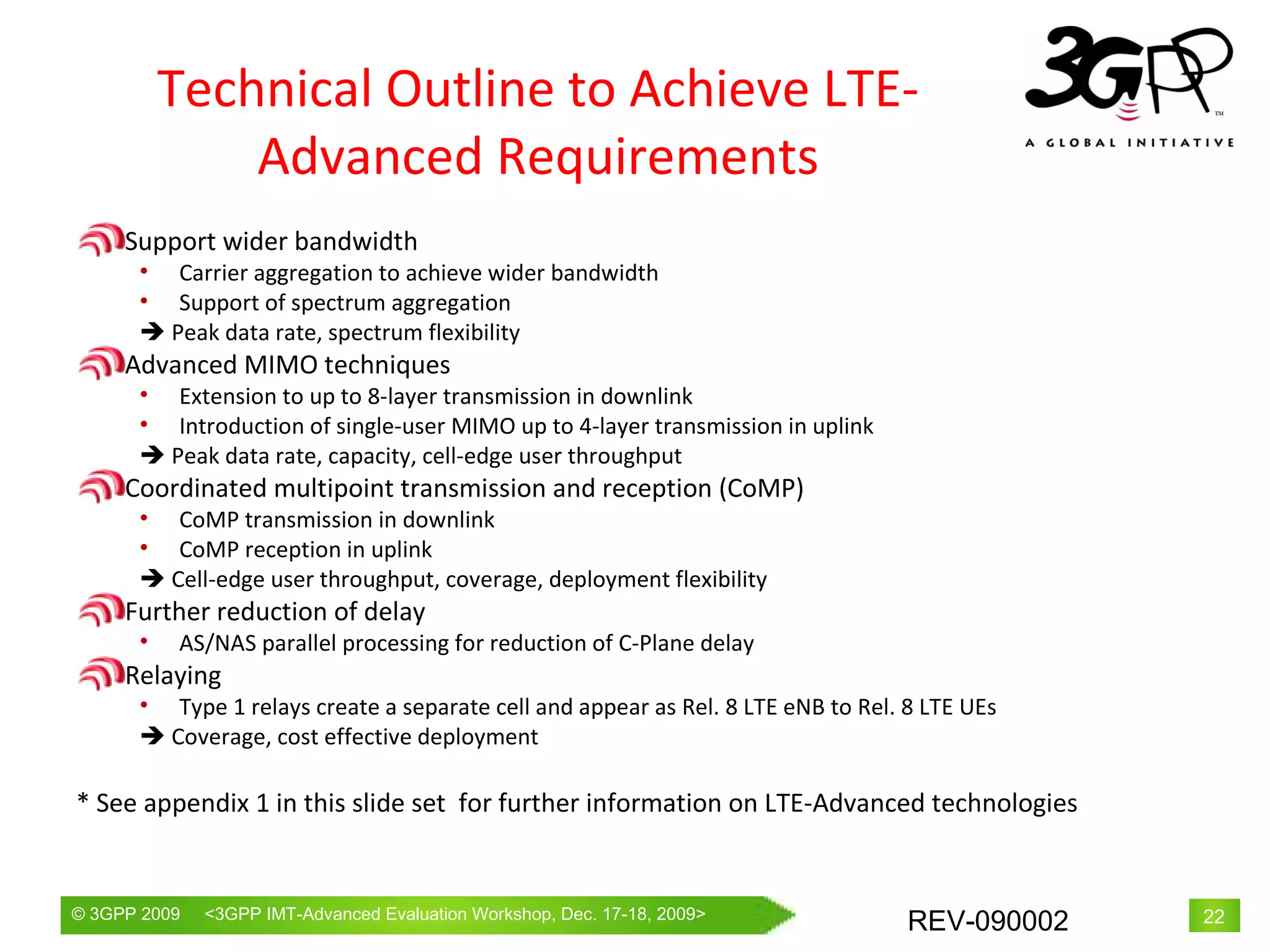
Technical Outline to Achieve LTE-Advanced Requirements Support wider bandwidth Carrier  aggregation to achieve wider bandwidth Support of spectrum aggregation    Peak data rate, spectrum flexibility Advanced MIMO techniques Extension to up to 8-layer transmission in downlink Introduction of single-user MIMO up to 4-layer transmission in uplink    Peak data rate, capacity, cell-edge user throughput Coordinated multipoint transmission and reception (CoMP) CoMP transmission in downlink CoMP reception in uplink    Cell-edge user throughput, coverage, deployment flexibility Further reduction of delay AS/NAS parallel processing for reduction of C-Plane delay Relaying Type 1 relays create a separate cell and appear as Rel. 8 LTE eNB to Rel. 8 LTE UEs    Coverage, cost effective deployment * See appendix 1 in this slide set  for further information on LTE-Advanced technologies
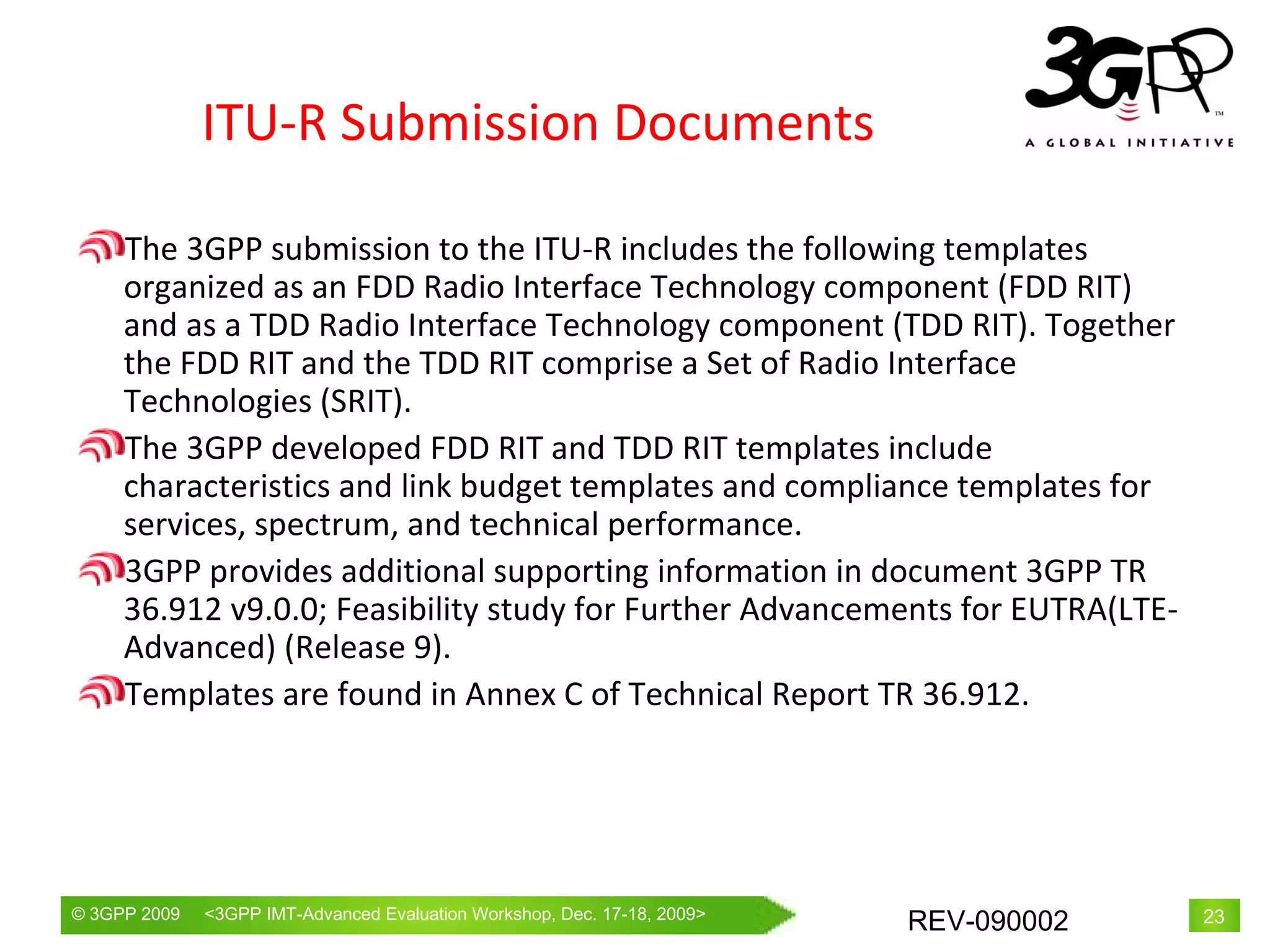
ITU-R Submission Documents The 3GPP submission to the ITU-R includes the following templates organized as an FDD Radio Interface Technology component (FDD RIT) and as a TDD Radio Interface Technology component (TDD RIT). Together the FDD RIT and the TDD RIT comprise a Set of Radio Interface Technologies (SRIT). The 3GPP developed FDD RIT and TDD RIT templates include characteristics and link budget templates and compliance templates for services, spectrum, and technical performance.  3GPP provides additional supporting information in document 3GPP TR 36.912 v9.0.0; Feasibility study for Further Advancements for EUTRA(LTE-Advanced) (Release 9).  T emplates are found in Annex C  of Technical Report TR 36.912 .
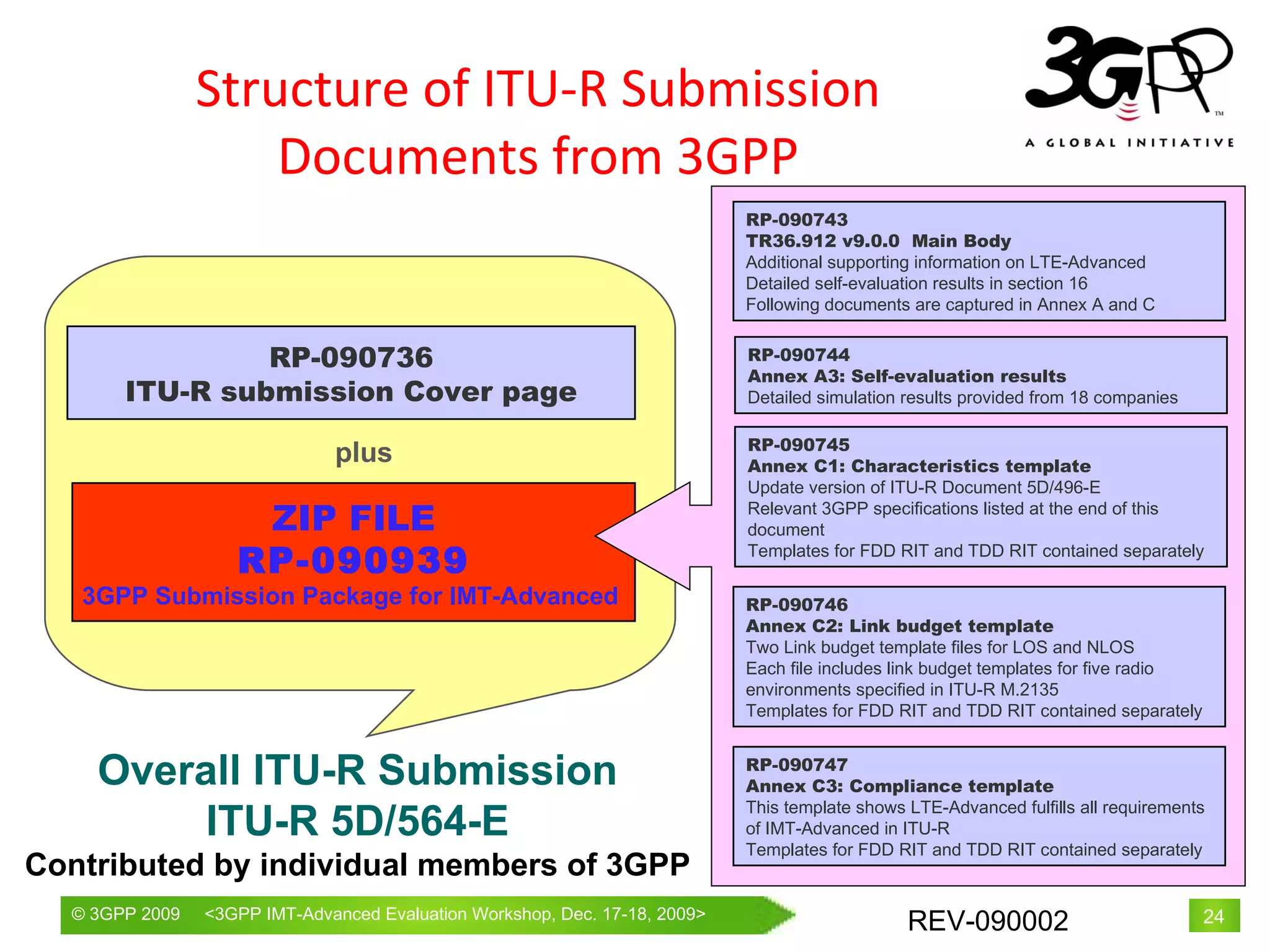
Structure of ITU-R Submission Documents from 3GPP RP-090736 ITU-R submission Cover page plus   ZIP FILE RP-090939 3GPP Submission Package for IMT-Advanced   RP-090743 TR36.912 v9.0.0  Main Body Additional supporting information on LTE-Advanced Detailed self-evaluation results in section 16 Following documents are captured in Annex A and C RP-090744 Annex A3: Self-evaluation results Detailed simulation results provided from 18 companies RP-090745 Annex C1: Characteristics template Update version of ITU-R Document 5D/496-E Relevant 3GPP specifications listed at the end of this document Templates for FDD RIT and TDD RIT contained separately RP-090746 Annex C2: Link budget template Two Link budget template files for LOS and NLOS Each file includes link budget templates for five radio environments specified in ITU-R M.2135 Templates for FDD RIT and TDD RIT contained separately RP-090747 Annex C3: Compliance template This template shows LTE-Advanced fulfills all requirements of IMT-Advanced in ITU-R Templates for FDD RIT and TDD RIT contained separately Overall ITU -R Submission ITU-R 5D/564-E Contributed by individual members of 3GPP
Contact Person for Questions Related to 3GPP ITU-R Submission Takehiro Nakamura NTT DOCOMO, Inc 3GPP TSG-RAN Chairman Email: nakamurata@nttdocomo.co.jp

LTE and LTE Advanced Introduction

  • 1.
    Proposal for CandidateRadio Interface Technologies for IMT-Advanced Based on LTE Release 10 and Beyond (LTE-Advanced) Takehiro Nakamura 3GPP TSG-RAN Chairman 3GPP IMT-Advanced Evaluation Workshop Beijing, China, 17-18 December, 2009
  • 2.
    Introduction In responseto the ITU-R Circular Letter 5/LCCE/2 which invites proposals for candidate radio interface technologies for the terrestrial component of IMT-Advanced, the Third Generation Partnership Project (3GPP) is providing a complete submission of LTE Release 10 & beyond (LTE-Advanced) under Step 3 of the IMT-Advanced process in Document IMT‑ADV/2(Rev.1) This submission of the 3GPP candidate SRIT (which includes an FDD RIT component and a TDD RIT component) is based on the currently approved work within 3GPP and follows the ITU-R IMT-Advanced submission format and guidelines. The 3GPP Proponent [1] has provided all required information within each of required major components either directly or by endorsement of this contribution made by 3GPP individual members on behalf of 3GPP: The submission of LTE-Advanced as a candidate for IMT-Advanced was acknowledged by ITU-R WP5D as a “complete” submission Following slides show overview of this submission together with relevant information [1] The 3GPP Proponent of the 3GPP submission is collectively the 3GPP Organizational Partners (OPs). The Organizational Partners of 3GPP are ARIB, ATIS, CCSA, ETSI, TTA and TTC (http://www.3gpp.org/partners)
  • 3.
    Contents 3GPP standardisationactivities LTE Release 8 LTE-Release 10 and beyond (LTE-Advanced) Self-evaluation ITU-R submission documents
  • 4.
  • 5.
    3GPP Standardisation Process3GPP develops technical specifications on 3G and beyond mobile communication systems 3GPP Organisational Partners standardize local specifications based on the specifications developed by 3GPP The standardisation process in each OP is only a form of transposition and that no technical changes are introduced ITU Existing process Project Coordination Group ( PCG ) Technical Specification Groups ( TSGs ) Technical specifications Partners Organisational Partners ( OP ) TTC, ARIB , ETSI, TTA, CCSA, ATIS Market Representation Partners ( MRP ) GSMA , TD-SCDMA Forum , Femto Forum , CDG, etc 14 partners Standardisation process in each OP Member companies Technical proposals and contributions ITU Recommendations Local specifications
  • 6.
    3GPP Structure UTRA/E-UTRAService and system aspects CN and Terminals GSM/EDGE RAN Technical Specification Group Working Group
  • 7.
    Release of 3GPPspecifications 1999 2000 2001 2002 2003 2004 2005 Release 99 Release 4 Release 5 Release 6 1.28Mcps TDD HSDPA, IMS W-CDMA HSUPA, MBMS, IMS+ 2006 2007 2008 2009 Release 7 HSPA+ (MIMO, HOM etc.) Release 8 2010 2011 LTE, SAE ITU-R M.1457 IMT-2000 Recommendations Release 9 LTE-Advanced Release 10 GSM/GPRS/EDGE enhancements Small LTE/SAE enhancements
  • 8.
  • 9.
    Motivation of LTERelease 8 Need to ensure the continuity of competitiveness of the 3G system for the future User demand for higher data rates and quality of services PS optimised system Continued demand for cost reduction (CAPEX and OPEX) Low complexity Avoid unnecessary fragmentation of technologies for paired and unpaired band operation
  • 10.
    LTE Release 8Standardisation History 2004 Q3 Q4 2005 Q1 Q2 Q3 Q4 2006 Q1 Q2 Q3 Q4 2007 Q1 Q2 Q3 Q4 2008 Q1 Q2 Q3 Q4 Study Item Work Item 3GPP TSG meeting Test specs approved Core specs functionally frozen Main work items closed Core specs approved Requirements approved Study Item “Evolved UTRA and UTRAN” Approved. Work Item “3G Long-term Evolution” approved. 2009 Q1 Q2 ASN.1 frozen
  • 11.
    LTE Release 8Key Features High spectral efficiency OFDM in Downlink Robust against multipath interference High affinity to advanced techniques Frequency domain channel-dependent scheduling MIMO DFTS-OFDM(“Single-Carrier FDMA”) in Uplink Low PAPR User orthogonality in frequency domain Multi-antenna application Very low latency Short setup time & Short transfer delay Short HO latency and interruption time Short TTI RRC procedure Simple RRC states Support of variable bandwidth 1.4, 3, 5, 10, 15 and 20 MHz
  • 12.
    LTE Release 8Key Features (Cont’d) Simple protocol architecture Shared channel based PS mode only with VoIP capability Simple Architecture eNodeB as the only E-UTRAN node Smaller number of RAN interfaces eNodeB  MME/SAE-Gateway   (S1) eNodeB  eNodeB (X2) Compatibility and inter-working with earlier 3GPP Releases Inter-working with other systems, e.g. cdma2000 FDD and TDD within a single radio access technology Efficient Multicast/Broadcast Single frequency network by OFDM Support of Self-Organising Network (SON) operation
  • 13.
    LTE Release 8Major Parameters Single layer for UL per UE Up to 4 layers for DL per UE MU-MIMO supported for UL and DL Spatial multiplexing 16.7  sec Long OFDMA DL Short UL QPSK, 16QAM, 64QAM Modulation 4.7  sec Cyclic prefix length 15kHz Sub-carrier spacing 1msec Minimum TTI 1.4, 3, 5, 10, 15, 20MHz Bandwidth DFTS-OFDM Access Scheme
  • 14.
    LTE Release 10and Beyond (LTE-Advanced)
  • 15.
    Overview of LTE-AdvancedMotivation of LTE-Advanced IMT-Advanced standardisation process in ITU-R Additional IMT spectrum band identified in WRC07 Further evolution of LTE Release 8 and 9 to meet: Requirements for IMT-Advanced of ITU-R Future operator and end-user requirements 3GPP status Feasibility study is ongoing under study item, “Further advancements for E-UTRA(LTE-Advanced)” Requirements and targets for LTE-Advanced were agreed and possible technologies to meet the requirements and the targets were identified Self-evaluations were conducted and confirmed that LTE-Advanced meet the all requirements of IMT-Advanced All necessary documents to be submitted to ITU-R WP 5D#6 as the complete submission were approved in 3GPP In 3GPP TSG-RAN#46 meeting in December 2009, some work items, based on the study results of the study item, were agreed to develop specifications for LTE-Advanced Proposal of LTE-Advanced is an SRIT including FDD RIT and TDD RIT
  • 16.
    Standardisation Schedule ForIMT/LTE-Advanced SDOs Individual members etc. 3GPP RAN LTE CR phase #38 #39 #40 #41 #42 #43 #44 #45 #46 #47 #48 #49 #50 #51 #52 #53 WS 2nd WS Work item Study item LTE-Advanced Technical specifications 2009 2010 2011 2007 2008 ITU-R WP5D meetings Proposals Evaluation Consensus Specification WRC-07 Circular letter to invite proposals Study item approved in 3GPP Submission of candidate RIT Initial technology submission of LTE-Advanced Complete submission incl. self-evaluation of LTE-Advanced #1 #2 #3 #4 #5 #6 #7 #8 #9 #10 #11 Release 10 Specification to be approved Spectrum identified Circular letter Agreed on requirements for IMT-Advanced Agreed on LTE-Advanced requirements
  • 17.
    General Requirements for LTE-Advanced LTE-Advanced is an evolution of LTE LTE-Advanced shall meet or exceed IMT-Advanced requirements within the ITU-R time plan Extended LTE-Advanced targets are adopted System Performance IMT-Advanced requirements and time plan Rel. 8 LTE LTE-Advanced targets Time
  • 18.
    Peak data rate1 Gbps data rate will be achieved by 4-by-4 MIMO and transmission bandwidth wider than approximately 70 MHz Peak spectrum efficiency DL: Rel. 8 LTE satisfies IMT-Advanced requirement UL: Need to double from Release 8 to satisfy IMT-Advanced requirement System Performance Requirements *“100 Mbps for high mobility and 1 Gbps for low mobility” is one of the key features as written in Circular Letter (CL) Rel. 8 LTE LTE-Advanced IMT-Advanced Peak data rate DL 300 Mbps 1 Gbps 1 Gbps (*) UL 75 Mbps 500 Mbps Peak spectrum efficiency [bps/Hz] DL 15 30 15 UL 3.75 15 6.75
  • 19.
    System Performance Requirements(Cont’d) x1.4-1.6 *1 See TR25.912(Case 1 scenario) *2 See TR36.913(Case 1 scenario) *3 See ITU-R M.2135(Base Coverage Urban scenario) Capacity and cell-edge user throughput Target for LTE-Advanced was set considering gain of 1.4 to 1.6 from Release 8 LTE performance Cell-edge user throughput [bps/Hz/cell/user] DL 2-by-2 0.05 0.07 – 4-by-2 0.06 0.09 0.06 4-by-4 0.08 0.12 – UL 1-by-2 0.024 0.04 – 2-by-4 – 0.07 0.03 Ant. Config. Rel. 8 LTE* 1 LTE-Advanced* 2 IMT-Advanced *3 Capacity [bps/Hz/cell] DL 2-by-2 1.69 2.4 – 4-by-2 1.87 2.6 2.2 4-by-4 2.67 3.7 – UL 1-by-2 0.74 1.2 – 2-by-4 – 2.0 1.4
  • 20.
    Spectrum flexibility Actualavailable spectra are different according to each region or country In 3GPP, various deployment scenarios for spectrum allocation are being taken into consideration in feasibility study Support for flexible deployment scenarios including downlink/uplink asymmetric bandwidth allocation for FDD and non-contiguous spectrum allocation Other Important Requirements Total 12 scenarios are identified with highest priority Tx BWs No. of Component Carriers (CCs) Bands Duplex 1 UL: 40 MHz DL: 80 MHz UL: Contiguous 2x20 MHz CCs DL: Contiguous 4x20 MHz CCs 3.5 GHz band FDD 2 100 MH z Contiguous 5x20 MHz CCs Band 40 (2.3 GHz) TDD 3 100 MH z Contiguous 5x20 MHz CCs 3.5 GHz band T DD 4 UL: 40 MHz DL: 80 MHz UL: Non-contiguous 20 + 20 MHz CCs DL: Non-contiguous 2x20 + 2x20 MHz CCs 3.5 GHz band FDD 5 UL: 10 MHz DL: 10 MHz UL/DL: Non-contiguous 5 MHz + 5 MHz CCs Band 8 (900 MHz) FDD 6 80 MHz Non-contiguous 2x20 + 2x20 MHz CCs Band 38 (2.6 GHz) TDD
  • 21.
    Other Important Requirements(Cont’d) LTE-Advanced will be deployed as an evolution of LTE Release 8 and on new bands. LTE-Advanced shall be backwards compatible with LTE Release 8 in the sense that a LTE Release 8 terminal can work in an LTE-Advanced NW, an LTE-Advanced terminal can work in an LTE Release 8 NW Increased deployment of indoor eNB and HNB in LTE-Advanced.
  • 22.
    Technical Outline toAchieve LTE-Advanced Requirements Support wider bandwidth Carrier aggregation to achieve wider bandwidth Support of spectrum aggregation  Peak data rate, spectrum flexibility Advanced MIMO techniques Extension to up to 8-layer transmission in downlink Introduction of single-user MIMO up to 4-layer transmission in uplink  Peak data rate, capacity, cell-edge user throughput Coordinated multipoint transmission and reception (CoMP) CoMP transmission in downlink CoMP reception in uplink  Cell-edge user throughput, coverage, deployment flexibility Further reduction of delay AS/NAS parallel processing for reduction of C-Plane delay Relaying Type 1 relays create a separate cell and appear as Rel. 8 LTE eNB to Rel. 8 LTE UEs  Coverage, cost effective deployment * See appendix 1 in this slide set for further information on LTE-Advanced technologies
  • 23.
    ITU-R Submission DocumentsThe 3GPP submission to the ITU-R includes the following templates organized as an FDD Radio Interface Technology component (FDD RIT) and as a TDD Radio Interface Technology component (TDD RIT). Together the FDD RIT and the TDD RIT comprise a Set of Radio Interface Technologies (SRIT). The 3GPP developed FDD RIT and TDD RIT templates include characteristics and link budget templates and compliance templates for services, spectrum, and technical performance. 3GPP provides additional supporting information in document 3GPP TR 36.912 v9.0.0; Feasibility study for Further Advancements for EUTRA(LTE-Advanced) (Release 9). T emplates are found in Annex C of Technical Report TR 36.912 .
  • 24.
    Structure of ITU-RSubmission Documents from 3GPP RP-090736 ITU-R submission Cover page plus ZIP FILE RP-090939 3GPP Submission Package for IMT-Advanced RP-090743 TR36.912 v9.0.0 Main Body Additional supporting information on LTE-Advanced Detailed self-evaluation results in section 16 Following documents are captured in Annex A and C RP-090744 Annex A3: Self-evaluation results Detailed simulation results provided from 18 companies RP-090745 Annex C1: Characteristics template Update version of ITU-R Document 5D/496-E Relevant 3GPP specifications listed at the end of this document Templates for FDD RIT and TDD RIT contained separately RP-090746 Annex C2: Link budget template Two Link budget template files for LOS and NLOS Each file includes link budget templates for five radio environments specified in ITU-R M.2135 Templates for FDD RIT and TDD RIT contained separately RP-090747 Annex C3: Compliance template This template shows LTE-Advanced fulfills all requirements of IMT-Advanced in ITU-R Templates for FDD RIT and TDD RIT contained separately Overall ITU -R Submission ITU-R 5D/564-E Contributed by individual members of 3GPP
  • 25.
    Contact Person forQuestions Related to 3GPP ITU-R Submission Takehiro Nakamura NTT DOCOMO, Inc 3GPP TSG-RAN Chairman Email: nakamurata@nttdocomo.co.jp