 Bharti Airtel Limited, commonly known as Airtel. Airtel is the
fifth largest telecom operator in the world with over 207.8 million
subscribers across 19 countries at the end of 2010.
 The company was founded on July 7, 1995 by its chairman and
MD Mr. SUNIL BHARTI MITTAL.
 Airtel is the 3rd largest in-country mobile operator by subscriber
base, behind China Mobile and China Unicom .
LTE : INTRODUCTION
LTE : TECHNOLOGY INSIGHT
LTE FEATURES
What is LTE ?
Driving Forces Behind LTE
LTE Vendor Ecosystem
LTE & 2G/3G Interworking Network Architecture
LTE Network Architecture - EPS
Technology Standardization Timeline
LTE Performance Targets
LTE Market Assessment
Overview of TD-LTE Market
LTE Indian Market Scenario
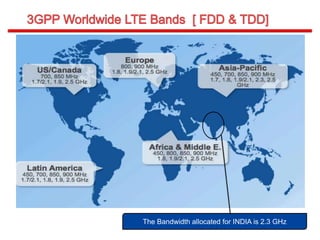
3GPP Worldwide LTE Bands [ FDD & TDD ]
Radio Technology Options
LTE Modes : TDD & FDD
“LTE” stands for Long -Term Evolution
Long Term Evolution (LTE) is the next generation 3GPP (Third Generation
Partnership Project) radio access network
LTE has an all IP Flat Network Architecture
LTE consists of SAE (System Architecture Evolution) And E-UTRAN, together known
as EPS (Evolved Packet System)
LTE works on 2 duplexing methods: TDD (Time Division Duplex) & FDD (Frequency
Division Duplex)
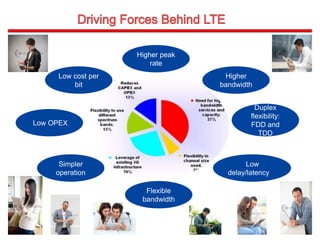
Higher peak
rate
Higher
bandwidth
Low
delay/latency
Low OPEX
Flexible
bandwidth
Low cost per
bit
Simpler
operation
Duplex
flexibility:
FDD and
TDD
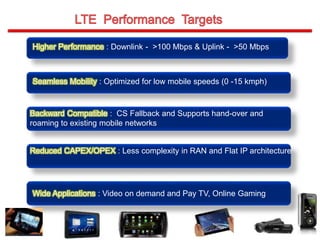
Higher Performance : Downlink - >100 Mbps & Uplink - >50 Mbps
Seamless Mobility : Optimized for low mobile speeds (0 -15 kmph)
Wide Applications : Video on demand and Pay TV, Online Gaming
Backward Compatible : CS Fallback and Supports hand-over and
roaming to existing mobile networks
Reduced CAPEX/OPEX : Less complexity in RAN and Flat IP architecture
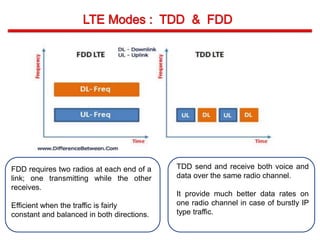
FDD requires two radios at each end of a
link; one transmitting while the other
receives.
Efficient when the traffic is fairly
constant and balanced in both directions.
TDD send and receive both voice and
data over the same radio channel.
It provide much better data rates on
one radio channel in case of burstly IP
type traffic.
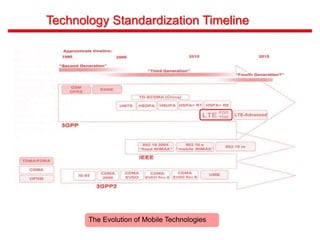
Technology Standardization Timeline
The Evolution of Mobile Technologies
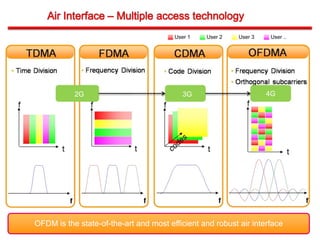
OFDM is the state-of-the-art and most efficient and robust air interface
User 1 User 2 User 3 User ..
2G 3G 4G
The Bandwidth allocated for INDIA is 2.3 GHz
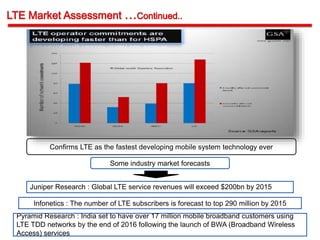
***Source : www.gsacom.com
[Latest by 2011, Aug 31st ]
 174 LTE network commitments in 64 countries
 63 pre-commitments trials in 21 more
countries
 26 commercial LTE networks launched
 At least 93 LTE networks are expected to be
in commercial service by end 2012
237 operators in 85 countries are
investing in LTE
Confirms LTE as the fastest developing mobile system technology ever
Some industry market forecasts
Juniper Research : Global LTE service revenues will exceed $200bn by 2015
Infonetics : The number of LTE subscribers is forecast to top 290 million by 2015
Pyramid Research : India set to have over 17 million mobile broadband customers using
LTE TDD networks by the end of 2016 following the launch of BWA (Broadband Wireless
Access) services
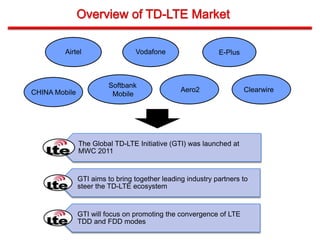
CHINA Mobile
Airtel
Softbank
Mobile
Vodafone
Aero2
E-Plus
Clearwire
The Global TD-LTE Initiative (GTI) was launched at
MWC 2011
GTI aims to bring together leading industry partners to
steer the TD-LTE ecosystem
GTI will focus on promoting the convergence of LTE
TDD and FDD modes
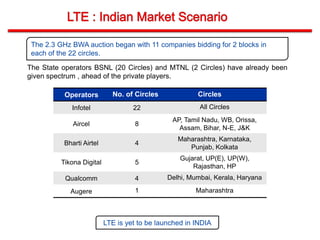
The 2.3 GHz BWA auction began with 11 companies bidding for 2 blocks in
each of the 22 circles.
Operators No. of Circles Circles
Infotel 22 All Circles
Aircel 8
AP, Tamil Nadu, WB, Orissa,
Assam, Bihar, N-E, J&K
Bharti Airtel 4
Maharashtra, Karnataka,
Punjab, Kolkata
Tikona Digital 5
Gujarat, UP(E), UP(W),
Rajasthan, HP
Qualcomm 4 Delhi, Mumbai, Kerala, Haryana
Augere 1 Maharashtra
The State operators BSNL (20 Circles) and MTNL (2 Circles) have already been
given spectrum , ahead of the private players.
LTE is yet to be launched in INDIA
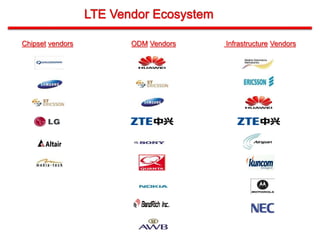
Chipset vendors ODM Vendors Infrastructure Vendors
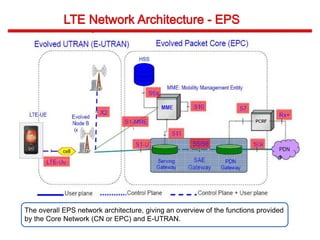
The overall EPS network architecture, giving an overview of the functions provided
by the Core Network (CN or EPC) and E-UTRAN.
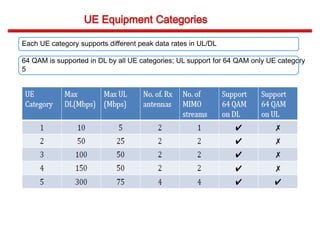
Each UE category supports different peak data rates in UL/DL
64 QAM is supported in DL by all UE categories; UL support for 64 QAM only UE category
5
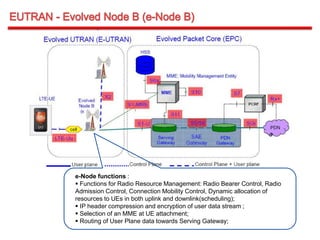
e-Node functions :
 Functions for Radio Resource Management: Radio Bearer Control, Radio
Admission Control, Connection Mobility Control, Dynamic allocation of
resources to UEs in both uplink and downlink(scheduling);
 IP header compression and encryption of user data stream ;
 Selection of an MME at UE attachment;
 Routing of User Plane data towards Serving Gateway;
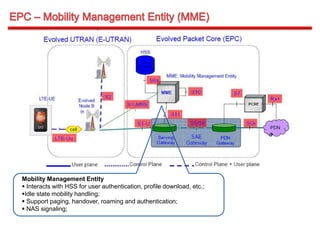
Mobility Management Entity
 Interacts with HSS for user authentication, profile download, etc.;
Idle state mobility handling;
 Support paging, handover, roaming and authentication;
 NAS signaling;
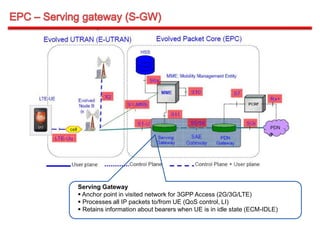
Serving Gateway
 Anchor point in visited network for 3GPP Access (2G/3G/LTE)
 Processes all IP packets to/from UE (QoS control, LI)
 Retains information about bearers when UE is in idle state (ECM-IDLE)
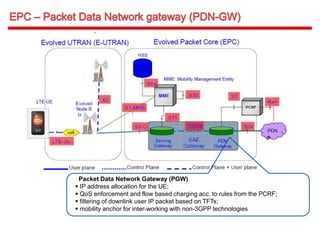
Packet Data Network Gateway (PGW)
 IP address allocation for the UE;
 QoS enforcement and flow based charging acc. to rules from the PCRF;
 filtering of downlink user IP packet based on TFTs;
 mobility anchor for inter-working with non-3GPP technologies
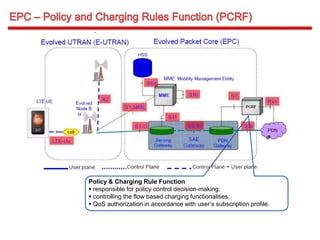
Policy & Charging Rule Function
 responsible for policy control decision-making;
 controlling the flow based charging functionalities;
 QoS authorization in accordance with user’s subscription profile.
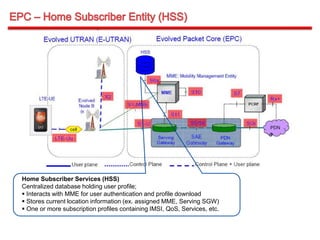
Home Subscriber Services (HSS)
Centralized database holding user profile;
 Interacts with MME for user authentication and profile download
 Stores current location information (ex. assigned MME, Serving SGW)
 One or more subscription profiles containing IMSI, QoS, Services, etc.
Air Interface – Multiple access technology
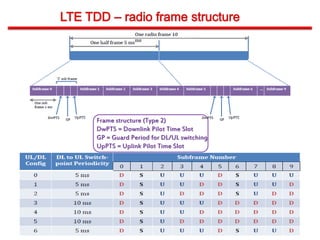
LTE TDD – radio frame structure
LTE Downlink : OFDMA
LTE Uplink : SC-FDMA
Cyclic Prefix
Field measurement parameters
Downlink Resource Block
Frame structure (Type 2)
DwPTS = Downlink Pilot Time Slot
GP = Guard Period for DL/UL switching
UpPTS = Uplink Pilot Time Slot
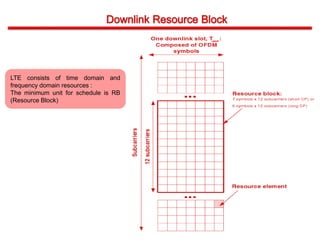
LTE consists of time domain and
frequency domain resources :
The minimum unit for schedule is RB
(Resource Block)
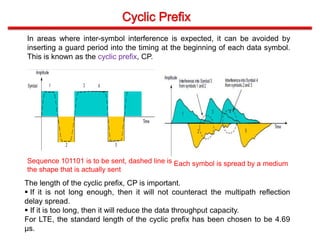
In areas where inter-symbol interference is expected, it can be avoided by
inserting a guard period into the timing at the beginning of each data symbol.
This is known as the cyclic prefix, CP.
The length of the cyclic prefix, CP is important.
 If it is not long enough, then it will not counteract the multipath reflection
delay spread.
 If it is too long, then it will reduce the data throughput capacity.
For LTE, the standard length of the cyclic prefix has been chosen to be 4.69
µs.
Sequence 101101 is to be sent, dashed line is
the shape that is actually sent
Each symbol is spread by a medium
Disadvantage : High PAPR.
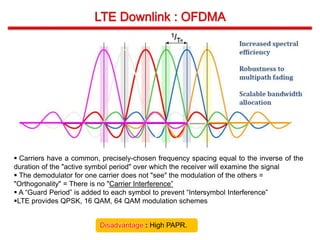
 Carriers have a common, precisely-chosen frequency spacing equal to the inverse of the
duration of the "active symbol period" over which the receiver will examine the signal
 The demodulator for one carrier does not "see" the modulation of the others =
"Orthogonality" = There is no "Carrier Interference”
 A “Guard Period” is added to each symbol to prevent “Intersymbol Interference”
LTE provides QPSK, 16 QAM, 64 QAM modulation schemes
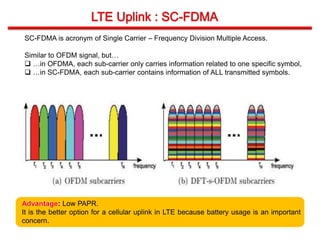
SC-FDMA is acronym of Single Carrier – Frequency Division Multiple Access.
Similar to OFDM signal, but…
 …in OFDMA, each sub-carrier only carries information related to one specific symbol,
 …in SC-FDMA, each sub-carrier contains information of ALL transmitted symbols.
Advantage: Low PAPR.
It is the better option for a cellular uplink in LTE because battery usage is an important
concern.
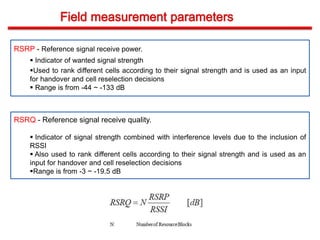
RSRP - Reference signal receive power.
 Indicator of wanted signal strength
Used to rank different cells according to their signal strength and is used as an input
for handover and cell reselection decisions
 Range is from -44 ~ -133 dB
RSRQ - Reference signal receive quality.
 Indicator of signal strength combined with interference levels due to the inclusion of
RSSI
 Also used to rank different cells according to their signal strength and is used as an
input for handover and cell reselection decisions
Range is from -3 ~ -19.5 dB
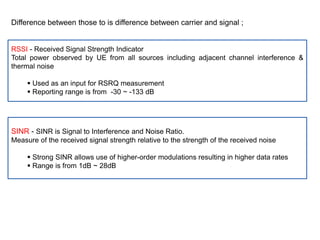
Difference between those to is difference between carrier and signal ;
RSSI - Received Signal Strength Indicator
Total power observed by UE from all sources including adjacent channel interference &
thermal noise
 Used as an input for RSRQ measurement
 Reporting range is from -30 ~ -133 dB
SINR - SINR is Signal to Interference and Noise Ratio.
Measure of the received signal strength relative to the strength of the received noise
 Strong SINR allows use of higher-order modulations resulting in higher data rates
 Range is from 1dB ~ 28dB
Advanced Antenna Systems
Beamforming
Inter Cell Interference Coordination (ICIC)
Self Organization Network (SON)
LTE Handover
MIMO
ARQ and HARQ
Circuit Switched (CS) Fallback
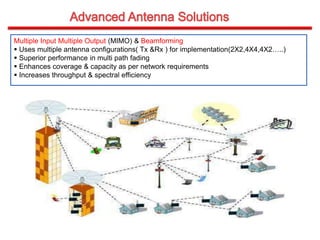
Multiple Input Multiple Output (MIMO) & Beamforming
 Uses multiple antenna configurations( Tx &Rx ) for implementation(2X2,4X4,4X2…..)
 Superior performance in multi path fading
 Enhances coverage & capacity as per network requirements
 Increases throughput & spectral efficiency
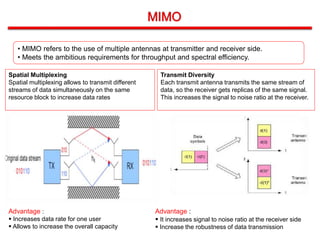
• MIMO refers to the use of multiple antennas at transmitter and receiver side.
• Meets the ambitious requirements for throughput and spectral efficiency.
Spatial Multiplexing
Spatial multiplexing allows to transmit different
streams of data simultaneously on the same
resource block to increase data rates
Transmit Diversity
Each transmit antenna transmits the same stream of
data, so the receiver gets replicas of the same signal.
This increases the signal to noise ratio at the receiver.
Advantage :
 Increases data rate for one user
 Allows to increase the overall capacity
Advantage :
 It increases signal to noise ratio at the receiver side
 Increase the robustness of data transmission
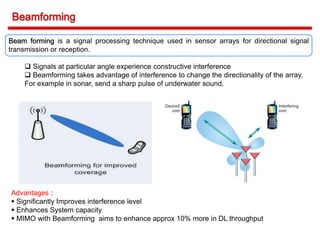
Beam forming is a signal processing technique used in sensor arrays for directional signal
transmission or reception.
 Signals at particular angle experience constructive interference
 Beamforming takes advantage of interference to change the directionality of the array.
For example in sonar, send a sharp pulse of underwater sound.
Advantages :
 Significantly Improves interference level
 Enhances System capacity
 MIMO with Beamforming aims to enhance approx 10% more in DL throughput
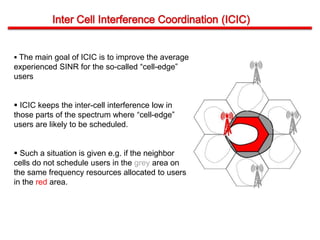
 The main goal of ICIC is to improve the average
experienced SINR for the so-called “cell-edge”
users
 ICIC keeps the inter-cell interference low in
those parts of the spectrum where “cell-edge”
users are likely to be scheduled.
 Such a situation is given e.g. if the neighbor
cells do not schedule users in the grey area on
the same frequency resources allocated to users
in the red area.
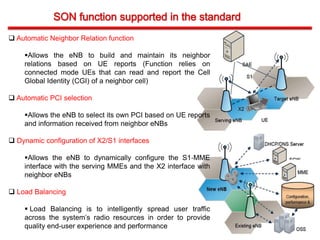
 Automatic Neighbor Relation function
Allows the eNB to build and maintain its neighbor
relations based on UE reports (Function relies on
connected mode UEs that can read and report the Cell
Global Identity (CGI) of a neighbor cell)
 Automatic PCI selection
Allows the eNB to select its own PCI based on UE reports
and information received from neighbor eNBs
 Dynamic configuration of X2/S1 interfaces
Allows the eNB to dynamically configure the S1‐MME
interface with the serving MMEs and the X2 interface with
neighbor eNBs
 Load Balancing
 Load Balancing is to intelligently spread user traffic
across the system’s radio resources in order to provide
quality end-user experience and performance
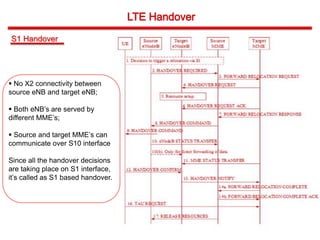
S1 Handover
 No X2 connectivity between
source eNB and target eNB;
 Both eNB’s are served by
different MME’s;
 Source and target MME’s can
communicate over S10 interface
Since all the handover decisions
are taking place on S1 interface,
it’s called as S1 based handover.
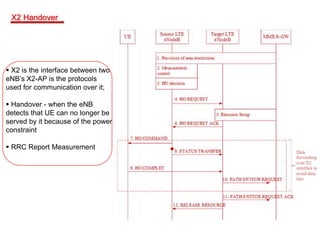
X2 Handover
 X2 is the interface between two
eNB’s X2-AP is the protocols
used for communication over it;
 Handover - when the eNB
detects that UE can no longer be
served by it because of the power
constraint;
 RRC Report Measurement
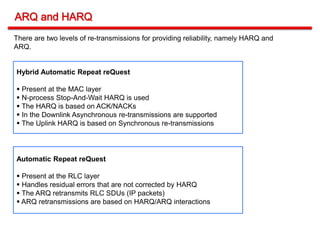
Hybrid Automatic Repeat reQuest
 Present at the MAC layer
 N-process Stop-And-Wait HARQ is used
 The HARQ is based on ACK/NACKs
 In the Downlink Asynchronous re-transmissions are supported
 The Uplink HARQ is based on Synchronous re-transmissions
There are two levels of re-transmissions for providing reliability, namely HARQ and
ARQ.
Automatic Repeat reQuest
 Present at the RLC layer
 Handles residual errors that are not corrected by HARQ
 The ARQ retransmits RLC SDUs (IP packets)
 ARQ retransmissions are based on HARQ/ARQ interactions
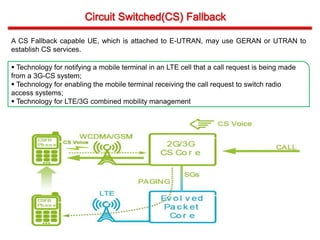
A CS Fallback capable UE, which is attached to E-UTRAN, may use GERAN or UTRAN to
establish CS services.
 Technology for notifying a mobile terminal in an LTE cell that a call request is being made
from a 3G-CS system;
 Technology for enabling the mobile terminal receiving the call request to switch radio
access systems;
 Technology for LTE/3G combined mobility management
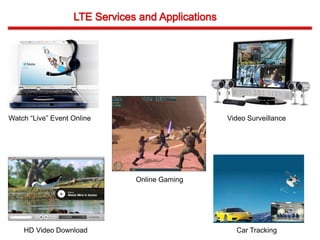
LTE Services and Applications
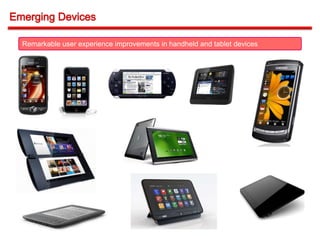
Emerging Devices
LTE – The Future Lifeline
Remarkable user experience improvements in handheld and tablet devices
Watch “Live” Event Online
Online Gaming
HD Video Download
Video Surveillance
Car Tracking
Video.. To know all about LTE
2.6.2010
Exciting services that…
• make her life easier
• entertain and inform her
• connect with her friends
• let her work efficiently
• can be used everywhere always
• … with affordable prices
20.9.2010
Thank youThank You

4G - LTE

  • 2.
     Bharti AirtelLimited, commonly known as Airtel. Airtel is the fifth largest telecom operator in the world with over 207.8 million subscribers across 19 countries at the end of 2010.  The company was founded on July 7, 1995 by its chairman and MD Mr. SUNIL BHARTI MITTAL.  Airtel is the 3rd largest in-country mobile operator by subscriber base, behind China Mobile and China Unicom .
  • 3.
    LTE : INTRODUCTION LTE: TECHNOLOGY INSIGHT LTE FEATURES
  • 4.
    What is LTE? Driving Forces Behind LTE LTE Vendor Ecosystem LTE & 2G/3G Interworking Network Architecture LTE Network Architecture - EPS Technology Standardization Timeline LTE Performance Targets LTE Market Assessment Overview of TD-LTE Market LTE Indian Market Scenario 3GPP Worldwide LTE Bands [ FDD & TDD ] Radio Technology Options LTE Modes : TDD & FDD
  • 5.
    “LTE” stands forLong -Term Evolution Long Term Evolution (LTE) is the next generation 3GPP (Third Generation Partnership Project) radio access network LTE has an all IP Flat Network Architecture LTE consists of SAE (System Architecture Evolution) And E-UTRAN, together known as EPS (Evolved Packet System) LTE works on 2 duplexing methods: TDD (Time Division Duplex) & FDD (Frequency Division Duplex)
  • 6.
    Higher peak rate Higher bandwidth Low delay/latency Low OPEX Flexible bandwidth Lowcost per bit Simpler operation Duplex flexibility: FDD and TDD
  • 7.
    Higher Performance :Downlink - >100 Mbps & Uplink - >50 Mbps Seamless Mobility : Optimized for low mobile speeds (0 -15 kmph) Wide Applications : Video on demand and Pay TV, Online Gaming Backward Compatible : CS Fallback and Supports hand-over and roaming to existing mobile networks Reduced CAPEX/OPEX : Less complexity in RAN and Flat IP architecture
  • 8.
    FDD requires tworadios at each end of a link; one transmitting while the other receives. Efficient when the traffic is fairly constant and balanced in both directions. TDD send and receive both voice and data over the same radio channel. It provide much better data rates on one radio channel in case of burstly IP type traffic.
  • 9.
    Technology Standardization Timeline TheEvolution of Mobile Technologies
  • 10.
    OFDM is thestate-of-the-art and most efficient and robust air interface User 1 User 2 User 3 User .. 2G 3G 4G
  • 11.
    The Bandwidth allocatedfor INDIA is 2.3 GHz
  • 12.
    ***Source : www.gsacom.com [Latestby 2011, Aug 31st ]  174 LTE network commitments in 64 countries  63 pre-commitments trials in 21 more countries  26 commercial LTE networks launched  At least 93 LTE networks are expected to be in commercial service by end 2012 237 operators in 85 countries are investing in LTE
  • 13.
    Confirms LTE asthe fastest developing mobile system technology ever Some industry market forecasts Juniper Research : Global LTE service revenues will exceed $200bn by 2015 Infonetics : The number of LTE subscribers is forecast to top 290 million by 2015 Pyramid Research : India set to have over 17 million mobile broadband customers using LTE TDD networks by the end of 2016 following the launch of BWA (Broadband Wireless Access) services
  • 14.
    CHINA Mobile Airtel Softbank Mobile Vodafone Aero2 E-Plus Clearwire The GlobalTD-LTE Initiative (GTI) was launched at MWC 2011 GTI aims to bring together leading industry partners to steer the TD-LTE ecosystem GTI will focus on promoting the convergence of LTE TDD and FDD modes
  • 15.
    The 2.3 GHzBWA auction began with 11 companies bidding for 2 blocks in each of the 22 circles. Operators No. of Circles Circles Infotel 22 All Circles Aircel 8 AP, Tamil Nadu, WB, Orissa, Assam, Bihar, N-E, J&K Bharti Airtel 4 Maharashtra, Karnataka, Punjab, Kolkata Tikona Digital 5 Gujarat, UP(E), UP(W), Rajasthan, HP Qualcomm 4 Delhi, Mumbai, Kerala, Haryana Augere 1 Maharashtra The State operators BSNL (20 Circles) and MTNL (2 Circles) have already been given spectrum , ahead of the private players. LTE is yet to be launched in INDIA
  • 16.
    Chipset vendors ODMVendors Infrastructure Vendors
  • 17.
    The overall EPSnetwork architecture, giving an overview of the functions provided by the Core Network (CN or EPC) and E-UTRAN.
  • 18.
    Each UE categorysupports different peak data rates in UL/DL 64 QAM is supported in DL by all UE categories; UL support for 64 QAM only UE category 5
  • 19.
    e-Node functions : Functions for Radio Resource Management: Radio Bearer Control, Radio Admission Control, Connection Mobility Control, Dynamic allocation of resources to UEs in both uplink and downlink(scheduling);  IP header compression and encryption of user data stream ;  Selection of an MME at UE attachment;  Routing of User Plane data towards Serving Gateway;
  • 20.
    Mobility Management Entity Interacts with HSS for user authentication, profile download, etc.; Idle state mobility handling;  Support paging, handover, roaming and authentication;  NAS signaling;
  • 21.
    Serving Gateway  Anchorpoint in visited network for 3GPP Access (2G/3G/LTE)  Processes all IP packets to/from UE (QoS control, LI)  Retains information about bearers when UE is in idle state (ECM-IDLE)
  • 22.
    Packet Data NetworkGateway (PGW)  IP address allocation for the UE;  QoS enforcement and flow based charging acc. to rules from the PCRF;  filtering of downlink user IP packet based on TFTs;  mobility anchor for inter-working with non-3GPP technologies
  • 23.
    Policy & ChargingRule Function  responsible for policy control decision-making;  controlling the flow based charging functionalities;  QoS authorization in accordance with user’s subscription profile.
  • 24.
    Home Subscriber Services(HSS) Centralized database holding user profile;  Interacts with MME for user authentication and profile download  Stores current location information (ex. assigned MME, Serving SGW)  One or more subscription profiles containing IMSI, QoS, Services, etc.
  • 25.
    Air Interface –Multiple access technology LTE TDD – radio frame structure LTE Downlink : OFDMA LTE Uplink : SC-FDMA Cyclic Prefix Field measurement parameters Downlink Resource Block
  • 26.
    Frame structure (Type2) DwPTS = Downlink Pilot Time Slot GP = Guard Period for DL/UL switching UpPTS = Uplink Pilot Time Slot
  • 27.
    LTE consists oftime domain and frequency domain resources : The minimum unit for schedule is RB (Resource Block)
  • 28.
    In areas whereinter-symbol interference is expected, it can be avoided by inserting a guard period into the timing at the beginning of each data symbol. This is known as the cyclic prefix, CP. The length of the cyclic prefix, CP is important.  If it is not long enough, then it will not counteract the multipath reflection delay spread.  If it is too long, then it will reduce the data throughput capacity. For LTE, the standard length of the cyclic prefix has been chosen to be 4.69 µs. Sequence 101101 is to be sent, dashed line is the shape that is actually sent Each symbol is spread by a medium
  • 29.
    Disadvantage : HighPAPR.  Carriers have a common, precisely-chosen frequency spacing equal to the inverse of the duration of the "active symbol period" over which the receiver will examine the signal  The demodulator for one carrier does not "see" the modulation of the others = "Orthogonality" = There is no "Carrier Interference”  A “Guard Period” is added to each symbol to prevent “Intersymbol Interference” LTE provides QPSK, 16 QAM, 64 QAM modulation schemes
  • 30.
    SC-FDMA is acronymof Single Carrier – Frequency Division Multiple Access. Similar to OFDM signal, but…  …in OFDMA, each sub-carrier only carries information related to one specific symbol,  …in SC-FDMA, each sub-carrier contains information of ALL transmitted symbols. Advantage: Low PAPR. It is the better option for a cellular uplink in LTE because battery usage is an important concern.
  • 31.
    RSRP - Referencesignal receive power.  Indicator of wanted signal strength Used to rank different cells according to their signal strength and is used as an input for handover and cell reselection decisions  Range is from -44 ~ -133 dB RSRQ - Reference signal receive quality.  Indicator of signal strength combined with interference levels due to the inclusion of RSSI  Also used to rank different cells according to their signal strength and is used as an input for handover and cell reselection decisions Range is from -3 ~ -19.5 dB
  • 32.
    Difference between thoseto is difference between carrier and signal ; RSSI - Received Signal Strength Indicator Total power observed by UE from all sources including adjacent channel interference & thermal noise  Used as an input for RSRQ measurement  Reporting range is from -30 ~ -133 dB SINR - SINR is Signal to Interference and Noise Ratio. Measure of the received signal strength relative to the strength of the received noise  Strong SINR allows use of higher-order modulations resulting in higher data rates  Range is from 1dB ~ 28dB
  • 33.
    Advanced Antenna Systems Beamforming InterCell Interference Coordination (ICIC) Self Organization Network (SON) LTE Handover MIMO ARQ and HARQ Circuit Switched (CS) Fallback
  • 34.
    Multiple Input MultipleOutput (MIMO) & Beamforming  Uses multiple antenna configurations( Tx &Rx ) for implementation(2X2,4X4,4X2…..)  Superior performance in multi path fading  Enhances coverage & capacity as per network requirements  Increases throughput & spectral efficiency
  • 35.
    • MIMO refersto the use of multiple antennas at transmitter and receiver side. • Meets the ambitious requirements for throughput and spectral efficiency. Spatial Multiplexing Spatial multiplexing allows to transmit different streams of data simultaneously on the same resource block to increase data rates Transmit Diversity Each transmit antenna transmits the same stream of data, so the receiver gets replicas of the same signal. This increases the signal to noise ratio at the receiver. Advantage :  Increases data rate for one user  Allows to increase the overall capacity Advantage :  It increases signal to noise ratio at the receiver side  Increase the robustness of data transmission
  • 36.
    Beam forming isa signal processing technique used in sensor arrays for directional signal transmission or reception.  Signals at particular angle experience constructive interference  Beamforming takes advantage of interference to change the directionality of the array. For example in sonar, send a sharp pulse of underwater sound. Advantages :  Significantly Improves interference level  Enhances System capacity  MIMO with Beamforming aims to enhance approx 10% more in DL throughput
  • 37.
     The maingoal of ICIC is to improve the average experienced SINR for the so-called “cell-edge” users  ICIC keeps the inter-cell interference low in those parts of the spectrum where “cell-edge” users are likely to be scheduled.  Such a situation is given e.g. if the neighbor cells do not schedule users in the grey area on the same frequency resources allocated to users in the red area.
  • 38.
     Automatic NeighborRelation function Allows the eNB to build and maintain its neighbor relations based on UE reports (Function relies on connected mode UEs that can read and report the Cell Global Identity (CGI) of a neighbor cell)  Automatic PCI selection Allows the eNB to select its own PCI based on UE reports and information received from neighbor eNBs  Dynamic configuration of X2/S1 interfaces Allows the eNB to dynamically configure the S1‐MME interface with the serving MMEs and the X2 interface with neighbor eNBs  Load Balancing  Load Balancing is to intelligently spread user traffic across the system’s radio resources in order to provide quality end-user experience and performance
  • 39.
    S1 Handover  NoX2 connectivity between source eNB and target eNB;  Both eNB’s are served by different MME’s;  Source and target MME’s can communicate over S10 interface Since all the handover decisions are taking place on S1 interface, it’s called as S1 based handover.
  • 40.
    X2 Handover  X2is the interface between two eNB’s X2-AP is the protocols used for communication over it;  Handover - when the eNB detects that UE can no longer be served by it because of the power constraint;  RRC Report Measurement
  • 41.
    Hybrid Automatic RepeatreQuest  Present at the MAC layer  N-process Stop-And-Wait HARQ is used  The HARQ is based on ACK/NACKs  In the Downlink Asynchronous re-transmissions are supported  The Uplink HARQ is based on Synchronous re-transmissions There are two levels of re-transmissions for providing reliability, namely HARQ and ARQ. Automatic Repeat reQuest  Present at the RLC layer  Handles residual errors that are not corrected by HARQ  The ARQ retransmits RLC SDUs (IP packets)  ARQ retransmissions are based on HARQ/ARQ interactions
  • 42.
    A CS Fallbackcapable UE, which is attached to E-UTRAN, may use GERAN or UTRAN to establish CS services.  Technology for notifying a mobile terminal in an LTE cell that a call request is being made from a 3G-CS system;  Technology for enabling the mobile terminal receiving the call request to switch radio access systems;  Technology for LTE/3G combined mobility management
  • 43.
    LTE Services andApplications Emerging Devices LTE – The Future Lifeline
  • 44.
    Remarkable user experienceimprovements in handheld and tablet devices
  • 45.
    Watch “Live” EventOnline Online Gaming HD Video Download Video Surveillance Car Tracking
  • 46.
    Video.. To knowall about LTE
  • 47.
    2.6.2010 Exciting services that… •make her life easier • entertain and inform her • connect with her friends • let her work efficiently • can be used everywhere always • … with affordable prices
  • 48.

Editor's Notes

  • #48 Contacts: Mika Aalto, Mikko Tsokkinen, Mika Uusitalo Purpose this slide can used as introduction to end user needs, if the audience is not familiar with mobile broadband use cases Key messages mobile broadband enables rich and high performance services everywhere always business users can increase productivity having office like experience everywhere all the time online information can be found efficiently for private or business purposes consumers can more efficiently take care of private and family tasks (banking, health care, day care, school, taxation, insurances,…) consumers can enjoy entertainment services as well as rich communication services with friends and relatives all this is possible with services packages matching different customer segments including right price