INVESTIGATIONS IN LOWER
GASTROINTESTINAL BLEEDING
By
Dr E Aravind
UnderGuidance of
Dr DSVL Narasimham MS
Dr R Hemanthi MS
Dr P S Sitaram MS
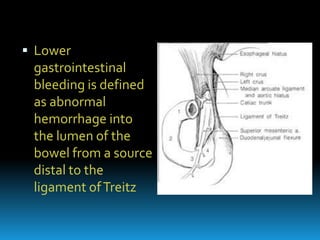
 Lower
gastrointestinal
bleeding is defined
as abnormal
hemorrhage into
the lumen of the
bowel from a source
distal to the
ligament ofTreitz
Epidemiology
 Overall mortality <5%. [Frequency and
severity of UGIB > LGIB]
 LGIB is more common in women > men.
 Incidence and prevalence related to specific
etiologies.
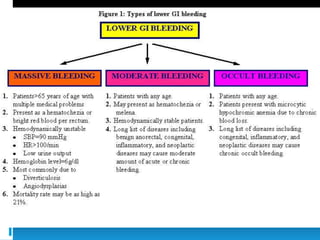
Categorization based on
intensity
 Massive
 Moderate
 Mild
Risk factors
 Low fiber diet
 Obesity, Physical Inactivity
 Radiation
 NSAID or Aspirin usage
 Advancing age
 Co morbidities
Causes in adults
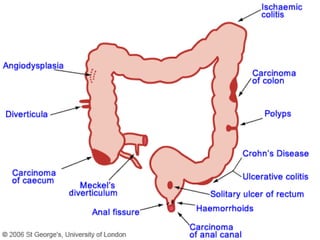
 Diverticulosis (30 - 50%)
 Angiodysplasia (20 - 30%) (or AVM, orVascular Ectasias)
 Neoplastic (10- 15%)
o Polyps
o Cancer
 Inflammatory (15 - 20%)
o Radiation - Intestinal damage due to fibrosis and ischemia.
o IBD
- Ulcerative colitis
- Crohn’s Disease
o Infectious (E. Coli 0157:H7, C. Difficile,C. Jejuni …)
o Ischemic (Hypoperfusion andVasoconstriction)
- Hypotension, Heart Failure, Arrhythmia
oVasculitis
 Others (5 – 10%)
o Post-polypectomy bleeding
o Aortoenteric fistula
o Coagulation deficiency
 Hemorrhoids (< 50 y.o. most common) (5 – 10%)
 Unknown (10 – 15%)
Causes in children
 Anal Fissure
 Infectious Colitis
 IBD
o Crohn’s Disease
o Ulcerative Colitis
 Polyps
 Intussusception
 Meckel’s Diverticulum (embryonic diverticulum)
 Pseudomembransous Colitis
History
 We should assess the chronicity of bleeding and
medication use .
• anti coagulants such as warfarin.
• low molecular weight heparin.
• inhibitors of platelet aggregation such as NSAID
• clopidrogel this can associated with mesentric
ischemia
• Use of digitalis should be documented because this
can associated with mesenteric ischemia
 Comorbid medical conditions like cardiac conditions.
 Family history of colorectal cancer
 Coagulopathy
Signs and Symptoms
 Hematochezia (most often painless)
 Anemia
 Occult blood in stool
 Rarely melena (UGIB most common)
 Normal Bowel Sounds, Normal Renal
Function (BUN/Cr)
 Nasogastric aspirate usually clear
 some patients with massive upper
gastrointestinal bleed can present with
hematochezia.
 An NG aspirate that contains bile and no
blood effectively rules out upper tract
bleeding in most patients.
 Majority of cases bleeding regresses
spontaneosly
 Outcome depends on risk stratification
 Predictors of poor outcome in lower GI bleed
• Hemodynamic instability
• Ongoing hematochezia
• Presence of comorbid illness
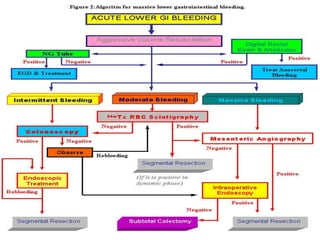
Manangement
 Includes
• Identification of site of bleeding
• Stopping the bleeding and treating the cause
 Digital rectal examination should be done to
exclude anorectal pathology as well as
confirm the patient’s description of stool
color.
Investigations
 CBC - Anemia, Infection,Thrombocytopenia,
Protein Levels, Iron, Crossmatch
 Coagulation
 Hemoccult and Stool cultures
 ECG
Endoscopic investigations
 Proctoscopy
 Sigmoidoscopy
 Colonoscopy
 Video Capsule Endoscopy
 Double balloon endoscopy
 Intraoperative Endoscopy
Radiological investigations
 Abdominal X rays
 Angiography
 Radionuclide scintigraphy
• Technetium Sulfur Colloid
• 99mTc pertechnate-labeled RBC
 Multidetector row CT (MDCT)
 Barium studies have no role in lower GI
bleeding
Colonoscopy
 Usually done after stabilizing the patient
 Provide both diagnosis and hemostasis
 Better than Sigmoidoscopy
 The diagnostic yield of urgent colonoscopy in
acute lower GI bleed has been reported to be
between 75-97% depending on the definition
of the bleeding source, patient selection
criteria, and timing of colonoscopy
 Bowel preparation
 Recent studies have suggested that
performing colonoscopy shortly after
presentation is advantageous
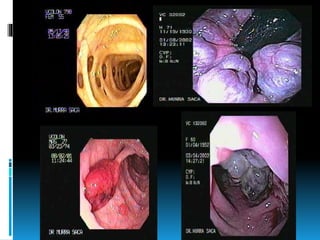
Criteria have been suggested for identifying
site of bleeding on colonoscopy
 Active colonic bleeding
 Non bleeding visible vessel
 Adherent clot
 Fresh blood localized to a colonic segment
 Ulceration of diverticulum with fresh blood in
adjoining area
 Absence of fresh bleed in terminal ileum with
fresh blood in the colon
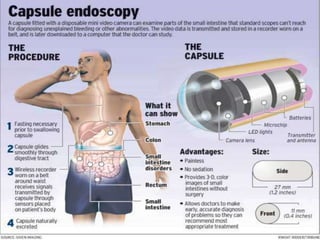
Video Capsule Endoscopy
 Capsule endoscopy uses a small capsule
with a video camera that is swallowed and
acquires video images as it passes through
the GI tract.
 This modality permits visualization of the
entire GI tract, but offers no interventional
capability.
 It is also very time consuming
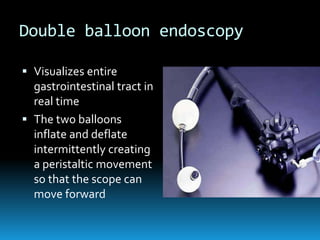
Double balloon endoscopy
 Visualizes entire
gastrointestinal tract in
real time
 The two balloons
inflate and deflate
intermittently creating
a peristaltic movement
so that the scope can
move forward
Intraoperative Endoscopy
 Intraoperative enteroscopy is reserved for
patients who have transfusion-dependent
obscure-overt bleeding in whom an
exhaustive search has failed to identify a
bleeding source.
 This typically uses a pediatric colonoscope
introduced through an enterotomy in the
small bowel made by the surgeon.
Abdominal X rays
 Perforation
 Obstruction
 “Thumb-printing” = Ischemic/Infectious
Colitis
 Megacolon
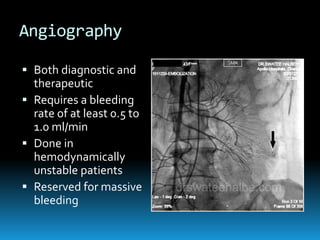
Angiography
 Both diagnostic and
therapeutic
 Requires a bleeding
rate of at least 0.5 to
1.0 ml/min
 Done in
hemodynamically
unstable patients
 Reserved for massive
bleeding
 Vasopressin was the first therapeutic modality
 Major complications occurred in 10% to 20% of
patients and included arrhythmias, pulmonary
edema, hypertension and ischemia
 Re bleeding occurred in up to 50% of patients
 Earlier embolization was associated with
infraction
 Technologic advances in coaxial microcatheters
and embolic materials have enabled the
embolization of specific distal arterial branches
with increased success and fewer complications
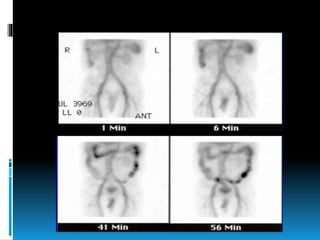
Radionuclide scintigraphy
 Non-invasive
 Done as screening before angiography
 More sensitive
 Detects bleeding as low as 0.1 ml/min
 Major disadvantage false localisation
 Two methods are used
• Technetium Sulfur Colloid
• 99mTc pertechnate-labeled RBC
 Tc-99m Red Blood Cells
• Tc-99m RBCs remain in the vascular
compartment
• In vitro or modified in vivo labeling of RBC is
done
• Allows continuous monitoring of the whole
gastrointestinal tract for a long period
• False-positive readings due to
misinterpretation of intravascular activity and
the possibility of free pertechnetate
accumulation
 sensitivity and specificity of this method are
very high
 Tc-99m sulfur colloid
 Rapid blood clearance of this tracer from
circulation allows for increased detection at
very low bleeding rates (0.05 to 0.1 ml/min)
 Detects bleeding only up to 15 minutes after
intravenous injection
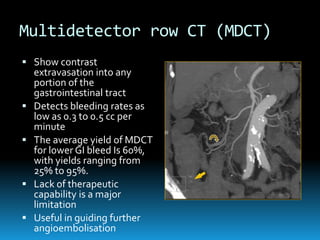
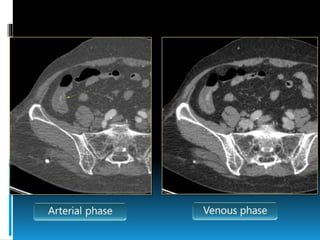
Multidetector row CT (MDCT)
 Show contrast
extravasation into any
portion of the
gastrointestinal tract
 Detects bleeding rates as
low as 0.3 to 0.5 cc per
minute
 The average yield of MDCT
for lower GI bleed Is 60%,
with yields ranging from
25% to 95%.
 Lack of therapeutic
capability is a major
limitation
 Useful in guiding further
angioembolisation
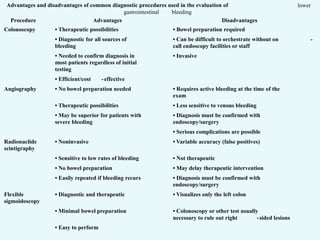
Advantages and disadvantages of common diagnostic procedures used in the evaluation of lower
gastrointestinal bleeding
Procedure Advantages Disadvantages
Colonoscopy • Therapeutic possibilities • Bowel preparation required
• Diagnostic for all sources of
bleeding
• Can be difficult to orchestrate without on -
call endoscopy facilities or staff
• Needed to confirm diagnosis in
most patients regardless of initial
testing
• Invasive
• Efficient/cost -effective
Angiography • No bowel preparation needed • Requires active bleeding at the time of the
exam
• Therapeutic possibilities • Less sensitive to venous bleeding
• May be superior for patients with
severe bleeding
• Diagnosis must be confirmed with
endoscopy/surgery
• Serious complications are possible
Radionuclide
scintigraphy
• Noninvasive • Variable accuracy (false positives)
• Sensitive to low rates of bleeding • Not therapeutic
• No bowel preparation • May delay therapeutic intervention
• Easily repeated if bleeding recurs • Diagnosis must be confirmed with
endoscopy/surgery
Flexible
sigmoidoscopy
• Diagnostic and therapeutic • Visualizes only the left colon
• Minimal bowel preparation • Colonoscopy or other test usually
necessary to rule out right -sided lesions
• Easy to perform
Lower gi bleed

Lower gi bleed

  • 1.
    INVESTIGATIONS IN LOWER GASTROINTESTINALBLEEDING By Dr E Aravind UnderGuidance of Dr DSVL Narasimham MS Dr R Hemanthi MS Dr P S Sitaram MS
  • 2.
     Lower gastrointestinal bleeding isdefined as abnormal hemorrhage into the lumen of the bowel from a source distal to the ligament ofTreitz
  • 3.
    Epidemiology  Overall mortality<5%. [Frequency and severity of UGIB > LGIB]  LGIB is more common in women > men.  Incidence and prevalence related to specific etiologies.
  • 4.
    Categorization based on intensity Massive  Moderate  Mild
  • 6.
    Risk factors  Lowfiber diet  Obesity, Physical Inactivity  Radiation  NSAID or Aspirin usage  Advancing age  Co morbidities
  • 7.
    Causes in adults Diverticulosis (30 - 50%)  Angiodysplasia (20 - 30%) (or AVM, orVascular Ectasias)  Neoplastic (10- 15%) o Polyps o Cancer  Inflammatory (15 - 20%) o Radiation - Intestinal damage due to fibrosis and ischemia. o IBD - Ulcerative colitis - Crohn’s Disease o Infectious (E. Coli 0157:H7, C. Difficile,C. Jejuni …) o Ischemic (Hypoperfusion andVasoconstriction) - Hypotension, Heart Failure, Arrhythmia oVasculitis
  • 8.
     Others (5– 10%) o Post-polypectomy bleeding o Aortoenteric fistula o Coagulation deficiency  Hemorrhoids (< 50 y.o. most common) (5 – 10%)  Unknown (10 – 15%)
  • 9.
    Causes in children Anal Fissure  Infectious Colitis  IBD o Crohn’s Disease o Ulcerative Colitis  Polyps  Intussusception  Meckel’s Diverticulum (embryonic diverticulum)  Pseudomembransous Colitis
  • 11.
    History  We shouldassess the chronicity of bleeding and medication use . • anti coagulants such as warfarin. • low molecular weight heparin. • inhibitors of platelet aggregation such as NSAID • clopidrogel this can associated with mesentric ischemia • Use of digitalis should be documented because this can associated with mesenteric ischemia  Comorbid medical conditions like cardiac conditions.  Family history of colorectal cancer  Coagulopathy
  • 12.
    Signs and Symptoms Hematochezia (most often painless)  Anemia  Occult blood in stool  Rarely melena (UGIB most common)  Normal Bowel Sounds, Normal Renal Function (BUN/Cr)  Nasogastric aspirate usually clear
  • 13.
     some patientswith massive upper gastrointestinal bleed can present with hematochezia.  An NG aspirate that contains bile and no blood effectively rules out upper tract bleeding in most patients.
  • 14.
     Majority ofcases bleeding regresses spontaneosly  Outcome depends on risk stratification  Predictors of poor outcome in lower GI bleed • Hemodynamic instability • Ongoing hematochezia • Presence of comorbid illness
  • 15.
    Manangement  Includes • Identificationof site of bleeding • Stopping the bleeding and treating the cause  Digital rectal examination should be done to exclude anorectal pathology as well as confirm the patient’s description of stool color.
  • 16.
    Investigations  CBC -Anemia, Infection,Thrombocytopenia, Protein Levels, Iron, Crossmatch  Coagulation  Hemoccult and Stool cultures  ECG
  • 17.
    Endoscopic investigations  Proctoscopy Sigmoidoscopy  Colonoscopy  Video Capsule Endoscopy  Double balloon endoscopy  Intraoperative Endoscopy
  • 18.
    Radiological investigations  AbdominalX rays  Angiography  Radionuclide scintigraphy • Technetium Sulfur Colloid • 99mTc pertechnate-labeled RBC  Multidetector row CT (MDCT)  Barium studies have no role in lower GI bleeding
  • 20.
    Colonoscopy  Usually doneafter stabilizing the patient  Provide both diagnosis and hemostasis  Better than Sigmoidoscopy  The diagnostic yield of urgent colonoscopy in acute lower GI bleed has been reported to be between 75-97% depending on the definition of the bleeding source, patient selection criteria, and timing of colonoscopy
  • 21.
     Bowel preparation Recent studies have suggested that performing colonoscopy shortly after presentation is advantageous
  • 22.
    Criteria have beensuggested for identifying site of bleeding on colonoscopy  Active colonic bleeding  Non bleeding visible vessel  Adherent clot  Fresh blood localized to a colonic segment  Ulceration of diverticulum with fresh blood in adjoining area  Absence of fresh bleed in terminal ileum with fresh blood in the colon
  • 24.
    Video Capsule Endoscopy Capsule endoscopy uses a small capsule with a video camera that is swallowed and acquires video images as it passes through the GI tract.  This modality permits visualization of the entire GI tract, but offers no interventional capability.  It is also very time consuming
  • 26.
    Double balloon endoscopy Visualizes entire gastrointestinal tract in real time  The two balloons inflate and deflate intermittently creating a peristaltic movement so that the scope can move forward
  • 27.
    Intraoperative Endoscopy  Intraoperativeenteroscopy is reserved for patients who have transfusion-dependent obscure-overt bleeding in whom an exhaustive search has failed to identify a bleeding source.  This typically uses a pediatric colonoscope introduced through an enterotomy in the small bowel made by the surgeon.
  • 28.
    Abdominal X rays Perforation  Obstruction  “Thumb-printing” = Ischemic/Infectious Colitis  Megacolon
  • 29.
    Angiography  Both diagnosticand therapeutic  Requires a bleeding rate of at least 0.5 to 1.0 ml/min  Done in hemodynamically unstable patients  Reserved for massive bleeding
  • 30.
     Vasopressin wasthe first therapeutic modality  Major complications occurred in 10% to 20% of patients and included arrhythmias, pulmonary edema, hypertension and ischemia  Re bleeding occurred in up to 50% of patients  Earlier embolization was associated with infraction  Technologic advances in coaxial microcatheters and embolic materials have enabled the embolization of specific distal arterial branches with increased success and fewer complications
  • 31.
    Radionuclide scintigraphy  Non-invasive Done as screening before angiography  More sensitive  Detects bleeding as low as 0.1 ml/min  Major disadvantage false localisation  Two methods are used • Technetium Sulfur Colloid • 99mTc pertechnate-labeled RBC
  • 32.
     Tc-99m RedBlood Cells • Tc-99m RBCs remain in the vascular compartment • In vitro or modified in vivo labeling of RBC is done • Allows continuous monitoring of the whole gastrointestinal tract for a long period • False-positive readings due to misinterpretation of intravascular activity and the possibility of free pertechnetate accumulation  sensitivity and specificity of this method are very high
  • 33.
     Tc-99m sulfurcolloid  Rapid blood clearance of this tracer from circulation allows for increased detection at very low bleeding rates (0.05 to 0.1 ml/min)  Detects bleeding only up to 15 minutes after intravenous injection
  • 35.
    Multidetector row CT(MDCT)  Show contrast extravasation into any portion of the gastrointestinal tract  Detects bleeding rates as low as 0.3 to 0.5 cc per minute  The average yield of MDCT for lower GI bleed Is 60%, with yields ranging from 25% to 95%.  Lack of therapeutic capability is a major limitation  Useful in guiding further angioembolisation
  • 37.
    Advantages and disadvantagesof common diagnostic procedures used in the evaluation of lower gastrointestinal bleeding Procedure Advantages Disadvantages Colonoscopy • Therapeutic possibilities • Bowel preparation required • Diagnostic for all sources of bleeding • Can be difficult to orchestrate without on - call endoscopy facilities or staff • Needed to confirm diagnosis in most patients regardless of initial testing • Invasive • Efficient/cost -effective Angiography • No bowel preparation needed • Requires active bleeding at the time of the exam • Therapeutic possibilities • Less sensitive to venous bleeding • May be superior for patients with severe bleeding • Diagnosis must be confirmed with endoscopy/surgery • Serious complications are possible Radionuclide scintigraphy • Noninvasive • Variable accuracy (false positives) • Sensitive to low rates of bleeding • Not therapeutic • No bowel preparation • May delay therapeutic intervention • Easily repeated if bleeding recurs • Diagnosis must be confirmed with endoscopy/surgery Flexible sigmoidoscopy • Diagnostic and therapeutic • Visualizes only the left colon • Minimal bowel preparation • Colonoscopy or other test usually necessary to rule out right -sided lesions • Easy to perform